
Japan Cell Culture Market (2026-2031)

The Japan Cell Culture Market was valued at $1113.2 Million in 2026 and projected to reach to $2011.1 Million by 2031, representing a compound annual growth rate of 12.6%. Japan's cell culture market is poised for sustained growth through 2031, driven by the country's world-class biopharmaceutical sector and significant investments in regenerative medicine research.


| Market Size in | USD 26.32 MN |
| Market Forecast in | |
| CAGR | |
| Forecast Period | |
| Units Considered | Value (USD MN) |
Japan Cell Culture Market Trends and Insights
- Japan's advanced biopharmaceutical infrastructure and strong investment in regenerative medicine are driving significant demand for cell culture technologies and products.
- The country's aging population and emphasis on precision medicine further accelerate adoption of cell culture systems across research institutions and commercial laboratories. Japan's cell culture market growth is supported by increasing R&D spending in biotechnology and pharmaceutical sectors.
- Japan's regulatory environment and government initiatives promoting life sciences innovation create favorable conditions for market expansion through 2031.
- The nation's leadership in stem cell research and cellular therapeutics positions Japan as a key regional hub for cell culture innovation and commercialization..
Key Market Statistics
- CAGR (2026-2031) 12.6% CAGR
- Market Size, 2026 ~USD 1113.2 Million
- Forecast, 2031 ~USD 2011.1 Million
- Country Japan
Japan Cell Culture Market Overview
Market Valuation Growth :
Japan's cell culture market is valued at $1,113.2 million in 2026 and is projected to reach $2,011.1 million by 2031, representing an 80.6% increase over the five-year forecast period.
Strong CAGR Performance :
Japan's cell culture market is growing at a CAGR of 12.6%, outpacing the global average of 12.1%, demonstrating the country's accelerating adoption of advanced cell culture technologies.
Regenerative Medicine Leadership :
Japan's advanced biopharmaceutical infrastructure and substantial government investment in regenerative medicine are positioning the country as a regional leader in cell culture innovation and commercialization.
Demographic-Driven Demand :
Japan's aging population and national focus on precision medicine are creating sustained demand for cell culture products and services, supporting long-term market expansion through 2031.
Japan Cell Culture Market Dynamics
- The aging demographic profile creates urgent demand for advanced therapeutic solutions, positioning cell culture technologies as critical enablers of next-generation treatments.
- Japan's regulatory environment and emphasis on precision medicine further accelerate market adoption. Key growth drivers include expanding biopharmaceutical R&D budgets, increasing collaborations between academic institutions and industry, and rising commercialization of cell-based therapies.
- The market will benefit from Japan's technological expertise, strong manufacturing capabilities, and government support for life sciences innovation, ensuring competitive positioning in the global cell culture landscape..
Market Ecosystem
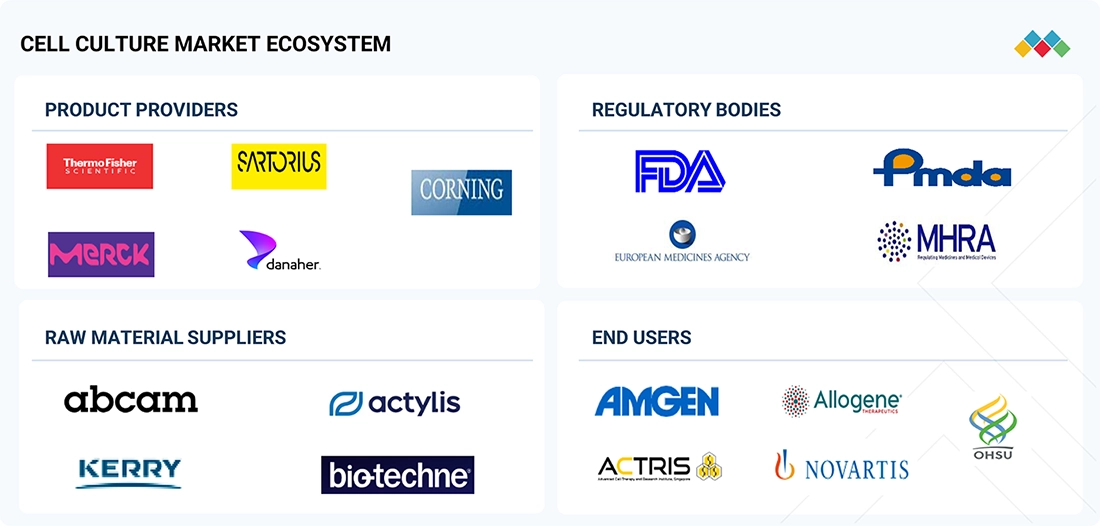
CELL CULTURE MARKET: COMMERCIAL USE CASES ACROSS INDUSTRIES
| COMPANY | USE CASE DESCRIPTION | BENEFITS |
|---|---|---|
 |
Collaborated with Universitat Autònoma de Barcelona to optimize cell culture media for CHO-S cells, enhancing protein productivity. | Achieved a 1.7-fold increase in monoclonal antibody productivity, demonstrating the impact of media optimization on cell culture efficiency. |
 |
Implemented Cytiva Xcellerex Disposable Reactors (XDR) for mAb and bispecific antibody production. | Demonstrated that XDR bioreactors can be used effectively for antibody production | The system met all benchmarks for viable cell density, viability, integral viable cell count (IVC), and titer | The real-time CO2 monitoring proved effective, allowing maintenance of optimal culture conditions. |
 |
Growing NS0 cells in disposable bioreactors for clinical trial production. | Process scale-up in single-use systems was confirmed at 50 L and 250 L scale and likewise GMP manufacturing was conducted at 2,000 L scale in single-use bioreactors | The 1st biological drug manufactured in China for global clinical trials was successfully produced by WuXi Biologics’ manufacturing site in Wuxi city. |
Logos and trademarks shown above are the property of their respective owners. Their use here is for informational and illustrative purposes only.
Related Ecosystem
Biotechnology
- Reagents
- Polymerase Chain Reaction (PCR)
- Stem Cells
- Assay Kits
- Flow Cytometers
- Thermo Fisher Scientific Inc.
- Merck KGaA
- Danaher Corporation
- Agilent Technologies, Inc.
- Bio-Rad Laboratories, Inc.
Key Takeaways
- Japan's cell culture market will nearly double from $1,113.2M (2026) to $2,011.1M (2031), reflecting 12.6% CAGR growth.
- Japan's advanced biopharmaceutical sector and regenerative medicine focus drive strong cell culture technology adoption.
- Japan's aging demographics and precision medicine initiatives create sustained demand for cell culture applications.
- Japan's stem cell research leadership and supportive regulatory environment position it as a regional innovation center.
Cell Culture Market Report Scope
| Report Metric | Details |
|---|---|
| Base Year | 2026 |
| Fastest Growing Segment | TISSUE ENGINEERING & REGENERATIVE MEDICINE (Application) |
| Forecast Period | 2026–2031 |
| Growth Rate | CAGR of 12.1% from 2026 to 2031 |
| Largest Segment | PHARMACEUTICAL & BIOTECHNOLOGY COMPANIES (End User) |
| Market Size Base Year (Billions) | ~USD 33 (2026) |
| Revenue Forecast (Billions) | ~USD 58.42 (2031) |
| Segments Covered | Product, Type, Application, End User |
Japan Cell Culture Market Report Segmentation
4 segment dimensions are covered across the global market.
By Product
- Consumables
- Equipment
By Type
- Adult Bovine Sera
- Antibiotics/Antimycotics
- Attachment & Matrix Factors
- Autoclaves
- Balanced Salt Solutions
- Bhk Media
- Bioreactors
- Biosafety Cabinets
- Buffers & Chemicals
- Carbon Dioxide Incubators
- Cell & Gene Therapy
- Cell Counters
- Cell Dissociation Reagents
- Cell Factory Systems/Cell Stacks
- Centrifuges
- Chemically-Defined Media
- Cho Media
- Classical Media & Salts
- Contamination Detection Kits
- Cryoprotective Reagents
- Cryostorage Systems
- Fetal Bovine Sera
- Filtration Systems
- Flasks
- Growth Factors
- Hek 293 Media
- Media
- Microscopes
- Monoclonal Antibody Production
- Multiwell Plates
- Other Animal Sera
- Other Consumables & Accessories
- Other Media
- Other Reagents
- Other Serum-Free Media
- Other Supporting Equipment
- Other Therapeutic Protein Production
- Other Tissue Engineering & Regenerative Medicine Applications
- Petri Dishes
- Reagents
- Refrigerators & Freezers
- Roller/Roux Bottles
- Sera
- Sera, Media, And Reagents
- Serum-Free Media
- Serum-Free Stem Cell Media
- Specialty Media
- Stem Cell Culture Media
- Storage Equipment
- Supplements
- Supporting Equipment
- Vaccine Production
- Vero Cell Media
- Vessels
By Application
- Biopharmaceutical Production
- Diagnostics
- Drug Screening & Development
- Other Applications
- Tissue Engineering & Regenerative Medicine
By End User
- Academic & Research Institutes
- Hospitals & Diagnostic Laboratories
- Other End Users
- Pharmaceutical & Biotechnology Companies
JAPAN: CELL CULTURE MARKET, BY END USER, 2024–2031
| Segment | 2024 | 2025 | 2026 | 2027 | 2028 | 2029 | 2030 | 2031 | CAGR (%) |
|---|---|---|---|---|---|---|---|---|---|
| ACADEMIC & RESEARCH INSTITUTES | 168.8 | 178.8 | 191.3 | 206 | 223.6 | 244.7 | 269.7 | 299.1 | 9.3 |
| HOSPITALS & DIAGNOSTIC LABORATORIES | 226.9 | 243.3 | 263.4 | 287.1 | 315.8 | 350.3 | 391.5 | 440.5 | 10.8 |
| OTHER END USERS | 155 | 167.6 | 183.1 | 201.5 | 223.6 | 250.4 | 282.5 | 321 | 11.9 |
| PHARMACEUTICAL & BIOTECHNOLOGY COMPANIES | 731.2 | 800.1 | 884.4 | 984.3 | 1105.3 | 1252 | 1428.6 | 1641.4 | 13.2 |
| TOTAL | 1282 | 1389.8 | 1522.2 | 1678.9 | 1868.4 | 2097.5 | 2372.3 | 2702 | 12.2 |
Target Audience
- Biopharmaceutical Companies : Japanese and international biotech firms need Japan-specific market data to assess growth opportunities, allocate R&D resources, and develop cell culture product strategies for the high-growth Japanese market.
- Medical Device Manufacturers : Equipment and consumables suppliers require detailed Japan market insights to identify demand drivers, competitive positioning, and distribution channel opportunities in the cell culture sector.
- Investment & Private Equity Firms : Investors evaluating opportunities in Japan's life sciences sector need comprehensive market analysis to assess portfolio companies, identify acquisition targets, and forecast financial returns.
- Research Institutions & Universities : Academic centers and research organizations require Japan market data to understand commercialization potential, secure funding, and establish partnerships with industry stakeholders.
- Healthcare Policy & Government Agencies : Japanese regulatory bodies and policy makers need market intelligence to inform regenerative medicine initiatives, funding decisions, and strategic healthcare innovation programs.
Key Companies in the Japan Cell Culture Market
| Company | HQ | Ownership | Strongest segments |
|---|---|---|---|
| PATHEON INC | Netherlands | Private Company | Drug product services (oral, sterile, packaging, lifecycle management),Pharmaceutical development services (formulation, analytical, clinical supply),Drug substance services (small-molecule and biologics APIs), |
| BIOMERIEUX S.A. | France | Public Company | Clinical microbiology (culture media, VITEK, blood culture, ID/AST),Molecular and syndromic diagnostics (BIOFIRE, SPOTFIRE, ARGENE, NUCLISENS),Immunoassays and CLIA (VIDAS, Hybiome), |
| SIGMA-ALDRICH CORPORATION | United States | Private Company | Chemicals, biochemicals, and analytical reagents,Cell culture media, critical raw materials, and bioprocess solutions,Filtration, water purification, and labware, |
| HI-MEDIA | France | Public Company | In-content native and integrated formats,Geo-marketing and location-based solutions,Managed campaign and data-driven services, |
| REPLIGEN CORPORATION | United States | Public Company | Filtration and cell retention (XCell ATF, KrosFlo, TangenX, ProConnex TFDF),Chromatography (OPUS columns, KRM systems, resins, ELISA kits),Process analytics and PAT (PATsmart suite, SoloVPE/FlowVPE, ZipChip, REBEL), |
| QIAGEN NV | Netherlands | Public Company | Sample technology consumables and instruments,Immune response and infectious disease assays,Oncology and sexual & reproductive health assays, |
| QUIDEL CORPORATION | United States | Public Company | Labs (clinical chemistry and immunoassay),Transfusion Medicine,Point of Care, |
| FLUOR CORPORATION | United States | Public Company | Energy Solutions,Urban Solutions,Mission Solutions, |
| TECHNICOLOR SA | France | Public Company | Broadband gateways and routers (fiber, xDSL, cable),Wi-Fi extenders, Wi-Fi XL, homeware and in-home networking,Video set-top boxes, dongles, smart media devices, |
| EIKEN CHEMICAL CO., LTD. | Japan | Public Company | Fecal immunochemical test (FIT) reagents and analyzers,Microbiological reagents (clinical),Urinalysis test strips and analyzers, |
| MAXCYTE, INC | United States | Public Company | ExPERT Instruments (ATx, STx, GTx, VLx),Consumables (Processing Assemblies, Buffers, Accessories),Licensing and Technology Access, |
| THERMO FISHER SCIENTIFIC INC. | United States | Public Company | Life Sciences Solutions,Analytical Instruments,Specialty Diagnostics, |
| DANAHER CORPORATION | United States | Public Company | Biotechnology (bioprocessing and related solutions),Life Sciences tools and genomic medicine,Diagnostics, |
| MERCK KGAA | Germany | Public Company | Life Science (tools, consumables, bioprocessing, CDMO),Healthcare (prescription drugs and biopharmaceuticals),Electronics (semiconductor and display materials, equipment), |
| SARTORIUS AG | Germany | Public Company | Bioprocess solutions (bioreactors, cell culture, fluid and process chromatography/filtration),Lab products and services (filtration, water systems, weighing, pipettes, microbiological testing),Analytical and PAT solutions (BLI, cytometry screening, live-cell imaging, SPR, data analytics), |
| CORNING INCORPORATED | United States | Public Company | Optical communications (fiber, cable, hardware, connectors),Display glass substrates (LCD/OLED),Specialty materials and optics, |
| FUJIFILM HOLDINGS CORPORATION | Japan | Public Company | Healthcare (medical systems, CDMO, pharma, regenerative medicine, cosmetics/supplements),Electronics (display/touch panels, semiconductor and display materials, storage media, industrial equipment, fine chemicals),Business Innovation (office equipment, document solutions, graphic communications, industrial inkjet), |
| BD | United States | Public Company | Medical Essentials (syringes, needles, vascular access, sharps, enteral),Connected Care (infusion pumps, medication management, pharmacy automation, informatics),BioPharma Systems (prefillable drug delivery, related solutions), |
| EPPENDORF SE | Germany | Private Company | Liquid handling (pipettes, dispensers, automated systems),Separation & instrumentation (centrifuges, PCR cyclers, ULT freezers),Consumables (tubes, tips, plates, single-use bioreactors), |
| LONZA | Switzerland | Public Company | Integrated Biologics (mammalian DS/DP platforms),Advanced Synthesis (small molecules, HPAPIs, ADCs/bioconjugates),Specialized Modalities (cell & gene, microbial, bioscience, mRNA), |
| GETINGE | Sweden | Public Company | Acute Care Therapies (ECMO, ventilation, monitoring, ICU infrastructure, drainage),Surgical Workflows (OR equipment, anesthesia, OR integration, sterile supply management),Life Science (sterilization, biocontainment, bioprocess, labware cleaning, vivarium), |
| AGILENT TECHNOLOGIES, INC. | United States | Public Company | Life Sciences and Diagnostics Markets,Agilent CrossLab (Services, Consumables, Software),Applied Markets (GC, MS, Spectroscopy, Vacuum, Remarketed), |
| BIO-TECHNE | United States | Public Company | Protein Sciences (reagents and proteomic tools),Diagnostics products and controls,Genomics and spatial biology, |
PATHEON INC
Patheon Inc. is a Netherlands-based private company with 9,100 employees operating in the pharmaceutical and biotechnology services sector.
BIOMERIEUX S.A.
bioMérieux S.A. is a French public company founded in 1963 with 14,894 employees specializing in in vitro diagnostics and microbiology testing solutions.
SIGMA-ALDRICH CORPORATION
Sigma-Aldrich Corporation is a United States-based private company founded in 1951 with 9,800 employees, supplying research chemicals and biochemicals globally.
HI-MEDIA
HI-MEDIA is a French public company founded in 1996 with 29 employees that manufactures culture media and laboratory reagents for microbiology.
REPLIGEN CORPORATION
Repligen Corporation is a United States-based public company founded in 1981 with 2,000 employees providing bioprocessing solutions and chromatography products.
QIAGEN NV
QIAGEN NV is a Netherlands-based public company founded in 1984 with 5,500 employees specializing in molecular diagnostics and sample preparation technologies.
QUIDEL CORPORATION
Quidel Corporation is a United States-based public company founded in 1979 with 6,500 employees developing rapid diagnostic testing solutions.
FLUOR CORPORATION
Fluor Corporation is a United States-based public company founded in 1912 with 22,995 employees providing engineering, procurement, and construction services.
TECHNICOLOR SA
Technicolor SA is a France-based public company founded in 1985 with 1,552 employees offering media and entertainment technology services.
EIKEN CHEMICAL CO., LTD.
Eiken Chemical Co., Ltd. is a Japan-based public company founded in 1939 with 696 employees manufacturing diagnostic reagents and laboratory chemicals.
MAXCYTE, INC
MaxCyte, Inc. is a United States-based public company founded in 1998 with 91 employees developing cell engineering and electroporation technologies.
THERMO FISHER SCIENTIFIC INC.
Thermo Fisher Scientific Inc. is a United States-based public company founded in 1956 with 125,000 employees providing laboratory equipment, reagents, and analytical instruments globally.
DANAHER CORPORATION
Danaher Corporation is a United States-based public company founded in 1969 with 59,000 employees operating diversified businesses in life sciences, diagnostics, and environmental solutions.
MERCK KGAA
Merck KGaA is a Germany-based public company founded in 1668 with 59,077 employees providing pharmaceuticals, chemicals, and life science products and services.
SARTORIUS AG
Sartorius AG is a Germany-based public company founded in 1870 with 14,242 employees manufacturing laboratory and bioprocess equipment for the life sciences industry.
CORNING INCORPORATED
Corning Incorporated is a United States-based public company founded in 1851 with 67,200 employees producing specialty glass, ceramics, and optical products.
FUJIFILM HOLDINGS CORPORATION
Fujifilm Holdings Corporation is a Japan-based public company founded in 1934 with 73,526 employees operating in imaging, information, and document solutions.
BD
BD is a United States-based public company founded in 1897 with 72,000 employees manufacturing medical devices, diagnostics, and life science tools.
EPPENDORF SE
Eppendorf SE is a Germany-based private company founded in 1945 with 4,358 employees manufacturing laboratory equipment and consumables for life sciences research.
LONZA
Lonza is a Switzerland-based public company founded in 1897 with 20,000 employees providing pharmaceutical and biotechnology manufacturing services and products.
GETINGE
Getinge is a Sweden-based public company founded in 1904 with 11,754 employees manufacturing medical devices and systems for healthcare and life sciences.
AGILENT TECHNOLOGIES, INC.
Agilent Technologies, Inc. is a United States-based public company founded in 1999 with 18,000 employees providing analytical instruments and life sciences solutions.
BIO-TECHNE
Bio-Techne is a United States-based public company founded in 1976 with 3,100 employees providing protein reagents, antibodies, and analytical instruments for life sciences research.
Reasons to Buy this Report
- Japan-Specific Market Sizing : Access precise valuation data for Japan's cell culture market with verified 2026 baseline ($1,113.2M) and 2031 forecast ($2,011.1M), enabling accurate financial planning and investment decisions.
- Competitive Intelligence : Understand Japan's 12.6% CAGR advantage over global growth rates (12.1%), identifying market dynamics and competitive opportunities unique to the Japanese biopharmaceutical landscape.
- Demographic Insights : Leverage analysis of Japan's aging population and precision medicine initiatives to identify high-growth segments and develop targeted market entry or expansion strategies.
- Regulatory & Infrastructure Analysis : Gain insights into Japan's advanced biopharmaceutical infrastructure, government support mechanisms, and regulatory environment to optimize product development and commercialization timelines.
- Strategic Partnership Opportunities : Identify collaboration potential with Japan's leading research institutions and biopharmaceutical companies through comprehensive market segmentation and stakeholder mapping.
Frequently asked questions
What is the projected size of Japan's cell culture market by 2031?
Japan's cell culture market is forecast to reach $2,011.1 million by 2031, growing from $1,113.2 million in 2026.
What is the CAGR for Japan's cell culture market?
Japan's cell culture market is expected to grow at a compound annual growth rate (CAGR) of 12.6% between 2026 and 2031.
What factors are driving growth in Japan's cell culture market?
Japan's cell culture market growth is driven by advanced biopharmaceutical infrastructure, regenerative medicine investments, aging population demographics, and government support for life sciences innovation.
How does Japan's cell culture market compare to other Asia Pacific countries?
Japan maintains a leading position in Asia Pacific's cell culture market due to its advanced research capabilities, strong regulatory framework, and significant investment in stem cell and cellular therapeutic research.
What applications are most prominent in Japan's cell culture market?
Japan's cell culture market serves regenerative medicine, biopharmaceutical development, vaccine production, and precision medicine research, with particular strength in stem cell applications.
RESEARCH METHODOLOGY
This research study relied extensively on secondary sources, directories, and databases to identify and collect valuable information for the analysis of the global cell culture market. In-depth interviews were conducted with various primary respondents, including key industry participants, subject-matter experts (SMEs), C-level executives at major market players, and industry consultants, to gather and validate critical qualitative and quantitative information and assess the market's growth prospects. The global market size estimated through secondary research was then triangulated with primary research inputs to arrive at the final market size.
Secondary Research
Secondary research was used mainly to identify and collect information for the extensive, technical, market-oriented, and commercial study of the cell culture market. The secondary sources used for this study include World Health Organization (WHO), Food and Drug Administration, American Society for Cell Biology (ASCB), National Institutes of Health (NIH), International Society for Cell & Gene Therapy (ISCT), American Society for Gene and Cell Therapy (ASGCT), Centers of Disease Control and Prevention (CDC), International Serum Industry Association (ISIA), Pharmaceutical Research and Manufacturers of America (PhRMA), International Society for Vaccines (ISV), International Federation of Pharmaceutical Manufacturers & Associations (IFPMA), the Society for In Vitro Biology (SIVB), Japan Agency for Medical Research and Development, European Federation of Pharmaceutical Industries and Associations (EFPIA), American Type Culture Collection (ATCC), and the Alliance for Regenerative Medicine (ARM); corporate filings such as annual reports, SEC filings, investor presentations, and financial statements; press releases; trade, business, professional associations and among others. These sources were also used to obtain key information on major players, market classification and segmentation aligned with industry trends, regional/country-level markets, market developments, and technology perspectives.
Primary Research
In-depth interviews were conducted with various primary respondents, including key industry participants, subject-matter experts (SMEs), C-level executives of key market players, and industry consultants, among others, to obtain and verify critical qualitative and quantitative information and to assess the market's future prospects. Various primary sources from both the supply and demand sides of the market were interviewed to obtain qualitative and quantitative information. The following is a breakdown of the primary respondents:
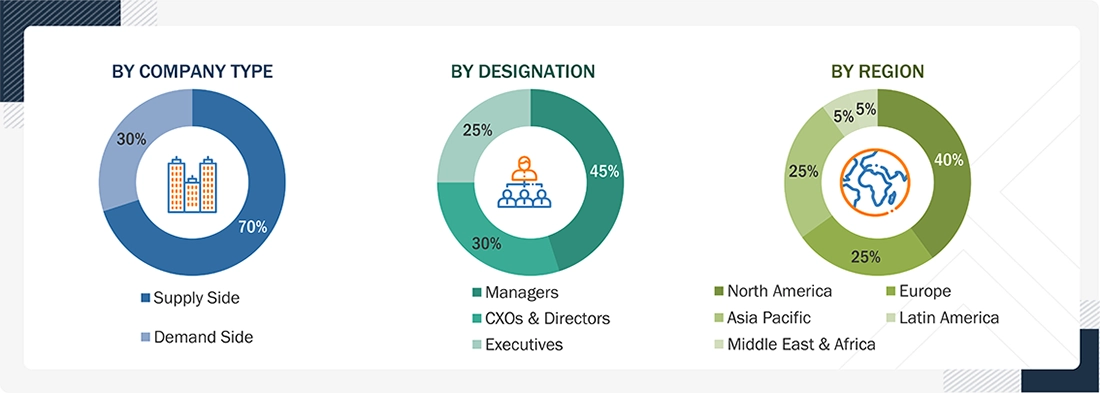
To know about the assumptions considered for the study, download the pdf brochure
Market Size Estimation
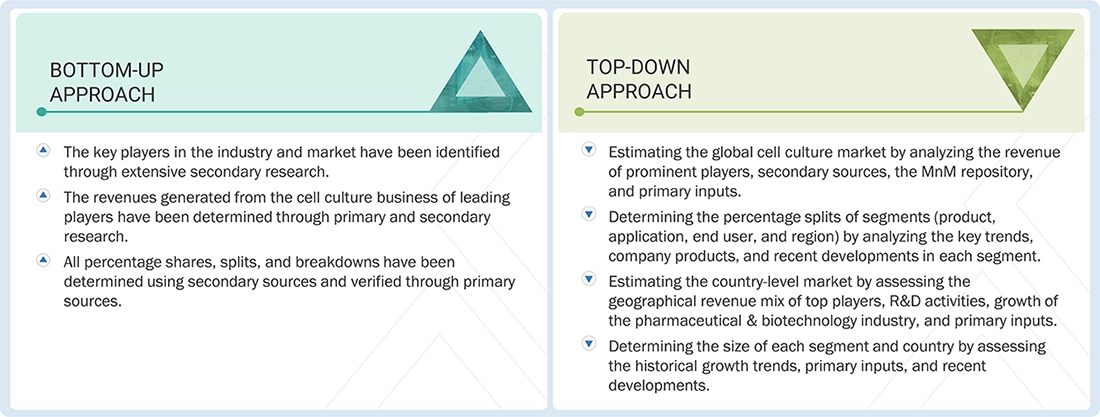
Both top-down and bottom-up approaches were used to estimate and validate the total size of the cell culture market. These methods were also used extensively to estimate the size of various subsegments in the market. The research methodology used to estimate the market size includes the following:
Cell Culture Market : Top-Down and Bottom-Up Approach
Data Triangulation
After arriving at the market size from the market size estimation process explained above, the total market was divided into several segments and subsegments. To complete the overall market engineering process and obtain the exact statistics for all segments and subsegments, data triangulation and market breakdown procedures were employed wherever applicable. The data was triangulated by studying various factors and trends from both the demand and supply sides.
Market Definition
Cell culture refers to the removal of cells from an animal or plant and their subsequent growth in an artificial environment under controlled conditions. It is a process of growing cells outside their natural environment, typically in a laboratory setting. This technique allows researchers to study cells in a controlled environment, providing insights into their behavior, growth, metabolism, and response to various stimuli.
The scope of this report includes products such as equipment and consumables, such as media, sera, reagents, vessels, bioreactors, storage equipment, and other cell culture-supporting equipment that support the cell culture process.
Key Stakeholders
- Cell Culture Equipment and Reagents Manufacturers
- Analytical and Life Science Instrumentation Companies
- Academic and Research Institutes
- Pharmaceutical and Biotechnology Companies
- Life Science Companies
- Venture Capitalists and Investors
- Government Organizations
- Private Research Firms
- Contract Research Organizations (CROs)
- Hospitals and Diagnostic Laboratories
- Cell Banks
Report Objectives
- To define, describe, and forecast the global cell culture market based on product, application, end user, and region
- To provide detailed information regarding the major factors influencing the growth of the market (such as drivers, restraints, opportunities, and challenges)
- To strategically analyze micromarkets with respect to individual growth trends, future prospects, and contributions to the overall cell culture market
- To analyze opportunities in the market for stakeholders and provide details of the competitive landscape for market leaders
- To forecast the size of the market segments with respect to six main regions, namely, North America, Europe, Asia Pacific, Latin America, the Middle East, and Africa
- To strategically profile the key players and comprehensively analyze their product portfolios, market positions, and core competencies
- To track and analyze competitive developments such as acquisitions, product launches, expansions, and R&D activities in the cell culture market
- To analyze and provide funding & investment activities, brand/product comparative analysis, and vendor valuation & financial metrics of the cell culture market
Available customizations:
Based on the given market data, MarketsandMarkets offers customization to meet the company’s specific needs. The following customization options are available for this report:
Portfolio Analysis
- Product Matrix, which gives a detailed comparison of the product portfolios of the top five companies.
Regional Analysis
- A further breakdown of the Rest of Europe cell culture market, by country
- A further breakdown of the Rest of Asia Pacific cell culture market, by country
- A further breakdown of the Rest of Latin America cell culture market, by country
Company Information
- Detailed analysis and profiling of additional market players (up to five).
Get the Full Cell Culture Market Report
Full forecast, segment splits, and company analysis for all Cell Culture Market.
- Rest Of Europe Cell Culture Market
- Rest Of Asia Pacific Cell Culture Market
- Rest Of Latin America Cell Culture Market
- Rest Of GCC Countries Cell Culture Market
- Italy Cell Culture Market
- Spain Cell Culture Market
- China Cell Culture Market
- India Cell Culture Market
- South Korea Cell Culture Market
- Australia Cell Culture Market
- Brazil Cell Culture Market
- Mexico Cell Culture Market
- Saudi Arabia Cell Culture Market
- UAE Cell Culture Market
- Canada Cell Culture Market
- US Cell Culture Market
- Germany Cell Culture Market
- UK Cell Culture Market
- France Cell Culture Market
Need a Tailored Report?
Customize this report to your needs
Get 10% FREE Customization
Customize This Report
