
Canada Aerospace Testing Market (2025-2030)

The Canada Aerospace Testing Market was valued at $480.6 Million in 2025 and projected to reach to $616.9 Million by 2030, representing a compound annual growth rate of 5.1%. Canada's aerospace testing market is positioned for sustained growth through 2030, supported by increased defense procurement initiatives and the recovery of commercial aviation operations.


| Market Size in | USD 26.32 MN |
| Market Forecast in | |
| CAGR | |
| Forecast Period | |
| Units Considered | Value (USD MN) |
Canada Aerospace Testing Market Trends and Insights
- Canada's aerospace sector benefits from advanced manufacturing capabilities, proximity to major North American aerospace hubs, and significant investment in defense and commercial aviation testing infrastructure.
- The market in Canada is driven by increasing demand for rigorous quality assurance protocols, regulatory compliance requirements, and the expansion of domestic aerospace manufacturing and maintenance operations. The aerospace testing market in Canada is characterized by growing adoption of advanced testing technologies, including non-destructive testing (NDT), fatigue analysis, and environmental simulation capabilities.
- Canada's strategic position within North America's integrated aerospace supply chain, combined with government support for aerospace innovation and defense procurement, creates sustained demand for specialized testing services.
- Between 2025 and 2030, Canada's market will benefit from increased aircraft production rates, aging fleet maintenance requirements, and heightened focus on safety and performance validation across commercial and military aviation segments..
Key Market Statistics
- CAGR (2025-2030) 5.1% CAGR
- Market Size, 2025 ~USD 480.6 Million
- Forecast, 2030 ~USD 616.9 Million
- Country Canada
Canada Aerospace Testing Market Overview
Strong CAGR Growth :
Canada's aerospace testing market is expanding at 5.1% CAGR from 2025 to 2030, outpacing the global growth rate of 4.6%, driven by increased defense spending and commercial aviation demand.
Strategic North American Position :
Canada's proximity to major U.S. aerospace manufacturing hubs and integrated supply chains position it as a critical testing hub for North American aerospace OEMs and Tier-1 suppliers.
Defense & Commercial Dual Growth :
Investment in both military aircraft modernization programs and commercial aviation recovery is fueling demand for advanced testing infrastructure and capabilities across Canada's aerospace sector.
Advanced Manufacturing Ecosystem :
Canada's established aerospace manufacturing base, skilled workforce, and government support for R&D create a competitive advantage in specialized testing services and technology adoption.
Canada Aerospace Testing Market Dynamics
- The country's established aerospace clusters in Ontario, Quebec, and British Columbia, combined with government incentives for advanced manufacturing, are attracting investment in testing infrastructure and capabilities.
- Expansion of unmanned aerial systems (UAS) testing and certification requirements will create additional market opportunities.
- However, supply chain dependencies and skilled labor availability remain key considerations for market participants seeking to capitalize on this growth trajectory..
Market Ecosystem
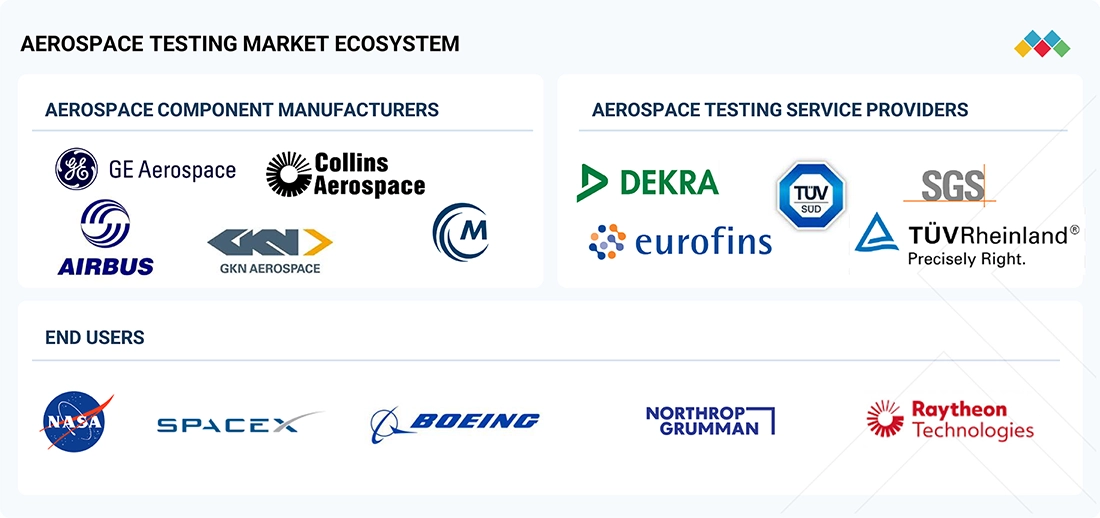
AEROSPACE TESTING MARKET SIZE, SHARE AND TRENDS: COMMERCIAL USE CASES ACROSS INDUSTRIES
| COMPANY | USE CASE DESCRIPTION | BENEFITS |
|---|---|---|
 |
Full-scale structural testing, fatigue testing, and vibration analysis for commercial aircraft platforms (737, 787). | Ensures airframe durability, improves safety margins, reduces maintenance risk, and accelerates certification timelines. |
 |
Environmental, climatic, and materials testing for composite-rich aircraft such as the A350 and A320neo. | Enhances material reliability, validates performance under extreme conditions, and supports lightweight design adoption. |
 |
Aerodynamic, thermal, and propulsion testing for defense aircraft (F-35, F-22) and hypersonic systems. | Boosts mission reliability, validates high-speed performance, and supports advanced propulsion innovations. |
Logos and trademarks shown above are the property of their respective owners. Their use here is for informational and illustrative purposes only.
Related Ecosystem
Airport Systems
- Antennas
- Sensors
- Aeronautical Information Management (AIM)
- Digital Signage
- Face Recognition
- Thales group
- SYSTRA LTD.
- Idaho Strategic Resources, Inc.
- HONEYWELL INTERNATIONAL INC.
- Leidos Holdings, Inc.
Industrial Automation
- Sensors
- Image Sensors
- Manufacturing Execution System (MES)
- Actuators
- Flow Sensors
- Siemens ag
- ABB India Limited
- Emerson Electric Co.
- HONEYWELL INTERNATIONAL INC.
- SCHNEIDER ELECTRIC SE
Testing Inspection And Certification
- Eddy Current Testing (ECT)
- Safety Testing
- Signal Generators
- Acoustic Emission Testing (AET)
- Automated Test Equipment
- Sgs s.a.
- Intertek Group plc
- Bureau veritas s.a.
- TUV RHEINLAND AG
- TUV SUD AG
Key Takeaways
- Canada's aerospace testing market reaches $480.6 million in 2025 with projected growth to $616.9 million by 2030 at a 5.1% CAGR.
- Canada's integrated position in North American aerospace supply chains drives consistent demand for advanced testing and validation services.
- Regulatory compliance, defense procurement, and commercial aviation expansion are primary growth catalysts for Canada's aerospace testing sector.
- Canada's market benefits from technological advancement in NDT, fatigue analysis, and environmental simulation testing capabilities through 2030.
Aerospace Testing Market Report Scope
| Report Metric | Details |
|---|---|
| Base Year | 2025 |
| Fastest Growing Segment | SPACE EXPLORATION (End User) |
| Forecast Period | 2025-2030 |
| Growth Rate | CAGR of 4.6% from 2025 to 2030 |
| Largest Segment | IN-HOUSE (Sourcing Type) |
| Market Size Base Year (Billions) | ~USD 5.52 (2025) |
| Revenue Forecast (Billions) | ~USD 6.91 (2030) |
| Segments Covered | Sourcing Type, Testing Type, End User |
Canada Aerospace Testing Market Report Segmentation
3 segment dimensions are covered across the global market.
By Sourcing Type
- In-House
- Outsourced
By Testing Type
- Avionics/Flight & Electronics Testing
- Environmental Testing
- Fuel Testing
- Material Testing
- Other Testing Types
- Propulsion System Testing
- Structural/Component Testing
By End User
- Commercial
- Military & Defense
- Other End Users
- Space Exploration
Target Audience
- Aerospace OEMs & Tier-1 Suppliers : Need market intelligence to evaluate testing service providers in Canada, plan facility investments, and optimize supply chain positioning within North American aerospace networks.
- Testing Service Providers : Require market sizing, growth forecasts, and competitive analysis to develop service offerings, justify capacity expansion, and identify high-growth segments within Canada's aerospace sector.
- Government & Defense Agencies : Use market data to inform procurement strategies, defense spending allocation, and policy decisions supporting Canada's aerospace testing infrastructure and industrial capabilities.
- Private Equity & Investors : Evaluate investment opportunities in Canadian aerospace testing companies by understanding market growth potential, consolidation trends, and return on investment scenarios.
- Consultants & Strategy Firms : Leverage Canada-specific market data to support client advisory engagements, competitive benchmarking, and strategic planning for aerospace and defense sector clients.
Reasons to Buy this Report
- Market Sizing & Forecasting : Accurate 2025-2030 projections specific to Canada's aerospace testing segment enable precise budget allocation and investment planning for market entrants and existing players.
- Competitive Landscape Intelligence : Understand Canada-specific competitive dynamics, key players, and market consolidation trends to identify partnership and acquisition opportunities within the regional market.
- Growth Driver Analysis : Detailed insights into defense spending, commercial aviation recovery, and regulatory changes driving Canada's 5.1% CAGR to inform strategic expansion and service development.
- Regional Supply Chain Mapping : Identify testing infrastructure gaps, geographic clusters, and integration points with North American aerospace supply chains to optimize operational and distribution strategies.
- Investment & Funding Opportunities : Leverage market data to attract investors, secure government grants, and justify capital expenditure for testing facility expansion and technology upgrades in Canada.
Frequently asked questions
What is the current size of Canada's aerospace testing market?
Canada's aerospace testing market is valued at $480.6 million in 2025 and is expected to grow to $616.9 million by 2030.
What is the projected growth rate for Canada's aerospace testing market?
Canada's aerospace testing market is projected to grow at a compound annual growth rate (CAGR) of 5.1% from 2025 to 2030.
What are the main drivers of growth in Canada's aerospace testing market?
Key growth drivers in Canada include regulatory compliance requirements, defense procurement initiatives, commercial aviation expansion, and increased adoption of advanced testing technologies such as non-destructive testing and environmental simulation.
How does Canada's aerospace testing market compare to North America?
Canada represents a significant segment of the North American aerospace testing market, benefiting from its strategic position within integrated supply chains and advanced manufacturing infrastructure that support both commercial and defense aerospace sectors.
What testing technologies are most prevalent in Canada's aerospace sector?
Canada's aerospace testing market emphasizes non-destructive testing (NDT), fatigue analysis, environmental simulation, quality assurance protocols, and performance validation services across commercial and military aviation applications.
RESEARCH METHODOLOGY
The research study involved four major steps in estimating the size of the aerospace testing market. Exhaustive secondary research has been done to collect important information about the market and peer markets. The next step has been to validate these findings and assumptions and size them with the help of primary research with industry experts across the value chain. Both top-down and bottom-up approaches have been used to estimate the market size. After this, the market breakdown and data triangulation approaches have been adopted to estimate the market sizes of segments and subsegments.
Secondary Research
In the secondary research process, various secondary sources were referred to to identify and collect information required for this study. The secondary sources include annual reports, press releases, investor presentations of companies, white papers, and articles from recognized authors. Secondary research has been mainly done to obtain key information about the market’s value chain, the pool of key market players, market segmentation according to industry trends, regional outlook, and developments from market and technology perspectives.
In the aerospace testing market report, the global market size has been estimated using the top-down and bottom-up approaches, along with several other dependent submarkets. The major players in the market were identified using extensive secondary research, and their presence in the market was determined using secondary and primary research. All the percentage splits and breakdowns have been determined using secondary sources and verified through primary sources.
Primary Research
Extensive primary research has been conducted after understanding the aerospace testing market scenario through secondary research. Several primary interviews have been conducted with key opinion leaders from demand- and supply-side vendors across four major regions—North America, Europe, Asia Pacific, and RoW. Approximately 25% of the primary interviews have been conducted with the demand-side vendors and 75% with the supply-side vendors. Primary data has been collected mainly through telephonic interviews, which consist of 80% of the total primary interviews; questionnaires and emails have also been used to collect the data.
After successful interaction with industry experts, brief sessions were conducted with highly experienced independent consultants to reinforce the findings of our primary research. This, along with the in-house subject matter experts’ opinions, has led us to the findings as described in the report. The breakdown of primary respondents is as follows:
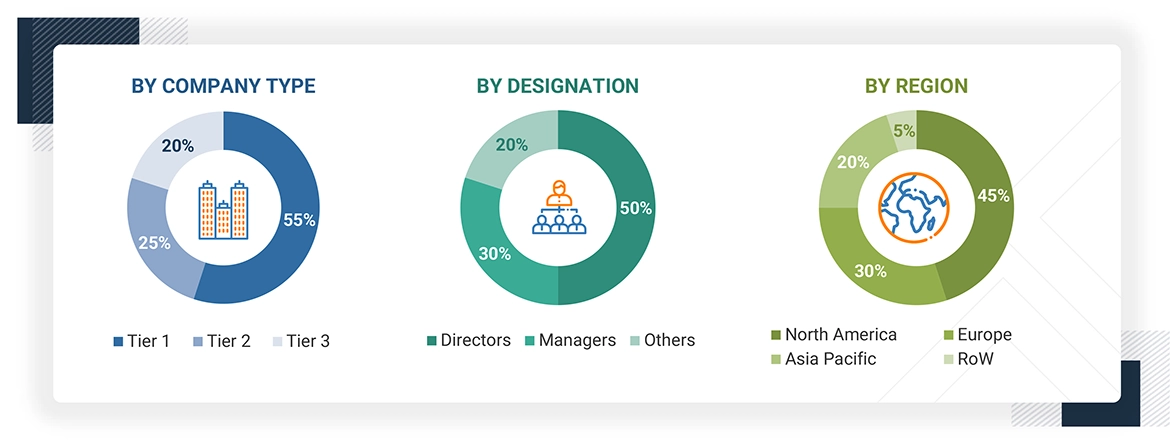
Note: “Others” includes sales, marketing, and product managers
About the assumptions considered for the study, To know download the pdf brochure
Market Size Estimation
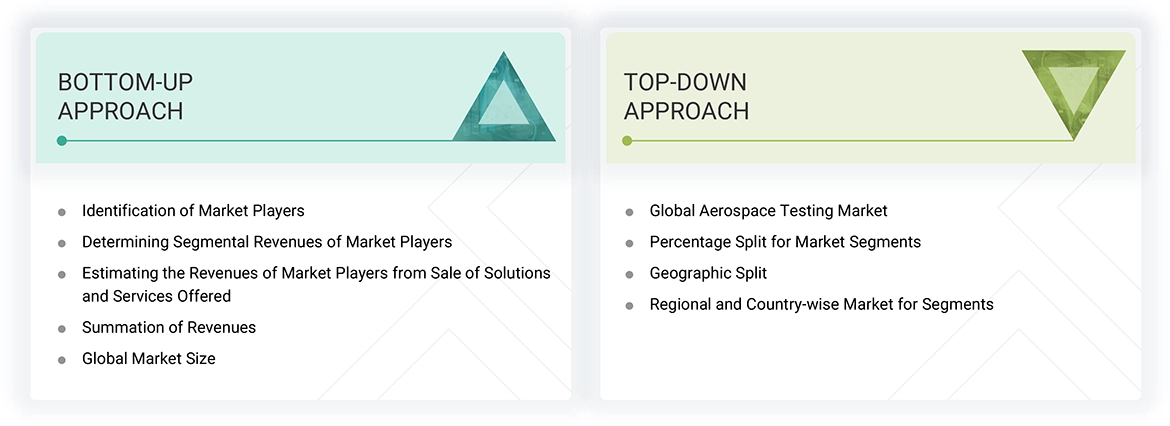
In the complete market engineering process, top-down and bottom-up approaches and several data triangulation methods have been used to estimate and forecast the market size for the overall market segments and subsegments listed in this report. Extensive qualitative and quantitative analyses have been performed on the complete market engineering process to list the key information/insights throughout the report. The following table explains the process flow of the market size estimation.
The key players in the aerospace testing market were identified through secondary research, and their rankings in the respective regions were determined through primary and secondary research. This entire procedure involved the study of the annual and financial reports of top players, and interviews with industry experts, such as chief executive officers, vice presidents, directors, and marketing executives, for quantitative and qualitative key insights. All percentage shares, splits, and breakdowns were determined using secondary sources and verified through primary sources. All parameters that affect the markets covered in this research study were accounted for, viewed in extensive detail, verified through primary research, and analyzed to obtain the final quantitative and qualitative data. This data was consolidated, supplemented with detailed inputs and analysis from MarketsandMarkets, and presented in this report.
Bottom-Up Approach
- Major companies that provide aerospace testing services were identified. This included analyzing company portfolios, service offerings, and presence across various regions.
- The segment-specific revenues of the companies, particularly those related to aerospace testing, were determined.
- These individual revenue figures were compiled to determine the total revenue generated across the identified companies within the sector.
- Using this consolidated data, the global market size for aerospace testing was obtained.
Top-Down Approach
- Estimated the overall aerospace testing market size, then segmented the global market by allocating shares to in-house and outsourced sources to determine the aerospace testing market by sourcing type
- Estimated the aerospace testing market size by end users by assigning end user penetration splits to the global aerospace testing market based on their respective proportions of testing demand
- Applied market share splits to the global aerospace testing market to derive the market segmentation, by testing type
- Distributed the testing types across regions and countries by aligning regional aerospace activity with economic indicators, aerospace manufacturing presence, and national development initiatives
Aerospace Testing Market : Top-Down and Bottom-Up Approach
Data Triangulation
After arriving at the overall market size-using the market size estimation processes as explained above—the market has been split into several segments and subsegments. Data triangulation and market breakdown procedures have been employed to complete the entire market engineering process and arrive at the exact statistics of each market segment and subsegment. The data has been triangulated by studying various factors and trends from the demand and supply sides in the aerospace testing market.
Market Definition
The aerospace sector encompasses designing, developing, producing, and maintaining aircraft (airplanes, helicopters, gliders, and balloons) and spacecraft (satellites, space probes, orbital stations, and shuttles) and their component parts and accessories for civilian and military purposes. In this broader industry, the aerospace testing market is committed to inspecting and verifying these components to determine that they can meet rigorous standards of safety, performance, and regulation. The aerospace testing industry encompasses a wide range of specialist test services, such as material testing to evaluate the strength, durability, and compatibility of materials used; environmental testing to simulate harsh operating conditions, such as temperature, pressure, humidity, and vibration; structural/component testing to validate the integrity and performance of assembled structures and critical components; avionics, flight, and electronics testing to validate reliability and accuracy of onboard systems, sensors, and software; and propulsion system testing to validate engine efficiency, thrust, and operating safety. These testing procedures ensure the early detection of weaknesses or faults, enhancing the overall safety, functionality, and reliability of aerospace systems.
Key Stakeholders
- Raw Material Suppliers
- Aerospace Component Manufacturers
- Testing and Certification Agencies
- Testing Service Providers
- Suppliers and Component Manufacturers
- Research and Development Institutions
- Regulatory Bodies
- Consulting Firms
- Testing Laboratories
- Military and Defense Agencies
- Airlines and Operators
- Industry Associations
- Investors and Financial Institutions
Report Objectives
- To define, describe, segment, and forecast the aerospace testing market, testing type, sourcing type, and end user, in terms of value
- To describe and forecast the market for various segments, with respect to four main regions: North America, Europe, Asia Pacific, and RoW, in terms of value
- To provide detailed information regarding drivers, restraints, opportunities, and challenges influencing the growth of the aerospace testing market
- To provide a detailed overview of the aerospace testing market’s supply chain, along with the ecosystem, technology trends, use cases, regulatory environment, and Porter’s five forces analysis for the market
- To analyze industry trends, patents and innovations, and trade data (export and import data) related to aerospace testing
- To strategically analyze the micromarkets with respect to individual growth trends, prospects, and contributions to the total market
- To strategically profile the key players and comprehensively analyze their market share and core competencies
- To analyze opportunities for stakeholders and provide a detailed competitive landscape of the market
- To analyze competitive developments, such as solution/service launches/developments, collaborations, agreements, partnerships, acquisitions, and research & development (R&D), carried out by players in the aerospace testing market
- To profile key players in the aerospace testing market and comprehensively analyze their market ranking based on their revenue, market share, and core competencies
Available Customizations
With the given market data, MarketsandMarkets offers customizations according to the specific requirements of companies. The following customization options are available for the report:
- Detailed analysis and profiling of additional market players based on various blocks of the supply chain
Get the Full Aerospace Testing Market Report
Full forecast, segment splits, and company analysis for all Aerospace Testing Market.
- US Aerospace Testing Market
- Mexico Aerospace Testing Market
- Germany Aerospace Testing Market
- UK Aerospace Testing Market
- France Aerospace Testing Market
- Spain Aerospace Testing Market
- China Aerospace Testing Market
- Japan Aerospace Testing Market
- India Aerospace Testing Market
- South Korea Aerospace Testing Market
- Australia Aerospace Testing Market
- Rest Of Europe Aerospace Testing Market
- Rest Of Asia Pacific Aerospace Testing Market
- GCC Aerospace Testing Market
- Argentina Aerospace Testing Market
- Brazil Aerospace Testing Market
- Chile Aerospace Testing Market
- Rest Of South America Aerospace Testing Market
Need a Tailored Report?
Customize this report to your needs
Get 10% FREE Customization
Customize This Report
