
Asia Pacific Cleanroom Technologies Market (2024-2029)

The Asia Pacific Cleanroom Technologies Market was valued at $2570.6 Million in 2024 and projected to reach to $3723.4 Million by 2029, representing a compound annual growth rate of CAGR 7.7%. Asia Pacific's cleanroom technologies market is positioned for sustained expansion, driven by the region's emergence as a global pharmaceutical and biopharmaceutical manufacturing hub.


| Market Size in | USD 26.32 MN |
| Market Forecast in | |
| CAGR | |
| Forecast Period | |
| Units Considered | Value (USD MN) |
Asia Pacific Cleanroom Technologies Market Trends and Insights
- Asia Pacific's cleanroom sector is driven by rapid pharmaceutical manufacturing expansion, increasing biopharmaceutical production capacity, and stringent regulatory compliance requirements across the region.
- The region's healthcare infrastructure modernization and rising demand for sterile manufacturing environments are accelerating adoption of advanced cleanroom solutions. Asia Pacific cleanroom technologies are benefiting from significant investments in semiconductor and electronics manufacturing alongside pharmaceutical applications.
- The region's competitive manufacturing landscape and cost advantages are attracting global pharmaceutical and biotech companies to establish cleanroom facilities in Asia Pacific.
- Between 2024 and 2029, Asia Pacific is expected to maintain its 7.7% compound annual growth rate, outpacing global expansion trends and solidifying its position as a critical hub for cleanroom technology deployment..
Key Market Statistics
- CAGR (2024-2029) CAGR 7.7%
- Market Size, 2024 ~USD 2570.6 Million
- Forecast, 2029 ~USD 3723.4 Million
- Geography Asia Pacific
Asia Pacific Cleanroom Technologies Market Overview
Rapid Pharmaceutical Expansion :
Asia Pacific is witnessing accelerated pharmaceutical manufacturing growth, with countries like China and India establishing advanced production facilities to meet regional and global demand for cleanroom technologies.
Biopharmaceutical Production Surge :
Increasing biopharmaceutical capacity investments across Japan, South Korea, and India are driving significant demand for specialized cleanroom solutions and contamination control systems.
Stringent Regulatory Compliance :
Evolving regulatory standards across Asia Pacific nations are compelling manufacturers to upgrade cleanroom infrastructure, ensuring adherence to international quality and safety benchmarks.
Market Growth Trajectory :
The Asia Pacific cleanroom technologies market is projected to grow from $2,570.6 million in 2024 to $3,723.4 million by 2029, representing a robust 7.7% CAGR, outpacing the global average of 6.9%.
Asia Pacific Cleanroom Technologies Market Dynamics
- Countries including China, Japan, India, and South Korea are investing heavily in state-of-the-art cleanroom facilities to support drug development, vaccine production, and advanced therapeutics manufacturing.
- Regulatory harmonization efforts and increasing foreign direct investment in healthcare infrastructure are accelerating market penetration. The region's competitive labor costs, growing skilled workforce, and improving regulatory frameworks make it an attractive destination for cleanroom technology adoption.
- Rising healthcare spending, coupled with government initiatives to strengthen domestic pharmaceutical capabilities, will continue to fuel demand for advanced cleanroom solutions through 2029.
- Strategic partnerships between regional manufacturers and global technology providers are expected to enhance market accessibility and innovation..
Market Ecosystem
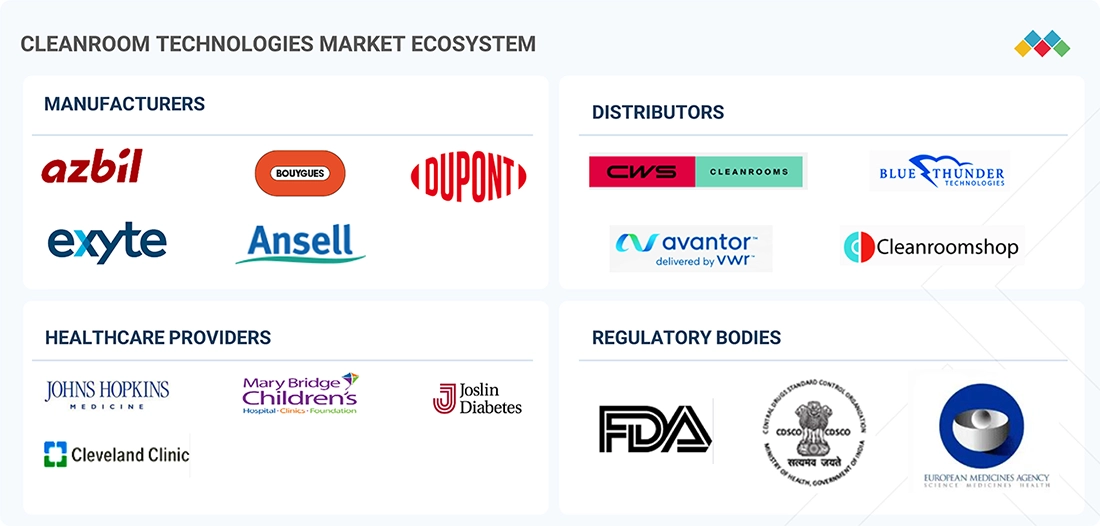
CLEANROOM TECHNOLOGIES MARKET: COMMERCIAL USE CASES ACROSS INDUSTRIES
| COMPANY | USE CASE DESCRIPTION | BENEFITS |
|---|---|---|
 |
Delivers end-to-end cleanroom construction, modular cleanroom units, and facility design engineering for biologics, cell & gene therapy, and advanced manufacturing sectors. | Enables rapid deployment, scalable facility expansions, and lower lifecycle costs with modular, future-ready cleanroom infrastructures. |
 |
Offers turnkey cleanroom commissioning, HVAC engineering, and high-efficiency filtration systems tailored for electronics manufacturing and life science industries. | Reduces energy consumption, maintains stable environmental conditions, and accelerates facility readiness with optimized airflow and temperature control. |
 |
Supplies cleanroom consumables including gloves, garments, sleeves, hoods, face masks, goggles, and footwear for pharmaceutical, biotechnology, semiconductor, medical device, and electronics manufacturing environments requiring stringent contamination control. | Minimizes particulate and microbial contamination, enhances operator safety and product integrity, supports GMP and ISO cleanroom compliance, and improves manufacturing quality in critical controlled environments. |
 |
Develops high-performance cleanroom garments, protective materials, and barrier fabrics used in pharmaceutical, semiconductor, and microelectronics facilities. | Improves product and worker protection, reduces contamination events, and meets stringent global regulatory and safety standards. |
 |
Designs and delivers turnkey cleanroom infrastructure, controlled-environment facilities, and high-specification technical buildings for pharmaceutical, biotech, semiconductor, and advanced manufacturing industries. Their services include full project engineering, HVAC integration, contamination-control architecture, and modular cleanroom construction | Ensures high-quality, regulatory-compliant cleanroom environments, accelerates facility construction timelines, and lowers lifecycle costs through efficient engineering, robust project management, and sustainable building technologies. |
Logos and trademarks shown above are the property of their respective owners. Their use here is for informational and illustrative purposes only.
Related Ecosystem
Key Takeaways
- Asia Pacific cleanroom technologies market valued at $2,570.6M in 2024, expanding to $3,723.4M by 2029 at 7.7% CAGR
- Pharmaceutical manufacturing expansion and biopharmaceutical production capacity growth are primary drivers in Asia Pacific
- Asia Pacific's cost advantages and regulatory compliance requirements attract global investment in cleanroom infrastructure
- Asia Pacific cleanroom market growth outpaces global trends, driven by semiconductor, electronics, and healthcare manufacturing demand
Cleanroom Technologies Market Report Scope
| Report Metric | Details |
|---|---|
| Base Year | 2024 |
| Fastest Growing Segment | SAFETY CONSUMABLES (Product Sub-Type) |
| Forecast Period | 2024–2029 |
| Growth Rate | CAGR of 6.9% from 2024 to 2029 |
| Largest Segment | CONSUMABLES (Product) |
| Market Size Base Year (Billions) | ~USD 8.81 (2024) |
| Revenue Forecast (Billions) | ~USD 12.3 (2029) |
| Segments Covered | Product, Product Sub-Type, Type, End User, Modular Cleanrooms |
Asia Pacific Cleanroom Technologies Market Report Segmentation
5 segment dimensions are covered across the global market.
By Product
- Consumables
- Controls
- Equipment
By Product Sub-Type
- Air Diffusers And Showers
- Alcohols
- Apparel
- Chlorine-Based Disinfectants
- Cleaning Consumables
- Disinfectants
- Fan Filter Units (Ffu)
- Gloves
- Hepa Filters
- Hvac Systems
- Hydrogen Peroxide
- Hypochlorous Acid
- Laminar Air Flow Systems And Biosafety Cabinets
- Other Cleaning Consumables
- Other Cleanroom Disinfectants
- Other Equipment
- Other Safety Consumables
- Pass-Hrough Cabinets
- Pass-Through Cabinets
- Phenolic Compounds
- Quaternary Ammonium Compounds
- Safety Consumables
- Vacuum Systems
- Wipes
By Type
- Hardwall Cleanrooms
- Mobile Cleanrooms
- Modular Cleanrooms
- Softwall Cleanrooms
- Standard Cleanrooms
By End User
- Biotechnology Industry
- Hospitals
- Medical Device Manufacturers
- Other End Users
- Pharmaceutical Industry
By Modular Cleanrooms
- Hardwall Cleanrooms
- Softwall Cleanrooms
Target Audience
- Pharmaceutical Manufacturers : Require detailed market intelligence on cleanroom technology adoption rates, regulatory compliance requirements, and infrastructure investment trends across Asia Pacific to optimize production facility planning.
- Cleanroom Technology Providers : Need comprehensive regional market data, competitive positioning analysis, and country-specific demand forecasts to identify expansion opportunities and tailor solutions for Asia Pacific customers.
- Healthcare Investment Firms : Seek market sizing, growth projections, and investment landscape analysis for Asia Pacific cleanroom technologies to evaluate portfolio opportunities and identify high-potential acquisition targets.
- Regulatory & Compliance Consultants : Require insights into evolving regulatory frameworks, compliance standards, and cleanroom technology requirements across Asia Pacific nations to advise clients on market entry and operational strategies.
- Biopharmaceutical Companies : Need market forecasts and regional capacity data to inform manufacturing site selection, technology procurement decisions, and strategic expansion planning within Asia Pacific markets.
Key Companies in the Asia Pacific Cleanroom Technologies Market
| Company | HQ | Ownership | Strongest segments |
|---|---|---|---|
| FLUOR CORPORATION | United States | Public Company | Energy Solutions (oil, gas, chemicals, LNG, power, energy transition),Urban Solutions (advanced technologies, life sciences, mining, infrastructure, staffing, maintenance),Mission Solutions (government, nuclear remediation, security, logistics, mission-critical facilities), |
| TECHNICOLOR SA | France | Public Company | Broadband CPE (fiber gateways, routers, extenders, FWA),Video CPE (STBs, dongles, smart media devices),Software platforms and service management (RDK-B, PRPL OS, Homeware, Navigate, HomeSight), |
| LEONI AG | Germany | Private Company | Wiring Systems (complete and high-voltage harnesses, energy distribution, connectors, services),Automotive Cables (standard, special, charging cables, wires and strands),Non-automotive (heating, HF technology, flex, miniaturization, aerospace), |
| KIMBERLY-CLARK CORPORATION | United States | Public Company | Baby and child care (diapers, training pants, swimpants, wipes),Adult incontinence and feminine care,Consumer tissue (facial, bathroom, paper towels, napkins), |
| ILLINOIS TOOL WORKS, INC. | United States | Public Company | Automotive OEM,Food Equipment,Test & Measurement and Electronics, |
| AZBIL CORPORATION | Japan | Public Company | Building Automation Business,Advanced Automation Business,Life Automation Business, |
| DUPONT DE NEMOURS, INC. | United States | Public Company | Healthcare & Water Technologies,Construction Materials (Tyvek house wrap, Styrofoam, Corian),Engineered Components & Industrial Solutions, |
| TAIKISHA LTD. | Japan | Public Company | Building and commercial HVAC systems,Industrial HVAC and environmental systems for factories and laboratories,Automotive painting systems and equipment, |
| CAMFIL | Sweden | Private Company | Commercial HVAC air filtration,Industrial air filtration and dust/fume collection,High-spec cleanroom and life sciences filtration, |
FLUOR CORPORATION
Fluor Corporation is a publicly traded United States engineering and construction company founded in 1912, employing approximately 23,000 people and providing services across multiple industrial sectors.
TECHNICOLOR SA
Technicolor SA is a French public company established in 1985 with 1,552 employees, operating in the media and entertainment technology industry.
LEONI AG
Leoni AG is a German private company with a history dating back to 1569 and approximately 95,090 employees, operating as a major supplier in the automotive and industrial sectors.
KIMBERLY-CLARK CORPORATION
Kimberly-Clark Corporation is a publicly traded United States company founded in 1872 with 36,000 employees, manufacturing personal care and consumer products globally.
ILLINOIS TOOL WORKS, INC.
Illinois Tool Works, Inc. is a publicly traded United States manufacturer founded in 1912 with 43,000 employees, producing diversified products and engineered systems across multiple industries.
AZBIL CORPORATION
Azbil Corporation is a Japanese public company established in 1906 with 9,170 employees, specializing in building automation, control systems, and industrial solutions.
DUPONT DE NEMOURS, INC.
DuPont de Nemours, Inc. is a publicly traded United States chemical and materials company established in 2015 with 15,000 employees, serving various industrial and consumer markets.
TAIKISHA LTD.
Taikisha Ltd. is a Japanese public company founded in 1913 with 5,525 employees, specializing in clean room technology and environmental control systems.
CAMFIL
Camfil is a Swedish private company established in 1963 with 3,736 employees, manufacturing air filtration and purification solutions for industrial and commercial applications.
Countries within Asia Pacific - compare and drill down
| Country | 2025 size (native) |
|---|---|
| China | USD 579.1 Million |
| Japan | USD 622.1 Million |
| India | USD 423 Million |
| Australia | USD 194.5 Million |
| South Korea | USD 142.2 Million |
| Rest Of Asia Pacific | USD 211.5 Million |
Country market size visualization
Reasons to Buy this Report
- Regional Market Sizing & Forecasts : Gain precise market valuations for Asia Pacific and individual country-level data, enabling accurate investment planning and resource allocation across the region's high-growth cleanroom sector.
- Competitive Landscape Intelligence : Understand key players, market consolidation trends, and competitive positioning specific to Asia Pacific, identifying partnership and acquisition opportunities in this rapidly evolving market.
- Growth Driver Analysis : Access detailed insights into pharmaceutical expansion, biopharmaceutical production capacity, and regulatory compliance drivers unique to Asia Pacific markets, informing strategic business decisions.
- Country-Specific Opportunities : Identify high-potential markets within Asia Pacific including China, Japan, India, and South Korea with tailored market dynamics, regulatory environments, and investment opportunities.
- Forecast-Driven Strategy : Leverage 2024-2029 projections showing 7.7% CAGR growth to develop long-term market entry strategies, product development roadmaps, and expansion plans aligned with regional demand trajectories.
Frequently asked questions
What is the current size of the Asia Pacific cleanroom technologies market?
The Asia Pacific cleanroom technologies market was valued at $2,570.6 million in 2024 and is projected to reach $3,723.4 million by 2029.
What is the expected growth rate for Asia Pacific cleanroom technologies?
Asia Pacific cleanroom technologies are expected to grow at a compound annual growth rate (CAGR) of 7.7% from 2024 to 2029.
Which industries drive cleanroom technology demand in Asia Pacific?
Pharmaceutical manufacturing, biopharmaceutical production, semiconductor fabrication, and electronics manufacturing are the primary industries driving cleanroom technology adoption in Asia Pacific.
Why is Asia Pacific a key region for cleanroom technology investment?
Asia Pacific offers competitive manufacturing costs, expanding healthcare infrastructure, stringent regulatory compliance requirements, and attracts global pharmaceutical and biotech companies seeking to establish production facilities.
How does Asia Pacific cleanroom market growth compare to global trends?
Asia Pacific's 7.7% CAGR outpaces the global cleanroom technologies market growth rate of 6.9%, positioning the region as a faster-growing market segment.
RESEARCH METHODOLOGY
This study involved four major activities in estimating the size of the cleanroom technologies market. Exhaustive secondary research was conducted to gather information on the market, the peer market, and the parent market. The next step was to validate these findings, assumptions, and sizing with industry experts across value chains through primary research. The bottom-up approach was employed to estimate the overall market size. After that, market breakdown and data triangulation were used to estimate the market size of segments and sub-segments.
Secondary Research
The secondary research process involved the extensive use of secondary sources, directories, databases (such as Bloomberg Businessweek, Factiva, and D&B Hoovers), white papers, annual reports, Companies House documents, investor presentations, and SEC filings. Secondary research was used to identify and collect information useful for the extensive, technical, market-oriented, and commercial study of the cleanroom technologies market. It was also used to obtain important information about key players, market classification and segmentation according to industry trends down to the bottom level, and key developments from market and technology perspectives. A database of the key industry leaders was also prepared using secondary research.
Primary Research
In the primary research process, various sources from both the supply and demand sides were interviewed to obtain qualitative and quantitative information for this report. The primary sources from the supply side include industry experts such as CEOs, vice presidents, marketing and sales directors, technology & innovation directors, and related key executives from various key companies and organizations operating in the cleanroom technologies market. The primary sources on the demand side included industry experts, purchasing and sales managers, doctors, and personnel from research organizations. Primary research was conducted to validate the market segmentation, identify key players in the market, and gather insights on key industry trends and key market dynamics.
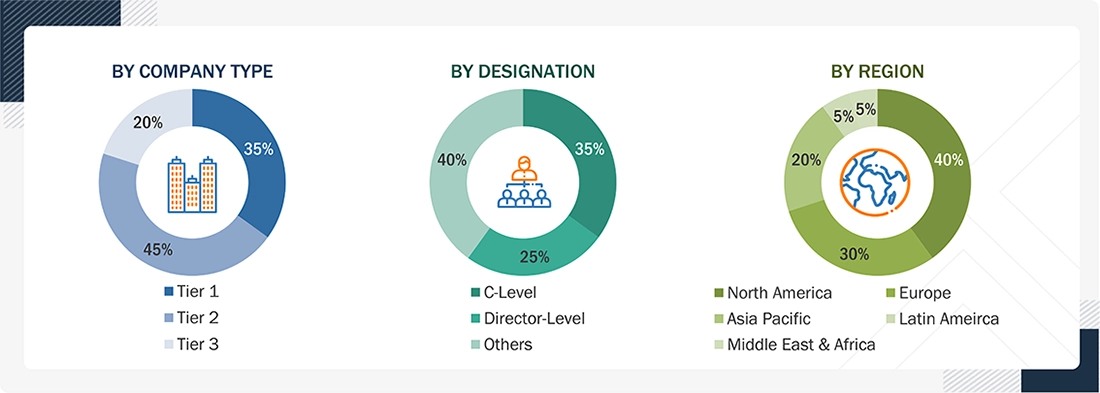
Note 1: C-level primaries include CEOs, COOs, CTOs, and VPs.
Note 2: Other designations include sales managers, marketing managers, and product managers.
Note 3: Companies are classified into tiers based on their total revenue. As of 2025: Tier 1=>USD 1 billion, Tier 2 = USD 500 million to USD 1 billion, Tier 3=<USD 500 million
To know about the assumptions considered for the study, download the pdf brochure
Market Size Estimation
Market sizing was conducted from a global perspective.
Country-level Analysis: The size of the cleanroom technologies market was obtained from the annual presentations of leading players and secondary data available in the public domain. The share of products and services in the overall cleanroom technologies market was derived from secondary data and validated with primary participants to determine the total market size. Primary participants further validated the numbers.
Geographic market assessment (by region & country): The geographic assessment was done using the following approaches:
Approach 1: Geographic revenue contributions/splits of leading players in the market (wherever available) and respective growth trends
Approach 2: Geographic adoption trends for individual product segments by end users and growth prospects for each of the segments (assumptions and indicative estimates validated from primary interviews)
At each point, the assumptions and approaches were validated through industry experts contacted during primary research. Considering the limitations of data available from secondary research, revenue estimates for individual companies (for the overall cleanroom technologies market and geographic market assessment) were ascertained based on a detailed analysis of their respective product offerings, geographic reach/strength (direct or through distributors or suppliers), and the shares of the leading players in a particular region or country.
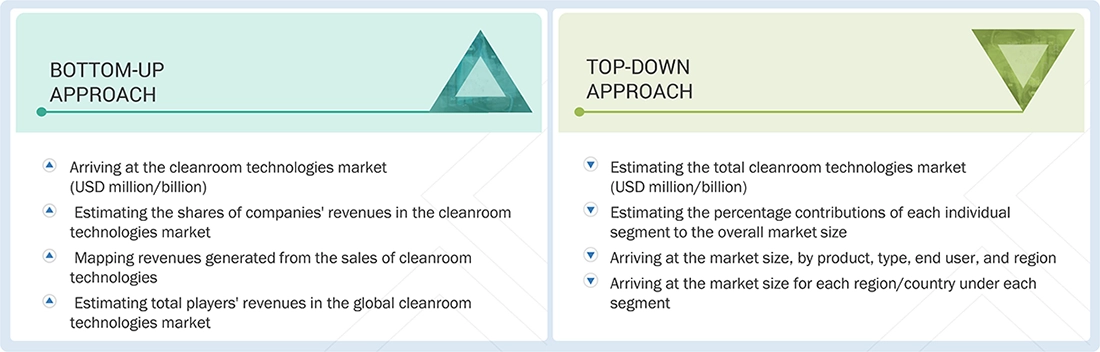
Data Triangulation
After arriving at the overall market size—using the market size estimation processes explained above—the market was split into several segments and sub-segments. To complete the overall market engineering process and arrive at the exact statistics for each market segment and subsegment, data triangulation and market breakdown procedures were employed wherever applicable. The data was triangulated by studying various factors and trends from both the demand and supply sides.
Market Definition
Cleanroom technologies are specialized systems, processes, and equipment designed to produce an environment with low concentrations of airborne particulates, contaminants, and pollutants. Such technologies have significant applications in industries including pharmaceuticals, biotechnology, electronics, and aerospace, where a minute contaminant might compromise product quality or safety. Cleanroom technologies include air filtration with HEPA and ULPA filters, environmental control for temperature, humidity, and pressure, and advanced monitoring systems to ensure compliance with specific cleanliness standards, such as ISO and GMP.
Key Stakeholders
- International Organization for Standardization (ISO) – ISO 14644 & ISO 14698 Standards
- U.S. Food and Drug Administration (FDA)
- European Medicines Agency (EMA)
- European Commission – EU GMP (Annex 1)
- World Health Organization (WHO)
- International Society for Pharmaceutical Engineering (ISPE)
- Institute of Environmental Sciences and Technology (IEST)
- Cleanroom Technology Providers & EPC Companies (e.g., Exyte, Bouygues Group, Ardmac, Clean Air Products, M+W Group)
- HVAC, Filtration, and Airflow System Manufacturers (HEPA/ULPA suppliers)Annual Reports/SEC Filings, Investor Presentations, and Press Releases of Key Players
- White Papers, Journals/Magazines, and News Articles
- Paid Databases, such as Factiva, D&B Hoovers, and Bloomberg Business
Report Objectives
- To define, describe, segment, and forecast the cleanroom technologies market by product, type, end user, and region
- To provide detailed information about the factors influencing the market growth (such as drivers, restraints, opportunities, and challenges)
- To analyze micromarkets with respect to individual growth trends, prospects, and contributions to the overall cleanroom technologies market
- To analyze market opportunities for stakeholders and provide details of the competitive landscape for key players
- To forecast the size of the cleanroom technologies market in five main regions (along with their respective key countries), namely, North America, Europe, the Asia Pacific, Latin America, and the Middle East & Africa
- To profile the key players in the cleanroom technologies market and comprehensively analyze their core competencies and market shares
- To track and analyze competitive developments such as acquisitions, product launches, expansions, collaborations, agreements, partnerships, and R&D activities of the leading players in the cleanroom technologies market
- To benchmark players within the cleanroom technologies market using the competitive leadership mapping framework, which analyzes market players on various parameters within the broad categories of business strategy, market share, and product offering
Available customizations:
With the given market data, MarketsandMarkets offers customizations as per the company’s specific needs. The following customization options are available for the report:
Geographic Analysis
- Further breakdown of the Rest of Asia Pacific cleanroom technologies market into Indonesia, Philippines, Vietnam, Hong Kong, and other countries
- Further breakdown of the Rest of Europe cleanroom technologies market into Belgium, Russia, the Netherlands, Switzerland, and other countries
- Further breakdown of the Rest of Latin America cleanroom technologies market into Argentina, Peru, and other countries
- Further breakdown of Rest of Middle East and Africa cleanroom technologies market into Israel, Iran, Iraq, Jordan, Yemen, and other countries
Get the Full Cleanroom Technologies Market Report
Full forecast, segment splits, and company analysis for all Cleanroom Technologies Market.
- Canada Cleanroom Technologies Market
- US Cleanroom Technologies Market
- Germany Cleanroom Technologies Market
- France Cleanroom Technologies Market
- UK Cleanroom Technologies Market
- Italy Cleanroom Technologies Market
- Spain Cleanroom Technologies Market
- China Cleanroom Technologies Market
- Japan Cleanroom Technologies Market
- India Cleanroom Technologies Market
- Australia Cleanroom Technologies Market
- South Korea Cleanroom Technologies Market
- Brazil Cleanroom Technologies Market
- Mexico Cleanroom Technologies Market
- GCC Countries Cleanroom Technologies Market
- Rest Of Asia Pacific Cleanroom Technologies Market
- Rest Of Europe Cleanroom Technologies Market
- Rest Of Latin America Cleanroom Technologies Market
- Franceq Cleanroom Technologies Market
Need a Tailored Report?
Customize this report to your needs
Get 10% FREE Customization
Customize This Report
