
Japan Cloud Security Market (2026-2031)

The Japan Cloud Security Market was valued at $974.9 Million in 2026 and projected to reach to $1599.8 Million by 2031, representing a compound annual growth rate of CAGR 10.4%. Japan's cloud security market is poised for sustained expansion as enterprises prioritize cybersecurity investments amid increasing digital adoption.


| Market Size in | USD 26.32 MN |
| Market Forecast in | |
| CAGR | |
| Forecast Period | |
| Units Considered | Value (USD MN) |
Japan Cloud Security Market Trends and Insights
- This expansion reflects Japan's increasing digital transformation initiatives and heightened regulatory compliance requirements across enterprises.
- Japan's market growth is driven by rising cyber threats, mandatory data protection regulations, and widespread cloud adoption among financial services, manufacturing, and government sectors. The 10.4% compound annual growth rate (CAGR) through 2031 positions Japan as a significant contributor to Asia Pacific cloud security investments.
- Japan's enterprises are prioritizing advanced threat detection, data encryption, and identity management solutions to secure hybrid and multi-cloud environments.
- Japan's market maturity, combined with strong IT infrastructure and regulatory frameworks, creates sustained demand for comprehensive cloud security solutions across organizations of all sizes..
Key Market Statistics
- CAGR (2026-2031) CAGR 10.4%
- Market Size, 2026 ~USD 974.9 Million
- Forecast, 2031 ~USD 1599.8 Million
- Country Japan
Japan Cloud Security Market Overview
Market Valuation Growth :
Japan's cloud security market is valued at USD 974.9 million in 2026 and is projected to reach USD 1,599.8 million by 2031, representing a robust CAGR of 10.4% over the forecast period.
Digital Transformation Acceleration :
Japanese enterprises are rapidly accelerating digital transformation initiatives, driving increased adoption of cloud-based security solutions across banking, manufacturing, and government sectors.
Regulatory Compliance Pressure :
Stringent data protection regulations and mandatory compliance requirements in Japan are compelling organizations to invest in advanced cloud security infrastructure and governance frameworks.
Cyber Threat Escalation :
Rising cyber threats targeting Japanese enterprises, including ransomware attacks and data breaches, are intensifying demand for comprehensive cloud security solutions and threat intelligence services.
Japan Cloud Security Market Dynamics
- The market's growth trajectory reflects Japan's commitment to strengthening data protection frameworks and addressing evolving cyber threats.
- Government initiatives promoting digital economy development and stricter regulatory mandates are expected to accelerate cloud security adoption across sectors. The forecast period through 2031 will witness heightened competition among security vendors, innovation in AI-driven threat detection, and consolidation of security platforms.
- Japanese organizations will increasingly adopt integrated cloud security solutions to manage multi-cloud environments, while investment in security talent and managed services will remain critical growth drivers..
Market Ecosystem
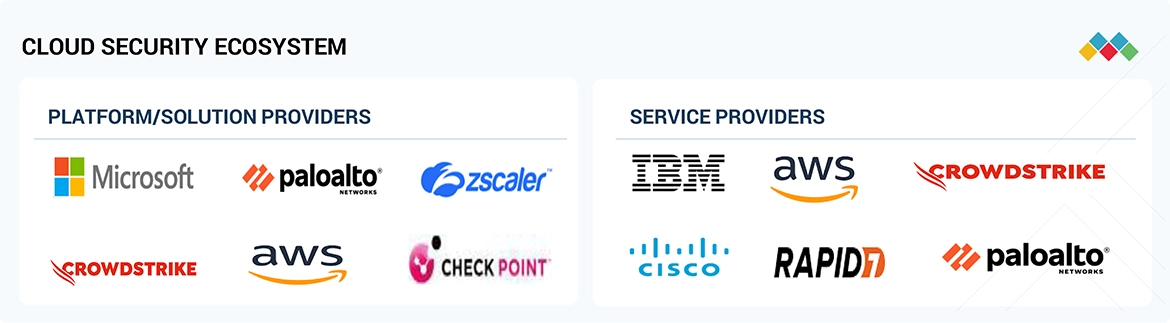
CLOUD SECURITY MARKET: COMMERCIAL USE CASES ACROSS INDUSTRIES
| COMPANY | USE CASE DESCRIPTION | BENEFITS |
|---|---|---|
 |
Capital One adopted AWS native security services, including IAM, GuardDuty, and CloudTrail, to monitor threats, manage access, and ensure compliance across cloud environments. | Secure and seamless remote access | Reduced dependency on traditional VPNs | Improved data protection and compliance | Enhanced user experience and productivity |
 |
Heineken implemented Microsoft Defender for Cloud and Azure Security Center to provide unified security management and threat protection. | Real-time threat detection and response | Improved workload visibility | Reduced security risks in dynamic environments | Scalable protection aligned with business growth |
 |
BMW deployed Palo Alto Networks Prisma Cloud and zero-trust solutions to secure workloads, enforce access policies, and monitor cloud environments. | Implementation of zero-trust architecture | Secure access across distributed users and systems | Enhanced workload and data protection | Reduced attack surface |
 |
Shopify implemented CrowdStrike Falcon Cloud Security to monitor workloads, detect threats, and respond to incidents in real time. | Centralized visibility and control across environments | Improved security posture management |Faster detection of vulnerabilities and threats | Streamlined compliance reporting |
 |
Siemens adopted Zscaler’s SASE platform to provide secure access, enforce policies, and protect data across cloud applications. | Enhanced visibility across cloud workloads | Improved threat detection and incident response | Strengthened compliance and governance | Reduced risk of data breaches and unauthorized access |
Logos and trademarks shown above are the property of their respective owners. Their use here is for informational and illustrative purposes only.
Related Ecosystem
Cloud Computing
- Software as A Service (SaaS)
- Natural Language Processing (NLP)
- Platform as A Service (PaaS)
- Machine Learning
- Supply Chain Management
- International Business Machines Corporation
- MICROSOFT CORPORATION
- Oracle Corporation
- Amazon.com, Inc.
Cyber Security
- Cloud Security
- Biometric Systems
- Data Loss Prevention (DLP)
- Multi-Factor Authentication
- Security Analytics
- International Business Machines Corporation
- Cisco Systems, Inc.
- MITSUI BUSSAN SECURE DIRECTIONS INC
- MICROSOFT CORPORATION
- Allot Ltd.
Key Takeaways
- Japan's cloud security market reaches USD 974.9 million in 2026, expanding to USD 1,599.8 million by 2031 at a 10.4% CAGR.
- Japan's regulatory environment and data protection mandates are primary drivers of cloud security adoption across enterprises.
- Japan's financial services and manufacturing sectors lead cloud security investments to mitigate cyber risks.
- Japan's market growth reflects increasing multi-cloud and hybrid infrastructure deployments requiring integrated security solutions.
Cloud Security Market Report Scope
| Report Metric | Details |
|---|---|
| Base Year | 2026 |
| Fastest Growing Segment | CDR (Cnapp) |
| Forecast Period | 2026–2031 |
| Growth Rate | CAGR of 11.5% from 2026 to 2031 |
| Largest Segment | PLATFORMS/SOLUTIONS (Offering) |
| Market Size Base Year (Billions) | ~USD 34.43 (2026) |
| Revenue Forecast (Billions) | ~USD 59.34 (2031) |
| Segments Covered | Offering, Service, Professional Service, Type, Cnapp, Deployment Mode, Organization Size, Vertical |
Japan Cloud Security Market Report Segmentation
8 segment dimensions are covered across the global market.
By Offering
- Platforms/Solutions
- Services
By Service
- Managed Services
- Professional Services
By Professional Service
- Consulting & Advisory
- Integration & Deployment
- Support & Maintenance
- Training & Education
By Type
- Analytics & Monitoring
- Casb
- Cnapp
By Cnapp
- Cdr
- Ciem
- Cspm
- Cwpp
- Iac Security
- Kspm
By Deployment Mode
- Hybrid Cloud
- Private Cloud
- Public Cloud
By Organization Size
- Large Enterprises
- Smes
By Vertical
- Bfsi
- Energy & Utilities
- Government & Defense
- Healthcare & Life Sciences
- It & Telecommunications
- Manufacturing
- Media & Entertainment
- Other Verticals
- Retail & E-Commerce
- Transportation & Logistics
- Travel & Hospitality
JAPAN: CLOUD SECURITY MARKET, BY VERTICAL, 2026–2031
| Segment | 2026 | 2027 | 2028 | 2029 | 2030 | 2031 | CAGR (%) |
|---|---|---|---|---|---|---|---|
| BFSI | 177.9 | 195 | 213.2 | 232.5 | 252.9 | 274.4 | 9.1 |
| ENERGY & UTILITIES | 66.5 | 73.1 | 80.2 | 87.7 | 95.7 | 104.1 | 9.4 |
| GOVERNMENT & DEFENSE | 193 | 210.6 | 229.3 | 248.9 | 269.4 | 290.9 | 8.6 |
| HEALTHCARE & LIFE SCIENCES | 71.4 | 82.9 | 95.8 | 110.2 | 126.1 | 144.1 | 15.1 |
| IT & TELECOMMUNICATIONS | 140.5 | 153.6 | 167.7 | 182.4 | 197.9 | 214.3 | 8.8 |
| MANUFACTURING | 39.6 | 44.4 | 49.7 | 55.4 | 61.7 | 68.5 | 11.6 |
| MEDIA & ENTERTAINMENT | 23.4 | 26.4 | 29.8 | 33.6 | 37.7 | 42.2 | 12.5 |
| OTHER VERTICALS | 115.4 | 128.6 | 143.2 | 158.8 | 176.1 | 194.2 | 11 |
| RETAIL & E-COMMERCE | 46 | 52.4 | 59.6 | 67.6 | 76.4 | 86.1 | 13.4 |
| TRANSPORTATION & LOGISTICS | 48.5 | 54.6 | 61.3 | 68.6 | 76.6 | 85.3 | 11.9 |
| TRAVEL & HOSPITALITY | 52.8 | 59.8 | 67.6 | 76.1 | 85.5 | 95.8 | 12.7 |
| TOTAL | 974.9 | 1081.5 | 1197.3 | 1321.8 | 1455.8 | 1599.8 | 10.4 |
Target Audience
- Cloud Security Vendors : Vendors need Japan-specific market data to develop localized product strategies, identify market entry opportunities, and understand competitive positioning in this growing 10.4% CAGR market.
- Enterprise IT Decision Makers : Japanese CISOs and IT leaders require market insights to justify cloud security investments, benchmark spending against industry peers, and align security strategies with regulatory requirements.
- Management Consulting Firms : Consultants advising Japanese enterprises on digital transformation need market data to support recommendations for cloud security adoption and infrastructure modernization initiatives.
- Investment & Private Equity Firms : Investors evaluating opportunities in Japan's cybersecurity sector need comprehensive market sizing and growth forecasts to assess portfolio companies and identify acquisition targets.
- Government & Regulatory Bodies : Japanese policymakers and regulatory agencies require market intelligence to develop effective cybersecurity policies, assess industry compliance trends, and guide digital economy initiatives.
Key Companies in the Japan Cloud Security Market
| Company | HQ | Ownership | Strongest segments |
|---|---|---|---|
| BOOZ ALLEN HAMILTON | United States | Public Company | AI and advanced analytics solutions,Cybersecurity and cyber operations,Cloud-enabled infrastructure and data platforms, |
| SAGE SOFTWARE | United States | Private Company | Sage Intacct (cloud financial management),Sage Business Cloud Accounting (SMB cloud accounting),Sage Business Cloud X3 (business management/ERP), |
| SYNNEX CORPORATION | United States | Public Company | Endpoint Solutions (PCs, peripherals, mobile, print),Advanced Solutions (data center, networking, security, hybrid/hyperscale),Cloud and X-as-a-Service (IaaS, PaaS, SaaS, DaaS), |
| CASA SYSTEMS | United States | Private Company | Converged cable access platforms (CCAP) and cable broadband,Fixed-line broadband (BNG, optical access, fiber extension, CPE),Wireless core (vEPC, 5G core) and small cells, |
| STARHUB | Singapore | Public Company | Mobile telecommunications (postpaid, prepaid, MVNO hosting),Fixed broadband and data connectivity,Pay TV and content services, |
| AVANADE | United States | Private Company | Cloud modernization & managed cloud on Microsoft platforms,Enterprise business applications (Dynamics, Power Platform, custom line-of-business),Analytics & artificial intelligence solutions, |
| PC CONNECTION | United States | Public Company | Client devices and peripherals,Data center and networking infrastructure,Software and cloud solutions, |
| TELEKOM MALAYSIA BERHAD | Malaysia | Public Company | Consumer fixed broadband and voice,Mobile and wireless services,Enterprise and government connectivity (data, leased lines, wholesale), |
| TRUE CORPORATION PUBLIC COMPANY LIMITED | Thailand | Public Company | Mobile services (voice, data, devices, MVAS),Broadband Internet and Wi-Fi,Pay TV and content, |
| ALLOT COMMUNICATIONS LTD. | Israel | Public Company | Allot Secure (NetworkSecure, HomeSecure, DNSecure, IoTSecure, EndpointSecure, BusinessSecure, Secure Cloud),DDoS Secure, NetProtect, 5GNetProtect,AllotSmart (Smart5G, SmartVisibility, SmartTraffic QoE, SmartPCC, SmartSentinel), |
| MICROSOFT | United States | Public Company | Intelligent Cloud (Azure, server products, GitHub, Nuance, enterprise services),Productivity and Business Processes (Microsoft 365, LinkedIn, Dynamics),Personal Computing (Windows OEM and commercial, devices, gaming, search and news advertising), |
| PALO ALTO NETWORKS | United States | Public Company | Network Security (Strata, VM-Series, CN-Series, subscriptions),Cloud Security (Prisma Cloud, Prisma Access, Code to Cloud, Prisma AIRS),Security Operations (Cortex XSIAM, XDR, XSOAR, Xpanse, Unit 42), |
| CISCO | United States | Public Company | Campus and data center switching and routing,Network security, SASE, and threat detection/response,Collaboration (Webex, devices, contact center, CPaaS), |
| ZSCALER | United States | Public Company | Zscaler Internet Access (ZIA) and Zero Trust Gateway,Zscaler Private Access (ZPA) and Zero Trust Firewall,Data Security (DLP, CASB, DSPM, AI-SPM, SaaS and GenAI protection), |
| IBM | United States | Public Company | Software (Hybrid Cloud & AI Platforms),Consulting (Strategy, Technology, Operations),Infrastructure (Servers, Storage, Lifecycle Services), |
| CHECK POINT | Israel | Public Company | Mesh Network Security (firewalls, gateways, security management),Workspace Security Platform (endpoint, email, mobile, browser, XDR),Threat Exposure Management and AI Security Platforms, |
| NETSKOPE | United States | Public Company | Cloud Inline Security, SWG & CASB,Data Security (DLP, DSPM, SaaS posture),Zero Trust Private Access & Enterprise Browser, |
| AKAMAI | United States | Public Company | Security solutions (WAF, API security, Bot & Abuse, account protection),Delivery solutions (web and mobile performance, media delivery, DNS),Cloud computing (compute, storage, cloud native, Akamai App Platform), |
| FORTINET | United States | Public Company | Secure Networking & Firewalls (FortiGate, SD-WAN, WLAN),Security Services & Support (FortiGuard, FortiCare, threat intelligence),Cloud, SASE & Cloud-Native Security, |
| CLOUDFLARE | United States | Public Company | Application Security (WAF, DDoS, Bot, API, TLS, Security Center),Application Performance & CDN (CDN, Load Balancing, DNS, Video, Optimization),SASE & Zero Trust (ZTNA, SWG, CASB, RBI, Email, DLP, DEM), |
| CROWDSTRIKE | United States | Public Company | Endpoint and Cloud Workload Security,Managed Security and Threat Intelligence,Identity, Data Protection and SaaS Security, |
| SENTINELONE | United States | Public Company | Endpoint Protection & EDR/XDR Core Subscriptions,Cloud Workload & Container Security,Identity Security & Exposure/Vulnerability Management, |
| TREND MICRO | Japan | Public Company | Enterprise endpoint and XDR (Vision One, endpoint security, security operations),Cloud and workload security,Email, collaboration, and network security, |
BOOZ ALLEN HAMILTON
BOOZ ALLEN HAMILTON is a publicly traded consulting and engineering firm founded in 1914 in the United States, with 31,500 employees.
SAGE SOFTWARE
SAGE SOFTWARE is a private software company founded in 1982 in the United States with 500 employees.
SYNNEX CORPORATION
SYNNEX CORPORATION is a publicly traded technology distributor and IT solutions provider founded in 1980 in the United States, employing 24,000 people.
CASA SYSTEMS
CASA SYSTEMS is a private software and hardware company founded in 2003 in the United States with 1,043 employees.
STARHUB
STARHUB is a publicly traded telecommunications and media company founded in 1998 in Singapore with 1,637 employees.
AVANADE
AVANADE is a private IT consulting and digital transformation company founded in 2000 in the United States with 3,900 employees.
PC CONNECTION
PC CONNECTION is a publicly traded IT distributor and solutions provider founded in 1982 in the United States with 2,525 employees.
TELEKOM MALAYSIA BERHAD
TELEKOM MALAYSIA BERHAD is a publicly traded telecommunications company founded in 1946 in Malaysia with 18,000 employees.
TRUE CORPORATION PUBLIC COMPANY LIMITED
TRUE CORPORATION PUBLIC COMPANY LIMITED is a publicly traded telecommunications and media company founded in 1990 in Thailand.
ALLOT COMMUNICATIONS LTD.
ALLOT COMMUNICATIONS LTD. is a publicly traded cybersecurity and network intelligence company founded in 1996 in Israel with 362 employees.
MICROSOFT
MICROSOFT is a publicly traded multinational technology company founded in 1975 in the United States with 228,000 employees.
PALO ALTO NETWORKS
PALO ALTO NETWORKS is a publicly traded cybersecurity company founded in 2005 in the United States with 21,491 employees.
CISCO
CISCO is a publicly traded networking and IT infrastructure company founded in 1984 in the United States with 86,200 employees.
ZSCALER
ZSCALER is a publicly traded cloud security company founded in 2007 in the United States with 7,923 employees.
IBM
IBM is a publicly traded multinational technology and consulting company founded in 1911 in the United States with 264,300 employees.
CHECK POINT
CHECK POINT is a publicly traded cybersecurity company founded in 1993 in Israel with 6,825 employees.
NETSKOPE
NETSKOPE is a publicly traded cloud security company founded in 2012 in the United States with 3,281 employees.
AKAMAI
AKAMAI is a publicly traded content delivery and cloud services company founded in 1998 in the United States with 11,000 employees.
FORTINET
FORTINET is a publicly traded cybersecurity company founded in 2000 in the United States with 15,311 employees.
CLOUDFLARE
CLOUDFLARE is a publicly traded web performance and security company founded in 2009 in the United States with 5,483 employees.
CROWDSTRIKE
CROWDSTRIKE is a publicly traded cybersecurity and endpoint protection company founded in 2011 in the United States with 11,157 employees.
SENTINELONE
SENTINELONE is a publicly traded cybersecurity and endpoint protection company founded in 2013 in the United States with 3,000 employees.
TREND MICRO
TREND MICRO is a publicly traded cybersecurity company founded in 1965 in Japan with 6,717 employees.
Reasons to Buy this Report
- Japan-Specific Market Sizing : Access precise market valuation data for Japan (USD 974.9M in 2026, USD 1,599.8M in 2031) to benchmark investments and identify growth opportunities in this high-value Asian market.
- Regulatory Landscape Intelligence : Understand Japan's unique compliance requirements and data protection mandates driving cloud security adoption, enabling tailored go-to-market strategies for Japanese enterprises.
- Competitive Positioning Analysis : Gain insights into Japan's competitive dynamics, vendor landscape, and market consolidation trends to inform product development and partnership strategies specific to the Japanese market.
- Sector-Specific Growth Drivers : Identify which Japanese industries (banking, manufacturing, government) are driving cloud security investments and prioritize sales and marketing efforts accordingly.
- 5-Year Forecast Planning : Leverage detailed projections through 2031 to develop long-term business strategies, resource allocation plans, and revenue forecasts for Japan's expanding cloud security market.
Frequently asked questions
What is the current size of Japan's cloud security market?
Japan's cloud security market is valued at USD 974.9 million in 2026 and is projected to grow to USD 1,599.8 million by 2031.
What is the growth rate of Japan's cloud security market?
Japan's cloud security market is growing at a compound annual growth rate (CAGR) of 10.4% from 2026 to 2031.
Which industries drive cloud security demand in Japan?
Japan's financial services, manufacturing, government, and healthcare sectors are primary drivers of cloud security investments due to regulatory compliance and data protection requirements.
What are the key challenges in Japan's cloud security market?
Japan faces challenges including legacy system integration, skilled cybersecurity talent shortages, and the complexity of securing multi-cloud environments across distributed organizations.
What solutions are most in demand in Japan's cloud security market?
Japan's enterprises prioritize data encryption, identity and access management, threat detection and response, and compliance monitoring solutions for cloud environments.
RESEARCH METHODOLOGY
Secondary research was conducted to collect information useful for this technical, market-oriented, and commercial study of the cloud security market. The next step involved validating these findings, assumptions, and sizing with industry experts across the value chain using primary research. Different approaches, including top-down and bottom-up methods, were employed to estimate the total market size. After that, the market breakup and data triangulation procedures were used to estimate the market size of the segments and subsegments of the cloud security market.
Secondary Research
During the secondary research process, various secondary sources were consulted to identify and collect information relevant to the study. The secondary sources included annual reports, press releases, investor presentations of cloud security vendors, forums, certified publications, and whitepapers. The secondary research was mainly used to obtain key information about the industry’s supply chain, the total pool of key players, market classification and segmentation according to industry trends to the bottom-most level, regional markets, and key developments from both market- and technology-oriented perspectives, all of which were further validated by primary sources.
Primary Research
In the primary research process, various primary sources from both the supply and demand sides were interviewed to obtain qualitative and quantitative information for this report. The primary sources from the supply side included industry experts such as chief executive officers (CEOs), vice presidents (VPs), marketing directors, technology and innovation directors, and other key executives from major companies and organizations operating in the cloud security market.
In the market engineering process, top-down and bottom-up approaches were extensively used, along with several data triangulation methods, to estimate and forecast the overall market segments and subsegments listed in this report. Extensive qualitative and quantitative analyses were performed on the complete market engineering process to present key information/insights throughout the report.
After the complete market engineering process (including calculations for market statistics, market breakups, market size estimates, market forecasts, and data triangulation), extensive primary research was conducted to gather information and verify & validate the derived critical numbers. The primary research was also conducted to identify the segmentation types, industry trends, competitive landscape of cloud security market players, and key market dynamics, such as drivers, restraints, opportunities, challenges, and key strategies.
Following is the breakup of the primary study:
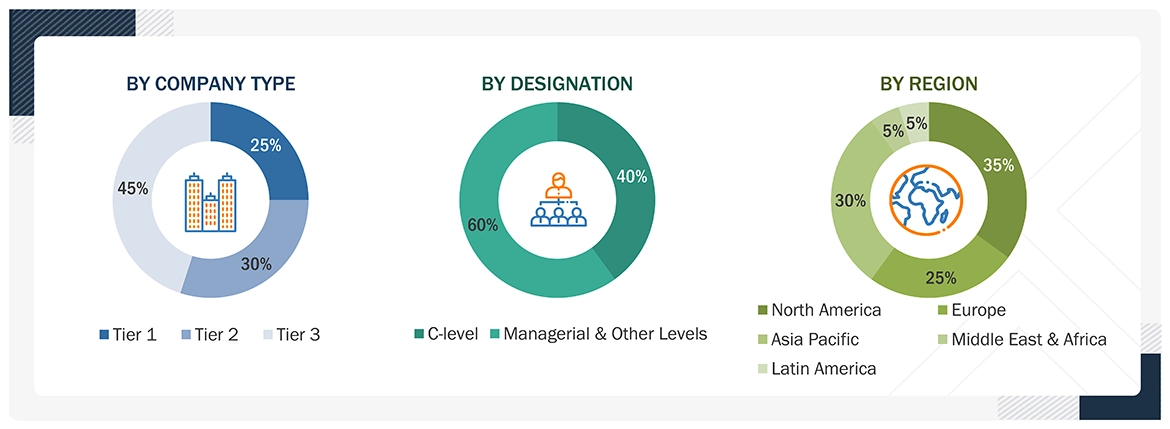
Note: Tier 1 companies receive revenues higher than USD 10 billion; Tier 2 companies' revenues range between USD 1 and 10 billion; and Tier 3 companies' revenues range between USD 500 million and USD 1 billion. Other designations include sales, marketing, and product managers.
To know about the assumptions considered for the study, download the pdf brochure
Market Size Estimation
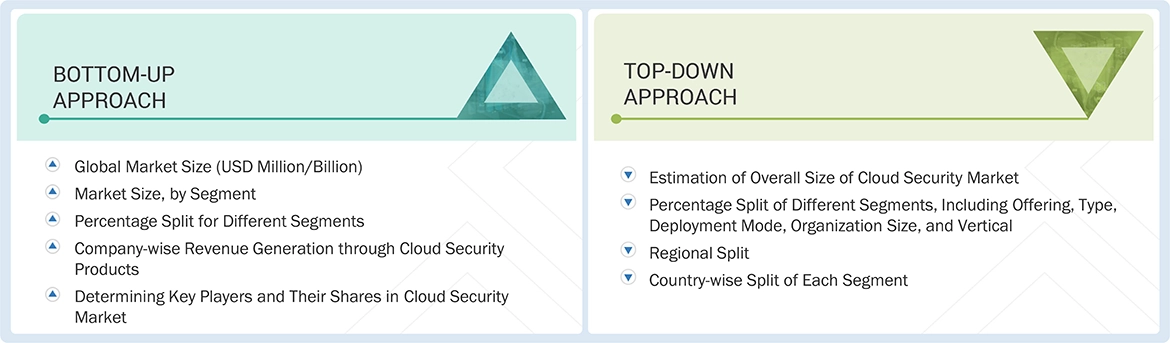
Top-down and bottom-up approaches were employed to estimate and validate the size of the cloud security market and of various dependent subsegments within it. The research methodology used to estimate the market size includes the following: critical players in the market were identified through secondary research, and their market shares in the respective regions were determined through both primary and secondary research. This procedure involved analyzing the annual and financial reports of the top market players and conducting extensive interviews with key industry leaders, including CEOs, VPs, directors, and marketing executives, to gather valuable insights.
All percentage splits and breakdowns were determined using secondary sources and verified through primary sources. All parameters that affect the market covered in this study were accounted for, examined in detail, verified through primary research, and analyzed to obtain final quantitative and qualitative data. This data was consolidated with detailed inputs and analysis from MarketsandMarkets.
Cloud Security Market : Top-Down and Bottom-Up Approach
Data Triangulation
The market was divided into several segments and subsegments after determining the overall market size using the market size estimation processes explained above. Data triangulation and market breakup procedures were employed, where applicable, to complete the overall market engineering process and arrive at the exact statistics for each market segment and subsegment. The data was triangulated by studying various factors and trends from both the demand and supply sides.
Market Definition
According to MarketsandMarkets, “The cloud security market refers to the segment of the cybersecurity industry that includes platforms/solutions and services designed to secure cloud-based infrastructure and data across public, private, and hybrid environments. As organizations increasingly adopt cloud computing to support digital transformation, the need to protect distributed and dynamic cloud environments from evolving cyber threats has become a critical priority.
The market primarily includes security solutions such as Cloud-Native Application Protection Platforms (CNAPP) and Cloud Access Security Broker (CASB). Cloud security encompasses a broad set of capabilities for securing cloud workloads, managing access to applications and resources, protecting sensitive data, and enabling continuous monitoring and threat detection. These capabilities are designed to address cloud-specific risks, including configuration vulnerabilities, unauthorized access, data exposure, and application-layer threats, arising from the shared responsibility model and the highly dynamic nature of cloud environments. Security is increasingly embedded across the cloud lifecycle, from development and deployment to runtime operations.
In addition to technology solutions, the market includes services that support the design, implementation, and ongoing management of cloud security environments. Organizations are leveraging external expertise to integrate security into cloud architectures, ensure regulatory compliance and maintain continuous visibility and control across multi-cloud environments. These services play a key role in addressing skill gaps and operational complexities associated with cloud security.
Key Stakeholders
- Chief technology and data officers
- Cloud security professionals
- Business analysts
- Information technology (IT) professionals
- Government agencies
- Investors and venture capitalists
- Small and medium-sized enterprises (SMEs) and large enterprises
- Third-party service providers
- Consultants/consultancies/advisory firms
- Managed and professional service providers
- The study categorizes the cloud security market by offering, type, organization size, deployment mode, vertical, and region.
Report Objectives
- To describe and forecast the cloud security market by offering, type, deployment mode, organization size, vertical, and region, as well as analyze the various macroeconomic and microeconomic factors that affect market growth
- To forecast the market size of five major regions: North America, Europe, Asia Pacific, the Middle East & Africa, and Latin America
- To analyze the subsegments of the market concerning individual growth trends, prospects, and contributions to the overall market
- To provide detailed information related to the primary factors (drivers, restraints, opportunities, and challenges) influencing the growth of the cloud security market.
- To analyze opportunities in the market for stakeholders by identifying high-growth segments of the cloud security market
- To profile the key players of the cloud security market and comprehensively analyze their market size and core competencies
- To analyze competitive developments, such as product launches, mergers and acquisitions, partnerships, agreements, and collaborations in the global cloud security market
Available customizations:
With the given market data, MarketsandMarkets offers customizations based on company-specific needs. The following customization options are available for the report:
Reginal Analysis
- Further breakdown of the Asia Pacific market, by country, contributes to the regional market size.
- Further breakdown of the North American market, by country, contributes to the regional market size.
- Further breakdown of the Latin American market, by country, contributes to the regional market size.
- Further breakdown of the Middle Eastern & African market by country contributes to the regional market size.
- Further breakdown of the European market by country contributes to the regional market size.
Company Information
- Detailed analysis and profiling of additional market players (up to 5)
Get the Full Cloud Security Market Report
Full forecast, segment splits, and company analysis for all Cloud Security Market.
- US Cloud Security Market
- Canada Cloud Security Market
- UK Cloud Security Market
- Germany Cloud Security Market
- France Cloud Security Market
- Italy Cloud Security Market
- China Cloud Security Market
- India Cloud Security Market
- Australia Cloud Security Market
- UAE Cloud Security Market
- Brazil Cloud Security Market
- Mexico Cloud Security Market
- Rest Of Europe Cloud Security Market
Need a Tailored Report?
Customize this report to your needs
Get 10% FREE Customization
Customize This Report
