
China Data Center Colocation Market (2025-2030)

The China Data Center Colocation Market was valued at $10953.1 Million in 2025 and projected to reach to $23214.2 Million by 2030, representing a compound annual growth rate of CAGR 16.2%. China's data center colocation market is poised for exceptional growth through 2030, driven by the nation's aggressive digital transformation agenda and technological advancement.


| Market Size in | USD 26.32 MN |
| Market Forecast in | |
| CAGR | |
| Forecast Period | |
| Units Considered | Value (USD MN) |
China Data Center Colocation Market Trends and Insights
- This represents a compound annual growth rate of 16.2%, significantly outpacing global trends.
- China's rapid digital transformation, driven by cloud adoption, artificial intelligence deployment, and e-commerce growth, is fueling unprecedented demand for secure, scalable colocation infrastructure across the country. The colocation sector in China is characterized by intense competition among domestic and international providers seeking to capitalize on the nation's digital economy expansion.
- China's strategic investments in data sovereignty, edge computing capabilities, and regional data center hubs are reshaping the competitive landscape.
- Between 2025 and 2030, China is expected to consolidate its position as a critical hub for Asia-Pacific colocation services, with enterprises increasingly relying on localized infrastructure to meet regulatory compliance and performance requirements. Key drivers propelling China's market growth include government support for digital infrastructure, rising enterprise data volumes, and the proliferation of 5G networks requiring distributed computing resources.
- China's colocation market reflects the country's commitment to technological self-sufficiency and digital innovation across industries..
Key Market Statistics
- CAGR (2025-2030) CAGR 16.2%
- Market Size, 2025 ~USD 10953.1 Million
- Forecast, 2030 ~USD 23214.2 Million
- Country China
China Data Center Colocation Market Overview
Exceptional Growth Trajectory :
China's data center colocation market is expanding at 16.2% CAGR, significantly outpacing the global rate of 14.4%, driven by massive investments in digital infrastructure and cloud computing adoption across enterprises.
AI and Cloud Acceleration :
Rapid deployment of artificial intelligence technologies and cloud services by Chinese enterprises is creating unprecedented demand for secure, scalable colocation facilities to support computational workloads and data processing requirements.
E-commerce and Digital Economy :
China's booming e-commerce sector and digital transformation initiatives are generating substantial data volumes, necessitating robust colocation infrastructure to support logistics, payment systems, and customer-facing applications.
Market Valuation Surge :
The market is valued at USD 10,953.1 million in 2025 and is projected to more than double to USD 23,214.2 million by 2030, reflecting strong investor confidence and sustained demand for data center services.
China Data Center Colocation Market Dynamics
- Government initiatives supporting cloud infrastructure, coupled with increasing enterprise adoption of AI and big data analytics, are creating sustained demand for colocation services.
- The market's 16.2% CAGR reflects China's position as a global technology leader and the critical role of data centers in supporting its digital economy. Regional expansion beyond tier-1 cities, coupled with rising data sovereignty requirements and regulatory compliance needs, will further accelerate colocation facility development.
- Investment from both domestic and international operators, combined with technological innovations in energy efficiency and cooling systems, will shape competitive dynamics.
- By 2030, China's colocation market is expected to become increasingly sophisticated, with specialized facilities catering to AI, financial services, and IoT applications..
Market Ecosystem
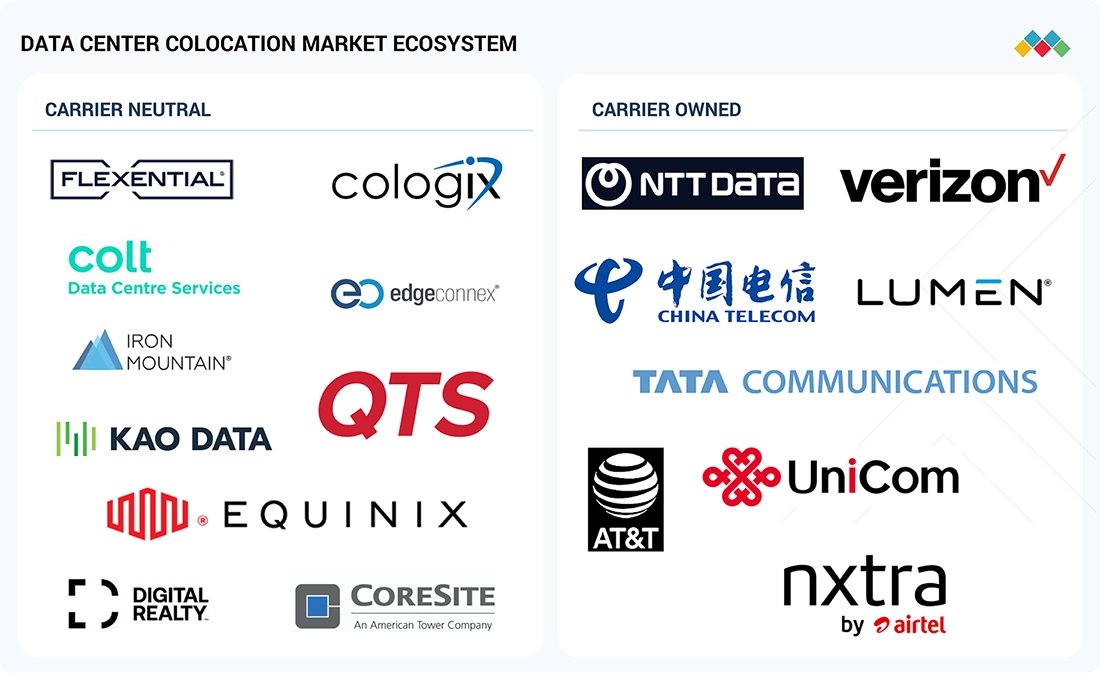
Data Center Colocation Market: COMMERCIAL USE CASES ACROSS INDUSTRIES
| COMPANY | USE CASE DESCRIPTION | BENEFITS |
|---|---|---|
 |
SAP needed to rapidly expand its global cloud infrastructure across more than 150 countries. Building proprietary data centers was slow and capital-intensive, prompting a strategic partnership with Digital Realty to accelerate deployment, centralize vendor management, and align with hybrid cloud and sustainability goals. | Leveraging PlatformDIGITAL, SAP scaled its infrastructure six times faster, reducing deployment time from 18 months to 3 months| Achieved 99.999% uptime, expanded capacity across continents, ensured green building compliance, and supported Net-Zero 2030 targets |
 |
BMW required a highly stable, automated global network and data center environment to support 31 production sites. With growing IT demands and a cloud-first strategy, BMW partnered with NTT DATA for managed colocation, enterprise networking, and Infrastructure-as-a-Service (IaaS) integration. | NTT DATA’s solution automated 85% of server deployments, achieved 99% network issue detection accuracy, and reduced manual effort | Enhanced stability across 30,000+ servers and 40,000 devices, enabling IT teams to focus on innovation and cloud enablement |
 |
Facing surging traffic and performance demands, CBS Interactive needed high-density, energy-efficient colocation to replace legacy infrastructure lacking adequate cooling and power. Partnered with Iron Mountain for scalable, SLA-driven colocation. | Iron Mountain’s Phoenix facility delivered 100% uptime SLA, reduced costs by two-thirds, and improved energy efficiency via sealed racks, ultrasonic humidification, and containment systems | The carrier-neutral setup enhanced flexibility, resilience, and global content delivery performance |
 |
Nestlé Japan sought to modernize EDI systems, support AI-driven e-commerce services, and ensure secure, compliant connectivity with AWS. Required hybrid monitoring and reduced IT overhead to maintain system stability. | Equinix’s siteROCK services enabled seamless hybrid cloud migration, real-time visibility, and faster disaster recovery | Reduced operational workloads, ensured global compliance, improved system stability, and accelerated digital transformation |
 |
Exabeam faced an unexpected closure of its colocation site, impacting its QA environment. Needed rapid migration, cost optimization, and infrastructure consolidation while maintaining compliance. Partnered with Evocative for colocation, IP transit, and remote access. | Evocative executed a flawless migration within one week, consolidating hundreds of servers into fewer racks | Achieved cost savings, improved architecture, enhanced remote access, and delivered a leaner, scalable, and resilient IT environment |
Logos and trademarks shown above are the property of their respective owners. Their use here is for informational and illustrative purposes only.
Related Ecosystem
Data Centre And Networking
- Software-Defined Networking (SDN)
- Mid-Sized Data Centers
- Small Data Centers
- Remote Monitoring
- Smart Healthcare
- Cisco Systems, Inc.
- HUAWEI TECHNOLOGIES CO LTD
- Hewlett Packard Enterprise Company
- MITSUBISHI ELECTRIC INFORMATION SYSTEMS CORPORATION
- MITSUBISHI ELECTRIC INFORMATION NETWORK CORPORATION
Key Takeaways
- China's data center colocation market will nearly double from USD 10.95B in 2025 to USD 23.21B by 2030, driven by 16.2% CAGR growth.
- China's digital economy expansion and cloud adoption are primary catalysts accelerating colocation infrastructure demand across the nation.
- Data sovereignty regulations and compliance requirements in China are intensifying demand for localized colocation services among enterprises.
- China's strategic positioning as an Asia-Pacific colocation hub is strengthening competitive advantages for providers meeting regional infrastructure needs.
Data Center Colocation Market Report Scope
| Report Metric | Details |
|---|---|
| Base Year | 2025 |
| Fastest Growing Segment | HIGH PERFORMANCE COMPUTING (HPC) (Workload Type) |
| Forecast Period | 2025–2030 |
| Growth Rate | CAGR of 14.4% from 2025 to 2030 |
| Largest Segment | GENERAL PURPOSE IT (Workload Type) |
| Market Size Base Year (Billions) | ~USD 104.32 (2025) |
| Revenue Forecast (Billions) | ~USD 204.4 (2030) |
| Segments Covered | Service Type, Service Scale, Workload Type, Organization Size, End User, Enterprises, Offering, Component |
China Data Center Colocation Market Report Segmentation
8 segment dimensions are covered across the global market.
By Service Type
- Managed Colocation
- Traditional Colocation
By Service Scale
- Retail Colocation
- Wholesale Colocation
By Workload Type
- General Purpose It
- High Performance Computing (Hpc)
- High-Performance Computing (Hpc)
By Organization Size
- Large Enterprises
- Smes
By End User
- Enterprises
- Hyperscalers
By Enterprises
- Bfsi
- Energy & Utilities
- Government & Public Sector
- Healthcare & Life Sciences
- It & Ites
- Manufacturing
- Other Enterprises
- Retail & E-Commerce
- Telecommunications
By Offering
- Services
- Solutions
By Component
- Hardware
- Services
- Software
Target Audience
- Data Center Operators and Providers : Colocation service providers and data center operators need China-specific market data to benchmark performance, identify expansion opportunities, and develop competitive strategies in this high-growth market segment.
- Enterprise IT and Infrastructure Leaders : CIOs and infrastructure decision-makers at Chinese enterprises require market insights to evaluate colocation partnerships, assess vendor capabilities, and optimize data center strategies aligned with business growth.
- Investment and Private Equity Firms : Investors and PE firms targeting the Chinese technology infrastructure sector need validated market sizing and growth projections to evaluate investment opportunities and assess portfolio company performance.
- Technology and Telecom Companies : Cloud providers, tech giants, and telecommunications operators expanding in China need market intelligence to guide infrastructure investments, capacity planning, and service development decisions.
- Management Consultants and Analysts : Strategy consultants and market analysts advising clients on China market entry or expansion require authoritative data and forecasts to support recommendations and competitive positioning strategies.
Key Companies in the China Data Center Colocation Market
| Company | HQ | Ownership | Strongest segments |
|---|---|---|---|
| OOREDOO | Qatar | Public Company | Traditional Colocation – Retail (space, power, connectivity),Managed Colocation and Hosting (managed services on top of racks),Wholesale Colocation for Enterprises and Local Cloud, |
| SIFY TECHNOLOGIES LIMITED | India | Public Company | Traditional Colocation (Retail),Managed Colocation & Digital Services (Retail),Wholesale Colocation for Enterprises, |
| ROGERS COMMUNICATIONS INC | Canada | Public Company | Traditional Colocation – Retail,Managed Colocation – Retail,Traditional Colocation – Wholesale, |
| PCCW | Hong Kong | Public Company | Traditional Colocation – Retail,Traditional Colocation – Wholesale,Managed Colocation & Hosting – Retail, |
| DIMENSION DATA | United Kingdom | Private Company | Traditional Colocation – Retail,Managed Colocation – Retail,Traditional Colocation – Wholesale, |
| TURK TELEKOM | Turkey | Public Company | Traditional Retail Colocation – General Purpose IT,Managed Colocation – General Purpose IT,Traditional Wholesale Colocation – Hyperscalers and Carriers, |
| BHARTI AIRTEL LIMITED | India | Public Company | Traditional Colocation – Retail (General Purpose IT),Traditional Colocation – Wholesale (Enterprises & Hyperscalers),Managed Colocation – Retail (General Purpose IT), |
| CISCO SYSTEMS INC | United States | Public Company | Data center switching and routing for colocation builds,Network security, SASE, and identity for colocation connectivity,Observability, monitoring, and analytics for colocation workloads, |
| COGENT COMMUNICATIONS | United States | Public Company | Traditional Colocation – Retail Scale,Traditional Colocation – Wholesale Scale,Managed Colocation – Retail Scale, |
| F5 NETWORKS | United States | Public Company | BIG-IP Systems and Packaged Software in Colocation,NGINX Plus, Ingress, and WAF for NGINX in Colocation,Distributed Cloud and Multi-Cloud Networking Services, |
| EQUINIX | United States | Public Investment Firm | Retail colocation & interconnection,Wholesale colocation,Managed and edge services, |
| DIGITAL REALTY | United States | Public Investment Firm | Traditional Colocation (Retail and Wholesale, non-managed),Managed Colocation and Interconnection Services, |
| NTT DATA | Japan | Private Company | Traditional retail colocation – General Purpose IT,Managed colocation – General Purpose IT,Traditional wholesale colocation – Hyperscalers, |
| KDDI CORPORATION | Japan | Public Company | Traditional Colocation – Retail,Managed Colocation – Retail,Traditional Colocation – Wholesale, |
| IRON MOUNTAIN | United States | Public Investment Firm | Traditional colocation – retail,Traditional colocation – wholesale,Managed colocation – general purpose IT, |
| CHINA TELECOM CORPORATION LTD | China | Public Company | Traditional Colocation Services,Managed Colocation / Hosted Infrastructure,Retail Colocation, |
| CYRUSONE | United States | Private Investment Firm | Wholesale / Hyperscale Colocation,Retail Colocation (Traditional),Managed / Hybrid-Cloud and Multi-Cloud Services, |
| SWITCH | United States | Private Company | Traditional Colocation Services,Managed Colocation & Value-Added Services,Retail Scale Colocation, |
| CORESITE | United States | Private Investment Firm | Traditional Colocation – Retail (Enterprises & Networks, General Purpose IT),Interconnection & Cloud On-Ramps (Retail, AI-Adjacent Workloads),Managed & Hybrid Services (Including Managed Colocation, Edge, Value-Added Services), |
OOREDOO
Ooredoo is a Qatari public telecommunications company founded in 1987, operating with 16,717 employees. The company provides mobile, fixed-line, and broadband services across the Middle East and North Africa region.
SIFY TECHNOLOGIES LIMITED
Sify Technologies Limited is an Indian public company founded in 1995 with 1,047 employees, offering IT services, telecommunications, and data center solutions.
ROGERS COMMUNICATIONS INC
Rogers Communications Inc is a Canadian public telecommunications and media company founded in 1960, employing 25,000 people and providing wireless, cable, and broadcasting services.
PCCW
PCCW is a Hong Kong-based public company founded in 1925 with 14,600 employees, providing telecommunications, media, and technology services across Asia.
DIMENSION DATA
Dimension Data is a United Kingdom-based private company founded in 1983 with 11,032 employees, specializing in IT services, networking, and infrastructure solutions.
TURK TELEKOM
Turk Telekom is a Turkish public telecommunications company founded in 1840 with 31,076 employees, serving as the country's leading provider of fixed-line, mobile, and broadband services.
BHARTI AIRTEL LIMITED
Bharti Airtel Limited is an Indian public telecommunications company founded in 1995 with 28,730 employees, providing mobile, broadband, and digital services across Asia and Africa.
CISCO SYSTEMS INC
Cisco Systems Inc is a United States-based public technology company founded in 1984 with 86,200 employees, specializing in networking, cybersecurity, and IT infrastructure solutions.
COGENT COMMUNICATIONS
Cogent Communications is a United States-based public telecommunications company founded in 1999 with 1,833 employees, providing high-speed internet and data services.
F5 NETWORKS
F5 Networks is a United States-based public company founded in 1996 with 6,545 employees, specializing in application delivery and cybersecurity software.
EQUINIX
Equinix is a United States-based public investment firm founded in 1998 with 13,716 employees, operating a global platform of data centers and interconnection services.
DIGITAL REALTY
Digital Realty is a United States-based public investment firm founded in 2004 with 4,282 employees, providing data center and colocation services worldwide.
NTT DATA
NTT Data is a Japanese private company founded in 1988 with 197,777 employees, offering IT services, consulting, and digital transformation solutions globally.
KDDI CORPORATION
KDDI Corporation is a Japanese public telecommunications company founded in 1984 with 73,198 employees, providing mobile, fixed-line, and broadband services.
IRON MOUNTAIN
Iron Mountain is a United States-based public investment firm founded in 1951 with 29,400 employees, specializing in data management, storage, and information governance services.
CHINA TELECOM CORPORATION LTD
China Telecom Corporation Ltd is a Chinese public telecommunications company founded in 2002, providing mobile, broadband, and cloud services across China.
CYRUSONE
CyrusOne is a United States-based private investment firm with 456 employees, operating data centers and providing colocation and managed services.
SWITCH
Switch is a United States-based private company founded in 2000 with 829 employees, operating advanced data center facilities and providing infrastructure services.
CORESITE
CoreSite is a United States-based private investment firm with 481 employees, operating data centers and providing colocation and managed hosting services.
Reasons to Buy this Report
- Market Size and Growth Validation : Obtain precise market valuation data for China (USD 10,953.1M in 2025) with verified 16.2% CAGR projections through 2030, enabling accurate financial forecasting and investment decision-making for colocation expansion strategies.
- Competitive Landscape Intelligence : Understand China-specific market dynamics, key players, and competitive positioning within the rapidly expanding colocation sector to identify partnership opportunities and market entry strategies tailored to local conditions.
- Demand Driver Analysis : Gain insights into China-specific growth catalysts including AI deployment, e-commerce expansion, and cloud adoption patterns that differentiate the Chinese market from global trends and inform targeted service offerings.
- Regulatory and Compliance Framework : Access critical information on China's data sovereignty requirements, compliance mandates, and regulatory environment affecting colocation operations, essential for risk mitigation and operational planning in this market.
- Investment and Expansion Planning : Leverage market forecasts and growth projections to develop evidence-based expansion strategies, capital allocation plans, and facility development roadmaps specifically aligned with China's colocation market trajectory through 2030.
Frequently asked questions
What is the projected market size of China's data center colocation market by 2030?
China's data center colocation market is projected to reach USD 23,214.2 million by 2030, nearly doubling from USD 10,953.1 million in 2025.
What is the CAGR for China's data center colocation market?
China's data center colocation market is expected to grow at a compound annual growth rate of 16.2% between 2025 and 2030.
What are the primary growth drivers for colocation services in China?
Key growth drivers in China include rapid cloud adoption, artificial intelligence deployment, e-commerce expansion, 5G network proliferation, and government support for digital infrastructure development.
How do data sovereignty regulations impact China's colocation market?
China's data sovereignty and compliance regulations mandate localized data storage and processing, driving enterprises to utilize domestic colocation providers and accelerating market growth.
What role does China play in the Asia-Pacific colocation market?
China is consolidating its position as a critical Asia-Pacific colocation hub, with localized infrastructure increasingly essential for enterprises meeting regional regulatory and performance requirements.
RESEARCH METHODOLOGY
This research study on the data center colocation market involved extensive secondary sources, directories, IEEE Communication-Efficient: Algorithms and Systems, International Journal of Innovation and Technology Management, and paid databases. Primary sources were mainly industry experts from the core and related industries, preferred data center colocation service providers, third-party service providers, consulting service providers, end users, and other commercial enterprises. In-depth interviews were conducted with primary respondents, including key industry participants and subject matter experts, to obtain and verify critical qualitative and quantitative information and assess the market’s prospects.
Secondary Research
In the secondary research process, various sources were referred to identify and collect information for this study. Secondary sources included annual reports, press releases, and investor presentations of companies; white papers, journals, and certified publications; and articles from recognized authors, directories, and databases. The data was also collected from other secondary sources, such as journals, government websites, blogs, and vendors’ websites. Additionally, the data center colocation spending of various countries was extracted from the respective sources.
Primary Research
In the primary research process, various primary sources from the supply and demand sides were interviewed to obtain qualitative and quantitative information on the market. The primary sources from the supply side included various industry experts, such as Chief Experience Officers (CXOs), Vice Presidents (VPs), and directors specializing in business development, marketing, and data center colocation service providers. It also included key executives from data center colocation vendors, system integrators (SIs), professional service providers, industry associations, and other key opinion leaders.
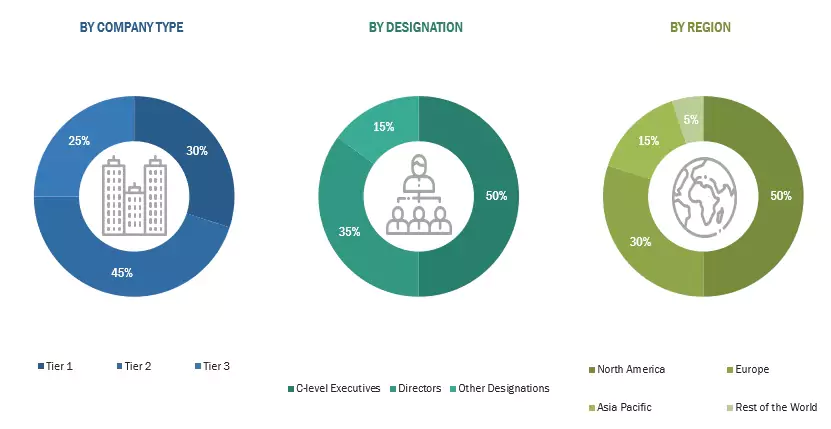
Note: Tier 1 companies’ revenues are more than USD 10 billion; tier 2 companies’ revenues range between USD 1 and 10 billion;
and tier 3 companies’ revenues range between USD 500 million and USD 1 billion.
Other designations include sales managers, marketing managers, and product managers.
Source: Industry Experts
To know about the assumptions considered for the study, download the pdf brochure
Market Size Estimation
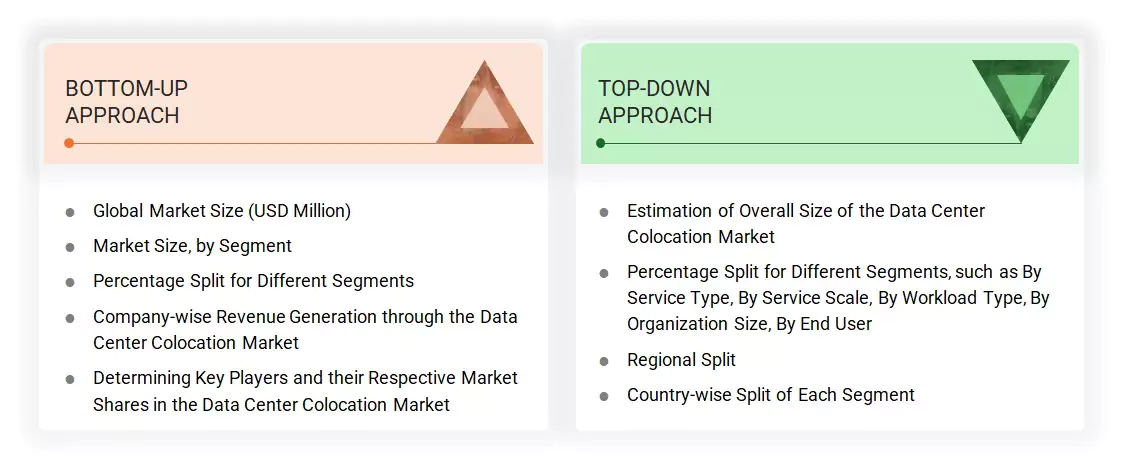
Multiple approaches were adopted to estimate and forecast the data center colocation market. The first approach involved estimating the market size by companies’ revenue generated through the sale of data center colocation services.
Market Size Estimation Methodology- Top-down approach
The top-down approach prepared an exhaustive list of all the vendors offering products in the data center colocation market. The revenue contribution of the market vendors was estimated through annual reports, press releases, funding, investor presentations, paid databases, and primary interviews. Each vendor’s offerings were evaluated based on platform, degree of customization, type, application, end user, and region. The markets were triangulated through primary and secondary research. The primary procedure included extensive interviews for key insights from industry leaders, such as CIOs, CEOs, VPs, directors, and marketing executives. The market numbers were further triangulated with the existing MarketsandMarkets’ repository for validation.
Market Size Estimation Methodology-Bottom-up approach
In the bottom-up approach, the adoption rate of data center colocation services among different verticals in key countries concerning their regions contributing the most to the market share was identified. For cross-validation, the adoption of data center colocation services among enterprises, along with different use cases for their regions, was identified and extrapolated. Weightage was given to use cases identified in different areas for the market size calculation.
Based on the market numbers, the regional split was determined by primary and secondary sources. The procedure included an analysis of the data center colocation market’s regional penetration. Based on secondary research, the regional spending on Information and Communications Technology (ICT), socioeconomic analysis of each country, strategic vendor analysis of major data center colocation providers, and organic and inorganic business development activities of regional and global players were estimated.
Data Center Colocation Market : Top-Down and Bottom-Up Approach
Data Triangulation
After determining the overall market size using the market size estimation processes as explained above, the market was split into several segments and subsegments. Data triangulation and market breakup procedures were employed, wherever applicable, to complete the overall market engineering process and arrive at the exact statistics of each market segment and subsegment. The overall market size was then used in the top-down procedure to estimate the size of other individual markets via percentage splits of the market segmentation.
Market Definition
The data center colocation refers to the segment where businesses rent space, power, cooling, and connectivity within third-party data center facilities to host their own servers, storage, and networking equipment. Colocation providers offer physical security, redundant power and cooling systems, and access to multiple network carriers, allowing different enterprises to operate in a shared yet secure environment while maintaining control over their infrastructure. This model enables companies to reduce capital expenditures, improve uptime and scalability, and meet compliance requirements more effectively. The market is expanding due to the rising adoption of cloud computing, big data analytics, and IoT, along with a growing emphasis on modular infrastructure and sustainable operations.
Stakeholders
- Data center colocation service providers
- Hyperscalers & Cloud service providers
- Networking companies
- Information technology (IT) infrastructure providers
- Consultants/Consultancies/Advisory firms
- Component providers
- Telecom service providers
- System integrators (SIs)
- Support and maintenance service providers
- Support service providers
- Third-party providers
- Government organizations and standardization bodies
- Datacenter providers
- Regional associations
- Independent hardware and software vendors
- Value-added resellers and distributors
Report Objectives
- To define, describe, and forecast the data center colocation market based on service type, service scale, workload type, organization size, end user, and region
- To forecast the market size of the five major regional segments: North America, Europe, Asia Pacific, Middle East & Africa, and Latin America
- To provide detailed information related to the major factors influencing the growth of the market (drivers, restraints, opportunities, and challenges)
- To strategically analyze macro and micro markets concerning growth trends, prospects, and their contribution to the overall market
- To analyze industry trends, patents and innovations, and pricing data related to the market
- To analyze the opportunities in the market for stakeholders and provide details of the competitive landscape for major players
- To profile key players in the market and comprehensively analyze their market share/ranking and core competencies
- To track and analyze competitive developments, such as mergers & acquisitions, product developments, and partnerships & collaborations in the market
Available Customizations
With the given market data, MarketsandMarkets offers customizations to meet the company’s specific needs. The following customization options are available for the report:
Product Analysis
- The product matrix provides a detailed comparison of each company’s product portfolio.
Geographic Analysis as per Feasibility
- Further breakup of the North American data center colocation market
- Further breakup of the European market
- Further breakup of the Asia Pacific market
- Further breakup of the Middle East & Africa market
- Further breakup of the Latin American data center colocation market
Company Information
- Detailed analysis and profiling of additional market players (up to five)
Get the Full Data Center Colocation Market Report
Full forecast, segment splits, and company analysis for all Data Center Colocation Market.
- Canada Data Center Colocation Market
- US Data Center Colocation Market
- UK Data Center Colocation Market
- Germany Data Center Colocation Market
- France Data Center Colocation Market
- Italy Data Center Colocation Market
- Japan Data Center Colocation Market
- India Data Center Colocation Market
- Hong Kong Data Center Colocation Market
- UAE Data Center Colocation Market
- South Africa Data Center Colocation Market
- Brazil Data Center Colocation Market
- Mexico Data Center Colocation Market
- Eastern Europe Data Center Colocation Market
- Northern Europe Data Center Colocation Market
- Southern Europe Data Center Colocation Market
- Rest Of Asia Pacific Data Center Colocation Market
- Rest Of Latin America Data Center Colocation Market
- GCC Countries Data Center Colocation Market
- Rest Of Southern Europe Data Center Colocation Market
- Ksa Data Center Colocation Market
- Rest Of GCC Countries Data Center Colocation Market
Need a Tailored Report?
Customize this report to your needs
Get 10% FREE Customization
Customize This Report
