
UAE Aircraft Seating Market (2026-2031)

The UAE Aircraft Seating Market was valued at $126 Million in 2026 and projected to reach to $149.1 Million by 2031, representing a compound annual growth rate of 3.4%. The UAE aircraft seating market is poised for steady growth through 2031, supported by the region's established position as a premier aviation destination and the continuous expansion of major airline fleets.


| Market Size in | USD 26.32 MN |
| Market Forecast in | |
| CAGR | |
| Forecast Period | |
| Units Considered | Value (USD MN) |
UAE Aircraft Seating Market Trends and Insights
- The UAE's strategic position as a global aviation hub, driven by major carriers and expanding fleet modernization initiatives, supports steady demand for advanced seating solutions.
- The UAE's investment in aerospace infrastructure and passenger comfort standards continues to fuel adoption of lightweight, ergonomic, and premium seating configurations across commercial and business aviation segments. Growth in the UAE aircraft seating market is anchored by the region's thriving airline industry, increasing international travel demand, and fleet expansion programs.
- The UAE's focus on cabin experience differentiation and regulatory compliance with international safety standards drives procurement of innovative seating technologies.
- Between 2026 and 2031, the UAE market will benefit from aircraft deliveries, retrofit programs, and the region's position as a maintenance, repair, and overhaul (MRO) hub for the Middle East..
Key Market Statistics
- CAGR (2026-2031) 3.4% CAGR
- Market Size, 2026 ~USD 126 Million
- Forecast, 2031 ~USD 149.1 Million
- Country UAE
UAE Aircraft Seating Market Overview
Market Valuation :
The UAE aircraft seating market is valued at USD 126.0 million in 2026 and is projected to reach USD 149.1 million by 2031, reflecting steady growth in the region's aviation sector.
Growth Trajectory :
With a CAGR of 3.4% through 2031, the UAE market demonstrates consistent expansion driven by fleet modernization and increased passenger capacity requirements among regional carriers.
Aviation Hub Status :
The UAE's position as a global aviation hub, anchored by major carriers like Emirates and Etihad Airways, creates sustained demand for premium and advanced seating solutions across commercial fleets.
Fleet Modernization :
Ongoing investments in aerospace infrastructure and aircraft fleet upgrades by UAE-based airlines support the adoption of innovative seating technologies and cabin comfort enhancements.
UAE Aircraft Seating Market Dynamics
- Emirates and Etihad Airways' ongoing modernization programs, coupled with increasing passenger traffic through UAE airports, will drive demand for advanced seating solutions that enhance comfort and operational efficiency.
- The market will benefit from investments in next-generation aircraft and cabin retrofitting initiatives.
- However, growth will be moderated compared to global rates due to market maturity and the concentrated nature of the UAE's airline industry, with opportunities emerging in premium economy and business-class seating segments..
Market Ecosystem
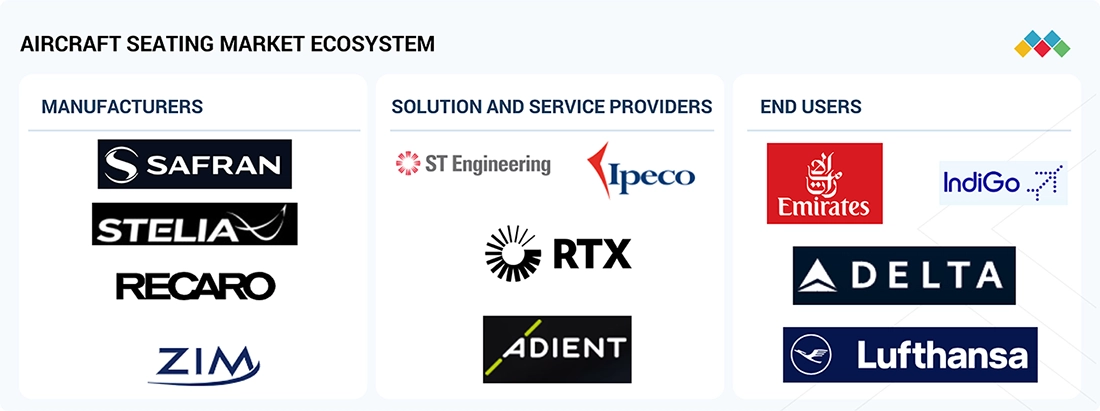
AIRCRAFT SEATING MARKET SIZE, SHARE, TRENDS & GROWTH ANALYSIS: COMMERCIAL USE CASES ACROSS INDUSTRIES
| COMPANY | USE CASE DESCRIPTION | BENEFITS |
|---|---|---|
 |
Design and manufacturing of advanced aircraft seating systems for commercial aviation, including economy, premium economy, and business class seats through its Collins Aerospace division | Improves passenger comfort and cabin efficiency, reduces aircraft weight for better fuel performance, supports modular cabin layouts, and enhances airline operational efficiency |
 |
Development of various aircraft seating solutions across economy to first-class cabins for commercial airlines | Enhances passenger experience with premium seating solutions, supports cabin differentiation, improves space utilization, and increases ancillary revenue opportunities for airlines |
 |
Design and production of high-end business and first-class seating systems for commercial aircraft | Enables premium passenger experience, supports airline brand positioning, optimizes cabin space, and improves comfort through fully flat and customized seating solutions |
 |
Manufacturing of lightweight and ergonomic economy and premium economy aircraft seats for short- and long-haul flights | Reduces aircraft weight and fuel consumption, improves passenger comfort, enhances durability and lifecycle performance, and supports high-density cabin configurations |
 |
Development of cost-efficient and flexible aircraft seating solutions for economy and premium cabins, including retrofit programs | Supports cost optimization for airlines, improves cabin flexibility, enables efficient retrofit solutions, and enhances passenger comfort with space-efficient seat designs |
Logos and trademarks shown above are the property of their respective owners. Their use here is for informational and illustrative purposes only.
Related Ecosystem
Key Takeaways
- The UAE aircraft seating market is valued at USD 126.0 million in 2026 and will reach USD 149.1 million by 2031 at a 3.4% CAGR.
- The UAE's role as a global aviation hub and home to major international carriers drives consistent demand for premium and advanced seating solutions.
- Fleet modernization and cabin retrofit programs in the UAE support growth in lightweight and ergonomic seating technologies.
- The UAE's MRO capabilities and focus on passenger experience differentiation position the market for sustained expansion through 2031.
Aircraft Seating Market Report Scope
| Report Metric | Details |
|---|---|
| Base Year | 2026 |
| Fastest Growing Segment | PREMIUM (Seat Class) |
| Forecast Period | 2026–2031 |
| Growth Rate | CAGR of 6.8% from 2026 to 2031 |
| Largest Segment | PASSENGER SEATS (Seat Type) |
| Market Size Base Year (Billions) | ~USD 10.08 (2026) |
| Revenue Forecast (Billions) | ~USD 14.01 (2031) |
| Segments Covered | Aircraft, Material, Seat Type, Seat Class, End User, Component |
UAE Aircraft Seating Market Report Segmentation
6 segment dimensions are covered across the global market.
By Aircraft
- Business Jets
- Commercial Helicopters
- Light Aircraft
- Narrow-Body Aircraft
- Regional Transport Aircraft
- Wide-Body Aircraft
By Material
- Cushion Filling Material
- Cushion Filling Materials
- Structure Material
- Structure Materials
- Upholsteries & Seat Covers
- Upholstery & Seat Cover
By Seat Type
- Passenger Seats
- Pilot & Crew Seats
By Seat Class
- Business
- Crew
- Economy
- First
- Pilot
- Premium
By End User
- Aftermarket
- Mro
- OEM
By Component
- Actuators
- Electrical Fittings
- Foams
- Structures
UAE: AIRCRAFT SEATING MARKET, BY END USER, 2026–2031
| Segment | 2026 | 2027 | 2028 | 2029 | 2030 | 2031 | CAGR (%) |
|---|---|---|---|---|---|---|---|
| AFTERMARKET | 45.9 | 47.3 | 48.8 | 50.8 | 53.1 | 55.6 | 3.9 |
| MRO | 5.2 | 5.2 | 5.2 | 5.4 | 5.5 | 5.6 | 1.4 |
| OEM | 74.9 | 76.7 | 78.9 | 81.4 | 84.5 | 87.9 | 3.3 |
| TOTAL | 126 | 129.2 | 132.9 | 137.6 | 143.1 | 149.1 | 3.4 |
Target Audience
- Aircraft Seating Manufacturers : Manufacturers need UAE-specific market data to assess demand from major carriers, identify procurement cycles, and develop localized product strategies for the region's premium aviation market.
- Airline Fleet Operators : UAE-based and international airlines operating in the region require market intelligence to benchmark seating investments, evaluate supplier options, and plan cabin modernization initiatives.
- Aerospace Supply Chain Partners : Suppliers and component manufacturers need detailed UAE market insights to identify opportunities with local carriers and align production capabilities with regional demand patterns.
- Investment & Private Equity Firms : Investors evaluating opportunities in the UAE aviation sector require market sizing, growth forecasts, and competitive analysis to support due diligence and portfolio decisions.
- Aviation Consultants & Industry Analysts : Consultants advising clients on Middle East aviation strategies need UAE-specific seating market data to provide credible recommendations and support strategic planning initiatives.
Key Companies in the UAE Aircraft Seating Market
| Company | HQ | Ownership | Strongest segments |
|---|---|---|---|
| TRIUMPH GROUP, INC | United States | Private Company | Systems & Support – Engine and Accessory Drives,Systems & Support – Actuation, Hydraulics, and Landing Gear,Systems & Support – Fuel, Thermal, and Controls, |
| CYIENT | India | Public Company | Digital, Engineering & Technology,Design Led Manufacturing,Others (Networks, Operations, Specialized Platforms), |
| RTX | United States | Public Company | Pratt & Whitney – Commercial and Military Engines plus Aftermarket,Collins Aerospace – Avionics, Interiors, and Mission Systems,Raytheon – Sensors, Effectors, and Command-and-Control Solutions, |
| SAFRAN | France | Public Company | Aerospace Propulsion,Aircraft Equipment, Defense and Aerosystems,Aircraft Interiors, |
| IPECO HOLDINGS LTD. | United Kingdom | Private Company | Aircraft crew seating (cockpit and cabin crew),Executive jet passenger seating,Electric galley inserts and cabin equipment, |
| ADIENT PLC. | Ireland | Public Company | Complete seating systems,Seat structures, mechanisms, and frames,Foams, head restraints, armrests, and trim covers, |
| UNUM | United States | Public Company | Group long-term and short-term disability,Group life and AD&D,Supplemental and voluntary benefits (accident, critical illness, cancer, individual disability, dental, vision), |
| ST ENGINEERING | Singapore | Public Company | Commercial Aerospace (MRO, P2F, interiors, asset management),Defence & Public Security,Urban Solutions & Smart Mobility, |
TRIUMPH GROUP, INC
Triumph Group, Inc. is a private U.S. manufacturing company founded in 1993 with 3,696 employees. The company specializes in aerospace and defense components and systems.
CYIENT
Cyient is an Indian public company founded in 1991 with 12,049 employees, providing engineering and technology services to aerospace, defense, and industrial clients.
RTX
RTX is a U.S. public company founded in 1934 with 180,000 employees, operating as a major aerospace and defense contractor providing advanced technologies and systems.
SAFRAN
Safran is a French public company founded in 1896 with 103,710 employees, specializing in aerospace propulsion, equipment, and defense systems.
IPECO HOLDINGS LTD.
IPECO Holdings Ltd. is a United Kingdom private company founded in 1960 with 450 employees, specializing in aircraft seating and interior products.
ADIENT PLC.
Thompson Aero is a United Kingdom private company founded in 1997, specializing in aircraft interior components and systems.
UNUM
ST Engineering is a Singapore public company founded in 1967 with 27,000 employees, providing aerospace, defense, and engineering services globally.
ST ENGINEERING
Reasons to Buy this Report
- Carrier-Specific Insights : Gain detailed intelligence on seating procurement strategies of Emirates, Etihad Airways, and other UAE-based carriers to identify partnership and supply opportunities.
- Market Sizing & Forecasts : Access precise market valuations (USD 126.0M in 2026, USD 149.1M in 2031) and segment breakdowns specific to the UAE to support investment and expansion decisions.
- Competitive Landscape : Understand the competitive positioning of seating manufacturers and suppliers operating in the UAE market, including local and international players.
- Growth Drivers & Opportunities : Identify key growth catalysts including fleet expansion, cabin retrofitting projects, and premium seating demand to prioritize market entry and product development strategies.
- Regional Regulatory & Infrastructure Context : Leverage insights into UAE aviation regulations, airport infrastructure developments, and industry standards to align offerings with local market requirements.
Frequently asked questions
What is the current size of the UAE aircraft seating market?
The UAE aircraft seating market is valued at USD 126.0 million in 2026 and is expected to grow to USD 149.1 million by 2031.
What is the growth rate of the UAE aircraft seating market?
The UAE aircraft seating market is projected to grow at a compound annual growth rate (CAGR) of 3.4% from 2026 to 2031.
What factors drive growth in the UAE aircraft seating market?
Growth in the UAE market is driven by fleet expansion, cabin modernization programs, increasing passenger demand, and the UAE's position as a leading aviation hub with major international carriers.
Which seating types are most in demand in the UAE market?
Premium economy, business class, and lightweight ergonomic seating solutions are in high demand in the UAE, driven by the region's focus on passenger comfort and cabin differentiation.
How does the UAE market compare to the global aircraft seating market?
The UAE aircraft seating market grows at 3.4% CAGR, which is below the global average of 6.8%, reflecting the region's mature aviation infrastructure and selective fleet expansion strategies.
RESEARCH METHODOLOGY
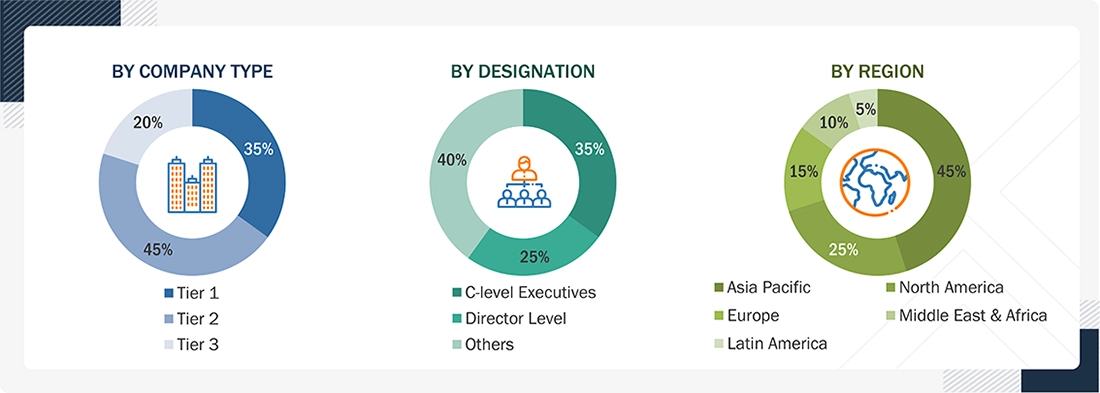
The study followed four main steps to estimate the size of the aircraft seating market. Secondary research was conducted to gather data on aircraft seating systems, cabin interiors, materials, seating configurations, and integration across narrow-body, wide-body, and regional aircraft. These findings were validated through primary interviews with airlines, seat manufacturers, OEMs, and industry experts. The research team analyzed aircraft deliveries, fleet expansion plans, retrofit programs, and airline investment strategies to assess market demand. Market estimates were then segmented by aircraft, material, seat type, seat class, component, and end user. Data triangulation was applied to validate the final figures for each segment and subsegment.
Secondary Research
Secondary research was conducted to establish the foundation for this study. Data was gathered from airline reports, aircraft manufacturers, and cabin interior programs across regions. Company information was reviewed from annual reports, product documentation, press releases, and investor disclosures of aircraft seating manufacturers. The study also examined industry publications, white papers, and research on seating technologies, materials, ergonomics, and cabin design. Additional insights were obtained from aviation industry associations and platforms to analyze market trends, innovation, and regional adoption.
Primary Research
Primary research was conducted after key insights from secondary analysis were identified. The study team engaged executives, engineers, cabin designers, and suppliers across the aircraft seating ecosystem. Discussions included seat manufacturers, airline representatives, OEMs, material suppliers, and industry experts across major regions. Interviews were conducted via calls and written correspondence to validate market size estimates and customer requirements. These inputs helped refine perspectives on competition, product innovation, and deployment strategies. Feedback was also used to adjust assumptions and improve data accuracy.
To know about the assumptions considered for the study, download the pdf brochure
Market Size Estimation
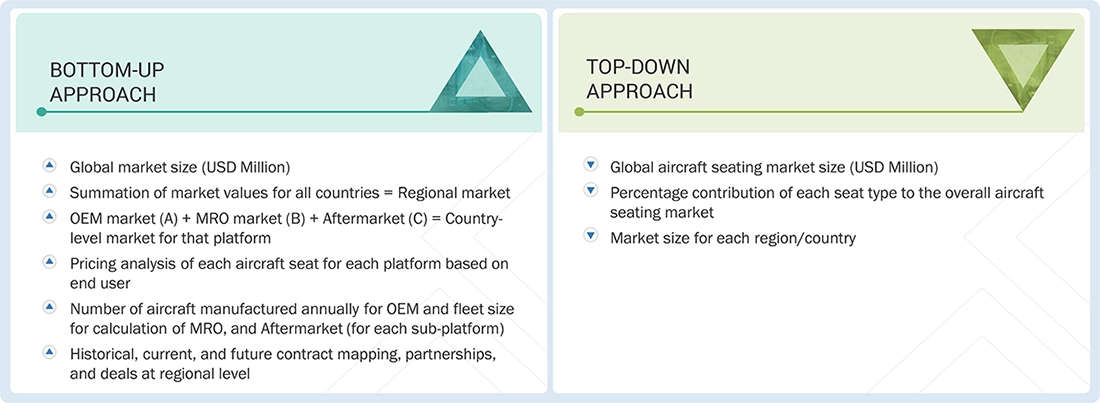
The top-down and bottom-up methods were used to estimate and validate the size of the aircraft seating market. The research process involved several steps to ensure accuracy.
- Key companies active in the aircraft seating market were identified through secondary research. Their market share was evaluated using a combination of primary inputs and published data. This included reviewing annual reports, financial disclosures, certification updates, and public filings from various organizations. Interviews were also conducted with industry participants such as company executives, program managers, operators, infrastructure providers, and aviation experts. These inputs were used to validate assumptions and refine market size estimates across regions.
- All percentage shares, segment splits, and market breakdowns were first developed using secondary information. These values were then verified through primary discussions with industry participants.
- The analysis evaluated key factors shaping the aircraft seating market, including aircraft delivery schedules, cabin retrofit programs, technological advancements, seat integration capabilities, and investment trends. Each factor was assessed through primary research and used to develop both quantitative and qualitative market estimates for this report.
Data Triangulation
After determining the overall market size, the total market was divided into multiple segments and subsegments. The data triangulation and market breakdown procedures described below were carried out, where applicable, to complete the overall market analysis and determine the estimated market figures for the segments and subsegments. The data was triangulated by examining various factors and trends from both demand and supply sides. Additionally, the market size was validated using the top-down and bottom-up approaches.
Market Definition
Aircraft seats are specialized passenger and pilot & crew seating solutions designed for use within an aircraft. These seats are engineered for safety, comfort, ergonomics, and space utilization, aligning with aviation standards and regulatory requirements. Manufacturers focus on incorporating lightweight materials and advanced features that enhance the passenger experience, including adjustable reclines, personal entertainment systems, and connectivity options. Aircraft seats include components such as structures, foams, actuators, and electrical fittings. The design and configuration of aircraft seats are critical for airlines to optimize cabin space, differentiate service offerings, and improve passenger satisfaction and pilot & crew safety, influencing airline branding and revenue generation.
Key Stakeholders
- Airlines and aircraft operators responsible for cabin configuration, passenger experience, and seat procurement decisions
- Aircraft manufacturers and OEMs integrating seating systems into aircraft platforms
- Aircraft seating manufacturers providing passenger, pilot, and crew seating solutions
- Material suppliers (composites, foams, textiles, and lightweight alloys) supporting seat design and manufacturing
- Component suppliers (actuators, seat controls, in-flight entertainment systems, and connectivity solutions)
- Cabin interior designers and engineering service providers focusing on ergonomics, layout optimization, and aesthetics
- MRO service providers supporting seat maintenance and lifecycle management
- Technology providers enabling smart seating, connectivity, and digital integration solutions
- Regulatory authorities ensuring compliance with aviation safety and certification standards
- Research organizations and industry associations supporting innovation, testing, and development of advanced seating technologies
Report Objectives
- To define, describe, and forecast the size of the aircraft seating market based on aircraft, material, seat type, seat class, component, and end user
- To forecast the size of market segments with respect to key countries in the following regions: North America, Europe, Asia Pacific, Middle East, Latin America, and Africa
- To identify and analyze drivers, restraints, opportunities, and challenges influencing the growth of the market
- To identify industry trends, market trends, and technology trends currently prevailing in the market
- To provide an overview of the regulatory landscape with respect to global aircraft seating market regulations
- To analyze micro markets with respect to individual growth trends, prospects, and their contribution to the overall market
- To analyze opportunities in the market for stakeholders by identifying key market trends
- To profile key market players and comprehensively analyze their market share and core competencies
- To analyze the degree of competition in the market by identifying growth strategies, such as agreements, acquisitions, partnerships, collaborations, and product launches, adopted by leading market players
- To identify detailed financial positions, key products, and unique selling points of leading market players
Available customizations:
MarketsandMarkets offers the following customizations for this market report:
- Additional country-level analysis of the aircraft seating market
- Profiling of other market players (up to five)
Product Analysis
- Product matrix, which provides a detailed comparison of the product portfolio of each company in the aircraft seating market
Get the Full Aircraft Seating Market Report
Full forecast, segment splits, and company analysis for all Aircraft Seating Market.
- US Aircraft Seating Market
- Canada Aircraft Seating Market
- UK Aircraft Seating Market
- Germany Aircraft Seating Market
- France Aircraft Seating Market
- Italy Aircraft Seating Market
- Spain Aircraft Seating Market
- China Aircraft Seating Market
- India Aircraft Seating Market
- Japan Aircraft Seating Market
- Saudi Arabia Aircraft Seating Market
- Brazil Aircraft Seating Market
- Mexico Aircraft Seating Market
- South Africa Aircraft Seating Market
- Nigeria Aircraft Seating Market
Need a Tailored Report?
Customize this report to your needs
Get 10% FREE Customization
Customize This Report
