
South Korea Companion Animal Diagnostic Market (2026-2031)

The South Korea Companion Animal Diagnostic Market was valued at $35.6 Million in 2026 and projected to reach to $56.2 Million by 2031, representing a compound annual growth rate of 9.6%. South Korea's companion animal diagnostic market is positioned for sustained growth through 2031, driven by demographic shifts toward pet ownership and elevated consumer willingness to invest in animal healthcare.


| Market Size in | USD 26.32 MN |
| Market Forecast in | |
| CAGR | |
| Forecast Period | |
| Units Considered | Value (USD MN) |
South Korea Companion Animal Diagnostic Market Trends and Insights
- This expansion reflects South Korea's rising pet ownership rates and increasing consumer spending on pet healthcare services.
- South Korea's market growth outpaces the global average, driven by advanced veterinary infrastructure and growing awareness of preventive diagnostics among pet owners. The market in South Korea is characterized by strong demand for point-of-care testing, imaging diagnostics, and laboratory services tailored to companion animals.
- South Korea's veterinary sector benefits from high disposable incomes and a culture that prioritizes pet wellness.
- Between 2026 and 2031, South Korea is expected to see accelerated adoption of digital diagnostic tools and integrated veterinary management systems, positioning the country as a key growth hub within the Asia Pacific region..
Key Market Statistics
- CAGR (2026-2031) 9.6% CAGR
- Market Size, 2026 ~USD 35.6 Million
- Forecast, 2031 ~USD 56.2 Million
- Country South Korea
South Korea Companion Animal Diagnostic Market Overview
Market Valuation Growth :
South Korea's companion animal diagnostic market is valued at USD 35.6 million in 2026, with projections reaching USD 56.2 million by 2031, representing a 57.9% increase over the forecast period.
Above-Average CAGR Performance :
South Korea's market grows at 9.6% CAGR, outpacing the global average of 8.7%, indicating stronger regional demand and market maturation compared to international benchmarks.
Pet Ownership Surge :
Rising pet ownership rates in South Korea are driving increased consumer spending on companion animal healthcare, with pet parents prioritizing diagnostic services for preventive and therapeutic care.
Advanced Veterinary Infrastructure :
South Korea's well-developed veterinary infrastructure and adoption of cutting-edge diagnostic technologies support market expansion and enable rapid integration of innovative testing solutions.
South Korea Companion Animal Diagnostic Market Dynamics
- The market benefits from a sophisticated veterinary ecosystem with access to advanced diagnostic technologies, including imaging, laboratory testing, and point-of-care solutions.
- Pet owners in South Korea increasingly view companion animals as family members, fueling demand for comprehensive health monitoring and early disease detection services. The forecast period will likely see expansion in specialized diagnostic services, including genetic testing and preventive health screening.
- Market growth will be supported by veterinary clinic modernization, rising disposable incomes, and growing awareness of pet health management.
- Strategic opportunities exist for diagnostic equipment manufacturers and service providers targeting South Korea's premium pet healthcare segment..
Market Ecosystem
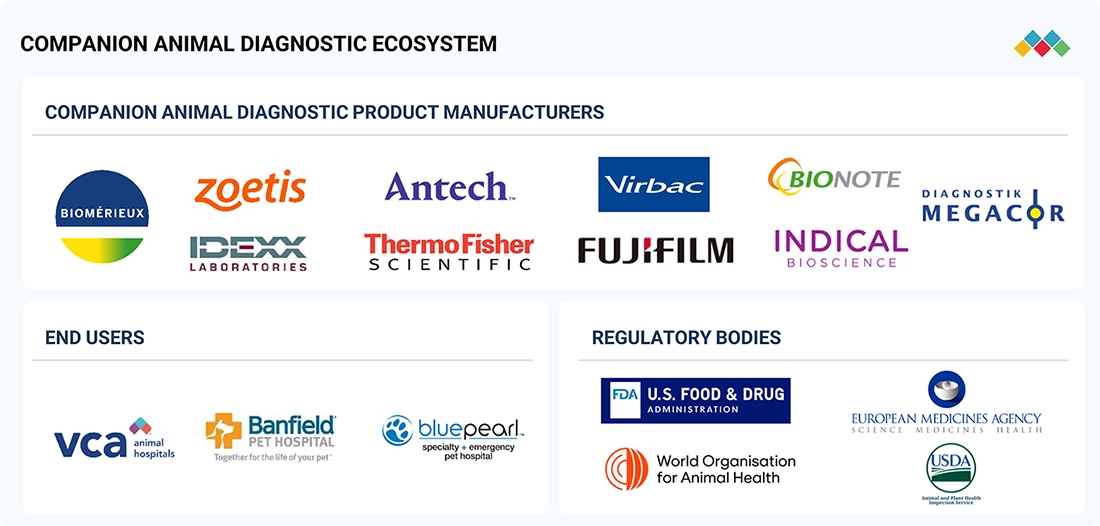
COMPANION ANIMAL DIAGNOSTIC MARKET: COMMERCIAL USE CASES ACROSS INDUSTRIES
| COMPANY | USE CASE DESCRIPTION | BENEFITS |
|---|---|---|
 |
Provides in-clinic and reference laboratory diagnostic products for companion animals, including clinical chemistry, hematology, immunoassays, urinalysis systems, and rapid diagnostic tests | Enables fast and accurate diagnosis | Supports preventive care | Improves clinical decision-making in veterinary practices |
 |
Offers point-of-care diagnostic analyzers and rapid tests for companion animals, covering clinical chemistry, hematology, and immunodiagnostic testing | Improves diagnostic efficiency | Supports earlier disease detection and treatment decisions |
 |
Produces and distributes companion animal diagnostic testing kits and laboratory analyzers used for clinical pathology and specialty diagnostics | Provides access to advanced diagnostic assays and consistent test performance across high-throughput laboratory environments |
 |
Supplies microbiology and immunodiagnostic instruments and reagents used for detecting infectious diseases in companion animals | Improves pathogen detection accuracy | Supports reliable, reproducible laboratory diagnostics |
 |
Markets rapid diagnostic test kits and immunodiagnostic products for companion animals alongside its therapeutic portfolio | Supports early diagnosis | Improves treatment selection through quick, easy-to-use tests |
Logos and trademarks shown above are the property of their respective owners. Their use here is for informational and illustrative purposes only.
Related Ecosystem
Medical Devices
- Polymerase Chain Reaction (PCR)
- Magnetic Resonance Imaging (MRI)
- Disposable Autoinjectors
- Pulse Oximeters
- Blood Pressure Monitors
- Medtronic plc
- Abbott Laboratories
- Stryker Corporation
- Becton, Dickinson and Company
- CONMED Corporation
Key Takeaways
- South Korea's companion animal diagnostic market will grow from USD 35.6M (2026) to USD 56.2M (2031) at a 9.6% CAGR, outpacing global growth.
- South Korea's advanced veterinary infrastructure and high pet ownership rates drive strong demand for diagnostic services.
- South Korea is experiencing increased adoption of point-of-care testing and digital diagnostic solutions in veterinary practices.
- South Korea's affluent consumer base and pet-centric culture support premium diagnostic service offerings and innovation.
Companion Animal Diagnostic Market Report Scope
| Report Metric | Details |
|---|---|
| Base Year | 2026 |
| Fastest Growing Segment | MOLECULAR DIAGNOSTICS (Technology) |
| Forecast Period | 2026–2031 |
| Growth Rate | CAGR of 8.7% from 2026 to 2031 |
| Largest Segment | CONSUMABLES (Product) |
| Market Size Base Year (Billions) | ~USD 3.56 (2026) |
| Revenue Forecast (Billions) | ~USD 5.4 (2031) |
| Segments Covered | Product, Technology, Type, Application, Animal Type, End User |
South Korea Companion Animal Diagnostic Market Report Segmentation
6 segment dimensions are covered across the global market.
By Product
- Consumables
- Instruments
By Technology
- Clinical Biochemistry
- Hematology
- Immunodiagnostics
- Molecular Diagnostics
- Other Technologies
- Urinalysis
By Type
- Allergen-Specific Immunodiagnostic Tests
- Blood Gas & Electrolyte Analysis
- Blood Gas & Electrolyte Analyzers
- Blood Gas & Electrolyte Reagents, Clips, And Cartridges
- Blood Glucose Strips
- Clinical Chemistry Analysis
- Clinical Chemistry Analyzers
- Clinical Chemistry Reagents, Clips, And Cartridges
- Elisa Tests
- Glucose Monitoring
- Glucose Monitors
- Hematology Analyzers
- Hematology Cartridges
- Immunoassay Analyzers
- Lateral Flow Assays
- Microarrays
- Nucleic Acid Sequencing
- Other Immunodiagnostics Products
- Other Molecular Diagnostics Products
- Pcr Tests
- Radioimmunoassays
- Rapid Tests
- Strip Readers
- Urinalysis Clips & Cartridges
- Urine Analyzers
- Urine Glucose Strips
- Urine Test Strips
By Application
- Bacteriology
- Clinical Pathology
- Other Applications
- Parasitology
- Virology
By Animal Type
- Cats
- Dogs
- Horses
- Other Companion Animals
By End User
- Home Care Settings
- Veterinary Hospital & Clinics
- Veterinary Reference Laboratories
- Veterinary Research Institutes & Universities
Target Audience
- Veterinary Diagnostic Equipment Manufacturers : Manufacturers need South Korea-specific market data to assess demand for diagnostic equipment, identify distribution opportunities, and develop localized product strategies for the region's advanced veterinary clinics.
- Pet Healthcare Service Providers : Diagnostic service providers require detailed market insights to understand South Korean pet owners' service preferences, pricing expectations, and growth opportunities in specialized testing and preventive care segments.
- Investment and Private Equity Firms : Investors evaluating opportunities in South Korea's pet healthcare sector need comprehensive market sizing, growth projections, and competitive landscape analysis to support due diligence and portfolio decisions.
- Veterinary Clinic Operators : Clinic owners and managers require market intelligence on diagnostic service demand, technology adoption trends, and consumer spending patterns to optimize service offerings and capital investments in South Korea.
- Market Research and Consulting Professionals : Analysts and consultants need granular South Korea market data to support client advisory work, competitive benchmarking, and strategic planning initiatives in the companion animal healthcare sector.
Key Companies in the South Korea Companion Animal Diagnostic Market
| Company | HQ | Ownership | Strongest segments |
|---|---|---|---|
| MINDRAY MEDICAL INTERNATIONAL LIMITED | China | Private Company | Patient Monitoring and Life Support Products,In-Vitro Diagnostic Products,Medical Imaging Systems, |
| QIAGEN NV | Netherlands | Public Company | Sample technology consumables and instruments,Immune response and infectious disease diagnostics (incl. TB IGRA, transplant, viral load),Oncology, sexual and reproductive health assays, |
| IDEXX LABORATORIES, INC. | United States | Public Company | Companion Animal Group – in-clinic analyzers and SNAP rapid assays,Companion Animal Group – reference laboratories and telemedicine/consulting,Veterinary software, services, VetConnect PLUS and VetLab Station, |
| FUJIFILM CORPORATION | Japan | Public Company | Healthcare (medical devices, CDMO, pharma, regenerative medicine, cosmetics/supplements),Business Innovation (office equipment, document solutions, graphic communications, inkjet),Electronics (display, semiconductor materials, storage, industrial equipment, fine chemicals), |
| THERMO FISHER SCIENTIFIC INC. | United States | Public Company | Life Sciences Solutions,Analytical Instruments,Specialty Diagnostics, |
| BIOMéRIEUX | France | Public Company | Clinical microbiology (culture media, VITEK 2, VITEK MS, AST including ETEST/VITEK REVEAL),Syndromic and molecular diagnostics (BIOFIRE, BIOFIRE SPOTFIRE, ARGENE, EMAG/NUCLISENS),Immunoassays and CLIA (VIDAS, Hybiome), |
| BIONOTE | South Korea | Public Company | Veterinary fluorescence immunoassay and molecular diagnostics,Veterinary clinical biochemistry systems and reagents,Veterinary rapid immunoassay and ELISA kits, |
| VIRBAC | France | Public Company | Companion-animal parasiticides and anti-infectives,Companion-animal specialty therapeutics & behavior (CKD diets, pheromones, mobility),Farm-animal vaccines (swine focus: Suigen range), |
MINDRAY MEDICAL INTERNATIONAL LIMITED
Mindray Medical International Limited is a Chinese medical device manufacturer founded in 1991 with 8,400 employees. Operating as a private company, it specializes in diagnostic and monitoring equipment for healthcare applications.
QIAGEN NV
QIAGEN NV is a Dutch public company founded in 1984 with 5,500 employees. It provides molecular diagnostics, sample preparation, and life sciences research tools globally.
IDEXX LABORATORIES, INC.
IDEXX Laboratories, Inc. is a United States-based public company founded in 1983 with 11,000 employees. The company develops and manufactures diagnostic equipment and software for veterinary and water testing markets.
FUJIFILM CORPORATION
Fujifilm Corporation is a Japanese public company founded in 1934 with 73,526 employees. It operates across imaging, diagnostics, pharmaceuticals, and industrial products globally.
THERMO FISHER SCIENTIFIC INC.
Thermo Fisher Scientific Inc. is a United States public company founded in 1956 with 125,000 employees. It is a leading provider of laboratory equipment, reagents, and analytical instruments worldwide.
BIOMéRIEUX
bioMérieux is a French public company founded in 1963 with 14,894 employees. It specializes in in vitro diagnostics and microbiology testing solutions for clinical and industrial applications.
BIONOTE
BioNote is a South Korean public company founded in 2003 with 298 employees. The company develops and manufactures diagnostic devices and reagents for veterinary and clinical use.
VIRBAC
Virbac is a French public company founded in 1968 with 6,442 employees. It specializes in veterinary pharmaceuticals and animal health products.
Reasons to Buy this Report
- Market-Specific Growth Data : Access precise valuation figures and CAGR metrics exclusive to South Korea's companion animal diagnostic sector, enabling accurate financial forecasting and investment decision-making for regional expansion.
- Competitive Positioning Intelligence : Understand South Korea's market dynamics relative to global trends, identifying competitive advantages and market gaps specific to the region's advanced veterinary infrastructure and consumer preferences.
- Consumer Behavior Insights : Gain detailed understanding of South Korean pet owners' spending patterns, healthcare priorities, and adoption of diagnostic services to tailor product offerings and marketing strategies effectively.
- Strategic Market Entry Planning : Leverage country-specific market analysis to develop informed go-to-market strategies, identify key stakeholders in South Korea's veterinary sector, and optimize resource allocation for regional success.
- Investment Opportunity Assessment : Evaluate the South Korea market's growth potential and profitability outlook through comprehensive forecasting data, supporting capital allocation decisions and partnership development in the region.
Frequently asked questions
What is the current size of South Korea's companion animal diagnostic market?
South Korea's companion animal diagnostic market is valued at USD 35.6 million in 2026 and is projected to reach USD 56.2 million by 2031.
What is the expected growth rate for South Korea's companion animal diagnostic market?
South Korea's companion animal diagnostic market is expected to grow at a compound annual growth rate (CAGR) of 9.6% from 2026 to 2031.
What factors are driving growth in South Korea's companion animal diagnostic market?
Growth in South Korea is driven by rising pet ownership, increased consumer spending on pet healthcare, advanced veterinary infrastructure, and growing awareness of preventive diagnostics.
Which diagnostic services are most in demand in South Korea?
South Korea shows strong demand for point-of-care testing, imaging diagnostics, laboratory services, and digital diagnostic tools integrated with veterinary management systems.
How does South Korea's market growth compare to global trends?
South Korea's 9.6% CAGR exceeds the global average of 8.7%, reflecting the country's strong pet healthcare market and consumer spending patterns.
RESEARCH METHODOLOGY
This research study extensively utilized both primary and secondary sources. It involved analyzing various factors influencing the industry to identify segmentation types, industry trends, key players, the competitive landscape, key market dynamics, and strategies employed by key players.
Secondary Research
This research study utilized a variety of comprehensive secondary sources, including directories, databases such as Bloomberg Business, Factiva, and Dun & Bradstreet, white papers, annual reports, company house documents, investor presentations, and SEC filings from various companies. Secondary research was employed to gather information crucial for an in-depth, technical, market-oriented, and commercial analysis of the companion animal diagnostics market. This approach also helped identify key players in the industry and allowed for classification and segmentation based on emerging trends at the most detailed level. Furthermore, significant developments pertaining to both market and technological perspectives were documented. A database of primary industry leaders was created as part of this secondary research.
Primary Research
In the primary research process, we interviewed a range of sources from both the supply and demand sides to gather qualitative and quantitative information for this report. Primary sources from the supply side include project/sales/marketing/business development managers, presidents, CEOs, vice presidents, chairpersons, chief operating officers, chief strategy officers, directors, chief information officers, and chief medical information officers related to the companion animal diagnostics market. Primary sources from the demand side include R&D product development teams in animal health companies, veterinary clinicians, diagnostic laboratory managers, and procurement heads at veterinary reference laboratories.
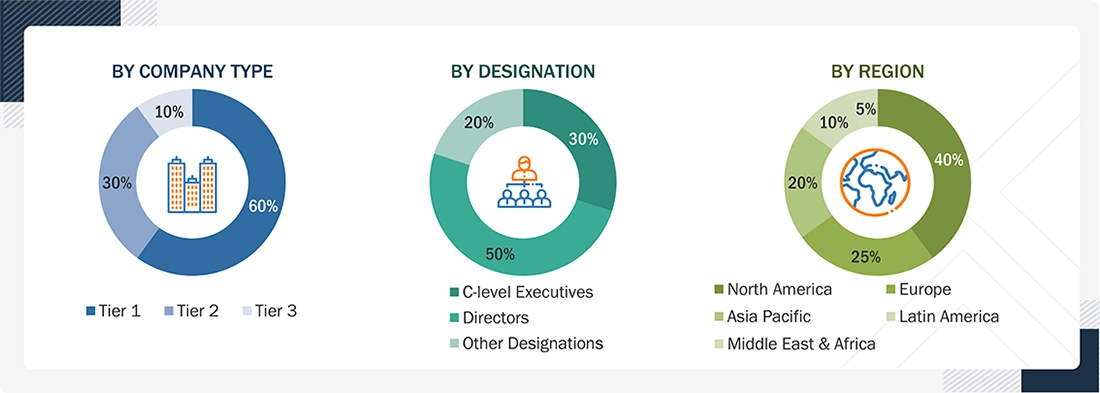
Note: C-level executives include CEOs, COOs, CTOs, and VPs. Other designations include sales, marketing, and product managers.
Tiers are defined based on a company’s total revenue. As of 2025: Tier 1 = >USD 1 billion, Tier 2 = USD 500 million to USD 1 billion, and Tier 3 = <USD 500 million.
To know about the assumptions considered for the study, download the pdf brochure
Market Size Estimation
The total size of the companion animal diagnostics market was determined through data triangulation across three approaches, as described below. After each approach, the weighted average of the three was calculated based on the level of assumptions used in each.
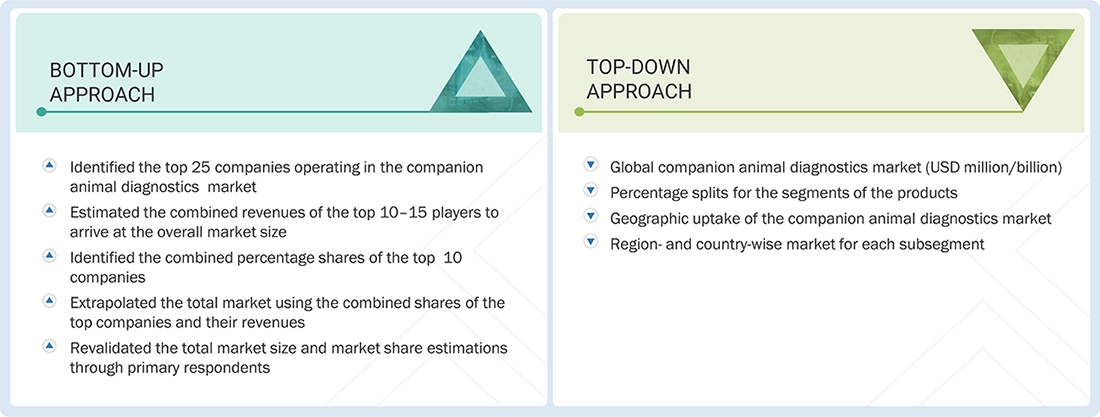
Data Triangulation
After arriving at the market size, the total market was divided into several segments and subsegments. Data triangulation and market breakdown procedures were employed as applicable to complete the overall market engineering process and obtain exact statistics for all segments and subsegments.
Market Definition
Companion animal diagnostics use plasma, serum, blood, urine, feces, and tissue samples to detect, monitor, and manage diseases and health conditions in dogs, cats, horses, and other household pets. The companion animal diagnostics market includes diagnostic instruments, test kits, reagents, and consumables used in veterinary clinics and laboratories, covering technologies such as clinical chemistry analyzers, hematology analyzers, immunodiagnostics and ELISA test kits, urinalysis systems, molecular diagnostic assays, glucose monitoring systems, and blood gas–electrolyte analyzers. These products support routine wellness screening, disease diagnosis, treatment monitoring, and preventive healthcare in companion animals.
Key Stakeholders
- Companion animal diagnostic manufacturers
- Companion animal diagnostic distributors and suppliers
- Companion animal R&D companies
- Veterinary reference laboratories
- Veterinary hospitals and clinics
- Veterinary universities and research institutes
- Government associations
- Market research and consulting firms
- Venture capitalists and investors
- Distributors, channel partners, and third-party suppliers
Report Objectives
- To define, describe, segment, and forecast the companion animal diagnostics market by product, technology, application, animal type, end user, and region
- To provide detailed information about the factors influencing market growth (such as drivers, restraints, opportunities, and challenges)
- To analyze micromarkets with respect to individual growth trends, prospects, and contributions to the overall companion animal diagnostics market
- To analyze market opportunities for stakeholders and provide details of the competitive landscape for key players
- To forecast the size of the companion animal diagnostics market in five main regions (along with their respective key countries): North America, Europe, the Asia Pacific, Latin America, and the Middle East & Africa
- To profile the key players in the companion animal diagnostics market and comprehensively analyze their core competencies and market shares
- To analyze competitive developments such as acquisitions, product launches, expansions, collaborations, agreements, and partnerships
Available customizations:
Based on the given market data, MarketsandMarkets offers customization to meet your company’s specific needs. The following customization options are available for the report:
Company Information- Detailed analysis and profiling of additional market players (up to 5)
- Further breakdown of the Rest of European companion animal diagnostics market into Austria, Finland, Switzerland, and other countries
- Further breakdown of the Rest of Latin American companion animal diagnostics market into Colombia, Chile, and other countries
- Market share analysis for North America and Europe, which provides market shares of the top 3–5 key players in the companion animal diagnostics market
- Competitive leadership mapping for established players in the US
Get the Full Companion Animal Diagnostic Market Report
Full forecast, segment splits, and company analysis for all Companion Animal Diagnostic Market.
- Canada Companion Animal Diagnostic Market
- US Companion Animal Diagnostic Market
- Germany Companion Animal Diagnostic Market
- UK Companion Animal Diagnostic Market
- France Companion Animal Diagnostic Market
- Italy Companion Animal Diagnostic Market
- Spain Companion Animal Diagnostic Market
- Netherlands Companion Animal Diagnostic Market
- Sweden Companion Animal Diagnostic Market
- Poland Companion Animal Diagnostic Market
- China Companion Animal Diagnostic Market
- Japan Companion Animal Diagnostic Market
- India Companion Animal Diagnostic Market
- Australia Companion Animal Diagnostic Market
- Thailand Companion Animal Diagnostic Market
- New Zealand Companion Animal Diagnostic Market
- Brazil Companion Animal Diagnostic Market
- Mexico Companion Animal Diagnostic Market
- Argentina Companion Animal Diagnostic Market
- Rest Of Europe Companion Animal Diagnostic Market
Need a Tailored Report?
Customize this report to your needs
Get 10% FREE Customization
Customize This Report
