
Asia Pacific Concrete Admixtures Market (2026-2031)

The Asia Pacific Concrete Admixtures Market was valued at $1403 Million in 2026 and projected to reach to $1996 Million by 2031, representing a compound annual growth rate of 7.3%. The Asia Pacific concrete admixtures market is poised for sustained expansion, growing from USD 1,403 million in 2026 to USD 1,996 million by 2031.


| Market Size in | USD 26.32 MN |
| Market Forecast in | |
| CAGR | |
| Forecast Period | |
| Units Considered | Value (USD MN) |
Asia Pacific Concrete Admixtures Market Trends and Insights
- Asia Pacific's rapid urbanization, infrastructure development, and construction activity are driving significant demand for performance-enhancing concrete solutions.
- The region's 7.3% compound annual growth rate reflects strong investment in residential, commercial, and transportation infrastructure across emerging economies. Asia Pacific's market growth is underpinned by increasing adoption of advanced admixture technologies to improve concrete durability, workability, and sustainability.
- Key markets within Asia Pacific, including China, India, and Southeast Asia, are witnessing heightened construction spending and regulatory emphasis on green building standards.
- The forecast period through 2031 indicates sustained momentum as Asia Pacific continues to lead global construction activity and concrete consumption. Innovation in water-reducing agents, plasticizers, and specialty admixtures is reshaping Asia Pacific's competitive landscape.
- Manufacturers are responding to regional demand for cost-effective solutions that meet evolving environmental standards, positioning Asia Pacific as a critical growth engine for the global concrete admixtures industry..
Key Market Statistics
- CAGR (2026-2031) 7.3% CAGR
- Market Size, 2026 ~USD 1403 Million
- Forecast, 2031 ~USD 1996 Million
- Geography Asia Pacific
Asia Pacific Concrete Admixtures Market Overview
Rapid Urbanization Driving Demand :
Asia Pacific's accelerating urbanization and mega-city development projects are creating unprecedented demand for advanced concrete admixtures to enhance durability, workability, and performance in high-rise and infrastructure construction.
Infrastructure Investment Boom :
Massive government-backed infrastructure initiatives across the region, including smart cities, transportation networks, and industrial zones, are significantly boosting concrete admixtures consumption for large-scale construction projects.
Strong Regional Growth Trajectory :
With a 7.3% CAGR from 2026 to 2031, Asia Pacific is outpacing the global average of 7.17%, reflecting the region's dominant position in construction activity and concrete consumption worldwide.
China and India Market Leadership :
China and India collectively represent the largest market share in Asia Pacific, driven by continuous urbanization, real estate development, and government infrastructure spending supporting sustained demand growth.
Asia Pacific Concrete Admixtures Market Dynamics
- This robust growth is underpinned by the region's position as a global construction powerhouse, with countries like China and India leading massive infrastructure modernization efforts.
- Rising environmental awareness is also driving adoption of eco-friendly admixtures that improve concrete sustainability and performance. Key growth catalysts include increasing investments in smart city projects, transportation infrastructure, and commercial real estate across emerging economies.
- The region's competitive manufacturing landscape and technological advancements in admixture formulations are enhancing product quality and cost-effectiveness.
- As construction standards become more stringent and performance requirements escalate, demand for specialized concrete admixtures will continue accelerating throughout the forecast period..
Market Ecosystem
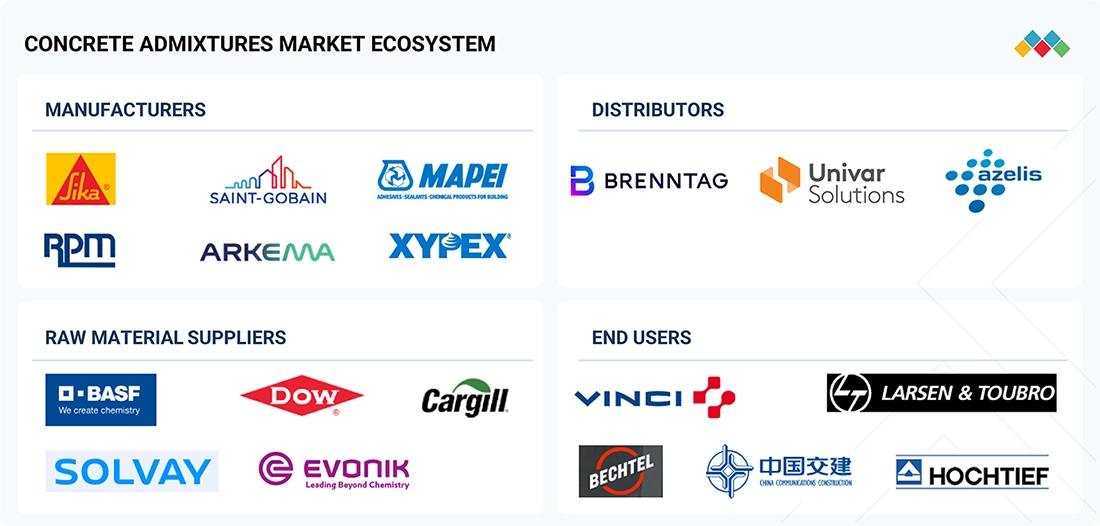
CONCRETE ADMIXTURES MARKET: COMMERCIAL USE CASES ACROSS INDUSTRIES
| COMPANY | USE CASE DESCRIPTION | BENEFITS |
|---|---|---|
 |
High-performance superplasticizers for high-strength concrete in large infrastructure bridges and tunnels | Improved workability and flow | Higher strength with less cement | Faster construction cycles | Reduced cracking |
 |
Advanced concrete admixtures for massive pours in power plants and metro projects | Better pumpability over long distances | Controlled setting time | Enhanced durability in harsh conditions | Lower shrinkage |
 |
Specialized admixtures for rapid-setting and high-early-strength concrete in industrial facilities | Faster formwork removal | Accelerated project timelines | Improved surface finish | Reduced labor costs |
 |
Sustainable concrete admixtures with corrosion inhibitors for marine and coastal structures | Extended service life in aggressive environments | Superior resistance to chloride penetration | Lower maintenance needs | Eco-friendly performance |
Logos and trademarks shown above are the property of their respective owners. Their use here is for informational and illustrative purposes only.
Related Ecosystem
Infrastructure Material
Speciality Chemicals
Building And Construction
Key Takeaways
- Asia Pacific concrete admixtures market will grow from USD 1,403M (2026) to USD 1,996M (2031) at a 7.3% CAGR.
- Rapid urbanization and infrastructure investment across Asia Pacific are primary drivers of admixture demand.
- Asia Pacific is increasingly adopting sustainable and high-performance admixture technologies to meet environmental regulations.
- China, India, and Southeast Asia represent the largest growth opportunities within the Asia Pacific region.
Concrete Admixtures Market Report Scope
| Report Metric | Details |
|---|---|
| Base Year | 2026 |
| Fastest Growing Segment | INFRASTRUCTURE (Application) |
| Forecast Period | 2026–2031 |
| Growth Rate | CAGR of 7.17% from 2026 to 2031 |
| Largest Segment | RESIDENTIAL (Application) |
| Market Size Base Year (Billions) | ~USD 22.63 (2026) |
| Revenue Forecast (Billions) | ~USD 31.99 (2031) |
| Segments Covered | Product Type, Application |
Asia Pacific Concrete Admixtures Market Report Segmentation
2 segment dimensions are covered across the global market.
By Product Type
- Accelerating Admixtures
- Air-Entraining Admixtures
- Normal Plasticizers
- Other Concrete Admixtures
- Retarding Admixtures
- Superplasticizers
- Waterproofing Admixtures
- –Acid Salt & Others
- –Lignosulphonate
- –Naphthalene
- –Tenside
- ––Betaine
- ––Root Resins
- ––Sulphosuccinate
By Application
- Commercial
- Infrastructure
- Residential
Target Audience
- Construction Material Manufacturers : Need Asia Pacific market data to expand product portfolios, identify regional demand trends, and develop localized concrete admixture solutions aligned with regional construction standards and preferences.
- Chemical & Admixture Suppliers : Require detailed market intelligence on Asia Pacific growth opportunities, competitive positioning, and customer segments to optimize distribution networks and capture market share in high-growth economies.
- Infrastructure & Construction Companies : Seek regional market insights to source quality concrete admixtures, understand cost trends, and evaluate supplier capabilities across Asia Pacific for large-scale infrastructure and construction projects.
- Investment & Private Equity Firms : Need comprehensive Asia Pacific market analysis to identify acquisition targets, assess growth potential, and evaluate investment opportunities in the region's expanding concrete admixtures sector.
- Government & Policy Makers : Require market data to inform infrastructure planning, construction standards development, and policy decisions that support sustainable concrete solutions and regional construction industry growth.
Key Companies in the Asia Pacific Concrete Admixtures Market
| Company | HQ | Ownership | Strongest segments |
|---|---|---|---|
| CRH PLC | Ireland | Public Company | Aggregates, cementitious materials, ready-mixed concrete, and asphalt,Paving and construction services,Precast and pre-stressed concrete and polymer-based infrastructure products, |
| SYNTHOMER PLC | United Kingdom | Public Company | Coatings and Construction Polymers,Adhesives and Sealants,Health and Protection Latex, |
| SAMSUNG | South Korea | Public Company | Smartphones, tablets, wearables, and accessories,TVs, audio, and visual devices,Home appliances and air solutions, |
| GODREJ GROUP | India | Private Company | Home and commercial appliances,Locks, security, and architectural hardware,Construction, real estate, and green building services, |
| SNC-LAVALIN GROUP INC. | Canada | Public Company | Consultancy, strategy, advisory, engineering, and design,Project and program management, project delivery, and O&M,Nuclear lifecycle services, |
| KAO CORPORATION | Japan | Public Company | Hygiene living care (fabric, kitchen, home, sanitary),Health beauty care and life care,Cosmetics (self-selection and counselling-based), |
| HOLCIM LTD | Switzerland | Public Company | Cement, clinker, and cementitious materials,Ready-mix concrete and digital concrete services,Aggregates (crushed stone, gravel, sand), |
| SIKA AG | Switzerland | Public Company | Concrete admixtures and additives,Waterproofing (SikaProof and related systems),Flat roofing (Sika Sarnafil and accessories), |
| RPM INTERNATIONAL INC. | United States | Public Company | Construction Products Group (CPG),Performance Coatings Group (PCG),Specialty Products Group (SPG), |
| MAPEI S.P.A. | Italy | Private Company | Adhesives and sealants for ceramic, stone, and resilient flooring,Concrete admixtures and cement additives,Waterproofing and building-envelope systems, |
| SAINT-GOBAIN S.A. | France | Public Company | Insulation and energy-efficiency systems,Glass and glazing solutions,Interior building systems (plasterboard, ceilings, mortars), |
| ARKEMA | France | Public Company | Adhesive Solutions (construction, renovation, DIY, packaging, non-woven, durable goods),Advanced Materials (high-performance polymers and performance additives),Coating Solutions (acrylics, coating resins, photocure and rheology additives, decorative paints), |
| CEMEX, S.A.B. DE C.V. | Mexico | Public Company | Cement (gray, white, blended, masonry),Ready-mix concrete,Aggregates, |
| WACKER CHEMIE AG | Germany | Public Company | Silicones,Polymers,Biosolutions, |
CRH PLC
CRH PLC is an Irish public company established in 1936 with 83,032 employees.
SYNTHOMER PLC
SYNTHOMER PLC is a United Kingdom-based public company founded in 1863 with 3,800 employees.
SAMSUNG
SAMSUNG is a South Korean public company founded in 1969 with 128,735 employees.
GODREJ GROUP
GODREJ GROUP is an Indian private company established in 1897 with 13,316 employees.
SNC-LAVALIN GROUP INC.
SNC-LAVALIN GROUP INC. is a Canadian public company founded in 1911 with 40,246 employees.
KAO CORPORATION
KAO CORPORATION is a Japanese public company established in 1887 with 31,514 employees.
HOLCIM LTD
HOLCIM LTD is a Swiss public company established in 1833 with 45,595 employees.
SIKA AG
SIKA AG is a Swiss public company founded in 1910 with 30,629 employees.
RPM INTERNATIONAL INC.
RPM INTERNATIONAL INC. is a United States-based public company established in 1947 with 17,778 employees.
MAPEI S.P.A.
MAPEI S.P.A. is an Italian private company founded in 1937 with 13,252 employees.
SAINT-GOBAIN S.A.
SAINT-GOBAIN S.A. is a French public company established in 1665.
ARKEMA
ARKEMA is a French public company founded in 2003 with 20,700 employees.
CEMEX, S.A.B. DE C.V.
CEMEX, S.A.B. DE C.V. is a Mexican public company founded in 1906 with 38,892 employees.
WACKER CHEMIE AG
WACKER CHEMIE AG is a German public company established in 1914 with 16,196 employees.
Countries within Asia Pacific - compare and drill down
| Country | 2025 size (native) |
|---|---|
| China | USD 12883.4 Million |
| India | USD 1683.5 Million |
| Japan | USD 315.8 Million |
| South Korea | USD 350.2 Million |
| Indonesia | USD 287.4 Million |
| Rest Of Asia Pacific | USD 2942.6 Million |
Country market size visualization
Reasons to Buy this Report
- Regional Market Segmentation : Gain detailed insights specific to Asia Pacific's concrete admixtures market, including country-level analysis of China, India, Japan, South Korea, and Indonesia to identify high-growth opportunities.
- Growth Trajectory Analysis : Understand the 7.3% CAGR drivers and market dynamics unique to Asia Pacific, enabling strategic planning for market entry, expansion, and competitive positioning in the region's fastest-growing construction markets.
- Infrastructure Investment Insights : Access comprehensive data on how government infrastructure spending, urbanization trends, and mega-project developments across Asia Pacific are reshaping concrete admixtures demand patterns.
- Competitive Landscape Intelligence : Identify key players, market consolidation trends, and competitive strategies specific to Asia Pacific, helping businesses optimize their regional market approach and partnership opportunities.
- Forecast-Driven Decision Making : Leverage accurate 2031 market projections and trend analysis for Asia Pacific to make informed investment decisions, product development strategies, and resource allocation for long-term regional success.
Frequently asked questions
What is the current size of the Asia Pacific concrete admixtures market?
The Asia Pacific concrete admixtures market is valued at USD 1,403 million in 2026 and is expected to grow to USD 1,996 million by 2031.
What is the projected growth rate for Asia Pacific concrete admixtures?
Asia Pacific concrete admixtures market is projected to grow at a compound annual growth rate (CAGR) of 7.3% from 2026 to 2031.
Which countries drive the Asia Pacific concrete admixtures market?
China, India, and Southeast Asian nations are the primary growth drivers in the Asia Pacific concrete admixtures market due to rapid urbanization and infrastructure development.
What types of admixtures are most in demand across Asia Pacific?
Water-reducing agents, plasticizers, and specialty admixtures are among the most demanded products in Asia Pacific as construction standards evolve.
How are sustainability trends affecting Asia Pacific's concrete admixtures market?
Asia Pacific manufacturers are increasingly developing eco-friendly and high-performance admixtures to comply with regional environmental regulations and green building standards.
RESEARCH METHODOLOGY
The study involved four major activities in estimating the market size for concrete admixtures. Exhaustive secondary research was done to collect information on the market, the peer market, and the parent market. The next step was to validate these findings, assumptions, and sizing with industry experts across the value chain through primary research. Both top-down and bottom-up approaches were employed to estimate the complete market size. After that, the market breakdown and data triangulation procedures were used to estimate the market size of the segments and subsegments.
Secondary Research
Secondary sources used in this study included annual reports, press releases, and investor presentations of companies; white papers; certified publications; articles from recognized authors; and gold-standard and silver-standard websites, such as Factiva, ICIS, Bloomberg, and others. The findings of this study were verified through primary research, which involved conducting extensive interviews with key officials, including CEOs, VPs, directors, and other executives. The breakdown of profiles of the primary interviewees is illustrated in the figure below:
Primary Research
The concrete admixtures market comprises several stakeholders, including raw material suppliers, end-product manufacturers, and regulatory organizations across the supply chain. Various primary sources from both the supply and demand sides of the market were interviewed to obtain qualitative and quantitative information.
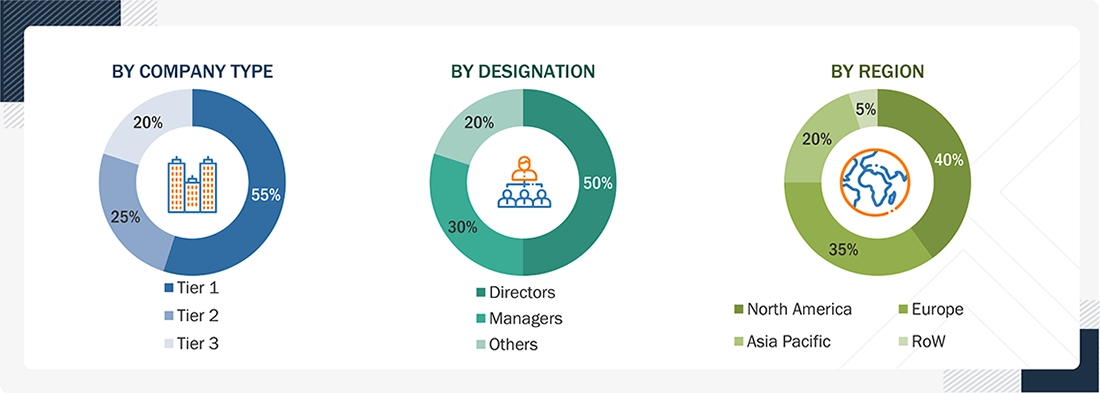
Notes: Tier 1, Tier 2, and Tier 3 companies are classified based on their market revenue in 2024/2025 available in the public domain, product portfolios, and geographical presence.
Other designations include consultants and sales, marketing, and procurement managers.
|
COMPANY NAME |
DESIGNATION |
|
Sika AG |
Senior Manager |
|
Saint-Gobain |
Innovation Manager |
|
MAPEI Corporation |
Vice-President |
|
RPM International Inc. |
Production Supervisor |
|
Arkema S.A. |
Sales Manager |
To know about the assumptions considered for the study, download the pdf brochure
Market Size Estimation
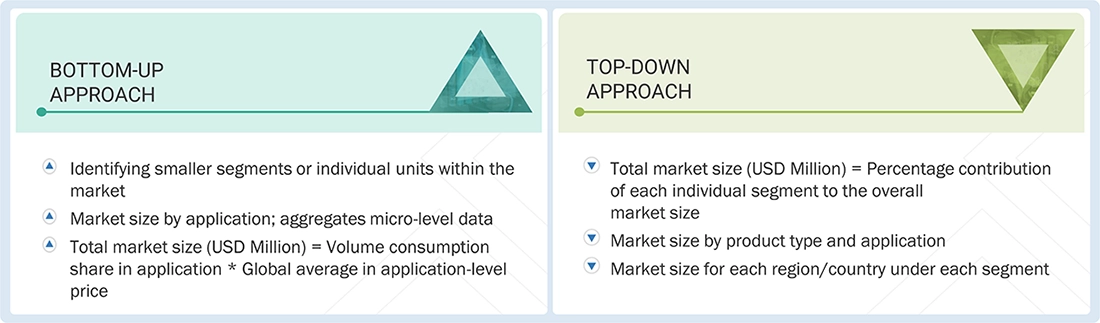
Both top-down and bottom-up approaches were used to estimate and validate the total size of the concrete admixtures market. These methods were also used extensively to estimate the size of various subsegments in the market. The research methodology used to estimate the market size includes the following:
- The key players in the industry have been identified through extensive secondary research.
- The supply chain of the industry has been determined through primary and secondary research.
- All percentage shares, splits, and breakdowns have been determined using secondary sources and verified through primary sources.
- All possible parameters that affect the markets covered in this research study have been accounted for, viewed in extensive detail, verified through primary research, and analyzed to obtain the final quantitative and qualitative data.
INFOGRAPHIC DEPICTING BOTTOM-UP AND TOP-DOWN APPROACHES
Data Triangulation
After determining the overall market size using the market size estimation processes explained above, the market was divided into several segments and subsegments. To complete the overall market engineering process and determine the exact statistics for each market segment and subsegment, data triangulation and market breakdown procedures were employed, as applicable. The data was triangulated by studying various factors and trends from both the demand and supply sides in the concrete admixtures industry.
Market Definition
According to the American Concrete Institute (ACI), concrete admixtures are generally substances added to concrete during the batching process, before or during mixing, to modify its properties. They can enhance the workability, durability, strength, or other characteristics of concrete. These admixtures can be chemical or mineral additives. They are widely used in construction applications for residential, commercial, and infrastructure projects.
Key Stakeholders
- Concrete admixture manufacturers
- Concrete admixture distributors
- Raw material suppliers
- Government and research organizations
- Investment banks and private equity firms
Report Objectives
- To analyze and forecast the size of the global concrete admixtures market in terms of value and volume
- To provide detailed information about the major drivers, restraints, challenges, and opportunities influencing the market growth
- To define, describe, and segment the market based on product type, application, and region
- To forecast the size of the market segments based on regions such as Asia Pacific, North America, Europe, the Middle East & Africa, and South America
- To strategically analyze micromarkets with respect to individual growth trends, prospects, and their contribution to the overall market
- To identify and analyze opportunities for stakeholders in the market
- To analyze competitive developments such as expansions, partnerships, joint ventures, mergers & acquisitions, agreements, and product launches in the market
- To strategically profile the key companies and comprehensively analyze their core competencies
Available customizations:
Along with the given market data, MarketsandMarkets offers customizations according to the company’s specific needs. The following customization options are available for the report:
Regional Analysis
- Further breakdown of a region with respect to a particular country or additional application
Company Information
- Detailed analysis and profiles of additional market players (up to five)
Get the Full Concrete Admixtures Market Report
Full forecast, segment splits, and company analysis for all Concrete Admixtures Market.
- Rest Of Europe Concrete Admixtures Market
- China Concrete Admixtures Market
- India Concrete Admixtures Market
- Japan Concrete Admixtures Market
- South Korea Concrete Admixtures Market
- Indonesia Concrete Admixtures Market
- US Concrete Admixtures Market
- Canada Concrete Admixtures Market
- Mexico Concrete Admixtures Market
- Germany Concrete Admixtures Market
- Italy Concrete Admixtures Market
- UK Concrete Admixtures Market
- France Concrete Admixtures Market
- Spain Concrete Admixtures Market
- Turkey Concrete Admixtures Market
- Saudi Arabia Concrete Admixtures Market
- Egypt Concrete Admixtures Market
- Iran Concrete Admixtures Market
- Brazil Concrete Admixtures Market
- Argentina Concrete Admixtures Market
- South America Concrete Admixtures Market
- Rest Of Asia Pacific Concrete Admixtures Market
Need a Tailored Report?
Customize this report to your needs
Get 10% FREE Customization
Customize This Report
