
France Connected Car Market (2024-2029)

The France Connected Car Market was valued at $378.8 Million in 2024 and projected to reach to $979 Million by 2029, representing a compound annual growth rate of 17.1%. France's connected car market is positioned for exceptional growth through 2029, driven by increasing consumer preference for digital mobility solutions and supportive government policies promoting automotive innovation.


| Market Size in | USD 26.32 MN |
| Market Forecast in | |
| CAGR | |
| Forecast Period | |
| Units Considered | Value (USD MN) |
France Connected Car Market Trends and Insights
- This represents a compound annual growth rate of 17.1%, significantly outpacing global trends.
- France is leveraging advanced automotive technologies, regulatory support for vehicle connectivity, and strong consumer demand for in-vehicle digital services to drive market expansion. The French connected car ecosystem is characterized by increasing adoption of IoT-enabled vehicles, 5G infrastructure deployment, and integration of artificial intelligence in automotive systems.
- France's automotive manufacturers and technology providers are investing heavily in connected vehicle platforms, telematics solutions, and autonomous driving capabilities.
- By 2029, France is expected to solidify its position as a leading European hub for connected car innovation, with enhanced vehicle-to-infrastructure (V2I) communication and smart mobility solutions becoming mainstream across the country..
Key Market Statistics
- CAGR (2024-2029) 17.1% CAGR
- Market Size, 2024 ~USD 378.8 Million
- Forecast, 2029 ~USD 979 Million
- Country France
France Connected Car Market Overview
Market Valuation & Growth :
France's connected car market reached $378.8 million in 2024 and is projected to grow to $979.0 million by 2029, representing a 17.1% CAGR—significantly exceeding the global growth rate of 13.3%.
Regulatory Support & Infrastructure :
France benefits from strong EU regulatory frameworks promoting vehicle connectivity and data security standards, creating a favorable environment for connected car technology adoption and investment.
Consumer Digital Adoption :
French consumers demonstrate high demand for in-vehicle digital services, including infotainment systems, navigation, and IoT-enabled vehicle management, driving market expansion across premium and mid-range segments.
Advanced Technology Integration :
France is leveraging cutting-edge automotive technologies including 5G connectivity, AI-powered driver assistance systems, and cloud-based vehicle platforms to enhance the connected car ecosystem.
France Connected Car Market Dynamics
- The country's strong automotive manufacturing base and tech-savvy population create ideal conditions for rapid connected car adoption.
- Investment in 5G infrastructure and autonomous vehicle technologies will further accelerate market expansion.
- By 2029, France is expected to become a leading European hub for connected vehicle services, with significant opportunities in telematics, predictive maintenance, and personalized in-vehicle experiences..
Market Ecosystem
Related Ecosystem
Automotive Advance Technologies
- Battery Electric Vehicle (BEV)
- Light Commercial Vehicles (LCVs)
- Fuel Cell Electric Vehicle (FCEV)
- Hybrid Electric Vehicle (HEV)
- Internal Combustion Engine (ICE)
- BOSCH LIMITED
- Continental ag
- Visteon Corporation
- DENSO Corporation
- ZF FRIEDRICHSHAFEN AG
Connected Car
- Light Commercial Vehicles (LCVs)
- Battery Electric Vehicle (BEV)
- Fuel Cell Electric Vehicle (FCEV)
- Cellular Network
- Sensors
- BOSCH LIMITED
- Visteon Corporation
- Jabil Inc.
- DENSO Corporation
- VALENS SEMICONDUCTOR LTD.
Key Takeaways
- France's connected car market will grow from $378.8M (2024) to $979.0M (2029) at a 17.1% CAGR, outpacing global growth rates.
- France is investing in 5G infrastructure and V2I communication systems to support advanced connected vehicle deployments.
- French automotive OEMs and tech companies are prioritizing AI-driven telematics and autonomous driving capabilities.
- Regulatory frameworks in France are accelerating connected car adoption through data privacy standards and vehicle safety mandates.
Connected Car Market Report Scope
| Report Metric | Details |
|---|---|
| Base Year | 2024 |
| Fastest Growing Segment | CELLULAR (Network) |
| Forecast Period | 2024-2029 |
| Growth Rate | CAGR of 13.3% from 2024 to 2029 |
| Largest Segment | EMBEDDED (Form Type) |
| Market Size Base Year (Billions) | ~USD 12.48 (2024) |
| Revenue Forecast (Billions) | ~USD 23.3 (2029) |
| Segments Covered | Service, Form Type, End Market, Hardware, Network, Vehicle Type |
France Connected Car Market Report Segmentation
6 segment dimensions are covered across the global market.
By Service
- Auto Parking /Connected Parking
- Auto Parking/ Connected Parking
- Auto Parking/Connected Parking
- Auto Pilot
- Autopilot
- Ecall & Sos Assistance
- Home Integration
- Multimedia Streaming
- Navigation
- On-Road Assistance
- Ota Update
- Ota Updates
- Remote Diagnostics
- Remote Operation
- Social Media & Other Apps
- Stolen Vehicle Recovery/Warning
By Form Type
- Embedded
- Integrated
By End Market
- Aftermarket
- OEM
By Hardware
- Central Gateway
- Electronic Control Unit
- Head Unit
- Intelligent Antenna
- Keyless Entry System
- Sensor
- Telematic Control Unit
By Network
- Cellular
- Dsrc
By Vehicle Type
- Bev
- Fcev
- Phev
Target Audience
- Automotive OEMs & Suppliers : Manufacturers and component suppliers need France-specific market data to develop localized connected car strategies, optimize product portfolios, and identify partnership opportunities in this high-growth market.
- Technology & Software Companies : Tech firms and software developers require insights into France's digital services demand, regulatory requirements, and consumer preferences to tailor connected car solutions and expand market presence.
- Investment & Private Equity Firms : Investors need comprehensive France market analysis to evaluate growth potential, identify acquisition targets, and assess risk-return profiles for connected car technology investments in the region.
- Telecom & Connectivity Providers : 5G and IoT service providers require France-specific data on connectivity demand, infrastructure gaps, and market opportunities to develop targeted offerings for connected vehicle applications.
- Government & Policy Makers : French regulatory bodies and government agencies need market intelligence to inform policy decisions, incentive programs, and infrastructure investments supporting connected car ecosystem development.
Reasons to Buy this Report
- Market-Specific Growth Data : Access detailed France-specific market sizing, forecasts, and CAGR analysis to benchmark competitive positioning and identify investment opportunities in Europe's fastest-growing connected car market.
- Regulatory & Policy Insights : Understand France's unique regulatory landscape, EU compliance requirements, and government incentives shaping connected car adoption, enabling compliant market entry and strategic planning.
- Consumer Behavior Analysis : Gain insights into French consumer preferences for digital services, willingness to adopt connected technologies, and demographic segments driving demand for in-vehicle connectivity solutions.
- Competitive Landscape Assessment : Identify key players, market consolidation trends, and competitive strategies specific to France's connected car ecosystem to inform partnership and acquisition decisions.
- Technology & Infrastructure Trends : Discover France's 5G rollout progress, cloud infrastructure development, and emerging technologies like autonomous driving that are reshaping the connected car market landscape.
Frequently asked questions
What is the current size of France's connected car market?
France's connected car market was valued at $378.8 million in 2024 and is expected to reach $979.0 million by 2029.
What is the growth rate of the connected car market in France?
France's connected car market is growing at a compound annual growth rate (CAGR) of 17.1% from 2024 to 2029.
What are the main drivers of connected car adoption in France?
Key drivers include 5G infrastructure expansion, regulatory support for vehicle connectivity, consumer demand for digital services, and investments in autonomous driving and telematics solutions.
Which technologies are leading France's connected car market?
Leading technologies in France include IoT-enabled vehicle platforms, AI-powered telematics, vehicle-to-infrastructure (V2I) communication, and autonomous driving systems.
How does France's connected car market compare to global trends?
France's 17.1% CAGR significantly exceeds the global average of 13.3%, positioning France as a high-growth market within the connected car industry.
RESEARCH METHODOLOGY
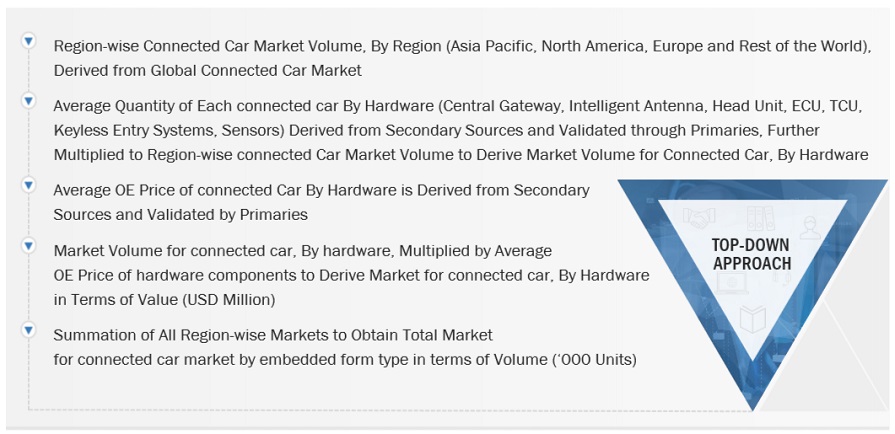
Various secondary sources, directories, and databases have been used to identify and collect information for an extensive connected car market study. The study involved four main activities in estimating the current size of the market: secondary research, validation through primary research, assumptions, and market analysis. Exhaustive secondary research was carried out to collect information on the market, such as the number of hardware used in cars, the number of on-board units installed in the vehicles, subscription cost from different service providers, annual renewal percentage of connected car service in bundles/subscriptions and upcoming technologies and trends. The next step was to validate these findings, assumptions, and market analysis with industry experts across the value chain through primary research. The top-down approach was employed to estimate the complete market size for different segments considered in this study.
Secondary Research
In the secondary research process, various secondary sources, such as company annual reports, presentations, and press releases; associations, such as Organisation Internationale des Constructeurs d'Automobiles (OICA), the International Energy Agency (IEA), European Automobile Manufacturers’ Association, Canadian Automobile Association (CAA), country-level automotive associations and trade organizations, and the US Department of Transportation (DOT); industry association publications, such as publications of OEMs’ vehicle sales; connected car magazine articles, directories, and technical handbooks; World Economic Outlook; trade websites, and technical articles, were used to identify and collect information useful for an extensive commercial study of the global connected car market.
Primary Research
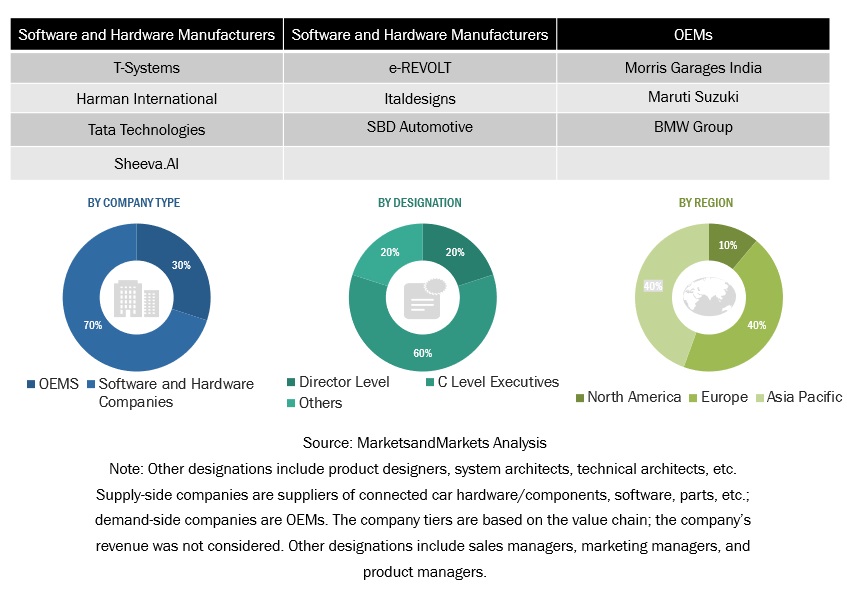
In the primary research process, various primary sources from both the supply and demand sides were interviewed to obtain qualitative and quantitative information on the market. The primary sources from the supply side included industry experts such as CXOs, vice presidents, directors from business development, marketing, product development/innovation teams, and related key executives from various key companies. Various system integrators, industry associations, independent consultants/industry veterans, and key opinion leaders were also interviewed.
Various sources from both the supply and demand sides were interviewed in the primary research process to obtain qualitative and quantitative information for this report. The primary sources from the supply side include industry experts such as research and development experts, CEOs, CTOs, COOS, vice presidents, marketing directors, technology and innovation directors, and related key executives from different vital companies operating in the connected car market.
After the complete market engineering, which includes calculations for market statistics, market breakdown, market size estimations, market forecasting, and data triangulation, extensive primary research has been conducted to gather information and verify and validate the critical numbers arrived at. Primary research has also been undertaken to identify and validate the segmentation, industry trends, key players, competitive landscape, and market dynamics, such as drivers, restraints, opportunities, challenges, industry trends, and key strategies. Extensive qualitative and quantitative analysis has been performed on the complete market engineering process to list key information/insights throughout the report.
After interacting with industry experts, we have also conducted brief sessions with highly experienced independent consultants to reinforce the findings from our primaries. This and the in-house subject matter expert's opinions have led us to the conclusions described in this report's remainder.
To know about the assumptions considered for the study, download the pdf brochure
Market Size Estimation
A detailed market estimation approach was followed to estimate and validate the value and volume of the connected car market and other dependent submarkets, as mentioned below:
- The market size, by volume, of the market has been derived by studying various vehicle models equipped with connected car services at the country level.
- In terms of volume, the regional-level market by vehicle type has been multiplied by the regional-level average selling price (ASP) for each service type to get the market for each service in terms of value.
- All vehicle level penetration rates, percentage shares, splits, and breakdowns for the market were determined using secondary sources and verified through primary sources.
- The summation of the regional-level market would give the global market by vehicle type. The total value of each region was then summed up to derive the total value of the market by service type.
- All key macro indicators affecting the revenue growth of the market segments and subsegments have been accounted for, viewed in extensive detail, verified through primary research, and analyzed to get the validated and verified quantitative and qualitative data.
- The gathered market data has been consolidated and added with detailed inputs, analyzed, and presented in this report.
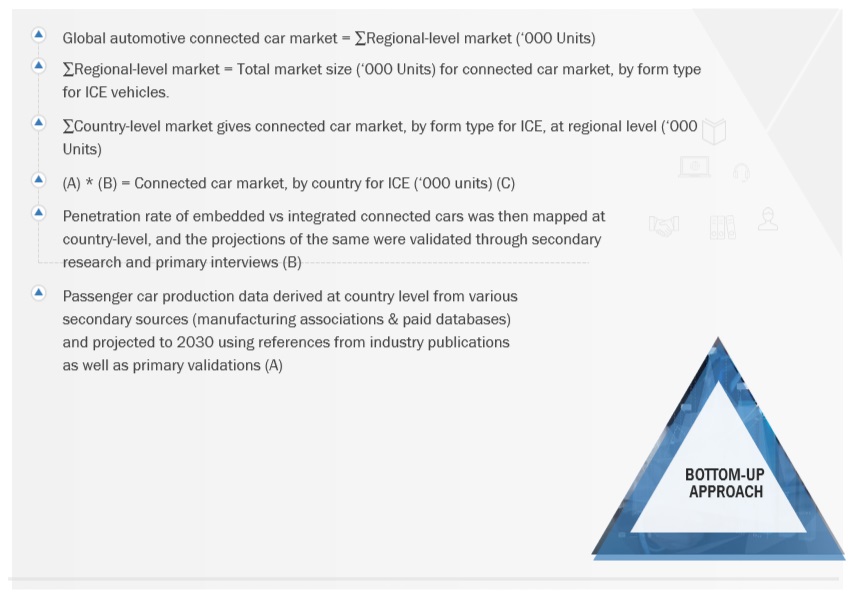
- The bottom-up approach has been used to estimate and validate the size of the global market. The market size, by volume, of the connected car market has been derived by studying various vehicles.
Connected Car Market Size: Bottom-Up Approach (Form Type And Region)
To know about the assumptions considered for the study, Request for Free Sample Report
Data Triangulation
All percentage shares, splits, and breakdowns have been determined using secondary sources and verified by primary sources. All parameters that affect the markets covered in this research study have been accounted for, viewed in extensive detail, and analyzed to obtain the final quantitative and qualitative data. This data has been consolidated and enhanced with detailed input and analysis and presented in the report. The following figure illustrates this study's overall market size estimation process.
Market Definition
Definition: According to Geotab, a connected car is a vehicle that is equipped with mobile technology and, therefore, “connected” via the internet. Telematics is also used to connect cars using a small device that plugs into the vehicle or through embedded technology. The telematics device acts as an Internet of Things (IoT) hub that sends vehicle data to a cloud service, which can be processed and accessed by the vehicle owner or fleet manager.
According to Bosch, a connected vehicle is defined as one that has devices that use sensors and wireless connectivity to connect with other components within the vehicle and with networks outside it to provide an enhanced driving experience. It also supports vehicle-to-vehicle and vehicle-to-infrastructure communication.
Stakeholders
- Connected car manufacturers.
- Automotive electronic component and software suppliers
- Automotive original equipment manufacturers (OEMs)
- Government regulatory bodies
- Telecommunication companies
- Automotive testing and certification services
- Automotive aftermarket suppliers
- Fleet management companies.
- Satellite communication providers
- Insurance companies
- Cybersecurity firms
Report Objectives
- To define, describe, segment, and forecast the connected car market in terms of volume (thousand units) and value (USD million)
-
To segment and forecast the market in terms of value and volume based on
- By service (navigation, remote diagnostics, multimedia streaming, social media & other apps, OTA updates, on-road assistance, eCall & SOS assistance, remote operation, auto parking/connected parking, autopilot, home integration, and stolen vehicle recovery/warning) at the regional level, in terms of value at the regional level
- By end market (OEM and aftermarket), in terms of value at the regional level
- By form type (embedded and integrated), in terms of volume at the regional level
- By hardware (head unit, central gateway, intelligent antenna, electronic control unit, telematics control unit, keyless entry system, and sensor), in terms of value at the regional level
- By transponder (onboard unit and roadside unit), in terms of volume at the regional level
- By network (DSRC and cellular) at the regional level, in terms of volume
- By connecting the electric car market based on vehicle type (BEV, PHEV, and FCEV) in terms of value at the regional level
- Region ((Asia Pacific, Europe, North America, and Rest of the World (RoW))
- To understand the market dynamics (Drivers, Restraints, Opportunities, and Challenges) and conduct Patent Analysis, Pricing Analysis, Recession Impact, Key Buying Criteria, Trade Analysis, Technology Analysis, ASP Analysis, Trades and Conferences, Case Study Analysis, Supply Chain Analysis, Regulatory Analysis, critical conference and events, and Ecosystem Mapping
- To understand the dynamics of the market players and distinguish them into stars, emerging leaders, pervasive players, and participants according to their product portfolio strength and business strategies.
- To strategically analyze markets concerning individual growth trends, prospects, and contributions to the total market
- To analyze recent developments, such as partnerships, supply agreements, joint ventures/mergers and acquisitions, geographic expansions, and product developments of key players in the market
Available Customizations
Connected Car Service Market By Vehicle Type
- BEV
- PHEV
- FCEV
Connected Car Market, By Cellular Network
- 2.14G/LTE
- 5G
Connected Car Hardware Market, By Aftermarket
- Head unit
- Central gateway
- Intelligent Antenna
- Electronic Control Unit (ECU)
- Telematic control unit (TCU)
- Keyless entry system
- Sensor
Detailed Analysis And Profiling Of Additional Market Players (Up To 3)
Get the Full Connected Car Market Report
Full forecast, segment splits, and company analysis for all Connected Car Market.
- Italy Connected Car Market
- Russia Connected Car Market
- Canada Connected Car Market
- Mexico Connected Car Market
- US Connected Car Market
- Brazil Connected Car Market
- Argentina Connected Car Market
- Iran Connected Car Market
- Rest Of Europe Connected Car Market
- Rest Of Asia Pacific Connected Car Market
- Other Countries Connected Car Market
- China Connected Car Market
- India Connected Car Market
- Japan Connected Car Market
- South Korea Connected Car Market
- Thailand Connected Car Market
- Germany Connected Car Market
- UK Connected Car Market
- Spain Connected Car Market
Need a Tailored Report?
Customize this report to your needs
Get 10% FREE Customization
Customize This Report
