
South Korea Control Valve Market (2026-2031)

The South Korea Control Valve Market was valued at $391.3 Million in 2026 and projected to reach to $535.7 Million by 2031, representing a compound annual growth rate of 5.4%. South Korea's control valve market is poised for sustained growth through 2031, driven by the country's world-leading semiconductor and electronics manufacturing sectors.


| Market Size in | USD 26.32 MN |
| Market Forecast in | |
| CAGR | |
| Forecast Period | |
| Units Considered | Value (USD MN) |
South Korea Control Valve Market Trends and Insights
- Valued at USD 391.3 million in 2026, South Korea's market is expected to expand to USD 535.7 million by 2031, reflecting a compound annual growth rate of 5.4%.
- This growth trajectory underscores South Korea's strategic importance in precision manufacturing and process automation across semiconductor fabrication and industrial applications. The expansion of South Korea's control valve market is driven by the country's robust semiconductor manufacturing base and increasing demand for advanced process control technologies.
- South Korea's investment in next-generation chip production facilities and automation infrastructure continues to fuel adoption of high-performance control valves.
- Between 2026 and 2031, South Korea is expected to maintain steady market momentum, supported by technological innovation and the country's leadership in electronics manufacturing. South Korea's control valve market benefits from strong domestic demand, export-oriented manufacturing, and continuous capital investment in industrial modernization.
- The country's competitive advantage in precision engineering positions South Korea as both a significant end-user market and a potential hub for control valve innovation within the broader Asia Pacific region..
Key Market Statistics
- CAGR (2026-2031) 5.4% CAGR
- Market Size, 2026 ~USD 391.3 Million
- Forecast, 2031 ~USD 535.7 Million
- Country South Korea
South Korea Control Valve Market Overview
Market Valuation Growth :
South Korea's control valve market is valued at USD 391.3 million in 2026 and is projected to reach USD 535.7 million by 2031, demonstrating robust expansion driven by semiconductor manufacturing demands.
Strong CAGR Performance :
South Korea's market exhibits a 5.4% CAGR from 2026-2031, outpacing the global average of 4.4%, reflecting the country's accelerated adoption of precision control technologies in electronics production.
Semiconductor Industry Leadership :
As a global semiconductor powerhouse, South Korea's control valve market benefits from the country's dominant position in chip manufacturing, with major players investing heavily in process automation and precision equipment.
Asia Pacific Strategic Hub :
South Korea serves as a critical manufacturing and innovation center within the Asia Pacific region, positioning its control valve market as essential infrastructure for advanced electronics and semiconductor production ecosystems.
South Korea Control Valve Market Dynamics
- The 5.4% CAGR reflects increasing investments in advanced fabrication facilities, process optimization, and automation technologies that require sophisticated control valve systems.
- South Korea's commitment to maintaining technological superiority in chip production ensures continued demand for high-precision control solutions. The market outlook is further strengthened by South Korea's focus on next-generation semiconductor technologies, including advanced packaging and 3D integration processes.
- Government initiatives supporting industrial automation and smart manufacturing will accelerate control valve adoption across the electronics supply chain.
- Strategic partnerships between local manufacturers and global technology leaders will enhance market penetration and drive innovation in precision control applications..
Market Ecosystem

CONTROL VALVE MARKET SIZE, SHARE & TRENDS: COMMERCIAL USE CASES ACROSS INDUSTRIES
| COMPANY | USE CASE DESCRIPTION | BENEFITS |
|---|---|---|
 |
Provides smart control valves, digital valve controllers, and automation systems for hydrogen production, LNG facilities, refineries, and chemical processing applications. Emerson’s solutions support hydrogen flow regulation, pressure management, leak prevention, and predictive maintenance through Industrial IoT-enabled monitoring platforms. | Enhances operational efficiency | Enables predictive maintenance | Improves process safety and reliability | Supports real-time monitoring and automation in hydrogen and energy infrastructure |
 |
Develops severe-service control valves, cryogenic valves, actuators, and sealing systems for hydrogen transportation, LNG terminals, petrochemical plants, and refinery applications. The company’s solutions are designed for high-pressure, corrosive, and extreme-temperature hydrogen environments. | Improves flow control accuracy | Supports safe hydrogen handling operations | Enhances reliability in severe-service environments | Reduces maintenance downtime and leakage risks |
 |
Deploys advanced flow control technologies, digital automation systems, and intelligent valve monitoring solutions for hydrogen, carbon capture, oil & gas, and energy transition projects. SLB supports hydrogen production and storage infrastructure with integrated process optimization technologies. | Enables digital process optimization | Supports energy transition projects | Improves operational visibility and safety | Enhances asset performance and remote monitoring capabilities |
 |
Manufactures hydrogen-compatible valves, cryogenic valves, stainless steel ball valves, and automated flow control systems for hydrogen fueling stations, semiconductor manufacturing, LNG facilities, and clean energy infrastructure applications. | Supports hydrogen and clean energy infrastructure | Enhances corrosion resistance and operational durability | Enables high-precision flow control | Improves reliability in cryogenic and high-purity applications |
 |
Provides intelligent flow control solutions including globe valves, butterfly valves, ball valves, and valve automation systems for hydrogen production, biofuel plants, chemical processing, and industrial decarbonization projects. Valmet integrates smart valve diagnostics and digital monitoring technologies into industrial automation systems. | Enables smart industrial automation | Supports predictive maintenance and digital monitoring | Improves energy efficiency and process optimization | Enhances operational safety and sustainability initiatives |
Logos and trademarks shown above are the property of their respective owners. Their use here is for informational and illustrative purposes only.
Related Ecosystem
Industrial Equipment
- HVAC System
- Fiberglass
- Actuators
- Cartridge Filters
- Electrostatic Precipitators
- Siemens ag
- GRUNDFOS GROUP
- ABB India Limited
- SCHNEIDER ELECTRIC SE
- Emerson Electric Co.
Industrial Automation
- Sensors
- Image Sensors
- Manufacturing Execution System (MES)
- Actuators
- Flow Sensors
- Siemens ag
- ABB India Limited
- Emerson Electric Co.
- HONEYWELL INTERNATIONAL INC.
- SCHNEIDER ELECTRIC SE
Key Takeaways
- South Korea's control valve market will grow from USD 391.3 million in 2026 to USD 535.7 million by 2031 at a 5.4% CAGR.
- South Korea's semiconductor manufacturing sector is the primary driver of control valve demand and market expansion.
- South Korea's advanced industrial infrastructure and automation investments support sustained market growth through 2031.
- South Korea's position in Asia Pacific makes it a strategic market for control valve manufacturers targeting electronics and precision industries.
Control Valve Market Report Scope
| Report Metric | Details |
|---|---|
| Base Year | 2026 |
| Fastest Growing Segment | UP TO 1" (Size) |
| Forecast Period | 2026–2031 |
| Growth Rate | CAGR of 4.4% from 2026 to 2031 |
| Largest Segment | ROTARY VALVES (Type) |
| Market Size Base Year (Billions) | ~USD 10.8 (2026) |
| Revenue Forecast (Billions) | ~USD 13.4 (2031) |
| Segments Covered | Type, Size, Industry, Valve Type, Component, Actuator Type, Material |
South Korea Control Valve Market Report Segmentation
7 segment dimensions are covered across the global market.
By Type
- Linear Valves
- Rotary Valves
By Size
- >1–6"
- >25– 50"
- >25–50"
- >50"
- >6–25"
- Up To 1"
By Industry
- Building & Construction
- Chemicals
- Energy & Power
- Food & Beverages
- Metals & Mining
- Oil & Gas
- Other Industries
- Pharmaceuticals
- Pulp & Paper
- Water & Wastewater Treatment
By Valve Type
- Ball Valves
- Butterfly Valves
- Diaphragm Valves
- Globe Valves
- Other Linear Valves
- Plug Valves
By Component
- Actuators
- Other Components
- Valve Bodies
By Actuator Type
- Electrical
- Hydraulic
- Pneumatic
By Material
- Alloy
- Cast Iron
- Cryogenic
- Other Materials
- Stainless Steel
Target Audience
- Semiconductor Equipment Manufacturers : South Korea-focused equipment makers need detailed market data to optimize product portfolios, identify growth opportunities in Korean fab expansions, and benchmark against regional competitors in precision control solutions.
- Control Valve Suppliers & Distributors : Suppliers targeting South Korea's electronics sector require country-specific market intelligence to assess demand forecasts, plan inventory strategies, and identify key customer segments within the semiconductor manufacturing base.
- Investment & Private Equity Firms : Investors evaluating opportunities in South Korea's industrial technology sector need comprehensive market data to assess growth potential, competitive positioning, and ROI prospects in the control valve supply chain.
- Electronics Manufacturing Companies : Korean and international electronics manufacturers require market insights to optimize procurement strategies, evaluate supplier capabilities, and plan capital investments in process automation and control systems.
- Technology & Strategy Consultants : Consulting firms advising clients on South Korea market expansion need detailed country-level analysis to develop market entry strategies, competitive assessments, and growth roadmaps in the semiconductor equipment sector.
Key Companies in the South Korea Control Valve Market
| Company | HQ | Ownership | Strongest segments |
|---|---|---|---|
| MKS INSTRUMENTS, INC | United States | Public Company | Vacuum Solutions Division (VSD),Photonics Solutions Division (PSD),Material Solutions Division (MSD), |
| WOODWARD, INC. | United States | Public Company | Aerospace OEM content (fuel systems, actuators, valves, sensors),Aerospace aftermarket (MRO, spares, services),Industrial turbine and engine controls (actuators, valves, control systems), |
| GE | United States | Public Company | Commercial Engines & Services,Defense & Propulsion Technologies, |
| WARTSILA | Finland | Public Company | Engine and hybrid power plants,Battery energy storage (Quantum BESS),GEMS Digital Energy Platform and software, |
| GRACO INC. | United States | Public Company | Contractor (paint, coatings, road-marking, roofing, dispense/mix equipment),Industrial (liquid and powder finishing, process pumps, lubrication systems),Expansion Markets (semiconductor pumps, high-pressure valves, environmental systems), |
| GODREJ GROUP | India | Private Company | Home and Commercial Appliances,Locks, Security, and Architectural Hardware,Construction, Civil Engineering, and Building Solutions, |
| ALIAXIS | Belgium | Public Company | Building and high-rise piping systems (water, drainage, symphonic),Municipal water supply, sewage, and stormwater management,Gas distribution and electrofusion/compression fittings, |
| EMERSON ELECTRIC CO. | United States | Public Company | Final Control,Measurement & Analytical,Discrete Automation, |
| FLOWSERVE CORPORATION | United States | Public Company | Flowserve Pumps Division (FPD) – pumps and systems,Flow Control Division (FCD) – valves and automation,Services, diagnostics, and asset management, |
| SLB | United States | Public Company | Digital & Integration,Reservoir Performance,Well Construction, |
| IMI | United Kingdom | Public Company | Process and Industrial Automation (fluid control, valves, actuators),Pneumatic and Electric Motion Systems,Climate Control (heating and cooling systems), |
| CRANE HOLDINGS, CO. | United States | Public Company | Aerospace & Advanced Technologies,Process Flow Technologies – Process Valves and Systems,Process Flow Technologies – Pumps and Commercial Valves, |
| KITZ CORPORATION | Japan | Public Company | Bronze valves,Steel valves,Other valve-related and filtration products, |
| CURTISS-WRIGHT CORPORATION | United States | Public Company | Defense Electronics,Naval & Power,Aerospace & Industrial, |
| VALMET | Finland | Public Company | Biomaterial Solutions and Services (pulp, paper, board, tissue lines and lifecycle services),Process Performance Solutions – Automation systems and industrial applications,Flow control – valves, pumps, and valve automation, |
| BAKER HUGHES COMPANY | United States | Public Company | Oilfield Services & Equipment – Drilling, Completions, Intervention,Oilfield Services & Equipment – Subsea, Surface & Integrated Well Services,Artificial Lift, Oilfield & Industrial Chemicals, |
| KSB SE & CO. KGAA | Germany | Public Company | Pumps,Valves,KSB SupremeServ (Services & Spare Parts), |
| CIRCOR INTERNATIONAL, INC. | United States | Private Company | Aerospace & Defense flow and motion control,Industrial screw and specialty pumps,Engineered and general service valves, |
| SAMSON AG | Luxembourg | Public Company | Travel luggage (hard/soft cases),Premium and business bags (Tumi, Hartmann, business/computer bags),Outdoor and casual bags (Gregory, High Sierra, Lipault, others), |
| HONEYWELL INTERNATIONAL INC. | United States | Public Company | Industrial Automation,Building Automation,Energy and Sustainability Solutions (UOP and related), |
MKS INSTRUMENTS, INC
MKS Instruments, Inc. is a publicly traded U.S. company founded in 1961 with 10,200 employees.
WOODWARD, INC.
Woodward, Inc. is a publicly traded U.S. company founded in 1870 with 10,200 employees.
GE
GE is a publicly traded U.S. company founded in 1892 with 57,000 employees.
WARTSILA
Wärtsilä is a publicly traded Finnish company founded in 1834 with 17,938 employees.
GRACO INC.
Graco Inc. is a publicly traded U.S. company founded in 1926 with 4,400 employees.
GODREJ GROUP
Godrej Group is a privately held Indian company founded in 1897 with 13,316 employees.
ALIAXIS
Aliaxis is a publicly traded Belgian company founded in 1980 with 16,000 employees.
EMERSON ELECTRIC CO.
Emerson Electric Co. is a publicly traded U.S. company founded in 1890 with 71,000 employees.
FLOWSERVE CORPORATION
Flowserve Corporation is a publicly traded U.S. company founded in 1790 with 16,000 employees.
SLB
SLB is a publicly traded U.S. company founded in 1926 with 109,000 employees.
IMI
IMI is a publicly traded U.K. company founded in 1862 with 10,358 employees.
CRANE HOLDINGS, CO.
Crane Holdings, Co. is a publicly traded U.S. company founded in 1855 with 7,100 employees.
KITZ CORPORATION
Kitz Corporation is a publicly traded Japanese company founded in 1944 with 5,469 employees.
CURTISS-WRIGHT CORPORATION
Curtiss-Wright Corporation is a publicly traded U.S. company founded in 1929 with 9,100 employees.
VALMET
Valmet is a publicly traded Finnish company founded in 1750 with 18,370 employees.
BAKER HUGHES COMPANY
Baker Hughes Company is a publicly traded U.S. company founded in 2016 with 53,000 employees.
KSB SE & CO. KGAA
KSB SE & Co. KGaA is a publicly traded German company founded in 1871 with 16,838 employees.
CIRCOR INTERNATIONAL, INC.
Circor International, Inc. is a privately held U.S. company founded in 1999 with 3,100 employees.
SAMSON AG
Samson AG is a publicly traded company based in Luxembourg founded in 1910 with 11,500 employees.
HONEYWELL INTERNATIONAL INC.
Honeywell International Inc. is a publicly traded U.S. company founded in 1885 with 101,000 employees.
Reasons to Buy this Report
- Market-Specific Sizing Data : Access precise valuation figures for South Korea's control valve market (USD 391.3M in 2026, USD 535.7M in 2031) with country-specific CAGR of 5.4%, enabling accurate financial forecasting and investment planning.
- Competitive Landscape Intelligence : Understand South Korea's unique competitive dynamics within the semiconductor and electronics sectors, identifying local and international players dominating the precision control valve supply chain.
- Sector-Specific Growth Drivers : Gain insights into South Korea-specific factors driving market expansion, including semiconductor fab investments, advanced manufacturing initiatives, and government industrial automation policies.
- Strategic Market Entry Planning : Develop targeted go-to-market strategies for South Korea by understanding regional demand patterns, customer preferences, and distribution channels specific to the Korean electronics manufacturing ecosystem.
- Investment Decision Support : Make informed capital allocation decisions with country-level market intelligence, including growth trajectory analysis, risk assessment, and opportunity identification within South Korea's high-value semiconductor sector.
Frequently asked questions
What is the current size of South Korea's control valve market?
South Korea's control valve market is valued at USD 391.3 million in 2026 and is projected to reach USD 535.7 million by 2031.
What is the growth rate of South Korea's control valve market?
South Korea's control valve market is expected to grow at a compound annual growth rate (CAGR) of 5.4% from 2026 to 2031.
Which industries drive demand for control valves in South Korea?
South Korea's semiconductor manufacturing, electronics production, and industrial automation sectors are the primary drivers of control valve demand.
Why is South Korea's control valve market significant in Asia Pacific?
South Korea's advanced manufacturing capabilities, semiconductor leadership, and precision engineering expertise make it a key market within the Asia Pacific region.
What factors support growth in South Korea's control valve market through 2031?
South Korea's continued investment in chip production facilities, automation infrastructure, and process control technologies support market expansion through 2031.
RESEARCH METHODOLOGY
The study involved four major activities in estimating the current size of the control valve market. Extensive secondary research was conducted to gather information on the market, adjacent industries, and the broader industrial automation ecosystem. This was followed by primary research with industry stakeholders across the value chain, including control valve manufacturers, automation solution providers, distributors, EPC (engineering, procurement, and construction) companies, and end users, to validate assumptions and market sizing. Both top-down and bottom-up approaches were used to estimate the overall market size. Market breakdowns and data triangulation techniques were then applied to derive the size of individual segments and subsegments. Secondary and primary sources were jointly used to support a comprehensive technical and commercial analysis of the control valve market.
Secondary Research
Various secondary sources were referred to in the secondary research process to identify and collect information relevant to the control valve market. These sources include annual reports, press releases, and investor presentations of key companies; white papers; technical journals; certified publications; and articles from recognized authors, industry websites, directories, and databases. Secondary research was conducted to obtain key insights into the market’s supply chain, value chain, competitive landscape, and segmentation across valve types, components, size, materials, industry, and regions. It also helped analyze industry trends, automation adoption, and recent technological developments in smart valve systems and industrial process control technologies. The collected data was further analyzed to estimate the overall market size and validate findings, which were subsequently refined through primary research with industry experts and stakeholders.
Primary Research
Extensive primary research was conducted after gaining knowledge about the current scenario of the control valve market through secondary research. Several primary interviews were conducted with experts from the demand and supply sides across four major regions: North America, Europe, Asia Pacific, and RoW. This primary data was collected through questionnaires, emails, and telephonic interviews.
Breakdown of Primary Interviews
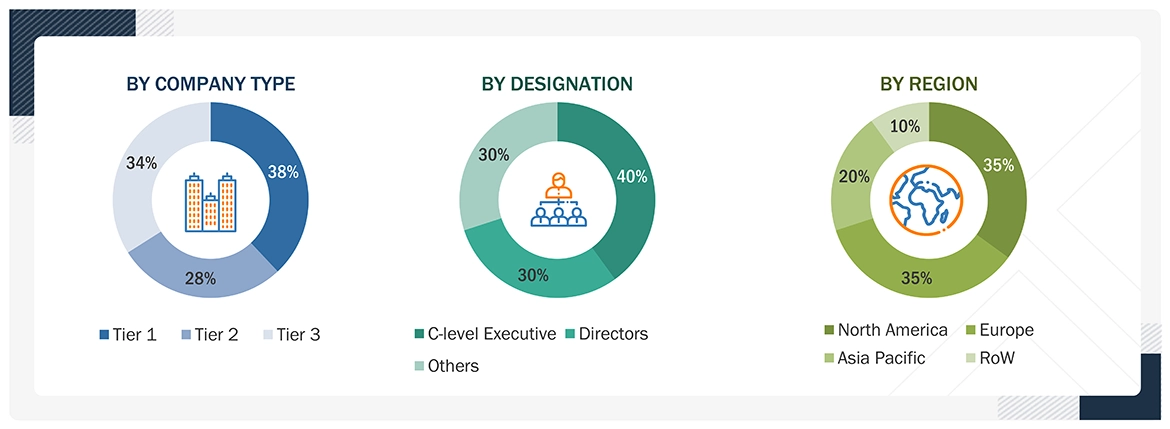
Note: The three tiers of the companies are defined based on their total revenue in 2025: Tier 1 - revenue greater than or equal to USD 1 billion; Tier 2 - revenue between USD 100 million and USD 1 billion; and Tier 3 revenue less than or equal to USD 100 million. Other designations include sales managers, marketing managers, and product managers.
To know about the assumptions considered for the study, download the pdf brochure
Market Size Estimation
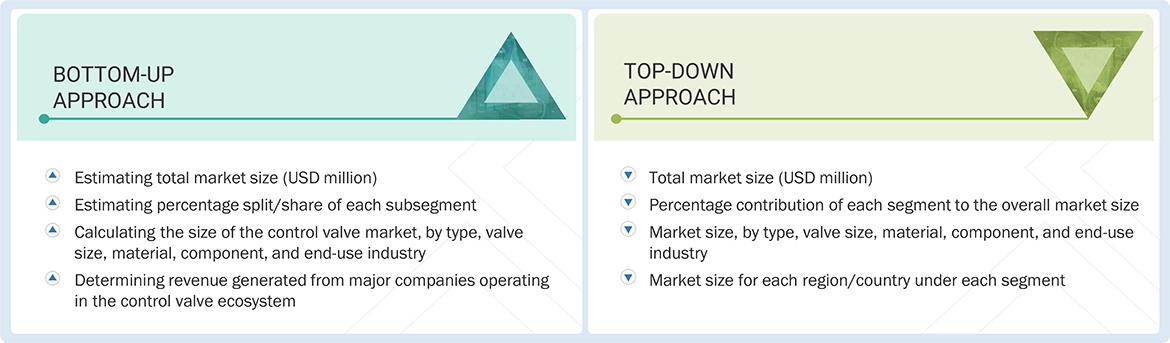
Both top-down and bottom-up approaches used to estimate and validate the total size of the control valve market. These methods have also been used extensively to estimate the size of various subsegments in the market. The following research methodology was used to estimate the market size:
- Major players in the industry and markets were identified through extensive secondary research.
- The industry’s value chain and market size (in terms of value) were determined through primary and secondary research processes.
- All percentage shares, splits, and breakdowns were determined using secondary sources and verified through primary sources.
Control Valve Market : Top-Down and Bottom-Up Approach
Data Triangulation
After arriving at the overall size of the control valve market from the market size estimation process explained above, the total market was split into several segments and subsegments. Data triangulation and market breakdown procedures were employed, wherever applicable, to complete the overall market engineering process and arrive at the exact statistics for all segments and subsegments of the market. The data was triangulated by studying various factors and trends from both the demand and supply sides. Along with this, the market size was validated using both top-down and bottom-up approaches.
Market Definition
A control valve is a device used to regulate the flow, pressure, temperature, and level of fluids within industrial process systems, ensuring operational efficiency, process safety, and automation across various industries. Control valves operate through different actuation and control mechanisms, including pneumatic, electric, hydraulic, and smart automated systems, depending on the application requirements and process conditions. These valves are designed to provide accurate flow control, optimize industrial performance, and support real-time process monitoring in critical industrial environments.
A control valve plays a vital role in industries such as oil & gas, energy & power, chemicals, water & wastewater treatment, pharmaceuticals, food & beverages, and pulp & paper. These valves help improve process reliability, reduce operational risks, and enhance energy efficiency by enabling precise control of industrial fluid systems. They are commonly integrated into industrial automation systems, pipelines, refineries, processing plants, and utility infrastructure. A typical control valve consists of valve bodies, actuators, positioners, controllers, and monitoring systems and may vary in design based on valve type, operating conditions, and application requirements.
Key Stakeholders
- Control valve manufacturers and industrial automation solution providers (control valves, actuators, positioners, and smart valve systems)
- Industrial process companies and EPC contractors involved in oil & gas, chemicals, power generation, and water infrastructure projects
- Oil & gas, chemical, and petrochemical companies utilizing control valves in process automation and fluid handling systems
- Power generation companies and utility operators using control valves for steam, pressure, and flow management applications
- Water & wastewater treatment companies and infrastructure operators deploying automated flow control solutions
- Government and regulatory authorities involved in industrial safety standards, environmental regulations, and infrastructure development initiatives
- Research institutions, laboratories, and R&D organizations working on industrial automation, smart manufacturing, and valve technology
- Investors, venture capitalists, and funding agencies supporting industrial automation and process control technology ecosystems
- End-use industries such as pharmaceuticals, food & beverages, pulp & paper, mining, and manufacturing sectors deploying control valve systems
- System integrators, distributors, and maintenance service providers supporting industrial process automation and control valve deployment
Report Objectives
- To define, describe, and forecast the control valve market, by component, media, pressure range, material, type, valve size, end-use industry, and region, in terms of value
- To forecast the market size, by region—North America, Europe, Asia Pacific, and Rest of the World (RoW), in terms of value
- To provide qualitative information about the applications of control valves, recent trends in industrial automation technologies, and advancements in smart valve solutions across industries
- To provide detailed information regarding the major factors influencing the growth of the market, namely, drivers (increasing industrial automation), restraints (high maintenance and operational costs), opportunities (Industry 4.0 and smart manufacturing adoption), and challenges (cybersecurity and system integration complexities)
- To estimate the market size in terms of value for control valves by type, including rotary and linear control valves
- To strategically analyze micro markets with respect to individual growth trends, prospects, and contributions to the total market
- To study the complete control valve value chain, including raw material suppliers, component manufacturers, control valve manufacturers, automation solution providers, distributors, and end users
- To analyze opportunities in the market for stakeholders by identifying high-growth segments such as oil & gas, energy & power, water & wastewater treatment, chemicals, and industrial automation applications
- To strategically profile key players and comprehensively analyze their core competencies, along with detailing the competitive landscape for market leaders
- To analyze competitive developments such as product launches, mergers, acquisitions, partnerships, and expansions in the control valve market
- To benchmark market players using company evaluation frameworks based on various parameters within business strategies, product portfolios, and technological capabilities
- To provide a macroeconomic outlook for all regions covered in this report, considering industrial automation trends, infrastructure development, and energy transition initiatives
- To provide information on ecosystem analysis, case study analysis, technology trends, emerging applications, interconnected markets, and cross-sector opportunities, along with the impact of evolving industrial safety regulations and digitalization trends on the control valve market
Available customizations:
With the given market data, MarketsandMarkets offers customizations according to the company’s specific needs. The following customization options are available for the report:
Company Information
-
Detailed analysis and profiling of additional market players (up to 5)
Get the Full Control Valve Market Report
Full forecast, segment splits, and company analysis for all Control Valve Market.
- US Control Valve Market
- Canada Control Valve Market
- Mexico Control Valve Market
- Germany Control Valve Market
- UK Control Valve Market
- France Control Valve Market
- Italy Control Valve Market
- Rest Of Europe Control Valve Market
- China Control Valve Market
- Japan Control Valve Market
- India Control Valve Market
- Rest Of Asia Pacific Control Valve Market
Need a Tailored Report?
Customize this report to your needs
Get 10% FREE Customization
Customize This Report
