
Argentina Dairy Processing Equipment Market (2026-2031)

The Argentina Dairy Processing Equipment Market was valued at $246.4 Million in 2026 and projected to reach to $340.8 Million by 2031, representing a compound annual growth rate of 6.7%. Argentina's dairy processing equipment market is experiencing robust growth, valued at USD 246.4 million in 2026 and projected to expand to USD 340.8 million by 2031, representing a 6.7% CAGR.


| Market Size in | USD 26.32 MN |
| Market Forecast in | |
| CAGR | |
| Forecast Period | |
| Units Considered | Value (USD MN) |
Argentina Dairy Processing Equipment Market Trends and Insights
- Argentina's strong dairy heritage and export-oriented production model drive demand for modernized processing technologies that enhance efficiency and product quality.
- The country's investment in automation and compliance with international food safety standards supports equipment adoption across milk processing, cheese production, and yogurt manufacturing facilities. The 6.7% compound annual growth rate reflects Argentina's commitment to upgrading aging infrastructure and increasing production capacity to meet both domestic and export demand.
- Argentina's competitive positioning in global dairy markets incentivizes processors to adopt advanced equipment for cost reduction and yield optimization.
- Regional consolidation among dairy cooperatives and private producers in Argentina further accelerates the transition toward mechanized, high-capacity processing solutions..
Key Market Statistics
- CAGR (2026-2031) 6.7% CAGR
- Market Size, 2026 ~USD 246.4 Million
- Forecast, 2031 ~USD 340.8 Million
- Country Argentina
Argentina Dairy Processing Equipment Market Overview
Strong Export-Driven Growth :
Argentina's dairy sector is one of South America's largest exporters, with processing equipment demand driven by international quality standards and production scaling requirements for global markets.
Automation Investment Surge :
Argentine dairy processors are increasingly adopting automated solutions to improve efficiency, reduce labor costs, and maintain competitiveness in premium export segments like cheese and milk powders.
Regulatory Compliance Drivers :
Stricter food safety regulations and international certifications (ISO, FSSC 22000) are compelling Argentine dairy facilities to upgrade processing equipment for traceability and quality assurance.
Regional Market Leadership :
Argentina commands significant dairy processing capacity in LATAM, with modernization investments supporting both domestic consumption and cross-border trade within Mercosur and beyond.
Argentina Dairy Processing Equipment Market Dynamics
- This expansion is underpinned by Argentina's established dairy heritage and export-oriented production model, which necessitates continuous technological upgrades.
- The country's processors are investing heavily in modernized equipment to enhance operational efficiency, improve product quality, and meet stringent international food safety standards. Key growth catalysts include rising automation adoption across processing facilities, increased investment in compliance infrastructure, and growing demand for specialized equipment in cheese, yogurt, and milk powder production.
- As Argentina strengthens its position in global dairy markets, equipment manufacturers and suppliers will benefit from sustained demand for innovative processing solutions that support both capacity expansion and product diversification..
Market Ecosystem
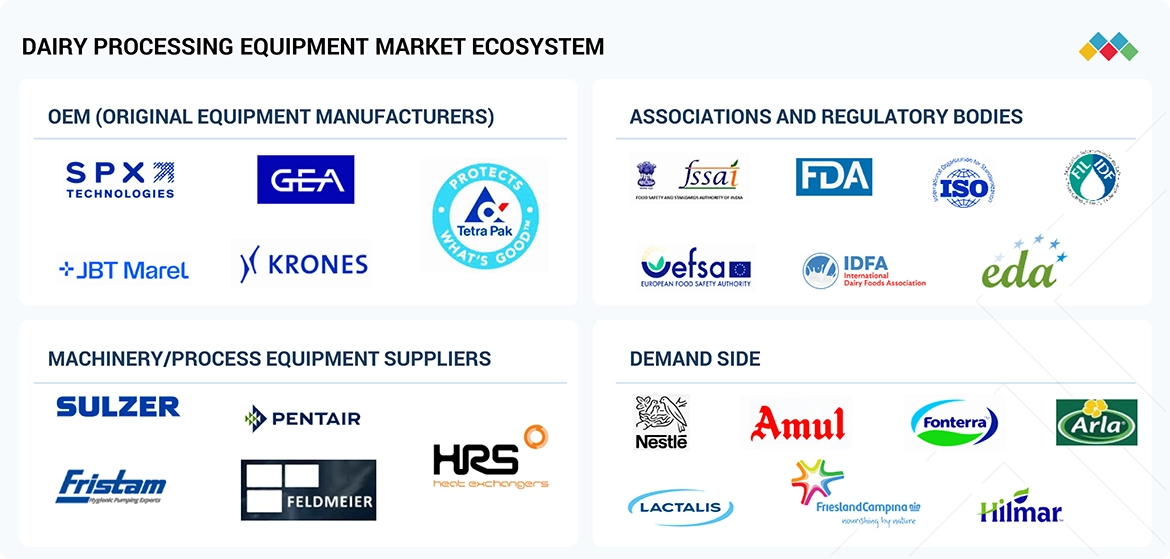
DAIRY PROCESSING EQUIPMENT MARKET TRENDS, GROWTH, AND FORECAST [LATEST]: COMMERCIAL USE CASES ACROSS INDUSTRIES
| COMPANY | USE CASE DESCRIPTION | BENEFITS |
|---|---|---|
 |
Uses large-scale dairy processing systems for production of milk powder, dairy beverages, and infant nutrition products | Ensures consistent product quality, enables high-volume production, and supports global distribution with extended shelf life |
 |
Operates integrated dairy processing plants for milk, butter, cheese, and dairy products across multiple facilities | Improves processing efficiency, maintains product safety standards, and supports large-scale milk handling and distribution |
 |
Utilizes advanced processing equipment for yogurt, fermented dairy products, and functional dairy beverages | Enhances product consistency, supports innovation in value-added dairy products, and improves process control |
 |
Uses evaporation and drying systems for the production of milk powder, whey proteins, and dairy ingredients | Enables efficient large-scale production, supports export-oriented operations, and ensures high product quality and stability |
Logos and trademarks shown above are the property of their respective owners. Their use here is for informational and illustrative purposes only.
Related Ecosystem
Fandb Processing And Technology
- Dairy Products
- Bakery Products
- Filtration Equipment
- Heat Exchanger
- Acetic Acid
- Gea group
- John Bean Technologies Corporation
- Alfa Laval Corporate AB
- AZELIS HOLDINGS SA
- SPX FLOW INC
Key Takeaways
- Argentina's dairy processing equipment market is valued at USD 246.4 million in 2026, expanding to USD 340.8 million by 2031 at a 6.7% CAGR.
- Argentina's export-driven dairy sector and infrastructure modernization initiatives are primary catalysts for equipment market growth.
- Automation and food safety compliance investments position Argentina as a regional leader in dairy processing technology adoption.
- Argentina's dairy cooperatives and consolidating producers are driving demand for high-capacity, cost-efficient processing solutions.
Dairy Processing Equipment Market Report Scope
| Report Metric | Details |
|---|---|
| Base Year | 2026 |
| Fastest Growing Segment | EVAPORATORS (Type) |
| Forecast Period | 2026–2031 |
| Growth Rate | CAGR of 6.4% from 2026 to 2031 |
| Largest Segment | AUTOMATIC (Mode Of Operation) |
| Market Size Base Year (Billions) | ~USD 12.73 (2026) |
| Revenue Forecast (Billions) | ~USD 17.36 (2031) |
| Segments Covered | Type, Application, Mode Of Operation |
Argentina Dairy Processing Equipment Market Report Segmentation
3 segment dimensions are covered across the global market.
By Type
- Depositors & Pan-Greasers
- Dryers
- Evaporators
- Homogenizers
- Membrane Filtration Equipment
- Mixers
- Mixers & Blenders
- Other Types
- Oven & Proofers
- Pasteurizers
- Pre-Processing
- Processing
- Separators
- Separators & Centrifuges
- Sheeters & Molders
- Slicers & Dividers
By Application
- Butter & Buttermilk
- Cheese
- Fresh Dairy Products
- Milk Powder
- Processed Milk
- Protein Ingredients
By Mode Of Operation
- Automatic
- Semi-Automatic
ARGENTINA: DAIRY PROCESSING EQUIPMENT MARKET, BY APPLICATION, 2026–2031
| Segment | 2026 | 2027 | 2028 | 2029 | 2030 | 2031 | CAGR (%) |
|---|---|---|---|---|---|---|---|
| BUTTER & BUTTERMILK | 5.6 | 5.9 | 6.2 | 6.5 | 6.9 | 7.3 | 5.3 |
| CHEESE | 52.8 | 56.3 | 60.1 | 64.3 | 68.9 | 74 | 7 |
| FRESH DAIRY PRODUCTS | 67.3 | 71.2 | 75.3 | 79.9 | 84.9 | 90.3 | 6 |
| MILK POWDER | 35.3 | 37.8 | 40.7 | 43.8 | 47.3 | 51.1 | 7.7 |
| PROCESSED MILK | 80.9 | 86.2 | 91.9 | 98.2 | 105.1 | 112.6 | 6.8 |
| PROTEIN INGREDIENTS | 4.5 | 4.6 | 4.8 | 5 | 5.2 | 5.4 | 3.9 |
| TOTAL | 246.4 | 262 | 279 | 297.7 | 318.2 | 340.8 | 6.7 |
Target Audience
- Dairy Equipment Manufacturers : Equipment makers need Argentina-specific market data to identify growth opportunities, understand local customer requirements, and develop competitive strategies for this export-driven dairy market.
- Dairy Processing Facility Operators : Processors require market insights to benchmark their operations, identify modernization priorities, understand technology trends, and make informed capital investment decisions for equipment upgrades.
- Investment & Private Equity Firms : Investors evaluating dairy sector opportunities in Argentina need detailed market forecasts, growth drivers, and competitive dynamics to assess investment returns and portfolio company potential.
- Trade & Export Associations : Industry bodies representing Argentine dairy exporters need market data to advocate for member interests, identify sector challenges, and develop strategic initiatives supporting equipment modernization.
- Consulting & Business Strategy Firms : Consultants advising clients on Argentina dairy sector expansion require localized market intelligence, regulatory insights, and competitive analysis to develop credible strategic recommendations.
Key Companies in the Argentina Dairy Processing Equipment Market
| Company | HQ | Ownership | Strongest segments |
|---|---|---|---|
| DANONE | France | ||
| ILLINOIS TOOL WORKS INC. | United States | Public Company | Automotive OEM,Food Equipment,Test & Measurement and Electronics, |
| UNILEVER PLC | United Kingdom |
DANONE
Danone is a company based in France.
ILLINOIS TOOL WORKS INC.
Illinois Tool Works Inc. is a public company founded in 1912 and headquartered in the United States. With 43,000 employees, it is a large multinational manufacturer serving diverse industrial markets.
UNILEVER PLC
Unilever PLC is a company based in the United Kingdom.
Reasons to Buy this Report
- Precise Argentina Market Sizing : Access validated market data specific to Argentina's dairy processing equipment sector with accurate 2026-2031 forecasts, enabling confident investment and expansion decisions in this key LATAM market.
- Export Opportunity Identification : Understand Argentina's export-driven demand dynamics and identify high-potential customer segments among dairy processors scaling production for international markets and premium product lines.
- Regulatory & Compliance Insights : Gain clarity on Argentina-specific food safety regulations and international certification requirements driving equipment upgrades, helping suppliers position compliant solutions effectively.
- Competitive Landscape Analysis : Benchmark against regional competitors and identify market gaps in automation, specialized processing, and technology adoption across Argentina's diverse dairy production ecosystem.
- Strategic Growth Planning : Leverage Argentina-focused market intelligence to develop targeted go-to-market strategies, partnership opportunities, and product development roadmaps aligned with local industry trends and customer needs.
Frequently asked questions
What is the current size of Argentina's dairy processing equipment market?
Argentina's dairy processing equipment market is valued at USD 246.4 million in 2026 and is projected to grow to USD 340.8 million by 2031.
What is the expected growth rate for Argentina's dairy processing equipment market?
Argentina's dairy processing equipment market is expected to grow at a compound annual growth rate (CAGR) of 6.7% from 2026 to 2031.
What factors are driving growth in Argentina's dairy processing equipment market?
Key drivers include Argentina's export-oriented dairy production, infrastructure modernization, automation adoption, international food safety compliance requirements, and consolidation among dairy cooperatives and producers.
Which dairy processing segments are most active in Argentina?
Argentina's primary dairy processing segments include milk processing, cheese production, and yogurt manufacturing, all of which are investing in modernized equipment.
How does Argentina's market compare to the broader Latin America region?
Argentina represents a significant portion of Latin America's dairy processing equipment market, driven by its established dairy industry, export competitiveness, and technology adoption rates.
RESEARCH METHODOLOGY
The study employed two primary approaches to estimate the current size of the dairy processing equipment market. Exhaustive secondary research was conducted to gather information on the market, peer markets, and parent markets. The next step was to validate these findings, assumptions, and sizing with industry experts across the value chain through primary research. Both top-down and bottom-up approaches were employed to estimate the complete market size. After that, data triangulation was used to estimate the market size of segments and subsegments.
Secondary Research
This research study involved the extensive use of secondary sources, directories and databases such as Bloomberg Businessweek and Factiva to identify and collect information useful for a technical, market-oriented and commercial study of the market.
In the secondary research process, various sources such as annual reports, press releases & investor presentations of companies, white papers, food journals, certified publications, articles from recognized authors, directories, and databases were referred to to identify and collect information.
Secondary research was mainly used to obtain key information about the industry’s supply chain, the total pool of key players, and market classification and segmentation as per the industry trends to the bottom-most level, regional markets, and key developments from both market- and technology-oriented perspectives.
Primary Research
Extensive primary research was conducted after obtaining information regarding the dairy processing equipment market scenario through secondary research. Several primary interviews were conducted with market experts from both the demand and supply sides across major countries of North America, Europe, Asia Pacific, South America, and RoW. Primary data was collected through questionnaires, emails, and telephonic interviews. The primary sources from the supply side included various industry experts, such as Chief X Officers (CXOs), Vice Presidents (VPs), Directors from business development, marketing, research, and development teams, and key opinion leaders. Primary interviews were conducted to gather insights such as market statistics, data on revenue collected from the products and services, market breakdowns, market size estimations, market forecasting, and data triangulation. Primary research also helped in understanding the various trends related to dairy processing equipment, related to type, specialty, distribution channels, and form of consumption. Stakeholders from the demand side, such as research institutions and universities, and third-party vendors, were interviewed to understand the buyer’s perspective on the service, and their current usage of dairy processing equipment and the outlook of their business, which will affect the overall market.
Breakdown of Primary Interviews
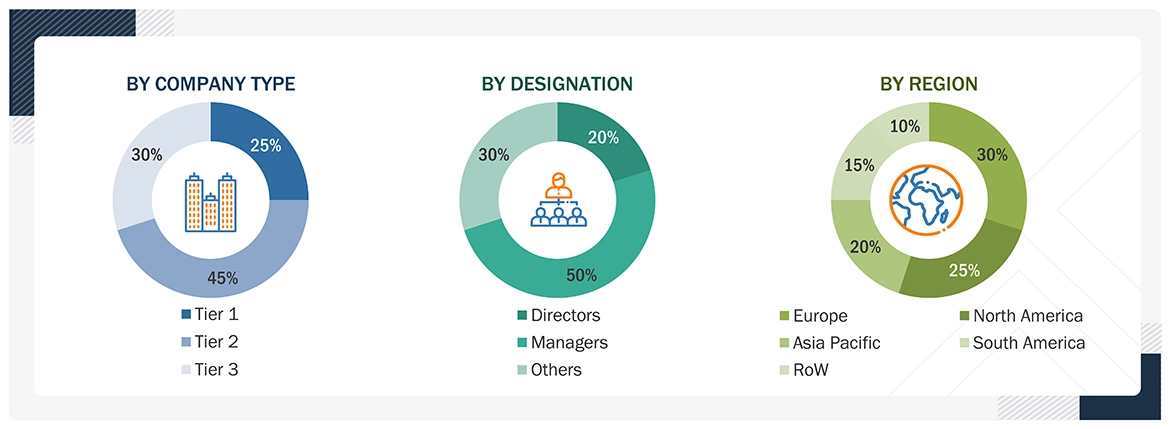
Note: The three tiers of the companies are defined based on their total revenues in 2023 or 2024, as per the availability of financial data: Tier 1: Revenue >USD 1 billion; Tier 2: USD 100 million ≤ Revenue ≤ USD 1 billion; Tier 3: Revenue <USD 100 million.
|
COMPANY NAME |
DESIGNATION |
|
Tetra Pak (Switzerland) |
R&D Expert |
|
GEA Group (Germany) |
Sales Manager |
|
Alfa Laval (Sweden) |
Manager |
|
SPX FLOW (US) |
Sales Manager |
|
IDMC Limited (India) |
Marketing Manager |
To know about the assumptions considered for the study, download the pdf brochure
Market Size Estimation
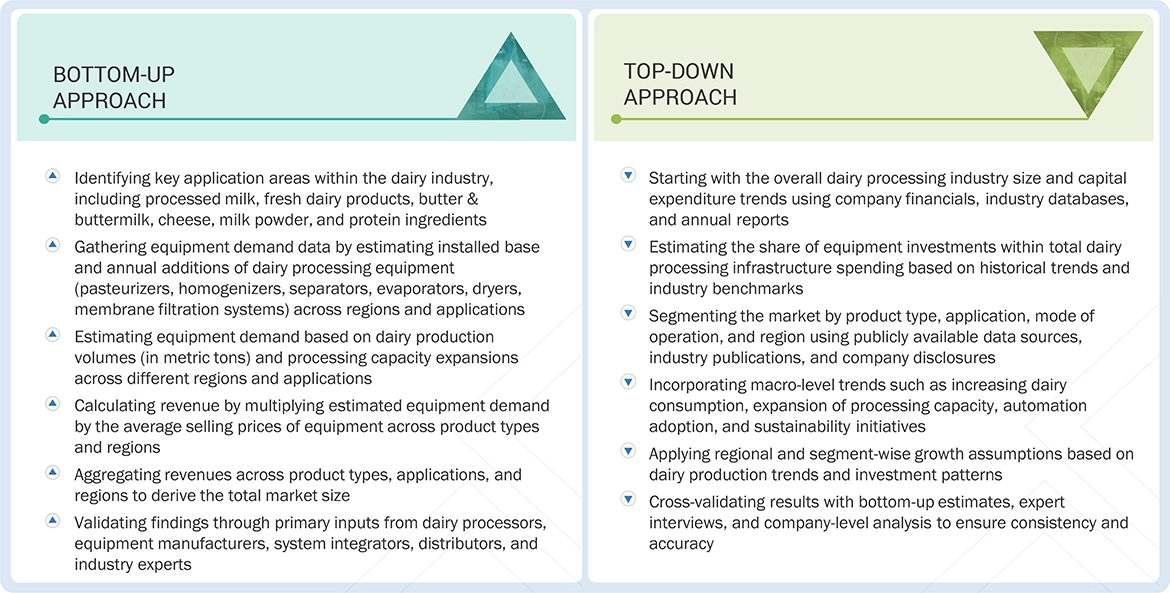
Both the top-down and bottom-up approaches were used to estimate and validate the total size of the dairy processing equipment market. These approaches were also used extensively to determine the size of various subsegments in the market. The research methodology used to estimate the market size includes the following details:
Dairy Processing Equipment Market: Bottom-up & Top-down Approaches
Data Triangulation
After arriving at the overall market size from the estimation process explained above, the total market was split into several segments and subsegments. The data triangulation and market breakdown procedures were employed, wherever applicable, to estimate the overall dairy processing equipment market and arrive at the exact statistics for all segments and subsegments. The data was triangulated by studying various factors and trends from the demand and supply sides. The market size was also validated using both the top-down and bottom-up approaches.
Market Definition
Dairy processing equipment consists of equipment used for the optimum utilization of milk properties and nutrients. To prepare a diverse range of dairy products such as processed milk, fresh dairy products, butter & buttermilk, cheese, milk powder, and protein ingredients, many different processes were developed by the industry. Dairy product manufacturing involves various processes such as pasteurization, homogenization, filtration, drying, and separation. To enable these processes, dairy processors use equipment such as pasteurizers, homogenizers, separators, evaporators & dryers, membrane filtration equipment, mixers & blenders, and other equipment such as churning equipment, crystallizers, chillers, silos, cutters, and cheese vats.
Key Stakeholders
- Manufacturers, dealers, and suppliers of dairy processing equipment
- Government bodies
- Dairy products manufacturers
- Dairy farms
- Intermediate suppliers such as retailers, wholesalers, and distributors
- Raw material suppliers
- Technology providers
- Industry associations
- Regulatory bodies and institutions:
- World Health Organization (WHO)
- Code of Federal Regulations (CFR)
- US Food and Drug Administration (FDA)
- Codex Alimentarius Commission (CAC)
- EUROPA
- United States Department of Agriculture (USDA)
- Food Processing Suppliers Association (FPSA)
- European Dairy Association
- Logistics providers & transporters
- Research institutes and organizations
- Consulting companies/consultants in the agricultural technology sectors
Report Objectives
-
MARKET INTELLIGENCE
- To determine, define, and project the size of the dairy processing equipment market with respect to product type, application, mode of operation, and regional markets over a five-year period (2026–2031)
- To identify attractive opportunities in the market by determining the largest and fastest-growing segments across product types, applications, and regions
- To provide detailed information about the key factors influencing market growth, including drivers, restraints, opportunities, and challenges
- To analyze the market at a granular level with respect to individual segment performance, growth trends, and their contribution to the overall market
- To evaluate the competitive landscape by profiling key market players and analyzing their product portfolios, technological capabilities, and strategic positioning
- To track and analyze competitive developments such as product launches, partnerships, expansions, and mergers & acquisitions within the dairy processing equipment market
Available customizations:
With the given market data, MarketsandMarkets offers customizations according to company-specific scientific needs.
The following customization options are available for the report:
PRODUCTS ANALYSIS
- Products Matrix, which gives a detailed comparison of the service portfolio of each company.
GEOGRAPHIC ANALYSIS
With the given market data, MarketsandMarkets offers customizations according to company-specific scientific needs.
- Further breakdown of the Rest of Europe dairy processing equipment market into key countries.
- Further breakdown of the Rest of Asia Pacific dairy processing equipment market into key countries.
- Further breakdown of the Rest of South America dairy processing equipment market into key countries.
COMPANY INFORMATION
- Detailed analyses and profiling of additional market players (up to five)
Get the Full Dairy Processing Equipment Market Report
Full forecast, segment splits, and company analysis for all Dairy Processing Equipment Market.
- US Dairy Processing Equipment Market
- Canada Dairy Processing Equipment Market
- Mexico Dairy Processing Equipment Market
- Germany Dairy Processing Equipment Market
- France Dairy Processing Equipment Market
- Italy Dairy Processing Equipment Market
- UK Dairy Processing Equipment Market
- Netherlands Dairy Processing Equipment Market
- China Dairy Processing Equipment Market
- India Dairy Processing Equipment Market
- Japan Dairy Processing Equipment Market
- Brazil Dairy Processing Equipment Market
- Rest Of Europe Dairy Processing Equipment Market
- Rest Of Asia Pacific Dairy Processing Equipment Market
- Rest Of South America Dairy Processing Equipment Market
Need a Tailored Report?
Customize this report to your needs
Get 10% FREE Customization
Customize This Report
