
Australia Diagnostic Imaging Market (2025-2030)

The Australia Diagnostic Imaging Market was valued at $498.2 Million in 2025 and projected to reach to $596.1 Million by 2030, representing a compound annual growth rate of 3.7%. Australia's diagnostic imaging market is positioned for steady growth at a 3.7% CAGR through 2030, supported by an aging population requiring increased diagnostic services and ongoing healthcare infrastructure modernization.


| Market Size in | USD 26.32 MN |
| Market Forecast in | |
| CAGR | |
| Forecast Period | |
| Units Considered | Value (USD MN) |
Australia Diagnostic Imaging Market Trends and Insights
- Australia's healthcare infrastructure and aging population are driving steady demand for advanced imaging technologies including MRI, CT, ultrasound, and digital radiography systems.
- The market in Australia reflects the country's commitment to modernizing diagnostic capabilities and improving patient outcomes across both public and private healthcare sectors. Growth in Australia's diagnostic imaging market is supported by increasing prevalence of chronic diseases, rising healthcare expenditure, and technological advancements in imaging equipment.
- Australia's regulatory environment and reimbursement policies continue to facilitate adoption of newer diagnostic modalities.
- Between 2025 and 2030, Australia is expected to see expanded investment in imaging infrastructure, particularly in regional areas, as healthcare providers seek to enhance diagnostic accuracy and operational efficiency..
Key Market Statistics
- CAGR (2025-2030) 3.7% CAGR
- Market Size, 2025 ~USD 498.2 Million
- Forecast, 2030 ~USD 596.1 Million
- Country Australia
Australia Diagnostic Imaging Market Overview
Market Valuation :
Australia's diagnostic imaging market is valued at USD 498.2 million in 2025, with projected growth to USD 596.1 million by 2030, driven by healthcare infrastructure investments and technological adoption.
Aging Population Dynamics :
Australia's rapidly aging demographic is a key growth driver, increasing demand for diagnostic imaging services across MRI, CT, ultrasound, and digital radiography for chronic disease detection and management.
Technology Adoption :
Advanced imaging technologies including AI-integrated systems and portable ultrasound devices are gaining traction in Australian healthcare facilities, improving diagnostic accuracy and patient outcomes.
Healthcare Infrastructure :
Strong public and private healthcare systems in Australia support steady investment in diagnostic imaging equipment, with both urban and regional facilities modernizing their imaging capabilities.
Australia Diagnostic Imaging Market Dynamics
- The market benefits from Australia's robust healthcare system, high technology adoption rates, and strong regulatory frameworks that ensure quality imaging services across both public and private sectors. Key growth opportunities exist in regional healthcare expansion, integration of AI-powered diagnostic tools, and adoption of advanced imaging modalities.
- While growth rates remain moderate compared to global averages (4.4%), Australia's mature healthcare market and high per-capita spending on diagnostic services provide stable, predictable revenue streams for market participants..
Market Ecosystem
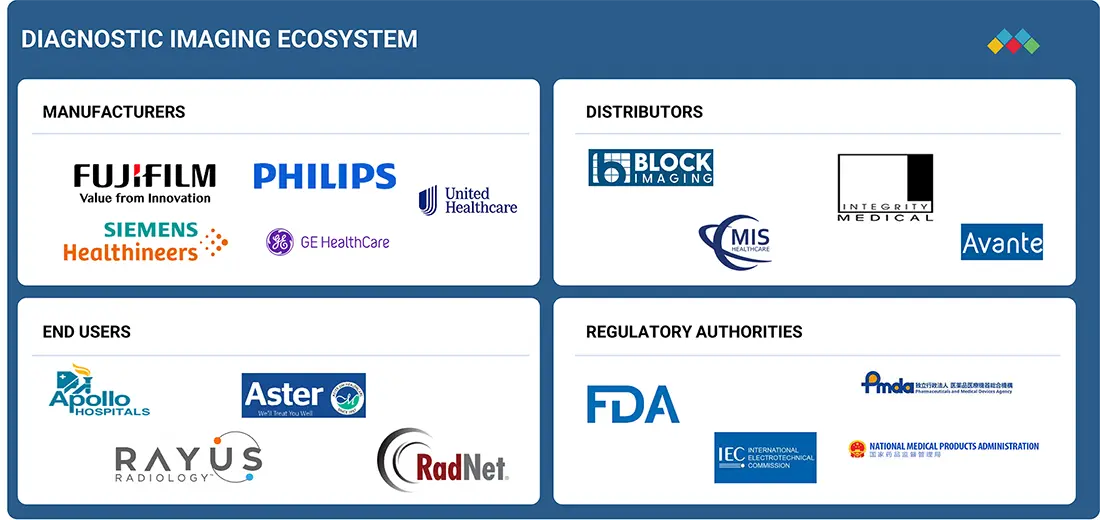
diagnostic Imaging market: COMMERCIAL USE CASES ACROSS INDUSTRIES
| COMPANY | USE CASE DESCRIPTION | BENEFITS |
|---|---|---|
 |
Integrated hospital-based diagnostic imaging centers offering CT, MRI, PET/CT, X-ray, mammography, and advanced AI-assisted reporting across India | Strong referral network from Apollo’s multi-specialty hospitals |
 |
Hub-and-spoke diagnostic imaging model with centers in hospitals and standalone clinics across India, GCC, and other regions | Efficient resource utilization through centralized radiology reporting |
 |
Outpatient diagnostic imaging centers specializing in MRI, CT, ultrasound, mammography, and pain management imaging services | Lower cost alternative to hospital-based imaging |
 |
Large-scale network of freestanding diagnostic imaging centers offering MRI, CT, PET/CT, mammography, ultrasound, and AI-powered analytics | Economies of scale leading to cost-efficient operations |
Logos and trademarks shown above are the property of their respective owners. Their use here is for informational and illustrative purposes only.
Related Ecosystem
Diagnostic Imaging
- Magnetic Resonance Imaging (MRI)
- Computed Tomography (CT)
- CT Scanners
- Nuclear Imaging
- Positron Emission Tomography
- Siemens healthineers
- PHILIPS HEALTHCARE
- CANON INC.
- FUJIFILM Holdings Corporation
- UNITED IMAGING HEALTHCARE CO., LTD.
Medical Devices
- Polymerase Chain Reaction (PCR)
- Magnetic Resonance Imaging (MRI)
- Disposable Autoinjectors
- Pulse Oximeters
- Blood Pressure Monitors
- Medtronic plc
- Stryker Corporation
- Abbott Laboratories
- Becton, Dickinson and Company
- JOHNSON & JOHNSON
Key Takeaways
- Australia's diagnostic imaging market is valued at USD 498.2 million in 2025 and will reach USD 596.1 million by 2030 at a 3.7% CAGR.
- Australia's aging demographic and rising chronic disease prevalence are primary drivers of diagnostic imaging demand.
- Australia's public and private healthcare sectors are both investing in advanced imaging technologies to improve diagnostic capabilities.
- Australia's regulatory framework and reimbursement policies support continued adoption of innovative imaging modalities through 2030.
Diagnostic Imaging Market Report Scope
| Report Metric | Details |
|---|---|
| Base Year | 2025 |
| Fastest Growing Segment | ULTRA-HIGH-FIELD (Field Strength) |
| Forecast Period | 2025–2030 |
| Growth Rate | CAGR of 4.4% from 2025 to 2030 |
| Largest Segment | HOSPITALS (End User) |
| Market Size Base Year (Billions) | ~USD 26.53 (2025) |
| Revenue Forecast (Billions) | ~USD 32.9 (2030) |
| Segments Covered | Application, Modality, Type, Technology, Portability, Architecture, Field Strength, End User |
Australia Diagnostic Imaging Market Report Segmentation
8 segment dimensions are covered across the global market.
By Application
- Brain & Neurological Mri
- Breast Mri
- Cardiac Mri
- Cardiology
- Dentistry
- Fluoroscopy
- General Radiography
- Neurology
- Obstetrics/Gynecology
- Oncology
- Other Applications
- Pelvic & Abdominal Mri
- Radiology/General Imaging
- Spine & Musculoskeletal Mri
- Urology
- Vascular
- Vascular Mri
By Modality
- Ct Scanners
- Mammography Systems
- Mri Systems
- Nuclear Imaging Systems
- Ultrasound
- Ultrasound Systems
- X-Ray Imaging Systems
By Type
- Analog
- Analog X-Ray Imaging Systems
- Cone-Beam
- Conventional
- Conventional Ct
- Digital
- Digital X-Ray Imaging Systems
- High-Slice
- Hybrid Spect
- Hybrid Spect Systems
- Low-Slice
- Mid-Slice
- Pet
- Pet Systems
- Spect
- Spect Systems
By Technology
- 2D
- 2D Ultrasound
- 3D & 4D
- 3D And 4D Ultrasound
- Contrast-Enhanced
- Contrast-Enhanced Ultrasound Systems
- Doppler Imaging
- Doppler Imaging Systems
By Portability
- Compact/Portable
- Portable
- Portable X-Ray
- Stationary
- Stationary X-Ray
- Trolley/Cart-Based
By Architecture
- Closed
- Open
By Field Strength
- High & Very High-Field
- High And Very-High-Field
- Low-To-Mid-Field
- Ultra-High-Field
By End User
- Diagnostic Imaging Centers
- Hospitals
- Other End Users
Target Audience
- Medical Device Manufacturers : Manufacturers of diagnostic imaging equipment need Australia-specific market data to assess market size, growth potential, and competitive positioning for product launches and expansion strategies in the region.
- Healthcare Facility Operators : Hospital networks and diagnostic imaging centers require market insights to benchmark performance, identify technology upgrade opportunities, and plan capital expenditure for imaging equipment procurement.
- Investment & Private Equity Firms : Investors evaluating healthcare sector opportunities in Australia need detailed market analysis to assess growth potential, valuation multiples, and investment returns in diagnostic imaging businesses.
- Healthcare Consultants & Advisors : Consulting firms advising healthcare organizations require Australia-specific market data to develop strategic recommendations, competitive analyses, and market entry strategies for imaging service providers.
- Government & Policy Makers : Healthcare policymakers and government agencies need market intelligence to inform healthcare infrastructure planning, technology adoption policies, and resource allocation decisions for diagnostic imaging services.
Key Companies in the Australia Diagnostic Imaging Market
| Company | HQ | Ownership | Strongest segments |
|---|---|---|---|
| TOSHIBA CORPORATION | Japan | Private Company | Energy Systems & Solutions,Infrastructure Systems & Solutions,Electronic Devices and Storage Solutions, |
| AT&S | Canada | Public Company | Custom automated manufacturing and assembly systems,Pre- and post-automation lifecycle services,Contract manufacturing and integration services, |
| HEALTHFUSION INC. | United States | Private Company | MediTouch EHR (clinical module),Practice Management & Scheduling,Clearinghouse & Revenue Cycle Transactions, |
| UNILABS | Switzerland | Private Company | Core laboratory testing,Medical imaging,Pathology and centres of excellence, |
| UNITED IMAGING HEALTHCARE CO., LTD. | China | Public Company | Magnetic Resonance Imaging,Computed Tomography,Molecular Imaging (PET/CT, SPECT), |
| SIEMENS HEALTHINEERS | Germany | Public Company | |
| GE HEALTHCARE | United States | Public Company | Imaging,Advanced Visualization Solutions (AVS),Patient Care Solutions (PCS), |
| KONINKLIJKE PHILIPS N.V. | Netherlands | Public Company | Diagnostic Imaging (MR, CT, X-ray, Ultrasound),Image Guided Therapy Systems and Devices,Monitoring and Enterprise Informatics, |
| FUJIFILM CORPORATION | Japan | Public Company | Healthcare (medical systems, CDMO, pharma, regenerative, cosmetics/supplements),Electronics (display, semiconductors, storage, industrial equipment, fine chemicals),Business Innovation (office equipment, document services, graphic communications, inkjet), |
| CANON | Japan | Public Company | Printing Business Unit (office, production, large-format, document solutions),Imaging Business Unit (cameras, lenses, network cameras, cinema/broadcast),Medical Business Unit (diagnostic imaging, ophthalmology, IVD, healthcare IT), |
| SHENZHEN MINDRAY BIO-MEDICAL ELECTRONICS CO., LTD. | China | Public Company | Patient monitoring, anesthesia, ventilators, and defibrillation,Ultrasound and radiology imaging,In-vitro diagnostics (CLIA, chemistry, hematology), |
| ESAOTE S.P.A | Italy | Private Company | Ultrasound diagnostic imaging systems,Dedicated MRI systems (MSK, weight-bearing, head),Healthcare IT software (radiology, cardiology, oncology), |
| SHIMADZU CORPORATION | Japan | Public Company | Analytical and Measuring Instruments,Medical Systems (Imaging and Fluorescence),Industrial and Vacuum Machinery, |
| HOLOGIC, INC. | United States | Private Company | Diagnostics (Panther/Aptima and related assays),Breast Health (3D mammography, biopsy, imaging software, service),GYN Surgical (MyoSure, NovaSure, Acessa, Fluent, CoolSeal), |
| AGFA-GEVAERT GROUP | Belgium | Public Company | Healthcare enterprise imaging platform and software,Diagnostic imaging hardware, X-ray film, and hardcopy,Sign and display and packaging printers, inks, and software, |
| CURVEBEAM AI, LTD. | United States | Public Company | Lower extremity weight-bearing CT (LineUP, pedCAT, pedCAT Premium, TALAS, Autometrics, Axiometrics),HiRise bilateral weight-bearing CT (multi-joint, including hip and full lower limb),Upper extremity and general point-of-care CT (InReach, OSSView, CubeVue, custom cloud platforms), |
TOSHIBA CORPORATION
Toshiba Corporation is a private company founded in 1875 and based in Japan with 106,648 employees.
AT&S
AT&S is a public company founded in 1978 and based in Canada with 7,000 employees.
HEALTHFUSION INC.
HealthFusion Inc. is a private company founded in 1998 and based in the United States with 120 employees.
UNILABS
Unilabs is a private company founded in 1987 and based in Switzerland with 1,897 employees.
UNITED IMAGING HEALTHCARE CO., LTD.
United Imaging Healthcare Co., Ltd. is a public company founded in 2011 and based in China with 8,703 employees.
SIEMENS HEALTHINEERS
Siemens Healthineers is a public company founded in 1896 and based in Germany with 72,369 employees.
GE HEALTHCARE
GE Healthcare is a public company founded in 2022 and based in the United States with 54,000 employees.
KONINKLIJKE PHILIPS N.V.
Koninklijke Philips N.V. is a public company founded in 1891 and based in the Netherlands with 64,317 employees.
FUJIFILM CORPORATION
Fujifilm Corporation is a public company founded in 1934 and based in Japan with 73,526 employees.
CANON
Canon is a public company founded in 1933 and based in Japan with 165,547 employees.
SHENZHEN MINDRAY BIO-MEDICAL ELECTRONICS CO., LTD.
Shenzhen Mindray Bio-Medical Electronics Co., Ltd. is a public company founded in 1991 and based in China with 21,288 employees.
ESAOTE S.P.A
Esaote S.p.A. is a private company founded in 1982 and based in Italy with 1,067 employees.
SHIMADZU CORPORATION
Shimadzu Corporation is a public company founded in 1875 and based in Japan with 14,649 employees.
HOLOGIC, INC.
Hologic, Inc. is a private company founded in 1985 and based in the United States with 7,070 employees.
AGFA-GEVAERT GROUP
Agfa-Gevaert Group is a public company founded in 1867 and based in Belgium with 4,211 employees.
CURVEBEAM AI, LTD.
CurveBeam AI, Ltd. is a public company founded in 2009 and based in the United States with 50 employees.
Reasons to Buy this Report
- Market-Specific Sizing Data : Access precise valuation figures for Australia's diagnostic imaging market (USD 498.2M in 2025) with detailed 5-year forecasts, enabling accurate budget allocation and revenue projections for Australian operations.
- Regional Growth Drivers Analysis : Understand Australia-specific growth catalysts including aging population trends, healthcare infrastructure investments, and technology adoption patterns that directly impact market expansion and competitive positioning.
- Competitive Landscape Intelligence : Gain insights into Australia's diagnostic imaging competitive dynamics, including market consolidation trends, key player strategies, and emerging opportunities in both urban and regional healthcare markets.
- Technology Adoption Trends : Identify which imaging modalities (MRI, CT, ultrasound, digital radiography) are gaining traction in Australia, helping manufacturers and service providers align product development with local demand patterns.
- Strategic Market Entry Planning : Leverage Australia-focused market intelligence to develop targeted go-to-market strategies, partnership opportunities, and investment decisions specific to the Australian healthcare ecosystem and regulatory environment.
Frequently asked questions
What is the current size of Australia's diagnostic imaging market?
Australia's diagnostic imaging market is valued at USD 498.2 million in 2025.
What is the projected market size for Australia's diagnostic imaging sector by 2030?
Australia's diagnostic imaging market is projected to reach USD 596.1 million by 2030.
What is the growth rate of Australia's diagnostic imaging market?
Australia's diagnostic imaging market is expected to grow at a compound annual growth rate of 3.7% from 2025 to 2030.
What factors are driving growth in Australia's diagnostic imaging market?
Key drivers include Australia's aging population, increasing prevalence of chronic diseases, rising healthcare expenditure, and technological advancements in imaging equipment.
Which imaging modalities are most in demand in Australia?
Australia shows strong demand for MRI, CT, ultrasound, and digital radiography systems across both public and private healthcare settings.
RESEARCH METHODOLOGY
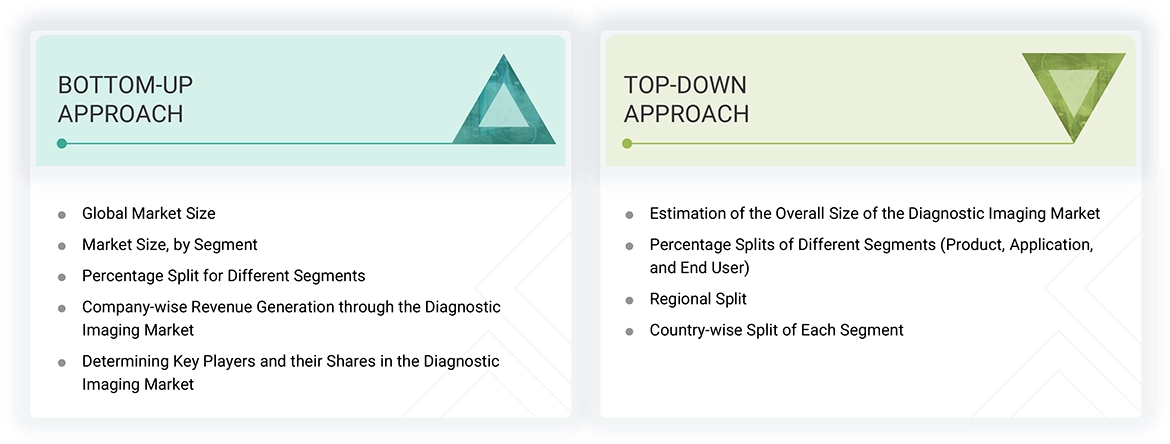
The study involved four major activities in estimating the current size of the diagnostic imaging market. Exhaustive secondary research was done to collect information on the peer and parent markets. The next step was to validate these findings, assumptions, and sizing with industry experts across the value chain through primary research. Both top-down and bottom-up approaches were employed to estimate the complete market size. After that, market breakdown and data triangulation were used to estimate the market size of segments and subsegments.
Secondary Research
The secondary research process involves the widespread use of secondary sources, directories, databases (such as Bloomberg Businessweek, Factiva, and D&B Hoovers), white papers, annual reports, company house documents, investor presentations, and SEC filings of companies. Secondary research was used to identify and collect information useful for the extensive, technical, market-oriented, and commercial diagnostic imaging market study. It was also used to obtain important information about the key players and market classification & segmentation according to industry trends to the bottom-most level, and key developments related to market and technology perspectives. A database of the key industry leaders was also prepared using secondary research.
Primary Research
In the primary research process, various supply and demand sources were interviewed to obtain qualitative and quantitative information for this report. The primary sources from the supply side include industry experts such as CEOs, vice presidents, marketing and sales directors, technology & innovation directors, and related key executives from various key companies and organizations in the diagnostic imaging market. The primary sources from the demand side include medical OEMs, CDMOs, and service providers. Primary research was conducted to validate the market segmentation, identify key players, and gather insights on key industry trends & key market dynamics.
A breakdown of the primary respondents is provided below:
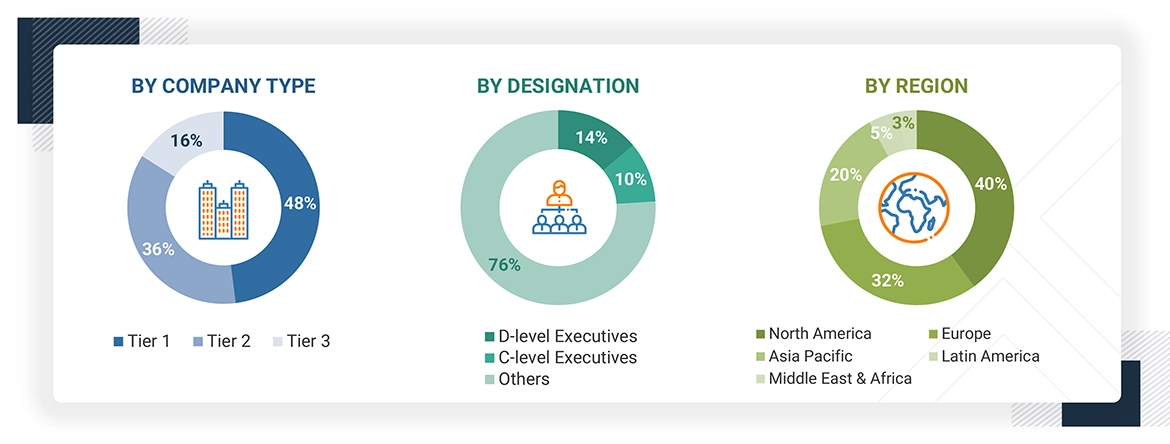
Note 1: Others include sales managers, marketing managers, business development managers, product managers, distributors, and suppliers.
Note 2: D-level executives include directors of operations, directors of finance, directors of marketing, and directors of product management
Note 3: C-level executives include chief executive officers, chief financial officers, chief operating officers, and chief marketing officers.
Note 4: Companies are classified into tiers based on their total revenue. As of 2024, Tier 1 = >USD 2 billion, Tier 2 = USD 50 million to USD 2 billion, and Tier 3 = < USD 50 million.
To know about the assumptions considered for the study, download the pdf brochure
Market Size Estimation
In this report, the size of the diagnostic imaging market was determined using the revenue share analysis of leading players. For this purpose, key players in the market were identified, and their revenues from the market business were determined through various insights gathered during the primary and secondary research phases. Secondary research included studying the annual and financial reports of the top market players. In contrast, primary research included extensive interviews with key opinion leaders, such as CEOs, directors, and key marketing executives.
Segmental revenues were calculated based on the revenue mapping of major product providers to calculate the global market value. This process involves the following steps:
- Generating a list of major global players operating in the diagnostic imaging market
- Mapping annual revenues generated by major global players from the product segment (or nearest reported business unit/category)
- Mapping the revenues of major players to cover a major share of the global market, as of 2024
- Extrapolating the global value of the diagnostic imaging market industry
Data Triangulation
After arriving at the overall market size from the market size estimation process explained above, the global diagnostic imaging market was split into segments and subsegments. Data triangulation and market breakdown procedures were employed to complete the overall market engineering process and arrive at the exact statistics for all segments and subsegments. The data was triangulated by studying various factors and trends from both the demand and supply sides. Additionally, the diagnostic imaging market was validated using top-down and bottom-up approaches.
Market Definition
Diagnostic imaging involves the use of various diagnostic modalities to visualize a patient’s anatomy. This market addresses the industry focusing on various technologies used for the detection, monitoring, and diagnosis of different medical conditions. Different imaging modalities include computed tomography (CT), ultrasound, X-ray imaging, MRI, nuclear imaging, and mammography technologies. These modalities help healthcare professionals to visualize the internal structure and other surrounding tissues. Diagnostic imaging equipment is primarily used in hospitals, diagnostic imaging centers, and ambulatory imaging centers.
Stakeholders
- Senior Management
- End Users
- R&D Department
- Finance/Procurement Department
Report Objectives
- To define, describe, and forecast the size of the diagnostic imaging market based on modality, application, end user, and region
- To provide detailed information regarding the major factors influencing the growth potential of the global diagnostic imaging market (drivers, restraints, opportunities, challenges, and trends)
- To analyze the micromarkets with respect to individual growth trends, prospects, and contributions to the global diagnostic imaging market
- To analyze key growth opportunities in the global diagnostic imaging market for key stakeholders and provide details of the competitive landscape for market leaders
- To forecast the size of market segments and/or subsegments with respect to five major regions: North America (US and Canada), Europe (Germany, France, the UK, Spain, Italy, and the Rest of Europe), Asia Pacific (Japan, China, India, Australia, South Korea, and the Rest of Asia Pacific), Latin America (Brazil, Mexico, and the Rest of Latin America), and the Middle East & Africa
- To profile the key players in the diagnostic imaging market and comprehensively analyze their market shares and core competencies
- To track and analyze the competitive developments undertaken in the global diagnostic imaging market, such as product launches, agreements, expansions, alliances, and mergers & acquisitions
Get the Full Diagnostic Imaging Market Report
Full forecast, segment splits, and company analysis for all Diagnostic Imaging Market.
- Canada Diagnostic Imaging Market
- US Diagnostic Imaging Market
- Germany Diagnostic Imaging Market
- UK Diagnostic Imaging Market
- Italy Diagnostic Imaging Market
- Spain Diagnostic Imaging Market
- China Diagnostic Imaging Market
- Japan Diagnostic Imaging Market
- India Diagnostic Imaging Market
- South Korea Diagnostic Imaging Market
- Brazil Diagnostic Imaging Market
- Mexico Diagnostic Imaging Market
Need a Tailored Report?
Customize this report to your needs
Get 10% FREE Customization
Customize This Report
