
Asia Pacific Digital Shipyard Market (2025-2030)

The Asia Pacific Digital Shipyard Market was valued at $842.8 Million in 2025 and projected to reach to $1963.9 Million by 2030, representing a compound annual growth rate of 18.4%. The Asia Pacific digital shipyard market is poised for exceptional growth through 2030, driven by substantial investments in aerospace and defence manufacturing modernization across key economies including China, South Korea, and Japan.


| Market Size in | USD 26.32 MN |
| Market Forecast in | |
| CAGR | |
| Forecast Period | |
| Units Considered | Value (USD MN) |
Asia Pacific Digital Shipyard Market Trends and Insights
- Asia Pacific's growth trajectory reflects accelerating digital transformation across aerospace and defence manufacturing, driven by increased adoption of advanced technologies such as AI, IoT, and cloud-based production systems.
- The region's shipyards are modernizing operations to enhance efficiency, reduce costs, and improve supply chain visibility, positioning Asia Pacific as a critical hub for next-generation maritime and aerospace production. Asia Pacific's 18.4% compound annual growth rate significantly outpaces traditional manufacturing paradigms, underpinned by government investments in defence capabilities and commercial aerospace expansion.
- Key markets within Asia Pacific, including China, India, Japan, and South Korea, are deploying digital shipyard solutions to strengthen competitive positioning and meet evolving regulatory standards.
- By 2030, Asia Pacific is expected to capture a substantial share of global digital shipyard adoption, driven by rising labour costs, skilled workforce availability, and strategic partnerships between regional players and international technology providers..
Key Market Statistics
- CAGR (2025-2030) 18.4% CAGR
- Market Size, 2025 ~USD 842.8 Million
- Forecast, 2030 ~USD 1963.9 Million
- Geography Asia Pacific
Asia Pacific Digital Shipyard Market Overview
Rapid Market Expansion :
Asia Pacific digital shipyard market is valued at USD 842.8 million in 2025, with a robust CAGR of 18.4%, significantly outpacing global growth and reflecting strong regional demand for advanced manufacturing solutions.
Technology-Driven Growth :
Accelerating adoption of AI, IoT, and cloud-based production systems across Asia Pacific aerospace and defence manufacturing is driving digital transformation and operational efficiency improvements across the region.
China's Market Leadership :
China dominates the Asia Pacific digital shipyard market with USD 743.5 million in market size, leveraging its expansive aerospace and defence manufacturing base and aggressive digital modernization initiatives.
Strong Regional Forecast :
The Asia Pacific market is projected to reach USD 1,963.9 million by 2030, representing a doubling of market value and establishing the region as a critical growth engine for global digital shipyard solutions.
Asia Pacific Digital Shipyard Market Dynamics
- Government initiatives promoting Industry 4.0 adoption, coupled with rising geopolitical focus on indigenous defence capabilities, are accelerating digital transformation across the region's shipbuilding and aerospace sectors. Regional manufacturers are increasingly integrating advanced technologies to enhance production efficiency, reduce costs, and improve product quality.
- The convergence of digital twin technology, AI-powered predictive maintenance, and cloud infrastructure is reshaping operational paradigms.
- Asia Pacific's competitive labour advantages combined with technological advancement create a compelling investment landscape, positioning the region as a global hub for next-generation digital shipyard solutions through 2030..
Market Ecosystem
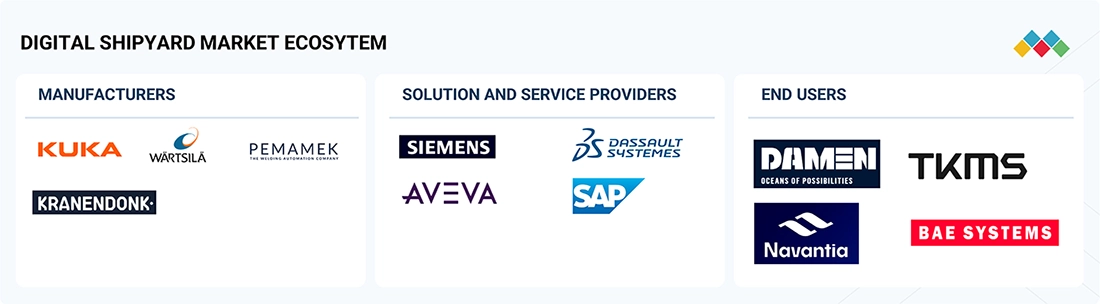
DIGITAL SHIPYARD MARKET SIZE, SHARE & TRENDS: COMMERCIAL USE CASES ACROSS INDUSTRIES
| COMPANY | USE CASE DESCRIPTION | BENEFITS |
|---|---|---|
 |
Integrated digital shipyard platforms for design planning and production using digital twin and automation tools | Improves production efficiency and reduces build time. Helps in better planning and real time monitoring of shipbuilding processes |
 |
Virtual ship design and lifecycle management using 3DEXPERIENCE platform for modeling simulation and collaboration | Improves design accuracy and coordination across teams. Reduces rework and supports faster decision making |
 |
Digital transformation services for shipyards including data analytics AI and smart manufacturing solutions | Improves operational efficiency and supports predictive maintenance. Helps reduce costs and improve productivity |
 |
End-to-end enterprise software for shipyard operations including supply chain project management and asset tracking | Improves resource planning and inventory management. Enhances visibility across operations and reduces delays |
 |
Advanced digital engineering and smart manufacturing solutions for naval shipbuilding programs | Improves build quality and supports complex defense projects. Enhances production control and reduces risks |
Logos and trademarks shown above are the property of their respective owners. Their use here is for informational and illustrative purposes only.
Related Ecosystem
Marine
- Tankers
- Fuel Cell
- HVAC System
- Navigation Systems
- Sensors
- Wartsila
- Kongsberg Gruppen ASA
- L3Harris Technologies, Inc.
- ABB India Limited
- Northrop Grumman Corporation
Key Takeaways
- Asia Pacific digital shipyard market will more than double from USD 842.8M (2025) to USD 1,963.9M (2030), representing an 18.4% CAGR.
- Asia Pacific's defence modernization initiatives and commercial aerospace growth are primary catalysts for digital shipyard technology adoption across the region.
- Asia Pacific shipyards are prioritizing AI, IoT, and cloud integration to optimize production efficiency and reduce operational costs in competitive global markets.
- Asia Pacific is positioned to become a dominant regional hub for digital shipyard solutions, attracting significant technology investments and international partnerships by 2030.
Digital Shipyard Market Report Scope
| Report Metric | Details |
|---|---|
| Base Year | 2025 |
| Fastest Growing Segment | FULLY DIGITAL SHIPYARD (Digitalization Level) |
| Forecast Period | 2025–2030 |
| Growth Rate | CAGR of 19% from 2025 to 2030 |
| Largest Segment | PARTIALLY DIGITAL SHIPYARD (Digitalization Level) |
| Market Size Base Year (Billions) | ~USD 1.8 (2025) |
| Revenue Forecast (Billions) | ~USD 4.3 (2030) |
| Segments Covered | Technology, Shipyard Type, Capacity, End Use, Process, Digitalization Level |
Asia Pacific Digital Shipyard Market Report Segmentation
6 segment dimensions are covered across the global market.
By Technology
- Additive Manufacturing
- Artificial Intelligence & Big Data Analytics
- Augmented & Virtual Reality
- Augmented & Virtual Reality (Ar & Vr)
- Blockchain
- Cloud Computing & Master Data Management
- Cloud Computing & Master Data Management (Mdm)
- Cybersecurity
- Digital Twin & Simulation
- Industrial Internet Of Things
- Industrial Internet Of Things (Iiot)
- Robotic Process Automation
By Shipyard Type
- Commercial
- Commercial Shipyard
- Military
- Military Shipyard
By Capacity
- Large Shipyard
- Medium Shipyard
- Small Shipyard
By End Use
- Implementation
- Upgrades & Services
By Process
- Design & Engineering
- Maintenance & Support
- Manufacturing & Planning
- Research & Development
- Training & Simulation
By Digitalization Level
- Fully Digital Shipyard
- Partially Digital Shipyard
- Semi Digital Shipyard
Target Audience
- Aerospace & Defence OEMs : Asia Pacific-based and global manufacturers require detailed market intelligence to guide digital transformation investments, technology selection, and competitive positioning across the region's high-growth markets.
- Digital Solution Providers : Software, cloud, and IoT solution vendors need Asia Pacific market insights to develop region-specific offerings, identify customer segments, and prioritize market entry strategies across key countries.
- Investment & Private Equity Firms : Investors evaluating opportunities in Asia Pacific aerospace and defence technology require comprehensive market data, growth forecasts, and competitive landscape analysis to support investment thesis development.
- Government & Defence Agencies : Regional defence ministries and government bodies need market intelligence to inform procurement strategies, industrial policy development, and indigenous capability building initiatives across Asia Pacific.
- Systems Integrators & Consultants : Implementation partners and management consultants require Asia Pacific-specific market data to advise clients on digital shipyard adoption, technology roadmaps, and competitive benchmarking across the region.
Key Companies in the Asia Pacific Digital Shipyard Market
| Company | HQ | Ownership | Strongest segments |
|---|---|---|---|
| DASSAULT SYSTèMES | France | Public Company | 3D Modeling (CATIA, SOLIDWORKS, GEOVIA, BIOVIA),Social & Collaborative / PLM (ENOVIA, CENTRIC PLM, 3DEXCITE),Simulation & Manufacturing (SIMULIA, DELMIA, 3DVIA), |
| SAP | Germany | Public Company | SAP S/4HANA and core ERP (finance, supply chain, manufacturing),SAP SuccessFactors and HR solutions,Spend management and Business Network, |
| BAE SYSTEMS | United Kingdom | Public Company | Electronic Systems (EW, avionics, sensors, precision weapons electronics),Air (combat air systems, Eurofighter, future combat air, MBDA-related activity),Maritime (submarines, shipbuilding, naval support), |
| HEXAGON AB | Sweden | Public Company | Manufacturing Intelligence (metrology, CAD/CAM/CAE, production software),Geosystems (surveying, mapping, laser scanning, AEC),Autonomous Solutions and Positioning (GNSS, machine control, mining, autonomy), |
| KUKA SE & CO. KGAA | Germany | Private Company | Industrial robots and controllers,Turnkey production systems and modular manufacturing cells,Mobile robots, AGVs, and intralogistics solutions, |
| IFS | Peru | Public Company | Retail and commercial banking (loans, deposits, current accounts),Insurance (life annuities, life, and retail insurance products),Payments and cards (issuing, acquiring, processing, e-commerce infrastructure), |
| SSI | Vietnam | Public Company | Retail and institutional brokerage (equities, ETFs, covered warrants, OTC support),Proprietary trading and treasury (equity, bond, derivatives, money market),Investment banking (corporate finance, IPOs, M&A, capital raising), |
DASSAULT SYSTèMES
Dassault Systèmes is a French software company founded in 1981 that employs 25,724 people and provides 3D design, simulation, and lifecycle management solutions.
SAP
SAP is a German multinational software corporation founded in 1972 with 111,038 employees that develops enterprise resource planning software and cloud-based business solutions.
BAE SYSTEMS
BAE Systems is a United Kingdom-based defense, aerospace, and security company founded in 1979 with 111,400 employees.
HEXAGON AB
Hexagon AB is a Swedish public company founded in 1975 with 16,118 employees that provides digital solutions for measurement, visualization, and autonomous systems.
KUKA SE & CO. KGAA
KUKA SE & CO. KGAA is a German private company founded in 1898 with 14,985 employees that specializes in robotics and automation technology.
IFS
IFS is a Peruvian public company founded in 1897 with 9,229 employees that provides enterprise software solutions.
SSI
SSI is a Vietnamese public company founded in 1999 with 1,453 employees.
Countries within Asia Pacific - compare and drill down
| Country | 2025 size (native) |
|---|---|
| China | USD 743.5 Million |
| South Korea | USD 343.7 Million |
| Japan | USD 339.6 Million |
| India | USD 157.5 Million |
| Australia | USD 121.7 Million |
| UAE | USD 75.6 Million |
| Rest Of Asia Pacific | USD 257.9 Million |
Country market size visualization
Reasons to Buy this Report
- Regional Market Intelligence : Gain comprehensive insights into Asia Pacific's USD 842.8 million digital shipyard market with country-level breakdowns for China, Japan, South Korea, India, and Australia to identify high-growth opportunities.
- Competitive Positioning : Understand regional competitive dynamics and technology adoption patterns across Asia Pacific's leading aerospace and defence manufacturers to benchmark against market leaders and emerging players.
- Investment Decision Support : Access detailed market forecasts projecting 18.4% CAGR through 2030, enabling informed capital allocation decisions and strategic planning for expansion into Asia Pacific's fastest-growing digital shipyard segments.
- Technology Trend Analysis : Identify emerging technology adoption trends including AI, IoT, and cloud systems specific to Asia Pacific manufacturers, supporting product development and go-to-market strategies tailored to regional requirements.
- Strategic Partnership Opportunities : Discover partnership and collaboration opportunities across Asia Pacific's diverse aerospace and defence ecosystem, from established OEMs to emerging digital solution providers and technology integrators.
Frequently asked questions
What is the current size of the Asia Pacific digital shipyard market?
The Asia Pacific digital shipyard market is valued at USD 842.8 million in 2025 and is expected to grow to USD 1,963.9 million by 2030.
What is the projected growth rate for Asia Pacific digital shipyards?
Asia Pacific's digital shipyard market is projected to grow at a compound annual growth rate (CAGR) of 18.4% from 2025 to 2030.
Which countries in Asia Pacific are leading digital shipyard adoption?
Key markets within Asia Pacific driving digital shipyard adoption include China, India, Japan, and South Korea, supported by government defence investments and aerospace expansion.
What technologies are driving Asia Pacific digital shipyard growth?
Asia Pacific shipyards are adopting AI, IoT, cloud-based systems, and advanced analytics to enhance production efficiency, reduce costs, and improve supply chain visibility.
Why is Asia Pacific becoming a hub for digital shipyard solutions?
Asia Pacific's strategic importance stems from rising labour costs, skilled workforce availability, government defence modernization initiatives, and increasing partnerships with international technology providers.
RESEARCH METHODOLOGY
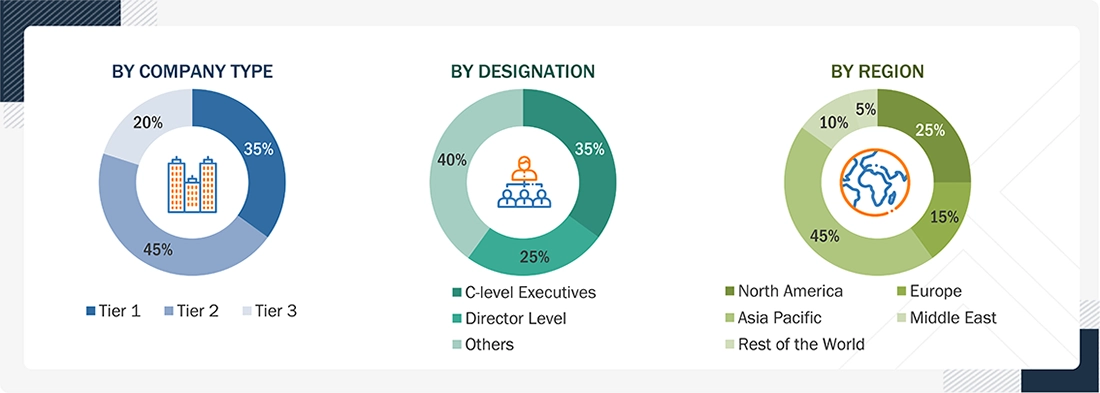
The study used four main steps to estimate the size of the Digital Shipyard market. Secondary research was conducted to collect data on shipbuilding operations, digital technologies, automation systems, and shipyard modernization programs across regions. These findings were validated through primary interviews with shipbuilders, shipyard operators, technology providers, system integrators, and industry experts. The research team reviewed shipbuilding volumes, trade data, government investments, procurement plans, and ongoing modernization initiatives to assess market demand. Market estimates were then segmented by shipyard type, technology, capacity, process, digitalization level, and end use. Data triangulation was applied to validate the final figures for each segment and sub-segment.
Secondary Research
Secondary research was used to build the base for this study. Information was collected from maritime authorities, shipbuilding regulators, and national shipyard modernization programs. Company data was reviewed from annual reports, certification updates, press releases, and investor disclosures of digital shipyard solution providers. The study also reviewed white papers, maritime journals, and published research on shipbuilding technologies, automation, and digital shipyard systems. Additional input was obtained from industry platforms and maritime associations to understand market trends and regional adoption.
Primary Research
Primary research was conducted after key findings from the secondary analysis were identified. The study team engaged with executives, engineers, shipyard operators, and technology providers active in the Digital Shipyard ecosystem. Discussions included shipbuilders, system integrators, infrastructure partners, and regulatory experts across major regions. Interviews were conducted through calls and written interactions to validate market size estimates and user requirements. These inputs helped refine views on competition, deployment plans, and technology adoption. Feedback was also used to adjust assumptions and improve data accuracy.
To know about the assumptions considered for the study, download the pdf brochure
Market Size Estimation
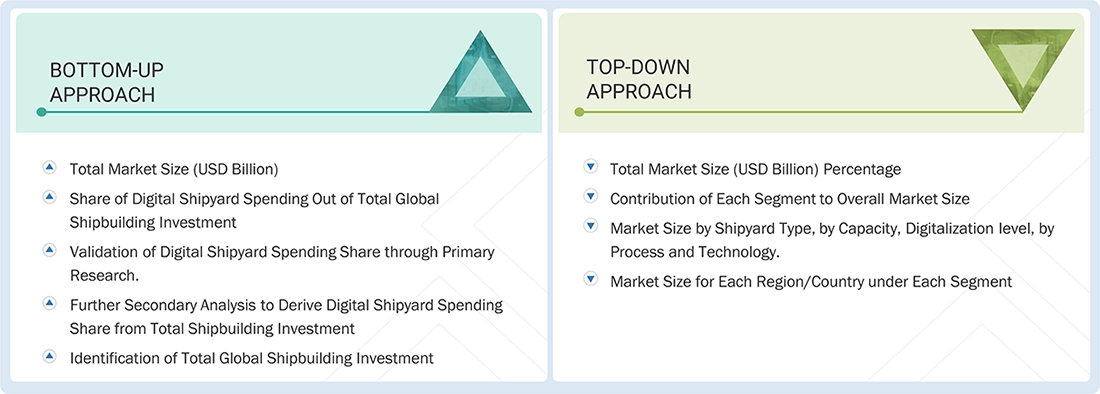
Top-down and bottom-up methods were used to estimate and validate the size of the Digital Shipyard market. The research approach included several steps to ensure accuracy:
- Key companies active in the Digital Shipyard market were identified through secondary research. Their market shares were assessed using a mix of primary inputs and published data. This included reviewing annual reports, financial disclosures, certification updates, and public filings from various organizations. Interviews were also conducted with industry participants, including company executives, program managers, operators, infrastructure providers, and aviation experts. These inputs were used to validate assumptions and refine market size estimates across regions.
- All percentage shares, segment splits, and market breakdowns were first developed using secondary information. These values were then verified through primary discussions with industry participants.
- Key factors affecting the Digital Shipyard market were assessed in the analysis. These included regulatory frameworks, certification timelines, technology progress, infrastructure readiness, and investment activity. Each factor was reviewed through primary research and used to finalize both quantitative and qualitative market estimates for this report.
Digital Shipyard Market: Top-Down and Bottom-Up Approach
Data Triangulation
After determining the overall market size, the total market was divided into several segments and subsegments. The data triangulation and market breakdown procedures explained below were implemented, wherever applicable, to complete the overall market engineering process and arrive at the estimated market numbers for the market segments and subsegments. The data was triangulated by examining various factors and trends on both the demand and supply sides. Additionally, the market size was validated using top-down and bottom-up approaches.
Market Definition
A digital shipyard is the integration of advanced systems and technologies or system-based solutions used to coordinate, monitor, and improve all processes related to ship manufacturing, maintenance, and support. A digital shipyard replaces outdated technology platforms and their compartmentalized technologies with AR & VR, digital twins, the Internet of Things, and robotic process automation, among others. The implementation of these cutting-edge technologies ensures increased productivity and efficiency for the shipyard across all processes throughout its service life.
This study covers the technologies mentioned above used in small, medium, and large commercial and military digital shipyards. It also covers processes such as research & development, design & engineering, manufacturing & planning, maintenance & support, training & simulation in shipyards, and the implementation and upgrades to the technologies mentioned. The shipyards considered are fully, semi, and partially digitalized.
Key Stakeholders
- Shipbuilders and shipyard operators are responsible for vessel design, manufacturing, and maintenance
- Maritime authorities and regulatory bodies overseeing safety, compliance, and standards
- Digital shipyard solution providers and original equipment manufacturers (OEMs)
- Automation and robotics solution providers for shipyard operations
- Software providers offering Product Lifecycle Management (PLM), Enterprise Resource Planning (ERP), and digital twin solutions
- Industrial Internet of Things (IIoT) and data analytics solution providers
- System integrators and engineering service providers
- Defense and naval organizations operating military shipyards
- Infrastructure and equipment suppliers supporting shipyard modernization
- Cloud service providers and cybersecurity solution providers
- Maintenance, support, and lifecycle service providers
- Classification societies and certification bodies ensure vessel and process compliance
- Training and simulation solution providers for workforce development
- Research institutes and technology development organizations
- Logistics and supply chain service providers supporting shipyard operations
Report Objectives
- To define, describe, and forecast the size of the Digital Shipyard market based on shipyard type, technology, capacity, process, digitalization level, and end use.
- To forecast the sizes of market segments with respect to key countries in the following regions: North America, Europe, Asia Pacific, the Middle East, and the Rest of the World
- To identify and analyze drivers, restraints, opportunities, and challenges influencing the growth of the market
- To identify industry trends, market trends, and technology trends currently prevailing in the market
- To provide an overview of the regulatory landscape with respect to global Digital Shipyard regulations
- To analyze micromarkets with respect to individual growth trends, prospects, and their contribution to the overall market
- To analyze opportunities in the market for stakeholders by identifying key market trends
- To profile key market players and comprehensively analyze their market shares and core competencies
- To analyze the degree of competition in the market by identifying growth strategies, such as agreements, acquisitions, partnerships, collaborations, and product launches,adopted by leading market players
- To identify detailed financial positions, key products, and unique selling points of leading market players
Available customizations:
MarketsandMarkets offers the following customizations for this market report:
- Additional country-level analysis of the Digital Shipyard market
- Profiling of other market players (up to 5)
Product Analysis
- Product matrix, which provides a detailed comparison of the product portfolio of each company in the Digital Shipyard market
Get the Full Digital Shipyard Market Report
Full forecast, segment splits, and company analysis for all Digital Shipyard Market.
- South Korea Digital Shipyard Market
- Japan Digital Shipyard Market
- India Digital Shipyard Market
- Australia Digital Shipyard Market
- UAE Digital Shipyard Market
- Turkey Digital Shipyard Market
- Rest Of Europe Digital Shipyard Market
- Rest Of Asia Pacific Digital Shipyard Market
- Rest Of Middle East Digital Shipyard Market
- Canada Digital Shipyard Market
- US Digital Shipyard Market
- UK Digital Shipyard Market
- Germany Digital Shipyard Market
- France Digital Shipyard Market
- Italy Digital Shipyard Market
- Netherlands Digital Shipyard Market
- Spain Digital Shipyard Market
- China Digital Shipyard Market
Need a Tailored Report?
Customize this report to your needs
Get 10% FREE Customization
Customize This Report
