
US Digital X-ray Market (2024-2029)

The US Digital X-ray Market was valued at $1576.5 Million in 2024 and projected to reach to $1905.2 Million by 2029, representing a compound annual growth rate of 3.9%. The US digital X-ray market is positioned for steady expansion through 2029, supported by aging population demographics, increasing diagnostic imaging demand, and continuous technological innovation.


| Market Size in | USD 26.32 MN |
| Market Forecast in | |
| CAGR | |
| Forecast Period | |
| Units Considered | Value (USD MN) |
US Digital X-ray Market Trends and Insights
- The US market benefits from advanced healthcare infrastructure, high adoption of diagnostic imaging technologies, and strong reimbursement frameworks that support digital X-ray deployment across hospitals, clinics, and imaging centers.
- In 2024, the US accounts for a significant portion of North American digital X-ray demand, driven by aging population demographics and increasing prevalence of chronic diseases requiring diagnostic imaging. Growth in the US digital X-ray market through 2029 is supported by technological advancements in image quality, integration with electronic health records (EHR), and rising demand for point-of-care imaging solutions.
- The US healthcare system's emphasis on operational efficiency and cost reduction encourages healthcare providers to transition from analog to digital X-ray systems.
- Regulatory support from the FDA and favorable reimbursement policies further accelerate market expansion across the US during the forecast period..
Key Market Statistics
- CAGR (2024-2029) 3.9% CAGR
- Market Size, 2024 ~USD 1576.5 Million
- Forecast, 2029 ~USD 1905.2 Million
- Country US
US Digital X-ray Market Overview
Market Valuation :
The US digital X-ray market is valued at $1,576.5 million in 2024, with projected growth to $1,905.2 million by 2029, driven by technological advancement and healthcare modernization.
Steady Growth Trajectory :
The US market demonstrates a 3.9% CAGR through 2029, slightly below the global average of 4%, reflecting mature market dynamics and established healthcare infrastructure.
Advanced Healthcare Infrastructure :
The US benefits from sophisticated diagnostic imaging networks, high capital investment in medical technology, and widespread adoption across hospitals, clinics, and specialized imaging centers.
Strong Reimbursement Framework :
Favorable Medicare and private insurance reimbursement policies support digital X-ray deployment and incentivize healthcare providers to upgrade from legacy systems to advanced digital solutions.
US Digital X-ray Market Dynamics
- Healthcare providers are increasingly transitioning to digital X-ray systems to improve operational efficiency, reduce radiation exposure, and enhance diagnostic accuracy.
- The market will benefit from ongoing investments in healthcare infrastructure modernization and the integration of AI-powered diagnostic tools.
- Regulatory support and favorable reimbursement policies will continue to drive adoption across diverse healthcare settings, from large hospital networks to independent imaging centers..
Market Ecosystem
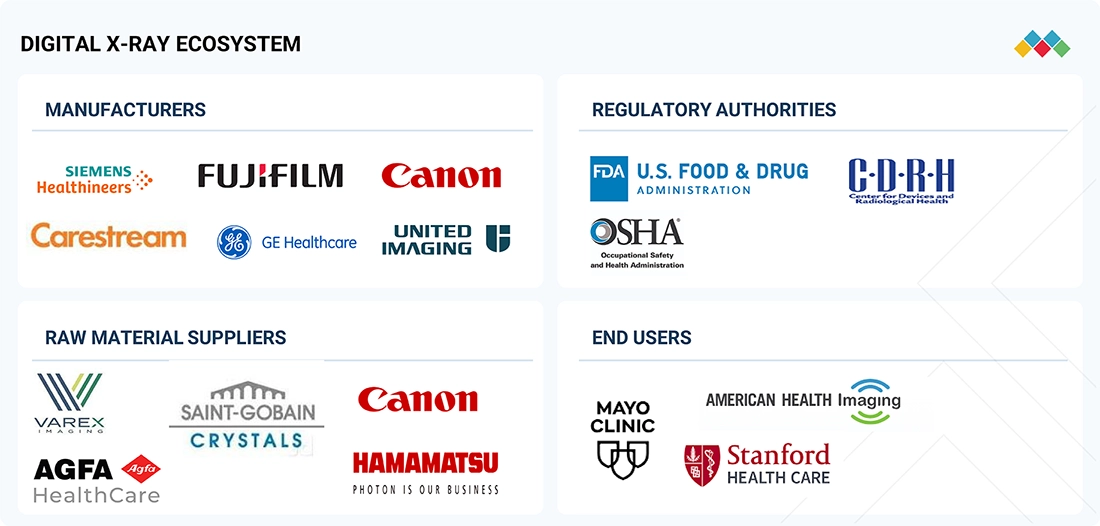
DIGITAL X-RAY MARKET: GROWTH, SIZE, SHARE, AND TRENDS: COMMERCIAL USE CASES ACROSS INDUSTRIES
| COMPANY | USE CASE DESCRIPTION | BENEFITS |
|---|---|---|
 |
Siemens Healthineers offers advanced x-ray systems used in both diagnostic and interventional applications. Their digital radiography solutions are designed to provide high-quality imaging, particularly in urgent care and outpatient settings. | Excellent image quality for faster, more accurate diagnoses | Reduced radiation dose and high patient throughput | Integration with other Siemens systems for seamless workflow in medical environments |
 |
GE Healthcare's x-ray detectors are employed in a variety of healthcare settings, including hospitals, outpatient clinics, and imaging centers. They specialize in providing both analog and digital imaging solutions. | High-resolution imaging with advanced image processing capabilities | Enhanced diagnostic confidence with faster image acquisition | Cost-effective solutions for healthcare providers with flexible system integration |
 |
Fujifilm provides digital x-ray detectors that support a broad spectrum of clinical examinations, including digital radiography (DR), fluoroscopy, and mobile imaging solutions. | Superior image quality with low radiation doses | High-speed image capture for better workflow efficiency | Enhanced diagnostic accuracy with reliable, scalable systems |
 |
Canon Medical's digital x-ray detectors are used in a variety of diagnostic imaging applications, from emergency care to long-term outpatient monitoring, delivering precise and detailed images for various clinical procedures | High-quality images with reduced radiation dose | Fast workflow and seamless integration into existing hospital systems | Improved diagnostic confidence with advanced image processing and clarity |
Logos and trademarks shown above are the property of their respective owners. Their use here is for informational and illustrative purposes only.
Related Ecosystem
Medical Devices
- Polymerase Chain Reaction (PCR)
- Magnetic Resonance Imaging (MRI)
- Disposable Autoinjectors
- Pulse Oximeters
- Blood Pressure Monitors
- Medtronic plc
- Stryker Corporation
- Abbott Laboratories
- Becton, Dickinson and Company
- JOHNSON & JOHNSON
Key Takeaways
- The US digital X-ray market is valued at $1,576.5 million in 2024 and will reach $1,905.2 million by 2029 at a 3.9% CAGR.
- Advanced healthcare infrastructure and strong reimbursement frameworks in the US drive widespread adoption of digital X-ray technologies.
- Integration with EHR systems and point-of-care imaging solutions are key growth drivers in the US market through 2029.
- FDA regulatory support and aging population demographics accelerate digital X-ray system deployment across US healthcare facilities.
Digital X-ray Market Report Scope
| Report Metric | Details |
|---|---|
| Base Year | 2024 |
| Fastest Growing Segment | HIGH-END DIGITAL X-RAY SYSTEMS (Price Range) |
| Forecast Period | 2024–2029 |
| Growth Rate | CAGR of 4% from 2024 to 2029 |
| Largest Segment | DIGITAL X-RAY SYSTEMS (Type) |
| Market Size Base Year (Billions) | ~USD 5.42 (2024) |
| Revenue Forecast (Billions) | ~USD 6.6 (2029) |
| Segments Covered | Type, Technology, System Type, Portability, Application, Price Range, End User |
US Digital X-ray Market Report Segmentation
7 segment dimensions are covered across the global market.
By Type
- Analog X-Ray Systems
- Ceiling-Mounted Systems
- Digital X-Ray Systems
- Floor-To-Ceiling-Mounted Systems
- Handheld X-Ray Systems
- Mobile X-Ray Systems
By Technology
- Computed Radiography
- Computed Radiology
- Direct Radiography
- Direct Radiology
By System Type
- New Digital X-Ray Systems
- Retrofit Digital X-Ray Systems
By Portability
- Fixed Digital X-Ray Systems
- Portable Digital X-Ray Systems
By Application
- Cancer Diagnosis & Treatment
- Cardiovascular Imaging
- Chest Imaging
- Dental Applications
- Orthopedics
- Other Applications
- Pediatric Imaging
By Price Range
- High-End Digital X-Ray Systems
- Low-End Digital X-Ray Systems
- Mid-Range Digital X-Ray Systems
By End User
- Dental Care Centers
- Diagnostic Centers
- Hospitals
US: DIGITAL X-RAY SYSTEMS MARKET, BY END USER, 2022–2029
| Segment | 2022 | 2023 | 2024 | 2025 | 2026 | 2027 | 2028 | 2029 | CAGR (%) |
|---|---|---|---|---|---|---|---|---|---|
| DENTAL CARE CENTERS | 96.9 | 97.3 | 97.7 | 98.3 | 99.3 | 100.4 | 101.4 | 102.1 | 0.9 |
| DIAGNOSTIC CENTERS | 446 | 458.6 | 472.2 | 487.1 | 505.4 | 525.2 | 545.8 | 566.1 | 3.7 |
| HOSPITALS | 941.5 | 972.8 | 1006.6 | 1043.5 | 1087.9 | 1136.3 | 1186.8 | 1237.1 | 4.2 |
| TOTAL | 1484.4 | 1528.6 | 1576.5 | 1628.9 | 1692.6 | 1762 | 1834 | 1905.2 | 3.9 |
Target Audience
- Medical Device Manufacturers : Manufacturers need US-specific market data to calibrate product development, pricing strategies, and go-to-market approaches for the American healthcare system.
- Healthcare Providers & Hospital Networks : Hospital administrators and imaging directors require market insights to justify capital expenditures, benchmark adoption rates, and plan digital X-ray system upgrades.
- Investment & Private Equity Firms : Investors evaluating healthcare technology opportunities need accurate US market forecasts and growth metrics to assess portfolio companies and identify acquisition targets.
- Healthcare Consultants & Advisors : Consulting firms advising healthcare clients require detailed US market analysis to support strategic recommendations on imaging technology investments and operational efficiency.
- Regulatory & Policy Analysts : Policy professionals and regulatory specialists need market data to understand digital X-ray adoption trends and inform healthcare technology regulations and reimbursement policies.
Key Companies in the US Digital X-ray Market
| Company | HQ | Ownership | Strongest segments |
|---|---|---|---|
| AT&S | Canada | Public Company | Integrated automation systems (design-build-commissioning),Lifecycle and post-automation services,Software and digital solutions, |
| PATTERSON COMPANIES, INC | United States | Private Company | Dental consumables and equipment,Dental technology and practice optimization solutions,Animal health pharmaceuticals, vaccines, and consumables, |
| TENET HEALTHCARE CORPORATION | United States | Public Company | Hospital Operations and Services,Ambulatory Care (ASCs and Surgical Hospitals),Other Outpatient and Ancillary Services, |
| SIEMENS HEALTHINEERS | Germany | Public Company | Imaging,Diagnostics,Varian (Oncology), |
| KONINKLIJKE PHILIPS N.V. | Netherlands | Public Company | Diagnostic Imaging (MR, CT, X-ray, Ultrasound),Image Guided Therapy (systems and devices),Connected Care & Monitoring / Enterprise Informatics, |
| GE HEALTHCARE | United States | Public Company | Imaging,Advanced Visualization Solutions (AVS),Patient Care Solutions (PCS), |
| SHIMADZU CORPORATION | Japan | Public Company | Analytical and Measuring Instruments,Medical Systems (Imaging and Related),Industrial and Vacuum Machinery, |
| CANON, INC. | Japan | Public Company | Printing Business Unit (office, production, large-format, document solutions),Medical Business Unit (diagnostic imaging, ophthalmology, IVD, healthcare IT),Imaging Business Unit (cameras, lenses, network cameras, MR, cinema), |
| FUJIFILM HOLDINGS CORPORATION | Japan | Public Company | Healthcare (medical systems, CDMO, pharma, regenerative medicine, cosmetics/supplements),Electronics (display, semiconductor and image sensor materials, storage, industrial equipment, fine chemicals),Business Innovation (office equipment, document services, graphic communications, inkjet), |
| AGFA-GEVAERT GROUP | Belgium | Public Company | Healthcare Enterprise Imaging (PACS/VNA/IT platforms),Diagnostic Imaging & X-ray (film, DR systems, SmartXR, software),Sign & Display and Packaging Inkjet Systems, Inks, and Software, |
| SHANGHAI UNITED IMAGING HEALTHCARE CO., LTD. | China | Public Company | Magnetic Resonance Imaging (MRI),Computed Tomography (CT),Molecular Imaging (PET/CT, PET/MR, SPECT), |
| SAMSUNG ELECTRONICS CO., LTD. | South Korea | Public Company | Memory (DRAM, NAND) and Storage,Foundry and System LSI,Smartphones, Tablets, and Wearables, |
| KONICA MINOLTA | Japan | Public Company | Digital Workplace (MFPs, office print, IT services),Professional Print and Industrial Printing,Healthcare (Diagnostic Imaging and Medical IT), |
| SHENZHEN MINDRAY BIO-MEDICAL ELECTRONICS CO., LTD. | China | Public Company | Patient Monitoring, Ventilation, and Anesthesia,Ultrasound and Radiology,Laboratory Diagnostics (CLIA, Chemistry, Hematology), |
AT&S
AT&S is a Canadian public company founded in 1978 with 7,000 employees.
PATTERSON COMPANIES, INC
Patterson Companies, Inc. is a United States private company founded in 1877 with 7,600 employees.
TENET HEALTHCARE CORPORATION
Tenet Healthcare Corporation is a United States public company founded in 1967 with 88,500 employees.
SIEMENS HEALTHINEERS
Siemens Healthineers is a German public company founded in 1896 with 72,369 employees.
KONINKLIJKE PHILIPS N.V.
Koninklijke Philips N.V. is a Netherlands public company founded in 1891 with 64,317 employees.
GE HEALTHCARE
GE Healthcare is a United States public company founded in 2022 with 54,000 employees.
SHIMADZU CORPORATION
Shimadzu Corporation is a Japanese public company founded in 1875 with 14,649 employees.
CANON, INC.
Canon, Inc. is a Japanese public company founded in 1933 with 165,547 employees.
FUJIFILM HOLDINGS CORPORATION
Fujifilm Holdings Corporation is a Japanese public company founded in 1934 with 73,526 employees.
AGFA-GEVAERT GROUP
Agfa-Gevaert Group is a Belgian public company founded in 1867 with 4,211 employees.
SHANGHAI UNITED IMAGING HEALTHCARE CO., LTD.
Shanghai United Imaging Healthcare Co., Ltd. is a Chinese public company founded in 2011 with 8,703 employees.
SAMSUNG ELECTRONICS CO., LTD.
Samsung Electronics Co., Ltd. is a South Korean public company founded in 1969 with 128,735 employees.
KONICA MINOLTA
Konica Minolta is a Japanese public company founded in 1873 with 34,363 employees.
SHENZHEN MINDRAY BIO-MEDICAL ELECTRONICS CO., LTD.
Shenzhen Mindray Bio-Medical Electronics Co., Ltd. is a Chinese public company founded in 1991 with 21,288 employees.
Reasons to Buy this Report
- Accurate Market Sizing : Obtain precise valuation data for the US digital X-ray market with verified figures for 2024 and 2029, enabling accurate financial planning and investment decisions.
- Growth Trajectory Insights : Understand the 3.9% CAGR dynamics specific to the US market, identifying growth drivers and market maturity factors that differ from global trends.
- Competitive Landscape Analysis : Gain intelligence on US-specific market dynamics, healthcare provider adoption patterns, and regional competitive positioning to inform strategic business decisions.
- Reimbursement & Regulatory Context : Access detailed analysis of US healthcare reimbursement frameworks, regulatory requirements, and policy impacts that directly influence digital X-ray market expansion.
- Segment & Channel Breakdown : Identify high-opportunity segments within the US market including hospital systems, independent imaging centers, and specialty clinics with tailored growth forecasts.
Frequently asked questions
What is the current size of the US digital X-ray market in 2024?
The US digital X-ray market is valued at $1,576.5 million in 2024, representing a mature and well-established segment within the broader North American healthcare imaging industry.
What is the projected market size for the US digital X-ray market by 2029?
The US digital X-ray market is projected to reach $1,905.2 million by 2029, reflecting steady growth driven by technological innovation and healthcare modernization.
What is the CAGR for the US digital X-ray market from 2024 to 2029?
The US digital X-ray market is expected to grow at a compound annual growth rate of 3.9% between 2024 and 2029.
What factors are driving growth in the US digital X-ray market?
Key growth drivers in the US include aging population demographics, increasing chronic disease prevalence, EHR integration, point-of-care imaging demand, and favorable FDA regulatory policies.
How does the US digital X-ray market compare to the global market?
The US digital X-ray market grows at 3.9% CAGR, slightly below the global average of 4%, reflecting the mature state of the US healthcare imaging sector relative to emerging markets.
RESEARCH METHODOLOGY
The study involved four major activities in estimating the current size of the global digital X-ray market. Exhaustive secondary research was done to collect information on the market, peer, and parent markets. The next step was to validate these findings, assumptions, and sizing with industry experts across the value chain through primary research. Both top-down and bottom-up approaches were employed to estimate the complete market size. After that, market breakdown and data triangulation were used to estimate the market size of segments and subsegments.
Secondary Research
The secondary research process involves the widespread use of secondary sources, directories, databases (such as Bloomberg Businessweek, Factiva, and D&B Hoovers), white papers, annual reports, company house documents, investor presentations, and SEC filings of companies. Secondary research was used to identify and collect information useful for the extensive, technical, market-oriented, and commercial digital X-ray market study. It was also used to obtain important information about the key players and market classification & segmentation according to industry trends to the bottom-most level, and key developments related to market and technology perspectives. A database of the key industry leaders was also prepared using secondary research.
Primary Research
In the primary research process, various supply and demand sources were interviewed to obtain qualitative and quantitative information for this report. The primary sources from the supply side include industry experts such as CEOs, vice presidents, marketing and sales directors, technology & innovation directors, and related key executives from various key companies and organizations in the digital X-ray market. The primary sources from the demand side include hospitals, orthopedic clinics, diagnostic centers, dental clinics and other end users. Primary research was conducted to validate the market segmentation, identify key players, and gather insights on key industry trends & key market dynamics.
A breakdown of the primary respondents is provided below:
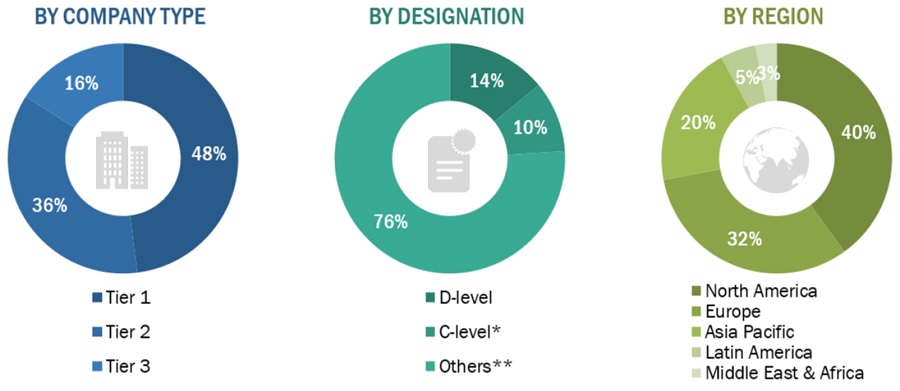
*Others include sales managers, marketing managers, business development managers, product managers, distributors, and suppliers.
The tiers of the companies are defined based on their total revenue. As of 2023: Tier 1 => USD 1 billion, Tier 2 = USD 500 million to USD 1 billion, and Tier 3 =< USD 500 million
To know about the assumptions considered for the study, download the pdf brochure
Market Estimation Methodology
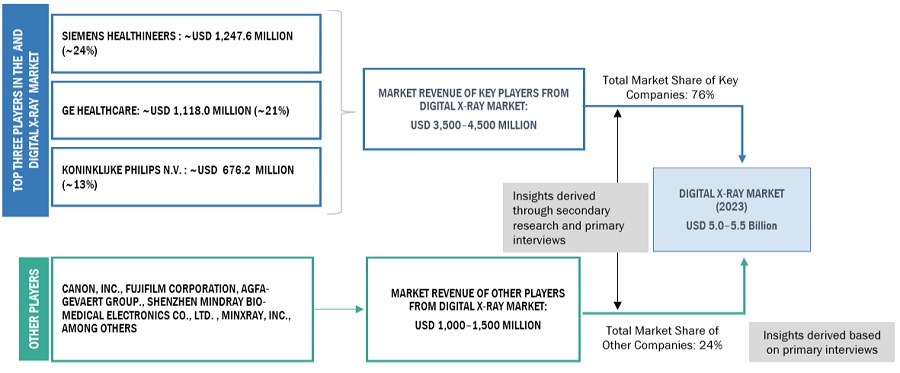
In this report, the digital X-ray market’s size was determined using the revenue share analysis of leading players. For this purpose, key players in the market were identified, and their revenues from the market business were determined through various insights gathered during the primary and secondary research phases. Secondary research included the study of the annual and financial reports of the top market players. In contrast, primary research included extensive interviews with key opinion leaders, such as CEOs, directors, and key marketing executives.
Segmental revenues were calculated based on the revenue mapping of major solution/service providers to calculate the global market value. This process involved the following steps:
- Generating a list of major global players operating in the digital X-ray market.
- Mapping annual revenues generated by major global players from the product segment (or nearest reported business unit/product category)
- Revenue mapping of major players to cover a major share of the global market share, as of 2023
- Extrapolating the global value of the digital X-ray market industry
Bottom-up approach
In this report, the size of the global digital X-ray market was determined using the revenue share analysis of leading players. For this purpose, key players in the market were identified, and their revenues from the digital X-ray business were determined through various insights gathered during the primary and secondary research phases. Secondary research included the study of the annual and financial reports of the top market players. In contrast, primary research included extensive interviews with key opinion leaders, such as CEOs, directors, and marketing executives.
Approach 1: Company revenue estimation approach
Segmental revenues were calculated based on the revenue mapping of major solution/product providers to calculate the global market value. This process involved the following steps:
- Generating a list of major global players operating in the digital X-ray market
- Mapping the annual revenues generated by major global players from the digital X-ray segment (or the nearest reported business unit/product category)
- Mapping the revenues of major players to cover at least 80–85% of the global market share as of 2022
- Extrapolating the global value of the digital X-ray industry
Market Size Estimation For Digital X-Ray: Approach 1 (Company Revenue Estimation)I
To know about the assumptions considered for the study, Request for Free Sample Report
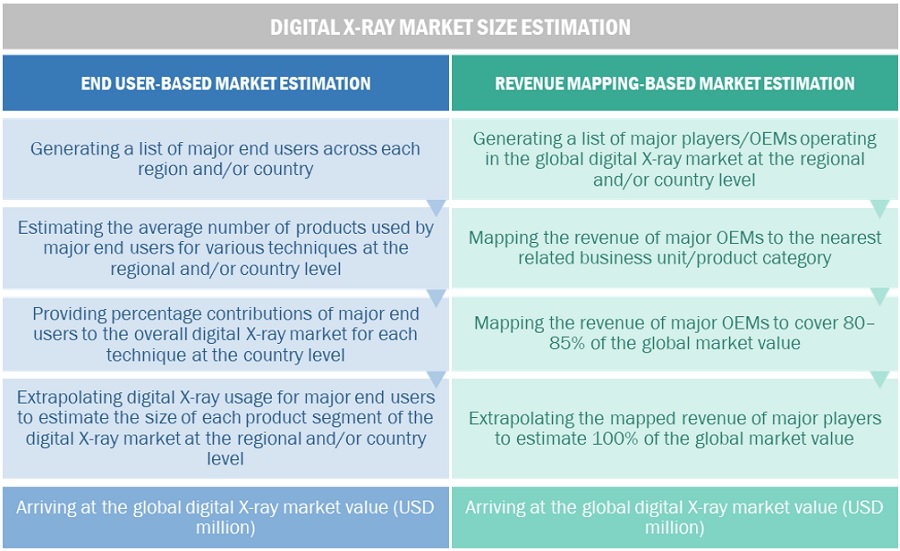
Approach 2: Customer-based market estimation
During preliminary secondary research, the total sales revenue of digital X-ray was estimated and validated at the regional and country level, triangulated, and validated to estimate the global market value. This process involved the following steps:
- Generating a list of major customer facilities across each region and country
- Identifying the average number of digital X-ray product supplies used by major customer facilities across each product type at the regional/country level, annually
- Identifying the percentage contribution of major customer facilities to the overall digital X-ray expenditure and usage at the regional/country level, annually
- Extrapolating the annual usage patterns for various products across major customer facilities to estimate the size of each product segment at the regional/country level, annually
- Identifying the percentage contributions of individual market segments and subsegments to the overall digital X-ray market at the regional/country level
Digital X-Ray Market Size Estimation: Bottom-Up Approach
Source: MarketsandMarkets Analysis
Data Triangulation
After arriving at the overall market size from the market size estimation process explained above, the global digital X-ray market was split into segments and subsegments. Data triangulation and market breakdown procedures were employed to complete the overall market engineering process and arrive at the exact statistics for all segments and subsegments. The data was triangulated by studying various factors and trends from both the demand and supply sides. Additionally, the digital X-ray market was validated using top-down and bottom-up approaches.
Market Definition
The digital X-ray market encompasses a diverse range of medical devices designed to provide external support, stabilization, and relief for musculoskeletal conditions. These products include braces, supports, and orthoses tailored for various anatomical areas such as the knee, ankle, spine, wrist, and shoulder. The market addresses the growing demand for solutions related to orthopedic injuries, post-surgical recovery, and chronic musculoskeletal disorders, driven by factors such as an aging population, increased awareness of preventive healthcare, and advancements in materials and technology. With a focus on enhancing patient comfort and mobility, the digital X-ray market plays a crucial role in promoting non-invasive treatment options and comprehensive musculoskeletal care within healthcare settings.
Key Stakeholders
- Digital X-ray product manufacturers
- Original equipment manufacturers (OEMs)
- Suppliers, distributors, and channel partners
- Healthcare service providers
- Hospitals and academic medical centers
- Radiologists
- Research laboratories
- Health insurance providers
- Government bodies/organizations
- Regulatory bodies
- Medical research institutes
- Business research and consulting service providers
- Venture capitalists and other public-private funding agencies
- Market research and consulting firms
Objectives of the Study
- To define, describe, and forecast the digital X-ray market based on technology, systems, portability, price range, type, application, end user, and region
- To provide detailed information regarding the major factors influencing the growth of the market (drivers, restraints, opportunities, and challenges)
- To strategically analyze micro markets with respect to individual growth trends, prospects, and contributions to the total market
- To analyze opportunities in the market for stakeholders and provide details of the competitive landscape for market leaders
- To forecast the revenue of the market segments with respect to five regions, namely, North America, Europe, the Asia Pacific, Latin America, Middle East and Africa
- To profile the key players and comprehensively analyze their market ranking and core competencies
- To benchmark players within the market using a proprietary competitive leadership mapping framework, which analyzes market players on various parameters within the broad categories of market share and product footprint
Available Customizations
With the given market data, MarketsandMarkets offers customizations per the company’s specific needs. The following customization options are available for the present global digital X-ray market report:
Product Analysis
- Product matrix, which gives a detailed comparison of the product portfolios of the top five companies
Company Information
- Detailed analysis and profiling of additional market players (up to five)
Geographic Analysis
- Further breakdown of the Rest of Europe digital X-ray market into Russia, Belgium, the Netherlands, Switzerland, Austria, Finland, Sweden, Poland, and Portugal, among others
- Further breakdown of the Rest of Asia Pacific digital X-ray market into Singapore, Taiwan, New Zealand, Philippines, Malaysia, and other APAC countries
- Further breakdown of the Rest of Latin America (RoLATAM), which comprises Argentina, Chile, Peru, Colombia, and Cuba
- Further breakdown of the RoW market into Latin America and MEA regions
Get the Full Digital X-ray Market Report
Full forecast, segment splits, and company analysis for all Digital X-ray Market.
- Canada Digital X-ray Market
- France Digital X-ray Market
- Germany Digital X-ray Market
- Italy Digital X-ray Market
- UK Digital X-ray Market
- Spain Digital X-ray Market
- China Digital X-ray Market
- Japan Digital X-ray Market
- India Digital X-ray Market
- Australia Digital X-ray Market
- South Korea Digital X-ray Market
- Brazil Digital X-ray Market
- Mexico Digital X-ray Market
Need a Tailored Report?
Customize this report to your needs
Get 10% FREE Customization
Customize This Report
