
Argentina DERMS Market (2024-2029)

The Argentina DERMS Market was valued at $4.07 Million in 2024 and projected to reach to $7.8 Million by 2029, representing a compound annual growth rate of 13.9%. Argentina's DERMS market is poised for sustained expansion as the country prioritizes renewable energy integration and modernizes its aging electrical infrastructure.


| Market Size in | USD 26.32 MN |
| Market Forecast in | |
| CAGR | |
| Forecast Period | |
| Units Considered | Value (USD MN) |
Argentina DERMS Market Trends and Insights
- This 13.9% compound annual growth rate reflects Argentina's increasing focus on renewable energy integration and grid modernization initiatives.
- Argentina is positioning itself as a regional leader in clean energy adoption, driven by favorable government policies and growing investment in distributed solar and wind resources. The DERMS market in Argentina is supported by the country's abundant renewable energy potential and regulatory frameworks promoting decentralized energy systems.
- Between 2024 and 2029, Argentina's market is expected to nearly double, as utilities and private operators seek advanced management solutions to optimize distributed resources.
- Argentina's energy transition strategy and infrastructure upgrades are creating significant opportunities for DERMS vendors and service providers operating in the Latin American region..
Key Market Statistics
- CAGR (2024-2029) 13.9% CAGR
- Market Size, 2024 ~USD 4.07 Million
- Forecast, 2029 ~USD 7.8 Million
- Country Argentina
Argentina DERMS Market Overview
Market Valuation Growth :
Argentina's DERMS market is valued at $4.07 million in 2024, with projections reaching $7.80 million by 2029, representing a robust 13.9% CAGR driven by renewable energy adoption and grid modernization.
Regional Clean Energy Leadership :
Argentina is establishing itself as a regional leader in clean energy transition, leveraging abundant solar and wind resources in Patagonia and northwestern provinces to drive DERMS deployment and smart grid technologies.
Grid Modernization Initiatives :
Government-backed grid modernization programs and renewable energy targets are accelerating DERMS adoption across Argentina, particularly in distributed solar installations and microgrid development in rural and urban areas.
Renewable Integration Acceleration :
Argentina's commitment to increasing renewable energy capacity is creating urgent demand for sophisticated DERMS solutions to manage variable generation, optimize grid stability, and integrate rooftop solar and wind installations efficiently.
Argentina DERMS Market Dynamics
- Government policies supporting distributed generation, combined with decreasing solar and wind technology costs, are creating favorable conditions for DERMS adoption among utilities, industrial facilities, and commercial enterprises.
- The 13.9% CAGR reflects growing investments in smart grid technologies and energy management systems across the country. Looking ahead, Argentina's DERMS market will be shaped by regulatory frameworks promoting distributed energy resources, increasing electrification demands, and the need for grid resilience.
- Regional partnerships and technology transfer initiatives will enhance market penetration, while local startups and international vendors are positioning themselves to capture opportunities in this emerging market segment..
Market Ecosystem
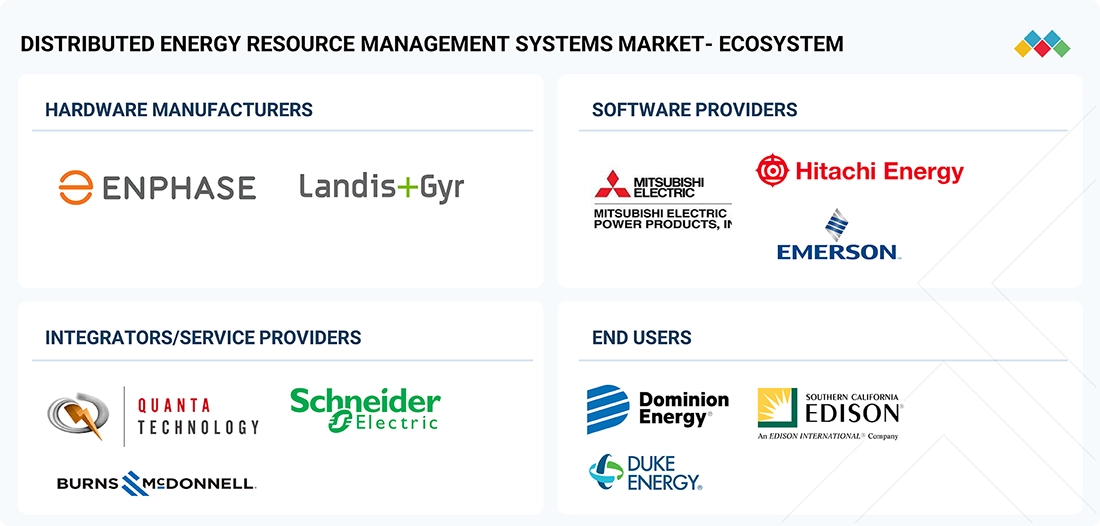
DERMS MARKET: COMMERCIAL USE CASES ACROSS INDUSTRIES
| COMPANY | USE CASE DESCRIPTION | BENEFITS |
|---|---|---|
 |
Evergy (formerly KCP&L) serves more than 800,000 customers in northwest Missouri and eastern Kansas and has a service area of about 18,000 square miles. Due to severe heat, the company was facing a major strain on its energy network and wanted to deploy a DERMS. | The DERMS implementation, supported by Burns & McDonnell, helped Evergy ease network strain during severe heat peaks. Serving over 800,000 customers across an 18,000-square-mile area in northwest Missouri and eastern Kansas, Evergy tackled peak demand challenges that risked grid reliability. Through DERMS deployment, configuration, and two demand response programs, the company reduced energy use during critical periods, optimizing resources, boosting resilience, and advancing sustainability by cutting waste and delaying expensive upgrades. This ensured reliable service, cost savings, and readiness for future distributed energy growth. |
 |
To effectively connect high levels of distributed energy resources (DERs), it is essential to manage grid hosting capacity to maintain network reliability. The National Renewable Energy Laboratory (NREL) aimed to explore the feasibility of accommodating over 50% DER penetration at home, community, and grid levels. | Strata Grid deployment by Smarter Grid Solutions helped NREL manage grid capacity and validate over 50% DER penetration at home, community, and grid levels, maintaining network reliability. By monitoring smart meter data and optimizing power flow from photovoltaics, EVs, and storage across homes, campuses, and networks, it ensured stable voltage and flow in high-solar settings. This real-time coordination integrated smart scenarios, showcasing scalable DER operations across regions, enhancing resilience, accelerating renewables, and offering utilities insights to reduce risks and speed decarbonization. |
Logos and trademarks shown above are the property of their respective owners. Their use here is for informational and illustrative purposes only.
Related Ecosystem
Decarbonization
- Battery Electric Vehicle (BEV)
- Energy Management Systems
- Fuel Cell
- Fuel Cell Electric Vehicle (FCEV)
- Geographical Information System (GIS)
- TotalEnergies SE
- Siemens ag
- Mitsui & Co., Ltd.
- General Electric Company
- Thyssenkrupp ag
Engines And Gensets
- Fuel Cell
- Agricultural Tractors
- Analytics Software
- Biometric Systems
- Cogeneration
- General Electric Company
- Wartsila
- Siemens ag
- Cummins Inc.
- UNIPER GLOBAL COMMODITIES SE
Power Infrastructure
- Geographical Information System (GIS)
- Cogeneration
- Battery Electric Vehicle (BEV)
- Cellular Network
- Fuel Cell
- ABB India Limited
- Siemens ag
- SCHNEIDER ELECTRIC SE
- General Electric Company
- Eaton Corporation plc
Key Takeaways
- Argentina's DERMS market is valued at $4.07 million in 2024 and is forecast to reach $7.80 million by 2029, representing a 13.9% CAGR.
- Argentina's renewable energy potential and supportive regulatory environment are driving adoption of distributed energy management solutions.
- Argentina's market growth is nearly double the pace of mature markets, positioning the country as a high-growth opportunity in Latin America.
- Argentina's energy transition strategy and grid modernization efforts are creating sustained demand for advanced DERMS technologies through 2029.
DERMS Market Report Scope
| Report Metric | Details |
|---|---|
| Base Year | 2024 |
| Fastest Growing Segment | SOLAR PV SYSTEMS (Application) |
| Forecast Period | 2024-2029 |
| Growth Rate | CAGR of 18.8% from 2024 to 2029 |
| Largest Segment | INDUSTRIAL (End User) |
| Market Size Base Year (Billions) | ~USD 0.61 (2024) |
| Revenue Forecast (Billions) | ~USD 1.44 (2029) |
| Segments Covered | Offering, Type, Application, End User |
Argentina DERMS Market Report Segmentation
4 segment dimensions are covered across the global market.
By Offering
- Services
- Software
By Type
- Analytics Software
- Energy Analytics Software
- Management & Control Software
- Vpp Software
By Application
- Chp Energy Systems
- Chp Solutions
- Chp Systems
- Combined Heat & Power
- Energy Storage Energy Systems
- Energy Storage Systems
- EV Charging Solutions
- Other Applications
- Solar Pv Systems
- Wind Energy Systems
By End User
- Commercial
- Industrial
- Residential
ARGENTINA: DISTRIBUTED ENERGY RESOURCE MANAGEMENT SYSTEM MARKET, BY END USER, 2024–2029
| Segment | 2024 | 2025 | 2026 | 2027 | 2028 | 2029 | CAGR (%) |
|---|---|---|---|---|---|---|---|
| COMMERCIAL | 1.17 | 1.41 | 1.66 | 1.91 | 2.02 | 2.1 | 12.5 |
| INDUSTRIAL | 2.37 | 2.94 | 3.57 | 4.18 | 4.5 | 4.78 | 15.1 |
| RESIDENTIAL | 0.54 | 0.63 | 0.73 | 0.83 | 0.88 | 0.91 | 11.2 |
| TOTAL | 4.07 | 4.98 | 5.96 | 6.93 | 7.4 | 7.8 | 13.9 |
Target Audience
- Utility Companies & Grid Operators : Need Argentina-specific DERMS market data to plan grid modernization investments, manage distributed renewable integration, and optimize operational efficiency across their networks.
- DERMS Technology Vendors : Require detailed Argentina market analysis to develop localized solutions, identify customer segments, and establish competitive positioning in this high-growth emerging market.
- Renewable Energy Developers : Seek Argentina market insights to understand DERMS requirements for solar and wind projects, assess grid integration challenges, and plan distributed generation deployments.
- Investment & Private Equity Firms : Need comprehensive Argentina DERMS market forecasts and growth drivers to evaluate investment opportunities in energy technology companies and infrastructure projects.
- Government & Policy Makers : Require market intelligence on Argentina's DERMS sector to develop effective renewable energy policies, grid modernization strategies, and regulatory frameworks supporting clean energy transition.
Reasons to Buy this Report
- Market-Specific Growth Projections : Access detailed Argentina-specific forecasts showing 13.9% CAGR through 2029, enabling accurate business planning and investment decisions tailored to this emerging South American market.
- Competitive Landscape Intelligence : Understand Argentina's unique competitive dynamics, local players, and international vendors entering the market, helping you identify partnership opportunities and market positioning strategies.
- Regulatory & Policy Insights : Gain comprehensive analysis of Argentina's renewable energy policies, grid modernization initiatives, and government incentives driving DERMS adoption and market expansion.
- Regional Leadership Positioning : Leverage insights on Argentina's role as a regional clean energy leader to identify cross-border opportunities and expansion strategies across South America.
- Investment & Expansion Strategy : Make informed decisions on market entry, technology deployment, and partnership development with detailed Argentina-specific market data and growth drivers.
Frequently asked questions
What is the current size of Argentina's DERMS market?
Argentina's DERMS market was valued at $4.07 million in 2024 and is expected to grow to $7.80 million by 2029.
What is the projected growth rate for Argentina's DERMS market?
Argentina's DERMS market is projected to grow at a compound annual growth rate (CAGR) of 13.9% between 2024 and 2029.
What factors are driving growth in Argentina's DERMS market?
Argentina's DERMS market growth is driven by renewable energy expansion, grid modernization initiatives, supportive government policies, and increasing distributed solar and wind deployment.
How does Argentina's DERMS market compare to other Latin American countries?
Argentina's 13.9% CAGR positions it as a high-growth market within Latin America, reflecting strong renewable energy adoption and energy transition commitments.
What opportunities exist for DERMS vendors in Argentina?
Argentina's energy transition strategy, grid modernization efforts, and growing distributed resource base create significant opportunities for DERMS solution providers and service integrators.
RESEARCH METHODOLOGY
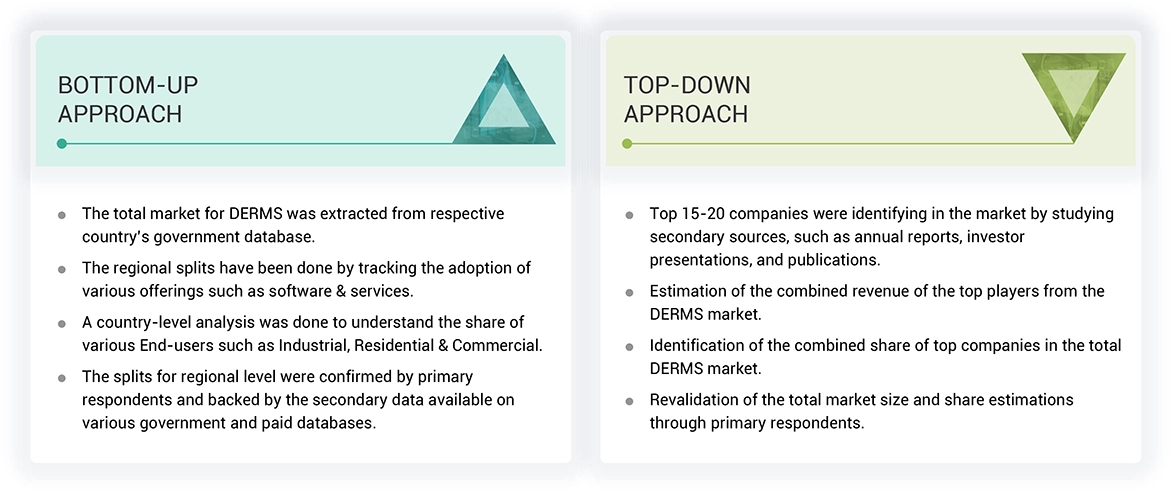
The study involved major activities in estimating the current size of the DERMS market. Exhaustive secondary research was done to collect information on the peer and parent markets. The next step was to validate these findings, assumptions, and sizing with industry experts across the value chain through primary research. Both top-down and bottom-up approaches were employed to estimate the total market size. Thereafter, market breakdown and data triangulation were used to estimate the market size of the segments and subsegments.
Secondary Research
Secondary sources referred to for this research study include annual reports, press releases, and investor presentations of companies; white papers; certified publications; articles by recognized authors; and databases of various companies and associations. Secondary research was mainly used to obtain key information about the industry’s supply chain, the total pool of key players, market classification, and segmentation according to industry trends to the bottom-most level, regional markets, and key developments from both, market- and technology-oriented perspectives.
Primary Research
In the primary research process, various primary sources from the supply and demand sides were interviewed to obtain qualitative and quantitative information for this report. Primary sources from the supply side include industry experts such as chief executive officers (CEOs), vice presidents (VPs), marketing directors, and related key executives from various companies and organizations operating in the DERMS market.
In the complete market engineering process, the top-down and bottom-up approaches, along with several data triangulation methods, were extensively used to perform the market size estimations and forecasts for all segments and subsegments listed in this report. Extensive qualitative and quantitative analyses were conducted to complete the market engineering process and list key information/insights throughout the report. Following is the breakdown of primary respondents:
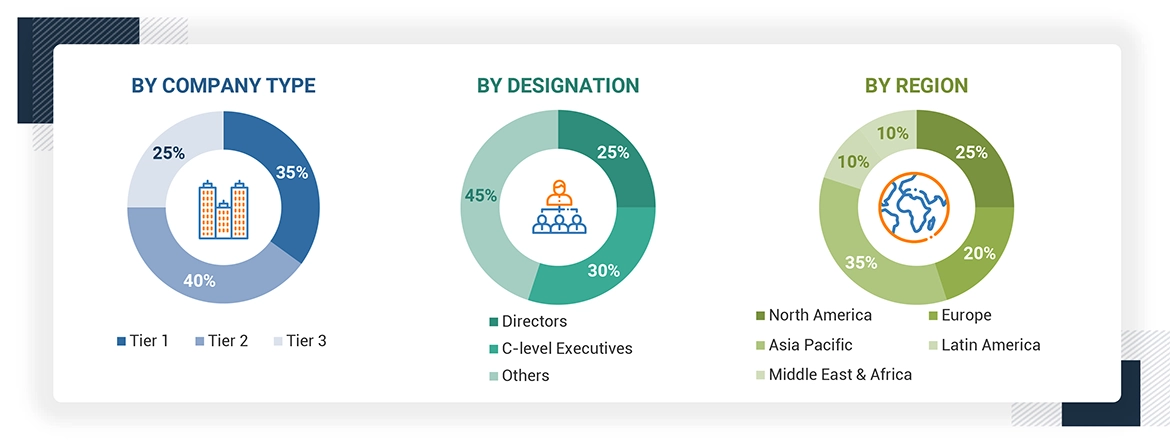
Note: Other designations include sales managers, engineers, and regional managers.
The tier of the companies is defined based on their total revenue; as of 2023: Tier 1 = > USD 1 billion,
Tier 2 = From USD 500 million to USD 1 billion, and Tier 3 = < USD 500 million.
To know about the assumptions considered for the study, download the pdf brochure
Market Size Estimation
Both top-down and bottom-up approaches were used to estimate and validate the size of the DERMS market. These methods were also used extensively to estimate the size of various subsegments in the market. The research methodology used to estimate the market size includes the following:
DERMS Market : Top-Down and Bottom-Up Approach
Data Triangulation
After arriving at the overall market size from the estimation process explained below, the total market has been split into several segments and subsegments. The data triangulation and market breakdown procedures have been employed, wherever applicable, to complete the overall market engineering process and arrive at the exact statistics for all the segments and subsegments. The data has been triangulated by studying various factors and trends from both the demand and supply sides.
Market Definition
A DERMS platform enables real-time control and communication of distributed energy resources, such as solar panels, energy storage solutions, and EV chargers, optimizing their integration and operation within the grid. It provides flexibility, reliability, and efficient energy management across the grid. The capabilities of DERMS include aggregation, optimization, and simplification of solar PV and energy storage plants and EV charging stations, ensuring greater reliability and efficient operation of the grid. DERM systems are crucial in managing areas with significant energy distribution demands. These systems are essential for seamlessly integrating electric vehicles (EVs), efficiently controlling microgrids, promoting renewable energy sources, enabling two-way power flow, and optimizing demand response management. Embracing DERM technology enhances energy efficiency and supports a sustainable energy future.
The market for distributed energy resource management systems is the sum of revenues global companies generate through the sales of distributed energy resource management systems.
Stakeholders
- Utility companies
- Distributed energy resource providers (DERPs)
- Energy consumers
- Technology providers
- Government and regulatory agencies
- Financial institutions
- Research institutions and academic communities
- Power and energy associations
- Repairs and maintenance service providers
- State and national regulatory authorities
- Research and consulting companies in the clean energy generation sector
- Organizations, forums, alliances, and associations
- Industrial authorities and associations
- State and national regulatory authorities
- Distributed energy resource management system operators
- Research institutes
Report Objectives
- To define, describe, segment, and forecast the distributed energy resource management system (DERMS) market by offering, application, end user, and region, in terms of value
- To describe and forecast the market for five key regions: North America, Europe, Asia Pacific, Latin America, Middle East & Africa, along with their country-level market sizes, in terms of value
- To provide detailed information regarding key drivers, restraints, opportunities, and challenges influencing market growth
- To strategically analyze the micromarkets1 with respect to individual growth trends, prospects, and contributions to the overall market size
- To provide supply chain analysis, trends/disruptions impacting customer business, ecosystem analysis, pricing analysis, patent analysis, technology analysis, Porter’s five forces analysis, case study analysis, key conferences and events, regulatory landscape, global macroeconomic outlook, and trade analysis pertaining to distributed energy resource management systems
- To analyze opportunities for stakeholders in the distributed energy resource management system market and draw a competitive landscape of the market
- To compare distributed energy resource management systems offered by key market players based on their specifications and applications
- To strategically profile key players and comprehensively analyze their market rankings and core competencies2
- To analyze competitive developments, such as contracts and agreements, investments and expansions, mergers and acquisitions, partnerships, joint ventures, and collaborations, in the distributed energy resource management system market
Available Customizations
With the given market data, MarketsandMarkets offers customizations according to the specific requirements of companies. The following customization options are available for the report:
Product Analysis
- Product Matrix, which provides a detailed comparison of the product portfolio of each company
Company Information
- Detailed analyses and profiling of additional market players
Get the Full DERMS Market Report
Full forecast, segment splits, and company analysis for all DERMS Market.
- Canada DERMS Market
- US DERMS Market
- UK DERMS Market
- Germany DERMS Market
- France DERMS Market
- Denmark DERMS Market
- China DERMS Market
- Australia DERMS Market
- Japan DERMS Market
- South Korea DERMS Market
- Saudi Arabia DERMS Market
- UAE DERMS Market
- South Africa DERMS Market
- Mexico DERMS Market
- Brazil DERMS Market
- Rest Of Europe DERMS Market
- Rest Of Asia Pacific DERMS Market
- Rest Of Latin America DERMS Market
- GCC DERMS Market
- Rest Of GCC DERMS Market
Need a Tailored Report?
Customize this report to your needs
Get 10% FREE Customization
Customize This Report
