
Asia Pacific Drug Screening Market (2025-2030)

The Asia Pacific Drug Screening Market was valued at $1077.3 Million in 2025 and projected to reach to $2470.4 Million by 2030, representing a compound annual growth rate of 18.1%. The Asia Pacific drug screening market is positioned for exceptional growth through 2030, driven by stringent regulatory frameworks and heightened awareness of workplace safety.


| Market Size in | USD 26.32 MN |
| Market Forecast in | |
| CAGR | |
| Forecast Period | |
| Units Considered | Value (USD MN) |
Asia Pacific Drug Screening Market Trends and Insights
- Asia Pacific's drug screening sector is driven by increasing regulatory compliance requirements, rising substance abuse concerns, and growing workplace safety initiatives across the region.
- The market in Asia Pacific is benefiting from enhanced healthcare infrastructure, technological advancements in screening methodologies, and expanding pharmaceutical and manufacturing sectors that mandate employee drug testing programs. Asia Pacific's drug screening market growth is accelerated by rising adoption of rapid testing solutions and point-of-care diagnostics throughout 2025–2030.
- The region's market is supported by government initiatives promoting workplace safety and public health awareness campaigns addressing substance abuse.
- Asia Pacific continues to attract investment in laboratory automation and digital screening platforms, positioning the region as a critical growth hub for the global drug screening industry..
Key Market Statistics
- CAGR (2025-2030) 18.1% CAGR
- Market Size, 2025 ~USD 1077.3 Million
- Forecast, 2030 ~USD 2470.4 Million
- Geography Asia Pacific
Asia Pacific Drug Screening Market Overview
Rapid Market Expansion :
Asia Pacific drug screening market is projected to grow from $1,077.3 million in 2025 to $2,470.4 million by 2030, representing a robust 18.1% CAGR, outpacing the global average of 15.5%.
Regulatory Compliance Drivers :
Increasing regulatory compliance requirements across Asia Pacific nations are compelling organizations to implement comprehensive drug screening programs, particularly in manufacturing, transportation, and healthcare sectors.
Workplace Safety Initiatives :
Growing workplace safety initiatives and corporate wellness programs throughout Asia Pacific are accelerating adoption of drug screening solutions among employers seeking to maintain safe work environments.
Substance Abuse Concerns :
Rising substance abuse concerns and government interventions across Asia Pacific countries are driving demand for workplace and clinical drug screening services to combat addiction and ensure public health.
Asia Pacific Drug Screening Market Dynamics
- Major economies in the region are implementing stricter drug testing policies across industries, creating sustained demand for screening services and technologies.
- The market benefits from increasing corporate investments in employee wellness programs and government-mandated testing protocols. Expanding healthcare infrastructure and rising disposable incomes in emerging Asia Pacific economies are enabling broader adoption of advanced drug screening technologies.
- Additionally, the region's growing pharmaceutical and manufacturing sectors require comprehensive compliance testing, further propelling market expansion.
- Strategic investments in laboratory automation and point-of-care testing solutions are expected to enhance market penetration across both developed and developing nations..
Market Ecosystem
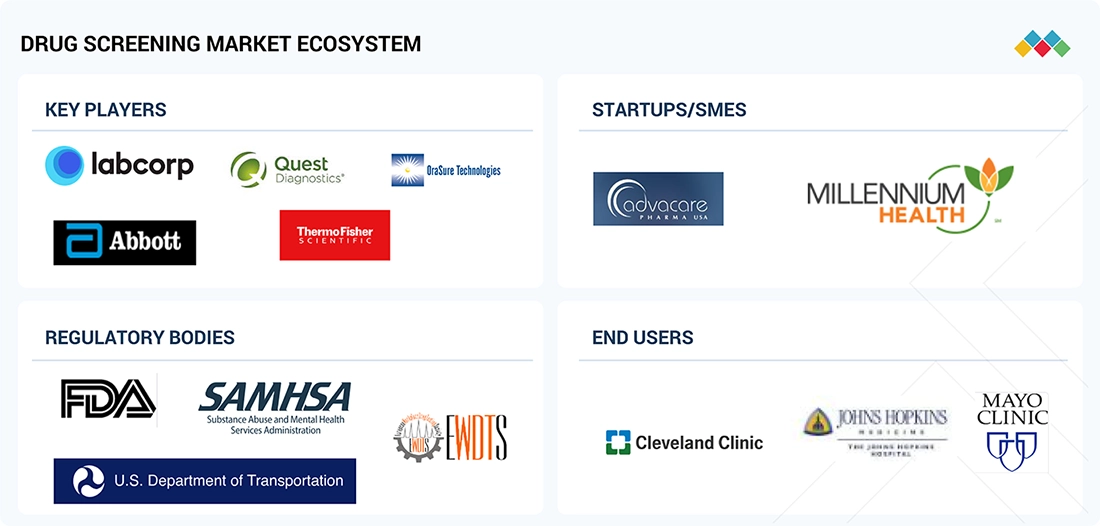
DRUG SCREENING MARKET: COMMERCIAL USE CASES ACROSS INDUSTRIES
| COMPANY | USE CASE DESCRIPTION | BENEFITS |
|---|---|---|
 |
Comprehensive drug screening + confirmatory testing services supporting workplace compliance and clinical monitoring | Broad test menu, consistent chain-of-custody, improved compliance readiness |
 |
Large-scale drug testing services for employers, healthcare providers, and government agencies (pre-employment, random, post-accident) | Nationwide access, reliable reporting, scalable testing volumes |
 |
Rapid drug-of-abuse screening solutions used in emergency departments, clinics, and workplace programs for quick preliminary detection | Faster decision-making, immediate triage support, reduced delays in care and safety actions |
 |
Oral fluid-based collection devices and screening solutions for workplace and forensic testing | Non-invasive collection, reduced tampering, easier on-site sample capture |
 |
LC-MS/MS confirmatory drug testing platforms for forensic and clinical toxicology labs (high sensitivity drug identification) | Higher specificity, reduced false positives, legally defensible results |
Logos and trademarks shown above are the property of their respective owners. Their use here is for informational and illustrative purposes only.
Related Ecosystem
In Vitro Diagnostics
- Polymerase Chain Reaction (PCR)
- Enzyme-Linked Immunosorbent Assay (ELISA)
- Dna Microarrays
- Assay Kits
- Microarrays
- ROCHE HOLDINGS AG
- Thermo Fisher Scientific Inc.
- Danaher Corporation
- Abbott Laboratories
- Biomerieux s.a.
Medical Devices
- Polymerase Chain Reaction (PCR)
- Magnetic Resonance Imaging (MRI)
- Disposable Autoinjectors
- Pulse Oximeters
- Blood Pressure Monitors
- Medtronic plc
- Abbott Laboratories
- Stryker Corporation
- Becton, Dickinson and Company
- CONMED Corporation
Key Takeaways
- Asia Pacific drug screening market will grow from $1,077.3M (2025) to $2,470.4M (2030) at an 18.1% CAGR.
- Regulatory compliance and workplace safety mandates are primary growth drivers in Asia Pacific.
- Rapid testing solutions and point-of-care diagnostics are gaining significant adoption across Asia Pacific.
- Asia Pacific represents a critical growth hub with expanding pharmaceutical and manufacturing sectors requiring drug screening.
Drug Screening Market Report Scope
| Report Metric | Details |
|---|---|
| Base Year | 2025 |
| Fastest Growing Segment | ON-SITE TESTING SERVICES (Type) |
| Forecast Period | 2025–2030 |
| Growth Rate | CAGR of 15.5% from 2025 to 2030 |
| Largest Segment | URINE (Sample Type) |
| Market Size Base Year (Billions) | ~USD 10.36 (2025) |
| Revenue Forecast (Billions) | ~USD 21.29 (2030) |
| Segments Covered | Offering, Type, Modality, Sample Type, Drug Type, End User |
Asia Pacific Drug Screening Market Report Segmentation
6 segment dimensions are covered across the global market.
By Offering
- Products
- Services
By Type
- Analytical Instruments
- Assay Kits
- Breathalyzers
- Calibrators & Controls
- Chromatography Instruments
- Consumables
- Dip Cards
- Drug Testing Cassettes
- Drug Testing Cups
- Fuel-Cell Breathalyzers
- Immunoassay Analyzers
- Laboratory Testing Services
- Non-Regulated Workplaces
- On-Site Testing Services
- Oral Fluid Testing Devices
- Other Breathalyzers
- Other Consumables
- Rapid Testing Devices
- Regulated Workplaces
- Sample Collection Devices
- Semiconductor Breathalyzers
- Urine Testing Devices
By Modality
- Benchtop Breathalyzers
- Handheld Breathalyzers
By Sample Type
- Breath
- Hair
- Oral Fluid
- Other Samples
- Urine
By Drug Type
- Alcohol
- Amphetamines & Meth Amphetamines
- Amphetamines & Methamphetamines
- Cannabis
- Cocaine
- Opioids
- Other Drugs
By End User
- Criminal Justice Systems & Law Enforcement Agencies
- Drug Testing Laboratories
- Drug Treatment Centers
- Hospitals
- Individual Users
- Other End Users
- Pain Management Centers
- Schools & Colleges
- Workplaces
Target Audience
- Healthcare Providers : Clinical laboratories and diagnostic centers need Asia Pacific market data to expand drug screening service offerings and align with regional regulatory requirements and compliance standards.
- Corporate HR Departments : Human resources and workplace safety professionals require market insights to implement compliant drug screening programs and benchmark best practices across Asia Pacific operations.
- Medical Device Manufacturers : Drug screening technology and equipment manufacturers need regional market analysis to guide product development, distribution strategies, and market penetration in Asia Pacific.
- Government & Regulatory Bodies : Policy makers and regulatory agencies utilize market data to develop evidence-based substance abuse prevention strategies and workplace safety regulations across Asia Pacific nations.
- Investment & Consulting Firms : Private equity, venture capital, and management consultants require detailed Asia Pacific market forecasts to identify investment opportunities and advise clients on sector expansion strategies.
Key Companies in the Asia Pacific Drug Screening Market
| Company | HQ | Ownership | Strongest segments |
|---|---|---|---|
| UNILABS | Switzerland | Private Company | Laboratory Testing (Core & Specialised),Medical Imaging,Pathology & Centres of Excellence, |
| EIKEN CHEMICAL CO., LTD. | Japan | Public Company | Fecal immunochemical test (FIT) reagents for colorectal cancer screening,Microbiological reagents and media (clinical),Urinalysis test strips, |
| LABCORP | United States | Public Company | Routine and specialty diagnostics (core lab, women’s health, chronic disease programs),Gene-based, esoteric, and advanced disease-targeted testing,Biopharma Laboratory Services (pharma, biotech, device, CRO clients), |
| QUEST DIAGNOSTICS INCORPORATED | United States | Public Company | Routine and non-routine clinical testing,Advanced diagnostics and anatomic pathology,Life insurance risk assessment and workplace drug testing, |
| ABBOTT | United States | Public Company | Diagnostic Products,Medical Devices,Nutritional Products, |
| ORASURE TECHNOLOGIES INC. | United States | Public Company | Rapid infectious disease tests (HIV, HCV, syphilis, Ebola, COVID-19, SickleSCAN),Genomic saliva collection (Oragene, ORAcollect),Microbiome collection (OMNIgene GUT, SALIVA, Dx), |
| THERMO FISHER SCIENTIFIC INC. | United States | Public Company | Life Sciences Solutions,Analytical Instruments,Specialty Diagnostics, |
| DRäGERWERK AG & CO. KGAA | Germany | Public Company | Acute-care capital equipment (ventilators, anaesthesia, monitoring, lights, pendants),Neonatal care and perinatal systems,Medical infrastructure, gas pipeline systems, and hospital planning, |
| LIFELOC TECHNOLOGIES, INC. | United States | Public Company | Hand-held fuel-cell breathalyzers (professional),Fixed and zero-tolerance screening stations (Sentinel, R.A.D.A.R.),Calibration systems, supplies, and accessories (EASYCAL, consumables), |
| MPD INC. | Australia | Private Company | Liquid milk & cream,Cheese (block, shredded, specialty),Butter, spreads & fats, |
| PSYCHEMEDICS CORPORATION | United States | Public Company | Employer job applicant and employee hair drug testing,Law enforcement and court-mandated testing,Schools and educational institutions, |
| SHIMADZU CORPORATION | Japan | Public Company | Analytical and Measuring Instruments,Medical Systems,Vacuum and Industrial Machinery, |
| SIEMENS HEALTHINEERS AG | Germany | Public Company | Imaging,Diagnostics,Varian (Oncology), |
UNILABS
UNILABS is a Swiss private laboratory services company established in 1987 with 1,897 employees.
EIKEN CHEMICAL CO., LTD.
Eiken Chemical Co., Ltd. is a Japanese public company founded in 1939 with 696 employees engaged in chemical and diagnostic products.
LABCORP
LabCorp is a United States-based public clinical laboratory company founded in 1995 with 66,385 employees providing diagnostic testing services.
QUEST DIAGNOSTICS INCORPORATED
Quest Diagnostics Incorporated is a publicly traded American diagnostic testing company established in 1967 with 51,500 employees.
ABBOTT
Abbott is a diversified American public healthcare company founded in 1888 with 115,000 employees operating across diagnostics, medical devices, and pharmaceuticals.
ORASURE TECHNOLOGIES INC.
OraSure Technologies Inc. is a United States public company founded in 1987 with 500 employees specializing in rapid diagnostic testing products.
THERMO FISHER SCIENTIFIC INC.
Thermo Fisher Scientific Inc. is a large American public company founded in 1956 with 125,000 employees providing laboratory equipment, reagents, and services.
DRäGERWERK AG & CO. KGAA
Drägerwerk AG & Co. KGaA is a German public company founded in 1889 with 16,033 employees specializing in medical and safety technology.
LIFELOC TECHNOLOGIES, INC.
LifeLoc Technologies, Inc. is a United States public company founded in 1983 with 37 employees focused on breath alcohol testing devices.
MPD INC.
MPD Inc. is an Australian private company founded in 1977 with 40 employees.
PSYCHEMEDICS CORPORATION
PsycheMedics Corporation is a publicly traded American company founded in 1986 with 101 employees specializing in hair drug testing.
SHIMADZU CORPORATION
Shimadzu Corporation is a Japanese public company founded in 1875 with 14,649 employees manufacturing analytical and measuring instruments.
SIEMENS HEALTHINEERS AG
Siemens Healthineers AG is a German public healthcare technology company founded in 1896 with 72,369 employees providing medical imaging and diagnostics solutions.
Countries within Asia Pacific - compare and drill down
| Country | 2025 size (native) |
|---|---|
| China | USD 1378.4 Million |
| Japan | USD 987.6 Million |
| India | USD 932.6 Million |
| Australia | USD 226.9 Million |
| South Korea | USD 165.1 Million |
Country market size visualization
Reasons to Buy this Report
- Regional Growth Insights : Gain comprehensive understanding of Asia Pacific's 18.1% CAGR trajectory and market dynamics that significantly outpace global averages, enabling strategic regional expansion planning.
- Country-Level Intelligence : Access detailed market sizing and forecasts for key Asia Pacific economies including China, Japan, India, and Australia to identify high-potential markets and investment opportunities.
- Regulatory Landscape Analysis : Understand region-specific regulatory compliance requirements and workplace safety mandates driving drug screening adoption across diverse Asia Pacific markets and industries.
- Competitive Positioning : Benchmark your organization against regional competitors and identify market gaps in Asia Pacific's rapidly expanding drug screening sector through comprehensive market analysis.
- Strategic Market Entry : Develop informed market entry strategies for Asia Pacific with data-driven insights on growth drivers, emerging opportunities, and sector-specific demand patterns through 2030.
Frequently asked questions
What is the current size of the Asia Pacific drug screening market?
The Asia Pacific drug screening market is valued at $1,077.3 million in 2025.
What is the projected market size for Asia Pacific by 2030?
The Asia Pacific drug screening market is forecast to reach $2,470.4 million by 2030.
What is the CAGR for Asia Pacific drug screening market?
The Asia Pacific drug screening market is expected to grow at a compound annual growth rate (CAGR) of 18.1% from 2025 to 2030.
What are the main drivers of growth in Asia Pacific?
Key growth drivers in Asia Pacific include regulatory compliance requirements, workplace safety initiatives, rising substance abuse concerns, and technological advancements in screening methodologies.
Which sectors are fueling demand in Asia Pacific?
The pharmaceutical, manufacturing, and healthcare sectors in Asia Pacific are primary drivers of drug screening demand due to mandatory employee testing programs and regulatory requirements.
RESEARCH METHODOLOGY
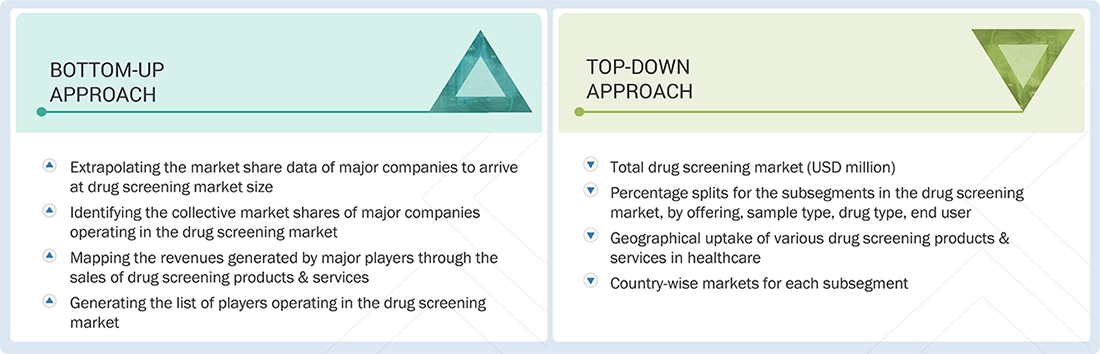
The study involved five major activities to estimate the current size of the drug screening market. Exhaustive secondary research was done to collect information on the market and its different subsegments. The next step was to validate these findings, assumptions, and sizing with industry experts across the value chain through primary research. Both top-down and bottom-up approaches were employed to estimate the complete market size. Thereafter, market breakdown and data triangulation procedures were used to estimate the market size of the segments and subsegments.
Secondary Research
In the secondary research process, various secondary sources such as annual reports, press releases & investor presentations of companies, white papers, certified publications, articles by recognized authors, gold-standard & silver-standard websites, regulatory bodies, and databases (such as D&B Hoovers, Bloomberg Business, and Factiva) were referred to identify and collect information for the study of the drug screening market. It was also used to obtain important information about the top players, market classification, and segmentation according to industry trends to the bottom-most level, geographic markets, and key developments related to the market. A database of the key industry leaders was also prepared using secondary research.
Primary Research
Extensive primary research was conducted after acquiring basic knowledge about the global drug screening market scenario through secondary research. Several primary interviews were conducted with market experts from both the demand side (Hospital directors, Hospital Vice Presidents, Department heads, and Critical care specialists ) and supply side (such as C-level and D-level executives, technology experts, product managers, marketing and sales managers, among others) across five major regions North America, Europe, the Asia Pacific, Latin America, Middle East, and Africa. This primary data was collected through questionnaires, e-mails, online surveys, personal interviews, and telephonic interviews.
The following is a breakdown of the primary respondents:
BREAKDOWN OF PRIMARY PARTICIPANTS:
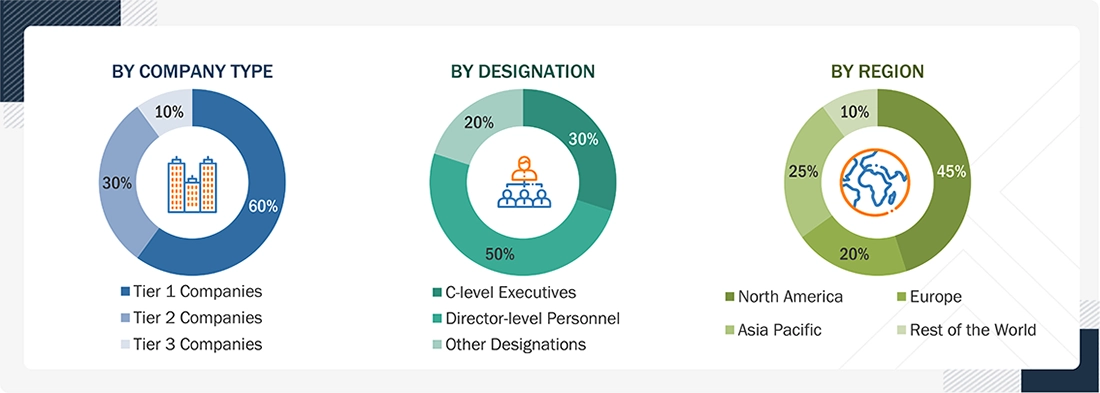
Note 1: Others include sales managers, marketing managers, and product managers.
Note 2: Tiers of companies are defined on the basis of their total revenues in 2023. Tier 1 = >USD 1 billion, Tier 2 = USD 500 million to USD 1 billion, and Tier 3 = <USD 500 million.
To know about the assumptions considered for the study, download the pdf brochure
Market Size Estimation
Both top-down and bottom-up approaches were used to estimate and validate the total size of the drug screening market. These methods were also used extensively to estimate the size of various subsegments in the market.
The research methodology used to estimate the market size includes the following:
Data Triangulation
After arriving at the overall market size using the market size estimation processes, the market was split into several segments and subsegments. To complete the overall market engineering process and arrive at the exact statistics of each market segment and sub-segment, data triangulation and market breakdown procedures were employed, wherever applicable. The data was triangulated by studying various factors and trends from both the demand and supply sides in the drug screening market.
Market Definition
Drug and alcohol testing or drug screening refers to testing individuals for illegal abuse of drugs (including legal drugs such as prescription drugs) through the use of biological samples, such as urine, oral fluids/saliva, hair, blood, and sweat.
Key Stakeholders
- Drug screening product & solution providers (Including immunoassay kit manufacturers, confirmatory testing technology providers, breathalyzer and oral fluid testing device developers, rapid test and POCT vendors)
- Drug screening service providers (including Clinical laboratories, reference labs, forensic toxicology labs, workplace testing providers, on-site/mobile testing service companies)
- Healthcare providers (Hospitals, emergency departments, trauma centers, outpatient clinics, rehabilitation centers, pain management clinics, mental health and addiction treatment facilities)
- Workplace & employer organizations
- Law enforcement & public safety agencies
- Research & development (R&D) companies
- Judicial & legal system stakeholders
- Government & regulatory authorities
- Sports organizations & anti-doping agencies
- Payers & insurers
- Patients, employees & tested individuals
- Substance abuse treatment & rehabilitation providers
- Research & development (R&D) organizations
- Venture capitalists & private equity firms
- Advocacy groups & professional associations
- Investors & financial institutions
- Medical research laboratories & clinical trial organizations
- Academic institutions & training centers
- Technology & instrumentation providers
- Laboratory information & data management providers
- Sample collection & logistics providers
- Quality assurance, accreditation & certification bodies
- Consulting, training & compliance service provider
- Data analytics & emerging technology developers
Report Objectives
- To define, describe, and forecast the global drug screening market based on offering, sample type, drug type, end user, and region
- To provide detailed information regarding the major factors (such as drivers, restraints, opportunities, and challenges) influencing market growth
- To strategically analyze micro-markets with respect to individual growth trends, prospects, and contributions to the overall drug screening market
- To analyze opportunities in the market for stakeholders and provide details of the competitive landscape for market leaders
- To strategically analyze the market structure profile of the key players of the drug screening market and comprehensively analyze their core competencies
- To forecast the size of the market segments with respect to five regions: North America, Europe, Asia Pacific, Latin America, and the Middle East & Africa
- To track and analyze competitive developments such as product launches and enhancements, investments, partnerships, collaborations, acquisitions, expansions, product approval, and alliances in the drug screening market during the forecast period.
Available customizations:
With the given market data, MarketsandMarkets offers customizations as per the company’s specific needs. The following customization options are available for the report:- Product Analysis: Product matrix, which gives a detailed comparison of the product portfolios of each company.
- Geographic Analysis: Further breakdown of Latin America, Europe, and the Middle East & Africa drug screening into specific countries
Get the Full Drug Screening Market Report
Full forecast, segment splits, and company analysis for all Drug Screening Market.
- Australia Drug Screening Market
- Brazil Drug Screening Market
- Canada Drug Screening Market
- China Drug Screening Market
- France Drug Screening Market
- Germany Drug Screening Market
- India Drug Screening Market
- Italy Drug Screening Market
- Japan Drug Screening Market
- Mexico Drug Screening Market
- Rest Of Europe Drug Screening Market
- Saudi Arabia Drug Screening Market
- South Africa Drug Screening Market
- South Korea Drug Screening Market
- Spain Drug Screening Market
- UAE Drug Screening Market
- UK Drug Screening Market
- US Drug Screening Market
Need a Tailored Report?
Customize this report to your needs
Get 10% FREE Customization
Customize This Report
