
Germany Electric Bus Market (2025-2030)

The Germany Electric Bus Market was valued at $1762 Million in 2025 and projected to reach to $4020 Million by 2030, representing a compound annual growth rate of 12.5%. Germany's electric bus market is poised for accelerated expansion through 2030, driven by regulatory mandates requiring zero-emission public transport and substantial government subsidies for fleet electrification.


| Market Size in | USD 26.32 MN |
| Market Forecast in | |
| CAGR | |
| Forecast Period | |
| Units Considered | Value (USD MN) |
Germany Electric Bus Market Trends and Insights
- Germany's commitment to decarbonization and stringent EU emissions regulations are driving rapid adoption of electric buses across municipal and regional transit systems.
- The country's advanced manufacturing infrastructure and strong government incentives position Germany as a leading market for electric bus deployment in Europe. During the 2025–2030 forecast period, Germany is expected to see accelerated fleet electrification as cities modernize public transportation networks and operators seek to meet climate targets.
- Germany's investment in charging infrastructure and battery technology development further supports market expansion.
- The combination of regulatory pressure, environmental consciousness, and technological maturity makes Germany a critical growth engine for the European electric bus sector..
Key Market Statistics
- CAGR (2025-2030) 12.5% CAGR
- Market Size, 2025 ~USD 1762 Million
- Forecast, 2030 ~USD 4020 Million
- Country Germany
Germany Electric Bus Market Overview
Market Valuation Growth :
Germany's electric bus market is valued at $1,762 million in 2025 and is projected to reach $4,020 million by 2030, demonstrating a robust 12.5% CAGR over the forecast period.
EU Emissions Compliance :
Stringent EU emissions regulations and Germany's commitment to decarbonization are primary drivers, mandating transit operators to transition from diesel to electric bus fleets across municipal and regional systems.
Infrastructure Development :
Germany is investing heavily in charging infrastructure and grid modernization to support widespread electric bus deployment, with major cities like Berlin, Munich, and Hamburg leading adoption initiatives.
OEM Leadership Position :
German manufacturers including Daimler, Volkswagen, and MAN are pioneering advanced electric bus technologies, positioning Germany as a key innovation hub for European e-mobility solutions.
Germany Electric Bus Market Dynamics
- Municipal transit authorities are increasingly prioritizing electric buses to meet climate targets and improve air quality in urban centers.
- The market will benefit from declining battery costs, improved charging infrastructure, and growing consumer demand for sustainable transportation solutions. Competitive dynamics will intensify as established German OEMs and emerging EV manufacturers vie for market share.
- Investment in battery technology, autonomous capabilities, and integrated mobility solutions will differentiate market players.
- Germany's role as a manufacturing and export hub will extend its influence across European markets, creating additional growth opportunities for domestic suppliers and technology providers..
Market Ecosystem
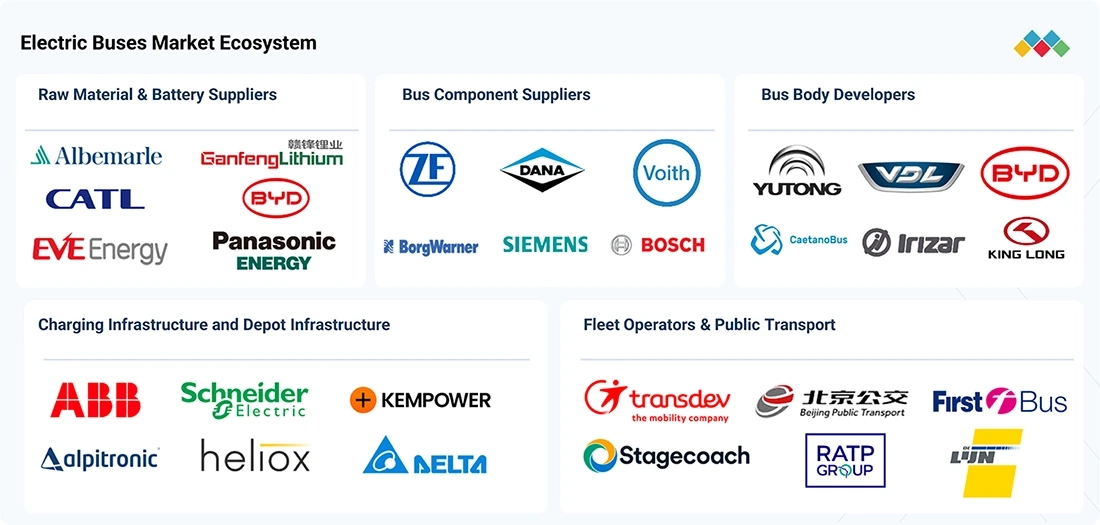
ELECTRIC BUSES MARKET: COMMERCIAL USE CASES ACROSS INDUSTRIES
| COMPANY | USE CASE DESCRIPTION | BENEFITS |
|---|---|---|
 |
BYD uses its battery-electric bus platforms, including the B12, in urban and public-transit operations where buses run frequent routes with high daily utilization. Its Blade Battery Chassis integrates the LFP Blade Battery into the vehicle structure, while the electric powertrain is designed to support longer operating ranges and reduced charging frequency. BYD has also developed electric double-decker and intercity applications for public transport operators | Lower operating energy consumption; zero tailpipe emissions; longer operating range; reduced charging interruptions; improved battery safety and durability; and suitability for high-frequency urban routes. The B12, for example, is offered with up to 500 kWh of battery capacity and a claimed range of up to 600 km, supporting intensive route operations. |
 |
Yutong uses electric and new-energy buses across urban transit, intercity transportation, tourism, commuting, school transportation and special mobility. Its product portfolio spans approximately 5–18 m electric buses, while its e-coach range addresses long-distance, tourist, commuter and intercity operations. Yutong also provides charging infrastructure planning and operational management solutions alongside vehicles. | Higher fleet utilization; lower energy and operating costs; route-specific vehicle selection; reduced emissions; improved charging efficiency; and better fleet management. Yutong reports that its integrated new-energy technologies can reduce vehicle energy consumption and operating costs, while its cloud platform supports charging cost control, energy management, maintenance reminders and battery-safety monitoring |
 |
Geely's commercial-vehicle ecosystem uses Farizon's electric platforms for city-bus applications. The Farizon E12, for example, is a fully electric city bus positioned around passenger well-being and low-emission urban mobility. This makes Geely's electric bus application particularly relevant to intracity public transportation and municipal fleet electrification. | Zero tailpipe emissions; improved urban air quality; lower noise; reduced dependence on fossil fuels; and improved passenger comfort. The E12's focus on cabin air quality and passenger wellness also provides an advantage in high-density urban transportation environments. |
 |
King Long applies electric buses across urban routes, airport transfers, intercity travel, and specialized short-distance operations. Its PEV14 is specifically designed for airport passenger transport, while the company also offers electric city buses and coaches. King Long has demonstrated airport applications, including electric shuttle buses operating between terminals at Beijing Capital Airport. | Zero-emission airport/urban operations; lower noise; high passenger capacity; fast charging; reduced operating costs; and improved operational efficiency. King Long's airport-focused electric buses are particularly suitable for repetitive shuttle routes because of their relatively predictable duty cycles and charging requirements. Its PEV14, for example, accommodates up to 114 passengers and has a stated range of 200–250 km. |
Logos and trademarks shown above are the property of their respective owners. Their use here is for informational and illustrative purposes only.
Related Ecosystem
Electric Hybrid Vehicles
- Battery Electric Vehicle (BEV)
- Fuel Cell Electric Vehicle (FCEV)
- Light Commercial Vehicles (LCVs)
- Hybrid Electric Vehicle (HEV)
- Agricultural Tractors
- Visteon Corporation
- Byd company ltd.
- BOSCH LIMITED
- Tesla, Inc.
- FORD MOTOR COMPANY
On Highway Off Highway Vehicles
- Internal Combustion Engine (ICE)
- Agricultural Tractors
- Crawler Excavator
- Battery Electric Vehicle (BEV)
- Excavators
- Visteon Corporation
- Deere & Company
- Honda Motor Co., Ltd.
- AB VOLVO PENTA
- Komatsu Ltd.
Energy Storage
- Energy Harvesting
- HVAC System
- Applicant Tracking System
- Battery Electric Vehicle (BEV)
- Carboxymethyl Cellulose (CMC)
- MOMENTIVE PERFORMANCE MATERIALS INC.
- Panasonic Holdings Corporation
- Lg corp
- ABB India Limited
- FDK Corporation
Key Takeaways
- Germany's electric bus market will more than double from $1,762M (2025) to $4,020M (2030) at a 12.5% CAGR.
- Germany's strict EU emissions compliance and climate goals are primary drivers of electric bus adoption.
- Germany's advanced manufacturing base and charging infrastructure investments accelerate market penetration.
- Germany is positioned as Europe's leading electric bus market due to regulatory support and technological leadership.
Electric Bus Market Report Scope
| Report Metric | Details |
|---|---|
| Base Year | 2025 |
| Fastest Growing Segment | COACHES (Application) |
| Forecast Period | 2025–2030 |
| Growth Rate | CAGR of 14% from 2025 to 2030 |
| Largest Segment | 10 – 20 TONNES (Gvw) |
| Market Size Base Year (Billions) | ~USD 23.82 (2025) |
| Revenue Forecast (Billions) | ~USD 45.86 (2030) |
| Segments Covered | Length Of Bus, Battery Type, Battery Capacity, Power Output, Range, Seating Capacity, Application, Consumer, Gvw, Propulsion, Component |
Germany Electric Bus Market Report Segmentation
11 segment dimensions are covered across the global market.
By Length Of Bus
- 9–14 M
- Less Than 9 M
- More Than 14 M
By Battery Type
- Lfp Batteries
- Nca Batteries
- Nmc Batteries
- Other Batteries
By Battery Capacity
- Above 400 Kwh
- Up To 400 Kwh
By Power Output
- Above 250 Kw
- Up To 250 Kw
By Range
- Above 300 Miles
- Up To 300 Miles
By Seating Capacity
- 40–70 Seats
- Above 70 Seats
- Up To 40 Seats
By Application
- City/Transit Buses
- Coaches
- Other Applications
- School Buses
By Consumer
- Government
- Private
By Gvw
- 10 – 20 Tonnes
- Above 20 Tonnes
- Up To 10 Tonnes
By Propulsion
- Battery Electric Buses
- Fuel Cell Electric Buses
By Component
- Ac/Dc Chargers
- Batteries
- Battery Cooling Systems
- Battery Management Systems
- Dc-Dc Converters
- EV Connectors
- Fuel Cell Stacks
- Inverters
- Motors
Target Audience
- Transit Operators & Fleet Managers : Need market data to justify electric bus investments, understand total cost of ownership, and align fleet electrification timelines with regulatory deadlines and subsidy availability in Germany.
- OEM & Component Suppliers : Require competitive intelligence on German manufacturers, market share dynamics, and technology differentiation to optimize product development and secure contracts with major transit authorities.
- Investment & Financial Institutions : Seek validated market forecasts and growth drivers to assess investment viability in German e-bus manufacturers, charging infrastructure, and related mobility technology companies.
- Government & Policy Makers : Use market insights to evaluate subsidy effectiveness, infrastructure investment priorities, and policy mechanisms needed to accelerate Germany's transition to zero-emission public transport.
- Consulting & Strategy Firms : Leverage Germany-specific market data to support client advisory on market entry, competitive positioning, and strategic partnerships within the rapidly evolving electric bus ecosystem.
Key Companies in the Germany Electric Bus Market
| Company | HQ | Ownership | Strongest segments |
|---|---|---|---|
| EDF ENERGY | United Kingdom | Private Company | Retail electricity supply (residential and SME),B2B power and heat supply,Generation (nuclear, wind, solar) and trading, |
| VISTEON CORPORATION | United States | Public Company | Instrument clusters (analog and digital),Information displays and cockpit displays,Infotainment and connected car platforms, |
| BYD COMPANY LTD. | China | Public Company | Automobiles and Related Products,Automobile Power Batteries and Lithium-ion Batteries,Mobile Handset Components, Assembly Service and Other Products, |
| YUTONG BUS CO., LTD. | China | Public Company | City buses (diesel and electric),Coaches and e-coaches,Airport buses and special vehicles, |
| ZHEJIANG GEELY HOLDING GROUP | China | Private Company | ICE and hybrid passenger cars (sedans, SUVs, MPVs),Battery-electric passenger vehicles,Commercial vehicles (vans, buses, light and heavy trucks), |
| DAIMLER TRUCK AG | Germany | Public Company | Heavy-duty trucks,Medium-duty trucks,Light-duty trucks, |
| NFI GROUP | Canada | Public Company | Heavy-duty transit buses (New Flyer),Motor coaches (MCI),Medium-duty and cutaway buses (ARBOC and related), |
| AB VOLVO | Sweden | Public Company | Industrial Operations - Trucks,Industrial Operations - Construction Equipment,Industrial Operations - Buses, |
| ZHONGTONG BUS HOLDING CO., LTD. | China | Public Company | Public and highway passenger buses,Tourist and corporate shuttle buses,School buses, |
| CRRC CORPORATION LIMITED | China | Public Company | Locomotives & Freight Rolling Stock (locos, wagons, track machinery),EMU/DMU & High-Speed Trains,Urban Rail (metro cars, LRVs, trams), |
| EBUSCO | Netherlands | Public Company | Battery-electric city and regional buses,Charging systems and depot infrastructure,Energy storage systems and mobile energy containers, |
| BLUE BIRD CORPORATION | United States | Private Company | LYFGENIA (SCD),ZYNTEGLO (TDT ß-thalassemia),SKYSONA (cerebral ALD), |
| THE LION ELECTRIC COMPANY | Canada | Private Company | All-electric school and transit buses,All-electric medium and heavy-duty trucks,Battery systems, chassis, parts, and accessories, |
EDF ENERGY
EDF Energy is a private energy company based in the United Kingdom, founded in 1989. With 819 employees, the company operates in the energy sector serving the UK market.
VISTEON CORPORATION
Visteon Corporation is a public company founded in 2000 and headquartered in the United States. The company employs 10,500 people and operates in the automotive components and technology sector.
BYD COMPANY LTD.
BYD Company Ltd. is a major public company based in China, founded in 1994. With 869,600 employees, the company is a leading manufacturer of electric vehicles, batteries, and renewable energy solutions.
YUTONG BUS CO., LTD.
Yutong Bus Co., Ltd. is a public company based in China, founded in 1963. The company employs 16,707 people and is a leading manufacturer of buses and commercial vehicles.
ZHEJIANG GEELY HOLDING GROUP
Zhejiang Geely Holding Group is a private company based in China, founded in 1986. With 18,000 employees, the company operates in the automotive manufacturing and related industries.
DAIMLER TRUCK AG
Daimler Truck AG is a public company headquartered in Germany, founded in 1896. The company employs 108,655 people and is a major manufacturer of commercial trucks and transportation solutions.
NFI GROUP
NFI Group is a public company based in Canada, founded in 1895. With 9,000 employees, the company manufactures buses and other transportation vehicles.
AB VOLVO
AB Volvo is a public company headquartered in Sweden, founded in 1915. The company employs 89,299 people and manufactures trucks, buses, and other commercial vehicles.
ZHONGTONG BUS HOLDING CO., LTD.
Zhongtong Bus Holding Co., Ltd. is a public company based in China, founded in 1958. The company employs 3,550 people and manufactures buses and commercial vehicles.
CRRC CORPORATION LIMITED
CRRC Corporation Limited is a public company based in China, founded in 2007. With 151,602 employees, the company is a major manufacturer of rail transit equipment and vehicles.
EBUSCO
Ebusco is a public company based in the Netherlands, founded in 2010. With 282 employees, the company specializes in the design and manufacture of electric buses.
BLUE BIRD CORPORATION
Blue Bird Corporation is a private company based in the United States, founded in 1992. With 248 employees, the company operates in the transportation and vehicle manufacturing sector.
THE LION ELECTRIC COMPANY
The Lion Electric Company is a private company based in Canada, founded in 2008. With 1,350 employees, the company manufactures electric buses and commercial vehicles.
Reasons to Buy this Report
- Market Size & Growth Validation : Access precise valuation data for Germany's electric bus market with verified 12.5% CAGR, enabling accurate financial forecasting and investment decision-making for the 2025-2030 period.
- Regulatory & Policy Insights : Understand Germany-specific EU compliance requirements, government incentive programs, and decarbonization targets that directly impact procurement timelines and fleet conversion strategies.
- Competitive Landscape Analysis : Identify key German OEMs, emerging competitors, and market consolidation trends to benchmark positioning and develop targeted go-to-market strategies within the German transit ecosystem.
- Infrastructure & Technology Trends : Gain insights into Germany's charging infrastructure development, battery technology advancements, and autonomous bus initiatives shaping the competitive environment and investment opportunities.
- Regional Expansion Strategy : Leverage Germany market intelligence to inform European expansion plans, as German adoption patterns and regulatory frameworks often precede broader EU market trends.
Frequently asked questions
What is the current size of Germany's electric bus market?
Germany's electric bus market was valued at $1,762 million in 2025 and is expected to grow to $4,020 million by 2030.
What is the growth rate of Germany's electric bus market?
Germany's electric bus market is projected to grow at a compound annual growth rate (CAGR) of 12.5% from 2025 to 2030.
What factors are driving growth in Germany's electric bus market?
Germany's electric bus market growth is driven by EU emissions regulations, government incentives, climate commitments, and investments in charging infrastructure.
How much will Germany's electric bus market grow by 2030?
Germany's electric bus market is forecast to reach $4,020 million by 2030, representing more than a doubling from 2025 levels.
Why is Germany a key market for electric buses in Europe?
Germany leads Europe's electric bus market due to its advanced manufacturing capabilities, strong regulatory framework, substantial government support, and commitment to decarbonization.
RESEARCH METHODOLOGY
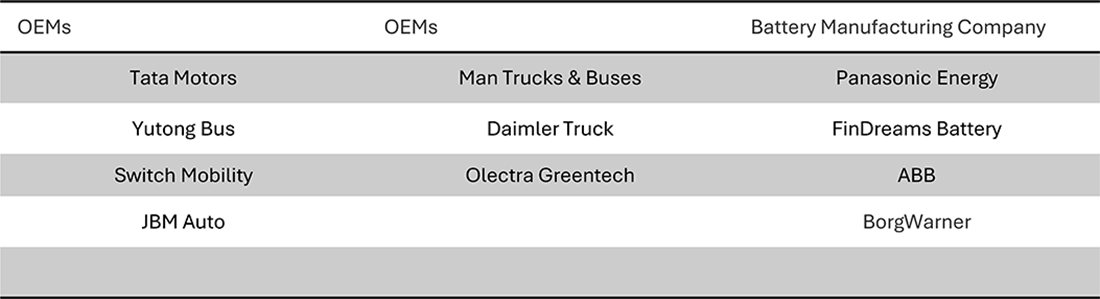
Various secondary sources, directories, and databases have been used to identify and collect information for the electric buses market study. The study involved four main activities in estimating the current size of the market: secondary research, validation through primary research, assumptions, and market analysis. Exhaustive secondary research was carried out to collect information on the market. The next step was to validate these findings, assumptions, and market analysis with industry experts across the value chain through primary research. The bottom-up approach was employed to estimate the complete market size for different segments considered in this study.
Secondary Research
In the secondary research process, various secondary sources were used to identify and collect relevant information for an extensive commercial study of the electric buses market. Secondary sources include company annual reports, investor presentations, product brochures, press releases, vehicle specifications, government publications, public-transport authority reports, industry association publications, and international organizations such as the International Energy Agency (IEA), International Council on Clean Transportation (ICCT), European Automobile Manufacturers' Association (ACEA), European Commission, Federal Transit Administration (FTA), US Department of Transportation (USDOT), Environmental Protection Agency (EPA), California Air Resources Board (CARB), Federal Motor Transport Authority (KBA), China Association of Automobile Manufacturers (CAAM), Ministry of Road Transport and Highways (MoRTH), Japan Automobile Manufacturers Association (JAMA), and Society of Indian Automobile Manufacturers (SIAM). Additionally, secondary research and electric bus model mapping were carried out to assess vehicle-level parameters such as battery capacity, driving range, passenger capacity, vehicle length, powertrain type, charging capability, and indicative vehicle pricing, supporting market segmentation and analysis across regions and applications.
Primary Research
Extensive primary research was conducted through secondary research after understanding the electric buses market scenario. Several primary interviews were conducted with market experts from both the demand (OEMs) and supply (electric bus and component manufacturers) sides across major regions, namely, Asia Pacific, Europe, Latin America, the Middle East & Africa, and North America. Approximately 90% and 10% of primary interviews were conducted with the OEM and Tier I players, respectively. Primary data was collected through questionnaires, emails, and telephonic interviews. In the canvassing of primary data, various departments within organizations, such as sales, operations, and marketing, were covered to provide a holistic viewpoint in the report.
After interacting with industry experts, brief sessions were conducted with highly experienced independent consultants to reinforce the findings from the primaries. This and the in-house subject matter experts' opinions led to the findings described in the remainder of this report.
Breakdown of Primary Interviews
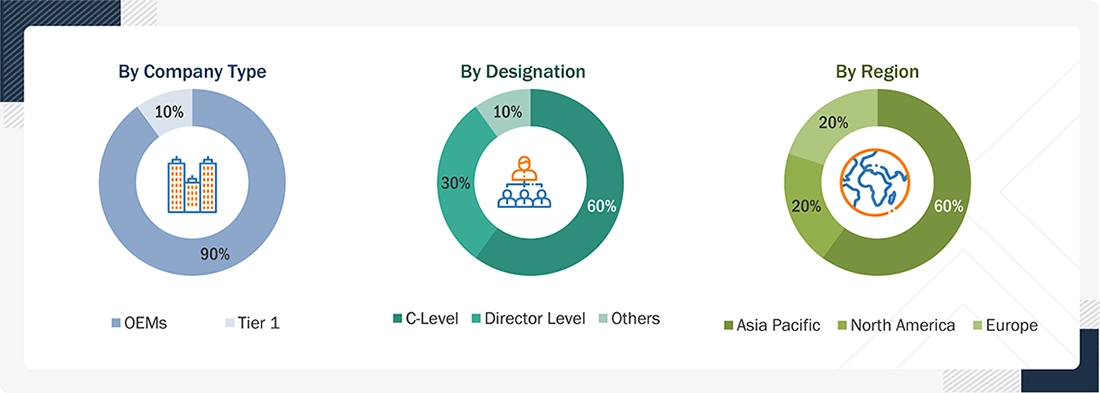
Notes: Company tiers are based on the supply chain; company revenue is not considered. Tier 1 includes component manufacturers and suppliers to OEMs, and Tier 2 includes component suppliers to Tier 1.
*Others include sales, marketing, and product managers.
To know about the assumptions considered for the study, download the pdf brochure
Market Size Estimation
A detailed market estimation approach was followed to estimate and validate the value of the electric buses market and other dependent submarkets.
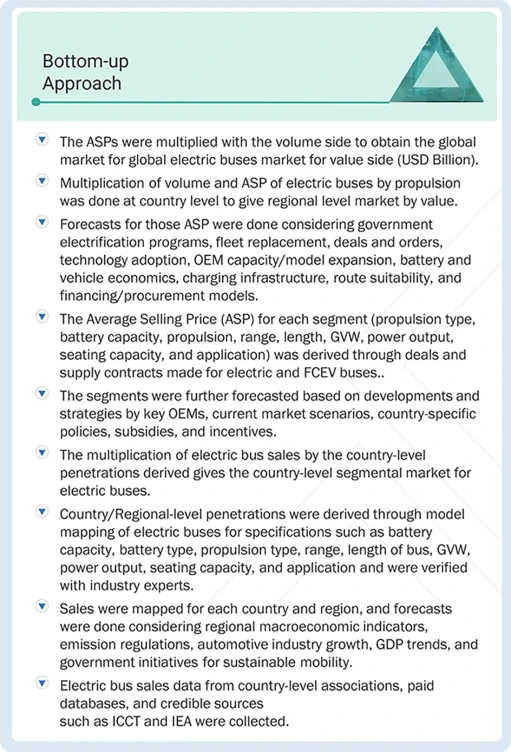
- The bottom-up approach was used to estimate and validate the size of the electric buses market. Firstly, the country-wise sales of electric buses were mapped from country-level associations, paid databases, and sources such as ICCT and IEA. The sales forecast for electric buses by country and region was based on macroeconomic indicators, emission regulations, automotive industry growth, GDP growth, fundings, government investments, companies' R&D investments, and investments in charging infrastructure.
- Secondly, all segments (propulsion type, battery capacity, propulsion, range, length, GVW, power output, seating capacity, and application) in the electric buses market were derived by mapping different electric buses at the country level in different regions, which were then verified with primary data.
- These segments' percentage split was then multiplied by the electric bus sales to get the volume side.
- The Average Selling Price (ASP) for each segment (propulsion type, battery capacity, propulsion, range, length, GVW, power output, seating capacity, and application) was derived through deals and supply contracts made for electric and FCEV buses.
- Forecasts for ASP were developed at the vehicle/country level using government electrification programs, fleet replacement, deals and orders, technology adoption, OEM capacity/model expansion, battery and vehicle economics, charging infrastructure, route suitability, and financing/procurement models.
- These ASPs were then verified by primaries and were multiplied by volume to get the value side in (USD Billion).
- The ASPs were then multiplied by the volume side to obtain the global market for electric buses for the value side.
Electric Buses Market: Bottom-Up Approach
Data Triangulation
After arriving at the overall size of the electric buses market through the methodology mentioned above, the market was split into several segments and subsegments. Data triangulation is a research technique used to increase the validity and reliability of findings by cross-validating data from multiple sources or methods. This technique involves the use of multiple sources of data, such as surveys, interviews, observations, and secondary data, to confirm and corroborate the findings obtained from each source. The extrapolated market data was triangulated by studying various macro indicators and regional trends from both the supply and demand sides.
Market Definition
An electric bus is a type of bus powered by electricity rather than fossil fuels such as gasoline or diesel. It uses electric motors for propulsion, with energy generally stored in onboard batteries that can be charged through electrical outlets or charging stations. Electric buses produce zero emissions while driving, making them a cleaner and quieter alternative to conventional buses, and are often used in public transit, school, and shuttle services. They are more energy-efficient, offer lower operating costs, and typically feature regenerative braking systems that help recharge their batteries during operation.
Key Stakeholders
- Electric Bus Manufacturers
- EV Battery, Motor and Other Component Suppliers
- Automotive Software Manufacturers and Providers
- EV Charging Equipment Manufacturers
- EV Charging Infrastructure Service Providers
- Associations, Forums, and Alliances Related to Electric Vehicles
- Automotive Industry Investors
- Government Agencies and Policy Makers
Report Objectives
-
To segment and forecast the electric buses market size in terms of volume & value:
- By propulsion (BEVs and FCEVs)
- By length of bus (less than 9 m, 9–14 m, more than 14 m)
- By component (batteries, motors, fuel cell stacks, battery management systems, battery cooling systems, DC-DC converters, inverters, AC/DC chargers, and EV connectors)
- By range (up to 300 miles and above 300 miles)
- By power output (up to 250 kW and above 250 kW)
- By battery capacity (up to 400 kWh and above 400 kWh)
- By application (transit buses, coaches, school buses, and other applications)
- By battery type (LFP batteries, NMC batteries, NCA batteries, and other batteries)
- By seating capacity (up to 40 seats, 40–70 seats, and above 70 seats)
- By consumers (government and private)
- By GVW (Up to 10 tonnes, 10 to 20 tonnes, and above 20 tonnes)
- By level of autonomy (semi-autonomous and autonomous)
- By region (North America, Europe, Asia Pacific, Latin America, and the Middle East & Africa)
- To provide detailed information about the major factors influencing the market growth (drivers, challenges, restraints, and opportunities)
- To track and analyze competitive developments, such as product launches, deals, and other activities by key industry participants.
- To strategically analyze the market with value chain analysis, bill of materials, revenue analysis, and regulatory analysis in the electric buses market
- To examine the opportunities in the market for stakeholders and provide details of the competitive landscape for market leaders
Available customizations:
With the given market data, MarketsandMarkets offers customizations according to the specific requirements of companies. The following customization options are available for the report:
- Electric buses market, by range at the country level (for countries covered in the report)
- Up to 300 miles
- Above 300 miles
- Electric buses market, by battery type at the country level (for countries covered in the report)
- LFP
- NMC
- NCA
- Others
Company Information
- Profiles of additional market players (up to five)
Get the Full Electric Bus Market Report
Full forecast, segment splits, and company analysis for all Electric Bus Market.
- China Electric Bus Market
- Japan Electric Bus Market
- India Electric Bus Market
- South Korea Electric Bus Market
- Singapore Electric Bus Market
- Indonesia Electric Bus Market
- Australia Electric Bus Market
- France Electric Bus Market
- Spain Electric Bus Market
- Italy Electric Bus Market
- Norway Electric Bus Market
- Sweden Electric Bus Market
- Denmark Electric Bus Market
- Netherlands Electric Bus Market
- Belgium Electric Bus Market
- UK Electric Bus Market
- Finland Electric Bus Market
- Poland Electric Bus Market
- Canada Electric Bus Market
- US Electric Bus Market
- Argentina Electric Bus Market
- Brazil Electric Bus Market
- Chile Electric Bus Market
- Mexico Electric Bus Market
- Colombia Electric Bus Market
- South Africa Electric Bus Market
- UAE Electric Bus Market
- Qatar Electric Bus Market
Need a Tailored Report?
Customize this report to your needs
Get 10% FREE Customization
Customize This Report
