
North America Electric Truck Market (2025-2030)

The North America Electric Truck Market was valued at $211.3 Million in 2025 and projected to reach to $5286.4 Million by 2030, representing a compound annual growth rate of 58.4%. North America's electric truck market is positioned for transformative growth through 2030, driven by regulatory mandates, corporate sustainability commitments, and improving battery economics.


| Market Size in | USD 26.32 MN |
| Market Forecast in | |
| CAGR | |
| Forecast Period | |
| Units Considered | Value (USD MN) |
North America Electric Truck Market Trends and Insights
- This explosive trajectory reflects North America's commitment to decarbonizing its transportation sector and meeting stringent emissions regulations.
- The region's robust infrastructure investments, supportive government incentives, and increasing fleet electrification initiatives are driving rapid adoption across commercial and logistics segments. In North America, the electric truck market's 58.4% compound annual growth rate significantly outpaces global trends, positioning the region as a critical hub for EV truck innovation and deployment.
- North America's major metropolitan areas and logistics corridors are witnessing accelerated adoption of electric trucks, supported by expanding charging networks and declining battery costs.
- By 2030, North America is expected to capture a substantial share of the global electric truck market, driven by regulatory mandates, corporate sustainability commitments, and technological advancements in battery and powertrain systems..
Key Market Statistics
- CAGR (2025-2030) 58.4% CAGR
- Market Size, 2025 ~USD 211.3 Million
- Forecast, 2030 ~USD 5286.4 Million
- Geography North America
North America Electric Truck Market Overview
Explosive Growth Trajectory :
North America's electric truck market is projected to grow at a CAGR of 58.4%, expanding from $211.3 million in 2025 to $5,286.4 million by 2030, significantly outpacing the global CAGR of 29.5%.
Regulatory & Emissions Pressure :
Stringent emissions regulations across the US and Canada are driving fleet operators to transition from diesel to electric trucks, creating sustained demand for zero-emission commercial vehicles.
Infrastructure Investment Surge :
Robust government incentives, charging infrastructure development, and federal funding initiatives in North America are accelerating the adoption of electric trucks across the region.
Fleet Electrification Momentum :
Major logistics companies and fleet operators in North America are committing to electrification targets, creating substantial market opportunities for electric truck manufacturers and suppliers.
North America Electric Truck Market Dynamics
- The region's advanced infrastructure ecosystem and government support mechanisms create a favorable environment for rapid market expansion.
- Fleet operators are increasingly recognizing the total cost of ownership advantages of electric trucks, despite higher upfront capital requirements. The forecast period will witness intensified competition among established OEMs and emerging EV manufacturers entering the commercial vehicle segment.
- Investment in charging networks, battery manufacturing capacity, and supply chain development will be critical success factors.
- North America's commitment to decarbonization and its substantial logistics sector present unparalleled opportunities for stakeholders across the electric truck value chain..
Market Ecosystem
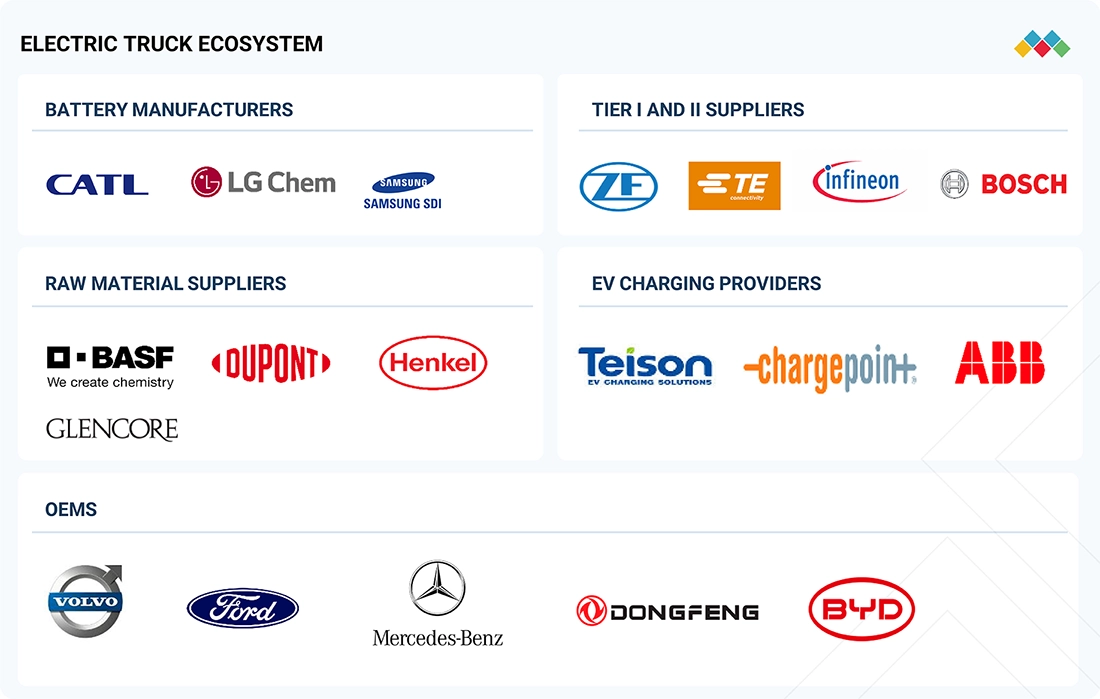
Electric Truck Market: COMMERCIAL USE CASES ACROSS INDUSTRIES
| COMPANY | USE CASE DESCRIPTION | BENEFITS |
|---|---|---|
 |
Manufacturing and deploying electric trucks for urban and regional logistics across China and other Asia Pacific markets | Enables scalable electrified fleets, strengthens market leadership, reduces fleet emissions, and supports regulatory compliance |
 |
Electrifying commercial truck fleets with Hitachi powertrain, BMS, ADAS, and telematics | Achieves lower TCO, regulatory compliance, enhanced fleet reliability, energy efficiency, and operational resilience |
 |
Deploying electric trucks in urban delivery networks to reduce emissions and optimize operational costs | Lower fuel and maintenance costs, improved ESG performance, and enhanced brand reputation |
 |
Providing high-capacity batteries and fast-charging solutions for heavy-duty electric trucks | Maximizes vehicle uptime, accelerates fleet electrification, and enables long-haul operations with reliable energy solutions |
Logos and trademarks shown above are the property of their respective owners. Their use here is for informational and illustrative purposes only.
Related Ecosystem
Automotive Advance Technologies
- Battery Electric Vehicle (BEV)
- Light Commercial Vehicles (LCVs)
- Fuel Cell Electric Vehicle (FCEV)
- Hybrid Electric Vehicle (HEV)
- Internal Combustion Engine (ICE)
- BOSCH LIMITED
- Continental ag
- Visteon Corporation
- DENSO Corporation
- ZF FRIEDRICHSHAFEN AG
Electric Hybrid Vehicles
- Battery Electric Vehicle (BEV)
- Fuel Cell Electric Vehicle (FCEV)
- Light Commercial Vehicles (LCVs)
- Hybrid Electric Vehicle (HEV)
- Agricultural Tractors
- Visteon Corporation
- BOSCH LIMITED
- Byd company ltd.
- Tesla, Inc.
- FORD MOTOR COMPANY
Key Takeaways
- North America's electric truck market will grow from $211.3M (2025) to $5,286.4M (2030), representing a 58.4% CAGR.
- North America's growth rate substantially exceeds the global average of 29.5%, establishing the region as a market leader.
- North America's regulatory environment and corporate sustainability goals are primary catalysts for rapid fleet electrification.
- North America's expanding charging infrastructure and declining battery costs are enabling widespread commercial truck adoption.
Electric Truck Market Report Scope
| Report Metric | Details |
|---|---|
| Base Year | 2025 |
| Fastest Growing Segment | LITHIUM-NICKEL-MANGANESE-COBALT OXIDE (Battery Type) |
| Forecast Period | 2025–2030 |
| Growth Rate | CAGR of 29.5% from 2025 to 2030 |
| Largest Segment | SEMI-AUTONOMOUS (Level Of Automation) |
| Market Size Base Year (Billions) | ~USD 5.26 (2025) |
| Revenue Forecast (Billions) | ~USD 19.16 (2030) |
| Segments Covered | Type, Range, Propulsion, Payload Capacity, Level Of Automation, Battery Type, Battery Capacity, End User |
North America Electric Truck Market Report Segmentation
8 segment dimensions are covered across the global market.
By Type
- Heavy-Duty Trucks
- Light-Duty Trucks
- Medium-Duty Trucks
By Range
- Above 200 Miles
- Up To 200 Miles
By Propulsion
- Bev
- Fcev
- Phev
By Payload Capacity
- 10,001–26,000 Lbs
- Above 26,001 Lbs
- Up To 10,000 Lbs
By Level Of Automation
- Autonomous
- Semi-Autonomous
By Battery Type
- Lithium-Iron-Phosphate
- Lithium-Nickel-Manganese-Cobalt Oxide
By Battery Capacity
- 50–250 Kwh
- Above 250 Kwh
- Less Than 50 Kwh
By End User
- Distribution Services
- Field Services
- Last-Mile Delivery
- Long-Haul Transportation
- Refuse Services
Target Audience
- Fleet Operators & Logistics Companies : Need detailed market intelligence to evaluate electrification strategies, assess ROI on EV truck investments, and benchmark against competitors in North America's rapidly growing segment.
- Automotive OEMs & Truck Manufacturers : Require regional market data to guide product development, capacity planning, and go-to-market strategies for electric truck launches across the US and Canadian markets.
- Battery & Component Suppliers : Need forecasts and market sizing to plan production capacity, R&D investments, and supply chain partnerships supporting North America's electric truck manufacturing ecosystem.
- Infrastructure & Charging Network Providers : Require market growth projections and adoption forecasts to justify investments in charging infrastructure development and identify high-opportunity deployment regions across North America.
- Investment & Financial Institutions : Need comprehensive market analysis and growth forecasts to evaluate investment opportunities, assess portfolio companies, and identify emerging players in North America's electric truck sector.
Key Companies in the North America Electric Truck Market
| Company | HQ | Ownership | Strongest segments |
|---|---|---|---|
| DAIMLER AG | Germany | ||
| AB VOLVO | Sweden | Public Company | BEV Heavy-duty Trucks,BEV Medium-duty Trucks,BEV Light-duty Trucks, |
| DAIMLER TRUCK AG | Germany | Public Company | BEV Heavy-duty Trucks,BEV Medium-duty Trucks,BEV Light-duty Trucks, |
| FORD MOTOR COMPANY | United States | Public Company | BEV Light-duty Trucks,BEV Medium-duty Trucks and Vans,BEV Heavy-duty Trucks, |
| DONGFENG MOTOR CORPORATION | China | Private Company | BEV Light-duty Trucks,BEV Medium-duty Trucks,BEV Heavy-duty Trucks, |
| RIVIAN | United States | Public Company | Light-duty BEV trucks (R1T and derivatives),Electric Delivery Vans / Commercial BEV platform,Software, services, and Autonomy+, |
| BYD COMPANY LTD. | United States | Public Company | BEV Light-duty Trucks,BEV Medium-duty Trucks,BEV Heavy-duty Trucks, |
| TESLA, INC. | United States | Public Company | BEV Heavy-duty Trucks,BEV Medium-duty Trucks,BEV Light-duty Trucks / Vans, |
| SCANIA | Sweden | Private Company | BEV Heavy-duty Trucks,BEV Medium-duty Trucks,BEV Light-duty / Urban Distribution Trucks, |
| PACCAR INC. | United States | Public Company | BEV Heavy-duty Trucks,BEV Medium-duty Trucks,Light-duty / Vocational Electric Trucks, |
| WORKHORSE GROUP | United States | Public Company | BEV Light-duty Trucks (Last-mile Delivery),BEV Medium-duty Trucks,Chassis and Technology Sales (Bodies, Platforms, Software), |
| TATA MOTORS LIMITED | India | Public Company | BEV Light-duty Trucks,BEV Medium-duty Trucks,BEV Heavy-duty Trucks, |
| ASHOK LEYLAND | India | Public Company | BEV Light-duty Trucks,BEV Medium-duty Trucks,BEV Heavy-duty Trucks, |
| ISUZU MOTORS LTD. | Japan | Public Company | BEV Light-duty Trucks,BEV Medium-duty Trucks,BEV Heavy-duty Trucks, |
DAIMLER AG
Daimler AG is a German automotive and transportation company.
AB VOLVO
AB Volvo is a Swedish public company founded in 1915 with 89,299 employees, operating in the automotive and industrial sectors.
DAIMLER TRUCK AG
Daimler Truck AG is a German public company founded in 1896 with 108,655 employees, specializing in commercial vehicle manufacturing.
FORD MOTOR COMPANY
Ford Motor Company is a United States-based public company founded in 1903 with 169,000 employees, engaged in automotive manufacturing and sales.
DONGFENG MOTOR CORPORATION
Dongfeng Motor Corporation is a Chinese private company founded in 2005 with 109,330 employees, operating in the automotive industry.
RIVIAN
Rivian is a United States-based public company founded in 2009 with 15,232 employees, focused on electric vehicle manufacturing.
BYD COMPANY LTD.
BYD Company Ltd. is a United States-based public company founded in 1994 with 869,600 employees, specializing in battery and electric vehicle technology.
TESLA, INC.
Tesla, Inc. is a United States-based public company founded in 2003 with 134,785 employees, leading the electric vehicle and renewable energy sectors.
SCANIA
Scania is a Swedish private company founded in 1891 with 52,494 employees, specializing in commercial vehicles and engines.
PACCAR INC.
PACCAR Inc. is a United States-based public company founded in 1905 with 25,900 employees, manufacturing heavy-duty trucks and related components.
WORKHORSE GROUP
Workhorse Group is a United States-based public company founded in 2007, focused on electric vehicle and drone technology development.
TATA MOTORS LIMITED
Tata Motors Limited is an Indian public company founded in 1945 with 60,332 employees, engaged in automotive and commercial vehicle manufacturing.
ASHOK LEYLAND
Ashok Leyland is an Indian public company founded in 1948 with 9,891 employees, specializing in commercial vehicle manufacturing.
ISUZU MOTORS LTD.
Isuzu Motors Ltd. is a Japanese public company founded in 1916 with 43,005 employees, manufacturing commercial vehicles and diesel engines.
Countries within North America - compare and drill down
| Country | 2025 size (native) |
|---|---|
| US | USD 119448 Million |
| Canada | USD 27354 Million |
Country market size visualization
Reasons to Buy this Report
- Regional Market Sizing & Forecasts : Obtain precise market valuations for North America's electric truck segment with detailed projections through 2030, enabling accurate business planning and investment decisions specific to the region.
- Competitive Landscape Analysis : Understand key players, market share dynamics, and competitive positioning within North America's rapidly evolving electric truck market to identify partnership and acquisition opportunities.
- Regulatory & Policy Insights : Access comprehensive analysis of US and Canadian emissions regulations, government incentives, and policy frameworks driving electric truck adoption across North America.
- Infrastructure & Technology Trends : Gain insights into charging infrastructure development, battery technology advancements, and supply chain evolution specific to North American electric truck deployment.
- Customer Adoption Patterns : Analyze fleet operator preferences, purchasing behaviors, and total cost of ownership considerations driving electric truck adoption decisions across North American logistics and transportation sectors.
Frequently asked questions
What is the projected market size for electric trucks in North America by 2030?
North America's electric truck market is projected to reach $5,286.4 million by 2030, up from $211.3 million in 2025.
What is the CAGR for North America's electric truck market?
North America's electric truck market is expected to grow at a compound annual growth rate of 58.4% between 2025 and 2030.
How does North America's growth compare to the global electric truck market?
North America's 58.4% CAGR significantly outpaces the global average of 29.5%, making it the fastest-growing major region.
What factors are driving electric truck adoption in North America?
North America's adoption is driven by stringent emissions regulations, government incentives, corporate sustainability commitments, and expanding charging infrastructure.
Which segments are leading North America's electric truck market growth?
North America's commercial logistics, last-mile delivery, and heavy-duty trucking segments are experiencing the strongest growth in electric truck adoption.
RESEARCH METHODOLOGY
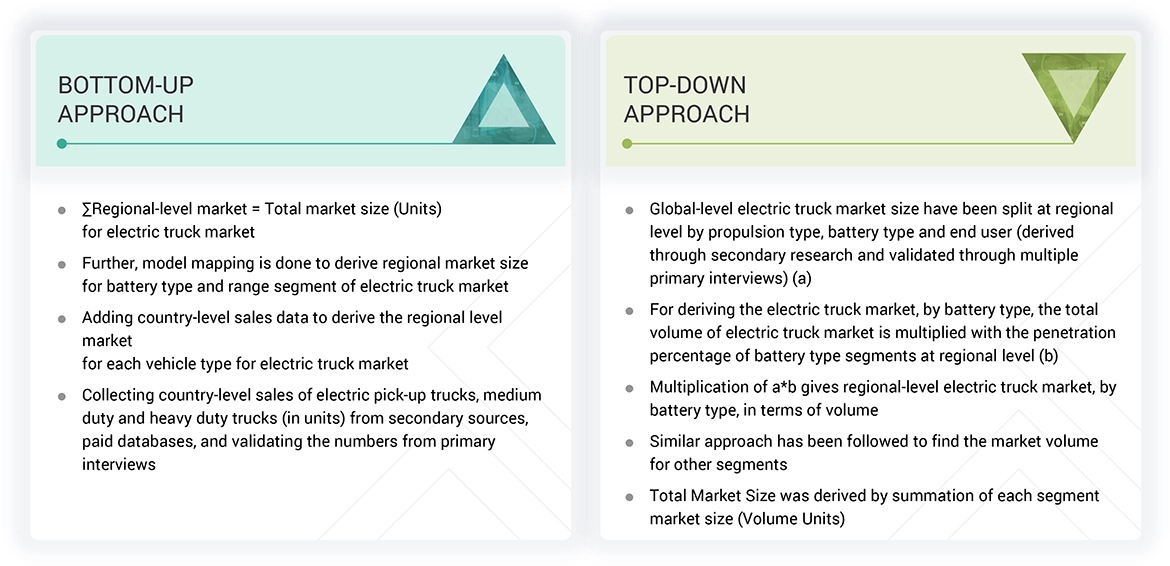
The study involved four major activities in estimating the current size of the electric truck market. Exhaustive secondary research was done to collect information on the market, the peer market, and the parent market. The next step was to validate these findings, assumptions, and sizing from industry experts across value chains through primary research. The top-down and bottom-up approaches were employed to estimate the complete market size. Thereafter, market breakdown and data triangulation processes were used to estimate the market size of segments and subsegments.
Secondary Research
In the secondary research process, various secondary sources such as company annual reports/presentations, press releases, industry association publications [e.g., publications of electric trucks OEMs, Canadian Automobile Association (CAA), country-level automotive associations and trade organizations, and the US Department of Transportation (DOT)], commercial vehicle magazine articles, directories, technical handbooks, World Economic Outlook, trade websites, and technical articles have been used to identify and collect information useful for an extensive commercial study of the global electric truck market.
Primary Research
Extensive primary research was conducted after acquiring an understanding of the electric truck market scenario through secondary research. Several primary interviews were conducted with market experts from both the demand (electric truck manufacturers, country-level government associations, and trade associations) and supply (OEMs and component manufacturers) sides across Asia Pacific, Europe, and North America. Primary data was collected through questionnaires, emails, and telephonic interviews. In the canvassing of primaries, various departments within organizations, such as sales, operations, and administration, were covered to provide a holistic viewpoint in this report.
After interacting with industry experts, brief sessions with highly experienced independent consultants were conducted to reinforce the findings from the primaries. This, along with the in-house subject-matter experts’ opinions, has led to the findings described in the remainder of this report.
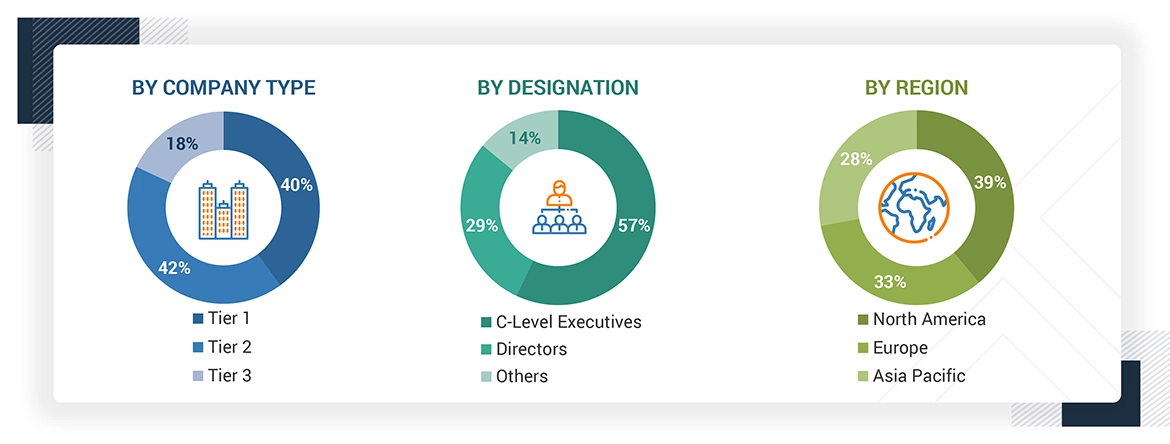
Note: Tiers of companies are based on the value chain of the electric truck market; revenues of companies have not been considered. Tier
1 companies are component manufacturers, and Tier 2 companies are material suppliers and system integrators.
Other designations include sales, marketing, and product managers.
To know about the assumptions considered for the study, download the pdf brochure
Market Size Estimation
A detailed market estimation approach was followed to estimate and validate the volume of the electric truck market and other dependent submarkets, as mentioned below:
- Key players in the electric truck market were identified through secondary research, and their global market shares were determined through primary and secondary research.
- The research methodology included the study of the annual and quarterly financial reports & regulatory filings of major market players, as well as interviews with industry experts for detailed market insights.
- All major penetration rates, percentage shares, splits, and breakdowns for the electric trucks market were determined using secondary sources and model mapping and verified through primary sources.
- All key macro indicators affecting the revenue growth of the market segments and subsegments were accounted for, viewed in extensive detail, verified through primary research, and analyzed to get the validated and verified quantitative & qualitative data.
- The market data gathered was consolidated and added with detailed inputs, analyzed, and presented in this report.
Electric Truck Market : Top-Down and Bottom-Up Approach
Data Triangulation
After arriving at the overall market size using the market estimation processes explained above, the market was split into several segments and sub-segments. To complete the overall market engineering process and arrive at the exact statistics of each market segment and sub-segment, data triangulation and market breakdown procedures were employed, wherever applicable. The data was triangulated by studying various factors and trends from both the demand and supply sides.
Market Definition
Electric trucks are designed to carry a weight of more than 3.5 tons. However, they have a few limitations, such as short-range and lower power output than conventional trucks. Electric trucks are further segmented into light-duty, medium-duty, and heavy-duty trucks.
Stakeholders
- Associations, Forums, and Alliances related to Electric Trucks
- Automobile Manufacturers
- Automotive Component Manufacturers
- Automotive Investors
- Automotive Software Manufacturers and Providers
- Companies Operating in Autonomous Vehicle Ecosystem
- Electric Pick-up Truck Manufacturers
- Electric Medium and Heavy-duty Truck Manufacturers
- EV Battery Manufacturers
- Charging Equipment Manufacturers
- Charging Infrastructure Service Providers
- EV Component Manufacturers
- EV Distributors and Retailers
- Government Agencies and Policy Makers
- Original Equipment Manufacturers
- Raw Material Suppliers for Automotive Software or Components
- Transport Authorities
- Technology Providers
- Vehicle Electronics Manufacturers
Report Objectives
-
To segment and forecast the size of the electric truck market in terms of volume
- By propulsion (BEV, PHEV, and FCEV)
- By type (light-duty trucks, medium-duty trucks, and heavy-duty trucks)
- By range (up to 200 miles and above 200 miles)
- By battery type [Lithium-Iron-Phosphate (LFP), Lithium-Nickel-Manganese-Cobalt Oxide (NMC), and others]
- By battery capacity (<50 kWh, 50−250 kWh, and above 250 kWh)
- By level of automation (semi-autonomous and autonomous)
- By payload capacity (up to 10,000 lbs, 10,001–26,000 lbs, and above 26,000 lbs)
- By end user (last-mile delivery, field services, distribution services, long-haul transportation, and refuse services)
- To segment and forecast the size of the regional electric truck market in terms of value
- To forecast the sizes of market segments with respect to key regions, namely North America, Europe, Asia Pacific, and the Middle East & Africa
- To provide detailed information regarding the major factors influencing market growth (drivers, challenges, restraints, and opportunities)
- To analyze regional markets for growth trends, prospects, and their contribution to the overall market
- To analyze opportunities for stakeholders and provide details of the competitive landscape for market leaders
-
To study the following with respect to the market:
- Impact of AI/Gen AI
- US 2025 Tariff
- Trend and Disruption Impact
- Value Chain Analysis
- Ecosystem Analysis
- Technology Analysis
- Case Study Analysis
- Patent Analysis
- Trade Analysis
- Regulatory Landscape
- Bill of Materials
- Investment And Funding Scenario
- Total Cost of Ownership
- Key Stakeholders and Buying Criteria
- Key Conferences and Events
- Average Selling Price Analysis
- To strategically profile key players and comprehensively analyze their market share and core competencies
- To track and analyze competitive developments such as deals (joint ventures, mergers & acquisitions, partnerships, collaborations), product launches/developments, and other activities carried out by key industry participants
Available Customizations
With the given market data, MarketsandMarkets offers customizations in line with company-specific needs.
Electric truck market, by range, at country level (For countries covered in the report)
Company Information
- Profiling of up to five additional players
Get the Full Electric Truck Market Report
Full forecast, segment splits, and company analysis for all Electric Truck Market.
- China Electric Truck Market
- India Electric Truck Market
- Japan Electric Truck Market
- South Korea Electric Truck Market
- France Electric Truck Market
- Germany Electric Truck Market
- Netherlands Electric Truck Market
- Norway Electric Truck Market
- Sweden Electric Truck Market
- UK Electric Truck Market
- Canada Electric Truck Market
- US Electric Truck Market
- South Africa Electric Truck Market
- Egypt Electric Truck Market
Need a Tailored Report?
Customize this report to your needs
Get 10% FREE Customization
Customize This Report
