
Japan Environmental Monitoring Market (2025-2030)

The Japan Environmental Monitoring Market was valued at $815.7 Million in 2025 and projected to reach to $1135.5 Million by 2030, representing a compound annual growth rate of 6.8%. Japan's environmental monitoring market is poised for sustained expansion, driven by increasing healthcare facility investments in air quality management and contamination prevention systems.


| Market Size in | USD 26.32 MN |
| Market Forecast in | |
| CAGR | |
| Forecast Period | |
| Units Considered | Value (USD MN) |
Japan Environmental Monitoring Market Trends and Insights
- Japan's commitment to stringent environmental regulations and advanced healthcare infrastructure is driving adoption of sophisticated monitoring technologies across clinical and industrial settings.
- The market in Japan benefits from strong government initiatives, aging population demographics, and increasing awareness of air and water quality impacts on public health. The 6.8% compound annual growth rate in Japan outpaces the global average, reflecting the nation's leadership in environmental health standards and technological innovation.
- Japan's healthcare sector is increasingly integrating environmental monitoring solutions to support preventive medicine and occupational safety compliance.
- By 2030, Japan is expected to solidify its position as a key market for environmental monitoring technologies in the Asia Pacific region, driven by continuous investment in smart city infrastructure and environmental sustainability initiatives..
Key Market Statistics
- CAGR (2025-2030) 6.8% CAGR
- Market Size, 2025 ~USD 815.7 Million
- Forecast, 2030 ~USD 1135.5 Million
- Country Japan
Japan Environmental Monitoring Market Overview
Market Valuation :
Japan's environmental monitoring market is valued at $815.7 million in 2025, with strong growth trajectory driven by healthcare sector expansion and industrial compliance requirements.
Regulatory Environment :
Japan's stringent environmental regulations and commitment to sustainability standards are accelerating adoption of advanced monitoring technologies across healthcare facilities and manufacturing sectors.
Technology Infrastructure :
Advanced healthcare infrastructure in Japan supports deployment of sophisticated environmental monitoring solutions, including real-time air quality, water quality, and contamination detection systems.
Growth Momentum :
With a 6.8% CAGR through 2030, Japan's market outpaces the global average of 5.6%, reflecting strong domestic demand and government support for environmental health initiatives.
Japan Environmental Monitoring Market Dynamics
- The nation's aging population and emphasis on infection control in medical settings are creating significant demand for real-time environmental monitoring solutions.
- Government initiatives promoting green healthcare practices and strict compliance with environmental standards further accelerate market growth.
- By 2030, the market is expected to reach $1,135.5 million, reflecting Japan's commitment to integrating advanced monitoring technologies into clinical and industrial operations.
- The convergence of regulatory pressure, technological advancement, and healthcare modernization positions Japan as a key growth market in the Asia-Pacific region..
Market Ecosystem
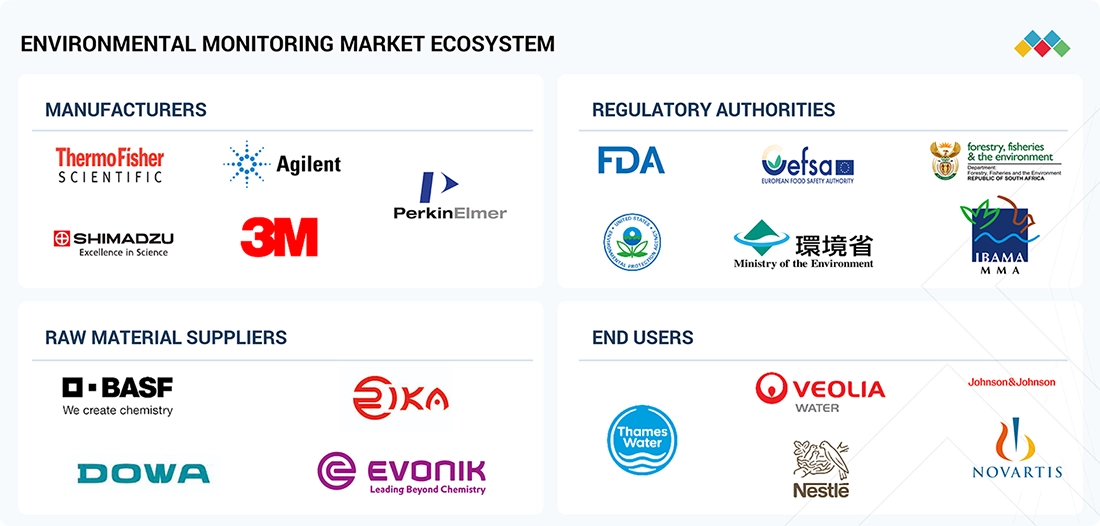
ENVIRONMENTAL MONITORING MARKET: COMMERCIAL USE CASES ACROSS INDUSTRIES
| COMPANY | USE CASE DESCRIPTION | BENEFITS |
|---|---|---|
 |
The use of Orion Water Quality Analyzers and Aerosol Monitoring Systems for analysis of air and water pollution | The analyzer ensures regulatory compliance and supports environmental risk assessments by providing extremely accurate, real-time detection of contaminants and particulates. |
 |
Development of GC/MS and LC-MS-based systems for detecting trace-level of organic pollutants, pesticides, and heavy metals | It facilitates tracking the source of pollutants, enhancing environmental safety monitoring, and ultra-sensitive chemical identification. |
 |
Use of Atomic Absorption Spectrometers and Clarus GC systems for soil and water contaminant analysis | The system improves data reliability in laboratories by enabling reliable, high-throughput detection of VOCs and heavy metals. |
 |
DNeasy PowerWater and PowerSoil kits for microbial DNA extraction from environmental samples (water, soil, and air) | The kit facilitates easier microbial community analysis, thereby facilitating faster detection of pathogens and bioindicators in ecosystems. |
 |
Deployment of continuous emission monitoring systems (CEMS) for compliance with industrial air quality norms | It provides automated, real-time monitoring and reporting of pollutant emissions, ensuring regulatory adherence and sustainability performance. |
Logos and trademarks shown above are the property of their respective owners. Their use here is for informational and illustrative purposes only.
Related Ecosystem
Analytical And Scientific Instrumentation
- Environmental Testing
- Gas Chromatography
- Polymerase Chain Reaction (PCR)
- Automated Liquid Handling Systems
- Flow Cytometry
- Thermo Fisher Scientific Inc.
- Danaher Corporation
- Agilent Technologies, Inc.
- Shimadzu Corporation
- Merck KGaA
Key Takeaways
- Japan's environmental monitoring market is valued at $815.7 million in 2025 with projected growth to $1,135.5 million by 2030.
- Japan's 6.8% CAGR exceeds the global average of 5.6%, indicating accelerated market expansion driven by regulatory compliance and healthcare innovation.
- Japan's aging population and stringent environmental standards create sustained demand for advanced monitoring technologies in healthcare and industrial applications.
- Japan is positioned as a regional leader in environmental monitoring adoption, supported by government initiatives and smart city development programs.
Environmental Monitoring Market Report Scope
| Report Metric | Details |
|---|---|
| Base Year | 2025 |
| Fastest Growing Segment | PORTABLE INDOOR MONITORS (Type) |
| Forecast Period | 2025–2030 |
| Growth Rate | CAGR of 5.6% from 2025 to 2030 |
| Largest Segment | OUTDOOR MONITORS (Product) |
| Market Size Base Year (Billions) | ~USD 16.1 (2025) |
| Revenue Forecast (Billions) | ~USD 21.14 (2030) |
| Segments Covered | Product, Type, Sampling Method, Application, Component, End User, End-User |
Japan Environmental Monitoring Market Report Segmentation
7 segment dimensions are covered across the global market.
By Product
- Indoor Monitors
- Outdoor Monitors
- Sensors
- Software
- Wearables
By Type
- Fixed Indoor Monitors
- Fixed Outdoor Monitors
- Gas Detection
- Other Chemical Detection
- Other Particulate Detection
- Pesticide Detection
- Pm10 Detection
- Pm2.5 Detection
- Portable Indoor Monitors
- Portable Outdoor Monitors
- Surface & Groundwater
- Surface & Groundwater Monitoring
- Volatile Organic
- Volatile Organic Compound Detection
- Wastewater Monitoring
By Sampling Method
- Active Monitoring
- Continuous Monitoring
- Intermittent Monitoring
- Passive Monitoring
By Application
- Air Pollution Monitoring
- Noise Pollution Monitoring
- Soil Pollution Monitoring
- Water Pollution Monitoring
By Component
- Biological Detection
- Chemical Detection
- Moisture Detection
- Noise Measurement
- Particulate Detection
- Temperature Sensing
By End User
- Commercial Users
- Enterprise
- Enterprises
- Government Agencies
- Government Agencies & Smart City Authorities
- Healthcare & Pharmaceutical
- Healthcare & Pharmaceutical Industries
- Industrial
- Industrial Users
- Other End Users
- Residential
- Residential Users
By End-User
- Commercial Users
- Enterprise
- Government Agencies
- Healthcare & Pharmaceutical
- Industrial
- Other End Users
- Residential
Target Audience
- Healthcare Facility Operators : Hospital administrators and clinic managers need Japan market insights to evaluate environmental monitoring investments, understand regulatory compliance costs, and benchmark against industry standards.
- Medical Device Manufacturers : Companies developing monitoring solutions require Japan-specific market data to assess demand, identify distribution channels, and tailor products to local healthcare infrastructure requirements.
- Environmental Compliance Officers : Corporate sustainability and compliance professionals need detailed market intelligence to understand Japan's regulatory environment and identify monitoring technologies that meet stringent local standards.
- Investment & Private Equity Firms : Investors evaluating opportunities in Japan's healthcare technology sector need accurate market sizing, growth projections, and competitive landscape data for due diligence and portfolio decisions.
- Technology Solution Providers : Software and IoT companies entering Japan's environmental monitoring space require market analysis to understand customer segments, pricing models, and integration requirements specific to Japanese healthcare facilities.
Key Companies in the Japan Environmental Monitoring Market
| Company | HQ | Ownership | Strongest segments |
|---|---|---|---|
| TSI INC | China | Public Company | Tsingtao Beer core portfolio,Laoshan Beer and regional brands,Hans Beer and youth-oriented labels, |
| KORE WIRELESS GROUP | United States | Public Company | IoT connectivity-as-a-service,Connectivity enablement-as-a-service,Device solutions and IoT devices, |
| DKK-TOA CORPORATION | Japan | Public Company | Water & wastewater analyzers and systems,Ambient air and emission gas analyzers,Laboratory analytical instruments, |
| ENDRESS + HAUSER AG | Switzerland | Private Company | Flow measurement instrumentation and systems,Level and pressure instrumentation,Analytical and temperature measurement, |
| BAKER HUGHES COMPANY | United States | Public Company | Drilling, completions, and well services,Oilfield and industrial chemicals and artificial lift,Subsea projects, flexible pipe, and surface pressure control, |
| SIEMENS HEALTHINEERS | Germany | Public Company | Imaging,Diagnostics,Varian (Oncology), |
| THERMO FISHER SCIENTIFIC INC. | United States | Public Company | Laboratory Products and Biopharma Services,Life Sciences Solutions,Analytical Instruments, |
| AGILENT TECHNOLOGIES, INC. | United States | Public Company | Life Sciences and Diagnostics Markets,Agilent CrossLab,Applied Markets, |
| SHIMADZU CORPORATION | Japan | Public Company | Analytical and Measuring Instruments (chromatography, MS, spectroscopy, elemental/surface analysis, TOC, thermal, particle size, balances, software),Medical Systems (angiography, fluoroscopy, radiography, mobile X-ray, PET, fluorescence imaging),Vacuum and Industrial Machinery (turbo molecular pumps, leak detectors, deposition, furnaces, mechatronics, dynamic balancing), |
| PERKINELMER | United States | Public Company | Diagnostics (prenatal, neonatal, infectious disease, immunodiagnostics),Life science reagents and assay platforms (BioLegend, AlphaLISA, Dharmacon, NEXTFLEX),Instruments, imaging, software, and services, |
| 3M | United States | Public Company | Safety and Industrial,Transportation and Electronics,Consumer, |
| EMERSON ELECTRIC CO. | United States | Public Company | Final Control,Measurement & Analytical,Discrete Automation, |
| BIOMÉRIEUX | France | Public Company | Microbiology systems and culture media (VITEK, BACT/ALERT, CHROMID, culture media),Molecular diagnostics (BIOFIRE, SPOTFIRE, ARGENE, EMAG/NUCLISENS, GENE-UP, VERIFLOW),Immunoassays and CLIA (VIDAS, Hybiome), |
| MERCK KGAA | Germany | Public Company | Life Science (reagents, consumables, bioprocessing, CDMO),Healthcare (prescription drugs and biopharmaceuticals),Electronics (semiconductor and display materials, gases, equipment), |
| HONEYWELL INTERNATIONAL, INC. | United States | Public Company | Industrial Automation,Building Automation,Energy and Sustainability Solutions (UOP and related), |
| SIEMENS | Germany | Public Company | Digital Industries,Smart Infrastructure,Mobility, |
| HORIBA LTD. | Japan | Public Company | Energy and Environment (water, liquid, industrial process, energy analytics),Mobility (emissions, engine, driveline, brake, wind tunnel systems),Bio and Healthcare (life science instruments and IVD systems), |
| TELEDYNE TECHNOLOGIES | United States | Public Company | Digital Imaging,Instrumentation,Aerospace and Defense Electronics, |
| TE CONNECTIVITY | Ireland | Public Company | Transportation Solutions (automotive, e-mobility, commercial vehicles, autosport, rail),Industrial Solutions (aerospace, defense, energy, industrial machinery, intelligent buildings, oil and gas/marine, space, rail infrastructure),Data, Devices, and IoT (5G, wireless equipment, data centers, connected home, personal electronics, IoT connectivity), |
TSI INC
TSI Inc is a public company founded in 1903 and headquartered in China with 29,257 employees.
KORE WIRELESS GROUP
Kore Wireless Group is a public company founded in 2002 in the United States with 403 employees.
DKK-TOA CORPORATION
DKK-TOA Corporation is a public company founded in 1944 in Japan with 639 employees.
ENDRESS + HAUSER AG
Endress + Hauser AG is a private company founded in 1953 in Switzerland with 17,046 employees.
BAKER HUGHES COMPANY
Baker Hughes Company is a public company founded in 2016 in the United States with 53,000 employees.
SIEMENS HEALTHINEERS
Siemens Healthineers is a public company founded in 1896 in Germany with 72,369 employees.
THERMO FISHER SCIENTIFIC INC.
Thermo Fisher Scientific Inc. is a public company founded in 1956 in the United States with 125,000 employees.
AGILENT TECHNOLOGIES, INC.
Agilent Technologies, Inc. is a public company founded in 1999 in the United States with 18,000 employees.
SHIMADZU CORPORATION
Shimadzu Corporation is a public company founded in 1875 in Japan with 14,649 employees.
PERKINELMER
PerkinElmer is a public company founded in 1937 in the United States with 11,000 employees.
3M
3M is a public company founded in 1902 in the United States with 60,500 employees.
EMERSON ELECTRIC CO.
Emerson Electric Co. is a public company founded in 1890 in the United States with 71,000 employees.
BIOMÉRIEUX
bioMérieux is a public company founded in 1963 in France with 14,894 employees.
MERCK KGAA
Merck KGaA is a public company founded in 1668 in Germany with 59,077 employees.
HONEYWELL INTERNATIONAL, INC.
Honeywell International, Inc. is a public company founded in 1885 in the United States with 101,000 employees.
SIEMENS
Siemens is a public company founded in 1847 in Germany with 310,312 employees.
HORIBA LTD.
Horiba Ltd. is a public company founded in 1945 in Japan with 9,101 employees.
TELEDYNE TECHNOLOGIES
Teledyne Technologies is a public company founded in 1960 in the United States with 15,800 employees.
TE CONNECTIVITY
TE Connectivity is a public company founded in 1941 in Ireland with 80,000 employees.
Reasons to Buy this Report
- Market Size & Growth Data : Access precise valuation metrics for Japan's environmental monitoring market with verified 2025-2030 forecasts, enabling accurate investment planning and competitive positioning in this high-growth segment.
- Regulatory Landscape Analysis : Understand Japan's stringent environmental regulations and healthcare compliance requirements that drive technology adoption, helping you align products and services with local market demands.
- Competitive Intelligence : Gain insights into Japan-specific market dynamics, technology preferences, and healthcare facility requirements to develop targeted strategies and identify partnership opportunities.
- Sector-Specific Opportunities : Identify high-potential segments within Japan's healthcare and industrial sectors where environmental monitoring solutions are experiencing accelerated adoption and investment.
- Strategic Market Entry : Leverage comprehensive Japan market data to develop localized go-to-market strategies, understand customer needs, and establish competitive advantages in this premium healthcare market.
Frequently asked questions
What is the current size of Japan's environmental monitoring market?
Japan's environmental monitoring market is valued at $815.7 million in 2025, with expectations to grow to $1,135.5 million by 2030.
What is the growth rate for Japan's environmental monitoring market?
Japan's environmental monitoring market is growing at a compound annual growth rate (CAGR) of 6.8% from 2025 to 2030, outpacing the global average.
What factors are driving growth in Japan's environmental monitoring market?
Growth in Japan is driven by stringent environmental regulations, an aging population, advanced healthcare infrastructure, government sustainability initiatives, and increasing smart city investments.
How does Japan's market growth compare to global trends?
Japan's 6.8% CAGR exceeds the global environmental monitoring market CAGR of 5.6%, reflecting Japan's leadership in environmental health standards and technological adoption.
What applications are driving environmental monitoring demand in Japan?
Demand in Japan is driven by clinical healthcare applications, occupational safety compliance, air and water quality monitoring, and preventive medicine initiatives across healthcare facilities.
RESEARCH METHODOLOGY
This research study extensively utilized secondary sources, directories, and databases to identify and gather valuable information for analyzing the global environmental monitoring market. Additionally, in-depth interviews were conducted with primary respondents, including key industry participants, subject-matter experts, C-level executives from leading market players, and industry consultants. These interviews helped obtain and validate critical qualitative and quantitative data while assessing growth prospects. The global market size was initially estimated through secondary research and refined and finalized through triangulation with insights from primary research.
Secondary Research
The secondary research process involved the widespread use of secondary sources, directories, databases (such as Bloomberg Businessweek, Factiva, and D&B Hoovers), white papers, annual reports, company house documents, investor presentations, and companies' SEC filings. Secondary research was used to identify and collect information useful for the extensive, technical, market-oriented, and commercial study of the environmental monitoring market. It was also used to obtain important information on key players, market classification & segmentation aligned with industry trends, and key developments from market and technology perspectives, down to the bottom-most level. A database of the key industry leaders was also prepared using secondary research.
Primary Research
In the primary research process, various sources from the supply and demand sides were interviewed to obtain qualitative and quantitative information for this report. The primary sources on the supply side include industry experts such as CEOs, vice presidents, marketing and sales directors, technology & innovation directors, and other key executives from leading companies and organizations in the environmental monitoring market. The primary demand-side sources include OEMs, private and contract testing organizations, and service providers, among others. Primary research was conducted to validate the market segmentation, identify key players, and gather insights on key industry trends & key market dynamics.
The following is a breakdown of the primary respondents
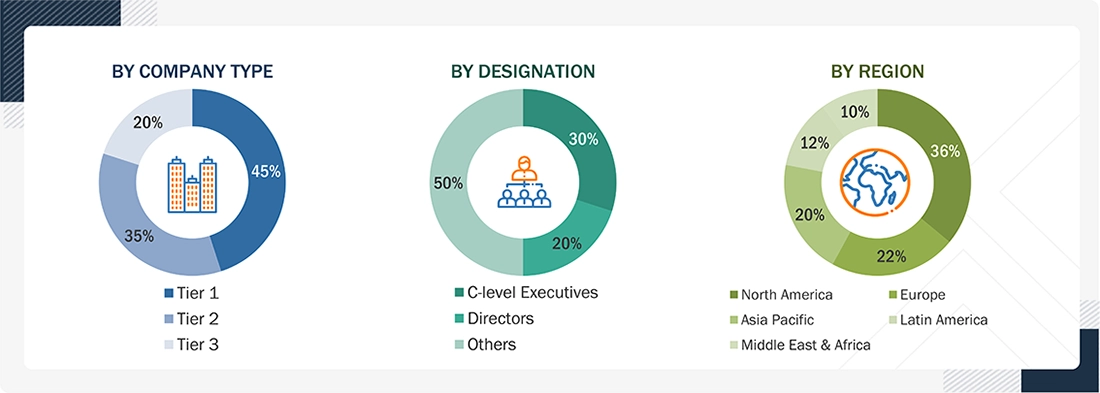
To know about the assumptions considered for the study, download the pdf brochure
Market Size Estimation
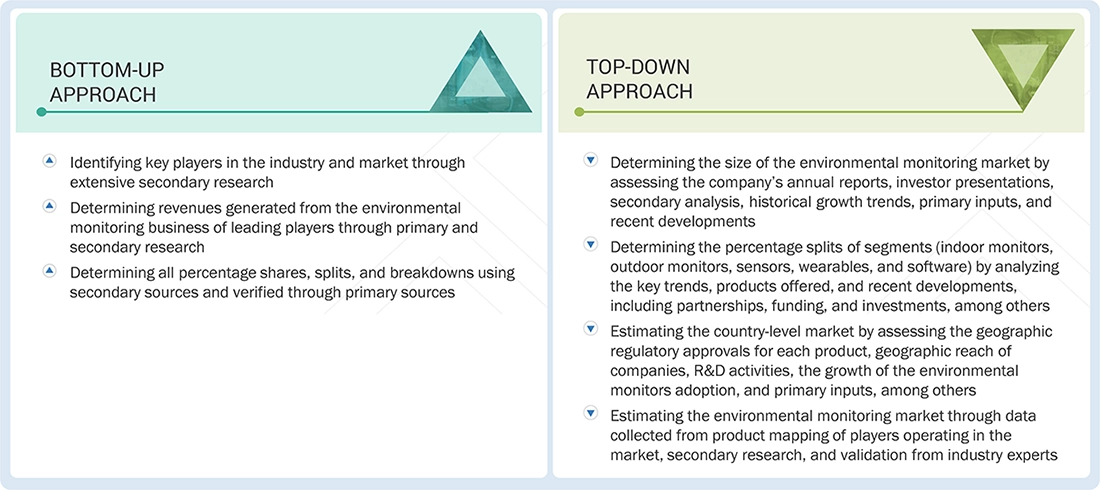
The bottom-up approach was used to estimate and validate the total size of the environmental monitoring market. These methods were also widely used to estimate the sizes of various market subsegments. The research methodology used to estimate the market size includes the following:
- Generating a list of major global players operating in the environmental monitoring market
- Mapping annual revenues generated by major global players from the sales of environmental monitoring solutions (or nearest reported business unit/service category)
- Revenue mapping of key players to cover a major share of the global environmental monitoring market as of 2024
- Extrapolating the global value of the environmental monitoring industry
Environmental Monitoring Market : Top-Down and Bottom-Up Approach
Data Triangulation
After arriving at the market size from the market-size estimation process described above, the total market was divided into several segments and subsegments. To complete the overall market engineering process and obtain exact statistics for all segments and subsegments, data triangulation and market breakdown procedures were employed, as applicable. The data was triangulated by studying various factors and trends from both the demand and supply sides.
Market Definition
Environmental monitoring comprises of solutions designed to measure and analyze environmental conditions, track trends, and support evidence-based policy formulation and implementation. These systems also generate reliable data for reporting to national authorities, international organizations, and the public. Environmental monitoring serves a wide range of applications, including detecting changes in temperature, humidity, smoke, airflow, and water quality across industrial facilities, data centers, and remote locations. Monitoring equipment and software solutions enable accurate identification and analysis of environmental pollutants. These technologies are widely used for monitoring air, water, soil, and noise pollution. Overall, environmental monitoring plays a critical role in assessing pollution levels, protecting human health, ensuring product and operational safety, and supporting compliance with environmental regulations.
Key Stakeholders
- Original equipment manufacturers (OEMs)
- Suppliers of raw materials and manufacturing equipment
- Environmental pollution detection traders, distributors, and suppliers
- Standards development officers
- Environmental Protection Agency (EPA) officials.
- Research and development (R&D) companies
- Laboratory directors
- Analytical chemists
- QA/QC managers
- Government agencies
- Regulatory agencies
- Solid waste management directors
Report Objectives
- To define, describe, and forecast the environmental monitoring market based on product, component, sampling method, application, end user, and region
- To provide detailed information on drivers, restraints, opportunities, challenges, and industry trends influencing the growth potential of the global environmental monitoring market
- To analyze the micromarkets with respect to individual growth trends, prospects, and contributions to the global environmental monitoring market
- To analyze key growth opportunities in the global environmental monitoring market for key stakeholders and provide details of the competitive landscape for market leaders
- To forecast the size of market with respect to five major regions: North America (US and Canada), Europe (Germany, UK, France, Italy, Spain, and Rest of Europe), Asia Pacific (Japan, China, India, Australia, South Korea, and Rest of Asia Pacific), Latin America (Brazil, Mexico, and Rest of Latin America), and Middle East & Africa (GCC and Rest of Middle East & Africa)
- To profile the key players in the environmental monitoring market and comprehensively analyze their market shares and core competencies
- To analyze the competitive developments undertaken in the global environmental monitoring market, such as agreements, expansions, and acquisitions
Available customizations:
Based on the given market data, MarketsandMarkets offers customizations tailored to the company’s specific needs. The following customization options are available for this report
Product Analysis
- Product Matrix, which gives a detailed comparison of the product portfolios of the top 3 companies
Regional Analysis
- A further breakdown of countries covered in the Rest of Asia Pacific environmental monitoring market
- A further breakdown of countries covered in the Rest of Europe environmental monitoring market
- A further breakdown of countries covered in the Rest of Latin American environmental monitoring market
Company Information
- Detailed analysis and profiling of additional market players (up to three)
Get the Full Environmental Monitoring Market Report
Full forecast, segment splits, and company analysis for all Environmental Monitoring Market.
- Spain Environmental Monitoring Market
- China Environmental Monitoring Market
- India Environmental Monitoring Market
- South Korea Environmental Monitoring Market
- Australia Environmental Monitoring Market
- Brazil Environmental Monitoring Market
- Mexico Environmental Monitoring Market
- US Environmental Monitoring Market
- Canada Environmental Monitoring Market
- Germany Environmental Monitoring Market
- France Environmental Monitoring Market
- UK Environmental Monitoring Market
- Italy Environmental Monitoring Market
Need a Tailored Report?
Customize this report to your needs
Get 10% FREE Customization
Customize This Report
