
Germany Fake Image Detection Market (2024-2029)

The Germany Fake Image Detection Market was valued at $39.5 Million in 2024 and projected to reach to $265.9 Million by 2029, representing a compound annual growth rate of 46.4%. Germany's fake image detection market is poised for exceptional growth, driven by regulatory pressures, digital transformation initiatives, and increasing corporate awareness of synthetic media risks.


| Market Size in | USD 26.32 MN |
| Market Forecast in | |
| CAGR | |
| Forecast Period | |
| Units Considered | Value (USD MN) |
Germany Fake Image Detection Market Trends and Insights
- This represents a compound annual growth rate of 46.4%, significantly outpacing global trends.
- Germany's strong digital infrastructure, stringent data protection regulations, and heightened awareness of synthetic media threats are driving substantial investment in detection technologies across media, finance, and government sectors. The German market benefits from the country's leadership in artificial intelligence research and its robust cybersecurity ecosystem.
- Germany's commitment to combating misinformation and deepfakes, coupled with regulatory frameworks like the NetzDG Act, creates favorable conditions for fake image detection solutions.
- Between 2024 and 2029, Germany is expected to emerge as a key innovation hub for detection technologies, attracting both domestic and international vendors seeking to establish European footholds..
Key Market Statistics
- CAGR (2024-2029) 46.4% CAGR
- Market Size, 2024 ~USD 39.5 Million
- Forecast, 2029 ~USD 265.9 Million
- Country Germany
Germany Fake Image Detection Market Overview
Market Valuation & Growth :
Germany's fake image detection market is valued at $39.5 million in 2024, with a projected CAGR of 46.4% through 2029, reaching $265.9 million. This growth rate significantly exceeds the global average of 41.6%, positioning Germany as a high-growth market.
Regulatory Drivers :
Germany's stringent GDPR compliance requirements and digital media regulations create strong demand for advanced fake image detection solutions. The country's commitment to data protection and content authenticity standards accelerates technology adoption across sectors.
Digital Infrastructure Advantage :
Germany's robust digital infrastructure and high internet penetration support rapid deployment of AI-powered detection technologies. Strong tech ecosystems in Berlin, Munich, and Frankfurt facilitate innovation and market expansion in synthetic media detection.
Synthetic Media Awareness :
Heightened awareness of deepfakes and synthetic media threats among German enterprises and government institutions drives investment in detection solutions. Media organizations and financial institutions prioritize authentication technologies to combat misinformation.
Germany Fake Image Detection Market Dynamics
- The country's strong emphasis on data protection and content authenticity creates a favorable environment for technology adoption across media, finance, and government sectors. The forecast period through 2029 will see accelerated investment in AI-driven detection platforms, particularly among enterprises managing sensitive visual content.
- Germany's position as a European tech leader, combined with stringent compliance requirements, positions the market as a critical hub for fake image detection innovation and deployment..
Market Ecosystem
Related Ecosystem
Software And Services
- Natural Language Processing (NLP)
- Machine Learning
- Supply Chain Management
- Predictive Analytics
- Image Sensors
- International Business Machines Corporation
- MICROSOFT CORPORATION
- Oracle Corporation
- SAP SE
- Amazon.com, Inc.
Cyber Security
- Cloud Security
- Biometric Systems
- Data Loss Prevention (DLP)
- Multi-Factor Authentication
- Security Analytics
- REDINGTON
- International Business Machines Corporation
- Cisco Systems, Inc.
- MITSUI BUSSAN SECURE DIRECTIONS INC
- MICROSOFT CORPORATION
Key Takeaways
- Germany's fake image detection market will grow from $39.5M (2024) to $265.9M (2029) at a 46.4% CAGR, driven by regulatory compliance and AI advancement.
- Germany's stringent data protection laws and NetzDG Act create strong demand for detection solutions across media, finance, and government institutions.
- Germany's leadership in AI research and cybersecurity positions it as a European innovation center for fake image detection technologies.
- The 575% market expansion in Germany between 2024 and 2029 reflects accelerating adoption of synthetic media detection across enterprise and public sectors.
Fake Image Detection Market Report Scope
| Report Metric | Details |
|---|---|
| Base Year | 2024 |
| Fastest Growing Segment | GOVERNMENT (Vertical) |
| Forecast Period | 2024-2029 |
| Growth Rate | CAGR of 41.6% from 2024 to 2029 |
| Largest Segment | MARKETING & SALES (Business Function) |
| Market Size Base Year (Billions) | ~USD 0.69 (2024) |
| Revenue Forecast (Billions) | ~USD 3.9 (2029) |
| Segments Covered | Offering, Deployment Mode, Organization Size, Target User, Technology, Application, Vertical, Type, Hardware, Deployment, Service, Professional Service, Business Function |
Germany Fake Image Detection Market Report Segmentation
13 segment dimensions are covered across the global market.
By Offering
- Hardware
- Services
- Software
- Solutions
By Deployment Mode
- Cloud
- On-Premises
By Organization Size
- Large Enterprises
- Smes
By Target User
- Enterprise Grade
- Individual
- Professional
By Technology
- Computer Vision
- Context Awareness
- Image Forensics
- Machine And Deep Learning
- Machine Learning
- Natural Language Processing
By Application
- Access Control And User Monitoring
- Digital Forensics
- Fraud Detection
- Healthcare And Medical Imaging
- Identity Fraud Compliance And Forensics
- Kyc, Kyb, And Onboarding
- Recruitment
- Social Media And Content Moderation
By Vertical
- Agriculture
- Automotive, Transportation, And Logistics
- Bfsi
- Education
- Energy & Utilities
- Gaming & Gambling
- Government
- Government & Defense
- Healthcare
- Healthcare & Life Sciences
- Healthcare& Life Sciences
- It & Ites
- It/Ites
- Manufacturing
- Media & Entertainment
- Media And Entertainment
- Other Verticals
- Real Estate
- Retail & Ecommerce
- Telecom
- Telecommunications
By Type
- AI Marketplaces
- Biometrics
- Customizable AI
- Edge AI
- Non-Biometrics
- Pre-Trained Models
By Hardware
- Accelerators
- Memory
- Network
- Processors
By Deployment
- Cloud
- On-Premises
By Service
- Managed Services
- Professional Services
By Professional Service
- Consulting Services
- Deployment And Integration
- Support And Maintenance
By Business Function
- Finance
- Human Resource
- Law
- Marketing & Sales
- Operations
- Security
- Supply Chain Management
GERMANY: FAKE IMAGE DETECTION MARKET, BY APPLICATION, 2024–2029
| Segment | 2024 | 2025 | 2026 | 2027 | 2028 | 2029 | CAGR (%) |
|---|---|---|---|---|---|---|---|
| DIGITAL FORENSICS | 8.2 | 12 | 17.5 | 25.8 | 38.3 | 57.3 | 47.4 |
| FRAUD DETECTION | 6.3 | 9.2 | 13.7 | 20.3 | 30.4 | 45.8 | 48.7 |
| HEALTHCARE AND MEDICAL IMAGING | 4.1 | 5.8 | 8.4 | 12 | 17.4 | 25.4 | 43.9 |
| RECRUITMENT | 2.3 | 3.2 | 4.5 | 6.4 | 9.2 | 13.4 | 42.6 |
| SOCIAL MEDIA AND CONTENT MODERATION | 18.6 | 26.9 | 39 | 57.1 | 83.9 | 124.1 | 46.1 |
| TOTAL | 39.5 | 57.1 | 83.1 | 121.7 | 179.3 | 265.9 | 46.4 |
Target Audience
- Technology Solution Providers : AI and detection software vendors need Germany-specific market data to develop localized solutions, understand regulatory requirements, and identify enterprise customers prioritizing synthetic media authentication and compliance.
- Enterprise Decision Makers : German corporate leaders in media, finance, and technology sectors require market intelligence to evaluate fake image detection investments, benchmark against competitors, and align technology adoption with regulatory obligations.
- Government & Regulatory Bodies : German government agencies and regulatory authorities need market insights to inform digital authenticity policies, assess technology readiness, and develop frameworks for combating synthetic media threats in critical sectors.
- Investment & Venture Capital Firms : Investors targeting German tech markets need detailed growth projections, market sizing, and competitive landscape analysis to identify high-potential fake image detection startups and technology companies for funding and acquisition.
- Media & Content Organizations : German media companies, news organizations, and content platforms require market data to justify detection technology investments, understand industry adoption trends, and implement content authenticity verification systems.
Reasons to Buy this Report
- Market-Specific Growth Intelligence : Gain detailed insights into Germany's 46.4% CAGR trajectory and understand the unique factors driving market expansion faster than global averages. Identify high-growth segments and emerging opportunities specific to the German market landscape.
- Regulatory & Compliance Roadmap : Understand how GDPR, NetzDG, and German digital regulations shape fake image detection requirements. Navigate compliance landscapes and identify regulatory-driven demand opportunities for solution providers and enterprises.
- Competitive Positioning Strategy : Benchmark against German market leaders and identify competitive gaps in detection technology adoption. Develop targeted go-to-market strategies for the German enterprise and government sectors with specific regulatory and operational requirements.
- Investment & Expansion Planning : Make informed decisions on market entry, partnerships, and resource allocation in Germany's high-growth fake image detection sector. Evaluate regional investment opportunities with clear market sizing and growth projections through 2029.
- Sector-Specific Demand Analysis : Identify which German industries—media, finance, government, e-commerce—drive the highest detection technology adoption. Tailor solutions and marketing strategies to sector-specific authentication and content verification needs.
Frequently asked questions
What is the current size of Germany's fake image detection market?
Germany's fake image detection market was valued at $39.5 million in 2024 and is projected to reach $265.9 million by 2029.
What is driving growth in Germany's fake image detection market?
Growth in Germany is driven by regulatory requirements like the NetzDG Act, increasing deepfake threats, strong AI capabilities, and heightened cybersecurity awareness across sectors.
What is the CAGR for Germany's fake image detection market?
Germany's fake image detection market is growing at a compound annual growth rate of 46.4% from 2024 to 2029.
Which industries in Germany are adopting fake image detection solutions?
Media organizations, financial institutions, government agencies, and social media platforms in Germany are primary adopters of fake image detection technologies.
How does Germany's market compare to global trends?
Germany's 46.4% CAGR significantly exceeds the global average of 41.6%, reflecting stronger regulatory drivers and higher digital maturity in the country.
RESEARCH METHODOLOGY
The study involved significant activities in estimating the current market size for the fake image detection market. Exhaustive secondary research was done to collect information on the fake image detection industry. The next step was to validate these findings, assumptions, and sizing with industry experts across the value chain using primary research. Different approaches, such as top-down and bottom-up, were employed to estimate the total market size. After that, the market breakup and data triangulation procedures were used to estimate the market size of the segments and sub-segments of the Fake image detection market.
Secondary Research
The market for the companies offering fake image detection market solutions and services is arrived at by secondary data available through paid and unpaid sources, analyzing the product portfolios of the major companies in the ecosystem, and rating the companies by their performance and quality. Various sources were referred to in the secondary research process to identify and collect information for this study. The secondary sources include annual reports, press releases, investor presentations of companies, white papers, journals, certified publications, and articles from recognized authors, directories, and databases.
In the secondary research process, various secondary sources were referred to for identifying and collecting information related to the study. Secondary sources included annual reports, press releases, and investor presentations of the Fake image detection market vendors, forums, certified publications, and whitepapers. The secondary research was used to obtain critical information on the industry's value chain, the total pool of key players, market classification, and segmentation from the market and technology-oriented perspectives.
Primary Research
In the primary research process, various supply and demand sources were interviewed to obtain qualitative and quantitative information for this report. The primary sources from the supply side included industry experts, such as Chief Executive Officers (CEOs), Vice Presidents (VPs), marketing directors, technology and innovation directors, and related key executives from various key companies and organizations operating in the Fake image detection market.
After the complete market engineering (calculations for market statistics, market breakdown, market size estimations, market forecasting, and data triangulation), extensive primary research was conducted to gather information and verify and validate the critical numbers arrived at. Primary research was also undertaken to identify the segmentation types, industry trends, competitive landscape of Fake image detection solutions offered by various market players, and fundamental market dynamics, such as drivers, restraints, opportunities, challenges, industry trends, and key player strategies.
In the complete market engineering process, the top-down and bottom-up approaches and several data triangulation methods were extensively used to perform the market estimation and market forecasting for the overall market segments and subsegments listed in this report. Extensive qualitative and quantitative analysis was performed on the complete market engineering process to list the key information/insights throughout the report.
Following is the breakup of the primary study:
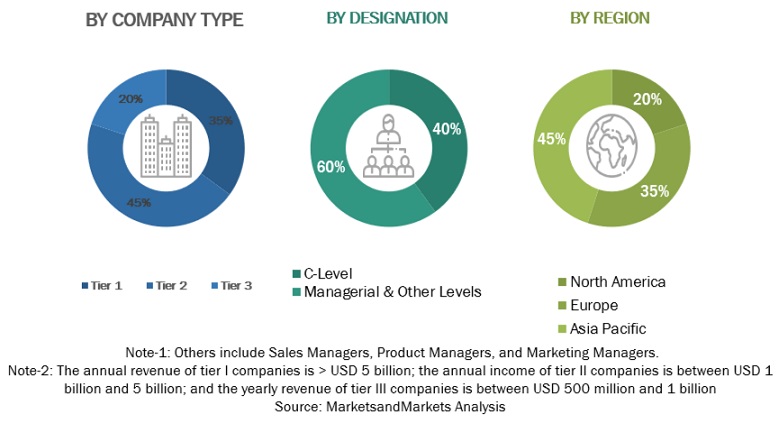
To know about the assumptions considered for the study, download the pdf brochure
Market Size Estimation
Top-down and bottom-up approaches were used to estimate and validate the size of the Fake image detection market and the size of various other dependent sub-segments in the overall Fake image detection market. The research methodology used to estimate the market size includes the following details: critical players in the market were identified through secondary research, and their market shares in the respective regions were determined through primary and secondary research. This entire procedure included the study of the annual and financial reports of the top market players, and extensive interviews were conducted for key insights from the industry leaders, such as CEOs, VPs, directors, and marketing executives.
All percentage splits and breakdowns were determined using secondary sources and verified through primary sources. All possible parameters that affect the market covered in this research study have been accounted for, viewed in extensive detail, verified through primary research, and analyzed to get the final quantitative and qualitative data. This data is consolidated and added to detailed inputs and analysis from MarketsandMarkets.
Infographic Depicting Bottom-Up And Top-Down Approaches
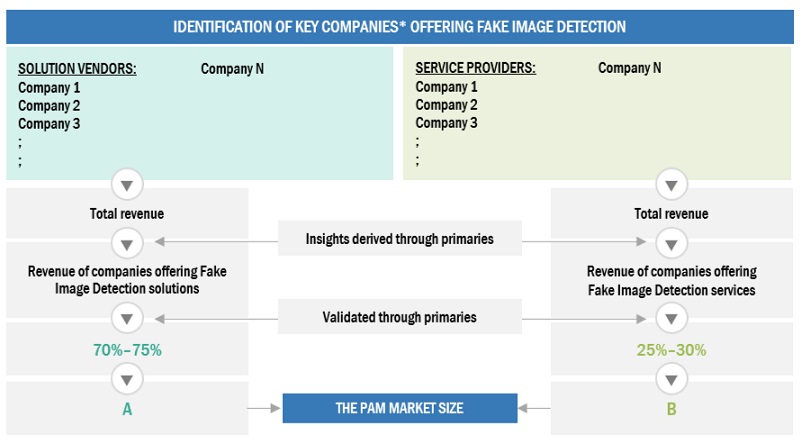
To know about the assumptions considered for the study, Request for Free Sample Report
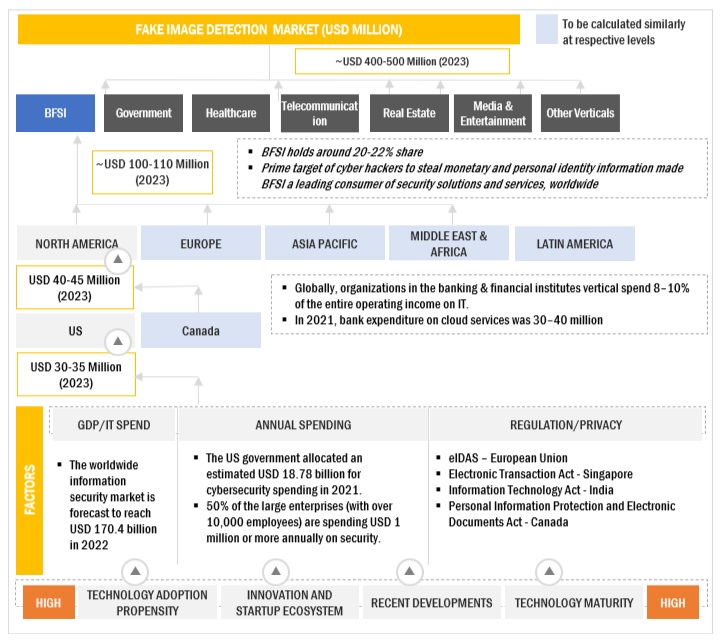
Data Triangulation
The market was split into several segments and subsegments after arriving at the overall market size using the market size estimation processes explained above. The data triangulation and market breakup procedures were employed, wherever applicable, to complete the overall market engineering process and arrive at the exact statistics of each market segment and subsegment. The data was triangulated by studying various factors and trends from both the demand and supply sides.
Market Definition
Fake image detection involves the identification of manipulated or fabricated images that are created to deceive viewers or convey false information. Still images manipulation or alterations, document forgery, photo image forgery, document/photo print forgery, deepfake image detection, and face swapping are considered in the definition of fake image detection.
Key Stakeholders
- Chief Technology and Data Officers
- Business Analysts
- Information Technology (IT) Professionals
- Government Agencies
- Investors and Venture Capitalists
- Small and Medium-Sized Enterprises (SMEs) And Large Enterprises
- Third-Party Providers
- Consultants/Consultancies/Advisory Firms
- Automation Tool Vendor
- OEMs
- Third-Party Providers
Report Objectives
- To describe and forecast the fake image detection market by offering, technology, application, target user, deployment mode, organization size, vertical, and region from 2024 to 2029, and analyze the various macroeconomic and microeconomic factors that affect market growth
- To analyze the subsegments of the market concerning individual growth trends, prospects, and contributions to the overall market
- To provide detailed information regarding major factors (drivers, restraints, opportunities, and challenges) influencing the growth of the market
- To analyze the opportunities in the market for stakeholders and provide details of the competitive landscape for the major players
- To profile the key market players; provide a comparative analysis based on the business overviews, regional presence, product offerings, business strategies, and critical financials; and illustrate the market's competitive landscape.
- To track and analyze the competitive developments, such as mergers and acquisitions, product developments, partnerships and collaborations, and research development (R&D) activities, in the market
Customization Options
With the given market data, MarketsandMarkets offers customizations based on company-specific needs. The following customization options are available for the report:
Geographic Analysis
- Further breakup of the Middle Eastern market into countries contributing 75% to the regional market size
Company Information
- Detailed analysis and profiling of additional market players (up to 5)
Get the Full Fake Image Detection Market Report
Full forecast, segment splits, and company analysis for all Fake Image Detection Market.
- Canada Fake Image Detection Market
- US Fake Image Detection Market
- UK Fake Image Detection Market
- France Fake Image Detection Market
- Italy Fake Image Detection Market
- China Fake Image Detection Market
- Japan Fake Image Detection Market
- India Fake Image Detection Market
- Brazil Fake Image Detection Market
- Mexico Fake Image Detection Market
- Rest Of Europe Fake Image Detection Market
- Rest Of Asia Pacific Fake Image Detection Market
- Rest Of Latin America Fake Image Detection Market
Need a Tailored Report?
Customize this report to your needs
Get 10% FREE Customization
Customize This Report
