
US Fake Image Detection Market (2024-2029)

The US Fake Image Detection Market was valued at $185 Million in 2024 and projected to reach to $1004.1 Million by 2029, representing a compound annual growth rate of 40.3%. The US fake image detection market is positioned for sustained hypergrowth through 2029, driven by escalating deepfake threats and regulatory mandates.


| Market Size in | USD 26.32 MN |
| Market Forecast in | |
| CAGR | |
| Forecast Period | |
| Units Considered | Value (USD MN) |
US Fake Image Detection Market Trends and Insights
- This explosive growth reflects the US market's critical need for advanced authentication technologies as deepfakes and synthetic media proliferate across digital platforms.
- The US leads in AI-driven detection solutions, driven by regulatory pressures, enterprise demand, and consumer protection initiatives. In 2024, the US market is characterized by significant investment in machine learning and neural network-based detection systems.
- By 2029, the US is expected to see widespread adoption across media, social platforms, government, and financial sectors.
- The 40.3% compound annual growth rate underscores the US market's acceleration as organizations prioritize content authenticity and combat misinformation at scale..
Key Market Statistics
- CAGR (2024-2029) 40.3% CAGR
- Market Size, 2024 ~USD 185 Million
- Forecast, 2029 ~USD 1004.1 Million
- Country US
US Fake Image Detection Market Overview
Explosive US Market Growth :
The US fake image detection market is projected to grow from $185.0 million in 2024 to $1,004.1 million by 2029, representing a 40.3% CAGR. This rapid expansion significantly outpaces traditional cybersecurity segments, driven by urgent demand for deepfake mitigation solutions across enterprise and government sectors.
AI-Driven Detection Leadership :
The US dominates global AI-powered fake image detection innovation, with leading technology companies and research institutions developing advanced machine learning algorithms. American enterprises are investing heavily in proprietary detection systems to combat synthetic media threats in real-time across digital channels.
Regulatory Compliance Pressure :
US regulatory bodies including the FTC, SEC, and state legislatures are implementing stricter requirements for synthetic media disclosure and authentication. This regulatory landscape is compelling US organizations across finance, healthcare, and media sectors to adopt certified detection solutions to ensure compliance and mitigate legal liability.
Enterprise Security Integration :
Major US corporations are integrating fake image detection into comprehensive security frameworks, particularly in financial services, social media platforms, and government agencies. The integration of detection tools with existing cybersecurity infrastructure is creating substantial demand for enterprise-grade solutions with seamless API compatibility.
US Fake Image Detection Market Dynamics
- Enterprise adoption will accelerate as organizations recognize the business risks of undetected synthetic media, particularly in financial fraud prevention, brand protection, and election security.
- Government agencies and critical infrastructure operators will emerge as major buyers, implementing detection systems to safeguard national security and public trust. Technological advancement will remain a key growth catalyst, with US companies developing increasingly sophisticated AI models capable of detecting next-generation synthetic media.
- Investment in R&D, coupled with strategic partnerships between technology vendors and end-users, will expand market penetration across mid-market and small business segments.
- By 2029, fake image detection will transition from a specialized security tool to a standard component of US enterprise security architecture..
Market Ecosystem
Related Ecosystem
Software And Services
- Natural Language Processing (NLP)
- Machine Learning
- Supply Chain Management
- Predictive Analytics
- Image Sensors
- International Business Machines Corporation
- MICROSOFT CORPORATION
- Oracle Corporation
- SAP SE
- Amazon.com, Inc.
Cyber Security
- Cloud Security
- Biometric Systems
- Data Loss Prevention (DLP)
- Multi-Factor Authentication
- Security Analytics
- REDINGTON
- International Business Machines Corporation
- Cisco Systems, Inc.
- MITSUI BUSSAN SECURE DIRECTIONS INC
- MICROSOFT CORPORATION
Key Takeaways
- The US fake image detection market will grow from $185.0M (2024) to $1,004.1M (2029), representing a 40.3% CAGR.
- The US market is driven by regulatory compliance, enterprise security needs, and rising deepfake threats across media and finance.
- AI and machine learning technologies dominate the US market, with neural networks enabling real-time detection capabilities.
- By 2029, the US market will see mainstream adoption across social media platforms, government agencies, and financial institutions.
Fake Image Detection Market Report Scope
| Report Metric | Details |
|---|---|
| Base Year | 2024 |
| Fastest Growing Segment | GOVERNMENT (Vertical) |
| Forecast Period | 2024-2029 |
| Growth Rate | CAGR of 41.6% from 2024 to 2029 |
| Largest Segment | MARKETING & SALES (Business Function) |
| Market Size Base Year (Billions) | ~USD 0.69 (2024) |
| Revenue Forecast (Billions) | ~USD 3.9 (2029) |
| Segments Covered | Offering, Deployment Mode, Organization Size, Target User, Technology, Application, Vertical, Type, Hardware, Deployment, Service, Professional Service, Business Function |
US Fake Image Detection Market Report Segmentation
13 segment dimensions are covered across the global market.
By Offering
- Hardware
- Services
- Software
- Solutions
By Deployment Mode
- Cloud
- On-Premises
By Organization Size
- Large Enterprises
- Smes
By Target User
- Enterprise Grade
- Individual
- Professional
By Technology
- Computer Vision
- Context Awareness
- Image Forensics
- Machine And Deep Learning
- Machine Learning
- Natural Language Processing
By Application
- Access Control And User Monitoring
- Digital Forensics
- Fraud Detection
- Healthcare And Medical Imaging
- Identity Fraud Compliance And Forensics
- Kyc, Kyb, And Onboarding
- Recruitment
- Social Media And Content Moderation
By Vertical
- Agriculture
- Automotive, Transportation, And Logistics
- Bfsi
- Education
- Energy & Utilities
- Gaming & Gambling
- Government
- Government & Defense
- Healthcare
- Healthcare & Life Sciences
- Healthcare& Life Sciences
- It & Ites
- It/Ites
- Manufacturing
- Media & Entertainment
- Media And Entertainment
- Other Verticals
- Real Estate
- Retail & Ecommerce
- Telecom
- Telecommunications
By Type
- AI Marketplaces
- Biometrics
- Customizable AI
- Edge AI
- Non-Biometrics
- Pre-Trained Models
By Hardware
- Accelerators
- Memory
- Network
- Processors
By Deployment
- Cloud
- On-Premises
By Service
- Managed Services
- Professional Services
By Professional Service
- Consulting Services
- Deployment And Integration
- Support And Maintenance
By Business Function
- Finance
- Human Resource
- Law
- Marketing & Sales
- Operations
- Security
- Supply Chain Management
US: FAKE IMAGE DETECTION MARKET, BY APPLICATION, 2024–2029
| Segment | 2024 | 2025 | 2026 | 2027 | 2028 | 2029 | CAGR (%) |
|---|---|---|---|---|---|---|---|
| DIGITAL FORENSICS | 29.2 | 40.8 | 57.2 | 80.8 | 114.8 | 164.1 | 41.2 |
| FRAUD DETECTION | 48.5 | 68.4 | 96.9 | 138.2 | 198.3 | 286.3 | 42.6 |
| HEALTHCARE AND MEDICAL IMAGING | 19.3 | 26.3 | 36 | 49.6 | 68.6 | 95.6 | 37.7 |
| RECRUITMENT | 10.4 | 14 | 19.1 | 26 | 35.8 | 49.5 | 36.6 |
| SOCIAL MEDIA AND CONTENT MODERATION | 77.5 | 106.9 | 148.2 | 206.7 | 289.8 | 408.6 | 39.4 |
| TOTAL | 185 | 256.4 | 357.5 | 501.3 | 707.3 | 1004.1 | 40.3 |
Target Audience
- Enterprise Security Officers : US CISOs and security leaders require market intelligence to justify detection technology investments, evaluate vendor solutions, and develop comprehensive synthetic media defense strategies aligned with corporate risk management objectives and regulatory compliance requirements.
- Technology Vendors & Startups : Detection solution providers need detailed US market sizing, growth forecasts, and competitive positioning data to guide product development, funding strategies, and market expansion plans. Market validation supports investor relations and customer acquisition efforts.
- Government & Defense Agencies : US federal, state, and local government procurement teams require market analysis to evaluate detection technology options for election security, national defense, and critical infrastructure protection. Market data supports budget justification and vendor selection processes.
- Financial Services Institutions : US banks, insurance companies, and fintech firms need market insights to understand deepfake fraud risks, evaluate detection solutions, and implement authentication systems protecting against synthetic media-based financial crimes and regulatory violations.
- Investment & Strategy Consultants : Private equity firms, management consultants, and strategic advisors require comprehensive US market data to evaluate acquisition targets, assess portfolio company growth potential, and develop market entry strategies for clients in the synthetic media detection sector.
Reasons to Buy this Report
- Market Size & Growth Validation : Quantified US market data demonstrating 40.3% CAGR growth trajectory provides concrete evidence for investment decisions, funding pitches, and strategic planning. Validated forecasts through 2029 enable accurate budget allocation and competitive positioning within the rapidly expanding US detection market.
- Regulatory Compliance Roadmap : Comprehensive analysis of US regulatory drivers including FTC and state-level requirements helps organizations understand compliance obligations and market opportunities. Detailed insights into regulatory pressure points enable vendors to align product development with emerging legal requirements and capture early-mover advantages.
- Competitive Landscape Intelligence : In-depth understanding of US market dynamics, technology leadership, and enterprise adoption patterns provides competitive intelligence for market entry, partnership development, and product differentiation. Identify key customer segments and decision-making criteria specific to the American market.
- Investment & Funding Justification : Robust market data supports venture capital pitches, corporate investment cases, and M&A valuations for US-based detection technology companies. Demonstrates market viability and growth potential to institutional investors and stakeholders evaluating opportunities in the synthetic media security space.
- Customer Acquisition Strategy : Segment-specific insights into US enterprise, government, and financial services buyers enable targeted go-to-market strategies and sales prioritization. Understand buyer pain points, budget cycles, and procurement processes to accelerate customer acquisition and revenue growth in high-value US segments.
Frequently asked questions
What is the current size of the US fake image detection market?
The US fake image detection market was valued at $185.0 million in 2024 and is projected to reach $1,004.1 million by 2029.
What is the growth rate of the US fake image detection market?
The US fake image detection market is growing at a compound annual growth rate (CAGR) of 40.3% from 2024 to 2029.
What are the primary drivers of growth in the US market?
The US market is driven by increasing deepfake threats, regulatory compliance requirements, enterprise security investments, and consumer protection initiatives across digital platforms.
Which technologies dominate the US fake image detection market?
AI-powered machine learning and neural network-based detection systems are the dominant technologies in the US market, enabling real-time authentication and synthetic media identification.
Which sectors are adopting fake image detection solutions in the US?
The US market adoption spans social media platforms, financial institutions, government agencies, media companies, and enterprise security departments.
RESEARCH METHODOLOGY
The study involved significant activities in estimating the current market size for the fake image detection market. Exhaustive secondary research was done to collect information on the fake image detection industry. The next step was to validate these findings, assumptions, and sizing with industry experts across the value chain using primary research. Different approaches, such as top-down and bottom-up, were employed to estimate the total market size. After that, the market breakup and data triangulation procedures were used to estimate the market size of the segments and sub-segments of the Fake image detection market.
Secondary Research
The market for the companies offering fake image detection market solutions and services is arrived at by secondary data available through paid and unpaid sources, analyzing the product portfolios of the major companies in the ecosystem, and rating the companies by their performance and quality. Various sources were referred to in the secondary research process to identify and collect information for this study. The secondary sources include annual reports, press releases, investor presentations of companies, white papers, journals, certified publications, and articles from recognized authors, directories, and databases.
In the secondary research process, various secondary sources were referred to for identifying and collecting information related to the study. Secondary sources included annual reports, press releases, and investor presentations of the Fake image detection market vendors, forums, certified publications, and whitepapers. The secondary research was used to obtain critical information on the industry's value chain, the total pool of key players, market classification, and segmentation from the market and technology-oriented perspectives.
Primary Research
In the primary research process, various supply and demand sources were interviewed to obtain qualitative and quantitative information for this report. The primary sources from the supply side included industry experts, such as Chief Executive Officers (CEOs), Vice Presidents (VPs), marketing directors, technology and innovation directors, and related key executives from various key companies and organizations operating in the Fake image detection market.
After the complete market engineering (calculations for market statistics, market breakdown, market size estimations, market forecasting, and data triangulation), extensive primary research was conducted to gather information and verify and validate the critical numbers arrived at. Primary research was also undertaken to identify the segmentation types, industry trends, competitive landscape of Fake image detection solutions offered by various market players, and fundamental market dynamics, such as drivers, restraints, opportunities, challenges, industry trends, and key player strategies.
In the complete market engineering process, the top-down and bottom-up approaches and several data triangulation methods were extensively used to perform the market estimation and market forecasting for the overall market segments and subsegments listed in this report. Extensive qualitative and quantitative analysis was performed on the complete market engineering process to list the key information/insights throughout the report.
Following is the breakup of the primary study:
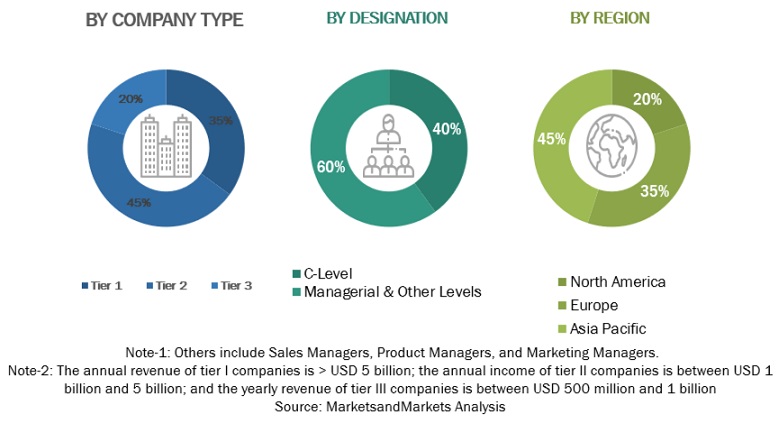
To know about the assumptions considered for the study, download the pdf brochure
Market Size Estimation
Top-down and bottom-up approaches were used to estimate and validate the size of the Fake image detection market and the size of various other dependent sub-segments in the overall Fake image detection market. The research methodology used to estimate the market size includes the following details: critical players in the market were identified through secondary research, and their market shares in the respective regions were determined through primary and secondary research. This entire procedure included the study of the annual and financial reports of the top market players, and extensive interviews were conducted for key insights from the industry leaders, such as CEOs, VPs, directors, and marketing executives.
All percentage splits and breakdowns were determined using secondary sources and verified through primary sources. All possible parameters that affect the market covered in this research study have been accounted for, viewed in extensive detail, verified through primary research, and analyzed to get the final quantitative and qualitative data. This data is consolidated and added to detailed inputs and analysis from MarketsandMarkets.
Infographic Depicting Bottom-Up And Top-Down Approaches
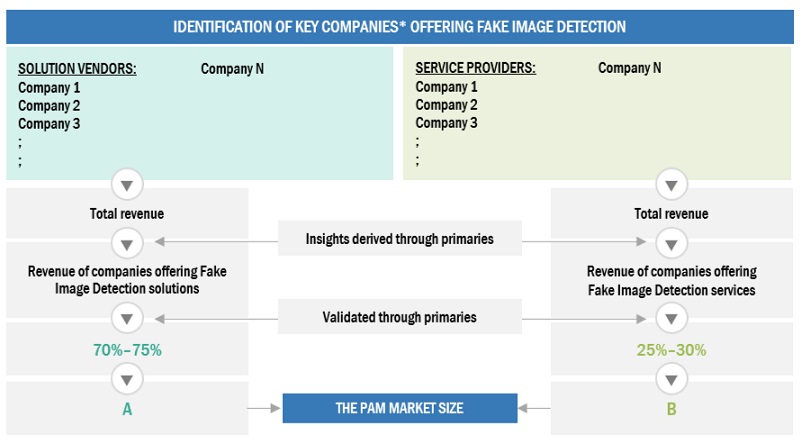
To know about the assumptions considered for the study, Request for Free Sample Report
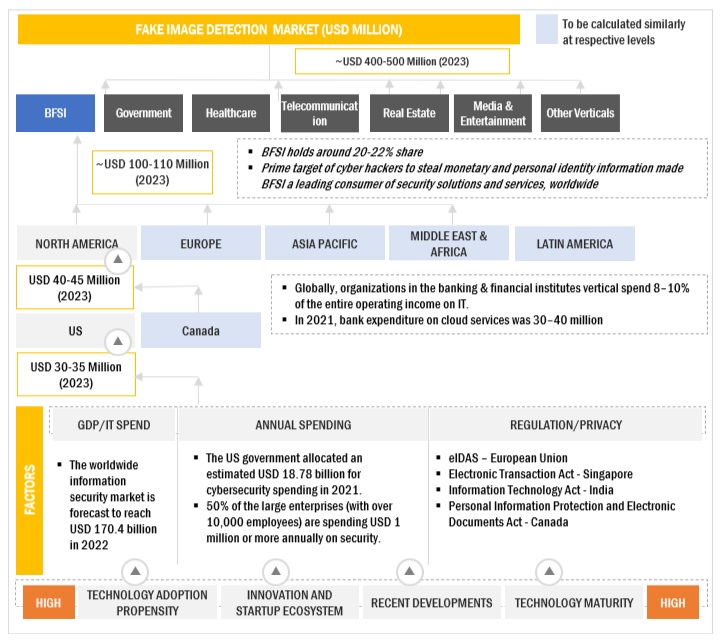
Data Triangulation
The market was split into several segments and subsegments after arriving at the overall market size using the market size estimation processes explained above. The data triangulation and market breakup procedures were employed, wherever applicable, to complete the overall market engineering process and arrive at the exact statistics of each market segment and subsegment. The data was triangulated by studying various factors and trends from both the demand and supply sides.
Market Definition
Fake image detection involves the identification of manipulated or fabricated images that are created to deceive viewers or convey false information. Still images manipulation or alterations, document forgery, photo image forgery, document/photo print forgery, deepfake image detection, and face swapping are considered in the definition of fake image detection.
Key Stakeholders
- Chief Technology and Data Officers
- Business Analysts
- Information Technology (IT) Professionals
- Government Agencies
- Investors and Venture Capitalists
- Small and Medium-Sized Enterprises (SMEs) And Large Enterprises
- Third-Party Providers
- Consultants/Consultancies/Advisory Firms
- Automation Tool Vendor
- OEMs
- Third-Party Providers
Report Objectives
- To describe and forecast the fake image detection market by offering, technology, application, target user, deployment mode, organization size, vertical, and region from 2024 to 2029, and analyze the various macroeconomic and microeconomic factors that affect market growth
- To analyze the subsegments of the market concerning individual growth trends, prospects, and contributions to the overall market
- To provide detailed information regarding major factors (drivers, restraints, opportunities, and challenges) influencing the growth of the market
- To analyze the opportunities in the market for stakeholders and provide details of the competitive landscape for the major players
- To profile the key market players; provide a comparative analysis based on the business overviews, regional presence, product offerings, business strategies, and critical financials; and illustrate the market's competitive landscape.
- To track and analyze the competitive developments, such as mergers and acquisitions, product developments, partnerships and collaborations, and research development (R&D) activities, in the market
Customization Options
With the given market data, MarketsandMarkets offers customizations based on company-specific needs. The following customization options are available for the report:
Geographic Analysis
- Further breakup of the Middle Eastern market into countries contributing 75% to the regional market size
Company Information
- Detailed analysis and profiling of additional market players (up to 5)
Get the Full Fake Image Detection Market Report
Full forecast, segment splits, and company analysis for all Fake Image Detection Market.
- Canada Fake Image Detection Market
- UK Fake Image Detection Market
- Germany Fake Image Detection Market
- France Fake Image Detection Market
- Italy Fake Image Detection Market
- China Fake Image Detection Market
- Japan Fake Image Detection Market
- India Fake Image Detection Market
- Brazil Fake Image Detection Market
- Mexico Fake Image Detection Market
- Rest Of Europe Fake Image Detection Market
- Rest Of Asia Pacific Fake Image Detection Market
- Rest Of Latin America Fake Image Detection Market
Need a Tailored Report?
Customize this report to your needs
Get 10% FREE Customization
Customize This Report
