
Brazil Farm Management Software Market (2024-2029)

The Brazil Farm Management Software Market was valued at $156.6 Million in 2024 and projected to reach to $252.5 Million by 2029, representing a compound annual growth rate of 13.1%. Brazil's farm management software market is poised for sustained expansion as the country's agribusiness sector continues its digital transformation journey.


| Market Size in | USD 26.32 MN |
| Market Forecast in | |
| CAGR | |
| Forecast Period | |
| Units Considered | Value (USD MN) |
Brazil Farm Management Software Market Trends and Insights
- This 13.1% compound annual growth rate reflects Brazil's position as a leading agricultural economy and increasing digital adoption across its farming sector.
- Brazil's agribusiness modernization, driven by precision farming adoption and IoT integration, is accelerating demand for sophisticated software solutions that optimize crop yields and resource management. The Brazilian market benefits from the country's vast agricultural output and growing investment in agricultural technology infrastructure.
- Brazil's farmers are increasingly recognizing the value of data-driven decision-making, spurring adoption of farm management platforms that integrate weather forecasting, soil analysis, and yield prediction.
- Between 2024 and 2029, Brazil is expected to see heightened competition among software providers targeting the country's diverse farming operations, from large-scale commodity producers to mid-sized operations seeking cost-effective digital solutions..
Key Market Statistics
- CAGR (2024-2029) 13.1% CAGR
- Market Size, 2024 ~USD 156.6 Million
- Forecast, 2029 ~USD 252.5 Million
- Country Brazil
Brazil Farm Management Software Market Overview
Market Valuation & Growth :
Brazil's farm management software market reached USD 156.6 million in 2024, with a robust 13.1% CAGR projected through 2029, outpacing the global growth rate of 11% and reflecting strong regional demand.
Agribusiness Modernization :
Brazil's position as a leading global agricultural economy is driving rapid digital transformation, with farmers increasingly adopting precision farming technologies and data-driven management solutions to enhance productivity.
Digital Adoption Acceleration :
Rising internet penetration and smartphone usage across rural Brazil are enabling widespread adoption of cloud-based farm management platforms, creating significant opportunities for software providers targeting the agribusiness sector.
Forecast Expansion :
The market is expected to grow to USD 252.5 million by 2029, representing a 61% increase from 2024 levels, driven by consolidation of large-scale farming operations and government support for agricultural technology initiatives.
Brazil Farm Management Software Market Dynamics
- The 13.1% CAGR through 2029 reflects increasing investments in precision agriculture, IoT integration, and data analytics solutions among Brazilian farmers seeking competitive advantages in global commodity markets.
- Large-scale operations, particularly in sugarcane, coffee, and soybean production, are leading adoption of sophisticated management platforms. Government initiatives promoting agricultural modernization, combined with declining software implementation costs and improved rural connectivity, are democratizing access to farm management tools across mid-sized and smaller operations.
- Strategic partnerships between international software vendors and local agricultural cooperatives are accelerating market penetration, while emerging solutions tailored to Brazil's unique crop varieties and climate conditions are creating differentiation opportunities in this high-growth regional market..
Market Ecosystem
Related Ecosystem
Precision Agriculture
- Sensors
- Global Positioning System (GPS)
- Camera Systems
- Data Services
- Platform as A Service (PaaS)
- MITSUBISHI AGRICULTURAL MACHINERY
- MSK FARM MACHINERY CORPORATION
- MITSUBISHI CHEMICAL AGRI DREAM
- Trimble Inc.
- Deere & Company
Information System And Analytics
- Machine Learning
- Natural Language Processing (NLP)
- Sensors
- Software as A Service (SaaS)
- Data Loss Prevention (DLP)
- International Business Machines Corporation
- MICROSOFT CORPORATION
- Amazon.com, Inc.
- Oracle Corporation
Agricultural Biologicals
- Bionematicides
- Auxins
- Cytokinins
- Ethylene
- Humic Substances
- NICHINO INDIA PVT LTD.
- Corteva, Inc.
- Basf se
- AZELIS HOLDINGS SA
- BAYER AG
Key Takeaways
- Brazil's farm management software market grows at 13.1% CAGR from 2024 to 2029, outpacing global growth rates.
- Brazil's market size is projected to increase from USD 156.6 million in 2024 to USD 252.5 million by 2029.
- Brazil's agricultural modernization and precision farming adoption are primary drivers of software market expansion.
- Brazil's diverse farming landscape creates opportunities for scalable, cost-effective farm management solutions.
Farm Management Software Market Report Scope
| Report Metric | Details |
|---|---|
| Base Year | 2024 |
| Fastest Growing Segment | PRE-PRODUCTION PLANNING (Farm Production) |
| Forecast Period | 2024-2029 |
| Growth Rate | CAGR of 11% from 2024 to 2029 |
| Largest Segment | PRODUCTION PLANNING (Farm Production) |
| Market Size Base Year (Billions) | ~USD 3.44 (2024) |
| Revenue Forecast (Billions) | ~USD 5.8 (2029) |
| Segments Covered | Offering, Application, Deployment, Farm Size, Application Type, Farm Production |
Brazil Farm Management Software Market Report Segmentation
6 segment dimensions are covered across the global market.
By Offering
- Data Analytics Services
- On-Cloud
- On-Premise
- On-Premises
By Application
- Automated Irrigation Scheduling
- Crop Health & Yield Monitoring
- Crop Scouting
- Farm Labor Management
- Farm Monitoring & Surveillance
- Feeding Management
- Field Mapping
- Financial Management
- Genetics & Nurseries
- Harvesting Management
- Hvac & Climate Control
- Identification & Tracking
- Identification And Tracking
- Inventory & Logistics Management
- Inventory Management
- Milk Harvesting
- Other Applications
- Other Precision Aquaculture Applications
- Other Precision Farming Applications
- Other Precision Livestock Applications
- Other Smart Greenhouses
- Precision Aquaculture
- Precision Farming
- Precision Forestry
- Precision Livestock
- Silviculture & Fire Management
- Smart Greenhouses
- Variable Rate Application
- Weather Tracking & Forecasting
- Yield Monitoring
By Deployment
- PaaS
- SaaS
By Farm Size
- Large
- Medium
- Small
By Application Type
- Cannabis
- Floriculture
- Indoor Farming, Research Centers, Vineyards & Orchards
- Indoor Farming, Research Centers, Vineyards, & Orchards
- Vertical Farming
By Farm Production
- Post-Production Planning
- Pre-Production Planning
- Production Planning
Target Audience
- Software Vendors & SaaS Providers : International and regional farm management software companies seeking to expand into Brazil's high-growth agritech market need detailed market sizing, growth forecasts, and competitive landscape data to justify investments and optimize market entry strategies.
- Agricultural Cooperatives & Associations : Brazilian farming cooperatives and agribusiness associations require market intelligence to guide member technology adoption initiatives, negotiate vendor partnerships, and advocate for digital agriculture policies aligned with market growth trends.
- Investment & Private Equity Firms : Investors evaluating agritech opportunities in Brazil need comprehensive market data, growth projections, and regional dynamics to assess portfolio companies, identify acquisition targets, and allocate capital to high-potential segments.
- Government & Policy Makers : Brazilian agricultural ministries and development agencies use market research to design technology adoption incentives, allocate rural infrastructure funding, and develop policies supporting the country's digital agriculture transformation.
- Large-Scale Farming Operations : Major Brazilian commodity producers and agribusiness enterprises need market benchmarking data to evaluate technology investments, compare vendor solutions, and align digital transformation initiatives with industry growth trajectories.
Reasons to Buy this Report
- Market Size & Growth Validation : Obtain precise market valuation data for Brazil (USD 156.6M in 2024) with verified 13.1% CAGR projections through 2029, enabling accurate financial forecasting and investment decision-making for regional expansion strategies.
- Competitive Positioning Intelligence : Understand Brazil's market dynamics relative to global trends (11% CAGR), identifying competitive advantages and market gaps specific to Brazilian agribusiness to inform product development and go-to-market strategies.
- Regional Adoption Insights : Access detailed analysis of digital adoption patterns, precision farming trends, and technology penetration rates across Brazil's diverse agricultural segments, from large commodity producers to emerging mid-sized operations.
- Investment & Partnership Opportunities : Identify high-potential segments, cooperative networks, and strategic partnership opportunities within Brazil's agribusiness ecosystem to accelerate market entry and establish sustainable competitive footholds.
- Forecast-Driven Planning : Leverage 2029 market projections (USD 252.5M) to align resource allocation, sales targets, and product roadmaps with Brazil's anticipated 61% market expansion, ensuring long-term business sustainability and growth.
Frequently asked questions
What is the current size of Brazil's farm management software market?
Brazil's farm management software market was valued at USD 156.6 million in 2024 and is expected to grow to USD 252.5 million by 2029.
What is the growth rate for farm management software in Brazil?
Brazil's farm management software market is projected to grow at a compound annual growth rate (CAGR) of 13.1% between 2024 and 2029.
What factors are driving growth in Brazil's farm management software market?
Key drivers include Brazil's agricultural modernization, increased adoption of precision farming technologies, IoT integration, and growing recognition of data-driven farming practices among Brazilian farmers.
Who are the primary users of farm management software in Brazil?
Brazil's primary users range from large-scale commodity producers to mid-sized farming operations seeking to optimize crop yields, manage resources efficiently, and improve decision-making through digital solutions.
How does Brazil's market growth compare to global trends?
Brazil's 13.1% CAGR exceeds the global farm management software market CAGR of 11%, indicating stronger regional demand and faster market expansion in the country.
RESEARCH METHODOLOGY
The study involved four major activities in estimating the size of the farm management software market. Exhaustive secondary research has been conducted to collect information on the market, the peer markets, and the parent market. Both top-down and bottom-up approaches have been employed to estimate the total market size. Market breakdown and data triangulation methods have also been used to estimate the market for segments and subsegments.
Secondary Research
Revenues of companies offering farm management software have been obtained from the secondary data available through paid and unpaid sources. The revenues have also been derived by analyzing the product portfolio of key companies, and these companies have been rated according to the performance and quality of their products.
Various secondary sources have been referred to in the secondary research process for identifying and collecting information important for this study. Secondary sources include corporate filings (such as annual reports, investor presentations, and financial statements); trade, business, and professional associations; white papers; IoT technologies journals and certified publications; articles by recognized authors; gold-standard and silver-standard websites; directories; and databases.
Secondary research has been conducted mainly to obtain critical information about the market’s value chain, the total pool of key players, market classification and segmentation according to the industry trends to the bottom-most level, geographic markets, and key developments from both demand- and technology-oriented perspectives. Secondary data has been collected and analyzed to determine the overall market size, further validated by primary research.
Primary Research
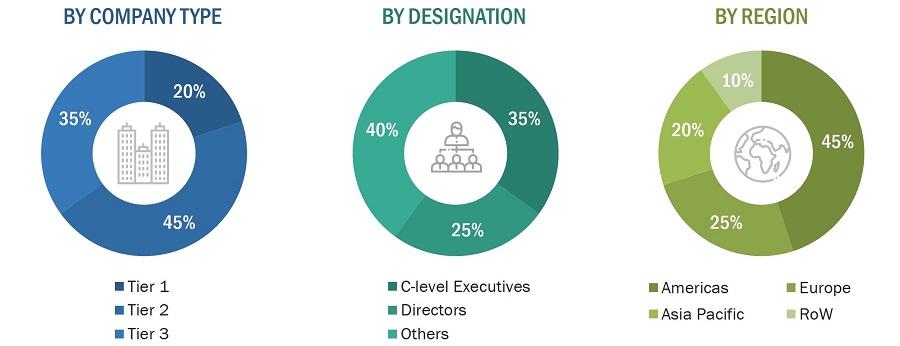
Extensive primary research has been conducted after understanding and analyzing the current scenario of the farm management software market through secondary research. Several primary interviews have been conducted with key opinion leaders from both demand and supply sides across 4 major regions: Americas, Europe, Asia Pacific, and RoW. Approximately 25% of the primary interviews have been conducted with the demand side, while 75% have been conducted with the supply side. Primary data has been collected mainly through telephonic interviews, which consist of 80% of the total primary interviews. questionnaires and e-mails have also been used to collect data.
After interacting with industry experts, brief sessions were conducted with highly experienced independent consultants to reinforce the findings from our primary. This, along with the in-house subject matter experts’ opinions, has led us to the findings as described in the remainder of this report. The breakdown of primary respondents is as follows:
To know about the assumptions considered for the study, download the pdf brochure
Market Size Estimation
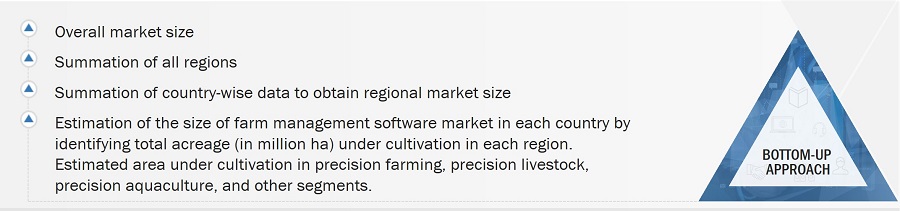
The bottom-up procedure has been employed to arrive at the overall size of the farm management software market.
- Analyzing the agriculture technology ecosystem in each country and identifying the major companies in the market
- Analyzing the market for farm management software for each country
- Identifying major farm management software applications, including precision farming, precision livestock, precision aquaculture, smart greenhouses, and precision forestry, along with the types of software and services required for various applications and sub-applications.
- Estimating the market size in each region by summation of country-wise market size
- Tracking the ongoing and upcoming implementation projects of farm management software by various companies in each region and forecasting the market size based on these developments and other critical parameters, including ongoing recession scenario and its impact on the farm management software market
- Arriving at the global farm management software market size through the summation of all the regions
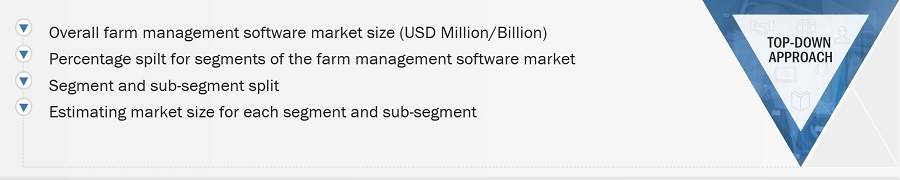
The top-down approach has been used to estimate and validate the total size of the farm management software market.
- Initially, MarketsandMarkets focused on the top-line investment and expenditure in the ecosystems of agriculture technology, which also includes farm management software. software upgrades, and major developments in the key market area.
- Further information was derived from the market revenue the key farm management software and service providers generated.
- Multiple on-field discussions were conducted with key opinion leaders from each major company involved in the development of farm management software and services.
- The geographic splits were estimated using secondary sources based on various factors, such as the number of players in a specific country and region, the level of services offered, and the type of software implemented.
Data Triangulation
After arriving at the overall size of the farm management software market through the process explained, the total market has been split into several segments and subsegments. Market breakdown and data triangulation procedures have been employed, wherever applicable, to complete the overall market engineering process and arrive at the exact statistics for all segments and subsegments. The data has been triangulated by studying various factors and trends from the demand and supply sides. The market has also been validated using the top-down and bottom-up approaches.
Market Definition
Farm management is a technique to optimize and manage farm operations by automating farm activities such as record keeping, data management, crop health analysis, livestock monitoring, and aquaculture farm optimization. The software is customized to meet specific farm requirements since each farm carries out different activities. Farm management software is used for planning, implementation, assessment, and optimization of tasks performed on farms. It helps farmers improve better plan and track, save on input and labor costs, and improve yield.
The software helps enhance farm productivity and reduce input wastage. The software is integrated with hardware equipment and devices to enhance the productivity of the farmland with the help of the Global Positioning System (GPS), sensing, and communication technologies.
Key Stakeholders
- Satellite service providers, UAVs/drone service providers, and data collection and analysis service providers
- Electronic components (sensors, GPSs, yield monitoring systems) and device manufacturers
- Agriculture original equipment manufacturers (OEMs)
- Component and device suppliers, system integrators, and distributors
- Software providers, including Software as a Service (SaaS) and Platform as a Service (SaaS) providers
- Data analytics service providers, agricultural IoT infrastructure providers, and technology providers
- Standardization and testing firms
- Government bodies such as regulatory authorities, policymakers, and agricultural ministry
- Associations, organizations, forums, and alliances related to agriculture technology
- Research institutes and organizations
- Market research and consulting firms
- Agri-food companies, contract farming companies, farm-input providers, agronomists, and independent agriculture consultants
Report Objectives
- To define, describe, segment, and forecast the size of the farm management software market, by offering, farm size, application, and farm production planning, in terms of value
- To forecast the market size for various segments with respect to four main regions, namely, the Americas, Europe, Asia Pacific, and Rest of the World (RoW), in terms of value
- To provide detailed information regarding the drivers, restraints, opportunities, and challenges influencing the growth of the farm management software market
- To study the complete value chain and allied industry segments and perform a value chain analysis of the market landscape
- To strategically analyze macro and micromarkets1 with respect to growth trends, prospects, and their contributions to the overall market
- To analyze industry trends, pricing data, patents and innovations, and trade data (export and import data) in the farm management software market
- To analyze opportunities in the market for stakeholders and provide a detailed competitive landscape of the market
- To strategically profile key players in the market and comprehensively analyze their market share/ranking and core competencies
- To analyze competitive developments such as contracts, product launches/developments, expansions, and research & development (R&D) activities carried out by players in the farm management software market.
Available customizations:
With the given market data, MarketsandMarkets offers customizations according to the specific requirements of companies. The following customization options are available for the report:
- Detailed analysis and profiling of additional market players based on various blocks of the supply chain
Get the Full Farm Management Software Market Report
Full forecast, segment splits, and company analysis for all Farm Management Software Market.
- US Farm Management Software Market
- Canada Farm Management Software Market
- Mexico Farm Management Software Market
- Germany Farm Management Software Market
- UK Farm Management Software Market
- France Farm Management Software Market
- Spain Farm Management Software Market
- Italy Farm Management Software Market
- Netherlands Farm Management Software Market
- Rest Of Europe Farm Management Software Market
- China Farm Management Software Market
- Japan Farm Management Software Market
- India Farm Management Software Market
- Rest Of Asia Pacific Farm Management Software Market
- Argentina Farm Management Software Market
- Rest Of South America Farm Management Software Market
- GCC Countries Farm Management Software Market
- Rest Of Mea Farm Management Software Market
Need a Tailored Report?
Customize this report to your needs
Get 10% FREE Customization
Customize This Report
