
Malaysia Fats & Oils Market (2024-2029)

The Malaysia Fats & Oils Market was valued at $5846.6 Million in 2024 and projected to reach to $6909.9 Million by 2029, representing a compound annual growth rate of 3.4%. Malaysia's fats and oils market is poised for steady growth through 2029, supported by robust demand from the food manufacturing and bakery industries.


| Market Size in | USD 26.32 MN |
| Market Forecast in | |
| CAGR | |
| Forecast Period | |
| Units Considered | Value (USD MN) |
Malaysia Fats & Oils Market Trends and Insights
- Malaysia's market is driven by rising demand from food processing, bakery, and confectionery sectors, alongside growing consumer preference for healthier oil variants.
- The country's strategic position as a major palm oil producer and exporter reinforces Malaysia's significance in the regional and global fats and oils supply chain. During the 2024-2029 forecast period, Malaysia's market will benefit from increasing urbanization, rising disposable incomes, and expanding food manufacturing capabilities.
- Malaysia continues to invest in sustainable production practices and product innovation to meet evolving consumer and regulatory requirements.
- The competitive landscape in Malaysia remains dynamic, with both multinational corporations and local producers competing to capture market share in this growing segment..
Key Market Statistics
- CAGR (2024-2029) 3.4% CAGR
- Market Size, 2024 ~USD 5846.6 Million
- Forecast, 2029 ~USD 6909.9 Million
- Country Malaysia
Malaysia Fats & Oils Market Overview
Market Size & Growth :
Malaysia's fats and oils market is valued at USD 5,846.6 million in 2024, with projected growth to USD 6,909.9 million by 2029, representing a steady CAGR of 3.4%.
Key Growth Drivers :
Rising demand from food processing, bakery, and confectionery sectors, combined with increasing consumer preference for healthier oil variants, are propelling market expansion across Malaysia.
Strategic Regional Position :
Malaysia's established position as a major palm oil producer and exporter provides competitive advantages in both domestic consumption and international trade within the fats and oils sector.
Health & Wellness Trend :
Growing consumer awareness regarding nutritional benefits is driving demand for specialty oils including canola, sunflower, and other health-conscious alternatives in the Malaysian market.
Malaysia Fats & Oils Market Dynamics
- The country's established palm oil infrastructure and production capabilities position it favorably for both domestic supply and export opportunities.
- Consumer preferences are increasingly shifting toward healthier oil options, prompting manufacturers to diversify their product portfolios and invest in premium oil variants. The market will benefit from rising disposable incomes, urbanization, and expanding food service sectors across Malaysia.
- Government initiatives promoting sustainable palm oil production and food safety standards will further strengthen market dynamics.
- Strategic investments in processing technologies and supply chain optimization will enable local players to capture growing demand while maintaining competitive pricing in regional and global markets..
Market Ecosystem
Related Ecosystem
Fandb Ingredients
- Dairy Products
- Bakery Products
- Microorganism
- Polydextrose
- Carbohydrates
- AZELIS HOLDINGS SA
- Archer-Daniels-Midland Company
- Kerry Group plc
- Amway
- DSM FIRMMENICH
Key Takeaways
- Malaysia's fats and oils market is valued at USD 5,846.6 million in 2024 and will reach USD 6,909.9 million by 2029.
- Malaysia's market is projected to grow at a CAGR of 3.4% over the 2024-2029 forecast period.
- Malaysia's position as a leading palm oil producer provides competitive advantages in both domestic and export markets.
- Sustainability initiatives and product innovation are key growth drivers shaping Malaysia's market trajectory through 2029.
Fats & Oils Market Report Scope
| Report Metric | Details |
|---|---|
| Base Year | 2024 |
| Fastest Growing Segment | OLIVE OIL (Vegetable Oil Type) |
| Forecast Period | 2024-2029 |
| Growth Rate | CAGR of 3.6% from 2024 to 2029 |
| Largest Segment | LIQUID (Form) |
| Market Size Base Year (Billions) | ~USD 271.23 (2024) |
| Revenue Forecast (Billions) | ~USD 323.7 (2029) |
| Segments Covered | Source, Form, Vegetable Oil Type, Fat Type, Application, Food Application |
Malaysia Fats & Oils Market Report Segmentation
6 segment dimensions are covered across the global market.
By Source
- Animals
- Vegetables
By Form
- Liquid
- Solid
By Vegetable Oil Type
- Olive Oil
- Other Oils
- Palm Oil
- Rapeseed Oil
- Soybean Oil
- Sunflower Oil
By Fat Type
- Butter & Margarine
- Lard
- Tallow & Grease
By Application
- Food
- Industrial
By Food Application
- Food Product Manufacturing
- Foodservice
- Retail
Target Audience
- Food & Beverage Manufacturers : Malaysian F&B producers need market data to optimize ingredient sourcing, forecast raw material costs, and identify opportunities in growing bakery and confectionery segments.
- Oil & Fats Distributors : Regional distributors require detailed market insights to assess demand trends, plan inventory levels, and identify high-growth product categories within Malaysia's fats and oils sector.
- Investment & Private Equity Firms : Investors evaluating opportunities in Malaysia's food industry need comprehensive market sizing and growth forecasts to assess portfolio companies and identify acquisition targets.
- Government & Trade Bodies : Malaysian government agencies and trade associations require market data for policy development, export promotion strategies, and sustainable palm oil industry initiatives.
- Retail & FMCG Companies : Retailers and consumer goods companies need Malaysia-specific market intelligence to guide product assortment decisions, pricing strategies, and marketing campaigns for oils and fats.
Reasons to Buy this Report
- Accurate Market Sizing : Obtain precise valuation data for Malaysia's fats and oils market with verified figures for 2024 baseline and 2029 projections, enabling confident financial planning and investment decisions.
- Sector-Specific Insights : Understand demand patterns across Malaysia's key end-use segments including food processing, bakery, confectionery, and food service industries with detailed market breakdowns.
- Competitive Intelligence : Identify growth opportunities and competitive positioning within Malaysia's fats and oils landscape, including emerging trends in healthier oil variants and premium product segments.
- Strategic Market Entry : Leverage comprehensive Malaysia-specific data to develop market entry strategies, distribution partnerships, and product localization plans tailored to regional consumer preferences.
- Forecast-Driven Planning : Utilize 5-year growth projections and CAGR analysis to align supply chain investments, capacity planning, and marketing initiatives with Malaysia's anticipated market trajectory.
Frequently asked questions
What is the current size of Malaysia's fats and oils market?
Malaysia's fats and oils market is estimated at USD 5,846.6 million in 2024.
What is the projected market size for Malaysia's fats and oils sector by 2029?
Malaysia's fats and oils market is forecast to reach USD 6,909.9 million by 2029.
What is the expected growth rate for Malaysia's fats and oils market?
Malaysia's fats and oils market is expected to grow at a CAGR of 3.4% from 2024 to 2029.
Which sectors drive demand in Malaysia's fats and oils market?
Key demand drivers in Malaysia include food processing, bakery, confectionery, and food manufacturing industries.
Why is Malaysia significant in the global fats and oils market?
Malaysia is a major palm oil producer and exporter, making it strategically important in the regional and global fats and oils supply chain.
RESEARCH METHODOLOGY
The study involved major segments in estimating the current size of the fats and oils market. Exhaustive secondary research was done to collect information on the market, peer, and parent markets. The next step was to validate these findings, assumptions, and sizing with industry experts across the value chain through primary research. Both top-down and bottom-up approaches were employed to estimate the complete market size. After that, market breakdown and data triangulation were used to estimate the market size of segments and subsegments.
Secondary Research
This research study involved the extensive use of secondary sources—directories and databases such as Bloomberg Businessweek and Factiva—to identify and collect information useful for a technical, market-oriented, and commercial study of the fats and oils market.
In the secondary research process, various sources such as annual reports, press releases & investor presentations of companies, white papers, food journals, certified publications, articles from recognized authors, directories, and databases were referred to identify and collect information.
Secondary research was mainly used to obtain key information about the industry’s supply chain, the total pool of key players, and market classification and segmentation as per the industry trends to the bottom-most level, regional markets, and key developments from both market- and technology-oriented perspectives.
Primary Research
Extensive primary research was conducted after obtaining information regarding the fats and oils market scenario through secondary research. Several primary interviews were conducted with market experts from both the demand and supply sides across major countries of North America, Europe, Asia Pacific, South America, and the Rest of the World. Primary data was collected through questionnaires, emails, and telephonic interviews. The primary sources from the supply side included various industry experts, such as Chief X Officers (CXOs), Vice Presidents (VPs), Directors from business development, marketing, research, and development teams, and related key executives from distributors and key opinion leaders. Primary interviews were conducted to gather insights such as market statistics, data on revenue collected from the products, market breakdowns, market size estimations, market forecasting, and data triangulation. Primary research also helped in understanding the various trends related to fats and oils type, form, source, application, and region. Stakeholders from the demand side, such as food & beverage manufacturers who use fats and oils, were interviewed to understand the buyer’s perspective on the suppliers, products, and their current usage of fats and oils and the outlook of their business, which will affect the overall market.
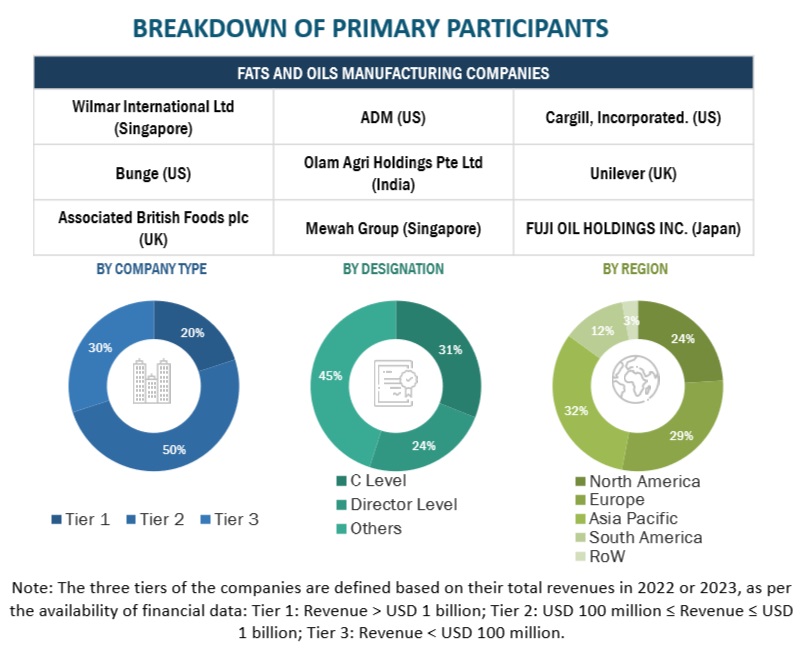
To know about the assumptions considered for the study, download the pdf brochure
|
COMPANY NAME |
designation |
|
Wilmar International Ltd (Singapore) |
Regional Sales Manager |
|
Cargill, Incorporated. (US) |
Marketing Manager |
|
ADM (US) |
General Manager |
|
Bunge. (US) |
Sales Manager |
|
Olam Group (Singapore) |
Sales Manager |
|
Unilever (UK) |
Sales Executive |
Market Size Estimation
Both the top-down and bottom-up approaches were used to estimate and validate the total market size. These approaches were also used to estimate the size of various dependent submarkets. The research methodology used to estimate the market size includes the following:
- The key players in the industry and markets were identified through extensive secondary research.
- All shares, splits, and breakdowns were determined using secondary sources and verified through primary sources.
- All possible parameters that affect the markets covered in this research study were accounted for, viewed in extensive detail, verified through primary research, and analyzed to obtain the final quantitative and qualitative data.
- The research included the study of reports, reviews, and newsletters of top market players, along with extensive interviews for opinions from leaders, such as CEOs, directors, and marketing executives.
Global Fats and Oils Market: Bottom-Up Approach.
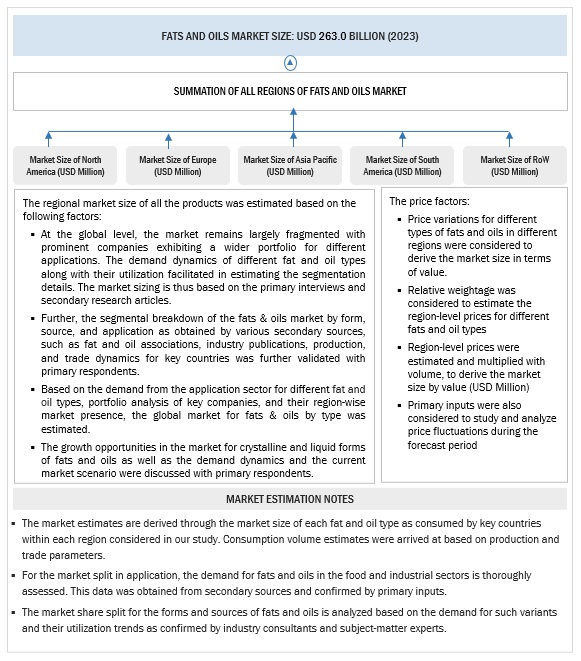
To know about the assumptions considered for the study, Request for Free Sample Report
Global Fats and oils Market: Top-Down Approach.
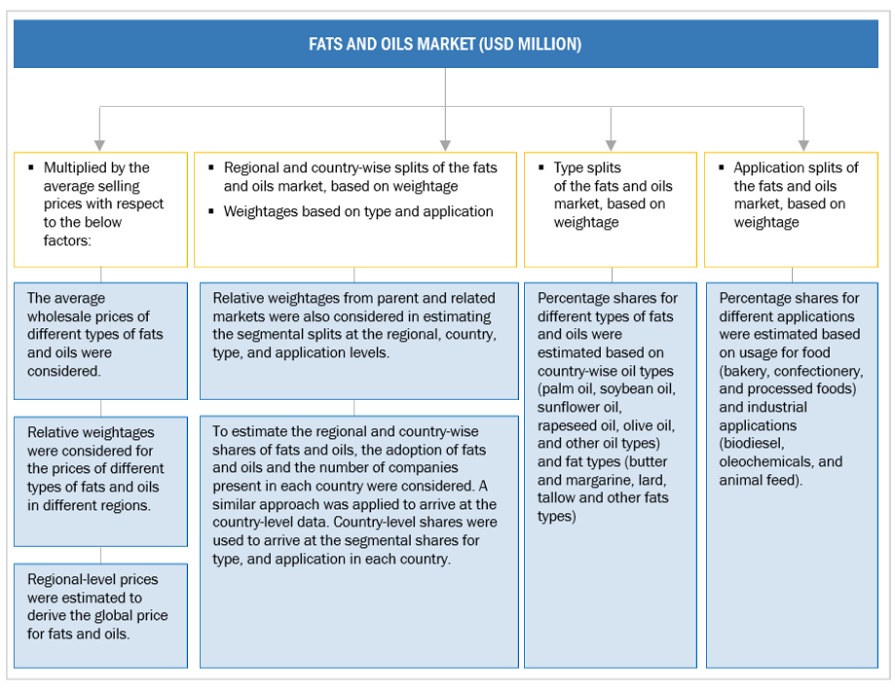
Data Triangulation
After arriving at the overall market size from the estimation process explained above, the total market was split into several segments and subsegments. To estimate the overall fats and oils market and arrive at the exact statistics for all segments and subsegments, data triangulation and market breakdown procedures were employed, wherever applicable. The data was triangulated by studying various factors and trends from the demand and supply sides. Along with this, the market size was validated using both the top-down and bottom-up approaches.
Market Definition
Fats & oils are simple or mixed glyceryl esters of various organic acids, which belong to the fatty acid series; they are derived from plant or animal sources. Fats belong to a group of compounds that are soluble in organic solvents but insoluble in water. Fats are available in either liquid (oil) or solid forms at room temperature.
Fats & oils are a group of organic substances widely used for various industrial applications. They are used as functional ingredients for manufacturing food products, such as confectionery, bakeries, and ice-creams, among others. Fats & oils play a major role in maintaining the physiochemical and sensory attributes, such as smoothness, creaminess, the texture of products, and greasy and thick consistency.
Key Stakeholders
- Fat and oil manufacturers
- Fat and oil importers and exporters
- Fat and oil traders, distributors, and suppliers
- Government and research organizations
- Commercial research & development institutes
- Raw material suppliers and distributors
- Associations and industry bodies such as:
- United States Department of Agriculture (USDA)
- Food and Agriculture Organization (FAO)
- American Fats and Oils Association (AFOA)
- National Edible Oil Distributors Association (NEODA)
- Institute of Shortening and Edible Oils (ISEO)
- American Oil Chemists’ Society (AOCS)
- Argentina Association of Fats and Oils (ASAGA)
Report Objectives
- To define, segment, and forecast the global fats & oils market based on type, form, source, application, and region from 2020 to 2023 and a forecast period from 2024 to 2029
- To provide detailed information about the key factors, including drivers, restraints, opportunities, and challenges influencing the growth of the market
- To identify attractive opportunities in the market by determining the largest and fastest-growing segments across regions
-
To analyze the demand-side factors based on the following:
- Impact of macro and microeconomic factors on the market
- Shifts in demand patterns across different subsegments and regions
- Strategically profile the key players and comprehensively analyze their core competencies
- Competitive developments, such as partnerships, mergers & acquisitions, new product developments, and expansions & investments in the fats & oils market
Available Customizations:
With the given market data, MarketsandMarkets offers customizations according to company-specific scientific needs.
The following customization options are available for the report:
Product Analysis
- Product Matrix, which gives a detailed comparison of the product portfolio of each company.
Geographic Analysis
With the given market data, MarketsandMarkets offers customizations according to company-specific scientific needs.
- Further breakdown of the Rest of the European fats and oils market into key countries
- Further breakdown of the Rest of Asia Pacific fats and oils market into key countries
- Further breakdown of the South American fats and oils market into key countries
Company Information
- Detailed analyses and profiling of additional market players (up to five)
Get the Full Fats & Oils Market Report
Full forecast, segment splits, and company analysis for all Fats & Oils Market.
- Canada Fats & Oils Market
- Mexico Fats & Oils Market
- US Fats & Oils Market
- Germany Fats & Oils Market
- UK Fats & Oils Market
- France Fats & Oils Market
- Italy Fats & Oils Market
- Spain Fats & Oils Market
- Russia Fats & Oils Market
- Netherlands Fats & Oils Market
- China Fats & Oils Market
- India Fats & Oils Market
- Japan Fats & Oils Market
- Indonesia Fats & Oils Market
- Brazil Fats & Oils Market
- Argentina Fats & Oils Market
- Rest Of Europe Fats & Oils Market
- Australia And New Zealand Fats & Oils Market
- Rest Of Asia Pacific Fats & Oils Market
- Africa Fats & Oils Market
- Middle East Fats & Oils Market
- Rest Of South America Fats & Oils Market
Need a Tailored Report?
Customize this report to your needs
Get 10% FREE Customization
Customize This Report
