
Europe Fiber Optic Components Market (2025-2030)

The Europe Fiber Optic Components Market was valued at $6400.7 Million in 2025 and projected to reach to $9694.5 Million by 2030, representing a compound annual growth rate of 8.7%. Europe's fiber optic components market is positioned for sustained growth through 2030, supported by continued 5G deployment, cloud infrastructure expansion, and regulatory mandates for digital connectivity.


| Market Size in | USD 26.32 MN |
| Market Forecast in | |
| CAGR | |
| Forecast Period | |
| Units Considered | Value (USD MN) |
Europe Fiber Optic Components Market Trends and Insights
- This 8.7% compound annual growth rate reflects Europe's strategic investments in digital infrastructure, 5G deployment, and data center modernization.
- Europe's telecommunications sector is driving demand for advanced optical transmission technologies, with major economies including Germany, France, and the United Kingdom leading adoption initiatives. The European market benefits from stringent regulatory frameworks and substantial EU funding for broadband expansion and digital connectivity.
- Europe's commitment to achieving gigabit-capable networks across member states is accelerating fiber optic component adoption in both urban and rural regions.
- By 2030, Europe is expected to solidify its position as a critical hub for optical component manufacturing and deployment, supported by ongoing investments in next-generation network infrastructure and IoT applications..
Key Market Statistics
- CAGR (2025-2030) 8.7% CAGR
- Market Size, 2025 ~USD 6400.7 Million
- Forecast, 2030 ~USD 9694.5 Million
- Geography Europe
Europe Fiber Optic Components Market Overview
5G Infrastructure Expansion :
Europe's aggressive 5G rollout across major economies is driving substantial demand for fiber optic components, with telecom operators investing heavily in backbone and fronthaul networks to support ultra-fast connectivity.
Data Center Modernization :
European data centers are undergoing significant upgrades to meet cloud computing and AI workload demands, requiring advanced optical interconnect solutions and high-speed transmission components.
Digital Sovereignty Initiatives :
EU regulations and digital sovereignty policies are encouraging investment in European-based fiber optic infrastructure and manufacturing, reducing dependence on non-European suppliers.
Sustainable Telecom Networks :
European telecom operators are prioritizing energy-efficient fiber optic solutions aligned with EU sustainability goals, driving adoption of next-generation low-power optical components.
Europe Fiber Optic Components Market Dynamics
- The region's mature telecommunications ecosystem and high capital expenditure by major carriers create stable demand for optical transmission, switching, and amplification technologies.
- Strategic investments in European manufacturing capabilities and supply chain resilience will further strengthen market dynamics, while emerging applications in edge computing and industrial IoT present additional growth opportunities for component suppliers..
Market Ecosystem
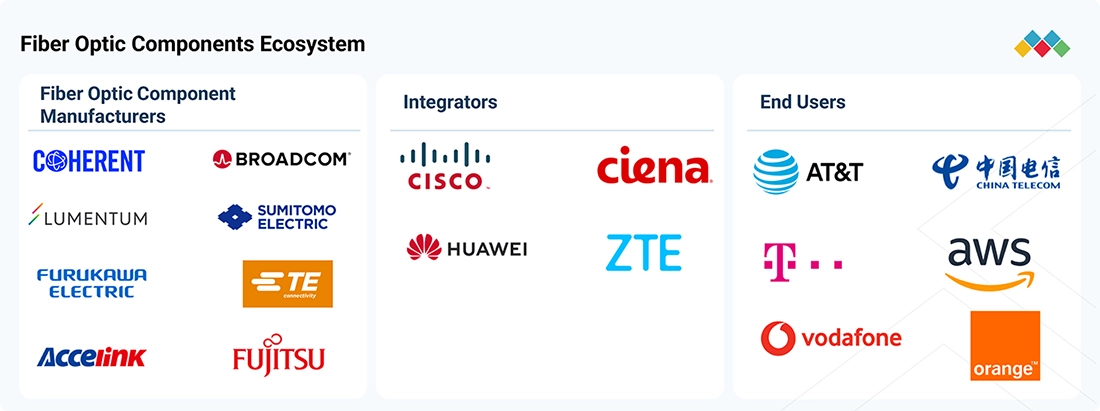
FIBER OPTIC COMPONENTS MARKET SIZE, SHARE AND TRENDS, 2026 TO 2032: COMMERCIAL USE CASES ACROSS INDUSTRIES
| COMPANY | USE CASE DESCRIPTION | BENEFITS |
|---|---|---|
 |
Coherent provides optical components and modules used in telecommunications and data center networks. Its products support high-speed optical transmission, optical amplification, and network connectivity. | Supports high-speed data transmission | Enables optical network connectivity | Supports increasing bandwidth requirements | Helps improve transmission performance |
 |
Lumentum provides optical components and modules used in telecommunications and data center applications. Its portfolio supports optical transmission, amplification, and high-speed network connectivity. | Supports high-capacity optical communication | Enables reliable signal transmission over fiber networks | Supports data center and telecom infrastructure | Helps meet increasing data-rate requirements |
 |
Broadcom provides optical connectivity products, including high-speed optical transceivers, used primarily in data center and networking applications. These products enable data transmission between switches, servers, and other network equipment. | Enables high-speed server-to-switch connectivity | Supports higher network bandwidth | Helps address data center connectivity requirements | Supports high-density network deployments |
 |
Sumitomo Electric provides fiber-optic cables, optical devices, transceivers, and related components used in telecommunications, data centers, and other optical communication networks. | Supports fiber-optic network deployment | Enables high-speed and reliable data transmission | Supports telecommunications and data center connectivity | Provides components for different network configurations |
 |
Accelink provides optical modules, transceivers, amplifiers, and other optical components used in telecommunications and data center networks. Its products support signal transmission and connectivity across optical communication infrastructure. | Supports high-speed optical transmission | Enables network connectivity and capacity expansion | Supports telecom and data center applications | Helps meet increasing optical network performance requirements |
Logos and trademarks shown above are the property of their respective owners. Their use here is for informational and illustrative purposes only.
Related Ecosystem
Communication And Connectivity Technology
- Sensors
- Smart Card & Readers
- Cellular Network
- Femtocell
- Image Sensors
- Cisco Systems, Inc.
- HUAWEI TECHNOLOGIES CO LTD
- Lenovo
- CommScope Holding Company, Inc.
- Nokia corporation
Semiconductor Materials And Components
- Sensors
- Gallium Nitride (GaN)
- Digital Signal Processor (DSP)
- Natural Language Processing (NLP)
- Silicon Carbide
- Texas Instruments Incorporated
- Samsung
- APPLIED MATERIALS, INC.
- Stmicroelectronics
- Lenovo
Key Takeaways
- Europe's fiber optic components market will grow from $6.4B in 2025 to $9.7B in 2030, representing an 8.7% CAGR.
- Europe's 5G rollout and EU digital infrastructure initiatives are primary catalysts for market expansion through 2030.
- Germany, France, and the United Kingdom dominate Europe's fiber optic component demand and manufacturing capacity.
- Europe's regulatory focus on gigabit-capable networks is accelerating fiber optic adoption across telecommunications and data center sectors.
Fiber Optic Components Market Report Scope
| Report Metric | Details |
|---|---|
| Base Year | 2025 |
| Fastest Growing Segment | ENTERPRISES (Communications Application) |
| Forecast Period | 2025–2030 |
| Growth Rate | CAGR of 9.8% from 2025 to 2030 |
| Largest Segment | COMMUNICATIONS (Application) |
| Market Size Base Year (Billions) | ~USD 36.75 (2025) |
| Revenue Forecast (Billions) | ~USD 58.65 (2030) |
| Segments Covered | Type, Application, Communications Application, Cable Type |
Europe Fiber Optic Components Market Report Segmentation
4 segment dimensions are covered across the global market.
By Type
- Amplifiers
- Aocs
- Cables
- Circulators
- Connectors
- Optical Transceivers
- Other Types
- Splitters
By Application
- Analytical & Medical Equipment
- Communications
- Distributed Sensing
- Lighting
By Communications Application
- Data Center
- Enterprises
- Telecommunications
By Cable Type
- Multimode
- Single Mode
Target Audience
- Telecom Equipment Manufacturers : European and global telecom OEMs need regional market intelligence to optimize product portfolios, prioritize R&D investments, and align sales strategies with 5G and network modernization cycles.
- Fiber Optic Component Suppliers : Component manufacturers require detailed European demand forecasts, customer concentration analysis, and competitive benchmarking to guide capacity planning and market share strategies.
- Data Center & Cloud Operators : European data center providers and hyperscalers need insights into optical interconnect trends, technology roadmaps, and supplier capabilities to optimize infrastructure investments and performance.
- Telecom Service Providers : European carriers and ISPs require market analysis to inform network capex decisions, technology vendor selection, and competitive positioning in 5G and broadband service delivery.
- Investment & Strategy Consultants : Private equity, venture capital, and management consulting firms need comprehensive European market data to evaluate acquisition targets, growth opportunities, and sector valuations.
Key Companies in the Europe Fiber Optic Components Market
| Company | HQ | Ownership | Strongest segments |
|---|---|---|---|
| COBHAM PLC | United Kingdom | Private Company | Airborne communications and connectivity,Mission systems integrated with navigation architectures,Satellite communications for navigation-reliant platforms, |
| MELLANOX TECHNOLOGIES | United States | Private Company | InfiniBand adapters, switches, and systems,Ethernet adapters (NICs) for servers and storage,Ethernet switch products and systems, |
| BOREALIS AG | Austria | Private Company | Polyolefin solutions (PE/PP for consumer, energy, healthcare, infrastructure, mobility),Base chemicals (olefins, phenol, aromatics, intermediates),Recycling, circular solutions, and technology licensing (recyclates, catalysts, process technologies), |
| SUPERLOOP | Australia | Public Company | Consumer broadband and mobile,Business connectivity and managed services,Wholesale and carrier services, |
| LUMENTUM HOLDINGS INC. | United States | Public Company | Cloud & Networking – optical chips and components,Cloud & Networking – modules and subsystems,Industrial Tech – solid-state and fiber lasers, |
| BROADCOM | United States | Public Company | Networking connectivity silicon (Ethernet switching/routing, NICs, PHYs, optics),Wireless device connectivity and RF,Server and storage connectivity (PCIe, SAS/RAID, Fibre Channel, HDD/SSD solutions), |
| SUMITOMO ELECTRIC INDUSTRIES, LTD. | Japan | Public Company | Automotive wires, cables, and harness components (incl. HV/EV),Infocommunications (fiber, fusion splicers, data center and FTTx solutions),Environment and Energy (HV cables, vanadium redox flow batteries, water treatment membranes), |
| ACCELINK TECHNOLOGIES CO. LTD | China | Public Company | Transmission optical transceiver modules,Optical fiber amplifiers and passive/smart optical devices,Fixed and wireless access products, |
| ACACIA COMMUNICATIONS, INC. | United States | Private Company | Multi-haul coherent modules (AC1200, AC400 flex, CIM 8),MSA pluggable coherent modules (CFP2, OSFP, QSFP-DD, CEP-DCO),Semiconductor products (DSP ASICs, silicon photonic PICs), |
| EMCORE CORPORATION | United States | Public Company | Defense and aerospace inertial/navigation solutions,Broadband and telecom optical components,Industrial and space photonics, |
| FUJITSU OPTICAL COMPONENT LIMITED | Japan | Subsidiary | Coherent optical components and modules (100G+ line-side),Client and data-center pluggable optics (10G–400G),Access/FTTx and fronthaul optics, |
| FURUKAWA ELECTRIC CO., LTD. | Japan | Public Company | Optical Solutions (fiber, cable, connectivity, fusion splicers, broadband systems),Energy Infrastructure (power cable, distribution, industrial equipment, submarine water pipe),Automotive Systems (wire harnesses, connectors, sensors, MCPB), |
| CORNING INCORPORATED | United States | Public Company | Optical communications (fiber, cable, hardware, components),Display glass substrates (LCD, OLED),Specialty materials (mobile device glass, semiconductor optics, sunglasses, shielding), |
| HEXATRONIC GROUP | Sweden | Public Company | FTTH and fibre access solutions,Transport and metro network solutions,5G and wireless infrastructure / powered fiber, |
| O-NET TECHNOLOGIES (SHENZHEN) GROUP CO.,LTD | China | Optical transceivers (datacom and telecom),Optical modules and subsystems,Industrial and sensing optics / specialty photonics, | |
| SOURCE PHOTONICS | United States | Private Company | Access and fixed-line optical interfaces (FTTx, fixed access SFP/XFP),Wireless broadband and front-haul transceivers,Data center and data communications pluggables (SFP+, QSFP, QSFP28), |
COBHAM PLC
Cobham PLC is a United Kingdom-based aerospace and defense company founded in 1889 with 10,037 employees, providing advanced technology solutions.
MELLANOX TECHNOLOGIES
Mellanox Technologies is a United States-based company founded in 1999 with 2,719 employees specializing in high-performance computing and data center networking solutions.
BOREALIS AG
Borealis AG is an Austrian polyolefins and base chemicals company founded in 1994 with 5,887 employees serving the plastics and chemical industries.
SUPERLOOP
Superloop is an Australian telecommunications company founded in 2014 with 800 employees, operating as a public company providing broadband and connectivity services.
LUMENTUM HOLDINGS INC.
Lumentum Holdings Inc. is a United States-based public company founded in 2015 with 10,562 employees manufacturing optical and photonic products for communications and consumer markets.
BROADCOM
Broadcom is a United States semiconductor company founded in 1961 with 33,000 employees designing and supplying infrastructure software and broadband connectivity solutions.
SUMITOMO ELECTRIC INDUSTRIES, LTD.
Sumitomo Electric Industries, Ltd. is a Japanese public company founded in 1897 with 302,972 employees manufacturing electrical wires, cables, and related products globally.
ACCELINK TECHNOLOGIES CO. LTD
Accelink Technologies Co. Ltd is a Chinese public company founded in 1976 with 4,945 employees specializing in optical communication equipment and components.
ACACIA COMMUNICATIONS, INC.
Acacia Communications, Inc. is a United States company founded in 2009 with 460 employees providing high-speed coherent optical interconnect solutions.
EMCORE CORPORATION
EMCORE Corporation is a United States public company founded in 1984 manufacturing compound semiconductors and fiber optics for communications and defense applications.
FUJITSU OPTICAL COMPONENT LIMITED
Fujitsu Optical Component Limited is a Japanese subsidiary founded in 2009 manufacturing optical components and modules.
FURUKAWA ELECTRIC CO., LTD.
Furukawa Electric Co., Ltd. is a Japanese public company founded in 1884 with 49,112 employees producing cables, wires, and optical fiber products.
CORNING INCORPORATED
Corning Incorporated is a United States public company founded in 1851 with 67,200 employees specializing in glass, ceramics, and optical communications materials.
HEXATRONIC GROUP
Hexatronic Group is a Swedish public company founded in 1972 with 2,106 employees providing fiber optic infrastructure solutions and connectivity products.
O-NET TECHNOLOGIES (SHENZHEN) GROUP CO.,LTD
O-NET Technologies (Shenzhen) Group Co., Ltd is a Chinese company founded in 2000 manufacturing optical communication components and modules.
SOURCE PHOTONICS
Source Photonics is a United States company founded in 1988 with 1,639 employees designing and manufacturing optical transceivers and modules.
Countries within Europe - compare and drill down
| Country | 2025 size (native) |
|---|
Country market size visualization
Reasons to Buy this Report
- Regional Market Sizing & Forecasts : Accurate 2025-2030 projections specific to Europe enable precise budget allocation and investment planning aligned with regional growth trajectories and economic cycles.
- 5G & Infrastructure Investment Tracking : Detailed analysis of European telecom capex, 5G deployment timelines, and network modernization plans helps identify high-priority market segments and customer acquisition opportunities.
- Competitive Landscape Intelligence : Comprehensive mapping of European suppliers, regional partnerships, and market consolidation trends provides strategic positioning insights for market entry or expansion strategies.
- Regulatory & Policy Impact Analysis : In-depth coverage of EU digital regulations, supply chain policies, and sustainability mandates reveals compliance requirements and emerging market drivers unique to European operations.
- Customer Segmentation & Demand Drivers : Granular insights into European telecom operators, data center providers, and enterprise customers clarify end-market priorities and purchasing behaviors for targeted go-to-market strategies.
Frequently asked questions
What is the projected size of Europe's fiber optic components market by 2030?
Europe's fiber optic components market is projected to reach $9,694.5 million by 2030, up from $6,400.7 million in 2025.
What is the CAGR for Europe's fiber optic components market?
Europe's fiber optic components market is expected to grow at a compound annual growth rate of 8.7% between 2025 and 2030.
Which European countries are leading the fiber optic components market?
Germany, France, and the United Kingdom are the primary drivers of Europe's fiber optic components market, supported by robust telecommunications infrastructure and digital investment initiatives.
What factors are driving growth in Europe's fiber optic components market?
Europe's market growth is driven by 5G deployment, EU broadband expansion programs, data center modernization, and regulatory mandates for gigabit-capable networks across member states.
How does Europe's fiber optic market compare to global trends?
Europe's 8.7% CAGR is slightly below the global average of 9.8%, reflecting mature market conditions and steady infrastructure investment rather than rapid expansion.
RESEARCH METHODOLOGY
The study involved four major activities in estimating the current size of the fiber optic components market. The team conducted extensive secondary research to gather information on the market, adjacent industries, and the broader optical communications, telecommunications, data center, cloud infrastructure, broadband, 5G, and fiber-optic networking ecosystem. This was followed by primary research with industry stakeholders across the value chain, including fiber optic component manufacturers, optical module and transceiver suppliers, fiber and cable manufacturers, optical network equipment providers, distributors, system integrators, telecom operators, data center operators, and end users across telecommunications, data centers, enterprises, distributed sensing, analytical & medical equipment, and lighting applications, to validate assumptions and market sizing. Both top-down and bottom-up approaches were used to estimate the overall market size. Market breakdowns and data triangulation techniques were then applied to derive the size of individual segments and subsegments. Secondary and primary sources were jointly used to support a comprehensive technical and commercial analysis of the fiber optic components market.
Secondary Research
Various secondary sources were referred to during the secondary research process to identify and collect information relevant to the fiber optic components market. These sources included annual reports, press releases, investor presentations of key companies, product catalogs, technical datasheets, white papers, industry journals, certified publications, patents, industry associations, company websites, trade directories, government databases, and optical communications, telecommunications, data center, and fiber-optic industry sources. Secondary research was conducted to obtain key insights into the market's supply chain, value chain, competitive landscape, and segmentation across product type, data rate, application, and region. It also helped analyze industry trends and the adoption of fiber optic cables, active optical cables, amplifiers, splitters, connectors, circulators, and transceivers across telecommunications, data centers, enterprises, distributed sensing, analytical & medical equipment, and lighting applications. The collected data was further analyzed to estimate the overall market size and validate findings, which were subsequently refined through primary research with industry experts and key stakeholders.
Primary Research
Extensive primary research was conducted after gaining knowledge about the current scenario of the fiber optic components market through secondary research. Several primary interviews were conducted with experts from the demand and supply sides across four major regions: North America, Europe, Asia Pacific, and RoW. This primary data was collected through questionnaires, emails, and telephonic interviews.
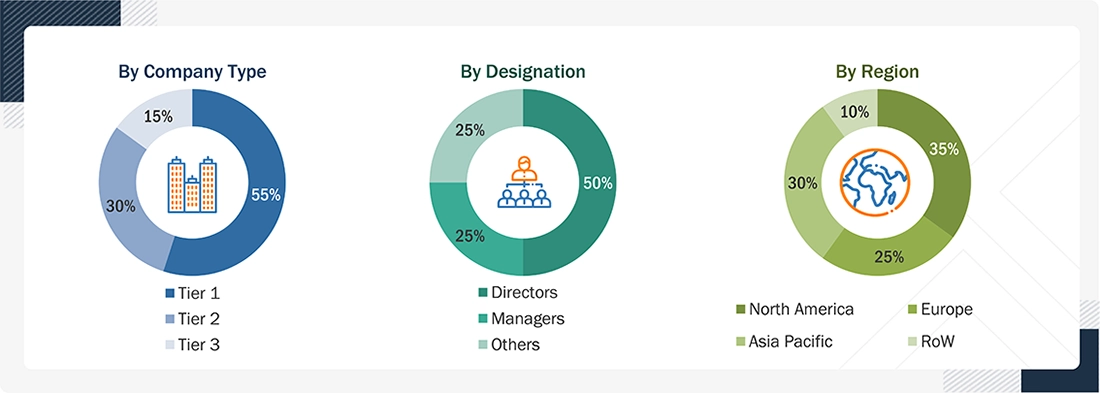
Note: The three tiers of companies are defined based on their total revenue in 2025: Tier 1 - revenue greater than or equal to USD 1 billion; Tier 2 - revenue between USD 100 million and USD 1 billion; and Tier 3 - revenue less than or equal to USD 100 million. Other designations include sales managers, marketing managers, and product managers.
To know about the assumptions considered for the study, download the pdf brochure
Market Size Estimation
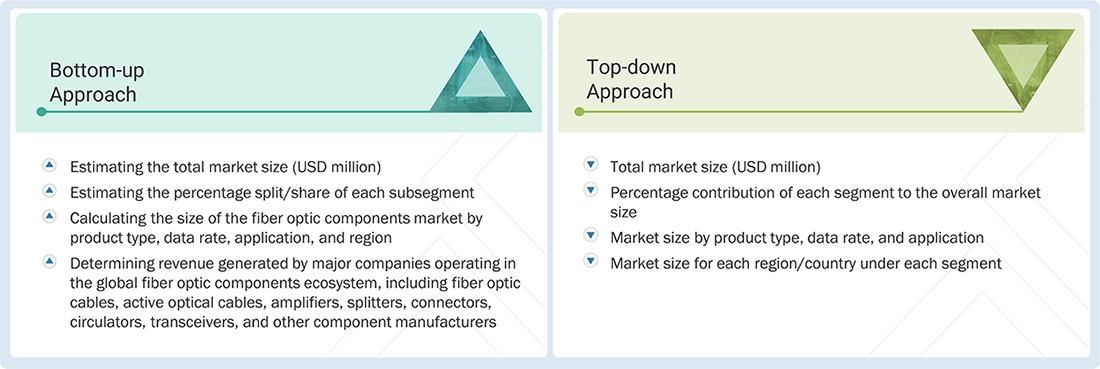
- Both top-down and bottom-up approaches were used to estimate and validate the total size of the fiber optic components market. These methods have also been used extensively to estimate the size of various subsegments in the market. The following research methodology was used to estimate the market size:
- Major players in the fiber optic components industry and related markets were identified through extensive secondary research.
- The industry's value chain and market size (in terms of value) were determined through primary and secondary research processes.
- All percentage shares, splits, and segment-level breakdowns across product type, data rate, application, and region were determined using secondary sources and verified through primary sources.
The market size estimation methodology is as follows:
Data Triangulation
After determining the overall size of the fiber optic components market using the market size estimation process explained above, the total market was split into several segments and subsegments. Data triangulation and market breakdown procedures were employed, where applicable, to complete the overall market engineering process and derive statistics for all market segments and subsegments. The data was triangulated by studying various factors and trends from both the demand and supply sides, including product type, data rate, application, and regional developments. The market size was also validated using both top-down and bottom-up approaches.
Market Definition
Fiber optic components are optical communication components used to transmit, receive, route, connect, split, amplify, and manage optical signals in fiber-optic networks. These components include fiber optic cables, active optical cables, amplifiers, splitters, connectors, circulators, transceivers, and other optical components that support high-speed, high-capacity data transmission. Fiber optic components are deployed across telecommunications, data centers, enterprise networks, distributed sensing, analytical & medical equipment, and lighting applications.
Fiber optic components are particularly important for applications that require high bandwidth, low latency, reliable connectivity, and long-distance data transmission. They support network deployment, capacity expansion, data center interconnects, FTTH, 5G backhaul, enterprise connectivity, and other optical communication requirements. A typical fiber-optic network may incorporate multiple components, including optical cables for signal transmission, transceivers for electrical-to-optical and optical-to-electrical signal conversion, connectors for physical fiber connections, splitters for distributing optical signals, and amplifiers for maintaining signal strength over longer distances. The configuration and combination of fiber optic components vary by application, data rate, network architecture, transmission distance, and performance requirements.
Key Stakeholders
- Raw material suppliers
- Component manufacturers
- System integrators
- Suppliers and distributors
- Market research and consulting firms
- Associations, organizations, forums, and alliances related to the fiber optic components industry
- Technology investors
- Governments and financial institutions
- Venture capitalists, private equity firms, and startups
- End users
Report Objectives
- To define, describe, and forecast the fiber optic components market in terms of value based on type, data rate, application, and region
- To define, describe, segment, and forecast the overall fiber optic components market in terms of volume based on type
- To forecast the market size, in terms of value, in four major regions: North America, Europe, Asia Pacific, and the Rest of the World
- To provide detailed information regarding the major factors influencing the growth of the fiber optic components market (drivers, restraints, opportunities, and challenges)
- To analyze the micromarkets for individual growth trends, prospects, and contributions to the total market
- To provide a detailed overview of the value chain of the fiber optic components market
- To analyze the opportunities for various stakeholders by identifying the high-growth segments of the market
- To profile the key players and comprehensively analyze their market positions in terms of ranking and core competencies, along with detailing the competitive landscape of the market
- To analyze competitive developments, such as product launches and developments, partnerships, acquisitions, contracts, expansions, and R&D in the fiber optic components market
Available customizations:
With the given market data, MarketsandMarkets offers customizations according to the company’s specific needs. The following customization options are available for the report:
Company Information:
- Detailed analysis and profiling of additional market players (up to 5)
Get the Full Fiber Optic Components Market Report
Full forecast, segment splits, and company analysis for all Fiber Optic Components Market.
Need a Tailored Report?
Customize this report to your needs
Get 10% FREE Customization
Customize This Report