
Mexico Flame Retardants Market (2025-2030)

The Mexico Flame Retardants Market was valued at $169.2 Million in 2025 and projected to reach to $220.3 Million by 2030, representing a compound annual growth rate of 5.42%. Mexico's flame retardants market is poised for steady expansion through 2030, driven by escalating regulatory requirements and industrial growth.


| Market Size in | USD 26.32 MN |
| Market Forecast in | |
| CAGR | |
| Forecast Period | |
| Units Considered | Value (USD MN) |
Mexico Flame Retardants Market Trends and Insights
- Mexico's market growth is driven by increasing regulatory compliance in construction, automotive, and electronics sectors, where flame retardant materials are essential for safety standards.
- The country's manufacturing base and proximity to North American supply chains position Mexico as a strategic hub for flame retardant production and distribution. Demand in Mexico is accelerating due to stricter building codes, rising consumer awareness of fire safety, and expansion of the automotive and electrical appliance industries.
- Mexico's construction sector, in particular, is driving adoption of flame-retardant materials in insulation, coatings, and composite applications.
- Between 2025 and 2030, Mexico is expected to see sustained growth as industrial modernization and foreign direct investment continue to strengthen the market foundation..
Key Market Statistics
- CAGR (2025-2030) 5.42% CAGR
- Market Size, 2025 ~USD 169.2 Million
- Forecast, 2030 ~USD 220.3 Million
- Country Mexico
Mexico Flame Retardants Market Overview
Market Size & Growth :
Mexico's flame retardants market is valued at USD 169.2 million in 2025, with projected growth to USD 220.3 million by 2030, reflecting a robust CAGR of 5.42%.
Regulatory Drivers :
Stringent safety regulations in Mexico's construction, automotive, and electronics sectors are mandating flame retardant materials, creating sustained demand across multiple industries.
Manufacturing Expansion :
Mexico's growing manufacturing base, particularly in automotive and consumer electronics, is increasing the consumption of flame retardant materials for component production and assembly.
Regional Trade Integration :
Mexico's strategic position in North American supply chains through USMCA drives demand for flame retardants in products destined for export to the US and Canada.
Mexico Flame Retardants Market Dynamics
- The construction sector's recovery and increased infrastructure investment are boosting demand for flame-retardant building materials.
- Additionally, Mexico's role as a manufacturing hub for automotive and electronics companies continues to elevate consumption of specialized flame retardant compounds. The market will benefit from rising awareness of fire safety standards and compliance pressures from multinational corporations operating in Mexico.
- Investment in local production facilities and technological advancements in flame retardant formulations will further support market growth, positioning Mexico as a key growth market within Latin America..
Market Ecosystem
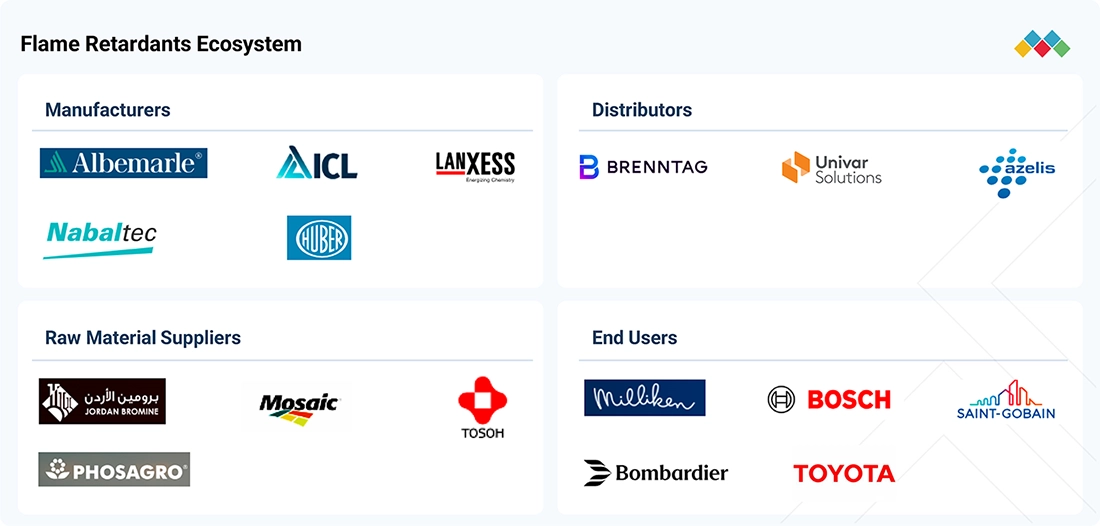
FLAME RETARDANTS MARKET: COMMERCIAL USE CASES ACROSS INDUSTRIES
| COMPANY | USE CASE DESCRIPTION | BENEFITS |
|---|---|---|
 |
Incorporating flame retardants into insulation materials, construction panels, and building products | Improved fire resistance, reduced flame spread, enhanced building safety, and support for compliance with fire safety requirements |
 |
Using flame-retardant plastics in electrical housings, power tools, and automotive electronic components | Reduced ignition risk, improved electrical safety, enhanced component reliability, and better protection against fire hazards |
 |
Incorporating flame-retardant materials into aircraft cabin interiors, seating, insulation, and electrical components | Reduced flame spread and smoke generation, improved passenger safety, and support for compliance with aircraft fire safety requirements |
 |
Incorporating flame retardant materials into automotive wiring systems, electronic components, battery-related parts, and interior plastics | Improved fire safety, reduced flame spread, enhanced electrical protection, and greater reliability in vehicle applications |
Logos and trademarks shown above are the property of their respective owners. Their use here is for informational and illustrative purposes only.
Related Ecosystem
Speciality Chemicals
- Corrosion Inhibitors
- Polyetheretherketone (PEEK)
- Acrylonitrile Butadiene Styrene (ABS)
- Epoxy Resin
- Polycarbonate
- Basf se
- DOW CHEMICAL COMPANY
- Evonik industries ag
- Clariant ag.
- Solvay sa
Key Takeaways
- Mexico's flame retardants market is valued at USD 169.2 million in 2025 and will grow to USD 220.3 million by 2030 at a 5.42% CAGR.
- Mexico's construction and automotive sectors are primary demand drivers for flame retardant materials and compliance-driven adoption.
- Mexico's strategic location and manufacturing capabilities position it as a key North American distribution and production center.
- Regulatory tightening and fire safety awareness in Mexico are accelerating market expansion through 2030.
Flame Retardants Market Report Scope
| Report Metric | Details |
|---|---|
| Base Year | 2025 |
| Fastest Growing Segment | NITROGEN (Type) |
| Forecast Period | 2025-2030 |
| Growth Rate | CAGR of 5.32% from 2025 to 2030 |
| Largest Segment | PHOSPHORUS (Type) |
| Market Size Base Year (Billions) | ~USD 8.12 (2025) |
| Revenue Forecast (Billions) | ~USD 10.52 (2030) |
| Segments Covered | Type, Application, End-Use Industry |
Mexico Flame Retardants Market Report Segmentation
3 segment dimensions are covered across the global market.
By Type
- Aluminum Trihydrate
- Antimony Oxides
- Brominated
- Chlorinated
- Nitrogen
- Other Types
- Phosphorus
By Application
- Abs & Blends
- Epoxy
- Other Applications
- Polyolefins
- Polystyrene
- Polyurethane
- Polyvinyl Chloride
- Unsaturated Polyesters
By End-Use Industry
- Automotive & Transportation
- Building & Construction
- Electronics & Appliances
- Other End-Use Industries
- Textiles
- Wire & Cables
MEXICO: FLAME RETARDANTS MARKET, BY END-USE INDUSTRY, 2025–2030
| Segment | 2025 | 2026 | 2027 | 2028 | 2029 | 2030 | CAGR (%) |
|---|---|---|---|---|---|---|---|
| AUTOMOTIVE & TRANSPORTATION | 51.68 | 54.36 | 57.22 | 60.28 | 63.6 | 67.1 | 5.35 |
| BUILDING & CONSTRUCTION | 33.83 | 35.5 | 37.28 | 39.19 | 41.2 | 43.4 | 5.11 |
| ELECTRONICS & APPLIANCES | 47.55 | 50.26 | 53.18 | 56.3 | 59.7 | 63.3 | 5.88 |
| OTHER END-USE INDUSTRIES | 3.39 | 3.55 | 3.71 | 3.89 | 4.1 | 4.3 | 4.78 |
| TEXTILES | 19.9 | 20.86 | 21.88 | 22.97 | 24.1 | 25.4 | 4.98 |
| WIRE & CABLES | 12.83 | 13.53 | 14.29 | 15.11 | 16 | 16.9 | 5.7 |
| TOTAL | 169.18 | 178.06 | 187.57 | 197.74 | 208.6 | 220.3 | 5.42 |
Target Audience
- Chemical Manufacturers & Suppliers : Identify market entry opportunities and expansion strategies in Mexico's growing flame retardants sector, with detailed demand forecasts and regulatory requirements for product development.
- Automotive & Electronics Companies : Understand flame retardant material requirements for manufacturing operations in Mexico and ensure compliance with local and export-destination safety standards.
- Construction & Building Material Firms : Access market data on flame retardant demand in Mexico's construction sector to inform product sourcing, supplier selection, and compliance strategy decisions.
- Investment & Private Equity Firms : Evaluate investment opportunities in Mexico's chemicals sector with comprehensive market sizing, growth projections, and sector-specific performance metrics for due diligence.
- Trade & Business Development Professionals : Leverage Mexico-specific market intelligence to identify partnerships, distribution opportunities, and cross-border trade strategies within the USMCA region.
Reasons to Buy this Report
- Market-Specific Sizing & Forecasts : Access precise valuation data for Mexico's flame retardants market with country-level CAGR (5.42%) and detailed projections through 2030, enabling accurate business planning and investment decisions.
- Regulatory Landscape Intelligence : Understand Mexico-specific safety standards and compliance requirements driving demand across construction, automotive, and electronics sectors to identify market opportunities and competitive advantages.
- Sector-Specific Demand Analysis : Gain insights into which Mexican industries are driving flame retardant consumption, including manufacturing hubs, construction projects, and export-oriented sectors within the USMCA framework.
- Competitive Positioning Strategy : Benchmark your business against Mexico's market dynamics, identify growth pockets, and develop targeted strategies for market entry or expansion in this emerging Latin American market.
- Supply Chain & Trade Insights : Leverage Mexico's strategic position in North American supply chains to understand sourcing opportunities, distribution channels, and cross-border trade implications for flame retardant products.
Frequently asked questions
What is the current size of Mexico's flame retardants market?
Mexico's flame retardants market is estimated at USD 169.2 million in 2025.
What is the projected market size for Mexico by 2030?
Mexico's flame retardants market is forecast to reach USD 220.3 million by 2030.
What is the CAGR for Mexico's flame retardants market?
Mexico's flame retardants market is expected to grow at a CAGR of 5.42% from 2025 to 2030.
Which industries drive demand for flame retardants in Mexico?
Construction, automotive, electronics, and electrical appliance manufacturing are the primary demand drivers in Mexico.
Why is Mexico important for the North American flame retardants market?
Mexico's manufacturing base, regulatory alignment, and proximity to North American supply chains make it a strategic production and distribution hub.
RESEARCH METHODOLOGY
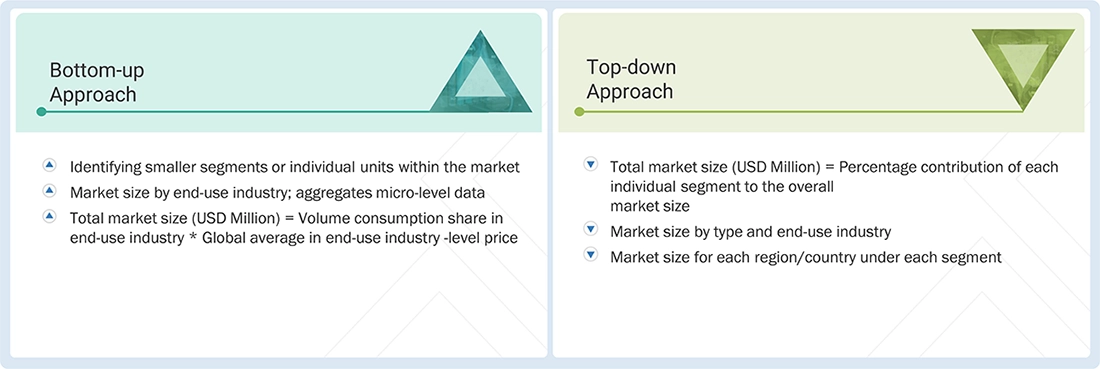
The study involved four major activities in estimating the market size for flame retardants. Exhaustive secondary research was done to collect information on the market, the peer market, and the parent market. The next step was to validate these findings, assumptions, and sizing with industry experts across the value chain through primary research. Both top-down and bottom-up approaches were employed to estimate the complete market size. After that, the market breakdown and data triangulation procedures were used to estimate the market size of the segments and subsegments.
Secondary Research
Secondary sources used in this study included annual reports, press releases, and investor presentations of companies; white papers; certified publications; articles from recognized authors; and gold-standard and silver-standard websites, such as Factiva, ICIS, Bloomberg, and others. The findings of this study were verified through primary research, which involved conducting extensive interviews with key officials, including CEOs, VPs, directors, and other executives. The breakdown of profiles of the primary interviewees is illustrated in the figure below:
Primary Research
The flame retardants market comprises several stakeholders, such as raw material suppliers, end-product manufacturers, and regulatory organizations in the supply chain. Various primary sources from both the supply and demand sides of the market were interviewed to obtain qualitative and quantitative information.
BREAKDOWN OF PRIMARY PARTICIPANTS
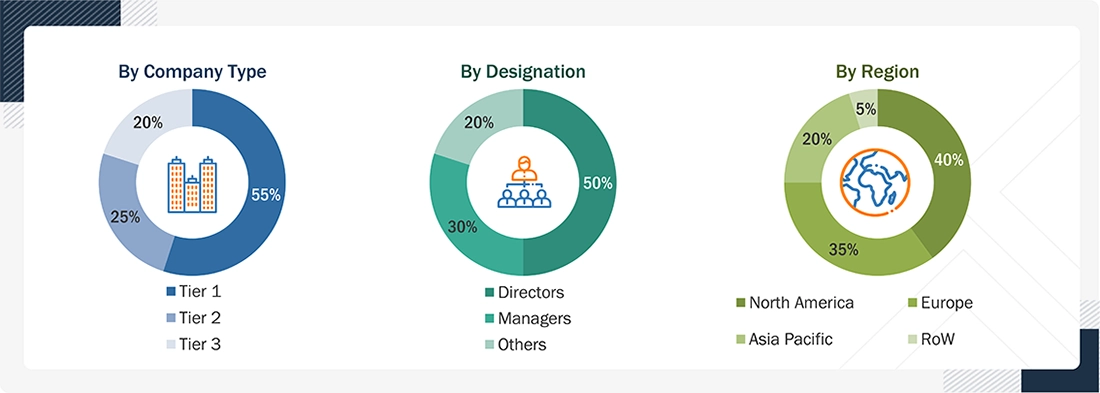
Notes: Tier 1, Tier 2, and Tier 3 companies are classified based on their market revenue in 2024/2025 available in the public domain, product portfolios, and geographical presence.
Other designations include consultants and sales, marketing, and procurement managers.
|
COMPANY NAME |
DESIGNATION |
|
Albemarle Corporation |
Senior Manager |
|
ICL Group Ltd. |
Innovation Manager |
|
LANXESS AG |
Development Manager |
|
J.M. Huber Corporation |
Production Supervisor |
|
Nabaltec AG |
Sales Manager |
To know about the assumptions considered for the study, download the pdf brochure
Market Size Estimation
Both top-down and bottom-up approaches were used to estimate and validate the total size of the flame retardants market. These methods were also used extensively to estimate the size of various subsegments in the market. The research methodology used to estimate the market size includes the following:
- The key players in the industry have been identified through extensive secondary research.
- The supply chain of the industry has been determined through primary and secondary research.
- All percentage shares, splits, and breakdowns have been determined using secondary sources and verified through primary sources.
- All possible parameters that affect the markets covered in this research study have been accounted for, viewed in extensive detail, verified through primary research, and analyzed to obtain the final quantitative and qualitative data.
Data Triangulation
After determining the overall market size using the market size estimation processes explained above, the market was divided into several segments and subsegments. To complete the overall market engineering process and determine the exact statistics for each market segment and subsegment, data triangulation and market breakdown procedures were employed, as applicable. The data were triangulated by studying various factors and trends from both the demand and supply sides in the flame retardants industry.
Market Definition
According to the PINFA (Phosphorus, Inorganic, and Nitrogen Flame Retardant) Association, “Flame retardants are key components in reducing the devastating effect of fire mishaps on people, property, and the environment. The most common elements used as flame retardants are bromine, chlorine, and phosphorus. The compounds of these elements are added to treat potentially flammable materials. Flame retardants stop the fire by interacting with the fire cycle in the gaseous phase and stop the chemical chain reaction. They act in two ways: they either prevent the fire from starting or slow it down significantly. They are added to plastics, among other materials, and do not alter the properties of the parent material.”
Key Stakeholders
- Flame retardant manufacturers
- Flame retardant distributors
- Raw material suppliers
- Government and research organizations
- Investment banks and private equity firms
Report Objectives
- To analyze and forecast the size of the global flame retardants market in terms of value and volume
- To provide detailed information about the major drivers, restraints, challenges, and opportunities influencing the market growth
- To define, describe, and segment the market based on type, application, end-use industry, and region
- To forecast the size of the market segments based on regions such as Asia Pacific, North America, Europe, the Middle East & Africa, and South America
- To strategically analyze micromarkets with respect to individual growth trends, prospects, and their contribution to the overall market
- To strategically analyze the segmented markets with respect to individual growth trends, prospects, and contributions to the overall market
- To identify and analyze opportunities for stakeholders in the market
- To analyze competitive developments such as expansions, partnerships, joint ventures, mergers & acquisitions, agreements, and product launches in the market
- To strategically profile the key companies and comprehensively analyze their core competencies
Available customizations:
Along with the given market data, MarketsandMarkets offers customizations according to the company’s specific needs. The following customization options are available for the report:
Regional Analysis
- Further breakdown of a region with respect to a particular country or additional application
Company Information
- Detailed analysis and profiles of additional market players (up to five)
Get the Full Flame Retardants Market Report
Full forecast, segment splits, and company analysis for all Flame Retardants Market.
- Argentina Flame Retardants Market
- Brazil Flame Retardants Market
- Canada Flame Retardants Market
- China Flame Retardants Market
- France Flame Retardants Market
- Germany Flame Retardants Market
- India Flame Retardants Market
- Israel Flame Retardants Market
- Italy Flame Retardants Market
- Japan Flame Retardants Market
- Rest Of Asia Pacific Flame Retardants Market
- Rest Of Europe Flame Retardants Market
- Rest Of South America Flame Retardants Market
- Rest Of Western Europe Flame Retardants Market
- Russia Flame Retardants Market
- Saudi Arabia Flame Retardants Market
- South Korea Flame Retardants Market
- Spain Flame Retardants Market
- Turkey Flame Retardants Market
- UK Flame Retardants Market
- US Flame Retardants Market
Need a Tailored Report?
Customize this report to your needs
Get 10% FREE Customization
Customize This Report
