
Italy Food Emulsifiers Market (2023-2028)

The Italy Food Emulsifiers Market was valued at $198.2 Million in 2023 and projected to reach to $232 Million by 2028, representing a compound annual growth rate of 3.2%. Italy's food emulsifiers market is positioned for steady expansion through 2028, driven by the country's strong food processing sector and consistent demand from established bakery, confectionery, and dairy manufacturers.


| Market Size in | USD 26.32 MN |
| Market Forecast in | |
| CAGR | |
| Forecast Period | |
| Units Considered | Value (USD MN) |
Italy Food Emulsifiers Market Trends and Insights
- Italy's market reflects steady demand driven by the country's robust food processing sector, particularly in bakery, confectionery, and dairy applications where emulsifiers play a critical role in product stability and texture.
- The Italian food industry's emphasis on quality and innovation supports consistent adoption of advanced emulsifier solutions across both traditional and modern food manufacturing segments. Growth in Italy's food emulsifiers market is underpinned by increasing consumer preference for processed convenience foods and clean-label formulations that maintain product integrity without artificial additives.
- Italy's position as a major European food exporter amplifies demand for reliable emulsifier technologies that meet stringent EU regulatory standards and international quality benchmarks.
- Between 2023 and 2028, Italy is expected to maintain moderate but stable growth, supported by ongoing investments in food technology and rising demand from the country's established dairy, bakery, and prepared foods sectors..
Key Market Statistics
- CAGR (2023-2028) 3.2% CAGR
- Market Size, 2023 ~USD 198.2 Million
- Forecast, 2028 ~USD 232 Million
- Country Italy
Italy Food Emulsifiers Market Overview
Market Valuation :
Italy's food emulsifiers market reached USD 198.2 million in 2023, with projections to expand to USD 232.0 million by 2028, representing steady growth in Southern Europe's food processing landscape.
Growth Trajectory :
The Italian market is expanding at a CAGR of 3.2% through 2028, outpacing broader economic trends and reflecting consistent demand from the country's established food manufacturing sector.
Key Application Sectors :
Bakery, confectionery, and dairy products dominate emulsifier consumption in Italy, where these ingredients are essential for achieving product stability, texture consistency, and shelf-life extension in traditional and modern formulations.
Regional Significance :
Italy's robust food processing infrastructure and heritage in artisanal food production create a unique market dynamic, balancing traditional manufacturing with modern industrial demands for emulsifier solutions.
Italy Food Emulsifiers Market Dynamics
- The 3.2% CAGR reflects moderate but reliable growth, supported by ongoing product innovation and reformulation trends in premium food categories.
- Italian manufacturers' focus on quality and food safety standards continues to drive adoption of specialized emulsifier solutions. Looking ahead, Italy's market will benefit from increasing consumer demand for clean-label products and natural emulsifiers, alongside growth in convenience foods and ready-to-eat segments.
- The country's position within the EU regulatory framework and its export-oriented food industry provide additional growth catalysts.
- However, market expansion will remain measured compared to global rates, reflecting Italy's mature food processing landscape and competitive pricing pressures..
Market Ecosystem

FOOD EMULSIFIERS MARKET SIZE, SHARE, GROWTH TRENDS AND ANALYSIS REPORT: COMMERCIAL USE CASES ACROSS INDUSTRIES
| COMPANY | USE CASE DESCRIPTION | BENEFITS |
|---|---|---|
 |
Emulpals 110 is a specialized cake emulsifier developed by Palsgaard to enable manufacturers to use a single emulsifier across different cake formulations. Designed for professional bakeries and industrial cake production, it delivers consistent performance across recipes and tolerates challenging ingredients. | Simplifies formulation and recipe engineering, reduces the need for multiple emulsifiers, provides consistent cake quality and performance, supports stability for up to 24 months, improves tolerance to formulation variations, and enables development of reduced-saturated-fat and better-for-you cake products. |
 |
GRINDSTED PGPR 90 is a specialty food emulsifier used in chocolate and confectionery applications. It helps control chocolate flow during processing, making it easier to handle and manufacture products with complex shapes and designs. | Improved chocolate flow and processing, controlled viscosity, easier molding and shaping, smoother processing, improved production efficiency, and consistent product quality. |
Logos and trademarks shown above are the property of their respective owners. Their use here is for informational and illustrative purposes only.
Related Ecosystem
Fandb Additives
- Dairy Products
- Bakery Products
- Polyglycerol Esters
- Microorganism
- Carbohydrates
- AZELIS HOLDINGS SA
- Archer-Daniels-Midland Company
- Amway
- UNILEVER PLC
- DuPont de Nemours, Inc.
Key Takeaways
- Italy's food emulsifiers market reached USD 198.2 million in 2023 with a projected value of USD 232.0 million by 2028.
- Italy's market is growing at a 3.2% CAGR, reflecting steady demand from bakery, dairy, and confectionery sectors.
- Italy's strong food export industry and EU regulatory compliance drive consistent adoption of advanced emulsifier technologies.
- Clean-label and natural emulsifier solutions are gaining traction in Italy's premium and health-conscious food segments.
Food Emulsifiers Market Report Scope
| Report Metric | Details |
|---|---|
| Base Year | 2023 |
| Fastest Growing Segment | LECITHIN (Type) |
| Forecast Period | 2023-2030 |
| Growth Rate | CAGR of 4.9% from 2023 to 2030 |
| Largest Segment | PLANT SOURCE (Source) |
| Market Size Base Year (Billions) | ~USD 3.62 (2023) |
| Revenue Forecast (Billions) | ~USD 5.06 (2030) |
| Segments Covered | Application, Source, Type |
Italy Food Emulsifiers Market Report Segmentation
3 segment dimensions are covered across the global market.
By Application
- Bakery Products
- Bread Products
- Confectionery Products
- Convenience Foods
- Dairy & Frozen Desserts
- Detergents & Cleaners
- Food
- Meat Products
- Other Applications
- Personal Care Products
By Source
- Animal Source
- Plant Source
By Type
- Lecithin
- Mono- & Di-Glycerides And Their Derivatives
- Other Types
- Polyglycerol Esters
- Sorbitan Esters
- Stearoyl Lactylates
Target Audience
- Food & Beverage Manufacturers : Italian and international F&B producers need Italy-specific emulsifier market data to optimize ingredient sourcing, formulation strategies, and production planning for bakery, confectionery, and dairy product lines serving domestic and export markets.
- Emulsifier Suppliers & Distributors : Ingredient suppliers and distributors require detailed Italy market insights to identify growth opportunities, assess competitive positioning, and develop targeted sales strategies for regional customers and emerging application segments.
- Market Entry & Expansion Teams : Companies planning market entry or expansion in Italy need localized market sizing, growth forecasts, and sector analysis to validate business cases, allocate resources effectively, and establish realistic revenue projections.
- Investment & Private Equity Firms : Investors evaluating opportunities in Italy's food processing sector require market-specific data on emulsifier demand, growth rates, and sector dynamics to assess portfolio companies, identify acquisition targets, and evaluate market attractiveness.
- Food Industry Consultants & Analysts : Consulting professionals and research analysts need Italy-focused market intelligence to support client advisory work, competitive analysis, and strategic recommendations for food manufacturers and ingredient companies operating in the Italian market.
Reasons to Buy this Report
- Italy-Specific Market Sizing : Access precise valuation data for Italy's food emulsifiers market with verified 2023 baseline (USD 198.2M) and 2028 forecasts, enabling accurate budget allocation and market entry strategies tailored to Italian market conditions.
- Sector-Focused Application Insights : Understand demand patterns across Italy's key emulsifier applications—bakery, confectionery, and dairy—with localized consumption trends and product preferences specific to Italian manufacturers and regional food traditions.
- Competitive Positioning Intelligence : Benchmark your products and strategies against Italy's market growth rate (3.2% CAGR) relative to global performance (4.9% CAGR), identifying competitive advantages and market gaps in Southern Europe's food processing hub.
- Regulatory & Quality Compliance Framework : Navigate Italy's EU-aligned food safety standards and quality requirements with market insights reflecting local regulatory expectations, certification needs, and compliance drivers influencing emulsifier adoption decisions.
- Strategic Growth Planning : Develop targeted expansion strategies for Italy with 5-year forecasts, growth trajectory analysis, and sector-specific demand drivers, supporting investment decisions and market penetration planning in this established European market.
Frequently asked questions
What is the current size of Italy's food emulsifiers market?
Italy's food emulsifiers market was valued at USD 198.2 million in 2023 and is expected to reach USD 232.0 million by 2028.
What is the growth rate of Italy's food emulsifiers market?
Italy's food emulsifiers market is growing at a compound annual growth rate (CAGR) of 3.2% from 2023 to 2028.
Which food segments drive demand for emulsifiers in Italy?
Italy's primary demand drivers include bakery products, confectionery, dairy products, and prepared foods, where emulsifiers enhance texture, stability, and shelf life.
How do EU regulations impact Italy's food emulsifiers market?
Italy's adherence to strict EU food safety and labeling regulations ensures that only approved emulsifiers are used, supporting market growth for compliant, high-quality solutions.
What trends are shaping Italy's food emulsifiers market?
Key trends in Italy include rising demand for clean-label products, natural and plant-based emulsifiers, and innovative formulations that meet both consumer preferences and export market requirements.
RESEARCH METHODOLOGY
This study employed two primary approaches to estimate the current size of the food emulsifiers market. Exhaustive secondary research was carried out to collect information on the food emulsifiers type, source, application, function and region for the market. The next step involved validating these findings, assumptions, and sizing with industry experts across the value chain through primary research. The top-down and bottom-up approaches were employed to estimate the complete market size. Thereafter, data triangulation was used to estimate the market size of segments and subsegments.
Secondary Research
This research study used extensive secondary sources—directories and databases such as Bloomberg Businessweek and Factiva—to identify and collect information for a technical, market-oriented, and commercial market study. In the secondary research process, sources such as annual reports, press releases & investor presentations of companies, white papers, agriculture- and food emulsifier-related journals, certified publications, articles from recognized authors, directories, and databases were referred to identify and collect information. Secondary research was mainly used to obtain key information about the industry’s supply chain, the pool of key players, and market classification and segmentation based on industry trends to the bottom-most level, regional markets, and key developments from market- and technology-oriented perspectives.
Primary Research
Extensive primary research was conducted after obtaining information regarding the food emulsifiers market scenario through secondary research. Several primary interviews were conducted with market experts from the demand and supply sides. Primary data was collected through questionnaires, emails, and telephonic interviews. Supply-side primary sources included industry experts such as chief experience officers (CXOs), vice presidents (VPs), directors from business development, marketing, research, and development teams, and key executives from distributors and key opinion leaders.
Primary interviews were conducted to gather insights on the food emulsifiers market, including market statistics, revenue data for products and services, market segmentation, market size estimates, market forecasting, and data triangulation. Primary research also helped identify key trends in emulsifier sources, types, functions, applications, and regional markets.
Stakeholders from the demand side, including food and beverage manufacturers, bakery and confectionery manufacturers, dairy product manufacturers, processed food manufacturers, meat and poultry processors, convenience food producers, and nutraceutical companies, were interviewed to understand buyers’ perspectives on food emulsifier suppliers, product requirements, purchasing trends, application preferences, pricing considerations, and the future outlook of the food emulsifiers market.
Following is the breakdown of primary respondents:
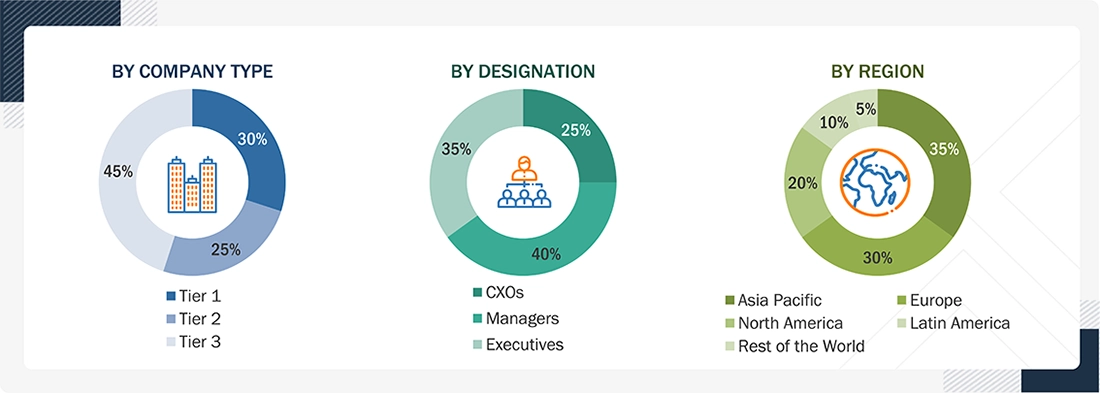
Note: The three tiers of the companies are defined based on their total revenues in 2023 or 2024, based on the availability of financial data: Tier 1: Revenue >USD 1 billion; Tier 2: USD 100 million ≤ revenue ≤ USD 1 billion; Tier 3: Revenue USD 100 million.
To know about the assumptions considered for the study, download the pdf brochure
|
COMPANY |
DESIGNATION |
|
Palsgaard (Denmark) |
Regional Sales Manager |
|
Lasenor Emul, S.L. (Spain) |
Marketing Manager |
|
American Lecithin Company (US) |
General Manager |
|
Stepan Company (US) |
Sales Manager |
|
Fine Organics (India) |
Sales Manager |
|
Foodchem International Corporation (China) |
Sales Executive |
Market Size Estimation
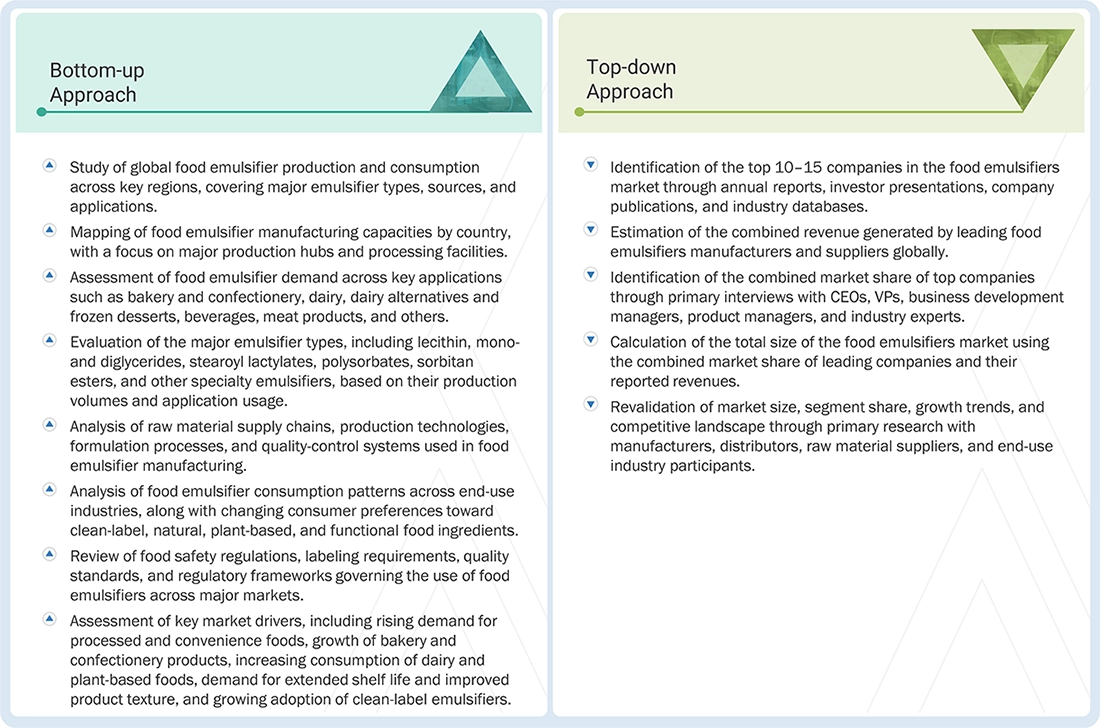
The top-down and bottom-up approaches were used to estimate and validate the total size of the food emulsifiers market. These approaches were also used extensively to determine the size of various market subsegments. The research methodology used to estimate the market size includes the following details:
- The key players in the industry and the overall market were identified through extensive secondary research.
- All shares, splits, and breakdowns were determined using secondary sources and verified through primary sources.
- All possible parameters that affect the market covered in this research study were accounted for, viewed in extensive detail, verified through primary research, and analyzed to obtain final quantitative and qualitative data.
- The research included the study of reports, reviews, and newsletters of top market players, along with extensive interviews for opinions from leaders, such as CEOs, directors, and marketing executives.
Data Triangulation
After determining the overall market size from the estimation process explained above, the total market was split into several segments and subsegments. The data triangulation procedure was employed, wherever applicable, to estimate the overall food emulsifiers market and obtain precise statistics for all segments and subsegments. The data was triangulated by studying various factors and trends from the demand and supply sides. The market size was also validated using the top-down and bottom-up approaches.
Market Definition
The food emulsifiers market encompasses the production, processing, distribution, and sale of food emulsifiers, functional ingredients that facilitate emulsion formation and stabilization by uniformly dispersing otherwise immiscible ingredients such as oil and water. Food emulsifiers are widely used across the food and beverage industry owing to their emulsifying, stabilizing, dispersing, texture-enhancing, and moisture-retention properties. The market includes various types, sources, grades, and formulations of food emulsifiers used worldwide in bakery and confectionery products, dairy and frozen desserts, processed foods, meat and poultry products, sauces and dressings, beverages, and other food applications.
Manufacturers develop food emulsifier products with enhanced functionality, stability, compatibility, and performance to meet evolving food processing and formulation requirements. The market is driven by rising demand for processed and convenience foods, clean-label and functional products, improved texture and shelf life, and growing consumption of bakery, dairy, confectionery, and ready-to-eat products. Additionally, the increasing adoption of plant-based and natural emulsifiers, advances in emulsifier formulation and processing technologies, and growing demand for multifunctional food ingredients continue to support global growth in the food emulsifiers market.
Key Stakeholders
- Raw material suppliers, including producers of vegetable oils, fatty acids, glycerol, lecithin, and other ingredients used in food emulsifier production.
- Food emulsifier manufacturers, including producers of lecithin, mono- and diglycerides, DATEM, SSL, CSL, PGPR, and other natural and synthetic emulsifiers.
- Intermediate stakeholders, including ingredient distributors, traders, contract manufacturers, logistics providers, packaging suppliers, and certification organizations.
- Food and beverage manufacturers and brand owners across bakery, confectionery, dairy, chocolate, beverages, sauces, processed foods, and plant-based products.
- Government organizations and regulatory authorities responsible for food additive safety, labeling, quality standards, and regulatory compliance.
- Research institutes, universities, and testing laboratories involved in emulsifier research, formulation development, stability testing, and quality evaluation.
- Industry professionals, including food technologists, R&D scientists, formulation specialists, quality assurance teams, and procurement managers.
-
Associations and industry bodies:
- Food and Agriculture Organization (FAO)
- World Health Organization (WHO)
- United States Department of Agriculture (USDA)
- Organisation for Economic Co-operation and Development (OECD)
- European Food Safety Authority (EFSA)
- US Food and Drug Administration (FDA)
- Health Canada
- International Organization for Standardization (ISO)
Report Objectives
- To determine and project the size of the food emulsifiers market based on type, source, application, function, and region over the forecast period
- To identify key growth opportunities by analyzing the largest and fastest-growing segments across regions
- To provide detailed insights on factors influencing market growth, including drivers, restraints, opportunities, and challenges
- To evaluate market opportunities for stakeholders and present the competitive landscape of leading players
- To analyze micro-markets with respect to individual growth trends, future potential, and their contribution to the overall market
- To identify and profile key companies operating in the food emulsifiers market
- To assess the competitive environment and highlight key strategies adopted by major players across regions
Customization Options
With the given market data, MarketsandMarkets offers customizations according to company-specific scientific needs. The following customization options are available for the report:
Product Analysis
- Product matrix, which gives a detailed comparison of the product portfolio of each company.
Segmental Analysis
With the given market data, MarketsandMarkets offers customizations according to company-specific scientific needs.
- Further breakdown of the Rest of Europe food emulsifiers market into key countries
- Further breakdown of the Rest of Asia Pacific food emulsifiers market into key countries
- Further breakdown of the Rest of South America food emulsifiers market into key countries
Company Information
- Detailed analyses and profiling of additional market players (up to five)
Get the Full Food Emulsifiers Market Report
Full forecast, segment splits, and company analysis for all Food Emulsifiers Market.
- US Food Emulsifiers Market
- Canada Food Emulsifiers Market
- Mexico Food Emulsifiers Market
- Germany Food Emulsifiers Market
- France Food Emulsifiers Market
- UK Food Emulsifiers Market
- Spain Food Emulsifiers Market
- China Food Emulsifiers Market
- Japan Food Emulsifiers Market
- India Food Emulsifiers Market
- South Korea Food Emulsifiers Market
- Rest Of Europe Food Emulsifiers Market
- Rest Of Asia-Pacific Food Emulsifiers Market
- Africa Food Emulsifiers Market
- Middle East Food Emulsifiers Market
- South America Food Emulsifiers Market
Need a Tailored Report?
Customize this report to your needs
Get 10% FREE Customization
Customize This Report
