
Asia Pacific Food Enzymes Market (2025-2030)

The Asia Pacific Food Enzymes Market was valued at $598.7 Million in 2025 and projected to reach to $870.6 Million by 2030, representing a compound annual growth rate of 7.8%. The Asia Pacific food enzymes market is positioned for accelerated growth through 2030, driven by rapid urbanization, rising disposable incomes, and shifting consumer preferences toward processed and convenience foods.


| Market Size in | USD 26.32 MN |
| Market Forecast in | |
| CAGR | |
| Forecast Period | |
| Units Considered | Value (USD MN) |
Asia Pacific Food Enzymes Market Trends and Insights
- Asia Pacific's growth trajectory reflects rising demand for processed foods, clean-label products, and enzyme-based solutions across bakery, beverage, and dairy sectors.
- The region's 7.8% compound annual growth rate outpaces global averages, driven by increasing consumer awareness of food quality and regulatory support for enzyme applications in Asia Pacific. Asia Pacific's food enzymes adoption is accelerating due to rapid urbanization, expanding middle-class populations, and growing food manufacturing capabilities across China, India, and Southeast Asia.
- Enzyme manufacturers in Asia Pacific are investing in localized production and R&D to meet region-specific regulatory requirements and consumer preferences.
- By 2030, Asia Pacific is expected to solidify its position as a critical growth engine, with enzyme innovation and sustainability initiatives reshaping the competitive landscape throughout the region..
Key Market Statistics
- CAGR (2025-2030) 7.8% CAGR
- Market Size, 2025 ~USD 598.7 Million
- Forecast, 2030 ~USD 870.6 Million
- Geography Asia Pacific
Asia Pacific Food Enzymes Market Overview
Market Valuation & Growth :
Asia Pacific food enzymes market valued at USD 598.7 million in 2025, expanding to USD 870.6 million by 2030, representing a robust 7.8% CAGR that outpaces the global average of 7.2%.
China's Market Leadership :
China dominates the Asia Pacific region with USD 400.7 million market size, driven by rapid industrialization of food processing, growing middle-class consumption, and increasing adoption of enzyme-based food solutions.
India's Emerging Opportunity :
India represents the second-largest market at USD 256.6 million, fueled by expanding dairy and beverage sectors, rising demand for clean-label products, and growing food manufacturing infrastructure across urban centers.
Sector-Specific Demand Drivers :
Bakery, beverage, and dairy sectors in Asia Pacific are accelerating enzyme adoption for improved product quality, shelf-life extension, and cost optimization, supported by regulatory shifts toward natural food processing aids.
Asia Pacific Food Enzymes Market Dynamics
- Key growth catalysts include increasing investments in food manufacturing infrastructure, regulatory support for enzyme-based solutions, and growing awareness of clean-label and natural food additives across the region. Countries like China and India will continue to lead market expansion, supported by large-scale food processing industries and expanding retail networks.
- Southeast Asian markets including Indonesia, Vietnam, and Philippines are emerging as secondary growth hubs, driven by growing food export industries and rising domestic consumption.
- Strategic partnerships between global enzyme manufacturers and regional food producers will further accelerate market penetration and innovation in enzyme applications..
Market Ecosystem
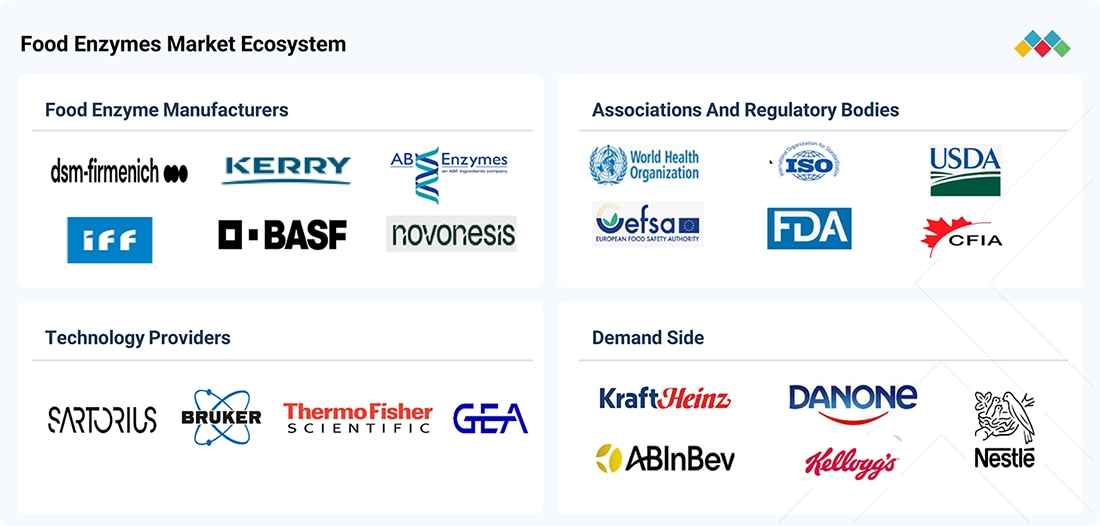
FOOD ENZYMES MARKET: COMMERCIAL USE CASES ACROSS INDUSTRIES
| COMPANY | USE CASE DESCRIPTION | BENEFITS |
|---|---|---|
 |
Novonesis develops enzyme solutions for key food-processing applications, particularly dairy, baking, brewing, and other food & beverage products. Its lactase enzymes are used to hydrolyze lactose in dairy products, while other enzyme solutions support processing efficiency, texture, product consistency, and quality. The company combines enzyme technology and fermentation expertise to develop application-specific solutions for food manufacturers. | Enables lactose-free and reduced-lactose products, improves processing efficiency and product consistency, and helps manufacturers develop products aligned with changing consumer preferences |
 |
Kerry provides enzyme solutions for food and beverage applications, including fruit juice processing and fermentation. Its enzymes support the breakdown and modification of food components during processing, helping manufacturers improve clarification, extraction, fermentation performance, and overall product quality. These solutions are integrated with Kerry's broader food ingredient and biotechnology expertise to address specific processing requirements. | Improves juice yield and clarification, supports efficient fermentation, enhances product consistency, and helps manufacturers optimize processing performance and raw material utilization |
 |
dsm-firmenich supplies enzyme solutions for food applications, including lipases used in cheese making and flavor development. Lipase enzymes facilitate the controlled hydrolysis of milk fat during cheese production and maturation, contributing to the development of desired flavor characteristics. The company uses its enzyme and food application expertise to develop solutions suited to specific dairy-processing requirements. | Supports controlled flavor development and cheese maturation, improves product consistency, and enables manufacturers to achieve targeted sensory characteristics in dairy products |
Logos and trademarks shown above are the property of their respective owners. Their use here is for informational and illustrative purposes only.
Related Ecosystem
Fandb Additives
- Dairy Products
- Bakery Products
- Polyglycerol Esters
- Microorganism
- Carbohydrates
- AZELIS HOLDINGS SA
- Archer-Daniels-Midland Company
- Amway
- UNILEVER PLC
- DuPont de Nemours, Inc.
Key Takeaways
- Asia Pacific food enzymes market valued at $598.7M in 2025, expanding to $870.6M by 2030 at 7.8% CAGR
- Asia Pacific's growth rate exceeds global average, driven by urbanization and middle-class expansion across the region
- Bakery, beverage, and dairy sectors in Asia Pacific are primary growth drivers for enzyme adoption
- Asia Pacific manufacturers are prioritizing localized production and regulatory compliance to capture regional market share
Food Enzymes Market Report Scope
| Report Metric | Details |
|---|---|
| Base Year | 2025 |
| Fastest Growing Segment | POLYMERASES & NUCLEASES (Type) |
| Forecast Period | 2025–2030 |
| Growth Rate | CAGR of 7.2% from 2025 to 2030 |
| Largest Segment | MICROORGANISMS (Source) |
| Market Size Base Year (Billions) | ~USD 2.97 (2025) |
| Revenue Forecast (Billions) | ~USD 4.2 (2030) |
| Segments Covered | Type, Application, Source, Formulation |
Asia Pacific Food Enzymes Market Report Segmentation
4 segment dimensions are covered across the global market.
By Type
- Carbohydrases
- Galactosidase
- Laccase
- Lipases
- Other Types
- Polymerases & Nucleases
- Proteases
- Xylanase
- –Amylase
- –Cellulase
- –Glucoamylase
- –Hemicellulase
- –Lactase
- –Other
- –Other Carbohydrases
- –Others
- –Pectinase
By Application
- Beverages
- Food
- –Bakery & Confectionery Products
- –Brewing/Beer
- –Dairy Products
- –Juices
- –Meat Products
- –Nutraceuticals
- –Other Beverages
- –Other Food Products
By Source
- Animals
- Microorganisms
- Plants
By Formulation
- Liquid
- Lyophilized Powder
- Other Formulations
Target Audience
- Food & Beverage Manufacturers : Manufacturers across Asia Pacific need market intelligence to optimize enzyme sourcing, improve product formulations, and capitalize on growing demand for processed foods and clean-label solutions.
- Enzyme Producers & Suppliers : Global and regional enzyme manufacturers require detailed market segmentation, competitive analysis, and country-specific growth forecasts to prioritize investments and expansion strategies in Asia Pacific.
- Food Processing Equipment Providers : Equipment suppliers need insights into enzyme adoption trends and processing technology requirements across bakery, beverage, and dairy sectors to align product offerings with market demands.
- Investment & Private Equity Firms : Investors evaluating opportunities in Asia Pacific food processing require comprehensive market data, growth projections, and competitive landscapes to make informed acquisition and funding decisions.
- Food Industry Consultants & Analysts : Consultants advising food companies on market entry, product innovation, and supply chain optimization need region-specific data and trend analysis to deliver actionable strategic recommendations.
Key Companies in the Asia Pacific Food Enzymes Market
| Company | HQ | Ownership | Strongest segments |
|---|---|---|---|
| BUNGE LIMITED | United States | Public Company | Soybean Processing and Refining,Softseed Processing and Refining,Other Oilseeds Processing and Refining, |
| UNILEVER PLC | United Kingdom | Public Company | Beauty & Wellbeing,Personal Care,Home Care, |
| VENTURA FOODS, LLC | United States | Private Company | Shortenings, oils, margarines, and spreads,Dressings, mayonnaises, and sauces,Dairy dips, bases, concessions, and specialty ingredients, |
| INTERNATIONAL FLAVORS & FRAGRANCES INC. | United States | Public Company | Taste,Food Ingredients,Health & Biosciences, |
| ASSOCIATED BRITISH FOODS PLC | United Kingdom | Public Company | Retail (Primark & Penneys),Grocery,Ingredients, |
| DSM-FIRMENICH | Switzerland | Public Company | Health, Nutrition & Care,Taste, Texture & Health,Perfumery & Beauty, |
| KERRY GROUP PLC | Ireland | Public Company | Taste solutions (flavours, extracts, taste modulation),Nutrition solutions (enzymes, proteins, lipids, fibre, wellness),Functional ingredients, food and beverage solutions, |
| ADM | United States | Public Company | Ag Services and Oilseeds,Carbohydrate Solutions,Nutrition, |
| ADVANCED ENZYME TECHNOLOGIES | India | Public Company | Human healthcare and nutrition (enzymes and probiotics),Animal nutrition,Food processing enzymes (baking, brewing, starch, dairy, oils and fats, specialty), |
BUNGE LIMITED
Bunge Limited is a United States-based public company founded in 1818 that operates as a major global agribusiness and food processing enterprise. With 34,000 employees, the company is involved in the production, processing, and distribution of agricultural commodities and food ingredients.
UNILEVER PLC
Unilever PLC is a United Kingdom-based public company established in 1860 that manufactures and markets a diverse portfolio of consumer goods, including food, beverages, and personal care products. The company employs 93,732 people globally and operates across multiple continents.
VENTURA FOODS, LLC
Ventura Foods, LLC is a United States-based private company founded in 1867 that specializes in food manufacturing and ingredient production. With 2,534 employees, the company serves the food industry with various products and solutions.
INTERNATIONAL FLAVORS & FRAGRANCES INC.
International Flavors & Fragrances Inc. is a United States-based public company founded in 1909 that creates and supplies flavors, fragrances, and specialty ingredients for the food, beverage, and personal care industries. With 21,500 employees, the company operates globally as a leading ingredient supplier.
ASSOCIATED BRITISH FOODS PLC
Associated British Foods PLC is a United Kingdom-based public company founded in 1934 with 138,000 employees operating across multiple business segments including food, retail, and ingredients. The company is a diversified multinational with significant global operations.
DSM-FIRMENICH
DSM-Firmenich is a Switzerland-based public company established in 1902 that specializes in nutrition, health, and beauty ingredients and solutions. With 26,873 employees, the company serves the food, beverage, dietary supplement, and personal care industries.
KERRY GROUP PLC
Kerry Group PLC is an Ireland-based public company founded in 1972 that develops and manufactures food ingredients, flavors, and nutritional solutions. With 19,284 employees, the company serves the global food and beverage industry.
ADM
ADM (Archer Daniels Midland) is a United States-based public company founded in 1902 that processes agricultural commodities and manufactures food ingredients and nutritional products. With 41,147 employees, the company operates globally in agriculture, food processing, and ingredient production.
ADVANCED ENZYME TECHNOLOGIES
Advanced Enzyme Technologies is an India-based public company founded in 1957 that develops and manufactures industrial enzymes and biochemical products. With 409 employees, the company serves various industries including food, beverages, and pharmaceuticals.
Countries within Asia Pacific - compare and drill down
| Country | 2025 size (native) |
|---|---|
| China | USD 400.7 Million |
| India | USD 256.6 Million |
| Japan | USD 125.4 Million |
| South Korea | USD 55.6 Million |
| Malaysia | USD 37.5 Million |
| Singapore | USD 19.5 Million |
| Indonesia | USD 50 Million |
| Vietnam | USD 40.8 Million |
| Philippines | USD 41.3 Million |
Country market size visualization
Reasons to Buy this Report
- Regional Market Dominance Insights : Understand China and India's market dynamics, competitive landscapes, and growth drivers to identify expansion opportunities in Asia Pacific's two largest enzyme markets.
- Emerging Market Opportunities : Discover high-growth potential in Southeast Asian countries including Indonesia, Vietnam, Philippines, and Malaysia where food processing industries are rapidly expanding.
- Sector-Specific Growth Strategies : Access detailed analysis of bakery, beverage, and dairy enzyme applications across Asia Pacific to tailor product development and market entry strategies for maximum ROI.
- Competitive Positioning Data : Benchmark your market position against regional competitors and identify white-space opportunities in underserved segments and geographies within Asia Pacific.
- Regulatory & Consumer Trend Analysis : Stay ahead of clean-label trends, regulatory changes, and consumer preferences driving enzyme adoption across Asia Pacific food manufacturing sectors.
Frequently asked questions
What is the current size of the Asia Pacific food enzymes market?
The Asia Pacific food enzymes market is valued at USD 598.7 million in 2025 and is projected to grow to USD 870.6 million by 2030.
What is the expected growth rate for Asia Pacific food enzymes?
Asia Pacific food enzymes market is expected to grow at a compound annual growth rate (CAGR) of 7.8% from 2025 to 2030.
Which sectors drive enzyme demand in Asia Pacific?
Bakery, beverage, and dairy sectors are the primary drivers of food enzyme demand across Asia Pacific, supported by clean-label and processed food trends.
Why is Asia Pacific outpacing global enzyme market growth?
Asia Pacific's 7.8% CAGR exceeds global averages due to rapid urbanization, expanding middle-class populations, and increasing food manufacturing capabilities in the region.
What strategies are Asia Pacific enzyme manufacturers adopting?
Asia Pacific manufacturers are investing in localized production facilities and R&D to meet region-specific regulatory requirements and consumer preferences for enzyme applications.
RESEARCH METHODOLOGY
This study employed two primary approaches to estimate the current size of the food enzymes market. Exhaustive secondary research was carried out to collect information on the type, source, application, functional role, and formulation of the market. The next step involved validating these findings, assumptions, and sizing with industry experts across the value chain through primary research. The top-down and bottom-up approaches were employed to estimate the complete market size. Thereafter, data triangulation was used to estimate the market size of segments and subsegments.
Secondary Research
This research study used extensive secondary sources—directories and databases such as Bloomberg Businessweek and Factiva—to identify and collect information for a technical, market-oriented, and commercial market study. In the secondary research process, sources such as annual reports, press releases & investor presentations of companies, white papers, enzymes and enzyme technology-related journals, certified publications, articles from recognized authors, directories, and databases were referred to identify and collect information. Secondary research was mainly used to obtain key information about the industry’s supply chain, the pool of key players, and market classification and segmentation based on industry trends to the bottom-most level, regional markets, and key developments from market- and technology-oriented perspectives.
Primary Research
Extensive primary research was conducted after obtaining information regarding the food enzymes market scenario through secondary research. Several primary interviews were conducted with market experts from the demand and supply sides across all regions. Primary data was collected through questionnaires, emails, and telephonic interviews. The primary sources from the supply side included various industry experts, such as chief experience officers (CXOs), vice presidents (VPs), directors from business development, marketing, research, and development teams, and related key executives from distributors and key opinion leaders.
Primary interviews were conducted to gather insights, including market statistics, revenue data from products and services, market breakdowns, market size estimations, market forecasting, and data triangulation. Primary research also helped to understand the various trends related to type, source, application, formulation, functional role, and region. Stakeholders from the demand side were suppliers, and to understand the buyers’ perspective on suppliers, products, and the outlook for their business, which will impact the overall market.
Breakdown of Primary Interviews
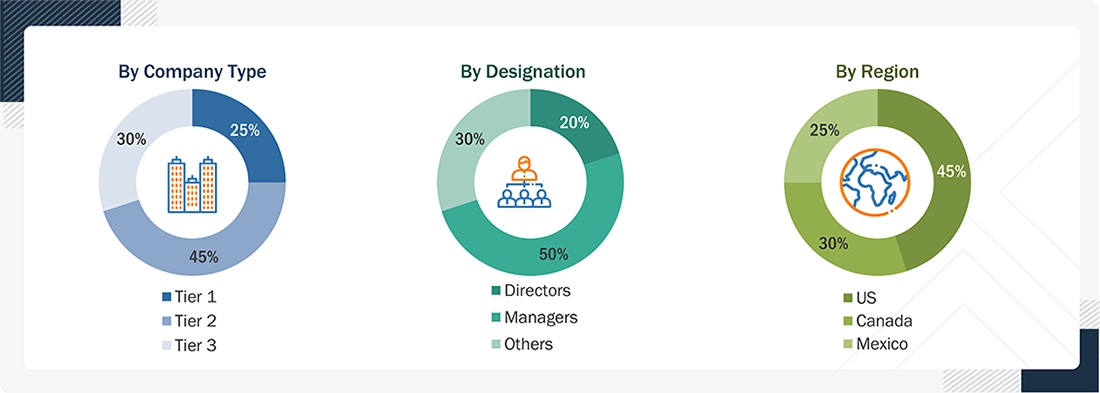
Note: The three tiers of the companies are defined based on their total revenues in 2024 or 2025, based on the availability of financial data: Tier 1: Revenue >USD 1 billion; Tier 2: USD 100 million ≤ revenue ≤ USD 1 billion; Tier 3: Revenue <USD 100 million.
|
COMPANY |
DESIGNATION |
|
ADM (US) |
Regional Sales Manager |
|
International Flavors & Fragrances Inc. (US) |
Marketing Manager |
|
dsm-firmenich (Switzerland) |
General Manager |
|
Associated British Foods plc (England) |
Sales Manager |
|
Novonesis Group (Denmark) |
Sales Manager |
|
Kerry Group plc (Ireland) |
Sales Executive |
To know about the assumptions considered for the study, download the pdf brochure
Market Size Estimation
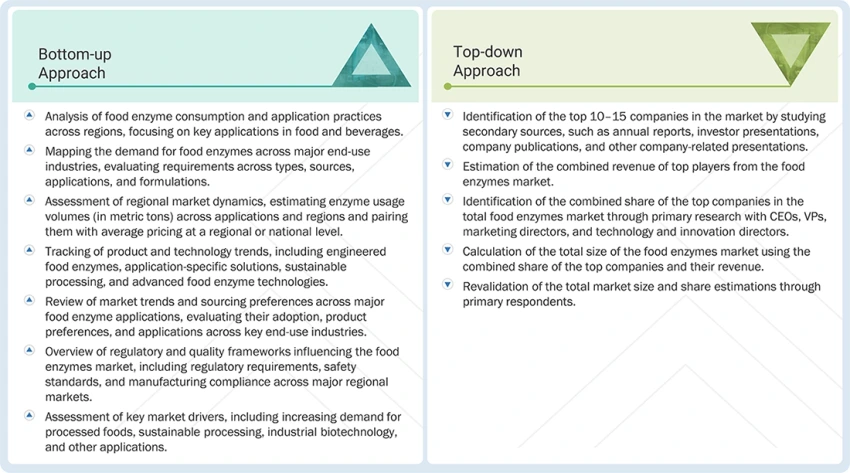
The top-down and bottom-up approaches were used to estimate and validate the total size of the food enzymes market. These approaches were also used extensively to determine the size of various subsegments in the market. The research methodology used to estimate the market size includes the following details:
- The key players in the industry and the overall market were identified through extensive secondary research.
- All shares, splits, and breakdowns were determined using secondary sources and verified through primary sources.
- All possible parameters that affect the market covered in this research study were accounted for, viewed in extensive detail, verified through primary research, and analyzed to obtain final quantitative and qualitative data.
- The research included the study of reports, reviews, and newsletters of top market players, along with extensive interviews for opinions from leaders, such as CEOs, directors, and marketing executives.
Food Enzymes Market : Top-Down and Bottom-Up Approach
Data Triangulation
After determining the overall market size from the estimation process explained above, the total market was split into several segments and subsegments. The data triangulation procedure was employed, wherever applicable, to estimate the overall food enzymes market and obtain precise statistics for all segments and subsegments. The data were triangulated by studying various factors and trends from the demand and supply sides. The market size was also validated using the top-down and bottom-up approaches.
Market Definition
According to the European Food Safety Authority (EFSA), “Enzymes are protein molecules that are present in all living things. They speed up and target chemical reactions, in many cases increasing the rate of reaction millions of times. For example, they aid digestion, metabolize and eliminate waste in humans and animals, and play a crucial role in muscle contraction.”
Key Stakeholders
-
Enzyme raw material suppliers
-
Food enzyme manufacturers
-
Specialty enzyme manufacturers
-
Intermediate suppliers, such as traders and distributors of enzymes
-
Government and research organizations
-
Associations and industry bodies:
- European communities
- World Health Organization (WHO)
- Association of Manufacturers & Formulators of Enzyme Products (AMFEP)
- Enzyme Technical Association (ETA)
- OECD-FAO Agricultural Outlook
- United States Department of Agriculture (USDA)
Report Objectives
- To determine, define, and project the size of the food enzymes market, with respect to type, source, formulation, application, functional role, and regional markets, over a five-year period, ranging from 2026 to 2031
- To identify the attractive opportunities in the market by determining the largest and fastest-growing segments across regions
- To provide detailed information about the key factors influencing the growth of the market (drivers, restraints, opportunities, and challenges)
- To analyze the micro markets with respect to individual growth trends, prospects, and their contribution to the total market
- To strategically profile key market players and comprehensively analyze their core competencies in each segment
- To track and analyze competitive developments, such as alliances, joint ventures, new product developments, mergers, and acquisitions, in the food enzymes market
Available customizations:
With the given market data, MarketsandMarkets offers customizations according to company-specific scientific needs. The following customization options are available for the report:
Product Analysis
-
Product matrix, which gives a detailed comparison of the product portfolio of each company.
Segmental Analysis
With the given market data, MarketsandMarkets offers customizations according to company-specific scientific needs.
- Further breakdown of other types of food enzymes market by type
- Further breakdown of other functional roles of food enzymes
Company Information
-
Detailed analyses and profiling of additional market players (up to five)
Get the Full Food Enzymes Market Report
Full forecast, segment splits, and company analysis for all Food Enzymes Market.
- Rest Of Europe Food Enzymes Market
- US Food Enzymes Market
- Canada Food Enzymes Market
- Mexico Food Enzymes Market
- Germany Food Enzymes Market
- France Food Enzymes Market
- Italy Food Enzymes Market
- Spain Food Enzymes Market
- UK Food Enzymes Market
- China Food Enzymes Market
- India Food Enzymes Market
- Japan Food Enzymes Market
- South Korea Food Enzymes Market
- Malaysia Food Enzymes Market
- Singapore Food Enzymes Market
- Indonesia Food Enzymes Market
- Vietnam Food Enzymes Market
- Philippines Food Enzymes Market
- Brazil Food Enzymes Market
- Argentina Food Enzymes Market
Need a Tailored Report?
Customize this report to your needs
Get 10% FREE Customization
Customize This Report
