
Asia Pacific Food Packaging Market (2025-2030)

The Asia Pacific Food Packaging Market was valued at $174094.4 Million in 2025 and projected to reach to $232641.2 Million by 2030, representing a compound annual growth rate of 6.0%. The Asia Pacific food packaging market is positioned for sustained growth, driven by demographic shifts, economic development, and changing consumer behaviors.


| Market Size in | USD 26.32 MN |
| Market Forecast in | |
| CAGR | |
| Forecast Period | |
| Units Considered | Value (USD MN) |
Asia Pacific Food Packaging Market Trends and Insights
- Asia Pacific's rapid urbanization, rising disposable incomes, and growing e-commerce food delivery sectors are driving demand for innovative and sustainable packaging solutions across the region.
- The market in Asia Pacific is increasingly shaped by regulatory pressures for eco-friendly materials and consumer preference for convenience-oriented packaging formats. Asia Pacific's food packaging landscape reflects diverse consumer behaviors and regulatory environments across major economies including China, India, Japan, and Southeast Asia.
- Between 2025 and 2030, Asia Pacific is expected to capture significant market share through investments in advanced packaging technologies, including active and intelligent packaging systems.
- The region's competitive intensity and manufacturing capabilities position Asia Pacific as a critical growth engine for the global food packaging industry..
Key Market Statistics
- CAGR (2025-2030) 6.0% CAGR
- Market Size, 2025 ~USD 174094.4 Million
- Forecast, 2030 ~USD 232641.2 Million
- Geography Asia Pacific
Asia Pacific Food Packaging Market Overview
Rapid Urbanization Driving Demand :
Asia Pacific's accelerating urbanization is fueling demand for convenient, ready-to-eat food products that require advanced packaging solutions. Growing middle-class populations in China, India, and Southeast Asia are increasing consumption of packaged foods and beverages.
E-Commerce Food Delivery Boom :
The explosive growth of online food delivery platforms across Asia Pacific is creating unprecedented demand for protective, hygienic, and sustainable packaging. Quick commerce and food delivery services require innovative packaging that maintains product integrity during transit.
Sustainability & Regulatory Pressure :
Stringent environmental regulations in developed Asia Pacific markets like Japan and Australia are pushing manufacturers toward eco-friendly packaging materials. Consumer preference for sustainable solutions is reshaping packaging strategies across the region.
Rising Disposable Incomes :
Increasing purchasing power in emerging economies like India and Vietnam is driving premiumization of packaged food products. Consumers are willing to pay for value-added packaging features including convenience, safety, and environmental responsibility.
Asia Pacific Food Packaging Market Dynamics
- China and India represent the largest markets, collectively accounting for a significant share of regional demand.
- The region's 6.0% CAGR outpaces the global average of 5.4%, reflecting structural advantages including rapid urbanization, expanding retail infrastructure, and growing food safety awareness. Innovation in flexible packaging, sustainable materials, and smart packaging technologies will define competitive dynamics through 2030.
- Regulatory frameworks promoting plastic reduction and circular economy principles are accelerating adoption of alternative materials.
- Strategic investments in manufacturing capacity and supply chain optimization will be critical for market participants seeking to capture growth opportunities across diverse Asia Pacific markets..
Market Ecosystem
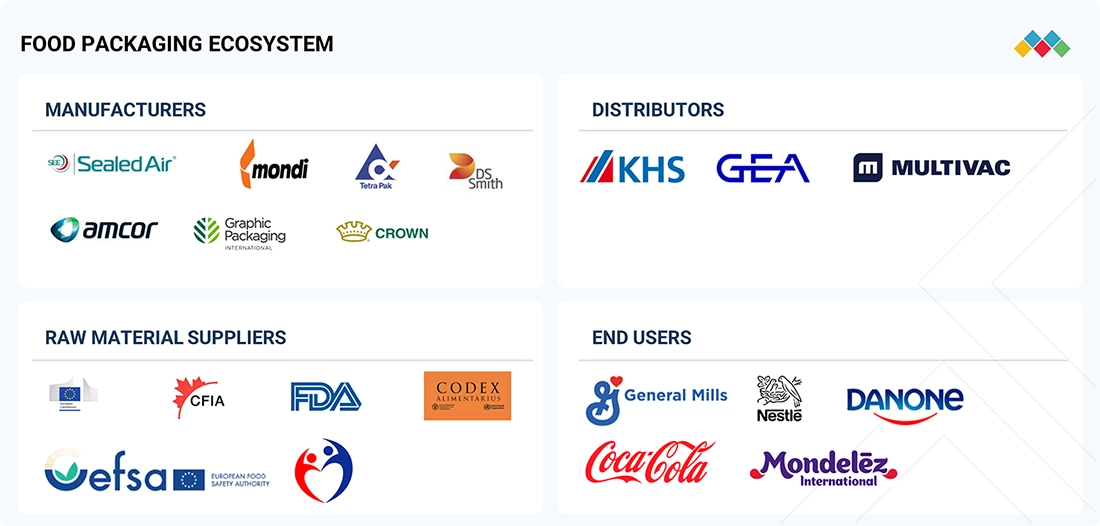
Food Packaging Market: COMMERCIAL USE CASES ACROSS INDUSTRIES
| COMPANY | USE CASE DESCRIPTION | BENEFITS |
|---|---|---|
 |
Flexible packaging for snacks and ready-to-eat meals | Extends shelf life, reduces food waste, and offers space-saving advantages |
 |
Vacuum-sealed pouches for cereals and snacks | Enhances product freshness and reduces packaging material usage |
 |
Modified atmosphere packaging (MAP) for meats | Extends shelf life, maintains product quality, and reduces spoilage |
 |
Stand-up pouches for biscuits and chocolates | Enhances product visibility, extends shelf life, and offers convenience |
Logos and trademarks shown above are the property of their respective owners. Their use here is for informational and illustrative purposes only.
Related Ecosystem
Fandb Logistics Cold Chain And Packaging
- Rigid Packaging
- Acrylics
- Active Packaging
- Dairy Products
- Gravure Process
- Amcor plc
- Essentra plc
- Basf se
- AZELIS HOLDINGS SA
- Sonoco Products Company
Key Takeaways
- Asia Pacific food packaging market will grow from USD 174.1B (2025) to USD 232.6B (2030) at a 6.0% CAGR, outpacing global growth.
- Sustainability and regulatory compliance are reshaping Asia Pacific packaging preferences toward eco-friendly and recyclable materials.
- E-commerce food delivery and modern retail expansion in Asia Pacific are accelerating demand for protective and convenient packaging formats.
- Asia Pacific's manufacturing scale and cost competitiveness make the region a strategic hub for global food packaging innovation and production.
Food Packaging Market Report Scope
| Report Metric | Details |
|---|---|
| Base Year | 2025 |
| Fastest Growing Segment | OTHER MATERIALS (Material) |
| Forecast Period | 2025–2030 |
| Growth Rate | CAGR of 5.4% from 2025 to 2030 |
| Largest Segment | CONVENTIONAL PACKAGING (Technology) |
| Market Size Base Year (Billions) | ~USD 421.68 (2025) |
| Revenue Forecast (Billions) | ~USD 548.51 (2030) |
| Segments Covered | Material, Type, Packaging Type, Format, Technology, Application |
Asia Pacific Food Packaging Market Report Segmentation
6 segment dimensions are covered across the global market.
By Material
- Glass
- Metal
- Other Materials
- Paper & Paperboard
- Plastic
By Type
- Aluminum
- Boxboard
- Corrugated Board
- Flexible Paper
- Hdpe (High-Density Polyethylene)
- Ldpe (Low-Density Polyethylene)
- Polyethylene Terephthalate (Pet)
- Polypropylene (Pp)
- Polystyrene (Ps)
- Polyvinyl Chloride (Pvc)
- Steel/Tinplate
By Packaging Type
- Bags
- Bottles
- Boxes
- Jars
- Pouches
By Format
- Flexible
- Rigid
- Semi-Rigid
By Technology
- Active Packaging
- Aseptic Packaging
- Conventional Packaging
- Modified Atmosphere Packaging
- Retort Packaging
- Smart Packaging
- Vacuum Packaging
By Application
- Bakery & Confectionery
- Convenience Food & Ready Meals
- Convenience Foods & Ready Meals
- Dairy Products
- Fruits & Vegetables
- Meat, Poultry, And Seafood
- Other Applications
- Snacks & Breakfast Cereals
Target Audience
- Packaging Manufacturers & Converters : Need region-specific demand forecasts and material trends to optimize production capacity, invest in sustainable technologies, and develop products aligned with Asia Pacific regulatory standards and consumer preferences.
- Food & Beverage Companies : Require market insights to guide packaging sourcing strategies, supplier selection, and product innovation initiatives across diverse Asia Pacific markets with varying regulatory environments and consumer expectations.
- Private Equity & Investment Firms : Seek validated market sizing and growth projections to evaluate acquisition targets, assess portfolio company growth potential, and identify consolidation opportunities in high-growth Asia Pacific packaging segments.
- Logistics & E-Commerce Operators : Need understanding of packaging demand drivers linked to food delivery and quick commerce growth to optimize supply chain partnerships, negotiate supplier contracts, and plan infrastructure investments.
- Sustainability & Materials Innovators : Require insights into regulatory trends and consumer demand for eco-friendly packaging across Asia Pacific to validate business models, prioritize R&D investments, and identify market entry opportunities.
Key Companies in the Asia Pacific Food Packaging Market
| Company | HQ | Ownership | Strongest segments |
|---|---|---|---|
| SOJITZ CORPORATION | Japan | Public Company | Energy, Resources, and Metals Trading,Automotive, Industrial Machinery, and Bearings,Infrastructure, Power, and ICT, |
| UNILEVER PLC | United Kingdom | Public Company | Beauty & Wellbeing,Personal Care,Home Care, |
| ESSENTRA PLC | United Kingdom | Public Company | Cable management, PCB hardware, and electronic components,Fasteners and point-of-sale hardware,Machine and hardware products (handles, feet, castors, workholding), |
| KUREHA CORPORATION | Japan | Public Company | Advanced Materials (PPS, PVDF, PGA, carbon products),Specialty Chemicals (pharma, agrochemicals, basic chlor-alkali),Specialty Plastics (consumer wraps, films, packaging machinery), |
| NORSK HYDRO ASA | Norway | Public Company | Hydro Bauxite & Alumina,Hydro Aluminium Metal,Hydro Metal Markets, |
| GRAPHIC PACKAGING HOLDING COMPANY | United States | Public Company | Paperboard Cartons for Food & Beverage CPG,Foodservice Packaging (cups, lids, containers),Household, Healthcare, Beauty & Other Consumer, |
| CONSTANTIA FLEXIBLES | Austria | Private Company | Consumer goods & food (incl. coffee, tea, confectionery, dairy, pet food),Pharmaceutical packaging,Personal care & home care packaging, |
SOJITZ CORPORATION
Sojitz Corporation is a Japanese public company founded in 1862 that operates as a major trading and investment enterprise. With 26,789 employees, the company engages in diverse business segments including machinery, chemicals, metals, and energy.
UNILEVER PLC
Unilever PLC is a British multinational public company founded in 1860 that manufactures and distributes consumer goods across food, beverages, personal care, and home care categories. With 93,732 employees worldwide, it is one of the world's largest consumer goods companies.
ESSENTRA PLC
Essentra PLC is a British public company established in 2005 that manufactures and distributes essential components and solutions for packaging and healthcare. With 2,998 employees, the company serves diverse end markets globally.
KUREHA CORPORATION
Kureha Corporation is a Japanese public company founded in 1944 that produces specialty chemicals, plastics, and materials. With 3,941 employees, the company serves industries including packaging, pharmaceuticals, and industrial applications.
NORSK HYDRO ASA
Norsk Hydro ASA is a Norwegian public company established in 1905 operating as an integrated aluminum and energy company. With 32,786 employees, the company engages in bauxite mining, alumina refining, aluminum smelting, and power generation.
GRAPHIC PACKAGING HOLDING COMPANY
Graphic Packaging Holding Company is a United States public company founded in 2007 that manufactures paperboard packaging solutions. With 23,000 employees, the company serves food, beverage, and consumer goods industries.
CONSTANTIA FLEXIBLES
Constantia Flexibles is an Austrian private company established in 2009 specializing in flexible packaging solutions. With 9,835 employees, the company serves food, beverage, pharmaceutical, and industrial sectors globally.
Countries within Asia Pacific - compare and drill down
| Country | 2025 size (native) |
|---|---|
| China | USD 109058.2 Million |
| India | USD 53791.8 Million |
| Japan | USD 13577.2 Million |
| Malaysia | USD 2402 Million |
Country market size visualization
Reasons to Buy this Report
- Market Size & Growth Validation : Obtain precise market valuation for Asia Pacific at USD 174.1B (2025) with 6% CAGR through 2030. Validate investment decisions and competitive positioning with region-specific data outperforming global growth rates.
- Country-Level Intelligence : Access granular market data for China, India, Japan, and Malaysia to identify high-growth segments and prioritize market entry strategies. Understand relative market sizes and growth trajectories across key Asia Pacific economies.
- Emerging Trend Analysis : Understand the intersection of e-commerce growth, urbanization, and sustainability demands shaping Asia Pacific packaging innovation. Identify white-space opportunities in sustainable and smart packaging segments.
- Competitive Benchmarking : Compare Asia Pacific market dynamics against global trends (5.4% CAGR) to assess regional competitive intensity. Benchmark your portfolio against region-specific growth drivers and regulatory requirements.
- Strategic Planning & Forecasting : Leverage 2030 forecast data (USD 232.6B) to develop long-term capacity planning, R&D investment strategies, and market expansion roadmaps tailored to Asia Pacific's unique growth trajectory.
Frequently asked questions
What is the current size of the Asia Pacific food packaging market?
The Asia Pacific food packaging market is valued at USD 174,094.4 million in 2025 and is projected to grow to USD 232,641.2 million by 2030.
What is the expected growth rate for Asia Pacific food packaging?
Asia Pacific food packaging is expected to grow at a compound annual growth rate (CAGR) of 6.0% from 2025 to 2030.
What are the main drivers of growth in Asia Pacific food packaging?
Key drivers include rapid urbanization, rising disposable incomes, growth in e-commerce food delivery, regulatory pressure for sustainable materials, and expansion of modern retail channels across Asia Pacific.
Which countries are leading the Asia Pacific food packaging market?
Major markets in Asia Pacific include China, India, Japan, and Southeast Asian nations, each contributing significantly to regional growth through distinct consumer preferences and regulatory frameworks.
How is sustainability impacting Asia Pacific food packaging demand?
Sustainability is a critical market driver in Asia Pacific, with increasing regulatory requirements and consumer demand pushing manufacturers toward eco-friendly, recyclable, and biodegradable packaging solutions.
RESEARCH METHODOLOGY
The study employed two primary approaches to estimate the current size of the food packaging market. Exhaustive secondary research was conducted to gather information on the market, peer markets, and parent markets. The next step was to validate these findings, assumptions, and sizing with industry experts across the value chain through primary research. Both top-down and bottom-up approaches were employed to estimate the complete market size. After this, the data triangulation method was used to estimate the market size of segments and subsegments.
Secondary Research
This research study involved the extensive use of secondary sources—directories and databases such as Bloomberg Businessweek and Factiva—to identify and collect information useful for a technical, market-oriented, and commercial study of the market.
In the secondary research process, sources such as annual reports, press releases & investor presentations of companies, white papers, food journals, certified publications, articles from recognized authors, directories, and databases were referred to for identifying and collecting information.
Secondary research was mainly used to obtain key information about the industry’s supply chain, the total pool of key players, and market classification and segmentation as per the industry trends to the bottom-most level, regional markets, and key developments from both market- and technology-oriented perspectives.
Primary Research
Extensive primary research was conducted after obtaining information regarding the food packaging market scenario through secondary research. Several primary interviews were conducted with market experts from both the demand and supply sides across major countries of North America, Europe, Asia Pacific, South America, and RoW. Primary data was collected through questionnaires, emails, and telephonic interviews. The primary sources from the supply side included various industry experts, such as Chief X Officers (CXOs), Vice Presidents (VPs), Directors from business development, marketing, research, and development teams, and key opinion leaders. Primary interviews were conducted to gather insights such as market statistics, data on revenue collected from the products and services, market breakdowns, market size estimations, market forecasting, and data triangulation. Primary research also helped in understanding the various trends related to packaging material, type, format, technology, and application. Stakeholders from the demand side, such as research institutions and universities, and third-party vendors, were interviewed to understand the buyer’s perspective on the service, their current usage of packaging, and the outlook of their business, which will affect the overall market.
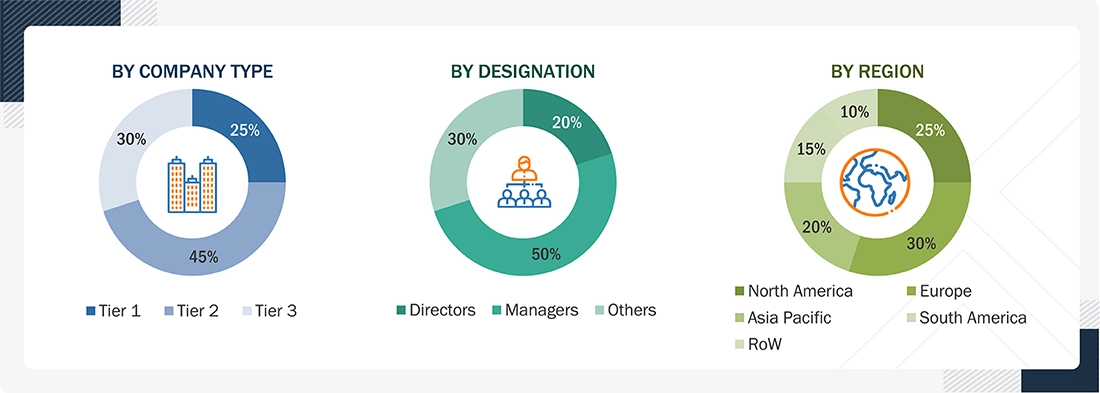
Note: The three tiers of the companies are defined based on their total revenues in 2023 or 2024, as per the
availability of financial data: Tier 1: Revenue greater than USD 1 billion; Tier 2: Revenue between USD 100 million and USD 1 billion;
Tier 3: Revenue less than USD 100 million.
To know about the assumptions considered for the study, download the pdf brochure
Market Size Estimation
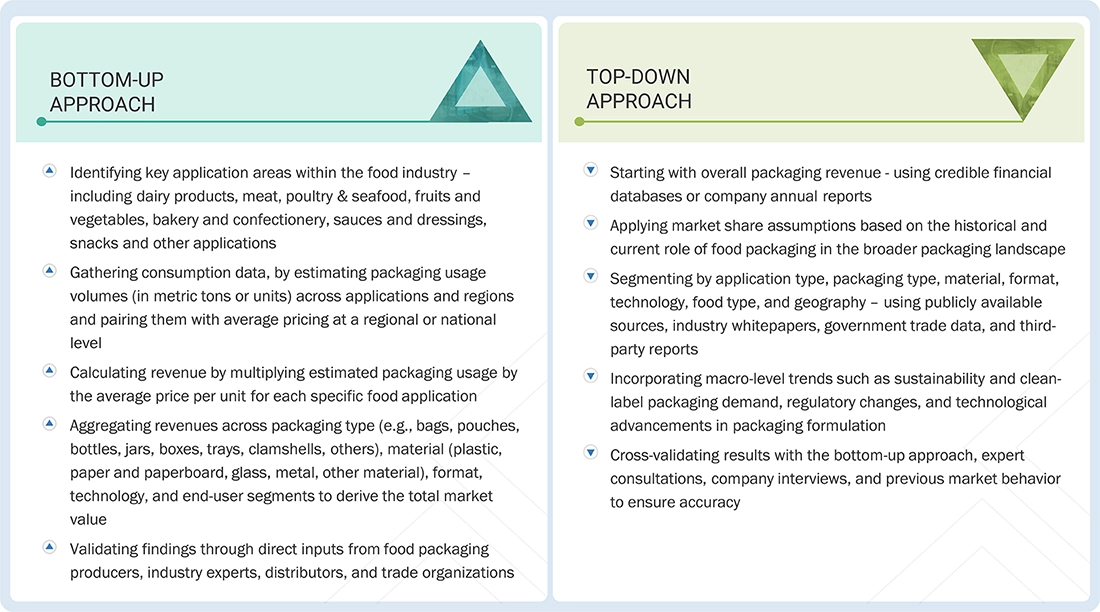
Both the top-down and bottom-up approaches were used to estimate and validate the total size of the food packaging market. These approaches were also used extensively to determine the size of various subsegments in the market. The research methodology used to estimate the market size includes the following details:
- The key players in the industry and the overall markets were identified through extensive secondary research.
- All shares, splits, and breakdowns were determined using secondary sources and verified through primary sources.
- All possible parameters that affect the market covered in this research study were accounted for, viewed in extensive detail, verified through primary research, and analyzed to obtain final quantitative and qualitative data.
- The research included the study of reports, reviews, and newsletters of top market players, along with extensive interviews for opinions from leaders, such as CEOs, directors, and marketing executives.
Food Packaging Market : Top-Down and Bottom-Up Approach
Data Triangulation
PAfter arriving at the overall market size from the estimation process explained above, the total market was split into several segments and subsegments. The data triangulation procedure was employed, wherever applicable, to estimate the overall food packaging market and arrive at the exact statistics for all segments and subsegments. The data was triangulated by studying various factors and trends from the demand and supply sides. The market size was also validated using both the top-down and bottom-up approaches.
Market Definition
According to the World Packaging Organisation (WPO), packaging is essential for “preserving food quality, minimizing food wastage and reducing preservatives used in food, while protecting against chemical and physical damage and providing information to consumers and marketers.”
Stakeholders
- Packaging raw material suppliers
- Food packaging manufacturers
- Food & beverage companies
- Packaging technology providers
- Intermediate suppliers, such as traders and distributors of packaging
- Government and research organizations
-
Associations, regulatory bodies, and other industry-related bodies:
- Food and Agriculture Organization (FAO)
- Environmental Protection Agency (EPA)
- Food Safety Council (FSC)
- Research Institutes and Universities
-
Organizations/Associations
- World Packaging Organisation (WPO)
- Institute of Packaging Professionals (IoPP)
- European Food Safety Authority (EFSA)
- United States Department of Agriculture (USDA)
- Food Standards Australia New Zealand (FSANZ)
- Food Safety and Standards Authority of India (FSSAI)
- Trade associations and industry bodies
Report Objectives
- To determine, define, and project the size of the food packaging market, with respect to material, packaging type, format, technology, food type, application, and regional markets, over a five-year period, ranging from 2025 to 2030
- To identify the attractive opportunities in the market by determining the largest and fastest-growing segments across regions
- To provide detailed information about the key factors influencing the growth of the market (drivers, restraints, opportunities, and challenges)
- To analyze the micro markets with respect to individual growth trends, prospects, and their contribution to the total market
- To strategically profile key market players and comprehensively analyze their core competencies in each segment
- To track and analyze competitive developments, such as alliances, joint ventures, new product developments, mergers, and acquisitions, in the food packaging market
Available Customizations
With the given market data, MarketsandMarkets offers customizations according to company-specific scientific needs.
The following customization options are available for the report:
Product Analysis
- Product Matrix, which gives a detailed comparison of the service portfolio of each company
Geographic Analysis as per Feasibility
With the given market data, MarketsandMarkets offers customizations according to company-specific scientific needs
- Further breakdown of the Rest of Europe food packaging market into key countries
- Further breakdown of the Rest of Asia Pacific food packaging market into key countries
- Further breakdown of the Rest of South America food packaging market into key countries
Company Information
- Detailed analyses and profiling of additional market players (up to five)
Get the Full Food Packaging Market Report
Full forecast, segment splits, and company analysis for all Food Packaging Market.
- US Food Packaging Market
- Canada Food Packaging Market
- Mexico Food Packaging Market
- Germany Food Packaging Market
- UK Food Packaging Market
- France Food Packaging Market
- Spain Food Packaging Market
- Italy Food Packaging Market
- Poland Food Packaging Market
- Norway Food Packaging Market
- Sweden Food Packaging Market
- Austria Food Packaging Market
- Greece Food Packaging Market
- China Food Packaging Market
- India Food Packaging Market
- Japan Food Packaging Market
- Malaysia Food Packaging Market
- Brazil Food Packaging Market
- Argentina Food Packaging Market
- Chile Food Packaging Market
- Colombia Food Packaging Market
- Rest Of Europe Food Packaging Market
Need a Tailored Report?
Customize this report to your needs
Get 10% FREE Customization
Customize This Report
