
North America Fuel Cell Generator Market (2025-2030)

The North America Fuel Cell Generator Market was valued at $320.9 Million in 2025 and projected to reach to $1137.9 Million by 2030, representing a compound annual growth rate of 28.8%. North America's fuel cell generator market is positioned for exceptional growth through 2030, driven by aggressive decarbonization targets, hydrogen economy investments, and supportive regulatory frameworks across the United States and Canada.


| Market Size in | USD 26.32 MN |
| Market Forecast in | |
| CAGR | |
| Forecast Period | |
| Units Considered | Value (USD MN) |
North America Fuel Cell Generator Market Trends and Insights
- This represents a compound annual growth rate of 28.8%, significantly outpacing global trends.
- North America's leadership in clean energy adoption, regulatory support for hydrogen infrastructure, and increasing demand for reliable backup power solutions are driving this accelerated growth trajectory. The region's fuel cell generator market is benefiting from substantial government incentives, corporate sustainability commitments, and technological advancements in fuel cell efficiency.
- North America's industrial, commercial, and residential sectors are increasingly investing in fuel cell generators as alternatives to traditional diesel and natural gas systems.
- By 2030, North America is expected to capture a substantial share of global fuel cell generator demand, supported by ongoing infrastructure development and declining technology costs..
Key Market Statistics
- CAGR (2025-2030) 28.8% CAGR
- Market Size, 2025 ~USD 320.9 Million
- Forecast, 2030 ~USD 1137.9 Million
- Geography North America
North America Fuel Cell Generator Market Overview
Exceptional Growth Trajectory :
North America's fuel cell generator market is expanding at 28.8% CAGR, nearly 5.5 percentage points faster than the global average of 23.3%, demonstrating the region's accelerated adoption of hydrogen-based power solutions.
Market Valuation Surge :
The market is projected to grow from $320.9 million in 2025 to $1,137.9 million by 2030, representing a 255% increase over five years and reflecting strong investment in clean energy infrastructure across the region.
Regulatory & Policy Support :
North America benefits from robust government incentives, hydrogen infrastructure development initiatives, and clean energy mandates that are driving commercial adoption of fuel cell generators across industrial and backup power applications.
Backup Power Demand Surge :
Increasing grid reliability concerns, extreme weather events, and the need for uninterrupted power supply in critical facilities are accelerating demand for fuel cell generators as a clean, efficient alternative to traditional diesel generators.
North America Fuel Cell Generator Market Dynamics
- The region's technological leadership, coupled with declining fuel cell costs and expanding hydrogen refueling infrastructure, creates a compelling investment landscape.
- Industrial facilities, data centers, and telecommunications providers are increasingly adopting fuel cell generators for reliable, emissions-free backup power.
- Government incentives and corporate sustainability commitments further accelerate market penetration, establishing North America as a global leader in fuel cell technology deployment and commercialization..
Market Ecosystem
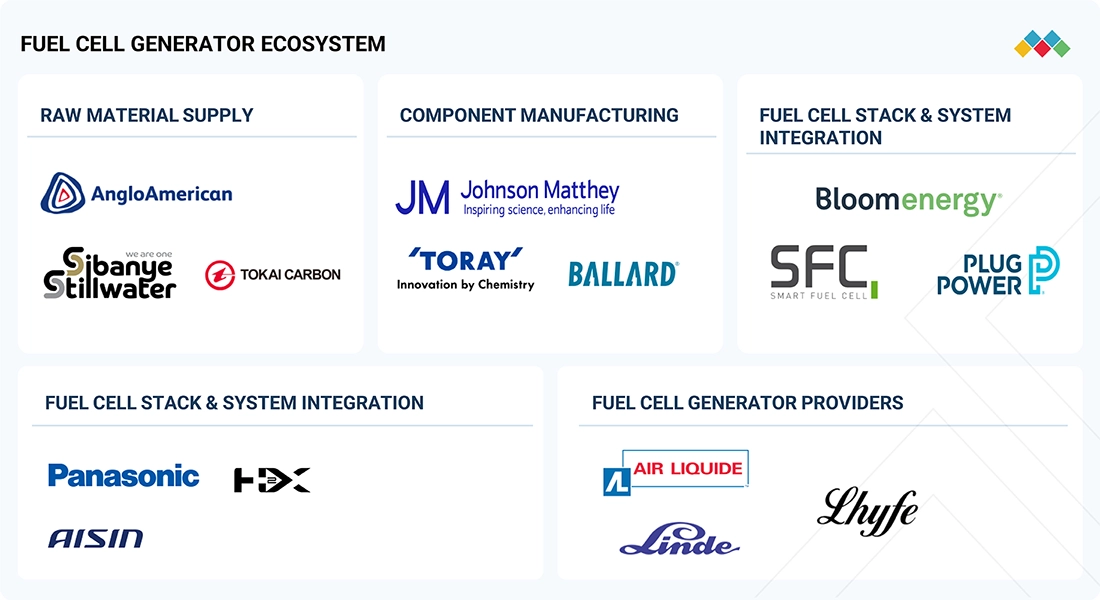
Fuel Cell Generator Market: COMMERCIAL USE CASES ACROSS INDUSTRIES
| COMPANY | USE CASE DESCRIPTION | BENEFITS |
|---|---|---|
 |
Walmart was pursuing a goal to be supplied by 100% renewable energy while maintaining ultra-low operating costs. However, it needed a clean energy solution that could deliver reliable, continuous power (even during grid outages) and help reduce energy expenses, all while meeting strict sustainability and supplier evaluation standards. Traditional grid power was not only carbon-intensive but also vulnerable to interruptions, which posed risks to operational efficiency and product safety. Additionally, Walmart sought a scalable solution that could be replicated across its widespread facilities without requiring major infrastructure overhauls. | The implementation of Bloom Energy Servers provided Walmart with multiple benefits. It enabled reliable, continuous on-site power generation, reducing dependence on the carbon-intensive and outage-prone grid. The biogas-fueled fuel cells significantly lowered Walmart’s carbon footprint while supporting its 100% renewable energy goal. Operational efficiency improved through stable, predictable electricity costs, helping optimize energy budgeting. The modular and scalable design allowed easy replication across multiple sites without major infrastructure upgrades. Additionally, by ensuring uninterrupted power during outages, Walmart enhanced product safety and supply chain resilience, aligning sustainability with cost-effectiveness and business continuity. |
 |
Verizon’s Garden City central office in New York, a major telecommunications hub, was experiencing increasingly unreliable grid electricity due to frequent outages and aging infrastructure. These power interruptions posed serious risks to the operation of critical services, including 9-1-1 emergency systems, with potential service disruptions costing millions of dollars per incident. Additionally, the facility faced high local electricity rates, ranging from USD 0.12 to USD 0.14 per kilowatt-hour, which significantly increased operational costs. Traditional backup generators also had limitations in terms of efficiency and environmental impact, prompting the need for a more reliable and sustainable energy solution | The fuel cell-based CHP system provided Verizon with major operational, economic, and environmental benefits. By generating on-site power with over 96% availability, it ensured uninterrupted electricity for critical telecom operations, including 9-1-1 services, significantly reducing outage risks. The system’s combined electrical and thermal efficiency of up to 61% enhanced overall energy utilization, cutting CO2 emissions by around 11 million pounds annually. Utilizing captured waste heat for heating and cooling met 75% of the facility’s thermal demand, further improving sustainability. Additionally, the solution lowered annual energy costs by about USD 500,000, strengthening both reliability and cost efficiency. |
Logos and trademarks shown above are the property of their respective owners. Their use here is for informational and illustrative purposes only.
Related Ecosystem
Decarbonization
- Battery Electric Vehicle (BEV)
- Energy Management Systems
- Fuel Cell
- Fuel Cell Electric Vehicle (FCEV)
- Geographical Information System (GIS)
- TotalEnergies SE
- Siemens ag
- Mitsui & Co., Ltd.
- General Electric Company
- Thyssenkrupp ag
Key Takeaways
- North America's fuel cell generator market will grow from $320.9M (2025) to $1,137.9M (2030) at a 28.8% CAGR, outpacing global growth rates.
- North America's regulatory environment and hydrogen infrastructure investments are primary catalysts accelerating fuel cell generator adoption across sectors.
- North America's industrial and commercial segments are driving demand for fuel cell generators as reliable, emissions-free backup power alternatives.
- North America is positioned to become a global leader in fuel cell generator deployment by 2030, supported by declining costs and technological maturity.
Fuel Cell Generator Market Report Scope
| Report Metric | Details |
|---|---|
| Base Year | 2025 |
| Fastest Growing Segment | AMMONIA (Fuel Type) |
| Forecast Period | 2025–2030 |
| Growth Rate | CAGR of 23.3% from 2025 to 2030 |
| Largest Segment | HYDROGEN (Fuel Type) |
| Market Size Base Year (Billions) | ~USD 0.63 (2025) |
| Revenue Forecast (Billions) | ~USD 1.8 (2030) |
| Segments Covered | Size, Fuel Type, End User |
North America Fuel Cell Generator Market Report Segmentation
3 segment dimensions are covered across the global market.
By Size
- Large Scale (Above 200 Kw)
- Small Scale (Up To 200 Kw)
By Fuel Type
- Ammonia
- Hydrogen
- Methanol
By End User
- Agricultural Facilities
- Aquaculture Facilities
- Construction Sites
- Data Centers
- Data Centres
- Emergency Response Generators
- Marine
- Marine Engineering Platforms
Target Audience
- Energy & Utility Companies : Utilities and energy providers need North America-specific market intelligence to develop hydrogen strategies, evaluate fuel cell generator investments, and plan grid modernization initiatives aligned with regional decarbonization goals.
- Industrial & Manufacturing Facilities : Plant operators and facility managers require detailed market data to assess fuel cell generator viability for backup power, understand total cost of ownership, and identify hydrogen supply chain options in their regions.
- Technology & Equipment Manufacturers : Fuel cell and generator manufacturers need competitive intelligence, market sizing, and customer demand analysis specific to North America to guide product development, pricing strategies, and market entry decisions.
- Investment & Private Equity Firms : Investors evaluating hydrogen and clean energy opportunities require comprehensive North America market forecasts, growth drivers, and risk assessments to make informed capital allocation and M&A decisions.
- Government & Policy Organizations : Federal and state agencies need market research to evaluate hydrogen infrastructure investments, assess policy effectiveness, and align incentive programs with actual market growth trajectories and regional needs.
Key Companies in the North America Fuel Cell Generator Market
| Company | HQ | Ownership | Strongest segments |
|---|---|---|---|
| TOSHIBA CORPORATION | Japan | Private Company | Small (=200 kW) – Hydrogen,Large (>200 kW) – Hydrogen,Small (=200 kW) – Ammonia/Methanol, |
| BLOOM ENERGY | United States | Public Company | Large (>200 kW) data center and mission-critical generators,Large (>200 kW) industrial, commercial, and utility on-site generation,Hydrogen-focused systems (electrolyzers and hydrogen-fueled SOFC generators), |
| DOOSAN FUEL CELL CO., LTD. | United States | Public Company | Large fuel cell generators (>200 kW) for commercial and industrial baseload,Large fuel cell generators (>200 kW) for utility-scale and grid-support applications,Fuel cell generators for data centers and mission-critical backup, |
| POWERCELL SWEDEN AB | Sweden | Public Company | Hydrogen fuel cell generators – Small (=200 kW),Hydrogen fuel cell generators – Large (>200 kW),Methanol-based fuel cell systems, |
| BALLARD POWER SYSTEMS | Canada | Public Company | Hydrogen small (=200 kW) generators,Hydrogen large (>200 kW) generators,Ammonia-fueled generators, |
| PLUG POWER INC. | United States | Public Company | Data center backup and continuous power (hydrogen PEM),Emergency response and critical infrastructure generators,Construction and temporary power sites, |
| ABB | India | Public Company | Large (>200 kW) hydrogen fuel cell generators – marine,Large (>200 kW) hydrogen fuel cell generators – data centers,Small (=200 kW) hydrogen fuel cell generators – emergency response and construction, |
| SIEMENS ENERGY | Germany | Public Company | Large (>200 kW) hydrogen fuel cell generators,Small (=200 kW) hydrogen fuel cell generators,Large (>200 kW) ammonia-capable fuel cell generators, |
| CUMMINS INC. | United States | Public Company | Large fuel cell generators (>200 kW),Small fuel cell generators (=200 kW),Hydrogen-fueled generators, |
| AFC ENERGY | United Kingdom | Public Company | Small (=200 kW) hydrogen fuel cell generators (H-Power Tower, S-series) – sales,Small (=200 kW) hydrogen fuel cell generators – rental,Large (>200 kW) hydrogen systems for data centers and maritime, |
| PANASONIC CORPORATION | Japan | Public Company | Small fuel cell generators (=200 kW),Large fuel cell generators (>200 kW),Hydrogen-fueled generators, |
TOSHIBA CORPORATION
Toshiba Corporation is a Japanese multinational conglomerate founded in 1875 with over 106,000 employees. Operating as a private company, it maintains a significant global presence across multiple industrial sectors.
BLOOM ENERGY
Bloom Energy is a United States public company founded in 2001 with 2,214 employees. The company focuses on energy generation and storage technologies.
DOOSAN FUEL CELL CO., LTD.
Doosan Fuel Cell Co., Ltd. is a United States-based public company founded in 2019 with 541 employees. The company operates in the fuel cell technology sector.
POWERCELL SWEDEN AB
PowerCell Sweden AB is a Swedish public company founded in 2008 with 154 employees. The company specializes in fuel cell power systems and related technologies.
BALLARD POWER SYSTEMS
Ballard Power Systems is a Canadian public company founded in 1979 with 492 employees. The company is a leading developer of fuel cell solutions for various applications.
PLUG POWER INC.
Plug Power Inc. is a United States public company founded in 1997 with 2,344 employees. The company provides hydrogen fuel cell solutions and related services.
ABB
ABB is a multinational public company founded in 1883 with over 111,000 employees operating in India. The company is a global leader in electrification and automation technologies.
SIEMENS ENERGY
Siemens Energy is a German public company founded in 1866 with approximately 99,000 employees. The company is a global leader in energy generation, transmission, and storage solutions.
CUMMINS INC.
Cummins Inc. is a United States public company founded in 1919 with 67,400 employees. The company is a major manufacturer of engines, power generation, and related technologies.
AFC ENERGY
AFC Energy is a United Kingdom-based public company founded in 2006 with 121 employees. The company develops alkaline fuel cell technology for power generation applications.
PANASONIC CORPORATION
Panasonic Corporation is a Japanese multinational public company founded in 1918 with over 183,000 employees. The company is a global leader in electronics, appliances, and energy solutions.
Countries within North America - compare and drill down
| Country | 2025 size (native) |
|---|
Country market size visualization
Reasons to Buy this Report
- Regional Market Sizing & Forecasts : Obtain precise valuation data specific to North America ($320.9M in 2025, $1,137.9M in 2030) with detailed breakdowns by country, application, and end-user segment to inform strategic planning and investment decisions.
- Competitive Landscape Analysis : Identify leading fuel cell generator manufacturers, technology providers, and hydrogen infrastructure developers operating in North America, including market share distribution and competitive positioning strategies.
- Regulatory & Policy Insights : Understand federal and state-level incentives, hydrogen development programs, emissions regulations, and clean energy mandates shaping market dynamics across the United States and Canada.
- End-User Demand Drivers : Analyze adoption patterns across industrial facilities, data centers, telecommunications, healthcare, and government sectors to identify high-growth verticals and emerging use cases in North America.
- Investment & Growth Opportunities : Discover untapped market segments, emerging technologies, partnership opportunities, and expansion strategies tailored to North America's unique regulatory environment and customer requirements.
Frequently asked questions
What is the projected market size for fuel cell generators in North America by 2030?
North America's fuel cell generator market is projected to reach $1,137.9 million by 2030, growing from $320.9 million in 2025.
What is the CAGR for North America's fuel cell generator market?
North America's fuel cell generator market is expected to grow at a compound annual growth rate of 28.8% between 2025 and 2030.
What factors are driving growth in North America's fuel cell generator market?
North America's growth is driven by government incentives, hydrogen infrastructure development, corporate sustainability goals, and demand for reliable backup power solutions.
Which sectors in North America are adopting fuel cell generators most rapidly?
North America's industrial, commercial, and residential sectors are leading adoption, seeking emissions-free alternatives to traditional diesel and natural gas generators.
How does North America's fuel cell generator market compare to global trends?
North America's 28.8% CAGR significantly exceeds the global average of 23.3%, reflecting the region's advanced regulatory framework and clean energy commitment.
RESEARCH METHODOLOGY
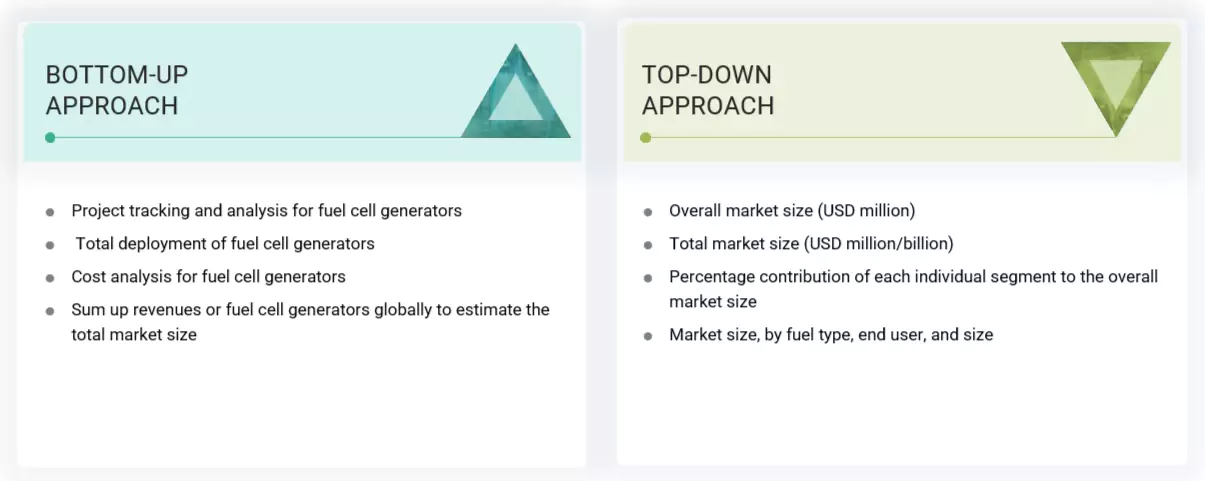
The study involved major activities in estimating the current size of the fuel cell generator market. Exhaustive secondary research was done to collect information on the peer and parent markets. The next step was to validate these findings, assumptions, and sizing with industry experts across the value chain through primary research. Both top-down and bottom-up approaches were employed to estimate the complete market size. Thereafter, market breakdown and data triangulation were used to estimate the market size of the segments and subsegments.
Secondary Research
Secondary sources referred to for this research study include annual reports, press releases, and investor presentations of companies; white papers; certified publications; articles from recognized authors; and databases of various companies and associations. Secondary research has been mainly used to obtain key information about the industry’s supply chain, monetary chain, the total pool of key players, market classification, and segmentation according to industry trends to the bottom-most level, regional markets, and key developments from both market- and technology-oriented perspectives.
Primary Research
In the primary research process, various primary sources from both the supply and demand sides have been interviewed to obtain qualitative and quantitative information for this report. Primary sources from the supply side include industry experts, such as CEOs, vice presidents, marketing directors, technology & innovation directors, and related key executives from various companies and organizations operating in the fuel cell generator market.
In the complete market engineering process, the top-down and bottom-up approaches and several data triangulation methods have been used to perform market estimation and market forecasts for the market segments and subsegments listed in this report. Extensive qualitative and quantitative analyses have been performed in the market engineering process to list key information/insights in the report.
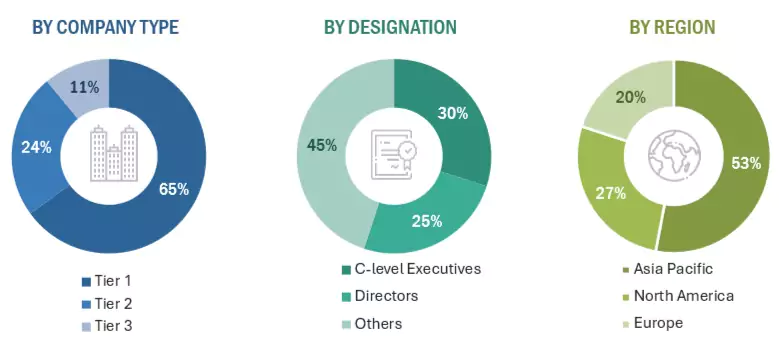
To know about the assumptions considered for the study, download the pdf brochure
Market Size Estimation
The top-down and bottom-up approaches were used to estimate and validate the size of the global fuel cell generator market and to evaluate the sizes of various other dependent submarkets. The key players in the market were identified through secondary research, and their shares in the respective regions were determined through primary and secondary research. This entire procedure included the study of annual and financial reports of top market players and extensive interviews for key insights with industry leaders such as CEOs, VPs, directors, and marketing executives. All percentage shares, splits, and breakdowns were determined using secondary sources and verified through primary sources. All possible parameters that affect the markets covered in this research study were accounted for, viewed in extensive detail, verified through primary research, and analyzed to get the final quantitative and qualitative data.
Fuel Cell Generator Market : Top-Down and Bottom-Up Approach
Data Triangulation
After arriving at the overall market size from the estimation process explained below, the total market has been split into several segments and subsegments. The data triangulation and market breakdown procedures have been employed, wherever applicable, to complete the overall market engineering process and arrive at the exact statistics for all the segments and subsegments. The data has been triangulated by studying various factors and trends from both the demand and supply sides.
Market Definition
Fuel cell generators (FCGs) are advanced devices that convert chemical energy from a fuel source, typically hydrogen, into electricity through electrochemical processes. These generators consist of various components, including an electrolyte, an anode, a cathode, and a catalyst. Additionally, an FCG comprises fuel cell stacks and other balance of plant (BoP) system components, such as a container, a power inverter, ultracapacitors, a cooling system, a fuel storage system, a system controller, and data acquisition equipment.
Estimating the fuel cell generator market size involves aggregating the revenues generated by global companies manufacturing fuel cell generators. While estimating the market size, we have considered the costs associated with the system and the balance of plant components.
Stakeholders
- Ceramic and electrolyte manufacturers
- Consulting companies in the energy & power sector
- Environmental research institutes
- Fuel cell and stack manufacturers
- Government and research organizations
- Institutional investors/shareholders
- Power and energy associations
- Repair and maintenance service providers
- Fuel cell technology manufacturing companies
- Organizations, forums, alliances, and associations
- Research and consulting companies in the clean energy generation sector
- State and national regulatory authorities
Report Objectives
- To define, describe, segment, and forecast the fuel cell generator market by size and fuel type, in terms of value
- To define, describe, segment, and forecast the fuel cell generator market by end user and region, in terms of value and volume
- To forecast the market size across North America, Europe, Asia Pacific, and Rest of the World (RoW), in terms of value
- To provide detailed information regarding key drivers, restraints, opportunities, and challenges influencing the growth of the fuel cell generator market
- To provide the supply chain analysis, trends/disruptions impacting customer business, ecosystem analysis, regulatory landscape, patent analysis, case study analysis, technology analysis, key conferences & events, the impact of AI/Gen AI, macroeconomic outlook, pricing analysis, porter’s five forces analysis, and regulatory analysis, the impact of 2025 US tariff on the market
- To analyze opportunities for stakeholders in the fuel cell generator market and draw a competitive landscape of the market
- To strategically analyze the fuel cell generator market with respect to individual growth trends, prospects, and contributions of each segment to the market
- To benchmark market players using the company evaluation matrix, which analyzes market players on broad categories of business and product strategies adopted by them
- To compare key market players for the market share, product specifications, and applications
- To strategically profile key players and comprehensively analyze their market ranking and core competencies
- To analyze competitive developments, such as contracts, agreements, partnerships, and joint ventures, in the fuel cell generator market
Available Customizations
MarketsandMarkets offers customizations according to the specific needs of the companies with the given market data.
The following customization options are available for the report:
Product Analysis
- Product matrix, which gives a detailed comparison of the product portfolio of each company
Geographic Analysis as per Feasibility
- Further breakdown of the fuel cell generator market within Europe, Asia Pacific, North America, and Rest of the World
Company Information
- Detailed analysis and profiling of additional market players (up to five)
Get the Full Fuel Cell Generator Market Report
Full forecast, segment splits, and company analysis for all Fuel Cell Generator Market.
Need a Tailored Report?
Customize this report to your needs
Get 10% FREE Customization
Customize This Report
