
Asia Pacific Fleet Telematics Market (2025-2030)

The Asia Pacific Fleet Telematics Market was valued at $1353 Million in 2025 and projected to reach to $2644 Million by 2030, representing a compound annual growth rate of 10.0%. The Asia Pacific fleet telematics market is positioned for sustained growth at a 10% CAGR through 2030, outpaced only by global expansion at 11.2%.


| Market Size in | USD 26.32 MN |
| Market Forecast in | |
| CAGR | |
| Forecast Period | |
| Units Considered | Value (USD MN) |
Asia Pacific Fleet Telematics Market Trends and Insights
- Asia Pacific's rapid urbanization, increasing logistics demand, and regulatory focus on vehicle safety are driving adoption of telematics solutions across the region.
- Major economies including China, India, and Southeast Asia are investing heavily in connected vehicle technologies and IoT infrastructure, positioning Asia Pacific as a critical growth engine for the global fleet telematics sector. Asia Pacific's market expansion is fueled by rising fuel costs, fleet optimization pressures, and government mandates for vehicle tracking and emissions monitoring.
- The region's diverse transportation landscape—spanning commercial trucking, ride-sharing, and last-mile delivery—creates varied use cases for telematics deployment.
- By 2030, Asia Pacific is expected to capture an increasingly significant share of global fleet telematics revenue, driven by digital transformation initiatives and the proliferation of 5G connectivity enabling real-time fleet management capabilities..
Key Market Statistics
- CAGR (2025-2030) 10.0% CAGR
- Market Size, 2025 ~USD 1353 Million
- Forecast, 2030 ~USD 2644 Million
- Geography Asia Pacific
Asia Pacific Fleet Telematics Market Overview
Rapid Market Expansion :
Asia Pacific fleet telematics market is projected to nearly double from $1,353 million in 2025 to $2,644 million by 2030, driven by increasing logistics demand and urbanization across the region.
Regulatory Safety Mandates :
Stringent vehicle safety regulations and government initiatives across Asia Pacific countries are accelerating telematics adoption among fleet operators seeking compliance and risk mitigation.
E-commerce & Logistics Boom :
Explosive growth in e-commerce and last-mile delivery services across China, India, and Southeast Asia is creating unprecedented demand for fleet tracking and optimization solutions.
Cost Efficiency Focus :
Fleet operators in Asia Pacific are increasingly investing in telematics to reduce fuel costs, improve driver safety, and enhance operational efficiency in competitive logistics markets.
Asia Pacific Fleet Telematics Market Dynamics
- Key drivers include rapid urbanization, expanding e-commerce infrastructure, and regulatory mandates for vehicle safety across major economies.
- China and India lead adoption, supported by growing logistics networks and government initiatives promoting connected vehicle technologies. Investment in smart transportation infrastructure and increasing fleet digitalization will continue to propel market expansion.
- Rising fuel costs and operational pressures are compelling fleet operators to adopt telematics for real-time visibility and cost optimization.
- The region's competitive logistics landscape and regulatory environment create favorable conditions for sustained market penetration and innovation in telematics solutions..
Market Ecosystem
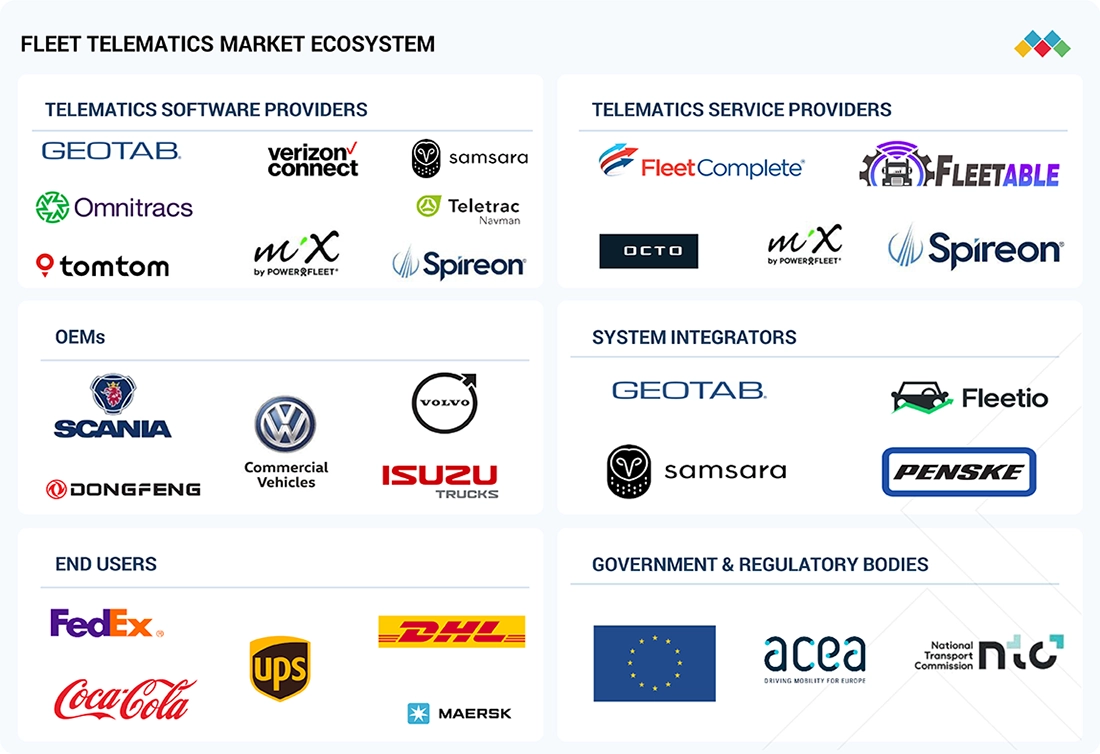
FLEET TELEMATICS MARKET SIZE, SHARE & ANALYSIS: COMMERCIAL USE CASES ACROSS INDUSTRIES
| COMPANY | USE CASE DESCRIPTION | BENEFITS |
|---|---|---|
 |
Deploys telematics for logistics fleets to monitor vehicle health, fuel usage, routing efficiency, and driver behavior across large enterprise fleets | Lowers fuel cost, reduces downtime through predictive maintenance, and improves delivery reliability |
 |
Supports municipal and public-sector fleets with tracking, routing, incident response, and fuel optimization tools | Enhances service quality, reduces operational cost, and improves fleet accountability |
 |
Provides telematics solutions for mining and heavy equipment | Enables engine diagnostics, geofencing, and load-cycle monitoring | Improves safety compliance, lowers maintenance cost, and maximizes equipment lifetime |
 |
Delivers telematics for school-bus and passenger-transport fleets, including inspection tools, GPS routing, and student safety monitoring | Improves route efficiency, enhances safety oversight, and ensures regulatory compliance |
 |
Provides video telematics for commercial fleets to monitor driver safety, behavior scoring, and event-based alerts | Reduces accident rates, lowers insurance costs, and improves overall fleet safety culture |
Logos and trademarks shown above are the property of their respective owners. Their use here is for informational and illustrative purposes only.
Related Ecosystem
Key Takeaways
- Asia Pacific fleet telematics market will nearly double from $1,353M (2025) to $2,644M (2030) at 10.0% CAGR
- Asia Pacific's rapid urbanization and e-commerce growth are accelerating telematics adoption across logistics and delivery fleets
- Government regulations on vehicle safety, emissions, and tracking in Asia Pacific are mandating telematics implementation
- 5G infrastructure expansion across Asia Pacific is enabling advanced real-time fleet management and predictive analytics capabilities
Fleet Telematics Market Report Scope
| Report Metric | Details |
|---|---|
| Base Year | 2025 |
| Fastest Growing Segment | SMARTPHONE/CELLULAR (Solution Type) |
| Forecast Period | 2025–2030 |
| Growth Rate | CAGR of 11.2% from 2025 to 2030 |
| Largest Segment | HEAVY COMMERCIAL VEHICLE (Vehicle Type) |
| Market Size Base Year (Billions) | ~USD 10.44 (2025) |
| Revenue Forecast (Billions) | ~USD 17.75 (2030) |
| Segments Covered | Package Type, Solution Type, Vehicle Type, Vendor Type |
Asia Pacific Fleet Telematics Market Report Segmentation
4 segment dimensions are covered across the global market.
By Package Type
- Advanced
- Entry Level
- Mid Tier
By Solution Type
- Embedded
- Portable
- Smartphone/Cellular
By Vehicle Type
- Heavy Commercial Vehicle
- Light Commercial Vehicle
By Vendor Type
- Aftermarket
- Oems
Target Audience
- Fleet Operators & Logistics Companies : Need market insights to evaluate telematics investments, understand regional adoption trends, and benchmark operational efficiency gains against competitors in Asia Pacific markets.
- Telematics Solution Providers : Require detailed regional market data to identify growth opportunities, prioritize market entry strategies, and develop localized solutions for Asia Pacific fleet operators.
- Investment & Private Equity Firms : Seek comprehensive market sizing and growth forecasts to evaluate investment opportunities in Asia Pacific telematics companies and assess portfolio expansion potential.
- Automotive OEMs & Suppliers : Need regional market intelligence to develop connected vehicle strategies, understand customer demand patterns, and plan product launches across Asia Pacific territories.
- Government & Policy Makers : Require market data to inform transportation policy, assess telematics adoption rates, and evaluate effectiveness of safety regulations in driving technology implementation.
Key Companies in the Asia Pacific Fleet Telematics Market
| Company | HQ | Ownership | Strongest segments |
|---|---|---|---|
| VISTEON CORPORATION | United States | Public Company | LCV – OEM embedded telematics (domain controllers, infotainment, clusters),HCV – OEM embedded telematics and digital cockpit,Entry-level and mid-tier packages (basic connectivity, display audio), |
| VERIZON | United States | Public Company | LCV-focused solutions,HCV-focused solutions,Entry-level packages, |
| TRIMBLE INC. | United States | Public Company | HCV-focused telematics and TMS-integrated solutions,LCV and mixed-fleet telematics (aftermarket and portable),Embedded OEM and advanced packages, |
| SAMSARA INC. | United States | Public Company | LCV – aftermarket – mid-tier packages,HCV – aftermarket – advanced packages,LCV – aftermarket – entry-level packages, |
| POWERFLEET | United States | Public Company | LCV-focused telematics (mixed asset fleets, field services, leasing/rental),HCV-focused telematics (trucking, construction, heavy equipment, oil and gas),Entry-level packages (basic tracking, smartphone/cellular-led), |
| MICROLISE LIMITED | United Kingdom | Public Company | HCV-focused telematics and journey management (embedded and aftermarket),LCV and mixed-fleet telematics (entry-level and mid-tier, portable/smartphone),Safety, health & compliance (multi-camera, AI cameras, vehicle health), |
| PTC | United States | Public Company | OEM-embedded, advanced packages (LCV and HCV),Aftermarket integrators using ThingWorx and Kepware,Service lifecycle and parts optimization for connected fleets, |
VISTEON CORPORATION
Visteon Corporation is a United States-based public company founded in 2000 with 10,500 employees. The company operates as a global automotive supplier specializing in cockpit electronics and connected car solutions.
VERIZON
Verizon is a United States-based public company founded in 1983 with 97,600 employees. The company is a leading telecommunications provider offering wireless, broadband, and enterprise communication services.
TRIMBLE INC.
Trimble Inc. is a United States-based public company founded in 1978 with 11,500 employees. The company provides positioning, navigation, and mobile solutions for various industries including construction, agriculture, and transportation.
SAMSARA INC.
Samsara Inc. is a United States-based public company founded in 2015 with 4,100 employees. The company offers cloud-based fleet operations and industrial IoT software solutions.
POWERFLEET
PowerFleet is a United States-based public company founded in 1993 with 2,658 employees. The company provides GPS fleet tracking and telematics solutions for vehicle and asset management.
MICROLISE LIMITED
Microlise Limited is a United Kingdom-based public company founded in 1982 with 800 employees. The company provides fleet management, telematics, and vehicle tracking solutions.
PTC
PTC is a United States-based public company founded in 1985 with 7,000 employees. The company develops product lifecycle management and industrial IoT software solutions.
Countries within Asia Pacific - compare and drill down
| Country | 2025 size (native) |
|---|---|
| China | USD 1529 Million |
| India | USD 281 Million |
| Japan | USD 472 Million |
| South Korea | USD 362 Million |
Country market size visualization
Reasons to Buy this Report
- Regional Market Sizing : Obtain precise market valuations for Asia Pacific and individual country breakdowns, enabling accurate investment decisions and competitive positioning in this high-growth region.
- Growth Trajectory Insights : Understand the 10% CAGR trajectory and $1.3 billion market expansion opportunity through 2030, critical for strategic planning and resource allocation in Asia Pacific operations.
- Country-Level Intelligence : Access detailed market data for China, India, Japan, and South Korea to identify highest-potential markets and tailor go-to-market strategies for specific geographies.
- Regulatory & Compliance Context : Gain insights into Asia Pacific safety regulations and government mandates driving telematics adoption, essential for compliance strategy and market entry planning.
- Competitive Benchmarking : Compare Asia Pacific market dynamics against global trends (11.2% CAGR) to identify regional advantages, gaps, and opportunities for differentiation and market capture.
Frequently asked questions
What is the current market size of fleet telematics in Asia Pacific?
The Asia Pacific fleet telematics market was valued at $1,353 million in 2025 and is projected to reach $2,644 million by 2030.
What is the expected growth rate for Asia Pacific fleet telematics?
Asia Pacific fleet telematics is expected to grow at a compound annual growth rate (CAGR) of 10.0% from 2025 to 2030.
Which countries are driving growth in Asia Pacific fleet telematics?
Major growth drivers in Asia Pacific include China, India, and Southeast Asian nations, which are investing in connected vehicle technologies and IoT infrastructure for fleet management.
What factors are accelerating fleet telematics adoption in Asia Pacific?
Key factors include rapid urbanization, e-commerce expansion, government regulations on vehicle safety and emissions, rising fuel costs, and 5G infrastructure deployment across the region.
How will Asia Pacific fleet telematics market evolve by 2030?
By 2030, Asia Pacific is expected to see widespread adoption of advanced telematics solutions including real-time tracking, predictive maintenance, and AI-driven fleet optimization enabled by 5G connectivity.
RESEARCH METHODOLOGY
This research study involved the extensive use of secondary sources, such as company annual reports/presentations, industry association publications, automotive magazine articles, directories, technical handbooks, the World Economic Outlook, trade websites, technical articles, and databases, to identify and collect information on the fleet telematics market. In-depth interviews were conducted with various primary respondents, including key industry participants, subject-matter experts (SMEs), C-level executives of key market players (fleet telematics service provider), and industry consultants, among other experts, to obtain and verify critical qualitative and quantitative information and assess market prospects.
Secondary Research
In the secondary research process, various secondary sources were used to identify and collect information on the fleet telematics market for this study. Secondary sources included annual reports, press releases, and investor presentations of companies; whitepapers, certified publications, and articles from recognized authors; directories; databases; and articles from recognized associations and government publishing sources.
Primary Research
Extensive primary research was conducted after understanding the fleet telematics market scenario through secondary research. Several primary interviews were conducted with market experts from demand-side vehicle manufacturers (in terms of component supply), country-level government associations, trade associations, and supply-side OEMs and component manufacturers across three major regions: North America, Europe, and Asia Pacific. Approximately 20% and 80% of primary interviews were conducted from the demand and supply sides, respectively. Primary data was collected through questionnaires, emails, and telephonic interviews. In the canvassing of primaries, various departments within organizations, such as sales, operations, and administration, were covered to provide a holistic viewpoint in the report.
In the canvassing of primaries, various departments , such as sales, operations, and marketing, within organizations were covered to provide a holistic viewpoint in the report. After interacting with industry experts, brief sessions were conducted with experienced independent consultants to reinforce the findings from the primaries. This, along with the opinions of in-house subject matter experts, led to the findings, as described in the remainder of this report.
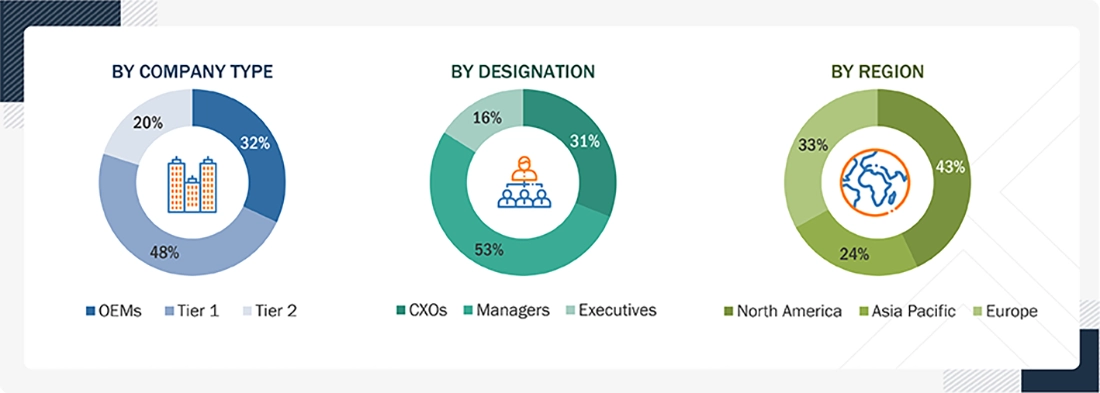
Tiers of companies are based on the supply chain of the fleet telematics market.
Tier 1 covers fleet telematics service providers.
Tier 2 covers technology and component suppliers providing hardware, connectivity, and data software that enable telematics service providers.
To know about the assumptions considered for the study, download the pdf brochure
Market Size Estimation
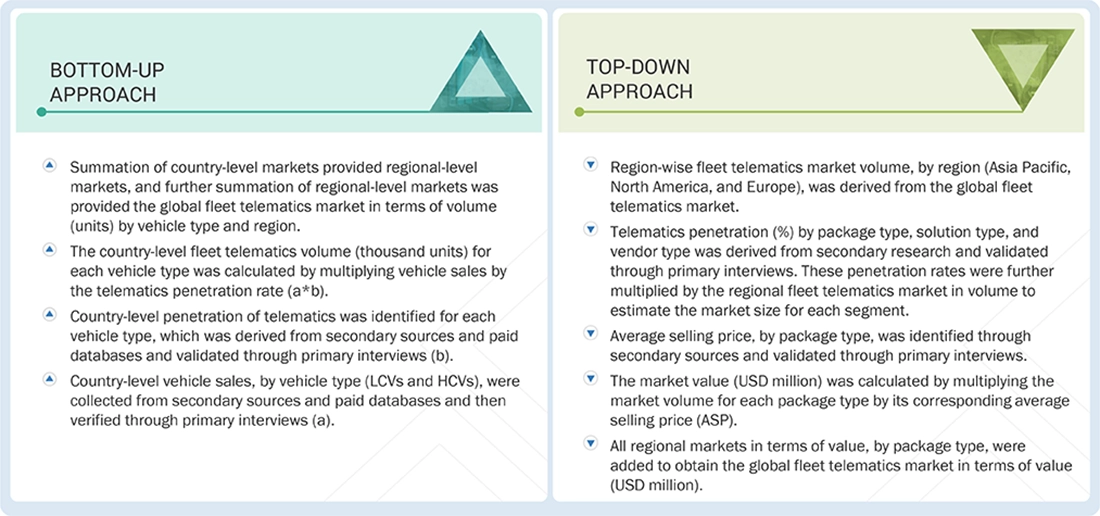
Bottom-up and top-down approaches were used to estimate and validate the total size of the fleet telematics market. This method was also used extensively to estimate the size of various subsegments in the market.
Fleet telematics market : Top-Down and Bottom-Up Approach
Data Triangulation
After arriving at the overall market size using the market size estimation processes as explained above, the market was split into several segments and subsegments. To complete the overall market engineering process and arrive at the exact statistics of each market segment and subsegment, data triangulation and market breakdown procedures were employed, wherever applicable. The data was triangulated by studying various factors and trends from both the demand and supply sides.
Market Definition
According to Geotab Inc., telematics is a method of monitoring cars, trucks, equipment, and other assets using GPS technology and on-board diagnostics (OBD) to plot asset movements on a computerized map. Also known as fleet tracking or GPS vehicle tracking, telematics has become an essential management tool for many commercial and government fleets. Commercial vehicle telematics enables real-time monitoring and management of vehicles, facilitating enhanced operational efficiency, safety, and compliance. By leveraging data from telematics systems, businesses can optimize routes, reduce fuel consumption, perform proactive maintenance, and improve overall fleet performance and longevity.
Key Stakeholders
- Authorized Service Centers and Independent Aftermarket Service Providers
- Automobile Organizations/Associations and Government Bodies
- Commercial Vehicle Original Equipment Manufacturers (OEMs)
- Automotive Camera Manufacturers
- Automotive Research Organizations
- Automotive TCU and ECU Manufacturers
- Automotive Telematics Hardware Suppliers
- Automotive Telematics Service Providers
- Automotive Telematics Software and Platform Providers
- Autonomous Driving Platform Providers
- Cloud Service Providers
- Fleet Leasing Companies
- Fleet Owners and Operators
- Fleet Telematics Vendors
- Managed Service Providers
- Support and Maintenance Service Providers
- System Integrators (SIs)/Migration Service Providers
Report Objectives
- To segment and forecast the fleet telematics market in terms of volume (thousand units) and value (USD billion)
- To define, describe, and forecast the market based on package type, solution type, vehicle type, vendor type, and region
-
To analyze regional markets for growth trends, prospects, and their contribution to the overall market
- To segment and forecast the market by package type (Entry Level, Mid Tier, Advanced)
- To segment and forecast the market by solution type (Embedded, Portable, Smartphone/Cellular)
- To segment and forecast the market by vehicle type (Light Commercial Vehicle, Heavy Commercial Vehicle)
- To segment and forecast the market by vendor type (OEMs and Aftermarket)
- To forecast the market by region (Asia Pacific, Europe, and North America)
- To analyze technological developments impacting the market
- To provide detailed information about the major factors (drivers, challenges, restraints, and opportunities) influencing market growth
-
To strategically analyze the market, considering individual growth trends, prospects, and contributions to the total market
- To study the following concerning the market
- Supply Chain Analysis
- Ecosystem Analysis
- Technology Analysis
- Trade Analysis
- Case Study Analysis
- Patent Analysis
- Regulatory Landscape
- Average Selling Price Analysis
- Impact of AI/Gen AI
- Trend and Disruption Impact
- Key Stakeholders and Buying Criteria
- Key Conferences and Events
- Impact of Fleet Telematics on Cost Savings of Key Players
- Insights on Fleet Telematics Data Plans, by OEM
- Insights into Commercial Vehicle Telematics Architecture
- Future Applications in Commercial Vehicle Telematics Ecosystem
- Sustainability Initiatives
- To strategically profile key players and comprehensively analyze their market ranking and core competencies
- To track and analyze competitive developments, such as product launches, deals, expansions, and others, carried out by key industry participants.
Customization Options
With the given market data, MarketsandMarkets offers customizations in accordance with the company’s specific needs. The customization options are given below:
Get the Full Fleet Telematics Market Report
Full forecast, segment splits, and company analysis for all Fleet Telematics Market.
- Canada Fleet Telematics Market
- US Fleet Telematics Market
- France Fleet Telematics Market
- Germany Fleet Telematics Market
- Italy Fleet Telematics Market
- Spain Fleet Telematics Market
- UK Fleet Telematics Market
- China Fleet Telematics Market
- India Fleet Telematics Market
- Japan Fleet Telematics Market
- South Korea Fleet Telematics Market
Need a Tailored Report?
Customize this report to your needs
Get 10% FREE Customization
Customize This Report
