
Canada Gas Analyzer, Sensor & Detector Market (2016-2021)

The Canada Gas Analyzer, Sensor & Detector Market was valued at $68.26 Million in 2016 and projected to reach to $91.9 Million by 2021, representing a compound annual growth rate of 6.13%. Canada's gas analyzer, sensor, and detector market is positioned for sustained growth through 2021 and beyond, driven by stringent occupational health and safety regulations and increasing industrial automation.


| Market Size in | USD 26.32 MN |
| Market Forecast in | |
| CAGR | |
| Forecast Period | |
| Units Considered | Value (USD MN) |
Canada Gas Analyzer, Sensor & Detector Market Trends and Insights
- In 2016, Canada's market was valued at $68.26 million, with strong momentum carrying the sector toward a projected valuation of $91.90 million by 2021.
- This growth trajectory, driven by a compound annual growth rate of 6.13%, positions Canada as a significant contributor to North American market development in analytical instrumentation. The Canadian market benefits from robust regulatory frameworks, particularly in environmental monitoring and workplace safety, which mandate the deployment of advanced gas detection systems.
- Canada's industrial base-spanning oil and gas, chemical manufacturing, and utilities-creates consistent demand for reliable gas analysis solutions.
- Between 2016 and 2021, Canada's market expansion outpaced global averages, reflecting regional industrial investment and heightened focus on emissions control and occupational health standards. Canada's strategic geographic position and integration with North American supply chains further support market penetration by leading manufacturers.
- The forecast period through 2021 anticipates continued adoption of sensor technologies across distributed monitoring networks, particularly in remote and harsh environments characteristic of Canadian operations..
Key Market Statistics
- CAGR (2016-2021) 6.13% CAGR
- Market Size, 2016 ~USD 68.26 Million
- Forecast, 2021 ~USD 91.9 Million
- Country Canada
Canada Gas Analyzer, Sensor & Detector Market Overview
Market Valuation Growth :
Canada's gas analyzer, sensor, and detector market grew from $68.26 million in 2016 to $91.90 million in 2021, demonstrating robust expansion in industrial instrumentation demand.
Strong CAGR Performance :
Canada's market CAGR of 6.13% outpaced the global average of 5.7%, indicating accelerated adoption and investment in gas detection technologies across Canadian industries.
Industrial Sector Drivers :
Growth in Canada's oil & gas, chemical processing, and manufacturing sectors fueled demand for advanced gas monitoring solutions to meet safety and environmental compliance standards.
Regional Market Maturity :
Canada's established regulatory framework and emphasis on workplace safety created a stable, mature market environment supporting consistent year-over-year expansion.
Canada Gas Analyzer, Sensor & Detector Market Dynamics
- The country's robust oil and gas sector, coupled with expanding chemical manufacturing operations, continues to generate strong demand for real-time gas monitoring solutions.
- Investment in environmental compliance technologies and workplace safety initiatives further supports market expansion. Looking ahead, Canada's market will benefit from technological advancements in sensor accuracy and IoT-enabled detection systems.
- Growing awareness of air quality monitoring in urban centers and industrial facilities, combined with government incentives for clean technology adoption, positions the Canadian market for continued outperformance relative to global trends..
Market Ecosystem
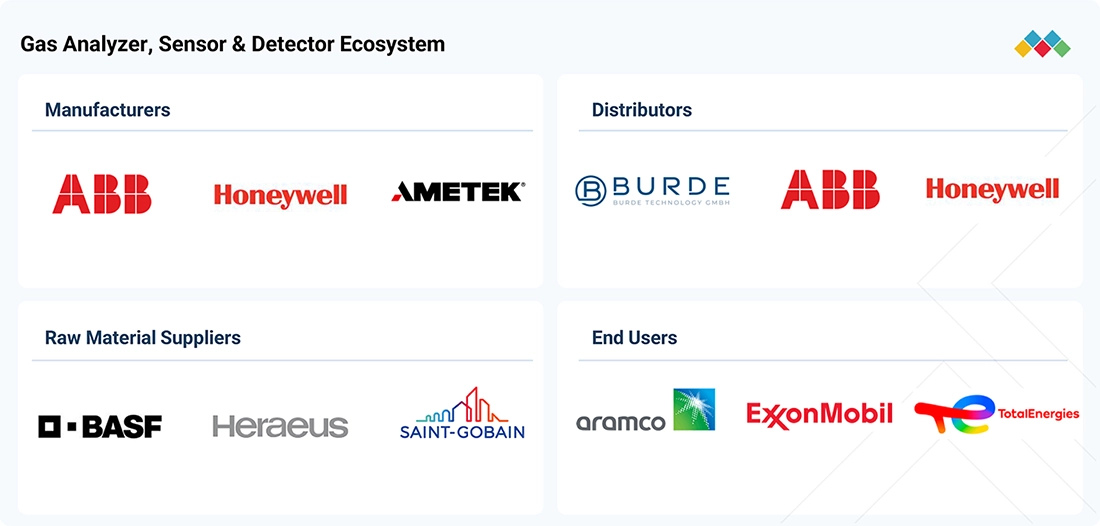
GAS ANALYZER, SENSOR & DETECTOR MARKET: COMMERCIAL USE CASES ACROSS INDUSTRIES
| COMPANY | USE CASE DESCRIPTION | BENEFITS |
|---|---|---|
 |
Hazardous gas detection, emissions monitoring, semiconductor gas monitoring, worker safety, continuous facility monitoring | High detection sensitivity | Worker protection | Regulatory compliance | Connected monitoring | Predictive maintenance |
 |
CEMS, process gas analysis, combustion optimization, refinery and chemical process monitoring, and high-purity gas analysis | Accurate gas measurement | Emissions compliance | Process optimization | Product quality | Environmental performance |
 |
Process gas analysis, gas chromatography, leak detection, combustion monitoring, and emissions monitoring | Early hazard detection | Reduced downtime |Lower maintenance costs | Process efficiency | Safety compliance |
 |
Gas purity monitoring, trace-gas analysis, hydrocarbon processing, emissions monitoring, and semiconductor and industrial gas applications | High-precision analysis | Improved purity | Process optimization | Contamination control | Emissions reduction |
 |
Personal gas detection, confined-space monitoring, leak detection, area monitoring, and fixed gas detection | Worker safety | Fast hazard detection | Reliable measurements | Long sensor life | Reduced service requirements |
Logos and trademarks shown above are the property of their respective owners. Their use here is for informational and illustrative purposes only.
Related Ecosystem
Key Takeaways
- Canada's gas analyzer, sensor & detector market grew from $68.26M (2016) to $91.90M (2021), representing 6.13% CAGR.
- Canada's market growth rate exceeded global CAGR of 5.7%, indicating stronger regional demand and industrial investment.
- Regulatory mandates in environmental monitoring and workplace safety drive consistent adoption of gas detection technologies across Canada.
- Canada's oil, gas, and chemical sectors provide sustained demand for advanced analytical instrumentation through 2021 and beyond.
Gas Analyzer, Sensor & Detector Market Report Scope
| Report Metric | Details |
|---|---|
| Base Year | 2016 |
| Fastest Growing Segment | METAL OXIDE SEMICONDUCTOR (Technology) |
| Forecast Period | 2016-2021 |
| Growth Rate | CAGR of 5.7% from 2016 to 2021 |
| Largest Segment | PORTABLE (Systems) |
| Market Size Base Year (Billions) | ~USD 3.08 (2016) |
| Revenue Forecast (Billions) | ~USD 4.06 (2021) |
| Segments Covered | Technology, End-Use Industry, Systems, Application, System |
Canada Gas Analyzer, Sensor & Detector Market Report Segmentation
5 segment dimensions are covered across the global market.
By Technology
- Catalytic
- Electrochemical
- Infrared
- Laser
- Metal Oxide Semiconductor
- Paramagnetic
- Pid
- Zirconia
By End-Use Industry
- Buildings & Construction
- Food & Beverage
- Health Care
- Healthcare
- Oil & Gas And Chemicals
- Water Treatment
By Systems
- Fixed
- Portable
By Application
- Buildings & Construction
- Food & Beverage
- Healthcare
- Oil & Gas And Chemicals
- Water Treatment
By System
- Fixed
- Portable
Target Audience
- Industrial Equipment Manufacturers : Manufacturers need Canada-specific market data to assess demand for gas detection integration, identify growth opportunities in key industrial verticals, and plan product localization strategies.
- Safety & Compliance Officers : Corporate safety leaders require market insights on emerging gas detection technologies and Canadian regulatory trends to upgrade workplace monitoring systems and ensure occupational health compliance.
- Investment & Private Equity Firms : Investors evaluating Canadian industrial technology companies need market sizing, growth trajectory, and competitive landscape data to support due diligence and valuation assessments.
- Sensor Technology Developers : R&D teams and technology innovators need Canada market intelligence to identify unmet needs, benchmark performance requirements, and prioritize development roadmaps for regional deployment.
- Distribution & Channel Partners : Distributors and resellers require Canada-focused market forecasts and segment analysis to optimize inventory, identify high-potential customer segments, and plan sales strategies.
Reasons to Buy this Report
- Canada-Specific Market Sizing : Access precise valuation data for Canada's gas analyzer market with verified historical figures (2016: $68.26M) and forecasts (2021: $91.90M) to inform investment and expansion decisions.
- Competitive Benchmarking : Compare Canada's 6.13% CAGR against the global 5.7% benchmark to identify market outperformance drivers and competitive advantages unique to the Canadian landscape.
- Regulatory & Compliance Insights : Understand Canada-specific safety standards, environmental regulations, and compliance requirements driving adoption of gas detection technologies across industrial sectors.
- Sector-Specific Opportunity Analysis : Identify high-growth segments within Canada's oil & gas, chemical, and manufacturing industries to prioritize market entry and product development strategies.
- Strategic Market Entry Planning : Leverage Canada-focused market intelligence to develop localized go-to-market strategies, partnership opportunities, and distribution channel optimization for the North American region.
Frequently asked questions
What was Canada's gas analyzer, sensor & detector market size in 2016?
Canada's market was valued at $68.26 million USD in 2016, establishing the baseline for the 2016-2021 forecast period.
What is the projected market size for Canada by 2021?
Canada's gas analyzer, sensor & detector market is forecast to reach $91.90 million USD by 2021, reflecting sustained industrial demand.
How does Canada's CAGR compare to global growth?
Canada's 6.13% CAGR outpaces the global average of 5.7%, demonstrating stronger regional market momentum and investment.
Which industries drive demand for gas analyzers and sensors in Canada?
Canada's oil and gas, chemical manufacturing, utilities, and environmental monitoring sectors are primary drivers of gas analyzer and sensor adoption.
What regulatory factors support Canada's gas analyzer market growth?
Canadian environmental protection regulations, workplace safety standards, and emissions monitoring requirements mandate deployment of advanced gas detection systems across industrial facilities.
RESEARCH METHODOLOGY
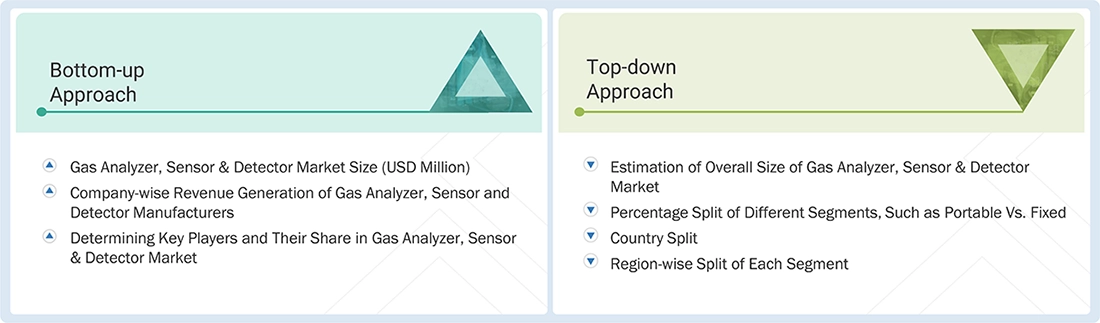
The study involves two major activities in estimating the current market size for the gas analyzer, sensor & detector market. Exhaustive secondary research was done to collect information on the market, peer market, and parent market. The next step was to validate these findings, assumptions, and sizing with industry experts across the value chain through primary research. Both top-down and bottom-up approaches were employed to estimate the complete market size. After that, market breakdown and data triangulation were used to estimate the market size of segments and subsegments.
Secondary Research
Secondary sources referred to for this research study include financial statements of companies offering gas analyzers, sensors, and detectors and information from various trade, business, and professional associations. Secondary research has been used to obtain critical information about the industry’s value chain, the total pool of key players, market classification, and segmentation according to industry trends to the bottom-most level and regional markets. The secondary data was collected and analyzed to arrive at the overall size of the gas analyzer, sensor & detector market, which was validated by primary respondents.
Primary Research
Extensive primary research was conducted after obtaining information regarding the gas analyzer, sensor & detector market scenario through secondary research. Several primary interviews were conducted with market experts from the demand and supply sides across major countries of North America, Europe, Asia Pacific, the Middle East & Africa, and South America. Primary data was collected through questionnaires, emails, and telephonic interviews. Primary sources from the supply side included various industry experts, such as chief executive officers (CXOs), vice presidents (VPs), directors from business development, marketing, product development/innovation teams, and related key executives from gas analyzer, sensor, and detector industry vendors; material providers; distributors; and key opinion leaders
Primary interviews were conducted to gather insights into market statistics, revenue from products and services, market breakdowns, market size estimates, market forecasting, and data triangulation. Primary research also helped in understanding the various trends related to product types, technologies, systems, end-use industries, and regions. Stakeholders from the demand side, such as CIOs, CTOs, CSOs, and installation teams of the customer/end users who are seeking gas analyzer, sensor and detector, were interviewed to understand the buyer’s perspective on the suppliers, products, and their current usage of gas analyzer, sensor and detector and future outlook of their business, which will affect the overall market.
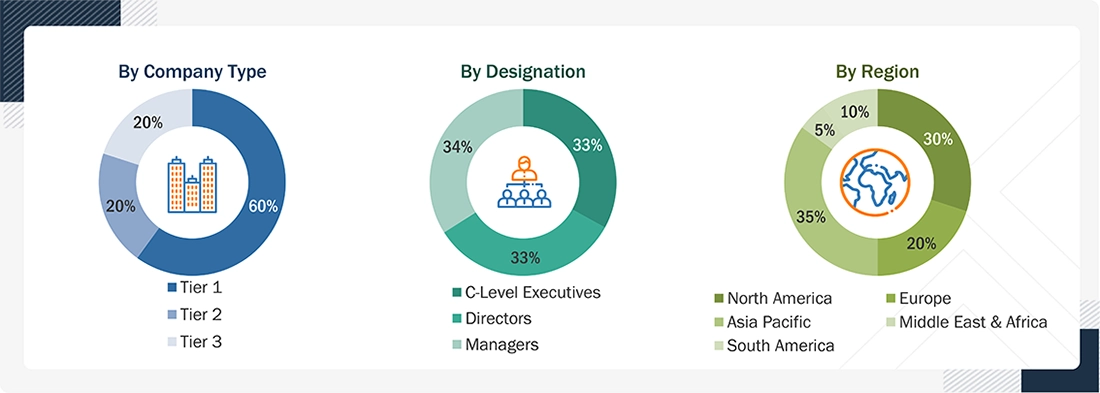
To know about the assumptions considered for the study, download the pdf brochure
Market Size Estimation
The research methodology used to estimate the size of the gas analyzer, sensor & detector market includes the following details. The market sizing of the market was undertaken from the demand side. The market was upsized based on the demand for gas analyzers, sensors, and detectors in different end-use industries at a regional level. Such procurements provide information on the demand aspects of the gas analyzer, sensor, and detector industry for each end-use industry. For each end-use, all possible segments of the market were integrated and mapped.
Data Triangulation
After arriving at the overall size from the market size estimation process explained above, the total market was split into several segments and subsegments. The data triangulation and market breakdown procedures explained below were implemented, wherever applicable, to complete the overall market engineering process and arrive at the exact statistics for various market segments and subsegments. The data was triangulated by studying various factors and trends from the demand and supply sides. Along with this, the market size was validated using both the top-down and bottom-up approaches.
Market Definition
The gas analyzer, sensor & detector market includes all the technologies used to detect, measure, monitor, and analyze the concentration of gases. Gas analyzers give out the quantitative measurement of particular gases and their composition, whereas gas sensors help in converting gas concentration into signals. The role of gas detectors is limited to detecting hazardous, flammable, toxic, or oxygen-deficient gases and raising an alarm whenever the concentration of such gases exceeds safety standards. This technology finds its application in various sectors including oil & gas, chemical, power generation, mining, manufacturing, pharmaceuticals, building & construction, and environmental monitoring.
Key Stakeholders
- Gas Analyzer, Sensor, and Detector Manufacturers
- Gas Analyzer, Sensor, and Detector Distributors and Suppliers
- End-use Industries
- Universities, Governments, and Research Organizations
- Associations and Industrial Bodies
- R&D Institutes
- Environmental Support Agencies
- Investment Banks and Private Equity Firms
- Research and Consulting Firms
Report Objectives
- To describe and forecast the gas analyzer, sensor & detector market size, by product type, system, technology, and end-use industry, in terms of volume and value
- To forecast the market size concerning five main regions (along with country-level data), namely North America, Europe, Asia Pacific, the Middle East & Africa, and South America, and analyze the significant region-specific trends
- To provide detailed information regarding the key factors, such as drivers, restraints, opportunities, and challenges influencing market growth
- To strategically analyze micromarkets with respect to individual growth trends, prospects, and contributions of the submarkets to the overall market
- To analyze the market opportunities and the competitive landscape for stakeholders and market leaders
- To assess recent market developments and competitive strategies, such as agreements, contracts, acquisitions, partnerships, collaborations, and product developments/launches, to draw the competitive landscape
- To strategically profile the key market players and comprehensively analyze their core competencies.
Available customizations:
MarketsandMarkets offers the following customizations for this market report:
- Additional country-level analysis of the gas analyzer, sensor & detector market
Product Analysis
- Product matrix, which provides a detailed comparison of the product portfolio of each company’s market
Get the Full Gas Analyzer, Sensor & Detector Market Report
Full forecast, segment splits, and company analysis for all Gas Analyzer, Sensor & Detector Market.
- Mexico Gas Analyzer, Sensor & Detector Market
- U.S. Gas Analyzer, Sensor & Detector Market
- France Gas Analyzer, Sensor & Detector Market
- Germany Gas Analyzer, Sensor & Detector Market
- Italy Gas Analyzer, Sensor & Detector Market
- Spain Gas Analyzer, Sensor & Detector Market
- U.K. Gas Analyzer, Sensor & Detector Market
- China Gas Analyzer, Sensor & Detector Market
- India Gas Analyzer, Sensor & Detector Market
- Indonesia Gas Analyzer, Sensor & Detector Market
- Japan Gas Analyzer, Sensor & Detector Market
- Malaysia Gas Analyzer, Sensor & Detector Market
- South Korea Gas Analyzer, Sensor & Detector Market
- Brazil Gas Analyzer, Sensor & Detector Market
- Saudi Arabia Gas Analyzer, Sensor & Detector Market
- South Africa Gas Analyzer, Sensor & Detector Market
- UAE Gas Analyzer, Sensor & Detector Market
Need a Tailored Report?
Customize this report to your needs
Get 10% FREE Customization
Customize This Report
