
Germany Gene Editing Market (2024-2029)

The Germany Gene Editing Market was valued at $102.4 Million in 2024 and projected to reach to $198.7 Million by 2029, representing a compound annual growth rate of 14.2%. Germany's gene editing market is positioned for accelerated growth through 2029, driven by strong regulatory frameworks, substantial R&D funding, and a concentration of leading biotech companies.


| Market Size in | USD 26.32 MN |
| Market Forecast in | |
| CAGR | |
| Forecast Period | |
| Units Considered | Value (USD MN) |
Germany Gene Editing Market Trends and Insights
- Germany's strong pharmaceutical and biotechnology infrastructure, combined with significant R&D investments, positions the country as a leading hub for gene editing innovation in Europe.
- The market in Germany is driven by increasing adoption of CRISPR and other advanced gene-editing technologies across therapeutic applications. Germany's gene editing sector benefits from a highly skilled workforce, substantial government funding for life sciences research, and a favorable regulatory environment that supports clinical development.
- Between 2024 and 2029, Germany is expected to see accelerated commercialization of gene therapies and expanded applications in oncology, rare genetic disorders, and regenerative medicine.
- Germany's commitment to precision medicine and biotechnology excellence continues to attract both domestic and international investment in the gene editing space..
Key Market Statistics
- CAGR (2024-2029) 14.2% CAGR
- Market Size, 2024 ~USD 102.4 Million
- Forecast, 2029 ~USD 198.7 Million
- Country Germany
Germany Gene Editing Market Overview
Market Valuation Growth :
Germany's gene editing market is valued at $102.4 million in 2024, with a projected CAGR of 14.2%, reaching $198.7 million by 2029, significantly outpacing the global growth rate of 10.2%.
Pharmaceutical & Biotech Hub :
Germany's robust pharmaceutical and biotechnology infrastructure, including world-class research institutions and manufacturing capabilities, establishes it as Europe's leading gene editing innovation center.
CRISPR Technology Adoption :
Increasing adoption of CRISPR and advanced gene editing technologies across German research facilities and clinical applications is driving market expansion and therapeutic development.
R&D Investment Leadership :
Significant government and private sector R&D investments in Germany support gene editing research, clinical trials, and commercialization of novel therapies.
Germany Gene Editing Market Dynamics
- The country's commitment to precision medicine and genetic therapies creates favorable conditions for market expansion.
- German research institutions continue to advance CRISPR applications in oncology, rare genetic disorders, and immunotherapy, attracting both domestic and international investment.
- Collaboration between academia, industry, and healthcare providers strengthens the innovation ecosystem and supports clinical translation of gene editing technologies..
Market Ecosystem
Related Ecosystem
Key Takeaways
- Germany's gene editing market is projected to nearly double from $102.4M (2024) to $198.7M (2029), representing a 14.2% CAGR.
- Germany leads European gene editing innovation through robust R&D infrastructure, skilled talent, and government-backed life sciences funding.
- CRISPR and advanced gene-editing technologies are rapidly gaining adoption across therapeutic areas in Germany, particularly in rare genetic disorders and oncology.
- Germany's regulatory framework and precision medicine initiatives create a favorable environment for gene therapy commercialization through 2029.
Gene Editing Market Report Scope
| Report Metric | Details |
|---|---|
| Base Year | 2024 |
| Fastest Growing Segment | CROS & CDMOS (End User) |
| Forecast Period | 2024–2029 |
| Growth Rate | CAGR of 10.2% from 2024 to 2029 |
| Largest Segment | PRODUCTS (Offering) |
| Market Size Base Year (Billions) | ~USD 4.67 (2024) |
| Revenue Forecast (Billions) | ~USD 7.59 (2029) |
| Segments Covered | Offering, Type, Technique, Technology, Application, End User |
Germany Gene Editing Market Report Segmentation
6 segment dimensions are covered across the global market.
By Offering
- Products
- Services
By Type
- Cell Line Development & Engineering
- Gene Editing Kits
- Gene Editing Libraries
- Gene Editing Reagents
- Grna Synthesis & Vector Construction
- Library Construction & Screening
- Other Services
- Reagents & Consumables
- Software & Systems
By Technique
- Gene Silencing
- Knock-In
- Knock-Out
- Other Techniques
By Technology
- Antisense
- Base Editing
- Crispr
- Other Technologies
- Rnai
- Talens
- Zfns
By Application
- Cell Line Engineering
- Drug Discovery & Development
- Genome Editing
- Other Applications
By End User
- Academic & Research Institutes
- Cros & Cdmos
- Other End Users
- Pharmaceutical & Biotechnology Companies
GERMANY: GENE EDITING PRODUCTS MARKET, BY END USER, 2022–2029
| Segment | 2022 | 2023 | 2024 | 2025 | 2026 | 2027 | 2028 | 2029 | CAGR (%) |
|---|---|---|---|---|---|---|---|---|---|
| ACADEMIC & RESEARCH INSTITUTES | 67.7 | 66 | 69.8 | 78.4 | 88.2 | 99.2 | 111.7 | 126 | 12.5 |
| CROS & CDMOS | 30.8 | 30.5 | 32.7 | 37.3 | 42.5 | 48.5 | 55.3 | 63.2 | 14.1 |
| OTHER END USERS | 26.1 | 24.5 | 25 | 27 | 29.2 | 31.5 | 34 | 36.8 | 8 |
| PHARMACEUTICAL & BIOTECHNOLOGY COMPANIES | 93.7 | 90.7 | 95.2 | 106.1 | 118.5 | 132.3 | 147.8 | 165.6 | 11.7 |
| TOTAL | 218.3 | 211.8 | 222.7 | 248.8 | 278.4 | 311.5 | 348.9 | 391.7 | 11.9 |
Target Audience
- Pharmaceutical & Biotech Companies : German and international pharma firms need market intelligence to assess expansion opportunities, identify acquisition targets, and develop gene editing-based therapeutic pipelines in Europe's largest biotech market.
- Healthcare Investors & VCs : Investment firms require detailed market data on Germany's gene editing sector to evaluate funding opportunities, portfolio companies, and growth potential in this high-value therapeutic area.
- Research Institutions & Universities : German academic centers need market insights to align research initiatives with commercial opportunities, secure funding, and establish industry partnerships for gene editing innovation.
- Medical Device & Diagnostic Companies : Firms developing complementary technologies require market analysis to identify integration opportunities, customer segments, and strategic partnerships within Germany's gene editing ecosystem.
- Healthcare Policy & Regulatory Bodies : Government agencies and regulatory authorities need market data to inform healthcare policy, reimbursement frameworks, and clinical trial regulations for gene editing therapies in Germany.
Key Companies in the Germany Gene Editing Market
| Company | HQ | Ownership | Strongest segments |
|---|---|---|---|
| EPPENDORF AG | Germany | Private Company | Liquid handling (pipettes, dispensers, automated systems),Separation & instrumentation (centrifuges, PCR cyclers, ULT freezers),Consumables (tubes, tips, plates, single-use bioreactors), |
| ILLUMINA INC | United States | Public Company | Sequencing instruments,Sequencing consumables (reagents, flow cells, library prep, WGS and targeted kits),Array-based instruments and consumables, |
| CALYXT | United States | Public Company | RTDS / Trait Machine platform services,Licensed gene-edited traits (royalties and access fees),Collaborative R&D and proof-of-concept projects, |
| MAXCYTE, INC | United States | Public Company | ExPERT GTx and VLx (therapeutic-scale instruments),ExPERT STx and ATx (discovery and development instruments),Disposable processing assemblies and consumables, |
| BECKMAN COULTER | United States | Private Company | Clinical diagnostics analyzers and reagents (chemistry, immunoassay, hematology, urinalysis, hemostasis, clinical flow cytometry),Research and discovery systems (flow cytometry, centrifugation, liquid handling, genomics and single-cell tools),Industrial and particle characterization instruments, |
| TAKEDA PHARMACEUTICAL COMPANY | Japan | Public Company | Gastroenterology (Entyvio, Takecab/Vocinti, EOHILIA),Rare Diseases & Plasma-Derived Therapies (Takhzyro, Advate, ADZYNMA, Gammagard, Hyqvia, Cuvitru, Flexbumin),Oncology (Adcetris, Ninlaro, Iclusig, FRUZAQLA, Alunbrig, Leuplin/Enantone), |
| DANAHER CORPORATION | United States | Public Company | Biotechnology (bioprocessing and single-use solutions),Life Sciences (tools, genomics, and imaging),Diagnostics (clinical instruments and consumables), |
| REVVITY, INC. | United States | Public Company | Diagnostics assays and instruments (prenatal, neonatal, infectious disease, autoimmunity),Life science reagents and consumables (immunology, cell biology, genomics),Instruments, imaging, and detection platforms, |
| THERMO FISHER SCIENTIFIC INC. | United States | Public Company | Life Sciences Solutions,Analytical Instruments,Specialty Diagnostics, |
| MERCK KGAA | Germany | Public Company | Life Science (reagents, consumables, bioprocessing, CDMO/testing services),Healthcare (prescription drugs and biopharmaceuticals),Electronics (semiconductor and display materials, specialty gases, equipment), |
| GENSCRIPT | Hong Kong | Public Company | Life Science Services and Products,Biologics Development Services,Industrial Synthetic Biology Products, |
| AGILENT TECHNOLOGIES, INC. | United States | Public Company | Life Sciences and Diagnostics Markets,Agilent CrossLab,Applied Markets, |
| LONZA | Switzerland | Public Company | Integrated Biologics,Advanced Synthesis (small molecules, ADCs, HPAPIs),Specialized Modalities (cell & gene, microbial, bioscience, mRNA), |
| SANGAMO THERAPEUTICS | United States | Public Company | Hemophilia A gene therapy collaborations (SB-525 / giroctocogene fitelparvovec),Fabry and other AAV gene therapy programs (ST-920 and related),Genetically modified cell therapy (TX200, kidney transplant), |
| PRECISION BIOSCIENCES | United States | Public Company | ARCUS platform collaborations and licensing,In vivo HBV and liver disease programs (PBGENE-HBV, iECURE-OTC),Neuromuscular and mitochondrial programs (PBGENE-DMD, PBGENE-3243), |
| CELLECTIS S.A. | France | Public Company | Allogeneic CAR-T for hematologic malignancies (BALLI-01, NatHaLi-01, ALPHA3),Gene therapy and non-hematologic oncology (TRAVERSE, Melanoma, other gene-editing programs),Platform technologies, collaborations, and other R&D-related revenue, |
| REGENERON PHARMACEUTICALS, INC. | United States | Public Company | EYLEA franchise (incl. 8 mg),Dupixent (atopic dermatitis, asthma, other type 2 diseases),Oncology (Libtayo and emerging bispecifics), |
| TAKARA BIO INC. | Japan | Private Company | Genetic and cellular research reagents,Instruments (PCR and cellular analysis devices),In vitro diagnostics (COVID-19 and related), |
EPPENDORF AG
Eppendorf AG is a German private company founded in 1945 that employs 4,358 people. The company specializes in laboratory equipment and life sciences solutions.
ILLUMINA INC
Illumina Inc. is a publicly traded U.S. company founded in 1998 with 8,625 employees. It is a leading provider of DNA sequencing and genetic analysis technologies.
CALYXT
Calyxt is a publicly traded U.S. company founded in 2010 with 118 employees. The company focuses on plant biotechnology and gene-edited crop development.
MAXCYTE, INC
MaxCyte, Inc. is a publicly traded U.S. company founded in 1998 with 91 employees. It develops cell engineering technologies for therapeutic applications.
BECKMAN COULTER
Beckman Coulter is a private U.S. company founded in 1935 with 11,900 employees. It manufactures laboratory instruments and diagnostic equipment for life sciences research.
TAKEDA PHARMACEUTICAL COMPANY
Takeda Pharmaceutical Company is a publicly traded Japanese pharmaceutical company founded in 1781 with 47,029 employees. It is one of the world's largest pharmaceutical manufacturers.
DANAHER CORPORATION
Danaher Corporation is a publicly traded U.S. company founded in 1969 with 59,000 employees. It operates a diversified portfolio of businesses in diagnostics, life sciences, and environmental solutions.
REVVITY, INC.
Revvity, Inc. is a publicly traded U.S. company founded in 1937 with 11,000 employees. It provides analytical technologies and solutions for life sciences and diagnostics.
THERMO FISHER SCIENTIFIC INC.
Thermo Fisher Scientific Inc. is a publicly traded U.S. company founded in 1956 with 125,000 employees. It is a global leader in serving science with laboratory equipment, reagents, and analytical instruments.
MERCK KGAA
Merck KGaA is a publicly traded German company founded in 1668 with 59,077 employees. It operates in pharmaceuticals, life sciences, and performance materials sectors.
GENSCRIPT
GenScript is a publicly traded company based in Hong Kong, founded in 2002 with 6,165 employees. It provides biotechnology services including gene synthesis, protein production, and antibody development.
AGILENT TECHNOLOGIES, INC.
Agilent Technologies, Inc. is a publicly traded U.S. company founded in 1999 with 18,000 employees. It manufactures analytical instruments and laboratory equipment for life sciences and diagnostics.
LONZA
Lonza is a publicly traded Swiss company founded in 1897 with 20,000 employees. It provides contract manufacturing and life sciences solutions for pharmaceuticals and biotechnology.
SANGAMO THERAPEUTICS
Sangamo Therapeutics is a publicly traded U.S. company founded in 1995 with 142 employees. It develops gene therapy and cell therapy treatments using zinc finger protein technology.
PRECISION BIOSCIENCES
Precision Biosciences is a publicly traded U.S. company founded in 2006 with 66 employees. It develops gene-editing therapies using its proprietary genome editing platform.
CELLECTIS S.A.
Cellectis S.A. is a publicly traded French company founded in 1999 with 227 employees. It develops immunotherapy treatments using gene-edited cell technologies.
REGENERON PHARMACEUTICALS, INC.
Regeneron Pharmaceuticals, Inc. is a publicly traded U.S. company founded in 1988 with 15,343 employees. It discovers, develops, and commercializes medicines for serious medical conditions.
TAKARA BIO INC.
Takara Bio Inc. is a private Japanese company founded in 2002 with 1,779 employees. It develops and manufactures biotechnology products and services for life sciences research.
Reasons to Buy this Report
- Market Size & Growth Validation : Confirm Germany's gene editing market valuation at $102.4M (2024) and validate the 14.2% CAGR projection to $198.7M (2029) for accurate business planning and investment decisions.
- Competitive Landscape Intelligence : Identify key German biotech players, research institutions, and pharmaceutical companies driving gene editing innovation to benchmark competitive positioning and partnership opportunities.
- Regulatory & Market Entry Strategy : Understand Germany's regulatory environment, clinical trial pathways, and reimbursement mechanisms to develop effective market entry and commercialization strategies for gene editing therapies.
- Technology Adoption Trends : Analyze CRISPR adoption rates, emerging gene editing platforms, and therapeutic applications in Germany to identify high-growth segments and innovation opportunities.
- Investment & Funding Insights : Access data on R&D spending, government grants, venture capital flows, and funding trends in Germany's gene editing sector to guide investment and partnership decisions.
Frequently asked questions
What is the current size of Germany's gene editing market?
Germany's gene editing market was valued at $102.4 million in 2024 and is expected to reach $198.7 million by 2029.
What is the projected growth rate for gene editing in Germany?
Germany's gene editing market is projected to grow at a compound annual growth rate (CAGR) of 14.2% from 2024 to 2029.
What factors are driving growth in Germany's gene editing market?
Growth in Germany's gene editing market is driven by strong R&D infrastructure, government funding for biotechnology, skilled workforce, favorable regulatory environment, and increasing adoption of CRISPR technologies across therapeutic applications.
Which therapeutic areas are seeing the most adoption of gene editing in Germany?
In Germany, gene editing technologies are experiencing rapid adoption in rare genetic disorders, oncology, and regenerative medicine applications.
How does Germany's gene editing market compare to other European countries?
Germany is positioned as a leading hub for gene editing innovation in Europe, supported by its strong pharmaceutical infrastructure, substantial life sciences investments, and commitment to precision medicine development.
RESEARCH METHODOLOGY
This study on the gene editing market employed secondary sources, directories, and databases to gather pertinent information. To gather and validate important qualitative and quantitative data and evaluate market growth prospects, in-depth interviews were conducted with many primary respondents including key industry participants, subject-matter experts (SMEs), C-level executives from key market players, and industry consultants. After estimating the gene editing market using several research strategies, the size of the final market was obtained by triangulating data from primary research.
Secondary Research
The secondary sources referred to for this research study include publications from government sources, such as the International Chromosome and Genome Society (ICGS), the National Human Genome Research Institute (NHGRI), the Asia Pacific Society of Human Genetics (APSHG), the Genetics Society of America (GSA), the European Society of Human Genetics (ESHG), Centers for Common Disease Genomics (CDDG), Centre for Cellular & Molecular Biology (CCMB) (India), and the Department of Biotechnology (DBT) (India). Secondary sources include corporate and regulatory filings, such as annual reports, SEC filings, investor presentations, and financial statements; business magazines & research journals; press releases; and trade, business, and professional associations. Secondary data was collected and analyzed to arrive at the overall size of the global gene editing market, which was validated through primary research.
Primary Research
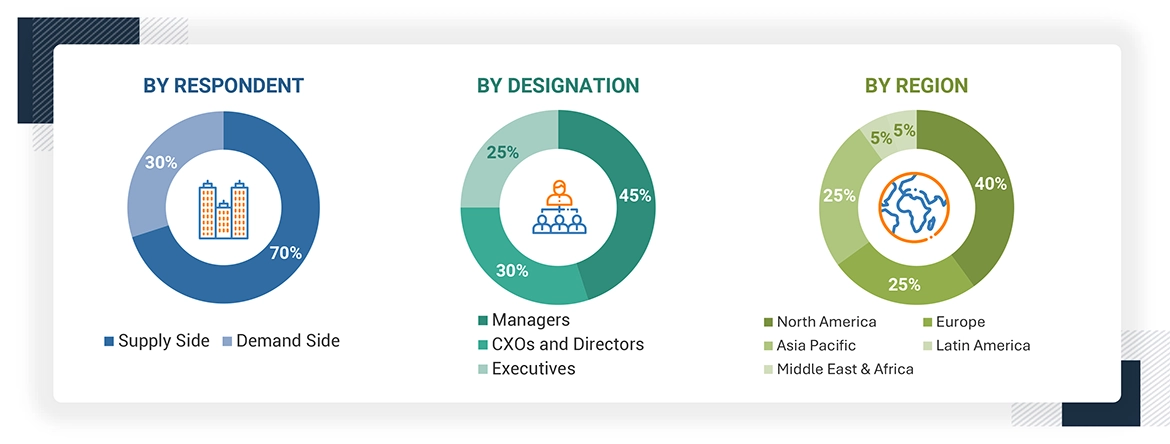
Extensive primary research was conducted after acquiring basic knowledge about the global gene editing market scenario through secondary research. Several primary interviews were conducted with market experts from the supply side, such as C-level and D-level executives, operational managers, marketing & sales managers of key manufacturers, distributors, and channel partners of companies providing gene editing products and services; experts from the demand side, such as personnel from pharmaceutical & biotechnology companies, Academic & research institutes, and CROs & CDMOs. These interviews were conducted across six major regions, including North America, Europe, the Asia Pacific, Latin America, the Middle East, and Africa. Approximately 70% and 30% of the primary interviews were conducted with supply-side and demand-side participants, respectively. This primary data was collected through questionnaires, e-mails, online surveys, personal interviews, and telephonic interviews.
The following is a breakdown of the primary respondents:
To know about the assumptions considered for the study, download the pdf brochure
Market Size Estimation
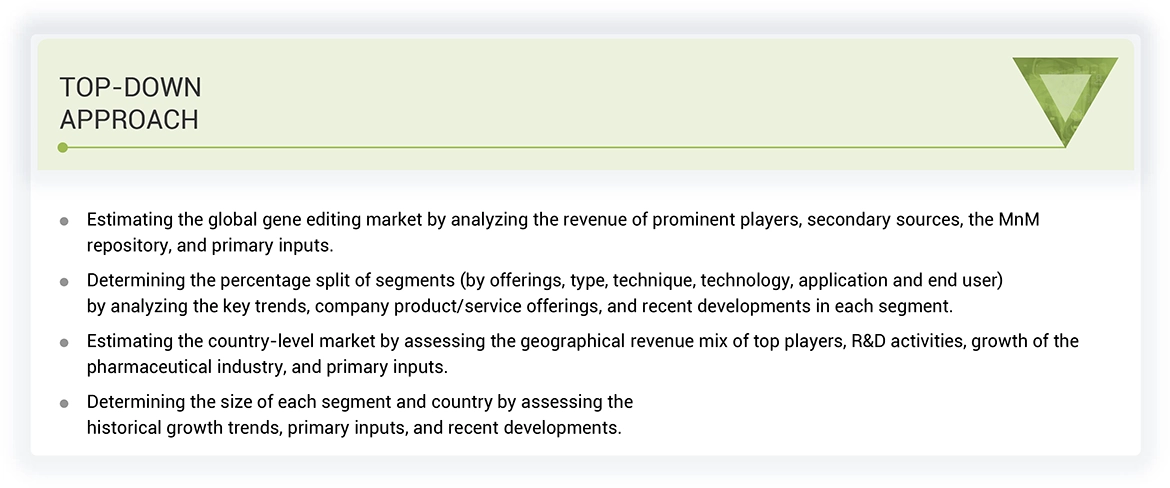
Both top-down and bottom-up approaches were used to estimate and validate the total size of the gene editing market. These methods were also used extensively to estimate the size of various subsegments in the market. The research methodology used to estimate the market size includes the following:
Bottom-up Approach
- The key players in the industry and market have been identified through extensive secondary research.
- The revenues generated from the gene editing market business of leading players have been determined through primary and secondary research.
- All percentage shares, splits, and breakdowns have been determined using secondary sources and verified through primary sources.
Top-down Approach
After arriving at the overall market size from the market size estimation process, the total market was split into several segments and subsegments.
Data Triangulation
To complete the overall market engineering process and arrive at the exact statistics for all segments and subsegments, data triangulation and market breakdown procedures were employed, wherever applicable. The data was triangulated by studying various factors and trends from both the demand and supply sides.
Market Definition
The gene editing market, as covered within the scope of this report, includes products, technologies, and services that facilitate genetic modifications across various applications. This encompasses reagents and consumables, as well as software and systems for planning, executing, and analyzing gene editing processes. Additionally, the report covers services that utilize gene editing technologies like CRISPR, TALEN, ZFN, and other methods such as Meganucleases, PiggyBac, and Prime Editing, applied in areas like cell line engineering, genome editing, drug discovery, clinical diagnostics, and xenotransplantation. These components serve end users, including pharmaceutical and biotechnology companies involved in therapeutic development, as well as academic and research institutes focused on scientific research.
Stakeholders
- Manufacturers and distributors of gene editing products and services
- Pharmaceutical and biotechnology companies
- Market research and consulting firms
- R&D centers
- Researchers and scientists
- Academic & research institutes
- CDMOs & CROs
- Biobanks
- Diagnostic companies.
Report Objectives
- To define, describe, segment, and forecast the gene editing market based on offerings, product type, product application, product technology, reagent & consumables technique, product end user, service type, service application, service end user and region
- To provide detailed information about the factors influencing market growth, such as drivers, restraints, opportunities, and challenges
- To strategically analyze micromarkets1 with respect to individual growth trends, prospects, and contributions to the overall gene editing market
- To analyze market opportunities for stakeholders and provide details of the competitive landscape for key players
- To forecast the size of the market segments concerning six main regions: North America, Europe, the Asia Pacific, Latin America, the Middle East, and Africa.
- To strategically profile the key players in the global gene editing market and comprehensively analyze their core competencies2 and market rankings.
- To track and analyze competitive developments, such as product launches, acquisitions, collaborations, expansions, and partnerships in the gene editing market.
- To profile the key players in the global gene editing market and comprehensively analyze their instruments, reagents, kits, consumables, and services portfolios, market positions, and core competencies
- To track and analyze competitive developments such as product & service launches, expansions, agreements, and collaborations in the gene editing market
- To benchmark players within the gene editing market using the ‘Company Evaluation Matrix' framework, which analyzes market players based on various parameters within the broad categories of business and service strategy
Get the Full Gene Editing Market Report
Full forecast, segment splits, and company analysis for all Gene Editing Market.
- France Gene Editing Market
- UK Gene Editing Market
- Italy Gene Editing Market
- Spain Gene Editing Market
- China Gene Editing Market
- Japan Gene Editing Market
- India Gene Editing Market
- South Korea Gene Editing Market
- Australia Gene Editing Market
- Brazil Gene Editing Market
- United Arab Emirates Gene Editing Market
- Rest Of Europe Gene Editing Market
- Rest Of Asia Pacific Gene Editing Market
- US Gene Editing Market
- Canada Gene Editing Market
- Rest Of Latin America Gene Editing Market
- Ksa Gene Editing Market
- Other GCC Countries Gene Editing Market
- UAE Gene Editing Market
Need a Tailored Report?
Customize this report to your needs
Get 10% FREE Customization
Customize This Report
