
India Geomembranes Market (2026-2031)

The India Geomembranes Market was valued at $144.2 Million in 2026 and projected to reach to $230.3 Million by 2031, representing a compound annual growth rate of 9.8%. India's geomembranes market is positioned for sustained growth driven by rapid urbanization, infrastructure modernization, and stringent environmental regulations.


| Market Size in | USD 26.32 MN |
| Market Forecast in | |
| CAGR | |
| Forecast Period | |
| Units Considered | Value (USD MN) |
India Geomembranes Market Trends and Insights
- This expansion reflects India's accelerating infrastructure development, water management initiatives, and environmental compliance requirements across waste containment and landfill applications.
- India's growing demand for geomembranes is driven by rapid urbanization, increased industrial activity, and government-mandated environmental protection standards that necessitate advanced containment solutions. The Indian geomembranes market is expanding at a compound annual growth rate (CAGR) of 9.8% from 2026 to 2031, outpacing global growth trends.
- India's construction sector, coupled with heightened focus on sustainable waste management and water conservation, is propelling adoption of geomembrane technologies across municipal and industrial segments.
- India's strategic investments in infrastructure and environmental remediation projects are expected to sustain this upward trajectory through the forecast period..
Key Market Statistics
- CAGR (2026-2031) 9.8% CAGR
- Market Size, 2026 ~USD 144.2 Million
- Forecast, 2031 ~USD 230.3 Million
- Country India
India Geomembranes Market Overview
Rapid Market Expansion :
India's geomembranes market is projected to grow from USD 144.2 million in 2026 to USD 230.3 million by 2031, representing a strong CAGR of 9.8%, outpacing the global growth rate of 7.5%.
Infrastructure & Urbanization Drivers :
India's accelerating infrastructure development and rapid urbanization are creating substantial demand for geomembranes in landfill construction, waste containment facilities, and environmental remediation projects across major cities.
Environmental Compliance Focus :
Stricter environmental regulations and waste management standards enforced by Indian authorities are mandating the use of geomembranes in landfills and containment systems, driving market adoption across waste management sectors.
Water Management Initiatives :
Government-backed water conservation and management programs, including irrigation projects and water storage solutions, are significantly increasing geomembrane applications in agricultural and industrial water containment applications.
India Geomembranes Market Dynamics
- The country's expanding waste management sector and increasing landfill construction activities are creating robust demand for high-quality geomembrane solutions.
- Government initiatives focused on environmental sustainability and water resource management further accelerate market penetration across both public and private sectors. The forecast period through 2031 presents significant opportunities as India continues to invest in smart cities, waste-to-energy projects, and water infrastructure.
- Rising awareness of environmental compliance and the adoption of advanced containment technologies will support market expansion.
- Regional manufacturing capabilities and competitive pricing are expected to enhance market accessibility, positioning India as a key growth market within the Asia-Pacific geomembranes landscape..
Market Ecosystem
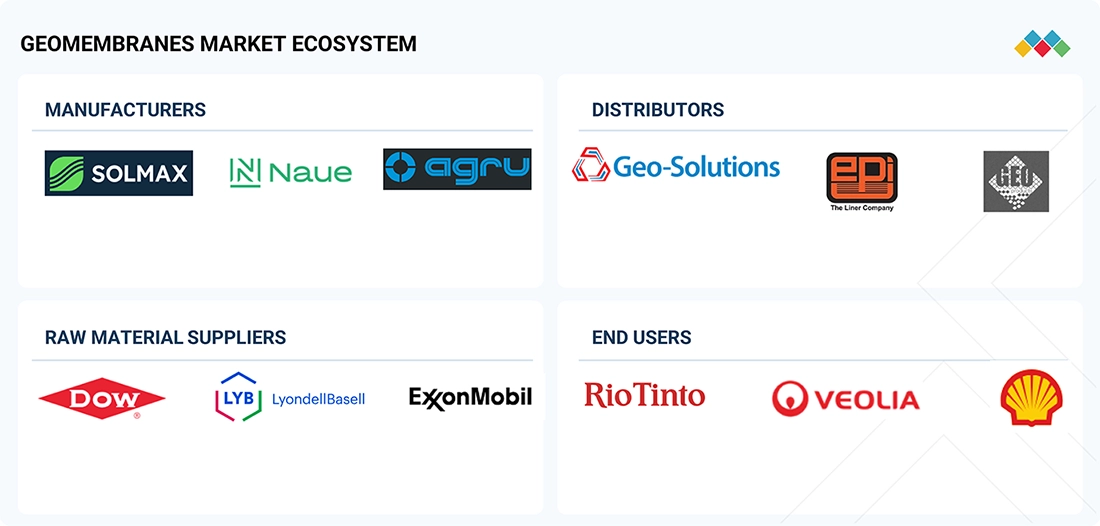
GEOMEMBRANES MARKET: COMMERCIAL USE CASES ACROSS INDUSTRIES
| COMPANY | USE CASE DESCRIPTION | BENEFITS |
|---|---|---|
 |
Supplies HDPE geomembranes for landfill liners, mining containment, and industrial environmental protection projects globally. | Delivers reliable containment, long service life, and regulatory compliance across demanding applications. |
 |
Provides geomembrane lining systems for reservoirs, wastewater ponds, canals, and agricultural water management infrastructure. | Minimizes seepage losses, conserves water resources, and lowers long-term maintenance requirements. |
 |
Offers geomembranes for tunnel waterproofing, transportation infrastructure, environmental containment, and hydraulic engineering applications. | Enhances structural durability, prevents water ingress, and improves infrastructure asset longevity. |
 |
Manufactures geomembranes for mining heap leach pads, tailings storage, and hazardous waste containment facilities. | Ensures chemical resistance, operational safety, and dependable containment in harsh environments. |
Logos and trademarks shown above are the property of their respective owners. Their use here is for informational and illustrative purposes only.
Related Ecosystem
Membranes
- Reverse Osmosis
- Acetone
- Acrylonitrile Butadiene Styrene (ABS)
- Bioremediation
- Cartridge Filters
- Veolia
- Toray Industries, Inc.
- PALL CORPORATION
- DuPont de Nemours, Inc.
- Pentair plc
Key Takeaways
- India's geomembranes market is valued at USD 144.2 million in 2026 and will reach USD 230.3 million by 2031, representing a 9.8% CAGR.
- India's rapid urbanization and infrastructure expansion are primary drivers of geomembrane demand across waste management and water containment sectors.
- India's stringent environmental regulations and compliance mandates are accelerating adoption of advanced geomembrane solutions in industrial and municipal applications.
- India's market growth outpaces the global 7.5% CAGR, positioning the country as a high-growth region within the Asia Pacific geomembranes market.
Geomembranes Market Report Scope
| Report Metric | Details |
|---|---|
| Base Year | 2026 |
| Fastest Growing Segment | MINING (Application) |
| Forecast Period | 2026-2031 |
| Growth Rate | CAGR of 7.5% from 2026 to 2031 |
| Largest Segment | HDPE (Type) |
| Market Size Base Year (Billions) | ~USD 3.62 (2026) |
| Revenue Forecast (Billions) | ~USD 5.2 (2031) |
| Segments Covered | Type, Application |
India Geomembranes Market Report Segmentation
2 segment dimensions are covered across the global market.
By Type
- Epdm
- Hdpe
- Ldpe & Lldpe
- Other Types
- Pp
- Pvc
By Application
- Civil Construction
- Mining
- Other Applications
- Waste Management
- Water Management
Target Audience
- Geomembrane Manufacturers & Suppliers : Manufacturers need India-specific market data to assess production capacity requirements, identify distribution channels, and develop localized product offerings aligned with Indian regulatory standards and customer preferences.
- Infrastructure & Construction Companies : Construction firms require detailed market insights to forecast geomembrane demand for landfill projects, water containment systems, and infrastructure developments, enabling accurate project budgeting and material procurement.
- Waste Management & Environmental Services : Waste management operators need India market intelligence to understand compliance requirements, evaluate geomembrane specifications for landfill operations, and plan capital investments in containment infrastructure.
- Government & Policy Makers : Government agencies and environmental regulators require market data to develop informed policies, allocate resources for waste management infrastructure, and assess the effectiveness of environmental compliance initiatives.
- Investment & Consulting Firms : Investors and consultants need India-specific market forecasts and growth drivers to evaluate investment opportunities, conduct due diligence on geomembrane companies, and develop strategic business recommendations.
Reasons to Buy this Report
- Market Size & Growth Validation : Obtain precise market valuation data for India (USD 144.2M in 2026) with verified 9.8% CAGR projections through 2031, enabling accurate business planning and investment decisions specific to the Indian market.
- Competitive Landscape Intelligence : Gain insights into India-specific market dynamics, local competitor positioning, and regional supply chain structures to identify competitive advantages and market entry strategies tailored to Indian conditions.
- Sector-Specific Application Insights : Understand India's primary geomembrane applications in landfills, waste containment, water management, and infrastructure projects, enabling targeted product development and marketing strategies for Indian end-users.
- Regulatory & Compliance Framework : Access detailed information on India's environmental regulations, waste management standards, and compliance requirements driving geomembrane adoption, essential for navigating the Indian regulatory landscape.
- Growth Opportunity Identification : Identify high-potential segments within India's market including smart city projects, water infrastructure initiatives, and waste-to-energy facilities to prioritize expansion and investment opportunities.
Frequently asked questions
What is the current size of India's geomembranes market?
India's geomembranes market is valued at USD 144.2 million in 2026 and is projected to grow to USD 230.3 million by 2031.
What is the growth rate of India's geomembranes market?
India's geomembranes market is growing at a compound annual growth rate (CAGR) of 9.8% from 2026 to 2031.
What are the primary applications driving India's geomembranes market?
India's geomembranes market is primarily driven by waste containment, landfill lining, water conservation projects, and industrial environmental protection applications.
How does India's geomembranes market growth compare to global trends?
India's 9.8% CAGR significantly outpaces the global geomembranes market CAGR of 7.5%, making India a high-growth region within Asia Pacific.
What factors are accelerating geomembrane adoption in India?
India's rapid urbanization, stringent environmental regulations, infrastructure development initiatives, and increased focus on sustainable waste management are key growth catalysts.
RESEARCH METHODOLOGY
This study involved four major activities to estimate the current size of the geomembranes market. Exhaustive secondary research was conducted to collect information on the market, the peer product market, and the parent product group market. The next step involved validating these findings, assumptions, and sizes with industry experts across the geomembrane value chain through primary research. Both the top-down and bottom-up approaches were employed to estimate the overall size of the geomembranes market. After that, market breakdown and data triangulation were used to determine the sizes of different market segments and subsegments.
Secondary Research
For the secondary research, sources such as D&B Hoovers, Factiva, Bloomberg BusinessWeek, and Dun & Bradstreet were used to identify and collect information for this study of the geomembranes market. These sources included annual reports, press releases, and investor presentations from companies; white papers; certified publications; databases; articles by recognized authors; regulatory bodies; and trade directories.
Primary Research
The geomembranes market involves various stakeholders along the supply chain, such as raw material suppliers, distributors, end-product manufacturers, buyers, and regulatory bodies. Both qualitative and quantitative data were collected through interviews with primary sources from both the supply and demand sides. On the demand side, key participants include opinion leaders, company executives, vice presidents, and CEOs in the market. On the supply side, primary sources consist of associations, institutions, influential opinion leaders, and processing companies involved in the market.
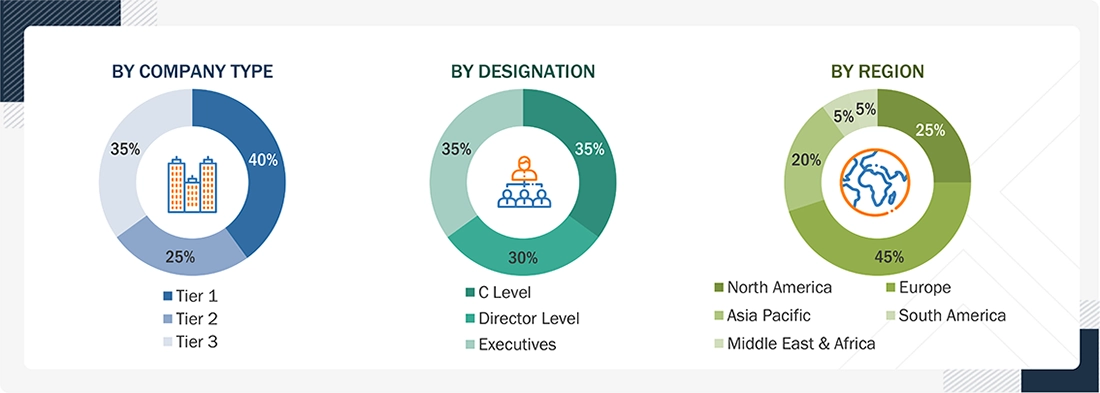
To know about the assumptions considered for the study, download the pdf brochure
Market Size Estimation
The bottom-up and top-down approaches were used to estimate the geomembranes market by type, application, and region. The research methodology used to calculate the market size includes the following steps:
- The key players in the industry and markets were identified through extensive secondary research.
- In terms of value, the industry’s supply chain and market size were determined through primary and secondary research processes.
- All percentage shares, splits, and breakdowns were determined using secondary sources and verified through primary sources.
- All parameters that affect the markets covered in this research study were accounted for, examined in detail, verified through primary research, and analyzed to obtain the final quantitative and qualitative data.
- The research included reviewing reports, reviews, and newsletters from top market players, as well as extensive interviews with leaders, such as directors and marketing executives, to gather opinions.
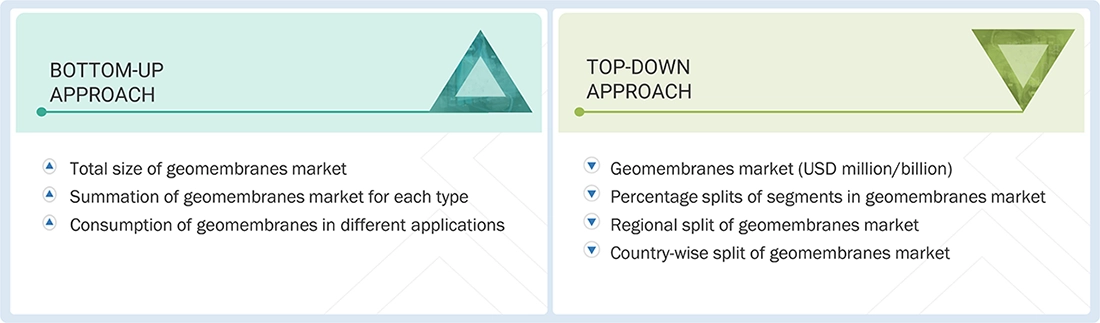
Data Triangulation
After estimating the total size of the geomembranes market, the market was divided into multiple segments and subsegments. Data triangulation and breakdown methods were used, where relevant, to refine the overall market analysis and determine precise statistics for all segments. The data was cross-checked by examining factors and trends from both demand and supply perspectives. Additionally, market size validation was performed using top-down and bottom-up approaches.
Market Definition
Geomembranes are a kind of impermeable polymer sheets that work as a barrier material to stop the movement of liquids, gases and different contaminants in environmental and civil engineering applications. They are usually made from high-density polyethylene (HDPE), linear low-density polyethylene (LLDPE), low-density polyethylene (LDPE), polyvinyl chloride (PVC), and other polymer-based blends. They are used in landfill sites, mining operations, wastewater treatment facilities, reservoirs and canals, tunnels, aquaculture ponds, and industrial containment units. They demonstrate strong chemical resistance, durability, flexibility, and low permeability, making them essential for the safe handling of materials, water conservation, and overall environmental protection across various industries.
Key Stakeholders
- Geomembranes manufacturers
- Raw material suppliers
- Regulatory bodies and government agencies
- Distributors and suppliers
- End-use industries
- Associations and industrial bodies
- Market research and consulting firms
Report Objectives
- To define, describe, and forecast the size of the geomembranes market in terms of value and volume
- To provide detailed information regarding the key factors influencing the growth of the market (drivers, restraints, opportunities, and challenges)
- To forecast the market size based on type, application, and region
- To study the market qualitatively based on manufacturing process
- To forecast the market size for the five main regions—North America, Europe, Asia Pacific, South America, and Middle East & Africa—along with their key countries
- To strategically analyze micromarkets with respect to individual growth trends, prospects, and contributions to the total market
- To analyze opportunities in the market for stakeholders and provide details of the competitive landscape for market leaders
- To strategically profile leading players and comprehensively analyze their key developments, such as product launches, expansions, and deals in the market
- To comprehensively analyze the market share and core competencies of key players
- To study the impact of AI/Gen AI on the market under study, along with the macroeconomic outlook
Available customizations:
With the given market data, MarketsandMarkets offers customizations per the specific needs of companies.
The following customization options are available for the report:
PRODUCT ANALYSIS
- Product matrix, which provides a detailed comparison of the market for different sources of geomembranes
REGIONAL ANALYSIS
- Further breakdown of a country with respect to the geomembranes market
COMPANY INFORMATION
- Detailed analysis and profiling of additional market players
Get the Full Geomembranes Market Report
Full forecast, segment splits, and company analysis for all Geomembranes Market.
- China Geomembranes Market
- Japan Geomembranes Market
- Australia Geomembranes Market
- Indonesia Geomembranes Market
- South Korea Geomembranes Market
- Germany Geomembranes Market
- UK Geomembranes Market
- France Geomembranes Market
- Italy Geomembranes Market
- Spain Geomembranes Market
- Russia Geomembranes Market
- Canada Geomembranes Market
- Mexico Geomembranes Market
- South Africa Geomembranes Market
- Brazil Geomembranes Market
- Argentina Geomembranes Market
- US Geomembranes Market
- Rest Of Europe Geomembranes Market
- Rest Of Asia Pacific Geomembranes Market
- GCC Countries Geomembranes Market
- - Rest Of GCC Countries Geomembranes Market
- Rest Of South America Geomembranes Market
Need a Tailored Report?
Customize this report to your needs
Get 10% FREE Customization
Customize This Report
