
Rest Of Europe GNSS Simulator Market (2026-2031)

The Rest Of Europe GNSS Simulator Market was valued at $17.89 Million in 2026 and projected to reach to $19.8 Million by 2031, representing a compound annual growth rate of 11.48%. Rest Of Europe's GNSS Simulator Market demonstrates accelerating growth momentum, with a 11.48% CAGR significantly outperforming global benchmarks.


| Market Size in | USD 26.32 MN |
| Market Forecast in | |
| CAGR | |
| Forecast Period | |
| Units Considered | Value (USD MN) |
Rest Of Europe GNSS Simulator Market Trends and Insights
- The region is projected to expand to USD 19.80 million by 2031, driven by increasing demand for precise positioning technologies across defense, aerospace, and automotive sectors.
- Rest Of Europe's growth trajectory reflects strong adoption of GNSS simulation solutions for testing and validation applications, supported by regulatory frameworks and technological advancement in satellite navigation systems. The Rest Of Europe market is experiencing robust expansion at a compound annual growth rate (CAGR) of 11.48% over the 2026-2031 forecast period.
- This outpaces global growth trends, indicating accelerating investment in GNSS simulator infrastructure and R&D capabilities within the region.
- Rest Of Europe's competitive landscape features both established players and emerging innovators focused on delivering advanced simulation platforms for critical applications requiring high-fidelity positioning accuracy and reliability..
Key Market Statistics
- CAGR (2026-2031) 11.48% CAGR
- Market Size, 2026 ~USD 17.89 Million
- Forecast, 2031 ~USD 19.8 Million
- Country Rest Of Europe
Rest Of Europe GNSS Simulator Market Overview
Regional Valuation Growth :
Rest Of Europe's GNSS Simulator Market is valued at USD 17.89 million in 2026, expanding to USD 19.80 million by 2031, representing a robust 11.48% CAGR that outpaces the global average of 9.4%.
Defense & Aerospace Demand :
The region experiences strong adoption driven by defense modernization initiatives and aerospace testing requirements, with European nations investing in advanced positioning technologies for military and commercial applications.
Automotive Sector Integration :
Increasing integration of GNSS simulation in autonomous vehicle development and connected car technologies across Rest Of Europe is accelerating market penetration and creating new revenue opportunities.
Technology Precision Standards :
Rest Of Europe's stringent regulatory requirements for positioning accuracy in critical infrastructure and transportation sectors drive demand for sophisticated GNSS simulation solutions.
Rest Of Europe GNSS Simulator Market Dynamics
- The region's expansion is underpinned by substantial investments in defense capabilities, aerospace innovation, and autonomous vehicle development across multiple European nations.
- Key drivers include regulatory compliance requirements for positioning accuracy and increasing adoption of GNSS simulation in critical infrastructure testing. Looking ahead to 2031, Rest Of Europe is positioned for sustained market expansion as emerging technologies in connected mobility and smart transportation systems gain traction.
- The region's mature industrial base, combined with strong R&D capabilities and government support for advanced positioning technologies, creates favorable conditions for GNSS simulator manufacturers and solution providers to capture growing market share..
Market Ecosystem
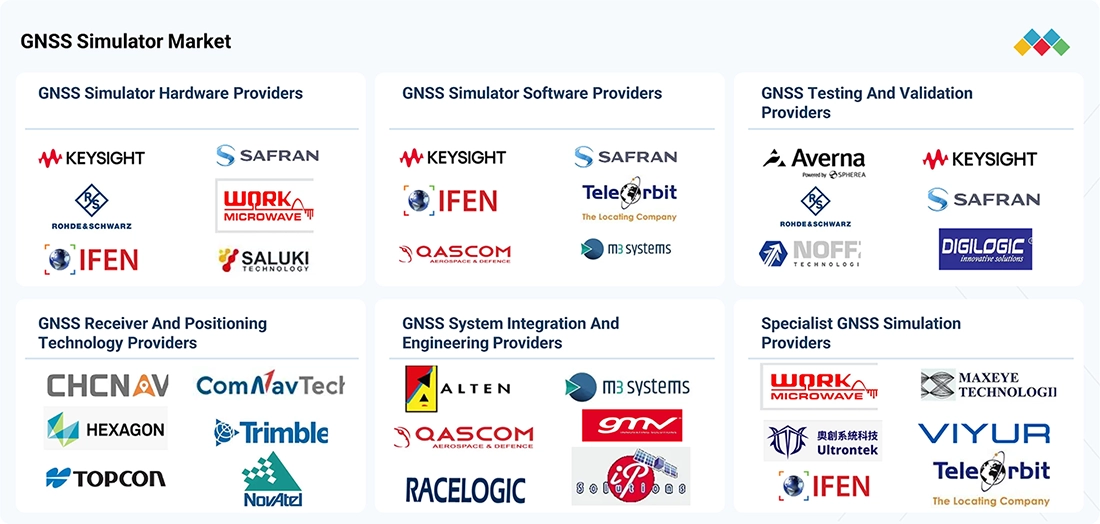
GNSS SIMULATOR MARKET: COMMERCIAL USE CASES ACROSS INDUSTRIES
| COMPANY | USE CASE DESCRIPTION | BENEFITS |
|---|---|---|
 |
Astrocast selected Keysight’s GSS7000 GNSS Simulator to expand laboratory testing of GNSS receivers used in its satellite IoT network. The system enabled Astrocast to compare receiver sensitivity and evaluate performance under different simulated conditions before deployment. | Identified differences in receiver sensitivity before launch, improved receiver evaluation, and enabled more comprehensive testing of satellite navigation performance. |
|
|
DLR selected a customized Keysight GSS9000 multi-element GNSS simulation system to support the development and validation of next-generation GNSS anti-jamming and anti-spoofing technology. | Supports controlled evaluation of anti-jamming and anti-spoofing technologies, enables repeatable testing, and helps assess receiver and antenna performance under simulated interference conditions. |
 |
Skyguide, Switzerland’s air navigation service provider, used IFEN’s NavX-NCS Professional GNSS Simulator to support compliance with new flight procedures. | Supports validation of GNSS-based flight procedures and helps assess navigation-system performance under controlled simulation conditions. |
|
|
Cobham SATCOM used IFEN’s NavX-NCS Essential GNSS Simulator to test a new GNSS receiver and prepare it for type approval. | Enabled receiver testing before type approval, supported verification of GNSS functionality, and helped prepare the receiver for formal qualification. |
 |
Stellantis (formerly Fiat Chrysler Automobiles) used Safran’s GSG-8 Advanced GNSS Simulator for automotive navigation R&D. The simulator reproduced satellite signals to test receiver performance under controlled conditions, supporting vehicle positioning system development and validation. | Enabled repeatable receiver testing, supported evaluation of navigation performance under simulated conditions, and helped validate vehicle positioning systems prior to deployment. |
Logos and trademarks shown above are the property of their respective owners. Their use here is for informational and illustrative purposes only.
Related Ecosystem
Analytics
- Natural Language Processing (NLP)
- Machine Learning
- Supply Chain Management
- Predictive Analytics
- Image Sensors
- International Business Machines Corporation
- MICROSOFT CORPORATION
- Oracle Corporation
- SAP SE
Mobility And Telecom
- Smart Utilities
- Sensors
- Smart Healthcare
- Parking Management System
- Passenger Information System (PIS)
- AT&T Inc.
- Cisco Systems, Inc.
- HUAWEI TECHNOLOGIES CO LTD
- Telefonaktiebolaget LM Ericsson (publ)
- International Business Machines Corporation
Software And Services
- Natural Language Processing (NLP)
- Machine Learning
- Supply Chain Management
- Predictive Analytics
- Image Sensors
- International Business Machines Corporation
- MICROSOFT CORPORATION
- Oracle Corporation
- SAP SE
- Amazon.com, Inc.
Key Takeaways
- Rest Of Europe GNSS Simulator Market valued at USD 17.89 million in 2026, expanding to USD 19.80 million by 2031
- Rest Of Europe demonstrates 11.48% CAGR, outperforming global average and reflecting strong regional demand
- Rest Of Europe's growth driven by defense, aerospace, and automotive sector investments in positioning technology validation
- Rest Of Europe market characterized by increasing R&D activity and adoption of advanced simulation platforms for critical applications
GNSS Simulator Market Report Scope
| Report Metric | Details |
|---|---|
| Base Year | 2026 |
| Fastest Growing Segment | SINGLE CHANNEL (Type) |
| Forecast Period | 2026-2030 |
| Growth Rate | CAGR of 9.4% from 2026 to 2030 |
| Largest Segment | HARDWARE (Solution) |
| Market Size Base Year (Billions) | ~USD 0.27 (2026) |
| Revenue Forecast (Billions) | ~USD 0.39 (2030) |
| Segments Covered | Component, Services, Type, Receiver, Application, Vertical, Service, Gnss Receiver, Solution |
Rest Of Europe GNSS Simulator Market Report Segmentation
9 segment dimensions are covered across the global market.
By Component
- Hardware
- Services
- Software
By Services
- Managed Services
- Professional Services
By Type
- Multi-Channel
- Single Channel
By Receiver
- Beidou
- Galileo
- Glonass
- Gps
By Application
- Location-Based Health Monitoring
- Location-Based Services
- Location-Based Social Networks
- Mapping
- Marketing And Advertising
- Navigation
- Other Applications
- Other Receivers
- Others*
- Surveying
- Tracking And Navigation
- Vehicle Assistance System
- Vehicle Assistance Systems
By Vertical
- Aerospace
- Automotive
- Consumer Electronics
- Marine
- Military And Defense
- Other Verticals
By Service
- Hardware Upgrades
- Maintenance & Support
- Managed Services
- Professional Services
- Software Upgrades
By Gnss Receiver
- Beidou
- Galileo
- Glonass
- Gps
- Other Receivers
By Solution
- Hardware
- Software
Target Audience
- Defense & Military Procurement : Military agencies and defense contractors in Rest Of Europe require detailed market intelligence on GNSS simulator capabilities and regional adoption trends to evaluate procurement strategies and technology investments.
- Aerospace & Aviation Companies : Aerospace manufacturers and testing facilities across Rest Of Europe need market data to assess GNSS simulation solution providers, benchmark capabilities, and plan integration into aircraft development and certification programs.
- Automotive & Mobility OEMs : Automotive manufacturers developing autonomous and connected vehicles in Rest Of Europe require market insights to identify GNSS simulator vendors and understand regional testing requirements and technology standards.
- Technology Solution Providers : GNSS simulator manufacturers and software developers targeting Rest Of Europe need regional market analysis to identify growth opportunities, competitive positioning, and customer segments within this high-growth market.
- Investment & Strategy Consultants : Private equity firms, venture capital investors, and management consultants evaluating opportunities in Rest Of Europe's positioning technology sector require comprehensive market data and growth forecasts for due diligence.
Reasons to Buy this Report
- Regional Market Sizing & Forecasts : Obtain precise valuation data specific to Rest Of Europe (USD 17.89M in 2026, USD 19.80M in 2031) with detailed 5-year projections to support strategic planning and investment decisions in this high-growth regional segment.
- Competitive Landscape Intelligence : Understand Rest Of Europe's unique competitive dynamics, key players, and market positioning strategies tailored to regional defense, aerospace, and automotive sectors that differ from broader European markets.
- Sector-Specific Growth Drivers : Identify and analyze the primary demand catalysts in Rest Of Europe including defense modernization, aerospace testing requirements, and autonomous vehicle development to prioritize market entry and expansion strategies.
- Regulatory & Standards Compliance : Access insights into Rest Of Europe's specific regulatory frameworks and positioning accuracy standards that influence GNSS simulator adoption, enabling compliant product development and market positioning.
- Investment & Partnership Opportunities : Discover high-potential partnerships, acquisition targets, and investment opportunities within Rest Of Europe's GNSS simulator ecosystem, supported by regional growth metrics and market trend analysis.
Frequently asked questions
What is the current market size of GNSS Simulators in Rest Of Europe?
Rest Of Europe's GNSS Simulator Market is valued at USD 17.89 million in 2026 and is projected to reach USD 19.80 million by 2031.
What is the growth rate for GNSS Simulators in Rest Of Europe?
Rest Of Europe's GNSS Simulator Market is growing at a compound annual growth rate (CAGR) of 11.48% from 2026 to 2031.
Which industries drive demand for GNSS Simulators in Rest Of Europe?
Rest Of Europe's demand is primarily driven by defense, aerospace, automotive, and telecommunications sectors requiring precise positioning validation and testing solutions.
How does Rest Of Europe's GNSS Simulator Market compare to global trends?
Rest Of Europe's 11.48% CAGR exceeds the global average of 9.4%, indicating stronger regional adoption and investment in GNSS simulation technologies.
What factors support growth in Rest Of Europe's GNSS Simulator Market?
Rest Of Europe's growth is supported by regulatory compliance requirements, increased R&D spending, technological advancements in satellite navigation, and rising demand for autonomous systems testing.
RESEARCH METHODOLOGY
Secondary research was conducted to gather information for this technical, market-oriented, commercial study of the GNSS simulator market. The next step involved validating these findings, assumptions, and sizing with industry experts across the value chain using primary research. Different approaches, including top-down and bottom-up methods, were employed to estimate the total market size. After that, market breakup and data triangulation procedures were used to estimate the market size of the segments and subsegments of the GNSS simulator market.
Secondary Research
During the secondary research process, various secondary sources were consulted to identify and collect information relevant to the study. The secondary sources included company annual reports, product documentation, press releases, investor presentations, technical publications, industry forums, conference materials, whitepapers, and government publications. Secondary research was mainly used to obtain key information about the industry's supply chain, the total pool of key players, market classification and segmentation according to industry trends, regional markets, product portfolios, and key developments from market- and technology-oriented perspectives, all of which were further validated by primary sources.
Primary Research
In the primary research process, various primary sources from both the supply and demand sides were interviewed to obtain qualitative and quantitative information for this report. Supply-side primary sources included industry experts such as chief executive officers (CEOs), vice presidents (VPs), marketing directors, technology and innovation directors, product managers, and other key executives from companies operating in the GNSS simulator market.
In the market engineering process, top-down and bottom-up approaches were extensively used, along with several data triangulation methods, to perform market estimation and forecasting for the overall market and its segments and subsegments. The market engineering process included extensive qualitative and quantitative analysis to compile the key information and insights presented in the report.
After completing the market engineering process, including calculations for market statistics, market breakups, market size estimates, market forecasts, and data triangulation, we conducted extensive primary research to gather information and verify and validate the key figures. Primary research was also conducted to identify segmentation types, industry trends, the competitive landscape of GNSS simulator market players, and key market dynamics, including drivers, restraints, opportunities, challenges, industry trends, and strategies.
The following is the breakdown of the primary study:
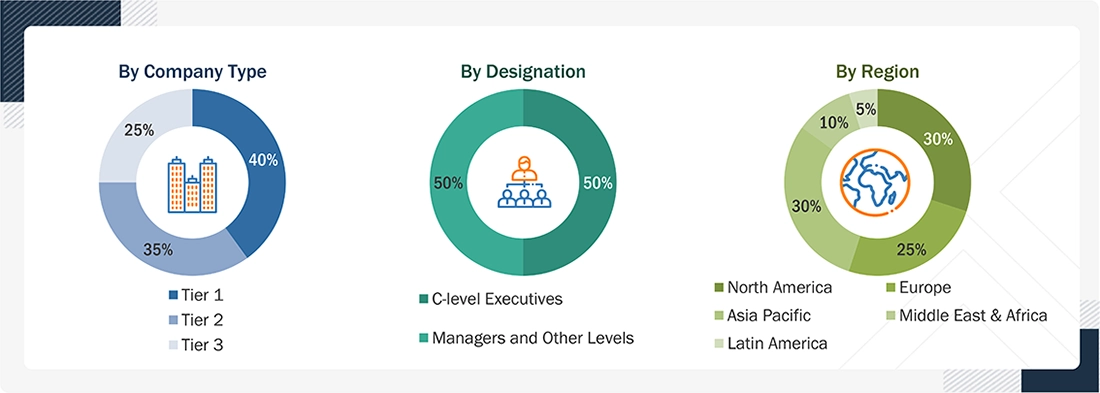
Note: Tier 1 companies have revenues above USD 10 billion; Tier 2 companies have revenues between USD 1 and 10 billion; and Tier 3 companies have revenues between USD 500 million and USD 1 billion. Other designations include sales, marketing, and product managers.
Source: Industry Experts
To know about the assumptions considered for the study, download the pdf brochure
Market Size Estimation
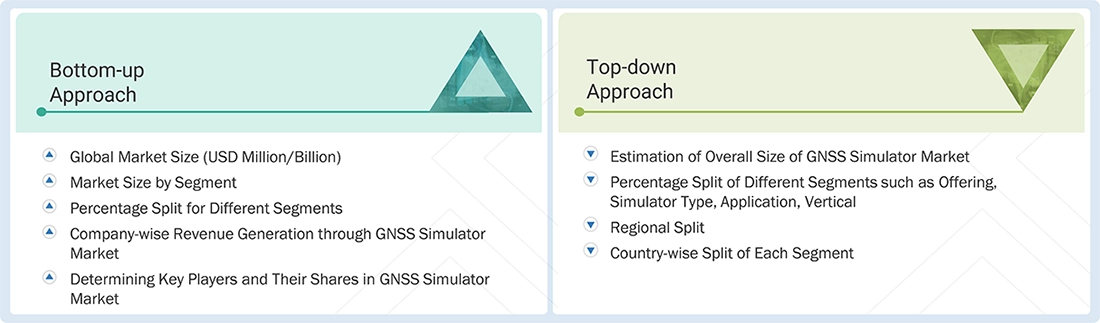
Top-down and bottom-up approaches were employed to estimate and validate the size of the GNSS simulator market, as well as the size of various dependent sub-segments within the overall GNSS simulator market. The research methodology used to estimate the market size includes the following details: critical players in the market were identified through secondary research, and their market shares in the respective regions were determined through primary and secondary research. This procedure involved reviewing the annual and financial reports of the top market players and conducting extensive interviews with key industry leaders, including CEOs, VPs, directors, and marketing executives, to gather insights.
We determined all percentage splits and breakdowns using secondary sources and verified them through primary sources. This study accounted for all parameters that affect the market, examined them in detail, verified them through primary research, and analyzed them to produce final quantitative and qualitative data. This data was consolidated with detailed inputs and analysis from MarketsandMarkets.
GNSS Simulator Market: Top-Down and Bottom-Up Approach
Data Triangulation
The market was divided into several segments and subsegments after estimating the overall market size using the market size estimation processes described above. Data triangulation and market breakup procedures were used, where applicable, to complete the market engineering process and estimate each segment and subsegment. Data was triangulated by evaluating multiple factors and trends from both demand-side and supply-side perspectives, including product offerings, end-use requirements, regional demand, and company-level information.
Market Definition
According to MarketsandMarkets, “GNSS simulators are hardware- and/or software-based systems that generate simulated Global Navigation Satellite System signals under controlled conditions to test, validate, and evaluate GNSS receivers and positioning systems. They reproduce satellite signals and configurable operating scenarios to assess receiver performance, positioning accuracy, timing, and resilience under different conditions.”
Key Stakeholders
- GNSS simulator manufacturers and solution providers
- GNSS receiver and chipset manufacturers
- Aerospace and defense organizations
- Automotive OEMs and autonomous-system developers
- Telecommunications and timing-system providers
- Surveying, mapping, and geospatial technology companies
- Government agencies and research institutions
- System integrators and testing laboratories
- Distributors and technology partners
- Investors and industry consultants
Report Objectives
- To define, describe, and forecast the GNSS simulator market based on component, simulator type, application, vertical, and region
- To provide detailed information about the major factors influencing market growth, including drivers, opportunities, restraints, and challenges
- To forecast market segment sizes across five major regions: North America, Europe, Asia Pacific, Middle East & Africa, and Latin America
- To analyze market subsegments in terms of individual growth trends, prospects, and contributions to the overall market
- To profile key market players and comprehensively analyze their market positioning, product portfolios, and core competencies
- To assess market opportunities for stakeholders and provide competitive landscape information on major players
- To analyze competitive intelligence through company profiles, strategies, and developments, including product launches, collaborations, partnerships, and acquisitions
- To track competitive developments in the global GNSS simulator market, including product enhancements, launches, acquisitions, partnerships, and collaborations
Available customizations:
With the given market data, MarketsandMarkets offers customizations based on company-specific needs. The following customization options are available for the report:
Goegraphic Analysis
-
Further breakdown of the Asia Pacific market by country, showing contributions to the regional market size.
-
Further breakdown of the North American market by country, showing each country's contribution to the regional market size.
-
Further breakdown of the Latin American market by country, showing each country's contribution to the regional market size.
-
Further breakdown of the Middle East & Africa market by country, showing each country's contribution to the regional market size.
-
Further breakdown of the European market into countries contributing to the rest of the regional market size.
Company Information
- Detailed analysis and profiling of additional market players (up to 5)
Get the Full GNSS Simulator Market Report
Full forecast, segment splits, and company analysis for all GNSS Simulator Market.
- Canada GNSS Simulator Market
- US GNSS Simulator Market
- UK GNSS Simulator Market
- Germany GNSS Simulator Market
- France GNSS Simulator Market
- China GNSS Simulator Market
- Japan GNSS Simulator Market
- India GNSS Simulator Market
- South Korea GNSS Simulator Market
- Rest Of Asia Pacific GNSS Simulator Market
- Brazil GNSS Simulator Market
- Mexico GNSS Simulator Market
- Rest Of Latin America GNSS Simulator Market
- Africa GNSS Simulator Market
- Middle East GNSS Simulator Market
Need a Tailored Report?
Customize this report to your needs
Get 10% FREE Customization
Customize This Report
