
Chile Green Ammonia Market (2024-2029)

The Chile Green Ammonia Market was valued at $8.7 Million in 2024 and projected to reach to $112.1 Million by 2029, representing a compound annual growth rate of 53.2%. Chile's green ammonia market is poised for transformative growth driven by the country's world-class renewable energy resources and strategic geographic location.


| Market Size in | USD 26.32 MN |
| Market Forecast in | |
| CAGR | |
| Forecast Period | |
| Units Considered | Value (USD MN) |
Chile Green Ammonia Market Trends and Insights
- This exceptional growth trajectory reflects Chile's strategic positioning as a renewable energy hub, leveraging abundant solar and wind resources to produce green ammonia for both domestic and export markets.
- Chile's commitment to decarbonization and its competitive advantage in renewable energy generation are driving significant investment in green ammonia production infrastructure. The 53.2% compound annual growth rate underscores Chile's emerging role in the global green ammonia transition.
- Between 2024 and 2029, Chile is expected to capitalize on its natural advantages and government incentives to establish itself as a key producer in Latin America.
- Chile's green ammonia sector is attracting international partnerships and capital, positioning the country to serve regional demand and contribute to global decarbonization objectives in fertilizer production, industrial processes, and clean energy applications..
Key Market Statistics
- CAGR (2024-2029) 53.2% CAGR
- Market Size, 2024 ~USD 8.7 Million
- Forecast, 2029 ~USD 112.1 Million
- Country Chile
Chile Green Ammonia Market Overview
Exceptional Growth Trajectory :
Chile's green ammonia market is projected to grow at a CAGR of 53.2%, expanding from $8.7 million in 2024 to $112.1 million by 2029, significantly outpacing global growth rates and positioning the country as a regional leader.
Renewable Energy Advantage :
Chile's abundant solar and wind resources in the Atacama Desert and Patagonia regions provide a competitive cost advantage for green ammonia production, enabling the country to become a major exporter to global markets.
Strategic Export Positioning :
With access to Pacific shipping routes and established trade relationships, Chile is uniquely positioned to supply green ammonia to Asia-Pacific and European markets, capitalizing on growing international demand for decarbonized fertilizers and fuels.
Government Decarbonization Commitment :
Chile's national climate targets and hydrogen strategy actively support green ammonia development through regulatory frameworks, investment incentives, and infrastructure development, creating a favorable business environment for market participants.
Chile Green Ammonia Market Dynamics
- The 53.2% CAGR reflects increasing investments from both domestic and international players seeking to establish production facilities that leverage Chile's competitive advantages in solar and wind power generation.
- Government support through hydrogen roadmaps and decarbonization policies further accelerates market development. By 2029, Chile is expected to emerge as a significant green ammonia producer and exporter, serving fertilizer manufacturers, chemical producers, and energy companies across multiple continents.
- The market expansion will be supported by infrastructure investments, port development, and partnerships with international energy majors, positioning Chile as a critical player in the global transition to sustainable ammonia production..
Market Ecosystem
Related Ecosystem
Decarbonization
- Battery Electric Vehicle (BEV)
- Energy Management Systems
- Fuel Cell
- Fuel Cell Electric Vehicle (FCEV)
- Geographical Information System (GIS)
- TotalEnergies SE
- Siemens ag
- Mitsui & Co., Ltd.
- General Electric Company
- Thyssenkrupp ag
Energy Storage
- Energy Harvesting
- HVAC System
- Applicant Tracking System
- Battery Electric Vehicle (BEV)
- Carboxymethyl Cellulose (CMC)
- MOMENTIVE PERFORMANCE MATERIALS INC.
- Panasonic Holdings Corporation
- Lg corp
- ABB India Limited
- Byd company ltd.
On Highway Off Highway Vehicles
- Internal Combustion Engine (ICE)
- Agricultural Tractors
- Crawler Excavator
- Battery Electric Vehicle (BEV)
- Excavators
- Visteon Corporation
- Deere & Company
- AB VOLVO PENTA
- Honda Motor Co., Ltd.
- Komatsu Ltd.
Key Takeaways
- Chile's green ammonia market is projected to grow from $8.7M (2024) to $112.1M (2029) at a 53.2% CAGR, reflecting strong regional demand and investment.
- Chile's abundant renewable energy resources-particularly solar and wind-provide a competitive cost advantage for green ammonia production compared to global peers.
- Government support and decarbonization policies in Chile are accelerating green ammonia adoption across fertilizer, industrial, and energy sectors.
- Chile is positioning itself as a key green ammonia exporter to Latin America and beyond, attracting multinational partnerships and foreign direct investment.
Green Ammonia Market Report Scope
| Report Metric | Details |
|---|---|
| Base Year | 2024 |
| Fastest Growing Segment | LARGE-SCALE (Capacity) |
| Forecast Period | 2024-2029 |
| Growth Rate | CAGR of 66% from 2024 to 2029 |
| Largest Segment | ALKALINE WATER ELECTROLYSIS (Technology) |
| Market Size Base Year (Billions) | ~USD 0.29 (2024) |
| Revenue Forecast (Billions) | ~USD 6.16 (2029) |
| Segments Covered | Technology, Capacity, Application, Type |
Chile Green Ammonia Market Report Segmentation
4 segment dimensions are covered across the global market.
By Technology
- Alkaline Water Electrolysis
- Proton Exchange Membrane Electrolysis
- Solid Oxide Electrolysis
By Capacity
- Large-Scale
- Medium-Scale
- Small-Scale
By Application
- Industrial Feedstock
- Power Generation
- Transportation
By Type
- Chemical, Pharmaceutical,
- Fertilizers
Target Audience
- Energy & Chemical Companies : Producers and distributors of ammonia and fertilizers need Chile-specific market data to evaluate production facility investments, sourcing strategies, and competitive positioning in the green ammonia supply chain.
- Renewable Energy Developers : Solar and wind energy companies operating in Chile require market insights to identify green ammonia as a value-added application for excess renewable capacity and to plan integrated energy-to-chemicals projects.
- Investment & Private Equity Firms : Investors evaluating opportunities in Chile's energy transition need detailed market sizing, growth projections, and risk assessments to make informed funding decisions in the green ammonia sector.
- Government & Policy Makers : Chilean government agencies and policymakers require market data to validate hydrogen strategy effectiveness, allocate resources efficiently, and design targeted incentive programs for green ammonia development.
- International Trading & Logistics Companies : Export-focused businesses and logistics providers need Chile market intelligence to develop ammonia trading routes, port infrastructure plans, and distribution networks for international green ammonia commerce.
Reasons to Buy this Report
- Market Size & Growth Validation : Obtain precise market valuation data for Chile's green ammonia sector with verified CAGR of 53.2%, enabling accurate financial forecasting and investment decision-making for the 2024-2029 period.
- Competitive Positioning Intelligence : Understand Chile's unique competitive advantages in renewable energy resources and export infrastructure compared to other regional producers, identifying market entry strategies and partnership opportunities.
- Investment & Expansion Planning : Access detailed market insights to support capital allocation decisions, facility location analysis, and supply chain development for companies planning to establish or expand green ammonia operations in Chile.
- Policy & Regulatory Landscape : Gain comprehensive understanding of Chile's hydrogen strategy, decarbonization policies, and government incentives that directly impact market growth, enabling compliant and optimized business operations.
- Export Market Opportunities : Identify demand drivers and customer segments across Asia-Pacific and European markets that Chile can serve, supporting market penetration strategies and long-term revenue projections for green ammonia exports.
Frequently asked questions
What is the current size of Chile's green ammonia market?
Chile's green ammonia market was valued at $8.7 million in 2024 and is expected to grow to $112.1 million by 2029.
What is the projected growth rate for green ammonia in Chile?
Chile's green ammonia market is projected to grow at a compound annual growth rate (CAGR) of 53.2% between 2024 and 2029.
Why is Chile well-positioned for green ammonia production?
Chile possesses abundant renewable energy resources, particularly solar and wind power, which provide cost-competitive advantages for green ammonia production and align with government decarbonization objectives.
What are the primary applications of green ammonia in Chile?
Green ammonia in Chile is primarily used in fertilizer production, industrial processes, and clean energy applications, with growing export potential to regional and global markets.
What factors are driving growth in Chile's green ammonia sector?
Key drivers include Chile's renewable energy abundance, government decarbonization policies, international partnerships, foreign direct investment, and rising regional demand for sustainable ammonia.
RESEARCH METHODOLOGY
The study involved major activities in estimating the current size of the green ammonia market. Exhaustive secondary research was done to collect information on the peer and parent markets. The next step was to validate these findings, assumptions, and sizing with industry experts across the value chain through primary research. Both top-down and bottom-up approaches were employed to estimate the total market size. Thereafter, market breakdown and data triangulation were used to estimate the market size of the segments and subsegments.
Secondary Research
This research study included secondary sources such as company annual reports, press announcements, and investor presentations, as well as white papers, certified publications, articles by renowned writers, and databases of numerous firms and associations. Secondary research has primarily been used to obtain key information about the industry's supply chain, monetary chain, total pool of key players, market classification and segmentation based on industry trends down to the lowest level, regional markets, and key developments from both market- and technology-oriented perspectives.
Primary Research
Primary research has been conducted to identify segments, industry trends, and the competitive landscape of the green ammonia market. In the primary research process, various primary sources from both the supply and demand sides have been interviewed to obtain qualitative and quantitative information for this report. Primary sources from the supply side include industry experts such as CEOs, vice presidents, marketing directors, technology and innovation directors, and related key executives from various companies and organizations operating in the green ammonia market. Various primary sources from both the supply and demand sides of the market were interviewed to obtain qualitative and quantitative information. Following is the breakdown of primary respondents:
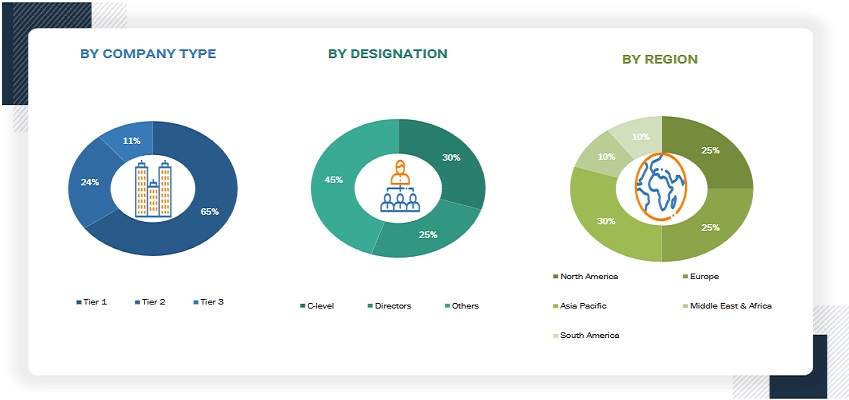
To know about the assumptions considered for the study, download the pdf brochure
Market Size Estimation
Top-down and bottom-up approaches have been used to estimate and validate the size of the green ammonia market and its dependent submarkets. Key players in the market have been identified through secondary research, and their market share in the respective regions has been obtained through both primary and secondary research. The research methodology includes the study of the annual and financial reports of the top market players and interviews with industry experts, such as chief executive officers, vice presidents, directors, sales managers, and marketing executives, to gain key quantitative and qualitative insights related to the green ammonia market. The research methodology used to estimate the market size includes the following:
- Extensive secondary research was used to identify the major players in the industry and market, and their market share was established using both primary and secondary research.
- Both primary and secondary research methods were used to assess the industry's value chain and market size.
- All percentage shares, splits, and breakdowns were obtained using secondary sources and validated by primary sources.
Green Ammonia Market Size: Top-Down and Bottom-Up Approach
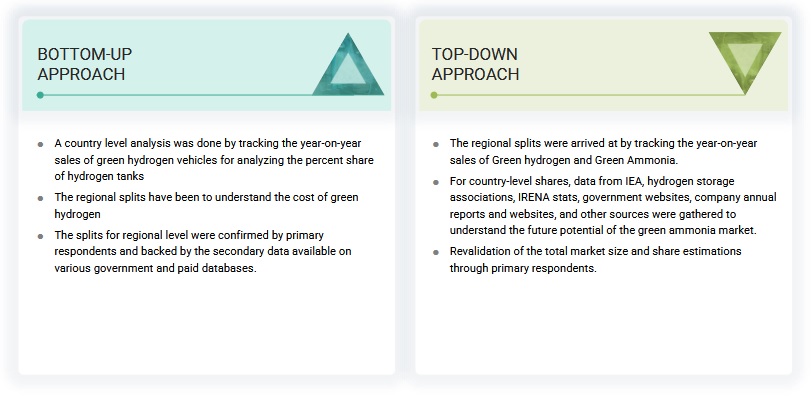
To know about the assumptions considered for the study, Request for Free Sample Report
Data Triangulation
After arriving at the overall market size from the estimation process explained below, the total market has been split into several segments and subsegments. The data triangulation and market breakdown procedures have been employed, wherever applicable, to complete the overall market engineering process and arrive at the exact statistics for all the segments and subsegments. The data has been triangulated by studying numerous factors and trends from both the demand and supply sides. Additionally, the market size has been validated using both top-down and bottom-up approaches.
Market Definition
Green ammonia refers to the manufacture of ammonia that is renewable and carbon-free. It is created by converting energy from sun, wind, and hydropower into an electrolyzer. It extracts hydrogen from water and removes nitrogen from the air using an air separation device. Ammonia is produced by reacting hydrogen and nitrogen at high temperatures and pressures. Green ammonia is used to produce carbon-neutral fertilizer products and decarbonize the food value chain, and it is likely to be used as a climate-neutral transportation fuel in the near future.
The Green ammonia market comprises revenues of companies for various end users such as transportation, power generation and industrial feedstock.
Key Stakeholders
- Industrial gas companies
- Ammonia manufacturers
- Electrolyzer and other equipment providers
- Hydrogen generation product and solution providers
- Engineering, procurement, and construction companies
- R&D laboratories
- Consulting companies from the energy & power sector
- Government and research organizations
- Renewable energy providers
Objectives of the Study
- To define, characterize, segment, and predict the value of the green ammonia market, by technology and end-use application.
- To predict the market size across four important regions: North America, Europe, Asia Pacific, and Rest of the World, as well as country-level analysis in terms of value and volume.
- To describe key elements required to produce green ammonia
- Provide statistical data on ammonia production, hydrogen generation, installed renewable capacity, and greenhouse gas emissions for each area and nation.
- To give extensive information about major drivers, restraints, opportunities, and industry-specific issues that influence the growth of the green ammonia market.
- To strategically study the green ammonia market in terms of individual growth patterns, opportunities, and contributions of each sector to the industry.
- To offer supply chain analysis, trends/disruptions effecting client business, market mapping, price analysis, and regulatory landscape for green ammonia.
- To strategically study micromarkets in terms of individual growth patterns, anticipated expansions, and their contribution to the overall market.
- Analyzing prospects for stakeholders in the green ammonia industry and creating a competitive landscape for market players
- To benchmark market participants, use the company assessment quadrant, which examines market players based on numerous characteristics within the broad areas of business and product strategies.
- To compare the main market participants based on their market share, product characteristics, and applications.
- To strategically profile important players and thoroughly study their market ranking and essential strengths.
- To examine competitive developments in the green ammonia market, such as sales contracts, agreements, investments, expansions, product launches, partnerships, joint ventures, and collaborations.
Available Customizations:
With the given market data, MarketsandMarkets offers customizations according to the specific requirements of companies. The following customization options are available for the report:
Product Analysis
- Product Matrix, which provides a detailed comparison of the product portfolio of each company
Company Information
- Detailed analyses and profiling of additional market players
Get the Full Green Ammonia Market Report
Full forecast, segment splits, and company analysis for all Green Ammonia Market.
- Germany Green Ammonia Market
- UK Green Ammonia Market
- Netherlands Green Ammonia Market
- Denmark Green Ammonia Market
- Norway Green Ammonia Market
- Spain Green Ammonia Market
- Australia Green Ammonia Market
- China Green Ammonia Market
- Japan Green Ammonia Market
- New Zealand Green Ammonia Market
- India Green Ammonia Market
- Canada Green Ammonia Market
- Mexico Green Ammonia Market
- US Green Ammonia Market
- Rest Of Europe Green Ammonia Market
- Rest Of Asia Pacific Green Ammonia Market
- Brazil Green Ammonia Market
- Other GCC Countries Green Ammonia Market
- Saudi Arabia Green Ammonia Market
- UAE Green Ammonia Market
Need a Tailored Report?
Customize this report to your needs
Get 10% FREE Customization
Customize This Report
