
Germany Green Data Center Market (2025-2030)

The Germany Green Data Center Market was valued at $2779.2 Million in 2025 and projected to reach to $8694.3 Million by 2030, representing a compound annual growth rate of CAGR 25.6%. Germany's green data center market is poised for exceptional growth as the country solidifies its position as Europe's sustainability leader.


| Market Size in | USD 26.32 MN |
| Market Forecast in | |
| CAGR | |
| Forecast Period | |
| Units Considered | Value (USD MN) |
Germany Green Data Center Market Trends and Insights
- Germany is positioning itself as a European leader in sustainable data infrastructure, driven by stringent environmental regulations, corporate sustainability commitments, and the country's renewable energy transition.
- The German market benefits from strong industrial demand, particularly from manufacturing and automotive sectors seeking energy-efficient computing solutions. The 25.6% compound annual growth rate reflects Germany's commitment to carbon neutrality and digital transformation.
- Germany's advanced infrastructure, skilled workforce, and investment in renewable energy sources-including wind and solar-create a competitive advantage for green data center operators.
- Between 2025 and 2030, Germany is expected to see significant capital deployment in cooling technologies, renewable energy integration, and modular data center designs that align with EU sustainability directives and corporate ESG objectives..
Key Market Statistics
- CAGR (2025-2030) CAGR 25.6%
- Market Size, 2025 ~USD 2779.2 Million
- Forecast, 2030 ~USD 8694.3 Million
- Country Germany
Germany Green Data Center Market Overview
Market Valuation Growth :
Germany's green data center market is valued at $2,779.2 million in 2025, with a projected CAGR of 25.6% through 2030, reaching $8,694.3 million. This growth significantly outpaces traditional data center expansion, reflecting Germany's commitment to sustainable infrastructure.
Regulatory & Policy Drivers :
Germany's stringent environmental regulations and EU Green Deal compliance requirements are accelerating adoption of green data centers. The country's Energy Efficiency Directive and carbon neutrality targets by 2045 create strong incentives for sustainable data infrastructure investments.
Renewable Energy Advantage :
Germany's robust renewable energy sector, with over 50% of electricity from renewables, provides a competitive advantage for green data center operations. This abundant clean energy supply reduces operational costs and carbon footprints for data center operators across the country.
Corporate Sustainability Leadership :
Major German enterprises and multinational corporations headquartered in Germany are driving demand for green data centers through ambitious ESG commitments. This corporate leadership creates sustained market momentum and attracts international investment in sustainable data infrastructure.
Germany Green Data Center Market Dynamics
- The convergence of regulatory mandates, renewable energy availability, and corporate environmental commitments creates a compelling investment landscape.
- German data center operators are increasingly adopting advanced cooling technologies, renewable energy integration, and circular economy principles to meet evolving market demands. Looking ahead to 2030, Germany's market will be shaped by continued digitalization, AI infrastructure expansion, and stricter EU environmental standards.
- The country's strong industrial base and technological expertise position it to develop innovative green data center solutions.
- Strategic investments in edge computing facilities and hyperscale sustainable data centers will drive market expansion, attracting both domestic and international players seeking to establish operations in Europe's most environmentally conscious market..
Market Ecosystem
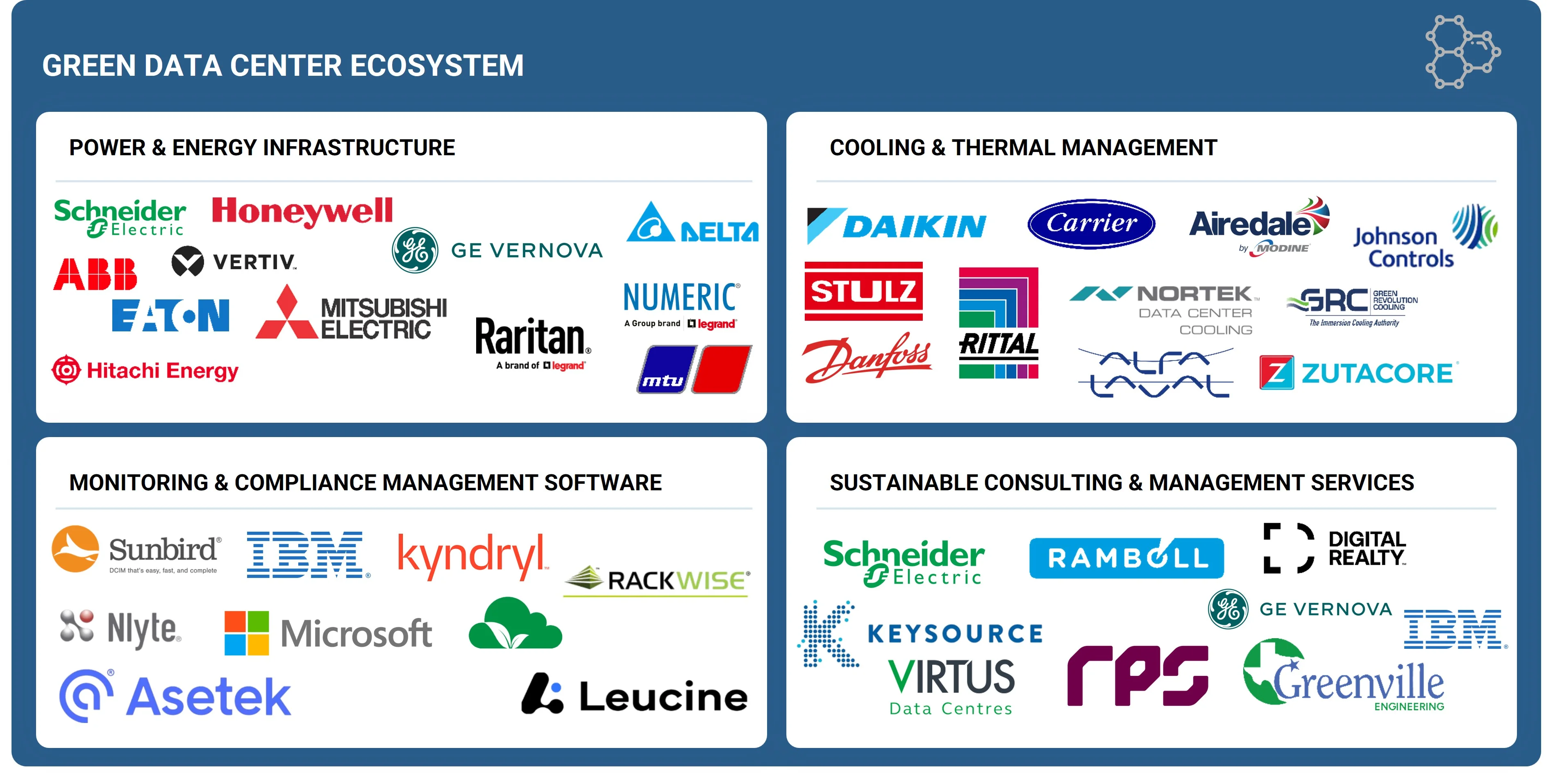
GREEN DATA CENTER MARKET: COMMERCIAL USE CASES ACROSS INDUSTRIES
| COMPANY | USE CASE DESCRIPTION | BENEFITS |
|---|---|---|
 |
Greenergy and A-Kaabel drive green data center growth with Vertiv rack PDUs | Seamless scaling from 4-6 kW racks to over 10 kW, improved energy efficiency with PUE reduced to 1.4, enhanced uptime performance surpassing 99.982% |
 |
Siemens supports BMO Financial Group with white space cooling optimization (WSCO) | Achieved 55% reduction in CRAH fan energy consumption, reduced the number of continuously operating CRAH units by 64%, improved thermal control & stability |
|
|
Siemens delivers AI-powered optimization at Greenergy Data Centers, Estonia | Improved cooling efficiency by 30%, achieved a PUE below 1.2, enabled AI-based predictive cooling, and reduced carbon footprint by reusing waste heat for office heating |
 |
Green Revolution Cooling enables green supercomputing at Texas Advanced Computing Center (TACC) with immersion cooling | Achieved a PUE of 1.1, significantly improving energy efficiency, reduced carbon footprint by up to 40%, enabled reliable cooling of 280W CPUs |
 |
Rittal lowers carbon footprint at Scottish Qualifications Authority (SQA) Data Centers | Reduced energy consumption and carbon footprint, freed up floor space by shifting to rack-mounted UPS and in-row cooling, enabled higher system reliability with N+1 redundancy in both cooling and UPS |
Logos and trademarks shown above are the property of their respective owners. Their use here is for informational and illustrative purposes only.
Related Ecosystem
Data Centre And Networking
- Software-Defined Networking (SDN)
- Mid-Sized Data Centers
- Small Data Centers
- Remote Monitoring
- Smart Healthcare
- Cisco Systems, Inc.
- HUAWEI TECHNOLOGIES CO LTD
- Hewlett Packard Enterprise Company
- MITSUBISHI ELECTRIC INFORMATION SYSTEMS CORPORATION
- MITSUBISHI ELECTRIC INFORMATION NETWORK CORPORATION
Key Takeaways
- Germany's green data center market will grow from $2,779.2M (2025) to $8,694.3M (2030), representing a 25.6% CAGR.
- Germany's renewable energy infrastructure and strict environmental regulations drive adoption of sustainable data center solutions.
- Germany's manufacturing and automotive sectors are primary demand drivers for energy-efficient computing infrastructure.
- Germany is positioned as a European hub for green data center innovation, attracting regional and global investment through 2030.
Green Data Center Market Report Scope
| Report Metric | Details |
|---|---|
| Base Year | 2025 |
| Fastest Growing Segment | GREEN LIQUID COOLING (Cooling Infrastructure) |
| Forecast Period | 2025-2030 |
| Growth Rate | CAGR of 26.4% from 2025 to 2030 |
| Largest Segment | LARGE & HYPERSCALE DATA CENTERS (50 MW & ABOVE) (Data Center Size & Capacity) |
| Market Size Base Year (Billions) | ~USD 48.27 (2025) |
| Revenue Forecast (Billions) | ~USD 155.75 (2030) |
| Segments Covered | Component, Infrastructure, Energy Infrastructure, Cooling Infrastructure, Software, Services, Data Center Size & Capacity, Data Center Type, Enterprise Data Center, Service |
Germany Green Data Center Market Report Segmentation
10 segment dimensions are covered across the global market.
By Component
- Infrastructure
- Services
- Software
- Solutions
By Infrastructure
- Cooling Infrastructure
- Energy Infrastructure
By Energy Infrastructure
- Energy-Effective Power Distribution
- Power Backup & Energy Storage
- Renewable Power Generators
By Cooling Infrastructure
- Green Air Cooling
- Green Liquid Cooling
By Software
- Building Management
- Compliance
- Data Center Infrastructure Management
- Data Center Infrastructure Management (Dcim)
- Other Software
By Services
- Eco-Friendly Integration & Deployment
- Other Services
- Others (Audit & Assessment, Migration And Decommissioning)
- Others Services
- Strategy Consulting & Energy Audits
- Strategy Consulting And Energy Audits
- Sustainable Operation & Maintenance Services
- Sustainable Operations & Maintenance Services
By Data Center Size & Capacity
- Edge & Micro Centers (1-5 Mw)
- Edge & Micro Data Centers (1-5 Mw)
- Large & Hyperscale Data Centers (50 Mw & Above)
- Medium Data Centers (5-50 Mw)
By Data Center Type
- Cloud & Hyperscale Data Centers
- Colocation Data Centers
- Enterprise Data Centers
By Enterprise Data Center
- Banking, Financial Services, & Insurance
- Banking, Financial Services, & Insurance (Bfsi)
- Bfsi
- Energy & Utilities
- Enterprise Data Center
- Enterprise Data Centers
- Government & Defense
- Healthcare & Life Sciences
- Manufacturing
- Media & Entertainment
- Other Enterprise Data Centers
- Retail & E-Commerce
- Technology & Software
- Telecommunications
By Service
- Eco-Friendly Integration & Deployment
- Other Services
- Strategy Consulting & Energy Audits
- Sustainable Operation & Maintenance Services
Target Audience
- Data Center Operators & Providers : German and international data center companies need market intelligence to optimize facility investments, assess competitive positioning, and identify growth opportunities in Germany's rapidly expanding green data center segment.
- Enterprise IT & Sustainability Leaders : Corporate decision-makers in Germany require market data to evaluate green data center partnerships, validate sustainability commitments, and ensure compliance with environmental regulations while optimizing infrastructure costs.
- Private Equity & Infrastructure Investors : Investment firms targeting Germany's digital infrastructure need comprehensive market analysis to identify acquisition targets, assess portfolio companies, and evaluate return potential in the high-growth green data center sector.
- Technology & Equipment Manufacturers : Suppliers of cooling systems, renewable energy solutions, and green data center technologies need German market insights to develop products, identify customer segments, and plan market penetration strategies.
- Government & Policy Advisors : German government agencies and policy organizations require market data to inform digital infrastructure strategy, assess regulatory effectiveness, and support evidence-based decision-making on sustainability initiatives.
Reasons to Buy this Report
- Market Size & Growth Validation : Obtain precise market valuation data for Germany ($2,779.2M in 2025) and verified CAGR projections (25.6%) through 2030. Validate investment decisions with authoritative market sizing and competitive positioning intelligence specific to the German market.
- Regulatory Landscape Intelligence : Understand Germany's unique environmental regulations, EU compliance requirements, and carbon neutrality targets that drive green data center adoption. Identify regulatory opportunities and compliance pathways essential for market entry and operational success in Germany.
- Competitive Positioning Strategy : Benchmark your organization against German market leaders and identify competitive gaps in sustainable data center offerings. Develop targeted strategies to capture market share in Europe's fastest-growing green data center economy.
- Investment & Expansion Planning : Make informed capital allocation decisions for German market expansion with detailed forecasts through 2030. Identify high-growth segments, emerging opportunities, and optimal timing for facility investments in Germany's thriving green data center sector.
- Stakeholder Communication : Present credible, data-backed market insights to investors, boards, and corporate partners regarding Germany's green data center opportunity. Strengthen business cases and secure funding with authoritative market research specific to German operations.
Frequently asked questions
What is the projected size of Germany's green data center market by 2030?
Germany's green data center market is projected to reach $8,694.3 million by 2030, growing from $2,779.2 million in 2025 at a 25.6% CAGR.
What factors are driving growth in Germany's green data center market?
Germany's growth is driven by stringent EU environmental regulations, corporate ESG commitments, abundant renewable energy resources, and strong demand from industrial sectors including manufacturing and automotive.
How does Germany's renewable energy capacity support green data centers?
Germany's significant wind and solar capacity provides cost-effective, low-carbon power for data center operations, reducing operational costs and environmental impact while meeting sustainability targets.
Which industries in Germany are driving green data center demand?
Germany's manufacturing, automotive, financial services, and technology sectors are primary drivers, seeking energy-efficient infrastructure to support digital transformation and sustainability goals.
What technologies are being deployed in Germany's green data centers?
Germany's green data centers are adopting advanced cooling systems, renewable energy integration, modular designs, and AI-driven energy optimization to maximize efficiency and minimize carbon footprint.
RESEARCH METHODOLOGY
This research study involved the use of extensive secondary sources, directories, and databases, such as D&B Hoovers, Bloomberg Businessweek, and Factiva, to identify and collect information for a technical, market-oriented, and commercial study of the green data center market. Additionally, a few other market-related reports and analyses published by various industry associations and consortia, such as the National Security Agency (NSA) and SC Magazine, were considered while conducting extensive secondary research.
Secondary Research
The market size of companies offering green data centers was determined based on secondary data available through paid and unpaid sources, analyzing the product portfolios of major companies in the ecosystem, and rating the companies based on their product capabilities and business strategies. Various sources were referred to in the secondary research process to identify and collect information for the study. The secondary sources included annual reports, press releases, investor presentations of companies, product data sheets, white papers, journals, certified publications, and articles from recognized authors, government websites, directories, and databases.
Primary Research
In the primary research process, various primary sources from the supply and demand sides were interviewed to obtain qualitative and quantitative information for this report. The primary sources from the supply side included industry experts, such as chief executive officers (CEOs), vice presidents (VPs), marketing directors, technology and innovation directors, and related key executives from various key companies and organizations operating in the green data center market.
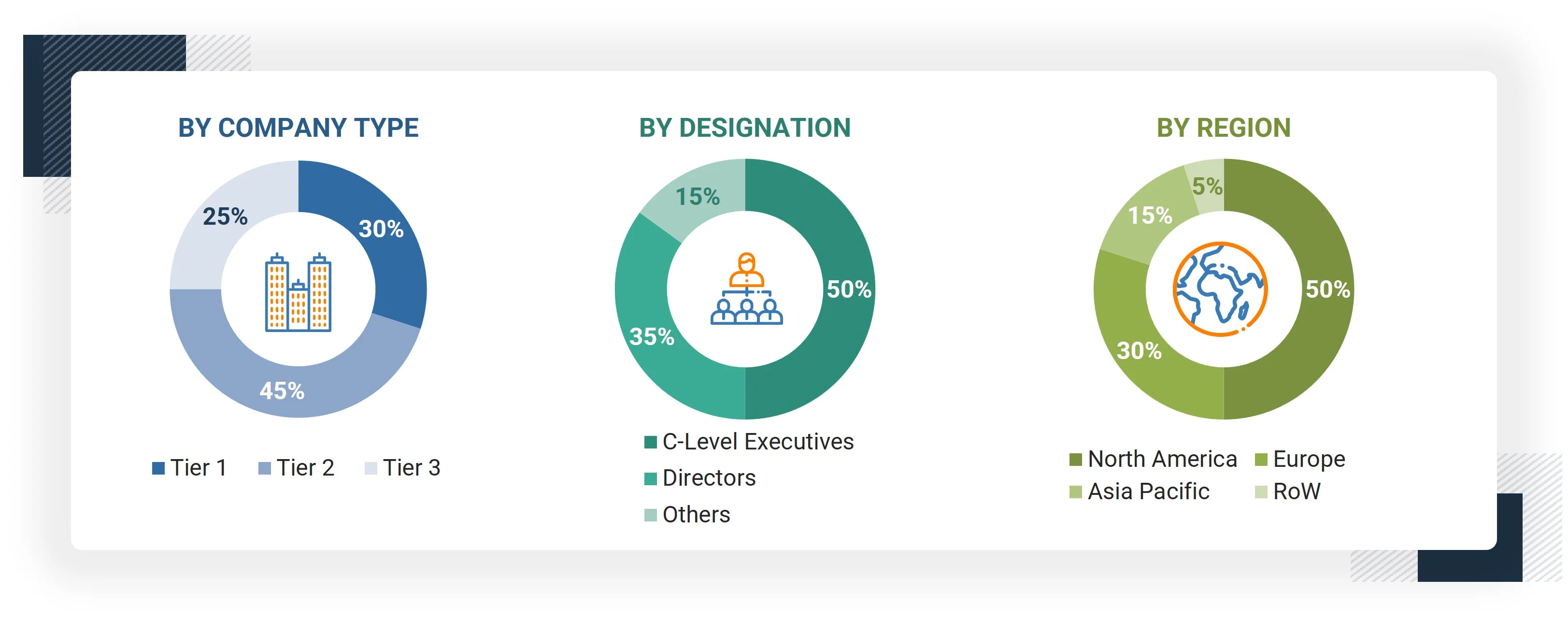
Note: Tier 1 companies’ revenues are more than USD 10 billion; tier 2 companies’ revenues range between USD 1 and 10 billion; and tier 3 companies’ revenues range between USD 500 million and USD 1 billion. Other designations include sales managers, marketing managers, and product managers.
Source: Industry Experts
To know about the assumptions considered for the study, download the pdf brochure
Market Size Estimation
Multiple approaches were adopted to estimate and forecast the green data center market. The first approach involved estimating the market size by companies’ revenue generated through the sale of green data center products.
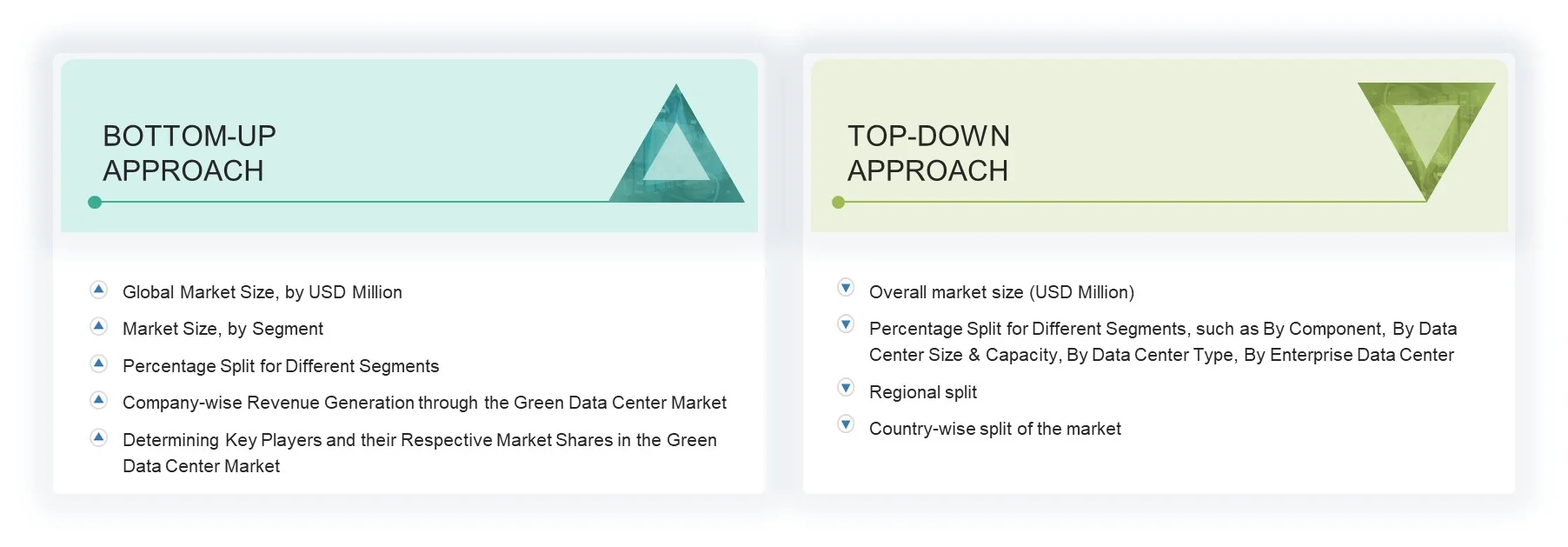
Market Size Estimation Methodology: Top-down Approach
The top-down methodology compiled a comprehensive database of all suppliers active within the green data center market. Revenue generation for these key industry players was assessed by analyzing annual financial statements, official press releases, capital investments, investor decks, premium market databases, and expert interviews. Every supplier's product portfolio was analyzed across parameters including architecture, level of tailorability, solution type, deployment scenario, vertical end user, and geographic location. Market estimates were cross-verified using a combination of primary and secondary intelligence gathering. The primary research phase involved detailed discussions to gather strategic perspectives from executive stakeholders, such as CIOs, CEOs, VPs, division heads, and commercial leads. Finally, the calculated market figures were cross-referenced against historical industry repositories for rigorous validation.
Market Size Estimation Methodology: Bottom-up Approach
The bottom-up methodology determined the deployment rate of green data center solutions across diverse industry verticals in major countries, accounting for regions that drive the majority of market share. To ensure cross-validation, the integration of eco-friendly data center infrastructure across enterprises and application scenarios within these regions was mapped and projected. Specific implementation cases across geographies were weighted to calculate total market valuation.
Driven by these market figures, geographic distribution was established using primary and secondary research insights. This framework incorporated an evaluation of regional market penetration for eco-friendly data centers. Through extensive secondary research, regional investments in Information and Communications Technology (ICT), national socioeconomic parameters, competitive vendor evaluation of key green data center providers, alongside organic and inorganic expansion strategies of global and regional stakeholders were quantified.
Data Triangulation
After determining the overall market size using the market size estimation processes as explained above, the market was split into several segments and subsegments. Data triangulation and market breakup procedures were employed, wherever applicable, to complete the overall market engineering process and arrive at the exact statistics of each market segment and subsegment. The overall market size was then used in the top-down procedure to estimate the size of other individual markets via percentage splits of the market segmentation.
Market Definition
Synthesizing perspectives from industry bodies and trade experts, MarketsandMarkets characterizes a green data center as a comprehensive ecosystem of power, thermal management, management software, and professional services tailored to drive sustainable, energy-efficient operations across data center environments. The power architecture encompasses green generation technologies, auxiliary energy storage, backup generators, and eco-friendly power distribution units, while thermal solutions feature advanced eco-air cooling and liquid cooling mechanisms. The software stack covers Data Center Infrastructure Management (DCIM), facility control systems, regulatory compliance monitoring, and related platforms. Supporting services incorporate sustainability consulting, energy assessment, green system integration, deployment, as well as ongoing eco-friendly maintenance. These technologies are integrated within hyperscale, colocation, and corporate facility environments to handle diverse compute workloads based on operational capacity.
According to IBM, a green data center—or eco-sustainable data center—denotes an operational facility built on highly efficient infrastructure that leverages clean technologies to optimize power consumption and minimize ecological footprints. Key evaluation metrics for sustainable data centers include facility footprint minimization, advanced thermal management efficiency, waste heat utilization, adoption of clean power alternatives, among other sustainability drivers.
Key Stakeholders
- Infrastructure & Equipment Vendors
- Software Solution Providers (DCIM, Energy Management, Compliance)
- Colocation Service Providers
- Hyperscale Cloud Providers
- Enterprises
- Renewable Energy Providers (Solar, Wind, Fuel Cells, etc.)
- Regulatory Bodies & Standards Organizations (ASHRAE, Uptime Institute, ISO, etc.)
- Consulting & Advisory Firms (Sustainability, Energy Audits, Certifications)
- Construction, Engineering & Real Estate Firms
- Investors and Real Estate Investment Trusts (REITs)
- System Integrators (SIs)
- Industry Alliances and Advocacy Groups
Report Objectives
- To define, describe, and forecast the green data center market based on component, data center size & capacity, data center type, and region
- To forecast the market size of the five major regional segments: North America, Europe, Asia Pacific, Middle East & Africa, and Latin America
- To strategically analyze the market subsegments concerning individual growth trends, prospects, and contributions to the total market
- To provide detailed information related to the major factors influencing market growth (drivers, restraints, opportunities, and challenges)
- To strategically analyze macro and micro markets1 with respect to growth trends, prospects, and their contribution to the overall market
- To analyze industry trends, patents and innovations, and pricing data related to the market
- To analyze the opportunities in the market for stakeholders and provide details of the competitive landscape for major players
- To profile key players in the market and comprehensively analyze their market share/ranking and core competencies2
- To track and analyze competitive developments, such as mergers & acquisitions, product developments, and partnerships & collaborations in the market
Available customizations:
With the given market data, MarketsandMarkets offers customizations as per the company’s specific needs. The following customization options are available for the report:
Product Analysis
- The product matrix provides a detailed comparison of the product portfolio of each company.y
Geographic Analysis based on feasibility
- Further breakup of the North American green data center market
- Further breakup of the European green data center market
- Further breakup of the Asia Pacific green data center market
- Further breakup of the Middle East & Africa green data center market
- Further breakup of the Latin American green data center market
Company Information
- Detailed analysis and profiling of additional market players (up to five)
Get the Full Green Data Center Market Report
Full forecast, segment splits, and company analysis for all Green Data Center Market.
- Canada Green Data Center Market
- US Green Data Center Market
- UK Green Data Center Market
- France Green Data Center Market
- Italy Green Data Center Market
- China Green Data Center Market
- Japan Green Data Center Market
- India Green Data Center Market
- Saudi Arabia Green Data Center Market
- UAE Green Data Center Market
- South Africa Green Data Center Market
- Brazil Green Data Center Market
- Mexico Green Data Center Market
- Rest Of Europe Green Data Center Market
- Rest Of Asia Pacific Green Data Center Market
- Rest Of Latin America Green Data Center Market
- GCC Countries Green Data Center Market
- Rest Of GCC Countries Green Data Center Market
Need a Tailored Report?
Customize this report to your needs
Get 10% FREE Customization
Customize This Report
