
Japan Green Hydrogen Market (2025-2030)

The Japan Green Hydrogen Market was valued at $279.5 Million in 2025 and projected to reach to $5637.5 Million by 2030, representing a compound annual growth rate of 53.6%. Japan's green hydrogen market is positioned as a cornerstone of the nation's energy transition strategy, with accelerating investments in production capacity and infrastructure development.


| Market Size in | USD 26.32 MN |
| Market Forecast in | |
| CAGR | |
| Forecast Period | |
| Units Considered | Value (USD MN) |
Japan Green Hydrogen Market Trends and Insights
- Japan is leveraging its advanced electrolyzer technology and renewable energy infrastructure to accelerate green hydrogen adoption across industrial and energy sectors.
- The market in Japan is expected to experience robust expansion, reaching USD 5,637.5 million by 2030, representing a compound annual growth rate of 53.6%. Japan's commitment to hydrogen as a clean energy carrier is driven by stringent emissions targets and limited domestic fossil fuel reserves.
- Japan has established hydrogen roadmaps and pilot projects in ammonia synthesis, steel production, and fuel cell vehicles, positioning the nation as a regional leader in green hydrogen commercialization.
- The rapid scaling in Japan reflects government incentives, corporate investment, and technological innovation across the hydrogen value chain. By 2030, Japan's green hydrogen market will benefit from declining electrolyzer costs, expanded renewable capacity, and international partnerships for hydrogen imports.
- Japan's strategic focus on hydrogen infrastructure development and industrial decarbonization will sustain accelerated market growth through the forecast period..
Key Market Statistics
- CAGR (2025-2030) 53.6% CAGR
- Market Size, 2025 ~USD 279.5 Million
- Forecast, 2030 ~USD 5637.5 Million
- Country Japan
Japan Green Hydrogen Market Overview
Market Valuation :
Japan's green hydrogen market is valued at USD 279.5 million in 2025, with a projected CAGR of 53.6% through 2030, reaching USD 5,637.5 million by forecast end.
Advanced Electrolyzer Technology :
Japan is leveraging cutting-edge electrolyzer manufacturing capabilities and domestic expertise to establish itself as a regional leader in green hydrogen production technology and innovation.
Renewable Energy Integration :
The nation's expanding renewable energy infrastructure, including offshore wind and solar capacity, provides a robust foundation for scaling green hydrogen production at competitive costs.
Industrial & Energy Sector Adoption :
Green hydrogen is being integrated across Japan's industrial manufacturing, power generation, and transportation sectors as part of the nation's comprehensive decarbonization roadmap.
Japan Green Hydrogen Market Dynamics
- The 53.6% CAGR reflects strong government support through subsidies, regulatory frameworks, and strategic partnerships with industrial stakeholders.
- By 2030, Japan aims to establish itself as a regional hub for green hydrogen technology and export capabilities. The market expansion is driven by Japan's commitment to achieving carbon neutrality by 2050 and meeting interim emission reduction targets.
- Industrial sectors including steel, chemicals, and refining are increasingly adopting green hydrogen as a decarbonization solution.
- Continued advancements in electrolyzer efficiency, coupled with declining renewable energy costs, will further accelerate market penetration and create new opportunities across the hydrogen value chain..
Market Ecosystem
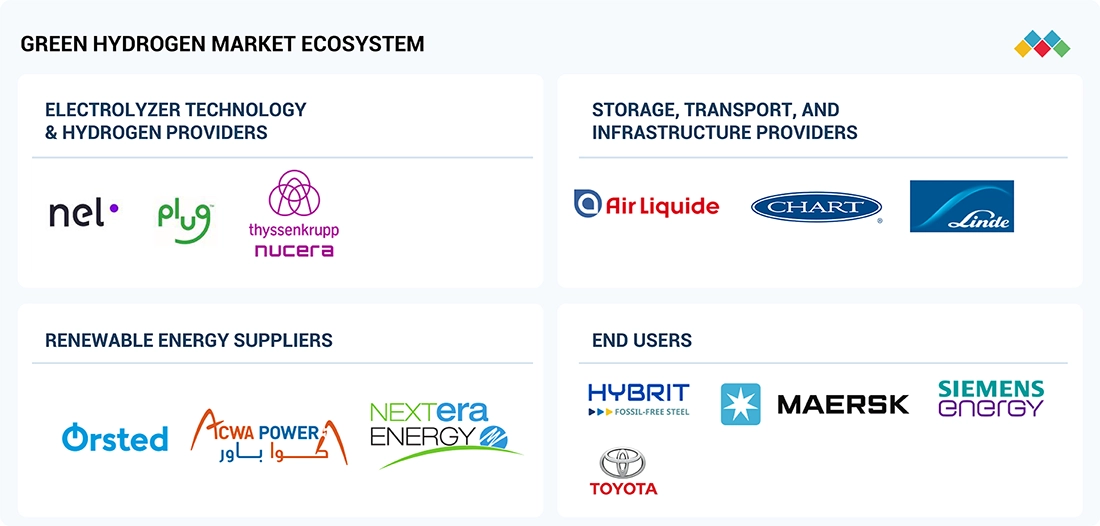
green-hydrogen-market: COMMERCIAL USE CASES ACROSS INDUSTRIES
| COMPANY | USE CASE DESCRIPTION | BENEFITS |
|---|---|---|
 |
HYBRIT produces steel using green hydrogen for Direct Reduced Iron (DRI), replacing coal-based blast furnaces. | Reduces CO2 emissions by up to 95% | Enables fossil-free steel production | Helps steelmakers meet EU and global net-zero standards |
 |
Yara uses green hydrogen to produce ammonia for fertilizers, reducing reliance on grey hydrogen from natural gas. | Cuts emissions in ammonia production (a major CO2 source) | Supports sustainable agriculture | Creates export opportunities for green ammonia fuel |
 |
Shell integrates green hydrogen into refinery operations to replace grey hydrogen used for hydrocracking and desulfurization. | Displaces fossil-derived hydrogen | Helps refineries comply with tightening carbon regulations | Supports production of low-carbon fuels |
 |
Fuel-cell heavy-duty trucks powered by green hydrogen for logistics fleets. | Zero tailpipe emissions | Longer range and faster refueling than battery trucks | Ideal for heavy, long-haul transport |
 |
Hydrogen-powered passenger trains operating on non-electrified rail routes. | Zero-emission rail transport | Avoids expensive overhead electrification | Quiet, efficient operations |
Logos and trademarks shown above are the property of their respective owners. Their use here is for informational and illustrative purposes only.
Related Ecosystem
Key Takeaways
- Japan's green hydrogen market is valued at USD 279.5 million in 2025 and is projected to reach USD 5,637.5 million by 2030, growing at a 53.6% CAGR.
- Japan is advancing green hydrogen through government policy support, pilot industrial projects, and partnerships in ammonia and steel decarbonization.
- Japan's limited fossil fuel resources and stringent climate targets position green hydrogen as essential to achieving net-zero emissions by 2050.
- Japan's technological leadership in electrolyzer manufacturing and fuel cell development strengthens its competitive position in the Asia Pacific green hydrogen market.
Green Hydrogen Market Report Scope
| Report Metric | Details |
|---|---|
| Base Year | 2025 |
| Fastest Growing Segment | OTHER RENEWABLE SOURCES (Renewable Source) |
| Forecast Period | 2025–2030 |
| Growth Rate | CAGR of 60% from 2025 to 2030 |
| Largest Segment | ALKALINE ELECTROLYSIS (Technology) |
| Market Size Base Year (Billions) | ~USD 2.79 (2025) |
| Revenue Forecast (Billions) | ~USD 29.22 (2030) |
| Segments Covered | Renewable Source, Technology, End-Use Industry |
Japan Green Hydrogen Market Report Segmentation
3 segment dimensions are covered across the global market.
By Renewable Source
- Other Renewable Sources
- Solar Energy
- Wind Energy
By Technology
- Alkaline Electrolysis
- Pem Electrolysis
By End-Use Industry
- Chemical
- Grid Injection
- Industrial
- Mobility
- Other End-Use Industries
- Power
JAPAN: GREEN HYDROGEN MARKET, BY END-USE INDUSTRY, 2025–2032
| Segment | 2025 | 2026 | 2027 | 2028 | 2029 | 2030 | 2031 | 2032 | CAGR (%) |
|---|---|---|---|---|---|---|---|---|---|
| CHEMICAL | 25.3 | 37.1 | 53.6 | 79.8 | 117.8 | 172 | 264 | 403.6 | 48.5 |
| GRID INJECTION | 26.6 | 39.7 | 60.3 | 90.6 | 140.2 | 215.2 | 327.5 | 521.6 | 53 |
| INDUSTRIAL | 14.1 | 20.9 | 30.6 | 46.2 | 69.1 | 102.1 | 159.1 | 246.6 | 50.5 |
| MOBILITY | 156.4 | 241.9 | 370.1 | 559.3 | 831.8 | 1278.9 | 2058.6 | 3302.7 | 54.6 |
| OTHER END-USE INDUSTRIES | 7.1 | 10.3 | 14.9 | 22.2 | 31.3 | 45.6 | 69.6 | 105.9 | 47.2 |
| POWER | 50 | 76.8 | 116.5 | 174.3 | 269.4 | 412 | 661.2 | 1057.1 | 54.6 |
| TOTAL | 279.5 | 426.6 | 646 | 972.4 | 1459.6 | 2225.9 | 3539.9 | 5637.5 | 53.6 |
Target Audience
- Industrial Manufacturers : Steel, chemical, and refining companies need Japan market data to evaluate green hydrogen adoption feasibility, cost structures, and supply chain integration strategies for decarbonization.
- Energy & Utility Companies : Power generators and energy providers require insights into Japan's hydrogen production capacity, renewable energy integration, and market opportunities for hydrogen-based energy solutions.
- Technology & Equipment Suppliers : Electrolyzer manufacturers and hydrogen technology providers need Japan-specific market intelligence to identify demand drivers, competitive landscape, and expansion opportunities.
- Investment & Financial Firms : Private equity, venture capital, and institutional investors need accurate market forecasts and growth projections to evaluate investment opportunities in Japan's green hydrogen sector.
- Government & Policy Organizations : Government agencies and policy makers require market data to assess decarbonization progress, validate policy effectiveness, and inform strategic hydrogen economy development initiatives.
Key Companies in the Japan Green Hydrogen Market
| Company | HQ | Ownership | Strongest segments |
|---|---|---|---|
| PETROBRAS | Brazil | Public Company | Exploration and Production (crude oil, NGLs, natural gas),Refining, Transportation & Marketing (oil products, petrochemicals, fertilizers),Gas & Low Carbon Energies (natural gas, LNG, power, renewables, biodiesel), |
| LINDE PLC | United Kingdom | Public Company | Atmospheric gases (oxygen, nitrogen, argon),Process gases (hydrogen, CO2, CO, helium, specialty),Engineering & turnkey process plants, |
| UNIPER SE | Germany | Public Company | Greener Commodities (gas, storage, low-carbon fuels, trading),Flexible Generation (gas, coal, oil plants and energy services),Green Generation (hydro, nuclear, wind, solar), |
| LHYFE | France | Public Company | On-site industrial hydrogen supply,Bulk delivery (trailers and logistics),Pipeline and cluster supply, |
| NEL | Norway | Public Company | Alkaline Electrolysers and Systems,PEM Electrolysers and Systems,Hydrogen Refueling and Distribution Solutions, |
| ØRSTED | Denmark | Public Company | Offshore wind generation,Onshore wind and solar,Energy trading and ancillary services, |
| BLOOM ENERGY | United States | Public Company | Bloom Energy Server (SOFC on-site power),Bloom Electrolyzer (hydrogen production),Services, installation, and long-term maintenance, |
| CUMMINS INC. | United States | Public Company | Engine segment (on- and off-highway diesel and natural gas engines),Distribution and aftermarket (parts, service, dealer network),Components and aftertreatment, |
| SINOSYNERGY | China | Public Company | Fuel cell systems (mobility: public and logistics transportation, rail),Fuel cell stacks and flexible graphite bipolar plates,Stationary power generation and backup power systems, |
PETROBRAS
Petrobras is a Brazilian public company founded in 1953 with 43,199 employees, operating as a major oil and energy corporation.
LINDE PLC
Linde PLC is a United Kingdom-based public company founded in 1879 with 65,034 employees, operating in the industrial gases and engineering sector.
UNIPER SE
Uniper SE is a German public company founded in 1894 with 7,177 employees, operating in the energy and utilities sector.
LHYFE
LHYFE is a French public company founded in 2017 with 188 employees, operating in the renewable energy sector.
NEL
NEL is a Norwegian public company founded in 1927 with 313 employees, operating in the energy technology sector.
ØRSTED
Ørsted is a Danish public company founded in 1972, operating in the renewable energy sector.
BLOOM ENERGY
Bloom Energy is a United States-based public company founded in 2001 with 2,214 employees, specializing in fuel cell technology and clean energy solutions.
CUMMINS INC.
Cummins Inc. is a United States-based public company founded in 1919 with 67,400 employees, operating in the design, manufacture, and distribution of engines and power generation equipment.
SINOSYNERGY
Sinosynergy is a Chinese public company founded in 2015 with 303 employees, operating in the energy sector.
Reasons to Buy this Report
- Market Size & Growth Projections : Access precise valuation data for Japan's green hydrogen market with a 53.6% CAGR, enabling accurate financial forecasting and investment planning through 2030.
- Technology & Infrastructure Insights : Understand Japan's advanced electrolyzer capabilities and renewable energy integration strategies that differentiate the market and create competitive advantages for stakeholders.
- Sector-Specific Adoption Trends : Identify which industrial sectors—steel, chemicals, refining, and power generation—are prioritizing green hydrogen adoption and their specific requirements and timelines.
- Regulatory & Policy Framework : Gain clarity on Japan's government incentives, subsidies, and decarbonization targets that are shaping market dynamics and creating investment opportunities.
- Competitive Positioning : Benchmark your organization against Japan's emerging green hydrogen ecosystem and identify partnership, acquisition, or market entry opportunities in a high-growth market.
Frequently asked questions
What is the current size of Japan's green hydrogen market in 2025?
Japan's green hydrogen market is valued at USD 279.5 million in 2025, reflecting early-stage commercialization and government-backed pilot initiatives across industrial sectors.
What is the projected market size for Japan's green hydrogen market by 2030?
Japan's green hydrogen market is forecast to reach USD 5,637.5 million by 2030, representing a 53.6% compound annual growth rate over the five-year period.
What are the primary drivers of green hydrogen growth in Japan?
Japan's green hydrogen growth is driven by carbon neutrality targets, industrial decarbonization needs, government subsidies, renewable energy expansion, and technological advances in electrolyzer efficiency.
Which industries in Japan are adopting green hydrogen?
Japan is deploying green hydrogen in steel production, ammonia synthesis, fuel cell vehicles, power generation, and chemical manufacturing as part of industrial decarbonization strategies.
How does Japan's green hydrogen market compare to other Asia Pacific countries?
Japan leads the Asia Pacific region in green hydrogen technology development and pilot deployment, though China and South Korea are also scaling production capacity rapidly.
RESEARCH METHODOLOGY
The research methodology used to estimate the current size of the green hydrogen market consisted of four major activities. Extensive secondary research was performed to acquire detailed information about the market, peer markets, and parent markets. These findings, assumptions, and metrics were verified through primary research with experts from both the demand and supply sides of the green hydrogen value chain. Both top-down and bottom-up approaches were used to estimate the total market size. The estimation of market sizes for various segments and subsegments in the market was finalized using full market segmentation and data triangulation techniques.
Secondary Research
The research methodology for estimating and forecasting the green hydrogen market begins with gathering data on key vendors' revenues by doing secondary research. The secondary research process involves consulting a range of secondary sources, including Hoover's, Bloomberg Businessweek, Factiva, the World Bank, and industry-specific journals. These secondary sources encompass annual reports, press releases, investor presentations, white papers, certified publications, articles from recognized authors, regulatory notifications, trade directories, and databases. Also, vendor offerings are taken into consideration to inform market segmentation.
Primary Research
The green hydrogen market comprises several stakeholders, including raw material suppliers, processors, end-product manufacturers, and regulatory organizations, throughout the supply chain. The demand side of this market is characterized by the development of various industries, including mobility, power, chemicals, industrial, and grid injection, among others. The supply side is characterized by advancements in technology and a wide range of diverse applications. Various primary sources from both the supply and demand sides of the market were interviewed to obtain qualitative and quantitative information. The following is the breakdown of the primary respondents:
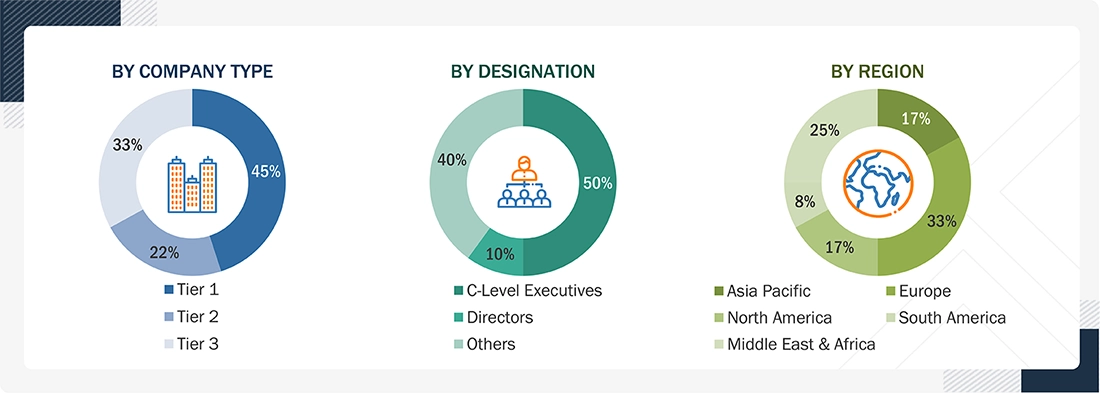
To know about the assumptions considered for the study, download the pdf brochure
Market Size Estimation
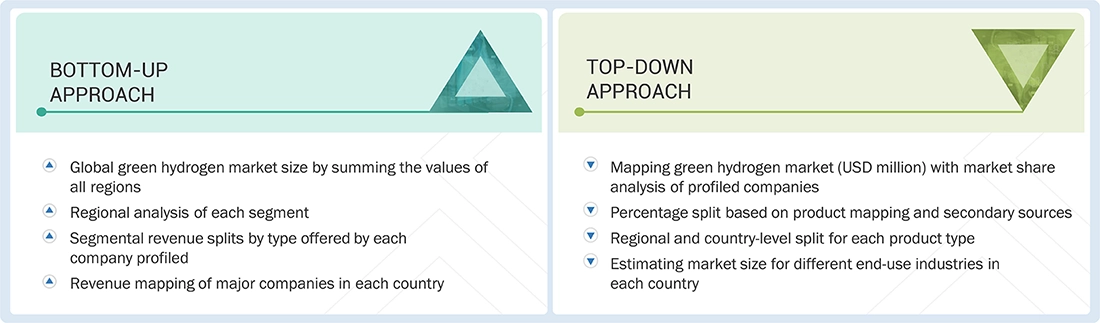
The top-down and bottom-up approaches have been used to estimate and validate the total size of the green hydrogen market. These approaches have also been used extensively to estimate the size of various dependent market subsegments. The research methodology used to estimate the market size included the following.
The following segments provide details about the overall market size estimation process employed in this study:
- Extensive primary and secondary research was done to identify the key players.
- The value chain and market size in terms of value of the green hydrogen market were determined through primary and secondary research.
- All percentage shares, splits, and breakdowns were collected through secondary sources and verified through primary sources.
- All possible parameters that affect the market were covered in this research study and are viewed in extensive detail, verified through primary research, and analyzed to obtain the final quantitative and qualitative data.
- The study of reports, reviews, and newsletters of top market players, along with extensive interviews for opinions from key leaders, such as CEOs, directors, and marketing executives, is included in this research.
Green Hydrogen Market : Top-Down and Bottom-Up Approach
Data Triangulation
After estimating the overall market size using the above estimation process, the market was split into various segments and subsegments. Data triangulation and market segmentation techniques, along with the market engineering process, were employed to obtain precise market analysis data for each segment and its subsegments.
Research Methodology: The research methodology used to estimate and forecast the global market size began by aggregating data and information from various levels, including country-level data.
Market Definition
According to the US Department of Energy, green hydrogen is carbon-free hydrogen produced through the electrolysis of renewable and nuclear resources. The electrolysis process uses electricity to split water into hydrogen and oxygen, a process that takes place in a unit called an electrolyzer. Electrolyzers are available in small and large sizes. Small-capacity electrolyzers are used for small-scale distributed hydrogen production. In the case of large-capacity electrolyzers, hydrogen production facilities can be tied directly to renewable or other non-greenhouse-gas-emitting forms of electricity production.
Key Stakeholders
- Green Hydrogen Plant Operators and Electrolyzer Manufacturers
- Renewable Energy Project Developers and Utility Power Providers
- Associations and Industrial Bodies such as the Hydrogen Council, ISO/IEC, IRENA, and National Energy Agencies
- NGOs, Governments, Investment Banks, Venture Capitalists, and Private Equity Firms
Report Objectives
- To define, describe, and forecast the market size of green hydrogen, in terms of value and volume
- To provide detailed information regarding the key factors, such as drivers, restraints, opportunities, and industry-specific challenges, influencing the growth of the green hydrogen market
- To analyze and forecast the size of various segments (renewable source, technology, end-use industry, distribution channel, production scale, purity level, and storage) of the green hydrogen market based on five major regions—North America, Europe, Asia Pacific, South America, Middle East & Africa—along with key countries in each of these regions
- To analyze recent developments and competitive strategies, including expansions, product launches, partnerships, and acquisitions, to understand the market's competitive landscape
- To strategically profile the key players in the market and comprehensively analyze their core competencies
Available Customizations:
With the given market data, MarketsandMarkets offers customizations according to the client-specific needs.
The following customization options are available for the report:
- Additional country-level analysis of the green hydrogen market
- Profiling of additional market players (up to 5)
Product Analysis
- Product matrix, which provides a detailed comparison of each company's product portfolio.
Geographic Analysis
- Further breakdown of the Rest of Europe surgical robots market into Russia, Switzerland, Denmark, Austria, and others
- Further breakdown of the Rest of Asia Pacific surgical robots market into South Korea, Taiwan, and others
- Further breakdown of the Rest of Latin America surgical robots market into Argentina, Colombia, Chile, Ecuador, and others
- Further breakdown of the Southeast Asia surgical robots market into Malaysia, Singapore, New Zealand, and others
Competitive Landscape Assessment
- Market share analysis, by region (North America and Europe), which provides market shares of the top 3–5 key players in the surgical robots market
- Competitive leadership mapping for established players in the US
Get the Full Green Hydrogen Market Report
Full forecast, segment splits, and company analysis for all Green Hydrogen Market.
- US Green Hydrogen Market
- Canada Green Hydrogen Market
- Mexico Green Hydrogen Market
- Germany Green Hydrogen Market
- Austria Green Hydrogen Market
- Denmark Green Hydrogen Market
- UK Green Hydrogen Market
- France Green Hydrogen Market
- China Green Hydrogen Market
- Australia Green Hydrogen Market
- Brazil Green Hydrogen Market
- Argentina Green Hydrogen Market
- Rest Of Europe Green Hydrogen Market
- Rest Of Asia Pacific Green Hydrogen Market
- GCC Countries Green Hydrogen Market
- –Rest Of GCC Green Hydrogen Market
- Rest Of South America Green Hydrogen Market
Need a Tailored Report?
Customize this report to your needs
Get 10% FREE Customization
Customize This Report
