
South Korea High Temperature Insulation Materials Market (2025-2030)

The South Korea High Temperature Insulation Materials Market was valued at $173.4 Million in 2025 and projected to reach to $198.1 Million by 2030, representing a compound annual growth rate of 2.7%. South Korea's high temperature insulation materials market is positioned for steady growth, supported by the country's world-class industrial infrastructure and continuous investment in manufacturing efficiency.


| Market Size in | USD 26.32 MN |
| Market Forecast in | |
| CAGR | |
| Forecast Period | |
| Units Considered | Value (USD MN) |
South Korea High Temperature Insulation Materials Market Trends and Insights
- South Korea's demand for these materials is driven by its robust industrial base, particularly in steel manufacturing, petrochemicals, and semiconductor production, where thermal management is critical.
- The market in South Korea reflects steady but moderate growth compared to global trends, reflecting the country's mature industrial infrastructure and focus on efficiency improvements rather than capacity expansion. South Korea's high temperature insulation materials sector benefits from the nation's advanced manufacturing capabilities and stringent energy efficiency regulations.
- Industries across South Korea are increasingly adopting high-performance insulation solutions to reduce operational costs and meet environmental standards.
- Between 2025 and 2030, South Korea's market will be shaped by technological innovation, industrial modernization, and the transition toward sustainable manufacturing practices.
- The country's position as a global manufacturing hub ensures continued demand for specialized thermal insulation products across diverse industrial applications..
Key Market Statistics
- CAGR (2025-2030) 2.7% CAGR
- Market Size, 2025 ~USD 173.4 Million
- Forecast, 2030 ~USD 198.1 Million
- Country South Korea
South Korea High Temperature Insulation Materials Market Overview
Market Valuation :
South Korea's high temperature insulation materials market is valued at USD 173.4 million in 2025, with steady growth projected to USD 198.1 million by 2030.
Industrial Demand Drivers :
Strong demand from South Korea's steel manufacturing, petrochemicals, and semiconductor production sectors, where thermal management and energy efficiency are critical operational requirements.
Growth Rate :
The market expands at a CAGR of 2.7% through 2030, reflecting moderate but consistent growth driven by industrial modernization and energy conservation initiatives.
Competitive Landscape :
South Korea's advanced manufacturing ecosystem and technology-driven industries create opportunities for premium insulation material suppliers and innovative thermal solutions.
South Korea High Temperature Insulation Materials Market Dynamics
- The semiconductor, steel, and petrochemical sectors remain primary growth catalysts, with increasing emphasis on energy efficiency and thermal management driving material adoption.
- Government initiatives promoting industrial sustainability and carbon reduction targets further support market expansion.
- By 2030, the market is expected to reach USD 198.1 million, reflecting South Korea's commitment to advanced manufacturing and technological innovation in thermal solutions..
Market Ecosystem
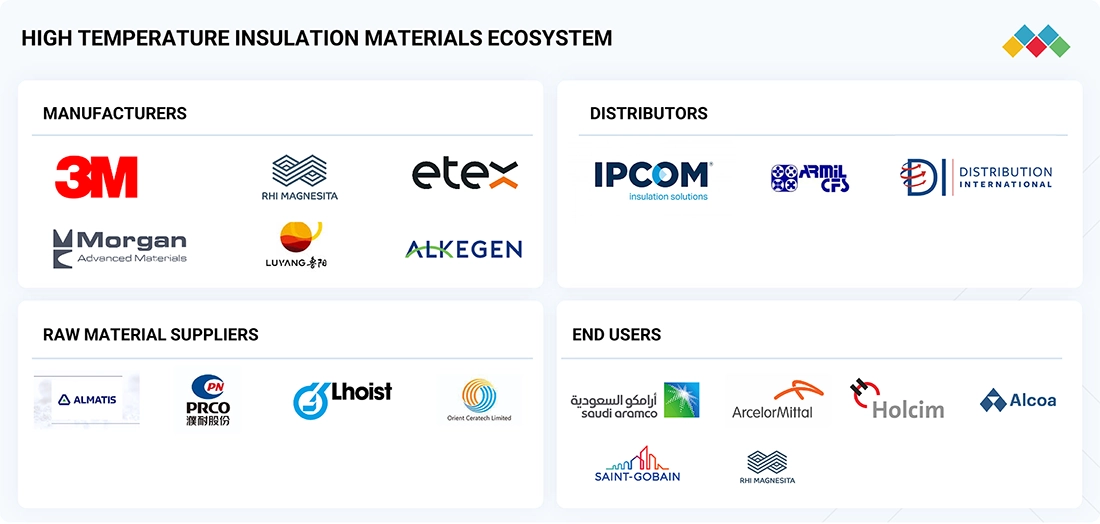
high-temperature-insulation-market: COMMERCIAL USE CASES ACROSS INDUSTRIES
| COMPANY | USE CASE DESCRIPTION | BENEFITS |
|---|---|---|
 |
TMT bar plants in Jalna, India; 15–55 ton induction furnaces melting at 1,640–1,655°C; replaced ceramic fiber with WDS LambdaFlex Super Microporous + SS 800 Board as ladle back-up insulation | Shell temperature reduced to 80–100°C, saving 150–160 kWh per heat with only 1°C/min drop vs. >2°C/min, yielding 1,800–1,920 kWh daily savings (12 heats) while maintaining high durability and corrosion resistance |
 |
KLAY EnerSol used prefabricated 3M Nextel high-temperature textiles to shield PDH process heater tubes in Selangor, Malaysia, from excessive radiant heat flux and secondary cracking | Improved heat-flux control reduced secondary cracking, while prefabricated Nextel insulation shortened turnaround from 3–4 weeks to a few days and minimized operational downtime and supply chain disruptions |
|
|
A European aluminum producer operating an anode baking furnace at 1,100–1,240°C replaced its existing 13 mm, 128 kg/m³ magnesium-silicate blanket in 20–25 mm expansion joints with Superwool Prime Blanket of identical specifications to improve thermal performance and durability during the furnace’s demanding 880-hour baking cycle | Superior resilience and tear-free handling enabled reuse for a second baking cycle in good-condition joints, while its lower thermal conductivity (0.28 vs. 0.43 W/m•K at 1,000°C) improved insulation efficiency and supported a full transition to Superwool® Prime in H2 2022 |
Logos and trademarks shown above are the property of their respective owners. Their use here is for informational and illustrative purposes only.
Related Ecosystem
Ceramics And Glass
- Zirconia
- Alumina Ceramics
- Silicon Carbide
- Silicon Nitride
- Titanate Ceramics
- Saint-gobain
- 3M COMPANY
- CERAMTEC GMBH
- Kyocera Corporation
- COORSTEK INCORPORATED
Foam And Insulation
- Fiberglass
- Acoustic Insulation
- Elastomeric Foam
- HVAC System
- Flexible Foam
- Basf se
- Saint-gobain
- ARMACELL INTERNATIONAL
- THE WOODBRIDGE GROUP
- Huntsman Corporation
Key Takeaways
- South Korea's high temperature insulation materials market is valued at USD 173.4 million in 2025 and will reach USD 198.1 million by 2030.
- South Korea exhibits a 2.7% CAGR, reflecting steady growth driven by industrial modernization and energy efficiency demands.
- South Korea's steel, petrochemical, and semiconductor industries are primary demand drivers for high-temperature insulation solutions.
- South Korea's mature manufacturing base and regulatory environment support sustained adoption of advanced thermal insulation technologies through 2030.
High Temperature Insulation Materials Market Report Scope
| Report Metric | Details |
|---|---|
| Base Year | 2025 |
| Fastest Growing Segment | 1700°C (3092°F) AND ABOVE (Temperature Range) |
| Forecast Period | 2025–2030 |
| Growth Rate | CAGR of 3.9% from 2025 to 2030 |
| Largest Segment | CERAMIC FIBERS (Material Type) |
| Market Size Base Year (Billions) | ~USD 4.32 (2025) |
| Revenue Forecast (Billions) | ~USD 5.23 (2030) |
| Segments Covered | Material Type, Temperature Range, End-Use Industry |
South Korea High Temperature Insulation Materials Market Report Segmentation
3 segment dimensions are covered across the global market.
By Material Type
- Calcium Silicate
- Ceramic Fibers
- Insulating Firebricks
- Other Types
By Temperature Range
- 1100°C–1500°C (2012°F-2732°F)
- 1100°C–1500°C (2012°F–2732°F)
- 1500°C–1700°C (2732°F–3092°F)
- 1700°C (3092°F) And Above
- 600°C–1100°C (1112°F–-2012°F)
- 600°C–1100°C (1112°F–2012°F)
By End-Use Industry
- Aluminum
- Cement
- Ceramic
- Glass
- Iron & Steel
- Other End-Use Industries
- Petrochemicals
- Powder Metallurgy
- Refractory
Target Audience
- Material Manufacturers & Suppliers : Need South Korea-specific market data to assess demand from steel, petrochemical, and semiconductor sectors, optimize production capacity, and develop localized product offerings.
- Industrial Equipment Manufacturers : Require detailed insights into South Korea's thermal management requirements across manufacturing sectors to integrate appropriate insulation solutions into equipment designs.
- Investment & Private Equity Firms : Seek market valuation, growth projections, and sector-specific performance data for South Korea to evaluate investment opportunities in insulation material companies and related ventures.
- Distributors & Trading Companies : Need South Korea market forecasts and sector demand analysis to optimize inventory management, identify growth segments, and develop distribution partnerships with manufacturers.
- Strategic Consultants & Business Planners : Require country-specific market intelligence, competitive landscape analysis, and growth drivers to support client strategy development and market entry planning in South Korea.
Key Companies in the South Korea High Temperature Insulation Materials Market
| Company | HQ | Ownership | Strongest segments |
|---|---|---|---|
| SEKISUI CHEMICAL CO., LTD | Japan | Public Company | High performance plastics and industrial tapes,Housing and residential services,Urban infrastructure and environmental products, |
| JOHNS MANVILLE | United States | Private Company | Building and Mechanical Insulation,Commercial Roofing Systems and Accessories,Glass Fibers and Nonwovens for Construction, |
| 3M | United States | Public Company | Safety and Industrial,Transportation and Electronics,Consumer, |
| MORGAN ADVANCED MATERIALS PLC | United Kingdom | Public Company | Thermal Products,Performance Carbon,Technical Ceramics, |
| LUYANG ENERGY-SAVING MATERIALS CO., LTD. | China | Public Company | Ceramic and aluminum silicate fiber products,Soluble and alumina fiber, lightweight bricks, unshaped refractories,Automotive gasket and friction fleece, |
| ALKEGEN | United States | Private Company | Ceramic fiber blankets, boards, modules, and furnace linings,Emission control mounting mats and automotive thermal management,Microfine glass fibers, microporous insulation, papers, and felts, |
| IBIDEN | Japan | Public Company | IC package substrates and high-end PCBs,Ceramic DPF substrates and automotive mats,Industrial ceramics, graphite, and special carbon products, |
SEKISUI CHEMICAL CO., LTD
Sekisui Chemical Co., Ltd. is a Japanese public company founded in 1947 with 26,752 employees. The company operates as a diversified chemical manufacturer serving various industrial sectors.
JOHNS MANVILLE
Johns Manville is a private American company founded in 1858 with 9,740 employees. The company manufactures building materials, insulation products, and engineered fibers for industrial applications.
3M
3M is a publicly traded American multinational company founded in 1902 with 60,500 employees. The company develops and manufactures a diverse range of products across industrial, healthcare, safety, and consumer segments.
MORGAN ADVANCED MATERIALS PLC
Morgan Advanced Materials PLC is a British public company established in 1856 with 8,088 employees. The company specializes in advanced materials and thermal management solutions for industrial applications.
LUYANG ENERGY-SAVING MATERIALS CO., LTD.
Luyang Energy-Saving Materials Co., Ltd. is a Chinese public company founded in 1984 with 2,707 employees. The company manufactures energy-saving and refractory materials for industrial use.
ALKEGEN
Alkegen is a private American company founded in 1891 with 1,044 employees. The company operates in the specialty materials and industrial products sector.
IBIDEN
Ibiden is a Japanese public company founded in 1912 with 11,105 employees. The company manufactures advanced ceramic products, semiconductor-related materials, and industrial components.
Reasons to Buy this Report
- Market-Specific Sizing Data : Access precise valuation figures for South Korea's market (USD 173.4M in 2025) with detailed forecasts through 2030, enabling accurate budget allocation and investment planning.
- Industry-Focused Insights : Understand demand patterns specific to South Korea's dominant sectors—semiconductors, steel, and petrochemicals—with tailored analysis of thermal management requirements and material specifications.
- Competitive Intelligence : Identify market opportunities and competitive positioning within South Korea's advanced manufacturing ecosystem, including supplier landscape and technology adoption trends.
- Growth Strategy Development : Leverage country-specific CAGR data (2.7%) and sector insights to develop targeted expansion strategies, product development roadmaps, and market entry approaches for South Korea.
- Regulatory & Sustainability Context : Gain insights into South Korea's energy efficiency standards, carbon reduction initiatives, and industrial sustainability policies driving insulation material adoption and market growth.
Frequently asked questions
What is the current market size of high temperature insulation materials in South Korea?
South Korea's high temperature insulation materials market is valued at USD 173.4 million in 2025.
What is the projected market size for South Korea by 2030?
South Korea's market is projected to reach USD 198.1 million by 2030.
What is the CAGR for South Korea's high temperature insulation materials market?
South Korea's market is expected to grow at a CAGR of 2.7% from 2025 to 2030.
Which industries drive demand for high temperature insulation materials in South Korea?
South Korea's primary demand drivers include steel manufacturing, petrochemicals, semiconductor production, and advanced industrial applications requiring thermal management.
How does South Korea's market growth compare to global trends?
South Korea's 2.7% CAGR is lower than the global 3.9% CAGR, reflecting the country's mature industrial base and focus on efficiency improvements rather than expansion.
RESEARCH METHODOLOGY
The study involved four major activities to estimate the current size of the global high temperature insulation materials market. Exhaustive secondary research was carried out to collect information on the market, the peer product market, and the parent product group market. The next step was to validate these findings, assumptions, and sizes with the industry experts across the value chain of high temperature insulation materials through primary research. The top-down and bottom-up approaches were employed to estimate the overall size of the high temperature insulation materials market. Following this, market breakdown and data triangulation procedures were employed to determine the size of various market segments and sub-segments.
Secondary Research
The market for companies offering high temperature insulation materials is arrived at by secondary data available through paid and unpaid sources, analyzing the product portfolios of the major companies in the ecosystem, and rating the companies by their performance and quality. Various secondary sources, such as Business Standard, Bloomberg, World Bank, and Factiva, were referred to for identifying and collecting information for this study on the high temperature insulation materials market. Secondary sources also included annual reports, press releases, and investor presentations from door vendors, as well as forums, certified publications, and whitepapers. The secondary research was utilized to gather critical information on the industry’s value chain, the total pool of key players, market classification, and segmentation from both market- and technology-oriented perspectives
Primary Research
In the primary research process, various primary sources from both the supply and demand sides were interviewed to obtain qualitative and quantitative information for this report. The primary sources from the supply side included industry experts, such as Chief Executive Officers (CEOs), Vice Presidents (VPs), marketing directors, technology and innovation directors, and related key executives from several key companies and organizations operating in the high temperature insulation materials market. After the complete market engineering (calculations for market statistics, market breakdown, market size estimations, market forecasting, and data triangulation), extensive primary research was conducted to gather information and verify and validate the critical numbers arrived at. Primary research was also conducted to identify the segmentation types, industry trends, competitive landscape of high temperature insulation materials offered by various market players, and key market dynamics, such as drivers, restraints, opportunities, challenges, industry trends, and key player strategies. In the complete market engineering process, the top-down and bottom-up approaches and several data triangulation methods were extensively used to perform the market estimation and market forecasting for the overall market segments and subsegments listed in this report. Extensive qualitative and quantitative analysis was performed on the complete market engineering process to list the key information/insights throughout the report.
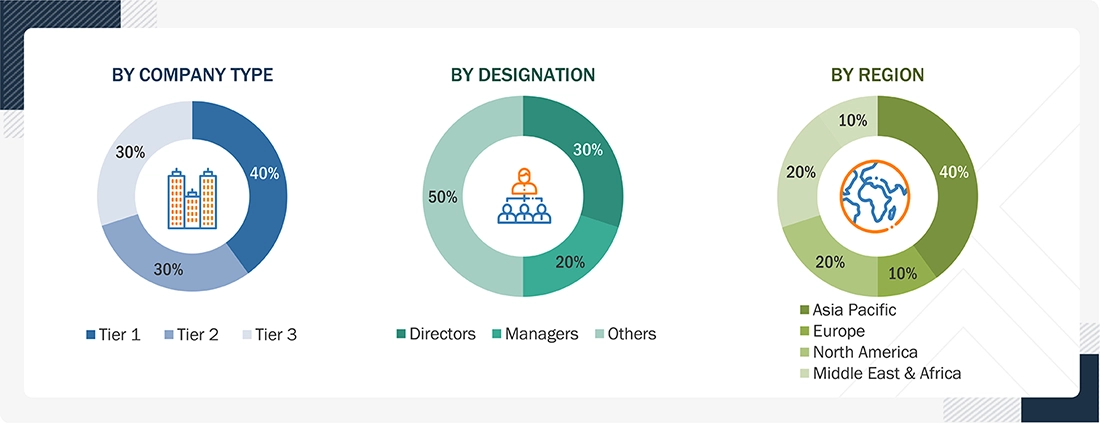
Notes: Other designations include sales, marketing, and product managers. Tier 1: >USD 1 Billion; Tier 2: USD 500 million–1 Billion; and Tier 3: USD 500 million.
To know about the assumptions considered for the study, download the pdf brochure
Market Size Estimation
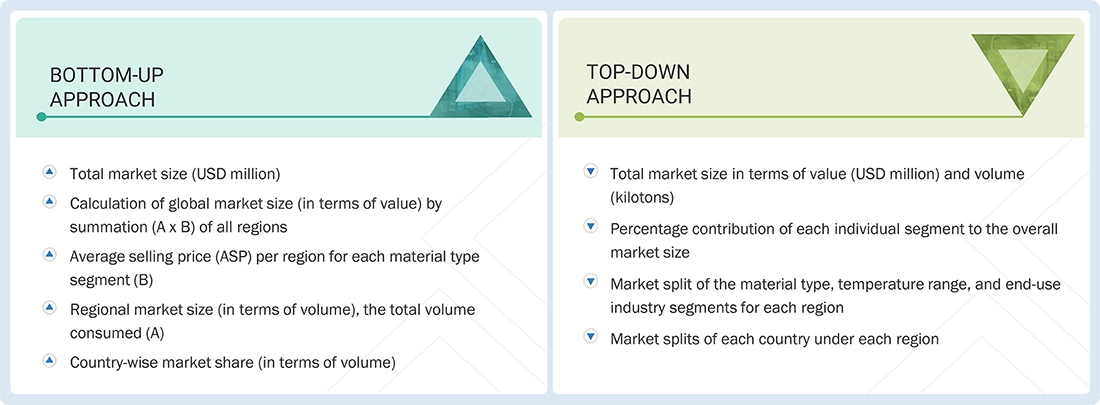
The top-down and bottom-up approaches were used to estimate and validate the size of the global high temperature insulation materials market. These approaches were also used extensively to estimate the size of various dependent market segments. The research methodology used to estimate the market size included the following:
High Temperature Insulation Materials Market : Top-Down and Bottom-Up Approach
Data Triangulation
After arriving at the overall market size using the market size estimation processes, the market was split into several segments and subsegments. The data triangulation and market breakdown procedures were employed, wherever applicable, to complete the overall market engineering process and arrive at the exact statistics of each market segment and subsegment. The data was triangulated by studying various factors and trends from both the demand and supply sides.
Market Definition
High temperature insulation materials are sophisticated thermal protection solutions engineered to function over 600°C (1,112°F), providing remarkable resistance to heat transfer and energy dissipation in harsh industrial environments. Prevalent varieties include ceramic fibers, insulating fire bricks, calcium silicate, aerogels, and microporous insulation, which are esteemed for their robustness, low thermal conductivity, and longevity. These materials are valued for their strength, low conductivity, and durability, and are widely utilized in such industries as petrochemical, steel, cement, glass, and nonferrous metals for precise temperature control, equipment protection, and energy efficiency. Adhering to ASTM, ISO, and national energy requirements, they facilitate emission reduction and process optimization. Continuous improvements in lightweight and eco-friendly formulations render HTIMs essential for improving sustainability and upgrading high-temperature industrial operations globally.
Key Stakeholders
- High temperature insulation materials manufacturers
- Raw material suppliers
- Converters & processors
- Distributors and traders
- Industry associations and regulatory bodies
- End users
Report Objectives
- To define, describe, and forecast the size of the global high temperature insulation materials market, based on material type, temperature range, end-use industry, and region in terms of value and volume
- To provide detailed information on the significant drivers, restraints, opportunities, and challenges influencing the market
- To strategically analyze micromarkets concerning individual growth trends, prospects, and their contribution to the market
- To assess the growth opportunities in the market for stakeholders and provide details on the competitive landscape for market leaders
- To forecast the market size of segments and subsegments for North America, Europe, Asia Pacific, South America, and the Middle East & Africa
- To strategically profile key players and comprehensively analyze their market shares and core competencies
- To analyze competitive developments such as acquisitions, expansions, partnerships, and agreements in the high temperature insulation materials market
- To provide the impact of AI/Gen AI on the market
Customization Options
With the given market data, MarketsandMarkets offers customizations according to client-specific needs.
The following customization options are available for the high temperature insulation materials market report:
Product Analysis
- A product matrix that gives a detailed comparison of the product portfolio of each company
Regional Analysis
- A further breakdown of the high temperature insulation materials market for additional countries
Company Information
- Detailed analysis and profiling of additional market players (up to five)
Get the Full High Temperature Insulation Materials Market Report
Full forecast, segment splits, and company analysis for all High Temperature Insulation Materials Market.
- China High Temperature Insulation Materials Market
- India High Temperature Insulation Materials Market
- Japan High Temperature Insulation Materials Market
- Germany High Temperature Insulation Materials Market
- France High Temperature Insulation Materials Market
- Turkey High Temperature Insulation Materials Market
- Russia High Temperature Insulation Materials Market
- UK High Temperature Insulation Materials Market
- Canada High Temperature Insulation Materials Market
- Mexico High Temperature Insulation Materials Market
- US High Temperature Insulation Materials Market
- Brazil High Temperature Insulation Materials Market
- Argentina High Temperature Insulation Materials Market
- South Africa High Temperature Insulation Materials Market
- Rest Of Europe High Temperature Insulation Materials Market
- Rest Of Asia Pacific High Temperature Insulation Materials Market
- GCC Countries High Temperature Insulation Materials Market
- –Rest Of GCC Countries High Temperature Insulation Materials Market
- Rest Of South America High Temperature Insulation Materials Market
Need a Tailored Report?
Customize this report to your needs
Get 10% FREE Customization
Customize This Report
