
Canada Home Automation System Market (2026-2032)

The Canada Home Automation System Market was valued at $58.4 Million in 2026 and projected to reach to $100.9 Million by 2032, representing a compound annual growth rate of 9.5%. Canada's home automation system market is positioned for sustained growth through 2032, driven by rising consumer awareness of smart home benefits and increasing investments in residential digital infrastructure.


| Market Size in | USD 26.32 MN |
| Market Forecast in | |
| CAGR | |
| Forecast Period | |
| Units Considered | Value (USD MN) |
Canada Home Automation System Market Trends and Insights
- This represents a compound annual growth rate of 9.5%, significantly outpacing the global average of 5.8%, reflecting Canada's strong adoption of smart home technologies and digital infrastructure investments.
- Canada's market expansion is driven by increasing consumer demand for energy-efficient solutions, rising disposable incomes, and growing awareness of home security and convenience benefits. The Canadian home automation sector benefits from favorable regulatory environments and substantial investments in broadband connectivity across urban and rural regions.
- Canada's tech-savvy population and established smart home ecosystem position the country as a key growth market within North America.
- Between 2026 and 2032, Canada is expected to capture significant market share through innovations in IoT integration, voice-activated systems, and AI-powered home management solutions. Canada's competitive landscape includes both international players and emerging local innovators focused on delivering customized solutions for the Canadian climate and lifestyle.
- The market's trajectory reflects Canada's commitment to sustainable living and digital transformation, making it an attractive investment destination for home automation manufacturers and service providers..
Key Market Statistics
- CAGR (2026-2032) 9.5% CAGR
- Market Size, 2026 ~USD 58.4 Million
- Forecast, 2032 ~USD 100.9 Million
- Country Canada
Canada Home Automation System Market Overview
Strong CAGR Outperformance :
Canada's home automation market is growing at 9.5% CAGR (2026-2032), significantly exceeding the global average of 5.8%, demonstrating accelerated market maturation and consumer adoption in the region.
Substantial Market Expansion :
The Canadian market is projected to grow from $58.4 million in 2026 to $100.9 million by 2032, representing a 72.8% increase over six years, driven by smart home technology penetration and digital infrastructure investments.
Digital Infrastructure Leadership :
Canada's advanced broadband infrastructure and high internet penetration rates create an ideal environment for smart home adoption, supporting seamless IoT device connectivity and integration across residential properties.
Consumer Tech Adoption Trends :
Canadian consumers demonstrate strong preference for connected home solutions, with increasing demand for energy efficiency, security automation, and voice-controlled smart devices aligned with sustainability goals.
Canada Home Automation System Market Dynamics
- The market's 9.5% CAGR reflects strong demand for integrated home automation solutions that enhance convenience, security, and energy efficiency.
- Key growth catalysts include expanding broadband coverage in rural areas, declining smart device costs, and growing integration of AI-powered home management systems.
- The Canadian market is expected to attract significant investment from both established technology companies and innovative startups targeting the affluent, tech-savvy demographic concentrated in major urban centers..
Market Ecosystem
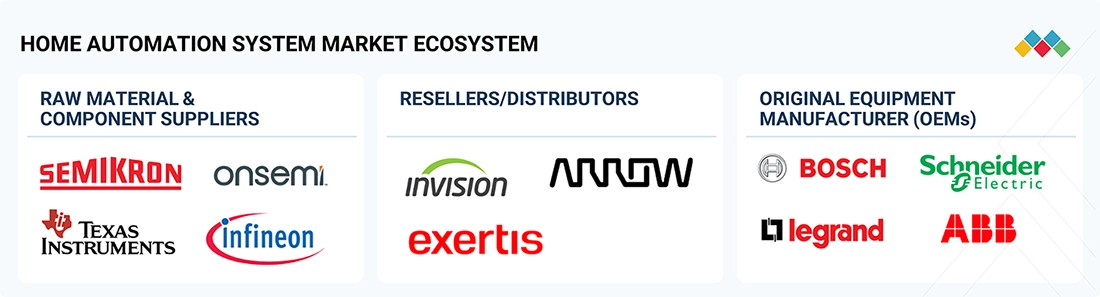
HOME AUTOMATION SYSTEM MARKET SIZE, SHARE & GROWTH: COMMERCIAL USE CASES ACROSS INDUSTRIES
| COMPANY | USE CASE DESCRIPTION | BENEFITS |
|---|---|---|
 |
Integration of AI-driven home automation system devices across residential and hospitality facilities for automated lighting, climate, and security control through mobile and voice-enabled interfaces | Improvement in energy efficiency | Lower maintenance costs | Elevated guest experience through intelligent and customizable automation features |
 |
Deployment of community-wide home automation system ecosystems in residential neighborhoods and educational facilities, connecting IoT sensors for lighting, ventilation, and energy analytics | Improvement in energy efficiency | Optimized living and learning conditions | Reduced energy waste through predictive automation and analytics |
 |
Implementation of IoT-enabled home automation systems and building systems, automating lighting, HVAC, and appliance control through smart devices, across student dormitories and classrooms | Reduction in overall utility costs | Improved occupant safety | Enhanced environmental comfort supporting digital campus sustainability goals |
 |
Deployment of home automation system energy management systems, integrating lighting, heating, and water management via IoT-enabled meters and sensors, across residential projects in Sweden | Improved household energy efficiency and water conservation | 20% reduction in energy usage | Enhanced sustainability compliance in line with Sweden’s green energy initiatives |
 |
Implementation of connected workplace automation, integrating smart lighting, HVAC scheduling, and occupancy-based energy control, across European office campuses | Achieved reduction in facility energy costs | Improved indoor comfort for employees | Enhanced operational transparency through real-time data insights |
Logos and trademarks shown above are the property of their respective owners. Their use here is for informational and illustrative purposes only.
Related Ecosystem
Industrial Automation
- Sensors
- Image Sensors
- Manufacturing Execution System (MES)
- Actuators
- Flow Sensors
- Siemens ag
- ABB India Limited
- Emerson Electric Co.
- HONEYWELL INTERNATIONAL INC.
- SCHNEIDER ELECTRIC SE
Sensors And Control
- Sensors
- Image Sensors
- Temperature Sensors
- Pressure Sensors
- Flow Sensors
- BAUMER ELECTRIC AG
- HONEYWELL INTERNATIONAL INC.
- Stmicroelectronics
- Lenovo
- Texas Instruments Incorporated
Smart Lighting
- Fiber Laser
- Fluorescent Lighting
- Gas Lasers
- Sensors
- 3D Sensors
- Zumtobel group ag
- Nedap n.v.
- Acuity Brands, Inc.
- OSRAM Licht AG
- Philips
Key Takeaways
- Canada's home automation market will grow from $58.4M (2026) to $100.9M (2032) at a 9.5% CAGR, outpacing global growth.
- Canada's strong digital infrastructure and tech-savvy population drive accelerated adoption of smart home solutions.
- Energy efficiency and home security are primary growth drivers in Canada's home automation market.
- Canada attracts both multinational corporations and local innovators competing for market share in the smart home sector.
Home Automation System Market Report Scope
| Report Metric | Details |
|---|---|
| Base Year | 2026 |
| Fastest Growing Segment | SOFTWARE & SERVICES (Smart Hvac Solution Type) |
| Forecast Period | 2026–2039 |
| Growth Rate | CAGR of 5.8% from 2026 to 2039 |
| Largest Segment | SMART ENTERTAINMENT & OTHER SYSTEMS (Product Type) |
| Market Size Base Year (Billions) | ~USD 57.56 (2026) |
| Revenue Forecast (Billions) | ~USD 80.73 (2039) |
| Segments Covered | Product Type, Smart Lighting Solution Type, Hardware Type, Lighting Control Type, Smart Security & Access Control System Type, Video Surveillance Solution Type, Camera Type, Access Control System Type, Reader Type, Smart Lock Type, Smart Hvac Solution Type, Smart Entertainment & Other System Type, Audio Type, Video Type, Control Type, Entertainment Control Type, Other Control Type, Protocol & Communication Technology, Residence Type, Installation Type, Control Interface, Application, End User |
Canada Home Automation System Market Report Segmentation
23 segment dimensions are covered across the global market.
By Product Type
- Hvac Control Sensors
- Smart Entertainment & Other Systems
- Smart Hvac Solutions
- Smart Lighting Solutions
- Smart Locks
- Smart Security & Access Control Systems
By Smart Lighting Solution Type
- Hardware
- Software & Services
By Hardware Type
- Actuators
- Alarm Systems
- Cameras
- Control Valves
- Controllers
- Dampers
- Hvac Controls
- Hvac Systems
- Lighting Controls
- Luminaires & Smart Lights
- Monitors
- Other Access Control Hardware Types
- Other Accessories
- Readers
- Sensors
- Smart Locks
- Smart Thermostats
- Smart Vents
- Storage Devices
- Tags
By Lighting Control Type
- Daylight Sensors
- Dimmers
- Occupancy Sensors
- Other Lighting Control Types
- Relays
- Switches
- Timers
By Smart Security & Access Control System Type
- Access Control Systems
- Video Surveillance Solutions
By Video Surveillance Solution Type
- Hardware
- Software & Services
By Camera Type
- Analog Cameras
- Ip Cameras
By Access Control System Type
- Hardware
- Software & Services
By Reader Type
- Biometrics Readers
- Card-Based Readers
- Multi-Technology Readers
By Smart Lock Type
- Smart Cam Locks
- Smart Deadbolt Locks
- Smart Door Handle Sets
- Smart Garage Door Locks & Controllers
- Smart Lever & Knob Locks
- Smart Mortise Locks
By Smart Hvac Solution Type
- Hardware
- Software & Services
By Smart Entertainment & Other System Type
- Audio
- Controls
- Video
By Audio Type
- Smart Speakers
- Voice-Enabled Devices
By Video Type
- Smart Streaming Devices
- Smart Tvs
By Control Type
- Entertainment Controls
- Other Controls
By Entertainment Control Type
- Audio & Volume Controls
- Home Theatre System Controls
- Touch Screen & Keypad
By Other Control Type
- Smart Hubs
- Smart Meters
- Smart Plugs
- Smoke Detectors
By Protocol & Communication Technology
- Wired
- Wireless
By Residence Type
- Multi-Family Buildings
- Single-Family Homes
- Villas/Luxury Homes
By Installation Type
- New Installation
- Retrofit Installation
By Control Interface
- Smartphone/Tablet Applications
- Voice Assistants
- Wall Panels & Switches
- Wearables
By Application
- Comfort & Convenience
- Energy Management
- Entertainment
- Other Applications
- Safety & Security
By End User
- Individual Homeowners
- Rental Housing Owners & Operators
- Residential Builders & Developers
Target Audience
- Smart Home Technology Manufacturers : Manufacturers need Canada-specific market data to assess market potential, identify growth opportunities, and develop localized product strategies for the high-growth Canadian segment.
- System Integrators & Installation Companies : Integration firms require detailed market insights to understand demand patterns, competitive positioning, and customer segments within Canada to optimize service offerings and expansion plans.
- Investment & Private Equity Firms : Investors need accurate Canadian market forecasts and growth metrics to evaluate acquisition targets, fund allocation decisions, and portfolio companies operating in the home automation sector.
- Telecommunications & Utility Providers : Telecom and utility companies need Canada market intelligence to identify smart home service bundling opportunities, customer retention strategies, and revenue diversification potential.
- Real Estate Developers & Property Managers : Real estate professionals require Canadian market data to understand smart home feature demand, property value enhancement opportunities, and competitive differentiation in residential developments.
Key Companies in the Canada Home Automation System Market
| Company | HQ | Ownership | Strongest segments |
|---|---|---|---|
| VEON LTD. | Netherlands | ||
| X-FAB | Germany | ||
| PC CONNECTION | United States | ||
| FOXCONN INDUSTRIAL INTERNET CO LTD | United States | ||
| PLDT ENTERPRISE | Philippines | ||
| LENOVO | China | ||
| ZENSAR TECHNOLOGIES LTD | India | ||
| FIRST SENSOR AG | Germany | ||
| MEDIATEK INC | Taiwan | ||
| TRANE TECHNOLOGIES PLC | Ireland | ||
| LENNOX INTERNATIONAL INC. | United States | ||
| SCHNEIDER ELECTRIC | France | Public Company | HVAC Controls,Security & Access Controls,Lighting Controls, |
| SIEMENS | Germany | Public Company | |
| HONEYWELL INTERNATIONAL INC. | United States | Public Company | HVAC Controls,Security & Access Controls,Lighting Controls, |
| ASSA ABLOY | Sweden | Public Company | Security & Access Controls,Lighting Controls,Smart Speakers, |
VEON LTD.
No sufficient details provided.
X-FAB
No sufficient details provided.
PC CONNECTION
No sufficient details provided.
FOXCONN INDUSTRIAL INTERNET CO LTD
No sufficient details provided.
PLDT ENTERPRISE
No sufficient details provided.
LENOVO
No sufficient details provided.
ZENSAR TECHNOLOGIES LTD
No sufficient details provided.
FIRST SENSOR AG
No sufficient details provided.
MEDIATEK INC
No sufficient details provided.
TRANE TECHNOLOGIES PLC
No sufficient details provided.
LENNOX INTERNATIONAL INC.
No sufficient details provided.
SCHNEIDER ELECTRIC
Schneider Electric is a French multinational corporation founded in 1836 that specializes in energy management and automation solutions. With 158,122 employees, the company operates as a public entity serving industrial, commercial, and residential sectors globally.
SIEMENS
Siemens is a German multinational conglomerate founded in 1847 with 310,312 employees operating as a public company. The company provides solutions in electrification, automation, and digitalization across diverse industries worldwide.
HONEYWELL INTERNATIONAL INC.
Honeywell International Inc. is a United States-based multinational corporation founded in 1885 with 101,000 employees. Operating as a public company, Honeywell provides diversified technology and manufacturing solutions across aerospace, building technologies, and industrial sectors.
ASSA ABLOY
ASSA ABLOY is a Swedish multinational corporation founded in 1881 with 63,939 employees operating as a public company. The company specializes in access solutions and security products for residential, commercial, and industrial applications globally.
Reasons to Buy this Report
- Market-Specific Growth Intelligence : Gain detailed insights into Canada's 9.5% CAGR trajectory and understand regional growth drivers distinct from global trends, enabling targeted market entry and expansion strategies.
- Competitive Positioning Data : Access comprehensive analysis of the Canadian competitive landscape, consumer preferences, and market dynamics to identify opportunities and benchmark against regional competitors.
- Investment Decision Support : Leverage accurate market sizing ($58.4M in 2026 to $100.9M in 2032) and forecasts to support capital allocation decisions, business case development, and ROI projections for Canadian operations.
- Consumer Behavior Insights : Understand Canadian consumer adoption patterns, technology preferences, and purchasing behaviors specific to home automation, enabling product development and marketing strategy optimization.
- Regulatory & Infrastructure Context : Receive analysis of Canada's digital infrastructure landscape, broadband policies, and regulatory environment affecting home automation deployment and market accessibility.
Frequently asked questions
What is the current size of Canada's home automation system market?
Canada's home automation system market is valued at $58.4 million in 2026, with expectations to reach $100.9 million by 2032.
What is the projected growth rate for Canada's home automation market?
Canada's home automation market is projected to grow at a compound annual growth rate (CAGR) of 9.5% from 2026 to 2032.
How does Canada's home automation market growth compare to global trends?
Canada's 9.5% CAGR significantly exceeds the global average of 5.8%, indicating stronger market momentum and adoption in Canada.
What factors are driving growth in Canada's home automation market?
Key drivers include increasing demand for energy-efficient solutions, rising consumer awareness of home security benefits, strong digital infrastructure, and growing disposable incomes across Canada.
Who are the main competitors in Canada's home automation market?
Canada's market includes international home automation leaders alongside emerging local innovators developing solutions tailored to Canadian consumer preferences and climate conditions.
RESEARCH METHODOLOGY
The research study involved four major activities in estimating the size of the global home automation system market. Exhaustive secondary research was done to collect important information about the market and peer markets. The validation of these findings, assumptions, and sizing with the help of primary research with industry experts across the supply chain was the next step. Both top-down and bottom-up approaches were used to estimate the market size. Thereafter, the market breakdown and data triangulation were adopted to estimate the market sizes of segments and sub-segments.
Secondary Research
In the secondary research process, various secondary sources were referred to for identifying and collecting information required for this study. The secondary sources include annual reports, press releases, investor presentations of companies, white papers, and articles from recognized authors. Secondary research was done to obtain key information about the market’s supply chain, the pool of key market players, market segmentation according to industry trends, regional outlook, and developments from both market and technology perspectives. In the global home automation system market report, the global market size was estimated using the top-down and bottom-up approaches, along with several other dependent submarkets. Major players in the market were identified using extensive secondary research, and their presence in the market was determined using secondary and primary research. All the percentage shares, splits, and breakdowns were determined using secondary sources and verified through primary sources.
Primary Research
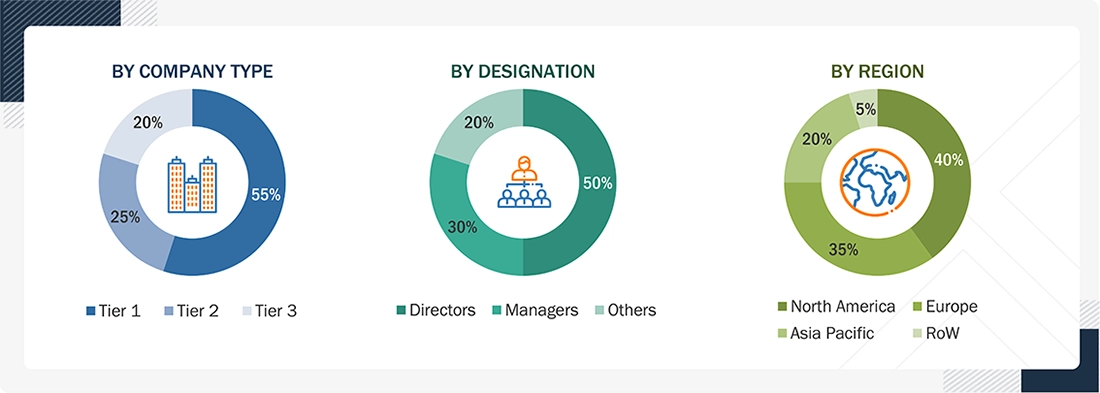
Extensive primary research was conducted after understanding the global home automation system market scenario through secondary research. Several primary interviews were conducted with key opinion leaders from demand- and supply-side vendors across four major regions: North America, Europe, Asia Pacific, and the Rest of the World. Approximately 25% of the primary interviews were conducted with the demand-side vendors and 75% with the supply-side vendors. Primary data was collected mainly through telephonic interviews, which consist of 80% of the total primary interviews; questionnaires and emails have also been used to collect the data.
After successful interaction with industry experts, brief sessions were conducted with highly experienced independent consultants to reinforce the findings of our primary research. This, along with the in-house subject matter experts’ opinions, led us to the findings as described in the report.
The following is a breakdown of the primary respondents:
Market Size Estimation
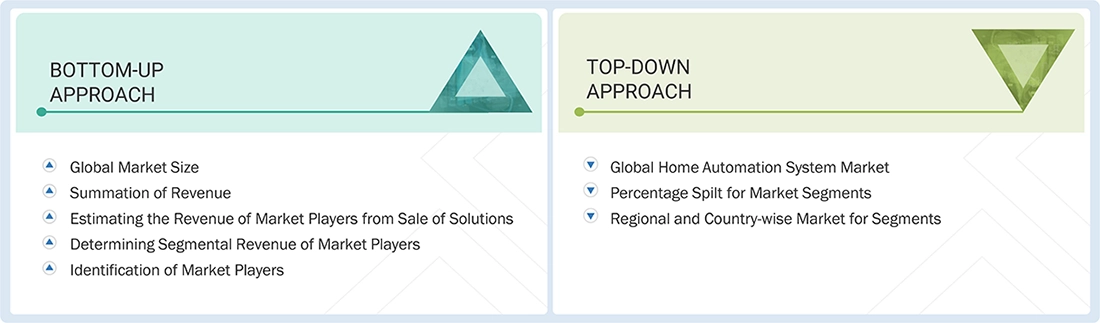
In the market engineering process, the top-down and bottom-up approaches, along with data triangulation methods, were used to estimate and validate the size of the home automation and other dependent submarkets.
The research methodology used to estimate the market sizes included the following:
- Identifying top-line investments and spending in the ecosystem, and considering segment-level splits and major market developments
- Identifying different stakeholders that influence the entire market, along with participants across the supply chain
- Analyzing major manufacturers and solution providers in the home automation system market and studying their solutions and service portfolios
- Analyzing trends related to the adoption of home automation solutions and services
- Tracking recent and upcoming market developments, including investments, R&D activities, solution launches, collaborations, acquisitions, and partnerships, as well as forecasting the market size based on these developments and other critical parameters
- Carrying out multiple discussions with key opinion leaders to identify the adoption trends of home automation systems
- Segmenting the overall market into various other market segments
- Validating the estimates at every level through discussions with key opinion leaders, such as chief executives (CXOs), directors, and operations managers, and finally with the domain experts at MarketsandMarkets
Top-Down and Bottom-Up Approach
Data Triangulation
After arriving at the overall market size—using the market size estimation processes as explained above—the market was split into several segments and subsegments. To complete the entire market engineering process and arrive at the exact statistics of each market segment and subsegment, data triangulation and market breakdown procedures were employed, wherever applicable. The data was then triangulated by studying various factors and trends from the demand and supply sides in the home automation system market.
Market Definition
A home automation system is a network of hardware, communication, and electronic interfaces that controls home devices to connect them through the internet. Each device comes with built-in sensors. Additionally, Wi-Fi, Bluetooth, or other communication protocols are linked to a central hub or controller to enable users to manage or automatically control multiple systems, appliances, and services either via mobile app or through preset programming. Examples of standard systems are lighting, heating, security, and entertainment systems. Home automation provides increased comfort, improved energy utilization, safety, and control of a home environment. It enables a user to make repetitive tasks automatic, manage their home devices using their smartphone or verbally, and monitor home events live.
Key Stakeholders
- Raw Material and Manufacturing Equipment Suppliers
- Automation and Control Networking Technology Vendors
- Real Estate Builders
- System Integrators
- Homeowners
- Project Consultants
- Designers/Consultants (HVAC, Security, and Fire and Safety)
- Component Manufacturers (Sensors and Controls)
- Home Management Solution Providers
- Smart Home-related Associations, Organizations, Forums, and Alliance
- Government Bodies Associated with Green Buildings
Report Objectives
- To define, describe, segment, and forecast the global home automation system market, by product, system type, protocol, residence type, and installation type, in terms of value
- To forecast the market for products, in terms of volume, in the global home automation system market
- To describe the protocols and technologies used for home automation in the global home automation system market
- To describe and forecast the global home automation system market for various segments across North America, Europe, Asia Pacific, and RoW, in terms of value
- To provide detailed information regarding the drivers, restraints, opportunities, and challenges influencing the growth of the global home automation system market
- To provide a detailed overview of the home automation market’s supply chain, along with the ecosystem, technology trends, use cases, regulatory environment, and Porter’s five forces analysis
- To analyze industry trends, pricing data, patents, innovations, and trade data (export and import data) related to the global home automation system industry
- To strategically analyze the micromarkets with respect to individual growth trends, prospects, and contributions to the total global home automation system market
- To strategically profile the key players and comprehensively analyze their market shares and core competencies
- To analyze opportunities for stakeholders and provide a detailed competitive landscape of the global home automation system market
- To analyze competitive developments, such as product launches/developments, collaborations, partnerships, acquisitions, and research & development (R&D) activities carried out by players in the global home automation system market
Available customizations:
With the given market data, MarketsandMarkets offers customizations according to the specific requirements of companies. The following customization options are available for the report:
- Detailed analysis and profiling of additional market players based on various blocks of the supply chain
Get the Full Home Automation System Market Report
Full forecast, segment splits, and company analysis for all Home Automation System Market.
- US Home Automation System Market
- Mexico Home Automation System Market
- UK Home Automation System Market
- Germany Home Automation System Market
- France Home Automation System Market
- Spain Home Automation System Market
- Italy Home Automation System Market
- Netherlands Home Automation System Market
- Nordics Home Automation System Market
- Rest Of Europe Home Automation System Market
- China Home Automation System Market
- Japan Home Automation System Market
- India Home Automation System Market
- Australia Home Automation System Market
- South Korea Home Automation System Market
- Singapore Home Automation System Market
- Southeast Asia Home Automation System Market
- Rest Of Asia Pacific Home Automation System Market
- GCC Countries Home Automation System Market
- South Africa Home Automation System Market
- Argentina Home Automation System Market
- Brazil Home Automation System Market
- Rest Of South America Home Automation System Market
- South America Home Automation System Market
Need a Tailored Report?
Customize this report to your needs
Get 10% FREE Customization
Customize This Report
