
Russia Hydrogen Market (2025-2030)

The Russia Hydrogen Market was valued at $13756.3 Million in 2025 and projected to reach to $20095.8 Million by 2030, representing a compound annual growth rate of CAGR 7.9%. Russia's hydrogen market is poised for significant growth through 2030, driven by the country's vast natural gas reserves and increasing industrial demand for cleaner energy solutions.


| Market Size in | USD 26.32 MN |
| Market Forecast in | |
| CAGR | |
| Forecast Period | |
| Units Considered | Value (USD MN) |
Russia Hydrogen Market Trends and Insights
- Russia's hydrogen industry is driven by abundant natural gas reserves and growing demand for clean energy solutions across industrial applications.
- The 7.9% compound annual growth rate reflects Russia's strategic focus on hydrogen production and export capabilities, leveraging its energy infrastructure advantages. During the 2025-2030 forecast period, Russia is expected to strengthen its position in hydrogen markets through technological advancement and increased investment in green hydrogen initiatives.
- Russia's hydrogen sector benefits from established petrochemical industries and refineries that can integrate hydrogen production seamlessly.
- The market expansion in Russia underscores the country's commitment to energy diversification and meeting evolving European hydrogen demand standards..
Key Market Statistics
- CAGR (2025-2030) CAGR 7.9%
- Market Size, 2025 ~USD 13756.3 Million
- Forecast, 2030 ~USD 20095.8 Million
- Country Russia
Russia Hydrogen Market Overview
Market Valuation :
Russia's hydrogen market is valued at USD 13,756.3 million in 2025, with projections reaching USD 20,095.8 million by 2030, representing a robust 7.9% CAGR driven by industrial demand and energy transition initiatives.
Natural Gas Advantage :
Russia's abundant natural gas reserves provide a competitive advantage for hydrogen production through steam methane reforming, positioning the country as a potential hydrogen exporter to European markets seeking decarbonization solutions.
Industrial Applications :
Growing hydrogen adoption across Russia's refining, chemical, and metallurgical sectors drives market expansion, with industrial end-users increasingly investing in hydrogen-based processes to enhance operational efficiency and meet environmental standards.
Strategic Energy Transition :
Russia's hydrogen sector reflects broader energy diversification strategies, with government support for clean hydrogen development and infrastructure investments positioning the market as a key component of the nation's long-term energy security framework.
Russia Hydrogen Market Dynamics
- The 7.9% CAGR outpaces the global average of 6.8%, reflecting Russia's strategic positioning in hydrogen production and potential export opportunities to European markets.
- Industrial sectors including refining, chemicals, and metallurgy are primary growth drivers, with companies investing in hydrogen-based technologies to improve competitiveness and meet evolving environmental regulations. Looking ahead, Russia's hydrogen market will benefit from infrastructure development, technological advancements in production efficiency, and potential international partnerships.
- Government initiatives supporting clean energy transition and industrial modernization will further accelerate market expansion.
- However, market dynamics will be influenced by geopolitical factors, international trade relationships, and global hydrogen standardization efforts, creating both opportunities and challenges for market participants through the forecast period..
Market Ecosystem
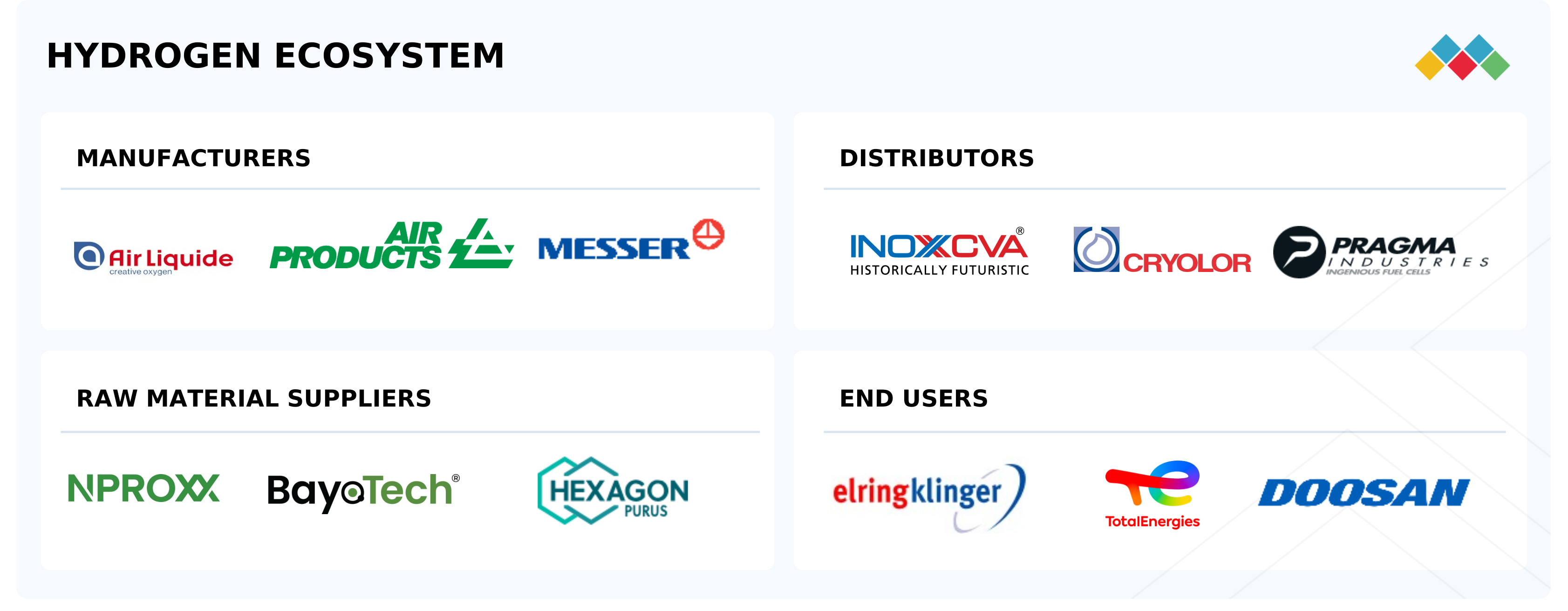
hydrogen market: COMMERCIAL USE CASES ACROSS INDUSTRIES
| COMPANY | USE CASE DESCRIPTION | BENEFITS |
|---|---|---|
 |
The steel industry accounts for nearly 7–9% of global CO2 emissions, with traditional coal-based blast furnaces being the primary source. SSAB, Sweden’s leading steelmaker, sought to decarbonize its operations by transitioning to hydrogen-based Direct Reduced Iron (DRI) technology. However, sourcing reliable, large-scale green hydrogen presented a significant challenge. To address this, SSAB partnered with Vattenfall and LKAB under the HYBRIT (Hydrogen Breakthrough Ironmaking Technology) initiative. The project deployed a 4.5 MW pilot electrolyzer powered by renewable electricity to produce fossil-free hydrogen for iron and steelmaking, demonstrating the feasibility of a sustainable production pathway. | The HYBRIT initiative proved that green hydrogen can replace coal in steelmaking, enabling fossil-free steel production. By integrating renewable electricity with electrolyzer technology, the project showcased a scalable solution for hydrogen generation at industrial levels. Upon full-scale commercialization, HYBRIT has the potential to reduce Sweden’s total CO2 emissions by nearly 10%, marking a major milestone in decarbonizing one of the most emission-intensive sectors. The project not only enhances hydrogen’s role as a clean industrial feedstock but also sets a blueprint for global steelmakers to adopt hydrogen-based pathways for sustainable operations. |
 |
The hydrogen industry faces a critical challenge in scaling green hydrogen production due to the limited durability, efficiency losses, and high costs of current electrolyzer technologies. Frequent degradation of components and insufficient validation of next-generation designs hinder their commercial viability, slowing progress toward affordable, large-scale renewable hydrogen solutions. To overcome these barriers, there is a need for advanced R&D efforts that can enhance electrolyzer performance, reduce lifecycle costs, and enable widespread deployment to support industrial decarbonization and the broader clean energy transition. | The collaboration enhances the performance and durability of electrolyzers, a key enabler for scaling green hydrogen production. By addressing degradation issues and validating next-generation designs, the project strengthens the pathway toward cost-competitive renewable hydrogen. Beyond advancing technical capabilities, the initiative creates broader decarbonization opportunities across energy-intensive industries, positioning hydrogen as a cornerstone of the clean energy transition. Drawing on NREL’s research excellence and Electric Hydrogen’s innovation, the partnership sets a precedent for accelerating commercialization of breakthrough renewable technologies. |
Logos and trademarks shown above are the property of their respective owners. Their use here is for informational and illustrative purposes only.
Related Ecosystem
Decarbonization
- Battery Electric Vehicle (BEV)
- Energy Management Systems
- Fuel Cell
- Fuel Cell Electric Vehicle (FCEV)
- Geographical Information System (GIS)
- TotalEnergies SE
- Siemens ag
- Mitsui & Co., Ltd.
- General Electric Company
- Thyssenkrupp ag
Energy Storage
- Energy Harvesting
- HVAC System
- Applicant Tracking System
- Battery Electric Vehicle (BEV)
- Carboxymethyl Cellulose (CMC)
- MOMENTIVE PERFORMANCE MATERIALS INC.
- Panasonic Holdings Corporation
- ABB India Limited
- Lg corp
- FDK Corporation
Key Takeaways
- Russia's hydrogen market is valued at USD 13,756.3 million in 2025 and is projected to reach USD 20,095.8 million by 2030, representing a 7.9% CAGR.
- Russia leverages its abundant natural gas reserves and established energy infrastructure to drive hydrogen production and export competitiveness.
- Industrial applications and refinery integration are primary growth drivers for Russia's hydrogen market expansion through 2030.
- Russia's hydrogen sector is positioned to meet increasing European demand for clean energy solutions and hydrogen-based industrial feedstocks.
Hydrogen Market Report Scope
| Report Metric | Details |
|---|---|
| Base Year | 2025 |
| Fastest Growing Segment | PHYSICAL STORAGE (Sector) |
| Forecast Period | 2025-2030 |
| Growth Rate | CAGR of 6.8% from 2025 to 2030 |
| Largest Segment | CHEMICAL & REFINERY (Application) |
| Market Size Base Year (Billions) | ~USD 225.19 (2025) |
| Revenue Forecast (Billions) | ~USD 312.9 (2030) |
| Segments Covered | Sector, Type, Application, Generation Type, Transportation |
Russia Hydrogen Market Report Segmentation
5 segment dimensions are covered across the global market.
By Sector
- Generation Type
- Physical Storage
- Transportation
By Type
- Blue Hydrogen
- Gray Hydrogen
- Green Hydrogen
- Liquid Tanker
- Long Distance
- Pipeline
- Short Distance
By Application
- Ammonia Production
- Chemical & Refinery
- Chp
- Energy
- Methanol Production
- Mobility
- Petroleum Refinery
- Power Generation
By Generation Type
- Blue Hydrogen
- Gray Hydrogen
- Green Hydrogen
By Transportation
- Long Distance
- Short Distance
Target Audience
- Energy & Utility Companies : Russian and international energy firms need market data to evaluate hydrogen integration into their portfolios, assess production feasibility, and identify partnership opportunities within Russia's expanding hydrogen sector.
- Industrial Manufacturers : Refining, chemical, and metallurgical companies operating in Russia require insights into hydrogen adoption trends, cost structures, and supply chain dynamics to optimize operations and plan hydrogen-based process transitions.
- Investment & Financial Institutions : Private equity, venture capital, and institutional investors need comprehensive market analysis to identify investment opportunities, evaluate project viability, and assess growth potential in Russia's hydrogen market through 2030.
- Government & Policy Makers : Russian federal and regional government agencies require market intelligence to inform energy policy, infrastructure investment decisions, and strategic initiatives supporting hydrogen sector development and international competitiveness.
- Technology & Equipment Providers : Hydrogen production equipment manufacturers and technology solution providers need market insights to identify customer segments, assess demand for specific technologies, and develop localized offerings for the Russian market.
Reasons to Buy this Report
- Market Size & Growth Validation : Obtain precise valuation data for Russia's hydrogen market (USD 13.8B in 2025) with verified 7.9% CAGR forecasts through 2030, enabling accurate financial planning and investment decision-making for market entry or expansion strategies.
- Competitive Positioning Intelligence : Understand Russia's competitive advantages in hydrogen production leveraging natural gas reserves, identify key industrial sectors driving demand, and benchmark against global market trends to develop targeted business strategies.
- Industrial Sector Insights : Access detailed analysis of hydrogen adoption across Russia's refining, chemical, and metallurgical industries, including end-user investment patterns, technology preferences, and growth opportunities specific to each vertical.
- Strategic Planning & Risk Assessment : Evaluate geopolitical factors, regulatory developments, and infrastructure investments shaping Russia's hydrogen landscape to inform long-term strategic planning, partnership development, and risk mitigation strategies.
- Export & Trade Opportunity Analysis : Assess Russia's potential as a hydrogen exporter to European markets, including production capacity, logistics infrastructure, and international demand dynamics to identify cross-border business and investment opportunities.
Frequently asked questions
What is the current size of Russia's hydrogen market?
Russia's hydrogen market is estimated at USD 13,756.3 million in 2025, with expectations to grow to USD 20,095.8 million by 2030.
What is the projected growth rate for Russia's hydrogen market?
Russia's hydrogen market is projected to grow at a compound annual growth rate (CAGR) of 7.9% from 2025 to 2030.
What are the main drivers of hydrogen demand in Russia?
Russia's hydrogen demand is primarily driven by industrial applications, refinery operations, petrochemical production, and increasing European demand for clean energy solutions.
How does Russia's hydrogen market compare to global trends?
Russia's hydrogen market CAGR of 7.9% exceeds the global average of 6.8%, indicating stronger growth momentum in Russia relative to worldwide hydrogen market expansion.
What role does Russia play in Europe's hydrogen supply chain?
Russia is positioned as a significant hydrogen producer and exporter within Europe, leveraging its natural gas reserves and energy infrastructure to supply regional hydrogen demand.
RESEARCH METHODOLOGY
The study involved major activities in estimating the current size of the Hydrogen market. Exhaustive secondary research was done to collect information on the peer and parent markets. The next step was to validate these findings, assumptions, and sizing with industry experts across the value chain through primary research. The top-down and bottom-up approaches were employed to estimate the total market size. Thereafter, market breakdown and data triangulation techniques were used to estimate the market size of the segments and subsegments.
Secondary Research
This research study on the hydrogen market involved the use of extensive secondary sources, directories, and databases, such as Hoover's, Bloomberg, Factiva, IRENA, International Energy Agency, and Statista Industry Journal, to collect and identify valuable information for a technical, market-oriented, and commercial study of the hydrogen market. The other secondary sources included annual reports, press releases, and investor presentations of companies; white papers; certified publications; and articles by recognized authors, manufacturer associations, trade directories, and databases.
Primary Research
The hydrogen market comprises several stakeholders, such as Hydrogen producers, Hydrogen storage providers, Hydrogen transportation and service providers, and End-Users in the supply chain. The rising demand for green, blue, and gray hydrogen characterizes the demand side of this market. The supply side is characterized by prominent players' increasing focus on securing contracts from industrial players. Various primary sources from the supply and demand sides of the market were interviewed to obtain qualitative and quantitative information. The following is the breakdown of primary respondents.
In the complete market engineering process, the top-down and bottom-up approaches and several data triangulation methods were extensively used to perform the market size estimations and forecasts for all segments and subsegments listed in this report. Extensive qualitative and quantitative analyses were conducted to complete the market engineering process and list key information/insights throughout the report.
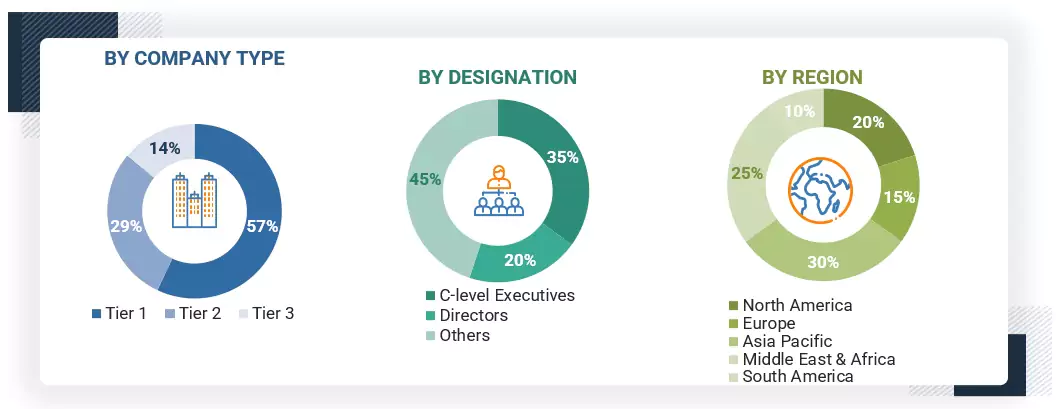
Note 1: Others include sales managers, marketing managers, and product managers.
Note 2: Tier 1 companies’ revenues are more than USD 10 billion; tier 2 companies’ revenues range between USD 1 and 10 billion; and tier 3 companies’ revenues range between USD 500 million and USD 1 billion.
Source: Industry Experts
To know about the assumptions considered for the study, download the pdf brochure
Market Size Estimation
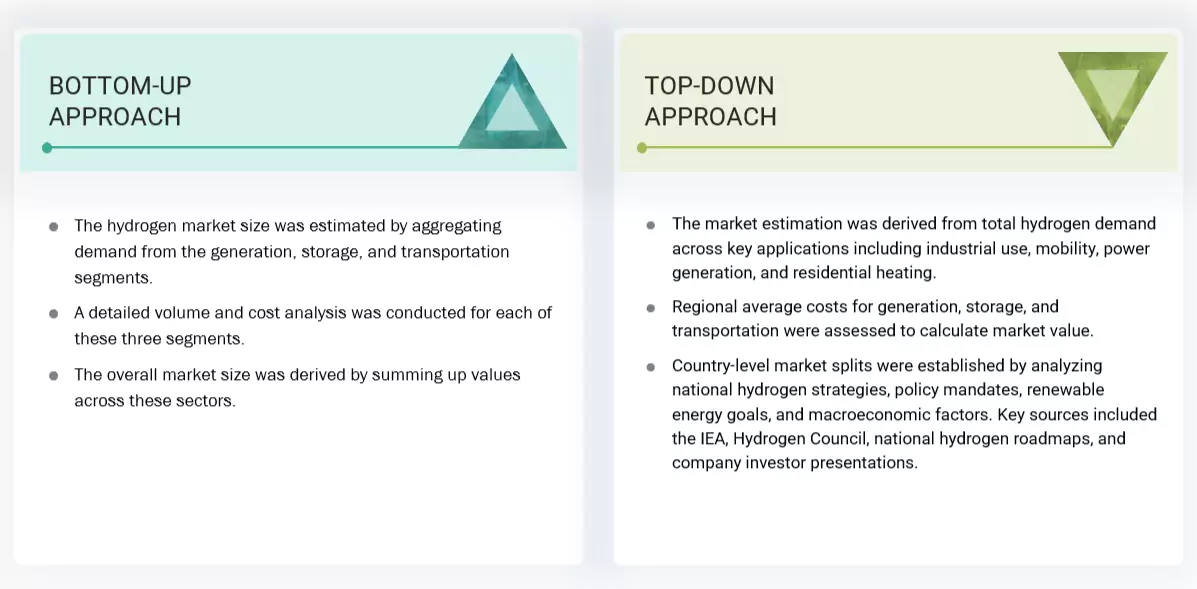
The top-down and bottom-up approaches were used to estimate and validate the total size of the hydrogen market. These methods were also used extensively to estimate the size of various subsegments in the market. The research methodology used to estimate the market size includes the following.
Hydrogen Market : Top-Down and Bottom-Up Approach
Data Triangulation
The total market was split into several segments and subsegments after arriving at the overall market size from the above estimation process. Data triangulation and market breakdown processes were employed to complete the overall market engineering process and arrive at the exact statistics for all the segments and subsegments, wherever applicable. The data was triangulated by studying various factors and trends from the demand and supply sides. In addition, the market size was validated using both the top-down and bottom-up approaches.
Market Definition
Hydrogen is the lightest and most abundant element in the universe. Hydrogen gas has an excellent energy-carrying capacity. It can be produced in large quantities and supplied to large-scale industries for various operations. It can be produced as a principal and by-product from various primary energy sources (such as wind, solar, coal, natural gas, and nuclear). Hydrogen is produced in bulk for many value-added uses and chemical substances. It delivers power for various applications, including fuel cells and combined heat and power technologies.
The hydrogen market is defined as the sum of the hydrogen generation, storage, and transportation markets. The hydrogen generation market is the sum of the revenue generated by companies producing hydrogen for various applications such as chemical & refinery, energy, and mobility. The hydrogen storage market includes the sum of physical-form hydrogen storage and material-based hydrogen storage. Hydrogen transportation encompasses the revenue generated by transporting hydrogen over long distances and short distances. The hydrogen market has been studied for the five key regions: North America, Europe, the Middle East & Africa, South America, and the Asia Pacific
Stakeholders
- Fuel cell electric vehicles (FCEVs) manufacturers
- Government organizations
- Hydrogen charging station owners
- Hydrogen fuel pump developers and operators
- Hydrogen generation equipment manufacturers and suppliers
- Hydrogen generation infrastructure developers
- Institutional investors
- Merchant hydrogen producers
- Methanol producers
- Refinery operators
- Research institutes
Report Objectives
- To define, describe, segment, and forecast the hydrogen market size, by sector, and region, in terms of value and volume
- To define, describe, segment, and forecast the hydrogen market size, by application, in terms of value
- To forecast the market size across five key regions, namely North America, Europe, Asia Pacific, Middle East & Africa, and South America, in terms of volume & value
- To provide detailed information about the key drivers, restraints, opportunities, and industry-specific challenges influencing the growth of the hydrogen market
- To provide the supply chain analysis, trends/disruptions impacting customer business, ecosystem analysis, regulatory landscape, patent analysis, case study analysis, technology analysis, key conferences & events, the impact of AI/Gen AI, pricing analysis, porter's five forces analysis, regulatory analysis, and the impact of 2025 US tariff on the hydrogen generation market
- To strategically analyze the micromarkets1 with respect to individual growth trends, upcoming expansions, and their contributions to the overall market
- To analyze opportunities for stakeholders in the hydrogen market and draw a competitive landscape for market players
- To benchmark players within the market using the company evaluation quadrant, which analyzes market players on various parameters within the broad categories of business and product strategies
- To compare key market players with respect to the market share, product specifications, and applications
- To strategically profile key players and comprehensively analyze their market ranking and core competencies.
- To track and analyze competitive developments in the hydrogen market, sales contracts, agreements, investments, expansions, product launches, alliances, mergers, partnerships, joint ventures, collaborations, and acquisitions.
Available Customizations
MarketsandMarkets offers customizations according to the specific needs of the companies using the given market data.
The following customization options are available for the report:
Product Analysis
- Product matrix, which gives a detailed comparison of the product portfolio of each company
Geographic Analysis as per Feasibility
- Further breakdown of the hydrogen market, by country
Company Information
- Detailed analysis and profiling of additional market players (up to five)
Get the Full Hydrogen Market Report
Full forecast, segment splits, and company analysis for all Hydrogen Market.
- Canada Hydrogen Market
- Mexico Hydrogen Market
- US Hydrogen Market
- China Hydrogen Market
- India Hydrogen Market
- Japan Hydrogen Market
- Australia Hydrogen Market
- South Korea Hydrogen Market
- Germany Hydrogen Market
- France Hydrogen Market
- UK Hydrogen Market
- South Africa Hydrogen Market
- Brazil Hydrogen Market
- Argentina Hydrogen Market
- Rest Of Europe Hydrogen Market
- Rest Of Asia Pacific Hydrogen Market
- GCC Hydrogen Market
- Rest Of South America Hydrogen Market
Need a Tailored Report?
Customize this report to your needs
Get 10% FREE Customization
Customize This Report
