
South Africa Identity Verification Market (2025-2030)

The South Africa Identity Verification Market was valued at $171.3 Million in 2025 and projected to reach to $385.7 Million by 2030, representing a compound annual growth rate of 17.6%. South Africa's identity verification market is poised for accelerated growth through 2030, driven by digital transformation initiatives and regulatory compliance requirements across financial services and government sectors.


| Market Size in | USD 26.32 MN |
| Market Forecast in | |
| CAGR | |
| Forecast Period | |
| Units Considered | Value (USD MN) |
South Africa Identity Verification Market Trends and Insights
- This growth trajectory reflects South Africa's increasing digital transformation across financial services, government, and enterprise sectors, where secure identity authentication has become critical.
- South Africa's regulatory environment and rising cybersecurity concerns are driving adoption of advanced verification technologies among banks, fintech platforms, and public institutions. The 17.6% compound annual growth rate underscores South Africa's position as a key market within the Middle East Africa region.
- South Africa's mature banking infrastructure and growing mobile penetration create favorable conditions for identity verification solutions.
- Between 2025 and 2030, South Africa is expected to see accelerated investment in biometric systems, document verification, and AI-powered authentication platforms as organizations prioritize fraud prevention and regulatory compliance..
Key Market Statistics
- CAGR (2025-2030) 17.6% CAGR
- Market Size, 2025 ~USD 171.3 Million
- Forecast, 2030 ~USD 385.7 Million
- Country South Africa
South Africa Identity Verification Market Overview
Market Valuation & Growth :
South Africa's identity verification market is valued at USD 171.3 million in 2025, with a robust CAGR of 17.6% projected through 2030, significantly outpacing the global average of 15.4%.
Digital Financial Services Expansion :
Rapid adoption of digital banking and fintech solutions across South Africa is driving demand for advanced identity verification technologies to combat fraud and ensure regulatory compliance.
Government & Regulatory Drivers :
South Africa's strengthened regulatory framework and government digitalization initiatives are mandating secure identity authentication across public services and financial institutions.
Enterprise Security Priorities :
South African enterprises across retail, telecommunications, and insurance sectors are increasingly investing in biometric and AI-powered identity verification solutions to protect customer data.
South Africa Identity Verification Market Dynamics
- The market's 17.6% CAGR reflects strong demand for advanced authentication technologies, including biometric solutions and AI-powered verification systems.
- Increasing cybersecurity threats and the need for Know Your Customer (KYC) compliance are compelling organizations to adopt sophisticated identity verification platforms.
- The convergence of mobile banking adoption, e-commerce expansion, and government digitalization efforts creates substantial opportunities for market participants.
- South Africa's position as a regional technology hub further accelerates innovation and investment in identity verification infrastructure, positioning the country as a key growth market within the African continent..
Market Ecosystem
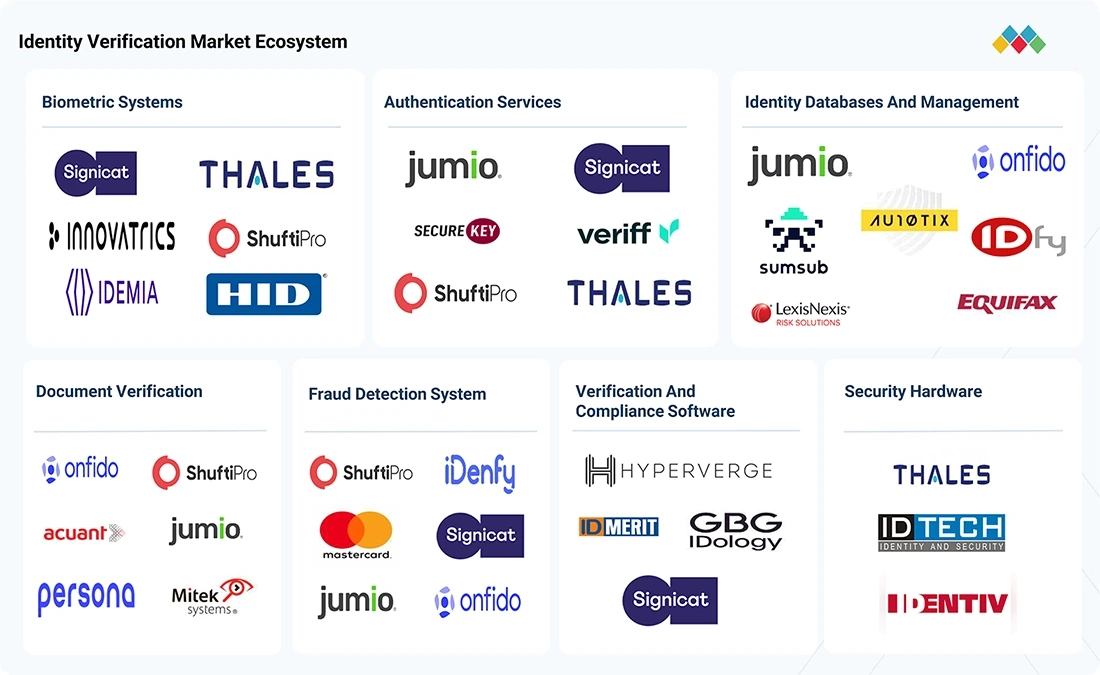
IDENTITY VERIFICATION MARKET: COMMERCIAL USE CASES ACROSS INDUSTRIES
| COMPANY | USE CASE DESCRIPTION | BENEFITS |
|---|---|---|
 |
Banco do Brasil deployed IBM watsonx.governance to centralize AI oversight, enabling real-time monitoring, proactive alerts, transparent compliance, and stronger governance across its expanding AI environment. | Unified AI oversight, improved monitoring and alerting, greater compliance transparency, stronger trust, and increased agility in AI deployment |
 |
Mastercard partnered with Credo AI to govern hundreds of generative AI use cases through centralized AI registries, automated risk assessments, stakeholder reviews, and third-party vendor assessments. | Reduced governance effort, improved visibility into AI adoption, accelerated reviews, strengthened collaboration, and enabled enterprise-wide control over AI risks |
|
|
Infosys deployed IBM watsonx.governance to govern more than 2,700 AI use cases, streamlining risk assessments, compliance processes, lifecycle oversight, and centralized governance across functions and geographies. | Achieved a 150% improvement in operational efficiency, accelerated AI project delivery, and maintained consistent governance across enterprise AI deployments |
|
|
The US Open used IBM watsonx.governance to identify and mitigate bias in tournament data, applying post-processing techniques to improve fairness without compromising overall accuracy. | Increased court fairness from 71% to 82%, representing an 11% improvement while maintaining overall model accuracy |
 |
The US Army deployed BigID to discover and classify sensitive data, identify vulnerable information, automate retention, and establish stronger governance and risk controls across its complex cloud and enterprise data environment. | Improved sensitive-data visibility, reduced data risk, accelerated secure cloud migration, minimized redundant data, and strengthened automated data retention |
Logos and trademarks shown above are the property of their respective owners. Their use here is for informational and illustrative purposes only.
Related Ecosystem
Cyber Security
- Cloud Security
- Biometric Systems
- Multi-Factor Authentication
- Security Analytics
- Data Loss Prevention (DLP)
- International Business Machines Corporation
- Cisco Systems, Inc.
- MITSUI BUSSAN SECURE DIRECTIONS INC
- MICROSOFT CORPORATION
- Allot Ltd.
Key Takeaways
- South Africa's identity verification market will more than double from USD 171.3M (2025) to USD 385.7M (2030), representing a 17.6% CAGR.
- South Africa's financial services sector is the primary driver, with banks and fintech companies investing heavily in biometric and document verification technologies.
- South Africa's regulatory framework and compliance requirements are accelerating adoption of advanced identity verification solutions across public and private sectors.
- South Africa's growing digital economy and mobile-first population create significant opportunities for cloud-based and AI-powered verification platforms.
Identity Verification Market Report Scope
| Report Metric | Details |
|---|---|
| Base Year | 2025 |
| Fastest Growing Segment | GAMING & GAMBLING (Vertical) |
| Forecast Period | 2025–2030 |
| Growth Rate | CAGR of 15.4% from 2025 to 2030 |
| Largest Segment | SOLUTIONS (Offering) |
| Market Size Base Year (Billions) | ~USD 14.33 (2025) |
| Revenue Forecast (Billions) | ~USD 29.32 (2030) |
| Segments Covered | Offering, Type, Organization Size, Deployment Mode, Application, Vertical |
South Africa Identity Verification Market Report Segmentation
6 segment dimensions are covered across the global market.
By Offering
- Services
- Solutions
By Type
- Biometrics
- Non- Biometrics
- Non-Biometrics
By Organization Size
- Large Enterprises
- Smes
By Deployment Mode
- Cloud
- On-Premise
- On-Premises
By Application
- Access Control & User Monitoring
- Access Control And User Monitoring
- Identity Fraud Compliance & Forensics
- Identity Fraud Compliance And Forensics
- Kyc, Kyb, & Onboarding
By Vertical
- Bfsi
- Education
- Energy & Utilities
- Gaming & Gambling
- Government & Defense
- Healthcare & Life Sciences
- It & Ites
- It And Ites
- Other Verticals
- Retail & Ecommerce
- Telecommunications
Target Audience
- Financial Services Institutions : South African banks and fintech companies need market intelligence to understand identity verification technology adoption rates, regulatory requirements, and competitive positioning in their sector.
- Technology Solution Providers : Identity verification vendors and software companies require South Africa-specific market data to develop localized solutions, identify customer segments, and plan market expansion strategies.
- Government & Regulatory Bodies : South African government agencies and regulators need market insights to inform digital identity policy development, procurement decisions, and national digitalization initiatives.
- Enterprise & Retail Organizations : Large South African enterprises across retail, telecommunications, and insurance sectors need market forecasts to guide identity verification technology investments and compliance strategies.
- Investment & Consulting Firms : Private equity, venture capital, and management consulting firms require detailed South Africa market analysis to evaluate investment opportunities and advise clients on market entry strategies.
Key Companies in the South Africa Identity Verification Market
| Company | HQ | Ownership | Strongest segments |
|---|---|---|---|
| PING IDENTITY CORPORATION | United States | Private Company | Single sign-on and access management,Multi-factor authentication and risk-based access,Directory and dynamic authorization, |
| EXPERIAN | Ireland | Public Company | B2B Credit & Risk Decisioning (data + software + analytics),Fraud, Identity, and Compliance Solutions,Consumer Services (credit monitoring, identity protection, offers), |
| EQUIFAX | United States | Public Company | Workforce Solutions (verification and employer services),U.S. Information Solutions (consumer and commercial credit, fraud, marketing),International information services and collections technology, |
| THALES | France | Public Company | Defence & Security (air defence, C4ISR, combat systems, EW, protection),Aerospace & Space (avionics, ATM, satellites, in-flight connectivity),Digital Identity & Security (banking, IAM, biometrics, secure IoT), |
| GBG | United Kingdom | Public Company | Identity Verification & KYC/KYB,Document & Biometric Authentication,Location Intelligence & Address Verification, |
| TRANSUNION | United States | Public Company | Credit Reporting & Core Risk Solutions,Fraud, Identity & Authentication,Marketing, Analytics & Consulting, |
| MASTERCARD | United States | Public Company | Consumer credit and debit payment products,Commercial credit, debit, and prepaid solutions,Cross-border and account-to-account solutions (incl. Mastercard Move), |
| ENTRUST | United States | Private Company | PKI and digital certificates,IdentityGuard and strong authentication,Citizen eID and ePassports, |
| MITEK SYSTEMS | United States | Public Company | Mobile Deposit & Check Capture,Check Fraud & Check Intelligence Suite,Digital Identity Verification Platform (Mobile Verify, Verified Identity Platform, MiSnap), |
| IDEMIA | France | Private Company | Government identity documents and enrollment systems,Biometric platforms, border control, and public safety,Payment solutions and tokenization, |
PING IDENTITY CORPORATION
PING IDENTITY CORPORATION is a United States private company founded in 2002 with 1,247 employees.
EXPERIAN
EXPERIAN is an Irish public company founded in 1826 with 25,200 employees.
EQUIFAX
EQUIFAX is a United States public company founded in 1899 with 15,000 employees.
THALES
THALES is a French public company founded in 1893 with 82,111 employees.
GBG
GBG is a United Kingdom public company founded in 1989 with 1,055 employees.
TRANSUNION
TRANSUNION is a United States public company founded in 1968 with 13,500 employees.
MASTERCARD
MASTERCARD is a United States public company founded in 1966 with 39,800 employees.
ENTRUST
ENTRUST is a United States private company founded in 1994 with 400 employees.
MITEK SYSTEMS
MITEK SYSTEMS is a United States public company founded in 1986 with 578 employees.
IDEMIA
IDEMIA is a French private company founded in 1987 with 6,800 employees.
Reasons to Buy this Report
- Market-Specific Growth Intelligence : Gain detailed insights into South Africa's 17.6% CAGR trajectory and understand the unique drivers propelling the market from USD 171.3M to USD 385.7M by 2030.
- Regulatory & Compliance Landscape : Understand South Africa's specific regulatory environment and compliance requirements shaping identity verification adoption across financial services and government sectors.
- Competitive Positioning Strategy : Identify key market players, technology trends, and competitive dynamics specific to South Africa to inform strategic market entry and expansion decisions.
- Sector-Specific Opportunity Analysis : Analyze demand patterns across South African banking, fintech, insurance, and government sectors to identify high-potential customer segments and revenue opportunities.
- Investment & Partnership Insights : Access actionable intelligence on investment trends, partnership opportunities, and technology adoption patterns critical for stakeholders targeting the South African market.
Frequently asked questions
What is the current size of South Africa's identity verification market?
South Africa's identity verification market is valued at USD 171.3 million in 2025 and is expected to grow to USD 385.7 million by 2030.
What is the projected growth rate for South Africa's identity verification market?
South Africa's identity verification market is projected to grow at a compound annual growth rate (CAGR) of 17.6% between 2025 and 2030.
Which sectors are driving growth in South Africa's identity verification market?
South Africa's financial services, government, and enterprise sectors are the primary drivers, with banks, fintech platforms, and public institutions investing in secure authentication solutions.
What technologies are most in demand in South Africa's identity verification market?
South Africa's market shows strong demand for biometric systems, AI-powered authentication, document verification, and cloud-based identity solutions.
What factors are accelerating identity verification adoption in South Africa?
South Africa's regulatory compliance requirements, rising cybersecurity threats, digital transformation initiatives, and mobile penetration are key factors driving market growth.
RESEARCH METHODOLOGY
This study involved estimating the current identity verification market size. Exhaustive secondary research was carried out to collect information on the identity verification industry. The next step was to validate these findings, assumptions, and sizing with industry experts across the value chain using primary research. Different approaches, such as top-down and bottom-up, were employed to estimate the total market size. After that, the market breakup and data triangulation procedures were used to estimate the market size of the segments and subsegments of the identity verification market.
Secondary Research
The market for companies offering identity verification solutions and services was arrived at by using secondary data available through paid and unpaid sources, analyzing the product portfolios of the major companies in the ecosystem, and rating the companies by their performance and quality. Various sources were referred to in the secondary research process to identify and collect information for this study. The secondary sources included annual reports, press releases, investor presentations of companies, white papers, journals, certified publications, and articles from recognized authors, directories, and databases.
In the secondary research process, various secondary sources were referred to to identify and collect information related to the study. Secondary sources included annual reports, press releases, and investor presentations of identity verification vendors, forums, certified publications, and whitepapers. Secondary research was used to obtain essential information on the industry’s value chain, the total pool of key players, market classification, and segmentation from the market and technology-oriented perspectives.
Primary Research
In the primary research process, various supply and demand sources were interviewed to obtain qualitative and quantitative information for this report. The primary sources from the supply side included industry experts, such as Chief Executive Officers (CEOs), Vice Presidents (VPs), marketing directors, technology and innovation directors, and related key executives from various key companies and organizations operating in the identity verification market.
After the complete market engineering (calculations for market statistics, market breakdown, market size estimations, market forecasting, and data triangulation), extensive primary research was conducted to gather information and verify and validate the critical numbers arrived at. Primary research was also undertaken to identify the segmentation types, industry trends, competitive landscape of identity verification hardware, software, and services offered by various market players, and fundamental market dynamics, such as drivers, restraints, opportunities, challenges, industry trends, and key player strategies.
In the complete market engineering process, the top-down and bottom-up approaches and several data triangulation methods were extensively used to perform the market estimation and market forecasting for the overall market segments and subsegments listed in this report. Extensive qualitative and quantitative analysis was performed on the complete market engineering process to list the key information/insights throughout the report.
Following is the breakup of the primary study:
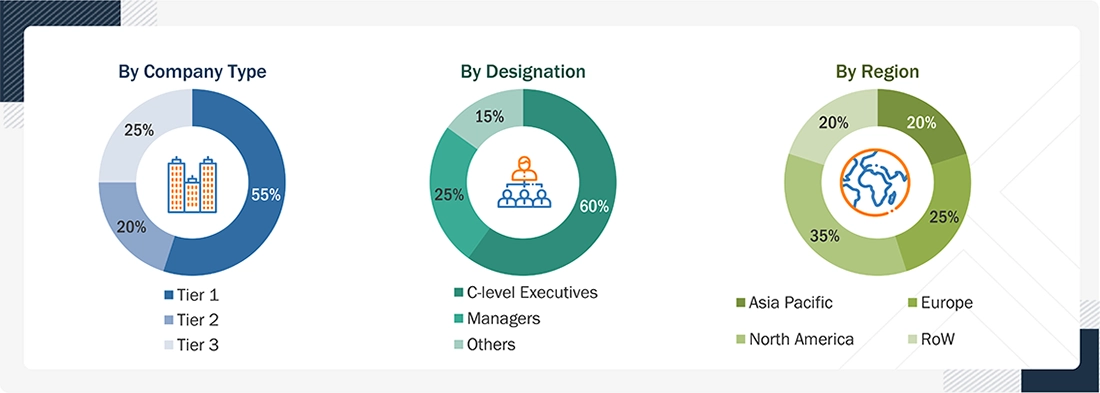
Note: The companies have been categorized based on their total annual revenue; tier 1 companies = revenue greater than USD 10 billion; tier 2 companies = revenue between USD 1 billion and USD 10 billion; and tier 3 companies = revenue between USD 500 million and USD 1 billion.
Source: MarketsandMarkets Analysis
To know about the assumptions considered for the study, download the pdf brochure
Market Size Estimation
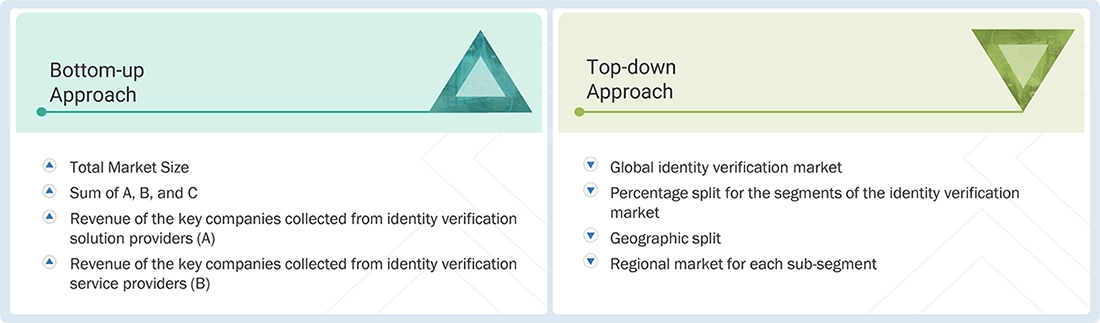
Top-down and bottom-up approaches were used to estimate and validate the size of the identity verification market and the size of various other dependent sub-segments. The research methodology used to estimate the market size included the following details: key players in the market were identified through secondary research, and their market shares in the respective regions were determined through primary and secondary research. This entire procedure included the study of the annual and financial reports of the top market players, as well as extensive interviews for key insights with industry leaders, such as CEOs, VPs, directors, and marketing executives.
All percentage splits and breakdowns were determined using secondary sources and verified through primary sources. All possible parameters that affect the market covered in this research study were accounted for, viewed in extensive detail, verified through primary research, and analyzed to get the final quantitative and qualitative data. This data was consolidated and added to detailed inputs and analysis from MarketsandMarkets.
Identity Verification Market: Top-Down and Bottom-Up Approach
Data Triangulation
After arriving at the overall market size using the market size estimation processes explained above, the market was split into several segments and subsegments. The data triangulation and market breakup procedures were employed, wherever applicable, to complete the overall market engineering process and arrive at the exact statistics of each market segment and subsegment. The data was triangulated by studying various factors and trends from both the demand and supply sides.
Market Definition
According to MarketsandMarkets, identity verification is a process of verifying an individual’s identity by using publicly or privately available databases. The solutions offered in the identity verification market help organizations verify an individual's identity quickly and easily, thereby actively improving customer experience and complying with privacy laws, anti-money laundering (AML) legislation, and know-your-customer (KYC) requirements.
Key Stakeholders
- Government agencies
- Consulting firms
- Information technology (IT) security agencies
- Raw material/component suppliers
- Research organizations and consulting companies
- Government bodies, such as regulating authorities and policymakers
- Venture capitalists and private equity firms
- Chief technology and data officers
- Identity verification service professionals
- Business analysts
- Information technology (IT) professionals
- Consultants/consultancies/advisory firms
Report Objectives
- To define, describe, and forecast the identity verification market based on offering, type, deployment mode, organization size, application, vertical, and region
- To forecast the market size of five main regions: North America, Europe, Asia Pacific (APAC), Middle East & Africa (MEA), and Latin America
- To analyze the subsegments of the market concerning individual growth trends, prospects, and contributions to the overall market
- To provide detailed information related to the primary factors (drivers, restraints, opportunities, and challenges) influencing the growth of the market
- To analyze opportunities in the market for stakeholders by identifying high-growth segments of the market
- To profile the key players of the market and comprehensively analyze their market size and core competencies
- To track and analyze competitive developments, such as product launches, mergers and acquisitions, partnerships, agreements, and collaborations in the identity verification market
Available customizations:
With the given market data, MarketsandMarkets offers customizations based on company-specific needs. The following customization options are available for the report:
Geographic Analysis
- Further breakup of the Asia Pacific market into countries contributing 75% to the regional market size
- Further breakup of the North American market into countries contributing 75% to the regional market size
- Further breakup of the Latin American market into countries contributing 75% to the regional market size
- Further breakup of the Middle Eastern and African market into countries contributing 75% to the regional market size
- Further breakup of the European market into countries contributing 75% to the regional market size
Company Information
- Detailed analysis and profiling of additional market players (up to 5)
Country Information
-
Additional country-level analysis of the dermatology devices market
Get the Full Identity Verification Market Report
Full forecast, segment splits, and company analysis for all Identity Verification Market.
- Canada Identity Verification Market
- US Identity Verification Market
- UK Identity Verification Market
- Germany Identity Verification Market
- France Identity Verification Market
- Italy Identity Verification Market
- Austria Identity Verification Market
- Romania Identity Verification Market
- China Identity Verification Market
- Japan Identity Verification Market
- India Identity Verification Market
- Singapore Identity Verification Market
- Philippines Identity Verification Market
- Indonesia Identity Verification Market
- UAE Identity Verification Market
- Brazil Identity Verification Market
- Mexico Identity Verification Market
- Rest Of Europe Identity Verification Market
Need a Tailored Report?
Customize this report to your needs
Get 10% FREE Customization
Customize This Report
