
India Industrial Cybersecurity Market (2024-2029)

The India Industrial Cybersecurity Market was valued at $1961.7 Million in 2024 and projected to reach to $3835.1 Million by 2029, representing a compound annual growth rate of 14.3%. India's industrial cybersecurity market is poised for exceptional growth through 2029, driven by the nation's aggressive digital transformation agenda and expanding manufacturing base.


| Market Size in | USD 26.32 MN |
| Market Forecast in | |
| CAGR | |
| Forecast Period | |
| Units Considered | Value (USD MN) |
India Industrial Cybersecurity Market Trends and Insights
- This accelerated expansion reflects India's rapid digital transformation across manufacturing, energy, and critical infrastructure sectors, where industrial control systems and operational technology environments face escalating cyber threats.
- India's strategic position as a global manufacturing hub and increasing government mandates for cybersecurity compliance are driving enterprise investment in threat detection, vulnerability management, and incident response solutions. The industrial cybersecurity landscape in India is characterized by growing awareness among semiconductor and electronics manufacturers regarding the vulnerability of legacy systems and connected devices.
- India's expanding IoT deployments and Industry 4.0 initiatives are creating heightened demand for integrated security platforms that protect both information technology and operational technology networks.
- Between 2024 and 2029, India is expected to witness significant adoption of AI-driven security analytics, cloud-based monitoring solutions, and zero-trust architecture frameworks as organizations prioritize resilience against sophisticated cyber attacks targeting production environments..
Key Market Statistics
- CAGR (2024-2029) 14.3% CAGR
- Market Size, 2024 ~USD 1961.7 Million
- Forecast, 2029 ~USD 3835.1 Million
- Country India
India Industrial Cybersecurity Market Overview
Rapid Market Expansion :
India's industrial cybersecurity market is growing at 14.3% CAGR, significantly outpacing the global rate of 9.8%, driven by accelerated digital transformation across manufacturing and critical infrastructure sectors.
Substantial Market Valuation :
The market is valued at USD 1,961.7 million in 2024 and is projected to nearly double to USD 3,835.1 million by 2029, reflecting strong investment in securing industrial control systems and operational technology.
Critical Infrastructure Focus :
India's energy, manufacturing, and critical infrastructure sectors are prioritizing cybersecurity investments to protect industrial control systems, driven by government initiatives and increasing threat awareness.
Digital Transformation Catalyst :
India's rapid industrialization and adoption of Industry 4.0 technologies are creating heightened demand for robust cybersecurity solutions to protect increasingly connected manufacturing and operational environments.
India Industrial Cybersecurity Market Dynamics
- Government policies promoting Make in India and critical infrastructure protection are accelerating adoption of advanced cybersecurity solutions across industrial sectors.
- The market's 14.3% CAGR reflects growing recognition of cyber threats to operational technology and industrial control systems. Key growth drivers include increasing regulatory compliance requirements, rising cyber incidents targeting industrial facilities, and substantial investments in smart manufacturing and energy infrastructure.
- As India strengthens its position in global supply chains, industrial cybersecurity becomes increasingly critical.
- Organizations across manufacturing, energy, and utilities are prioritizing integrated security solutions, creating significant opportunities for both domestic and international cybersecurity providers..
Market Ecosystem
Related Ecosystem
Cyber Security
- Cloud Security
- Biometric Systems
- Data Loss Prevention (DLP)
- Multi-Factor Authentication
- Security Analytics
- REDINGTON
- International Business Machines Corporation
- Cisco Systems, Inc.
- MITSUI BUSSAN SECURE DIRECTIONS INC
- MICROSOFT CORPORATION
Industrial Iot
- Sensors
- Pressure Sensors
- Flow Sensors
- Gas Sensors
- Image Sensors
- Siemens ag
- ABB India Limited
- HONEYWELL INTERNATIONAL INC.
- Emerson Electric Co.
- SCHNEIDER ELECTRIC SE
Information System And Analytics
- Machine Learning
- Natural Language Processing (NLP)
- Sensors
- Software as A Service (SaaS)
- Data Loss Prevention (DLP)
- International Business Machines Corporation
- MICROSOFT CORPORATION
- Amazon.com, Inc.
- Oracle Corporation
Key Takeaways
- India's industrial cybersecurity market will nearly double from USD 1,961.7 million in 2024 to USD 3,835.1 million by 2029, driven by accelerating digital transformation and regulatory compliance requirements.
- India's 14.3% CAGR significantly outpaces the global average of 9.8%, reflecting heightened cybersecurity investments across India's manufacturing and critical infrastructure sectors.
- India's semiconductor and electronics manufacturers are increasingly adopting AI-powered threat detection and zero-trust security architectures to protect operational technology environments from sophisticated cyber threats.
- India's government initiatives promoting Industry 4.0 and digital manufacturing are catalyzing enterprise spending on integrated industrial cybersecurity solutions that bridge IT and OT security gaps.
Industrial Cybersecurity Market Report Scope
| Report Metric | Details |
|---|---|
| Base Year | 2024 |
| Fastest Growing Segment | SCADA (Solution Type) |
| Forecast Period | 2024-2029 |
| Growth Rate | CAGR of 9.8% from 2024 to 2029 |
| Largest Segment | SOLUTIONS (Offering) |
| Market Size Base Year (Billions) | ~USD 84.66 (2024) |
| Revenue Forecast (Billions) | ~USD 135.11 (2029) |
| Segments Covered | Deployment Mode, Security Type, Solution Type, Offering, Type, Vertical |
India Industrial Cybersecurity Market Report Segmentation
6 segment dimensions are covered across the global market.
By Deployment Mode
- Clou-Based
- Cloud-Based
- Hybrid
- On-Premises
By Security Type
- Application Security
- Cloud Security
- Endpoint Security
- Network Security
- Other Security Types
- Other Verticals
- Wireless Security
By Solution Type
- Antivirus/Malware
- Ddos
- Dlp
- Firewall
- Iam
- Ids/Ips
- Other Solution Types
- Scada
- Siem
- Utm
- Virtualization Security
By Offering
- Services
- Solutions
By Type
- Audit & Reporting Services
- Design, Integration, & Consulting Services
- Hardware
- Managed Services
- Professional Services
- Risk Management Services
- Software
By Vertical
- Aerospace & Defense
- Energy & Utilities
- Healthcare & Life Sciences
- Manufacturing
- Other Verticals
- Telecommunications
INDIA: INDUSTRIAL CYBERSECURITY MARKET, BY VERTICAL, 2024–2029
| Segment | 2024 | 2025 | 2026 | 2027 | 2028 | 2029 | CAGR (%) |
|---|---|---|---|---|---|---|---|
| AEROSPACE & DEFENSE | 380.6 | 433.2 | 490.5 | 551.7 | 617.2 | 686.5 | 12.5 |
| ENERGY & UTILITIES | 367.5 | 414.7 | 465.4 | 518.7 | 574.7 | 632.8 | 11.5 |
| HEALTHCARE & LIFE SCIENCES | 610.1 | 737.1 | 884.5 | 1052.8 | 1244.5 | 1461.2 | 19.1 |
| MANUFACTURING | 233.4 | 273.5 | 318.8 | 369.2 | 425.2 | 487.1 | 15.8 |
| OTHER VERTICALS | 79.8 | 84.7 | 88.7 | 91.5 | 92.7 | 92 | 2.9 |
| TELECOMMUNICATIONS | 290.3 | 324.8 | 361.1 | 398.4 | 436.8 | 475.5 | 10.4 |
| TOTAL | 1961.7 | 2268.1 | 2609 | 2982.4 | 3391 | 3835.1 | 14.3 |
Target Audience
- Industrial Cybersecurity Vendors : Solution providers need India-specific market data to develop localized offerings, identify growth opportunities in manufacturing and energy sectors, and establish competitive positioning in this high-growth market.
- Manufacturing & Industrial Enterprises : Indian manufacturers require market intelligence to benchmark cybersecurity investments, understand threat landscapes, and make informed decisions about protecting industrial control systems and operational technology.
- Energy & Critical Infrastructure Operators : Utilities and critical infrastructure providers need comprehensive market analysis to align cybersecurity budgets with industry trends, regulatory requirements, and emerging threats specific to India's industrial sectors.
- Investment & Private Equity Firms : Investors evaluating opportunities in India's industrial cybersecurity space require validated market sizing, growth projections, and sector dynamics to support due diligence and portfolio strategy decisions.
- Government & Policy Makers : Indian government agencies and policymakers need market data to inform critical infrastructure protection policies, cybersecurity regulations, and digital transformation initiatives aligned with industry growth.
Reasons to Buy this Report
- Market Size & Growth Validation : Quantified market data for India showing USD 1,961.7M (2024) to USD 3,835.1M (2029) enables accurate investment planning and revenue forecasting specific to the Indian industrial cybersecurity landscape.
- Competitive Positioning Strategy : Understand India's 14.3% CAGR advantage over global 9.8% growth to identify market entry opportunities and competitive advantages in a high-growth emerging market with less saturation than developed regions.
- Sector-Specific Insights : Detailed analysis of India's manufacturing, energy, and critical infrastructure cybersecurity needs enables targeted product development and go-to-market strategies aligned with regional industrial priorities.
- Regulatory & Policy Intelligence : Comprehensive understanding of India-specific compliance requirements, government initiatives, and critical infrastructure protection mandates informs product roadmaps and sales strategies for local market penetration.
- Investment Decision Support : Validated market forecasts and growth trajectories provide confidence for M&A decisions, partnership development, and resource allocation in India's rapidly expanding industrial cybersecurity ecosystem.
Frequently asked questions
What is the projected size of India's industrial cybersecurity market by 2029?
India's industrial cybersecurity market is projected to reach USD 3,835.1 million by 2029, nearly doubling from USD 1,961.7 million in 2024.
What is driving growth in India's industrial cybersecurity market?
India's market growth is driven by rapid digital transformation, Industry 4.0 adoption, government compliance mandates, increasing IoT deployments, and rising cyber threats targeting manufacturing and critical infrastructure sectors.
How does India's cybersecurity market growth compare to global trends?
India's industrial cybersecurity market is growing at 14.3% CAGR, significantly exceeding the global average of 9.8%, indicating accelerated investment and adoption across India's industrial sectors.
Which industries in India are driving industrial cybersecurity demand?
India's semiconductor and electronics manufacturing, energy, utilities, and critical infrastructure sectors are primary drivers of industrial cybersecurity investment and solution adoption.
What technologies are gaining traction in India's industrial cybersecurity market?
India's market is witnessing increased adoption of AI-driven security analytics, cloud-based monitoring platforms, zero-trust architecture frameworks, and integrated IT-OT security solutions.
RESEARCH METHODOLOGY
The research study involved 4 major activities in estimating the size of the industrial cybersecurity market. Exhaustive secondary research has been done to collect important information about the market and peer markets. The validation of these findings, assumptions, and sizing with the help of primary research with industry experts across the supply chain has been the next step. Both top-down and bottom-up approaches have been used to estimate the market size. Post which the market breakdown and data triangulation have been adopted to estimate the market sizes of segments and sub-segments.
Secondary Research
In the secondary research process, various secondary sources have been referred to for identifying and collecting information required for this study. The secondary sources include annual reports, press releases, investor presentations of companies, white papers, and articles from recognized authors. Secondary research has been mainly done to obtain key information about the market’s value chain, the pool of key market players, market segmentation according to industry trends, regional outlook, and developments from both market and technology perspectives.
Primary Research
In primary research, various primary sources from both supply and demand sides have been interviewed to obtain qualitative and quantitative insights required for this report. Primary sources from the supply side include experts such as CEOs, vice presidents, marketing directors, manufacturers, technology and innovation directors, end users, and related executives from multiple key companies and organizations operating in the industrial cybersecurity market ecosystem. After interacting with industry experts, brief sessions were conducted with highly experienced independent consultants to reinforce the findings from our primary respondents. This, along with the in-house subject matter experts’ opinions, has led us to the findings as described in the remainder of this report. The breakdown of primary respondents is as follows:
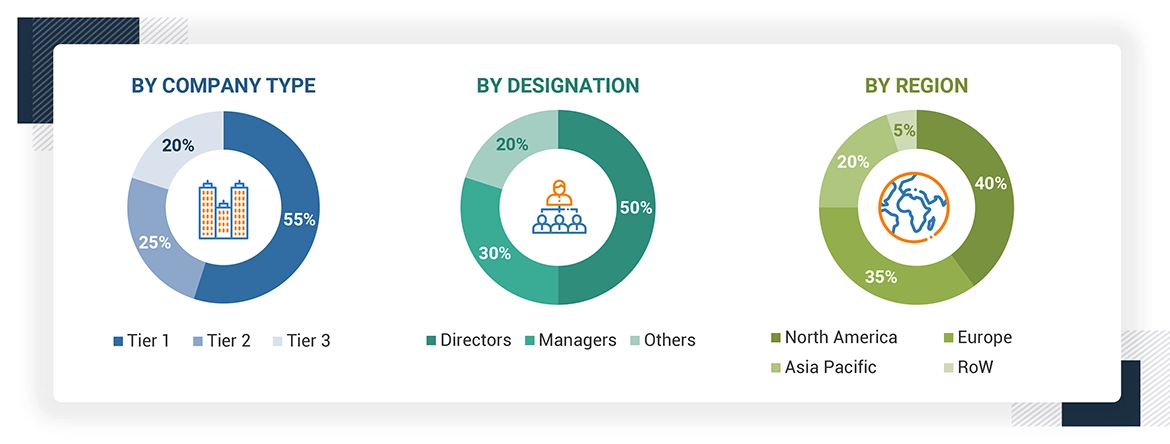
Note: Other designations include sales and marketing executives, researchers, and members of various industrial cybersecurity organizations. Three tiers of companies are defined based on their total revenue as of 2023; tier 1: revenue more than or equal to USD 500 million, tier 2: revenue between USD 100 million and USD 500 million, and tier 3: revenue less than or equal to USD 100 million.
About the assumptions considered for the study, To know download the pdf brochure
Market Size Estimation
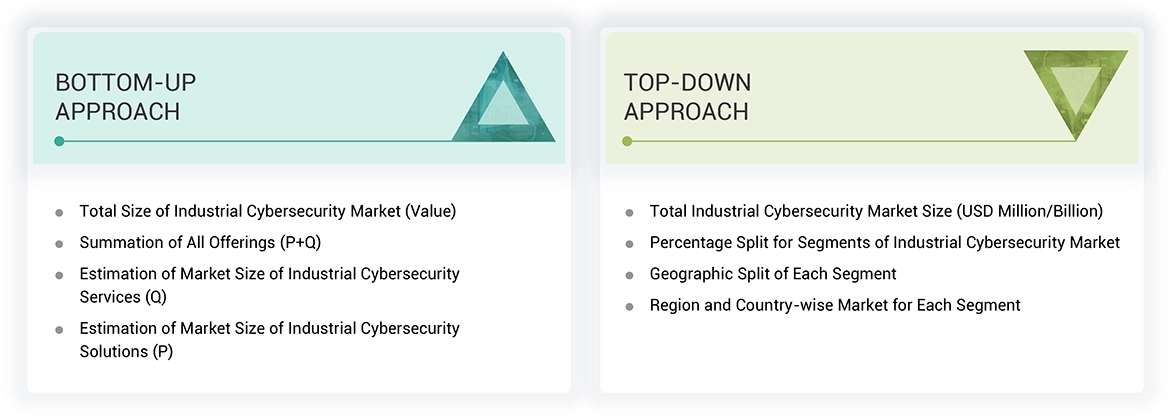
The bottom-up procedure has been employed to arrive at the overall size of the industrial cybersecurity market.
- Identifying and analyzing major providers of industrial cybersecurity solutions and service providers, as well as studying their portfolios and understanding different technologies used
- The market size of industrial cybersecurity solutions was estimated by calculating the total value generated from cybersecurity software, hardware, and platform deployments across various industries
- The market size of industrial cybersecurity services was estimated by summing up revenues from services like managed and professional services. Arriving at the market estimates by analyzing the revenue of companies and then combining these figures to arrive at the market size
- Studying various paid and unpaid sources, such as annual reports, press releases, white papers, and databases, to gather the required information
- Tracking the ongoing developments and identifying the upcoming developments in the market that include investments, research and development activities, product launches, contracts, collaborations, and partnerships undertaken, and forecasting the market size based on these developments
- Carrying out multiple discussions with key opinion leaders to understand the types of industrial cybersecurity hardware and software designed and developed, thereby analyzing the break-up of the scope of work carried out by the major companies in the industrial cybersecurity market
- Arriving at the market estimates by analyzing the revenue generated by key companies providing industrial cybersecurity solutions on the basis of their locations (countries) and then combining the market size for each country to get the market estimate by region
- Verifying and crosschecking the estimates at every level by discussing with key opinion leaders, including CXOs, directors, and operation managers, and then finally with the domain experts at MarketsandMarkets
The top-down approach has been used to estimate and validate the total size of the industrial cybersecurity market.
- Focusing on top-line investments and expenditures being made in the ecosystems of various applications
- Calculating the market size, considering revenues from major players through the cost of industrial cybersecurity solutions
- Segmenting each application of the industrial cybersecurity system in each region and deriving the global market size based on the region
- Acquiring and analyzing information related to revenues generated by players through their crucial offerings
- Conducting multiple on-field discussions with key opinion leaders involved in developing various industrial cybersecurity solutions
- Estimating geographical splits by using secondary sources on the basis of various factors, such as the number of players in a specific country and region and types of industrial cybersecurity solutions offered across end-user industries.
Industrial Cybersecurity Market : Top-Down and Bottom-Up Approach
Data Triangulation
After arriving at the overall market size—using the market size estimation processes as explained above—the market has been split into several segments and subsegments. To complete the entire market engineering process and arrive at the exact statistics of each market segment and subsegment, data triangulation and market breakdown procedures have been employed, wherever applicable. The data has been triangulated by studying various factors and trends from the demand and supply sides of the industrial cybersecurity market.
Market Definition
Industrial cybersecurity refers to the protection of industrial systems and networks from cyber threats, ensuring the safe and reliable operation of critical infrastructure, manufacturing plants, and industrial processes. It involves safeguarding systems like control units, sensors, and operational technology (OT) from cyberattacks, which could disrupt operations, cause equipment damage, or lead to safety hazards.
Key Stakeholders
- Raw material and manufacturing equipment suppliers
- Semiconductor foundries
- Industrial cybersecurity hardware manufacturers
- Industrial cybersecurity software providers
- Industrial cybersecurity service providers
- Original design manufacturers (ODMs) and OEM technology solution providers
- Research organizations
- Technology standard organizations, forums, alliances, and associations
- Technology investors
- Governments, financial institutions, and investment communities
- Analysts and strategic business planners
Report Objectives
- To describe and forecast the size of the industrial cybersecurity market by offering, security type, solution type, deployment type, end-user industry, and region in terms of value
- To describe and forecast the market size of various segments across four key regions—North America, Europe, Asia Pacific, and Rest of the World (RoW), in terms of value
- To forecast the size of the industrial cybersecurity market by offering in terms of volume
- To provide detailed information regarding the drivers, restraints, opportunities, and challenges influencing the growth of the industrial cybersecurity market
- To analyse the industrial cybersecurity value chain and ecosystem, along with the average selling price of industrial cybersecurity solutions
- To strategically analyze the regulatory landscape, tariff, standards, patents, Porter’s five forces, import and export scenarios, trade values, and case studies pertaining to the market under study
- To strategically analyze micromarkets with regard to individual growth trends, prospects, and contributions to the overall market
- To analyze opportunities in the market for stakeholders by identifying high-growth segments
- To provide details of the competitive landscape for market leaders
- To analyze strategies such as product launches, expansion, collaborations, acquisitions, partnerships, and expansions adopted by players in the industrial cybersecurity market
- To profile key players in the industrial cybersecurity market and comprehensively analyse their market ranking based on their revenue, market share, and core competencies.
This research report categorizes the industrial cybersecurity market based on offering, security type, solution type, deployment type, end-user industry, and region.
Available Customizations
With the given market data, MarketsandMarkets offers customizations according to the specific requirements of companies. The following customization options are available for the report:
- Detailed analysis and profiling of additional market players based on various blocks of the supply chain
Get the Full Industrial Cybersecurity Market Report
Full forecast, segment splits, and company analysis for all Industrial Cybersecurity Market.
- Canada Industrial Cybersecurity Market
- Mexico Industrial Cybersecurity Market
- US Industrial Cybersecurity Market
- UK Industrial Cybersecurity Market
- Germany Industrial Cybersecurity Market
- France Industrial Cybersecurity Market
- Italy Industrial Cybersecurity Market
- Netherlands Industrial Cybersecurity Market
- China Industrial Cybersecurity Market
- Japan Industrial Cybersecurity Market
- South Korea Industrial Cybersecurity Market
- Rest Of Europe Industrial Cybersecurity Market
- Rest Of Asia Pacific Industrial Cybersecurity Market
- GCC Countries Industrial Cybersecurity Market
Need a Tailored Report?
Customize this report to your needs
Get 10% FREE Customization
Customize This Report
