
Rest Of Europe Industrial Gaskets Market (2025-2030)

The Rest Of Europe Industrial Gaskets Market was valued at $102.9 Million in 2025 and projected to reach to $119 Million by 2030, representing a compound annual growth rate of 3.0%. Rest Of Europe's industrial gaskets market demonstrates resilience through a moderate 3% CAGR, supported by the region's mature manufacturing base and established industrial operations.


| Market Size in | USD 26.32 MN |
| Market Forecast in | |
| CAGR | |
| Forecast Period | |
| Units Considered | Value (USD MN) |
Rest Of Europe Industrial Gaskets Market Trends and Insights
- This moderate growth trajectory reflects the region's mature industrial base and steady demand across manufacturing, automotive, and chemical processing sectors.
- Rest Of Europe continues to benefit from established supply chains and regulatory frameworks that support consistent gasket adoption across diverse applications. The industrial gaskets market in Rest Of Europe is characterized by incremental expansion driven by equipment maintenance cycles and gradual industrial modernization.
- Rest Of Europe's growth rate of 3.0% is notably lower than the global CAGR of 5.7%, indicating a more conservative market dynamic compared to emerging regions.
- Between 2025 and 2030, Rest Of Europe is expected to add approximately USD 16.1 million in market value, supported by ongoing investments in infrastructure and manufacturing efficiency improvements across the region..
Key Market Statistics
- CAGR (2025-2030) 3.0% CAGR
- Market Size, 2025 ~USD 102.9 Million
- Forecast, 2030 ~USD 119 Million
- Country Rest Of Europe
Rest Of Europe Industrial Gaskets Market Overview
Steady Market Growth :
Rest Of Europe's industrial gaskets market is valued at USD 102.9 million in 2025, with projected growth to USD 119.0 million by 2030, demonstrating consistent demand across the region's established industrial sectors.
Moderate CAGR of 3% :
The region exhibits a 3% CAGR through 2030, reflecting a mature industrial base with stable, predictable growth patterns compared to the global average of 5.7%, indicating a more conservative market expansion.
Diverse Industrial Applications :
Rest Of Europe's gasket demand spans manufacturing, automotive, and chemical processing sectors, with established supply chains and regulatory frameworks supporting consistent market performance across multiple end-use industries.
Regional Manufacturing Strength :
The region benefits from a robust industrial infrastructure and skilled workforce, positioning Rest Of Europe as a stable market with reliable demand from legacy manufacturing operations and modernization initiatives.
Rest Of Europe Industrial Gaskets Market Dynamics
- The market benefits from steady demand across automotive, chemical processing, and general manufacturing sectors, where gasket replacement and maintenance remain consistent operational requirements.
- Regulatory compliance and quality standards drive continued investment in reliable sealing solutions. Looking ahead to 2030, growth will be tempered by market maturity but supported by industrial modernization efforts and sustainability initiatives.
- The region's focus on equipment efficiency and environmental compliance will sustain demand for high-performance gaskets.
- Strategic opportunities exist in specialized applications and advanced materials, though overall expansion will remain measured compared to emerging markets..
Market Ecosystem
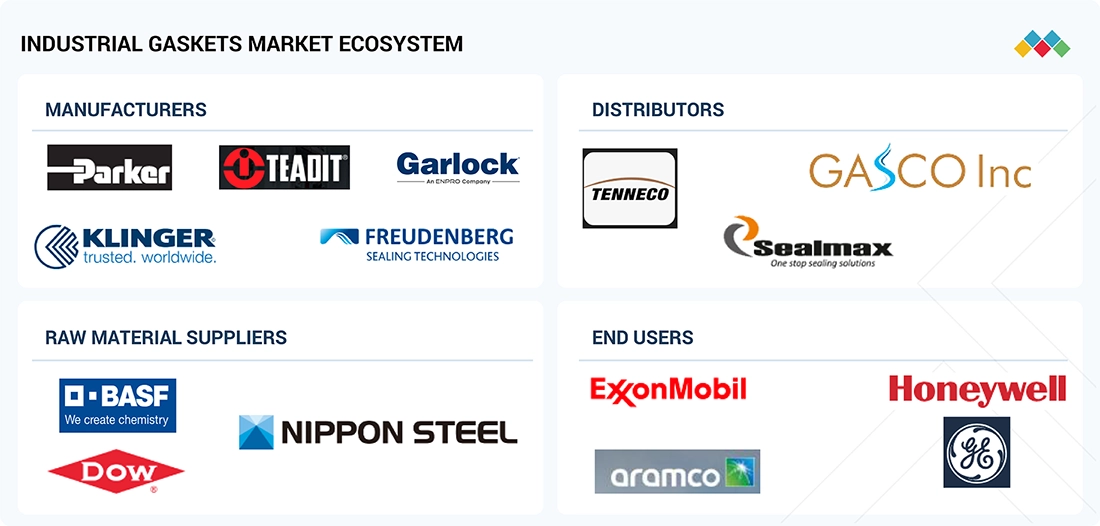
Industrial Gaskets Market: COMMERCIAL USE CASES ACROSS INDUSTRIES
| COMPANY | USE CASE DESCRIPTION | BENEFITS |
|---|---|---|
 |
Supplies press-in-place gaskets, edge-bonded gaskets, and over-molded gaskets for the chemical, pharmaceutical, and food & beverage industries. | Custom-shaped, ensuring reliable placement and optimized sealing performance. |
 |
Provides CNAF gaskets, elastomer gaskets, graphite gaskets, and metal gaskets for chemical, pulp & paper, food & beverage, marine, and petrochemical industries. | Excellent sealing performance while being easy to cut, handle, and install. |
 |
Offers specialized jacketed gasket, camprofile gasket, and solid metallic gasket for heat exchangers, valves, chemical industry, and power stations. | The specialized gaskets have superior sealing capabilities. Provides excellent resistance to mechanical wear and chemical attack |
 |
Develops railcar manway gaskets, hygienic sanitary gaskets, and O-rings. | The gasket is specially designed to improve system performance, simplify assembly, and lower total cost. |
 |
Manufactures spiral-wound metal gaskets, corrugated metal gaskets, kammprofile metal gaskets, jacketed metal gaskets, and solid metal gaskets. | Delivers exceptional mechanical strength, versatile, and cost-effective sealing solutions. |
Logos and trademarks shown above are the property of their respective owners. Their use here is for informational and illustrative purposes only.
Related Ecosystem
Equipment Machine And Tooling
- Wastewater Treatment
- Air Cooled Heat Exchangers
- Diaphragm Pumps
- Fiberglass
- HVAC System
- Alfa Laval Corporate AB
- Veolia
- Johnson Controls International plc
- Daikin Industries,Ltd.
- Parker-Hannifin Corporation
Key Takeaways
- Rest Of Europe's industrial gaskets market is valued at USD 102.9 million in 2025 with a projected value of USD 119.0 million by 2030.
- Rest Of Europe exhibits a 3.0% CAGR, reflecting a mature market with steady but moderate growth compared to global expansion rates.
- Rest Of Europe's market growth is driven by equipment maintenance cycles, industrial modernization, and established manufacturing sectors.
- Rest Of Europe will add approximately USD 16.1 million in market value over the 2025–2030 forecast period.
Industrial Gaskets Market Report Scope
| Report Metric | Details |
|---|---|
| Base Year | 2025 |
| Fastest Growing Segment | NON-METALLIC (Material Type) |
| Forecast Period | 2025–2030 |
| Growth Rate | CAGR of 5.7% from 2025 to 2030 |
| Largest Segment | SEMI-METALLIC (Material Type) |
| Market Size Base Year (Billions) | ~USD 12.76 (2025) |
| Revenue Forecast (Billions) | ~USD 16.84 (2030) |
| Segments Covered | Material Type, Product Type, End-Use Industry |
Rest Of Europe Industrial Gaskets Market Report Segmentation
3 segment dimensions are covered across the global market.
By Material Type
- Metallic
- Non-Metallic
- Semi-Metallic
By Product Type
- Corrugated Gaskets
- Jacketed Gaskets
- Kammprofile Gaskets
- Other Product Types
- Ring Joint Gaskets
- Soft Gaskets
- Spiral Wound Gaskets
By End-Use Industry
- Chemical Processing
- Food & Pharmaceutical
- Industrial Machinery
- Other End-Use Industries
- Power Generation
- Pulp & Paper
- Refineries
- Semiconductor
- –Hydrogen Processing
- –Lithium Industry
Target Audience
- Gasket Manufacturers : Manufacturers need Rest Of Europe-specific market data to optimize production capacity, identify regional demand trends, and develop localized product strategies for this mature industrial market.
- Industrial Equipment Suppliers : Equipment suppliers require regional market insights to forecast gasket component demand, plan inventory levels, and align supply chain operations with Rest Of Europe's steady industrial requirements.
- Automotive & Chemical Companies : End-users in automotive and chemical processing sectors need market intelligence to understand gasket availability, pricing trends, and supplier landscape within Rest Of Europe.
- Business Development Managers : BD professionals need regional market sizing and growth forecasts to evaluate expansion opportunities, identify partnership prospects, and support investment decisions in Rest Of Europe.
- Market Consultants & Analysts : Consultants require detailed Rest Of Europe data to support client advisory work, competitive analysis, and strategic recommendations for industrial gasket market participants.
Key Companies in the Rest Of Europe Industrial Gaskets Market
| Company | HQ | Ownership | Strongest segments |
|---|---|---|---|
| BOYD CORPORATION | Canada | Public Company | Soft Gaskets,Spiral Wound Gaskets,Semi-metallic Gaskets, |
| JAPAN VILENE COMPANY, LTD. | Japan | Private Company | Non-metallic gasket materials (soft gaskets, fiber/nonwoven based),Semi-metallic gasket materials and composites,Metallic gasket adjacencies and sealing components, |
| LINDE PLC | United Kingdom | Public Company | Semi-metallic gaskets,Non-metallic gaskets,Metallic gaskets, |
| PARKER HANNIFIN CORP. | United States | Public Company | Semi-metallic gaskets,Non-metallic gaskets,Metallic gaskets, |
| DäTWYLER HOLDING INC. | Switzerland | Public Company | Semi-metallic gaskets,Non-metallic gaskets,Metallic gaskets, |
| IGP | United Kingdom | Public Company | Semi-metallic gaskets,Non-metallic gaskets,Metallic gaskets, |
| 3M | United States | Public Company | Semi-metallic gasket-adjacent materials and systems,Non-metallic gasket-adjacent materials and systems,Metallic gasket-adjacent materials and systems, |
BOYD CORPORATION
Boyd Corporation is a Canadian public company founded in 1990 with 13,424 employees.
JAPAN VILENE COMPANY, LTD.
Japan Vilene Company, Ltd. is a private Japanese manufacturer established in 1960 with 1,739 employees.
LINDE PLC
Linde PLC is a United Kingdom-based public company founded in 1879 with 65,034 employees.
PARKER HANNIFIN CORP.
Parker Hannifin Corp. is a United States public company founded in 1917 with 57,950 employees.
DäTWYLER HOLDING INC.
Dätwyler Holding Inc. is a Swiss public company founded in 1915 with 7,823 employees.
IGP
IGP is a United Kingdom public company established in 1992 with 111 employees.
3M
3M is a United States public company founded in 1902 with 60,500 employees.
Reasons to Buy this Report
- Regional Market Sizing : Obtain precise market valuation for Rest Of Europe at USD 102.9M (2025) and USD 119M (2030), enabling accurate budget allocation and revenue forecasting specific to this mature industrial region.
- Sector-Specific Insights : Understand demand patterns across manufacturing, automotive, and chemical processing sectors unique to Rest Of Europe, identifying which industries drive gasket consumption and growth opportunities.
- Competitive Positioning : Benchmark your business against regional market dynamics and the 3% CAGR trajectory, helping you develop targeted strategies for Rest Of Europe that account for its mature market characteristics.
- Growth Opportunity Identification : Identify niche segments and modernization trends within Rest Of Europe's industrial base that present expansion opportunities despite moderate overall growth rates.
- Strategic Planning Data : Access comprehensive forecasts through 2030 to support long-term business planning, market entry strategies, and resource allocation decisions specific to Rest Of Europe's industrial landscape.
Frequently asked questions
What is the market size of industrial gaskets in Rest Of Europe in 2025?
Rest Of Europe's industrial gaskets market is estimated at USD 102.9 million in 2025.
What is the projected market size for Rest Of Europe by 2030?
Rest Of Europe's industrial gaskets market is forecast to reach USD 119.0 million by 2030.
What is the CAGR for Rest Of Europe's industrial gaskets market?
Rest Of Europe's industrial gaskets market is expected to grow at a CAGR of 3.0% from 2025 to 2030.
How does Rest Of Europe's growth compare to the global market?
Rest Of Europe's CAGR of 3.0% is lower than the global CAGR of 5.7%, indicating a more mature and slower-growing regional market.
What drives demand for industrial gaskets in Rest Of Europe?
Rest Of Europe's demand is driven by equipment maintenance cycles, industrial modernization, and steady activity in manufacturing, automotive, and chemical processing sectors.
RESEARCH METHODOLOGY
The study involved four major activities to estimate the current size of the global industrial gaskets market. Exhaustive secondary research was conducted to collect information on the market, the peer product market, and the parent product group market. The next step was to validate these findings, assumptions, and sizes with the industry experts across the value chain of industrial gaskets through primary research. Both the top-down and bottom-up approaches were employed to estimate the overall size of the industrial gaskets market. After that, market breakdown and data triangulation procedures were used to determine the size of different segments and subsegments of the market.
Secondary Research
In the secondary research process, various secondary sources such as Hoovers, Factiva, Bloomberg BusinessWeek, and Dun & Bradstreet were referred to identify and collect information for this study on the industrial gaskets market. These secondary sources included annual reports, press releases & investor presentations of companies, white papers, certified publications, and articles by recognized authors, regulatory bodies, trade directories, and databases.
Primary Research
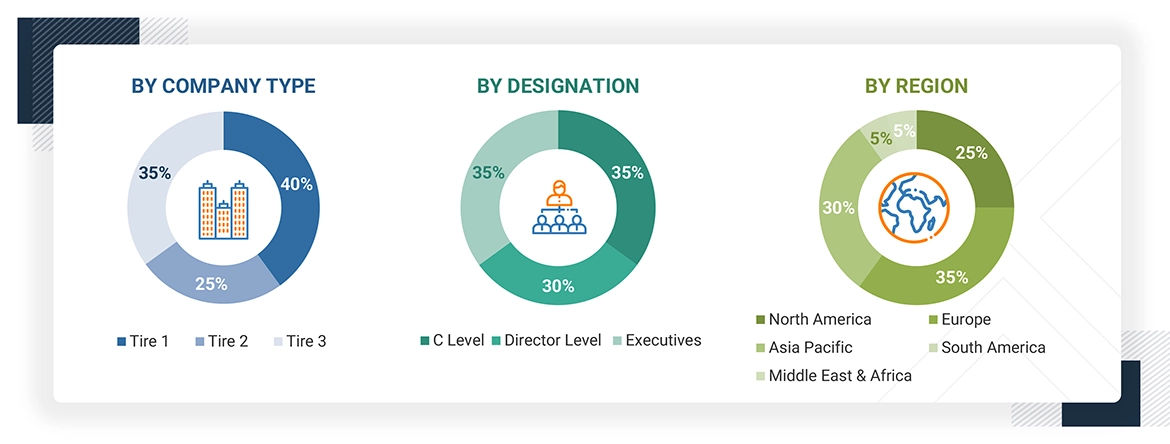
The industrial gaskets market comprises several stakeholders in the supply chain, which include raw material suppliers, equipment suppliers, distributors, end-product manufacturers, buyers, and regulatory organizations. Various primary sources from the supply and demand sides of the markets have been interviewed to obtain qualitative and quantitative information. The primary participants from the demand side include key opinion leaders, executives, vice presidents, and CEOs of companies in the industrial gaskets market. Primary sources from the supply side include associations and institutes involved in the industrial gaskets market, key opinion leaders, and processing players.
The following is the breakdown of primary respondents:
To know about the assumptions considered for the study, download the pdf brochure
Market Size Estimation
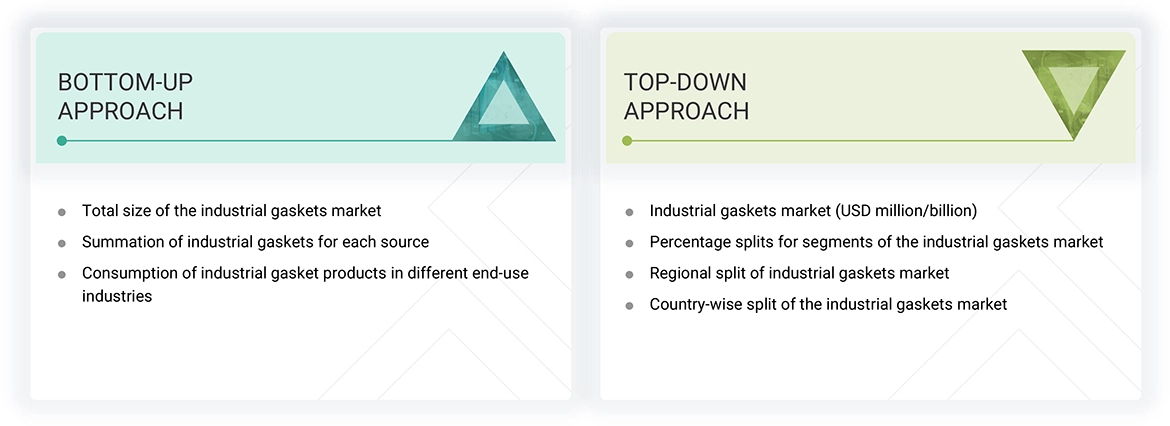
The bottom-up and top-down approaches have been used to estimate the industrial gaskets market by material type, product type, end-use industry, and region. The research methodology used to calculate the market size includes the following steps:
- The key players in the industry and markets were identified through extensive secondary research.
- In terms of value, the industry’s supply chain and market size were determined through primary and secondary research processes.
- All percentage shares, splits, and breakdowns were determined using secondary sources and verified through primary sources.
- All possible parameters that affect the markets covered in this research study were accounted for, viewed in extensive detail, verified through primary research, and analyzed to obtain the final quantitative and qualitative data.
- The research included studying reports, reviews, and newsletters of top market players and extensive interviews with leaders, such as directors and marketing executives, to obtain opinions.
The following figure illustrates the overall market size estimation process employed for this study.
Data Triangulation
After arriving at the overall size of the industrial gaskets market from the estimation process explained above, the total market was split into several segments and subsegments. The data triangulation and market breakdown procedures were employed, wherever applicable, to complete the overall market engineering process and arrive at the exact statistics for all segments and subsegments. The data was triangulated by studying various factors and trends from both the demand and supply sides. Along with this, the market size was validated using both the top-down and bottom-up approaches.
Market Definition
Industrial gaskets are essential sealing components designed to fill the space between two mating surfaces, preventing the leakage of fluids or gases under compression. Used across a wide range of applications, from pipelines and pressure vessels to pumps, engines, and industrial machinery, these gaskets play a vital role in ensuring the integrity, efficiency, and safety of mechanical systems.
By creating a reliable seal, industrial gaskets help maintain pressure, prevent contamination, reduce emissions, and protect equipment from wear or failure. Depending on the application, industrial gaskets can be made from metallic, non-metallic, or composite materials, each selected for its ability to withstand specific temperature, pressure, and chemical conditions.
Stakeholders
- Industrial Gasket Manufacturers
- Raw Material Suppliers
- Equipment Suppliers
- Regulatory Bodies and Government Agencies
- Distributors and Suppliers
- End-use Industries
- Associations and Industrial Bodies
Report Objectives
- To define, describe, and forecast the size of the industrial gaskets market in terms of value and volume
- To provide detailed information regarding the key factors influencing the market growth (drivers, restraints, opportunities, and challenges)
- To forecast the market size based on material type, product type, end-use industry, and region
- To forecast the market size for the five main regions—North America, Europe, Asia Pacific (APAC), South America, and the Middle East & Africa (MEA), along with their key countries
- To strategically analyze micromarkets with respect to individual growth trends, prospects, and contributions to the total market
- To analyze the opportunities in the market for stakeholders and provide details of the competitive landscape for the market leaders
- To strategically profile leading players and comprehensively analyze their key developments, such as product launches, expansions, and deals in the industrial gasket market
- To strategically profile the key players and comprehensively analyze their market shares and core competencies
- To study the impact of AI/Gen AI on the market under study, along with the macroeconomic outlook
Get the Full Industrial Gaskets Market Report
Full forecast, segment splits, and company analysis for all Industrial Gaskets Market.
- China Industrial Gaskets Market
- India Industrial Gaskets Market
- Japan Industrial Gaskets Market
- South Korea Industrial Gaskets Market
- Thailand Industrial Gaskets Market
- Australia Industrial Gaskets Market
- Germany Industrial Gaskets Market
- France Industrial Gaskets Market
- Spain Industrial Gaskets Market
- UK Industrial Gaskets Market
- Italy Industrial Gaskets Market
- Russia Industrial Gaskets Market
- Netherlands Industrial Gaskets Market
- Canada Industrial Gaskets Market
- Mexico Industrial Gaskets Market
- US Industrial Gaskets Market
- South Africa Industrial Gaskets Market
- Brazil Industrial Gaskets Market
- Argentina Industrial Gaskets Market
- Rest Of Asia Pacific Industrial Gaskets Market
- GCC Countries Industrial Gaskets Market
- –Rest Of GCC Countries Industrial Gaskets Market
- Rest Of South America Industrial Gaskets Market
Need a Tailored Report?
Customize this report to your needs
Get 10% FREE Customization
Customize This Report
