
Brazil Industrial Vehicles Market (2026-2031)

The Brazil Industrial Vehicles Market was valued at $77 Million in 2026 and projected to reach to $92 Million by 2031, representing a compound annual growth rate of 8.9%. Brazil's industrial vehicles market is positioned for sustained expansion through 2031, driven by infrastructure modernization and increased logistics requirements across the nation.


| Market Size in | USD 26.32 MN |
| Market Forecast in | |
| CAGR | |
| Forecast Period | |
| Units Considered | Value (USD MN) |
Brazil Industrial Vehicles Market Trends and Insights
- This 8.9% compound annual growth rate significantly outpaces the global average of 5.9%, reflecting Brazil's robust demand for logistics, construction, and manufacturing infrastructure.
- Brazil's market expansion is driven by increased urbanization, e-commerce growth, and infrastructure modernization initiatives across the country. The Brazilian industrial vehicles sector benefits from a large domestic manufacturing base and rising investment in supply chain optimization.
- Brazil's strategic position as South America's largest economy creates substantial opportunities for fleet expansion and vehicle replacement cycles.
- Between 2026 and 2031, Brazil is expected to capture growing market share as regional trade intensifies and industrial activity accelerates across key sectors including agriculture, mining, and retail distribution..
Key Market Statistics
- CAGR (2026-2031) 8.9% CAGR
- Market Size, 2026 ~USD 77 Million
- Forecast, 2031 ~USD 92 Million
- Country Brazil
Brazil Industrial Vehicles Market Overview
Outpacing Global Growth :
Brazil's industrial vehicles market grows at 8.9% CAGR, significantly exceeding the global average of 5.9%, driven by accelerating logistics and construction demand across the region.
Substantial Market Expansion :
Market valuation is projected to grow from $77 million in 2026 to $92 million by 2031, representing a $15 million increase over the five-year forecast period.
Latin American Leadership :
Brazil serves as the primary growth engine for industrial vehicles in Latin America, leveraging its manufacturing base, infrastructure development, and e-commerce logistics expansion.
Sector-Driven Demand :
Growth is fueled by robust demand from logistics networks, construction projects, and manufacturing operations requiring specialized industrial vehicle solutions.
Brazil Industrial Vehicles Market Dynamics
- The 8.9% CAGR reflects strong demand from construction, manufacturing, and e-commerce sectors investing in fleet expansion and vehicle upgrades.
- Government infrastructure initiatives and private sector growth in major metropolitan areas support continued market development. The forecast period will see intensified competition among vehicle manufacturers and suppliers targeting Brazil's growing industrial base.
- Rising urbanization, supply chain optimization, and manufacturing sector recovery create favorable conditions for market participants.
- Strategic investments in distribution networks and localized product offerings will be critical for capturing market share in this dynamic Latin American hub..
Market Ecosystem
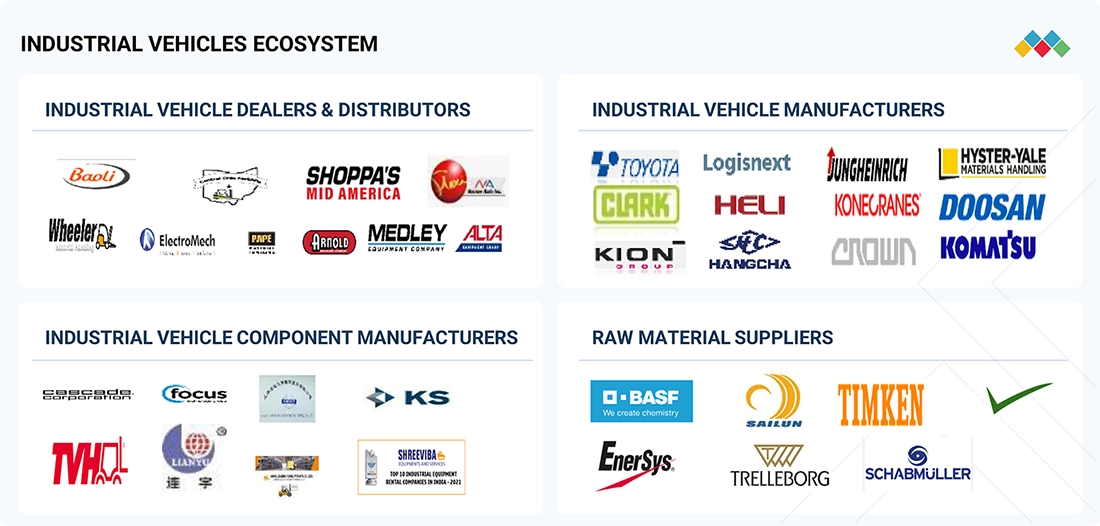
INDUSTRIAL VEHICLES MARKET: COMMERCIAL USE CASES ACROSS INDUSTRIES
| COMPANY | USE CASE DESCRIPTION | BENEFITS |
|---|---|---|
 |
The company supplied the compact and highly maneuverable EDiA electric counterbalance trucks as the solution. The compact trucks are designed to be used in various environments and are equipped with many safety features to protect pedestrians. | On-site safety was significantly enhanced without compromising productivity. Moreover, the near misses or accidents that involved pedestrians were reduced significantly, and damage to the building and infrastructure was also reduced. |
 |
L’Oréal, with the help of Dematic (Germany), installed 14 autonomous forklifts with a capacity of 1 ton and a lift height of 2.4 meters with pallet detection capacity. The system optimizes storage as well as retrieval, which takes up the most effort. Autonomous forklifts have reduced the need for labor and improved the material handling processes by reducing damage. | The changes brought by automation enhanced both productivity and processing throughput. For instance, the quality of internal transport operations of liquid goods was improved by a reduction in the number of spills. The number of workers related to intralogistics on-site was reduced by 90%. Additionally, the threat of temperature change caused by manual ICE forklifts, which used to affect the quality of products, was eliminated. |
 |
To increase the overall efficiency and cost-effectiveness of the warehouse, the company invested in an automatic narrow-aisle warehouse. Coko-Werk GmbH & Co. KG invested in three automated ETXa high-rack stackers by Jungheinrich AG. | With the incorporation of the ETXa high-rack stackers (which are designed for an optimal lift height of 10 meters), the overall efficiency and supply capability of warehouse processes have increased. |
Logos and trademarks shown above are the property of their respective owners. Their use here is for informational and illustrative purposes only.
Related Ecosystem
Logistics And Transportation
- Internal Combustion Engine (ICE)
- Crawler Excavator
- Fuel Cell
- Light Commercial Vehicles (LCVs)
- Sensors
- Siemens ag
- Alstom s.a.
- Hitachi, Ltd.
- Godrej Industries Limited
- ABB India Limited
On Highway Off Highway Vehicles
- Internal Combustion Engine (ICE)
- Agricultural Tractors
- Crawler Excavator
- Battery Electric Vehicle (BEV)
- Excavators
- Visteon Corporation
- Deere & Company
- AB VOLVO PENTA
- Honda Motor Co., Ltd.
- Komatsu Ltd.
Key Takeaways
- Brazil's industrial vehicles market will grow from $77M (2026) to $92M (2031) at an 8.9% CAGR, outpacing global growth.
- Brazil's e-commerce and logistics sectors are primary demand drivers for industrial vehicle adoption through 2031.
- Brazil's domestic manufacturing capabilities position the country as a regional hub for industrial vehicle production and distribution.
- Brazil's infrastructure modernization and urbanization trends create sustained investment opportunities in the industrial vehicles segment.
Industrial Vehicles Market Report Scope
| Report Metric | Details |
|---|---|
| Base Year | 2026 |
| Fastest Growing Segment | BATTERY-OPERATED (Propulsion) |
| Forecast Period | 2026–2031 |
| Growth Rate | CAGR of 5.9% from 2026 to 2031 |
| Largest Segment | AISLE TRUCKS (Vehicle Type) |
| Market Size Base Year (Billions) | ~USD 54.58 (2026) |
| Revenue Forecast (Billions) | ~USD 72.7 (2031) |
| Segments Covered | Type, Propulsion, Motor Type, Power Output, Power Source, Vehicle Type, Capacity, Application |
Brazil Industrial Vehicles Market Report Segmentation
8 segment dimensions are covered across the global market.
By Type
- Boom Lifts
- Scissor Lifts
By Propulsion
- Battery Operated
- Battery-Operated
- Gas-Powered
- ICE
By Motor Type
- Hydraulic Motors
- Power Steering Motors
- Traction Motors
By Power Output
- > 5 Kw
- = 5 Kw
By Power Source
- Ac
- Dc
By Vehicle Type
- Aisle Trucks
- Container Handlers
- Forklifts
- Tow Tractors
By Capacity
- 11–30 Tons
- 11–36 Tons
- 1–2 Tons
- 30–40 Tons
- 5–10 Tons
- < 30 Tons
- < 5 Tons
- <1 Tons
- > 30 Tons
- > 36 Tons
- > 40 Tons
- >2 Tons
By Application
- Freight & Logistics
- Manufacturing
- Warehousing
Target Audience
- Vehicle Manufacturers & OEMs : Manufacturers need Brazil-specific market data to assess production capacity requirements, localization strategies, and competitive positioning in Latin America's fastest-growing industrial vehicle market.
- Logistics & Fleet Operators : Fleet operators require market insights to plan vehicle procurement, understand demand trends in construction and e-commerce sectors, and optimize fleet composition for Brazilian operations.
- Investment & Private Equity Firms : Investors evaluating Brazil's automotive and transportation sector need detailed market sizing and growth forecasts to assess investment opportunities and portfolio company valuations.
- Supply Chain & Distribution Partners : Distributors and suppliers need Brazil market data to plan inventory, identify growth segments, and develop partnerships with manufacturers targeting the region's expanding industrial base.
- Government & Policy Makers : Brazilian government agencies and infrastructure planners require market intelligence to inform transportation policies, infrastructure investments, and industrial development initiatives.
Key Companies in the Brazil Industrial Vehicles Market
| Company | HQ | Ownership | Strongest segments |
|---|---|---|---|
| GATES CORPORATION | United States | Public Company | Power Transmission – Automotive Aftermarket (belts, kits, components),Power Transmission – Industrial (stationary and mobile drives, personal mobility),Fluid Power – Hydraulics (hoses, tubing, couplings, assemblies), |
| KOMATSU LTD. | Japan | Public Company | Construction Machinery and Vehicles,Mining Equipment (within Construction segment),Utility & Forestry Machinery, |
| DOOSAN BOBCAT | South Korea | Public Company | Compact loaders and excavators (incl. telehandlers),Compact tractors, turf, and utility/light compaction,Attachments and related products, |
| MANITOU GROUP | France | Public Company | Rough-terrain telehandlers (fixed, rotating, heavy-duty),Forklift trucks and warehousing equipment,Compact loaders (skid-steer, track, articulated, backhoe), |
| CARGOTEC | Finland | Public Company | Loader cranes (HIAB, EFFER, ARGOS),Truck-mounted forklifts (MOFFETT, PRINCETON),Forestry and recycling cranes (LOGLIFT, JONSERED), |
| ACTION CONSTRUCTION EQUIPMENT LTD. | India | Public Company | Cranes (mobile, truck-mounted, crawler, rough terrain, pick-and-carry),Material Handling & Construction Equipment (forklifts, tower cranes, loaders, road equipment),Agri Equipment (tractors, harvesters, implements), |
| DAIFUKU | Japan | Public Company | Warehouse and distribution material handling systems,Cleanroom transport and storage systems,Automobile production line systems, |
| JBT | United States | Public Company | Protein Solutions,Prepared Food and Beverage Solutions,Automated Guided Vehicle and Material Handling Systems, |
| GODREJ & BOYCE MANUFACTURING COMPANY LIMITED | India | Private Company | Consumer home appliances,Commercial appliances and cooling solutions,Locks, architectural hardware, and kitchen fittings, |
GATES CORPORATION
Gates Corporation is a publicly traded American manufacturing company founded in 1911 that employs 13,000 people. The company operates as a major industrial manufacturer serving global markets.
KOMATSU LTD.
Komatsu Ltd. is a Japanese public company founded in 1884 with 67,279 employees. The company is a major global manufacturer operating across multiple industrial sectors.
DOOSAN BOBCAT
Doosan Bobcat is a South Korean public company founded in 1947 with 142 employees.
MANITOU GROUP
Manitou Group is a French public company founded in 1954 with 6,028 employees. The company operates as an industrial manufacturer serving global markets.
CARGOTEC
Cargotec is a Finnish public company founded in 1944 with 4,049 employees. The company operates as an industrial manufacturer and service provider.
ACTION CONSTRUCTION EQUIPMENT LTD.
Action Construction Equipment Ltd. is an Indian public company founded in 1995 with 1,492 employees. The company operates as an industrial manufacturer.
DAIFUKU
Daifuku is a Japanese public company founded in 1937 with 11,417 employees. The company operates as a major global industrial manufacturer.
JBT
JBT is an American public company founded in 1994 with 11,500 employees. The company operates as an industrial manufacturer serving global markets.
GODREJ & BOYCE MANUFACTURING COMPANY LIMITED
Godrej & Boyce Manufacturing Company Limited is an Indian private company founded in 1897 with 13,316 employees. The company operates as a major industrial manufacturer.
Reasons to Buy this Report
- Brazil-Specific Market Sizing : Access precise valuation data for Brazil's industrial vehicles market with detailed 2026-2031 projections, enabling accurate budget allocation and revenue forecasting for regional operations.
- Competitive Growth Intelligence : Understand Brazil's 8.9% CAGR advantage over global markets, identifying competitive opportunities and market dynamics unique to Latin America's largest industrial economy.
- Sector-Specific Demand Analysis : Gain insights into logistics, construction, and manufacturing drivers specific to Brazil, allowing targeted product development and go-to-market strategies for regional expansion.
- Strategic Market Entry Planning : Leverage Brazil-focused data to evaluate market entry timing, partnership opportunities, and investment requirements for establishing or expanding industrial vehicle operations.
- Risk Mitigation & Forecasting : Make informed decisions with Brazil-specific growth projections and market trends, reducing uncertainty in long-term planning and resource allocation for Latin American markets.
Frequently asked questions
What is the current size of Brazil's industrial vehicles market?
Brazil's industrial vehicles market is estimated at $77 million in 2026, with verified data confirming this as the base year valuation for the country.
What is Brazil's industrial vehicles market forecast for 2031?
Brazil's industrial vehicles market is projected to reach $92 million by 2031, representing growth of $15 million over the five-year forecast period.
How does Brazil's growth rate compare to global trends?
Brazil's 8.9% CAGR significantly exceeds the global industrial vehicles market CAGR of 5.9%, indicating stronger regional momentum and market opportunity.
What sectors drive industrial vehicle demand in Brazil?
Brazil's primary demand drivers include e-commerce logistics, construction, agriculture, mining, and retail distribution sectors requiring fleet modernization and expansion.
Why is Brazil a strategic market for industrial vehicles?
Brazil's position as South America's largest economy, combined with urbanization trends and infrastructure investment, creates substantial opportunities for industrial vehicle manufacturers and logistics operators.
RESEARCH METHODOLOGY
The market size assessment was conducted through a structured multi-stage research approach. Extensive secondary research was used to compile data on the industrial vehicles market, adjacent markets, competitive landscape, and product mapping from company reports, industry publications, and recent developments. These findings and assumptions were then validated through primary interviews with industry participants across the value chain, including manufacturers, distributors, and end users. Both bottom-up and top-down estimation approaches were applied to derive the overall market size. Finally, market segmentation, cross-verification, and data triangulation methods were used to calculate the size of individual segments and subsegments, ensuring consistency, reliability, and alignment with current market dynamics.
Secondary Research
The secondary research phase utilized a broad set of reliable and authoritative sources to develop a comprehensive understanding of the industrial vehicles market. These sources included company annual reports, investor presentations, press releases, industry whitepapers, recognized publications, commercial databases, and documents issued by industry associations and government agencies. The analysis of these materials enabled the identification of the industry value chain, key market participants, market segmentation based on prevailing industry trends, regional market dynamics, and recent technological and business developments. The insights derived from this phase served as a foundational basis for the overall market assessment.
Primary Research
Extensive primary research was undertaken following a comprehensive assessment of the industrial vehicles market through secondary analysis. Multiple in-depth interviews were conducted with industry experts representing both demand-side industrial vehicle end users and supply-side original equipment manufacturers across key regions, including North America, Europe, and the Asia Pacific. Approximately 17% of the interviews were conducted with demand-side stakeholders, while 83% interviews were conducted with supply-side stakeholders.
Primary insights were gathered through structured questionnaires, email interactions, and telephonic discussions. To ensure a well-rounded perspective, respondents from diverse organizational functions, including sales, operations, and marketing, were involved in the discussion.
In addition, discussions were held with highly experienced independent consultants to validate and strengthen the primary findings. These inputs, together with the perspectives of in-house subject matter experts, formed the basis for the conclusions and insights presented in the subsequent sections of this report.
BREAKDOWN OF PRIMARY INTERVIEW PARTICIPANTS
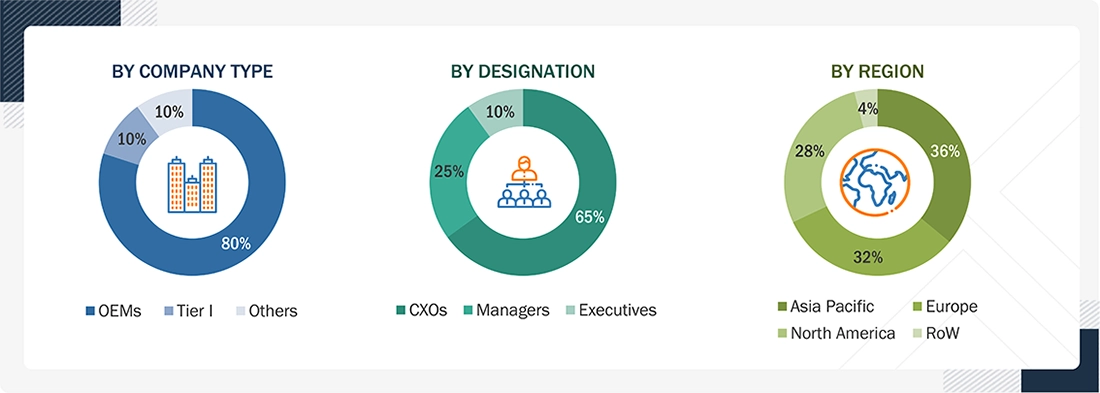
Note: The company's tiers are based on the value chain of the industrial vehicles market; companies' revenues have not been considered. Tier 1 suppliers supply components to OEMs.
To know about the assumptions considered for the study, download the pdf brochure
Market Size Estimation
A detailed market estimation approach was followed to estimate and validate the value of the industrial vehicles market. Key players in the industrial vehicles market were identified through secondary research, and their global market shares were determined through primary and secondary research. The research methodology included the study of the annual and quarterly financial reports & regulatory filings of major market players, as well as interviews with industry experts for detailed market insights. All major penetration rates, percentage shares, splits, and breakdowns for the industrial vehicles market were determined using secondary sources, model mapping, and verified through primary sources. All key macro indicators affecting the revenue growth of the market segments and subsegments were accounted for, viewed in extensive detail, verified through primary research, and analyzed to get the validated and verified quantitative & qualitative data. The gathered market data was consolidated and added with detailed inputs, analyzed, and presented in this report.
Data Triangulation
All percentage shares, splits, and breakdowns were determined using secondary sources and verified by primary sources. All parameters that affect the markets covered in this research study were accounted for, viewed in extensive detail, and analyzed to obtain the final quantitative and qualitative data. This data was consolidated and enhanced with detailed inputs and analysis from MarketsandMarkets and presented in the report. The following figure is an illustrative representation of the overall market size estimation process employed for this study.
Market Definition
- Industrial vehicles: The industrial vehicles market encompasses the production, distribution, and utilization of specialized vehicles tailored for material handling, transportation, and logistical operations within industrial environments like warehouses, manufacturing facilities, distribution centers, and ports. These vehicles, including forklifts, aisle trucks, tow tractors, and container handlers, are crucial for optimizing operational productivity, safety, and efficiency. Key stakeholders involved in this market include industrial vehicle manufacturers, component manufacturers, industrial vehicle rental/leasing companies, and end users.
Key Stakeholders
- Associations, forums, and alliances related to industrial vehicles
- Raw material suppliers
- Industrial vehicle distributors and dealers
- Manufacturers of industrial vehicles
- Manufacturers of industrial vehicle components
- Autonomous vehicle solution providers
- Technology vendors
- Industrial vehicle rental/leasing companies
- Material handling associations
- Standards organizations and regulatory authorities related to the material handling industry
Report Objectives
- To segment and forecast the size of the global industrial vehicles market, by value & volume, based on vehicle type & capacity (forklifts (<5ton, 5-10 ton, 11-36 ton, >36 ton), aisle trucks (<1ton, 1-2 ton, >2 ton), tow tractors (<5ton, 5-10 ton, 11-30 ton, >30 ton), container handlers (<30 ton, 30-40 ton, >40 ton), automated guided vehicles, and personnel carriers)
- To segment and forecast the size of the global industrial vehicles market, by value & volume, based on drive type (internal combustion engine industrial vehicles, battery-operated industrial vehicles, and gas-powered industrial vehicles)
- To segment and forecast the size of the global industrial vehicles market, by value & volume, based on application (manufacturing (chemical, food & beverages, mining, automotive, metals & heavy machinery, and others), warehousing, freight & logistics, and others)
- To segment and forecast the size of the global industrial vehicles market by value, based on level of autonomy (non/semi-autonomous and autonomous)
- To segment and forecast the size of the global industrial vehicles market by value, based on motor type and power output (traction motors (<4.9 KW and >5 KW) and power source (AC and DC), hydraulic motors (<4.9 KW and >5 KW and power source (AC and DC)), and power steering motors (<4.9 KW and >5 KW) and power source (AC and DC))
- To segment and forecast the size of the global aerial work platforms market, by value & volume, based on type (scissor lifts (scissor lifts by drive type), boom lifts (articulating AWP, telescopic AWP), and boom lifts by drive type)
- To segment and forecast the size of the industrial vehicles market, by value & volume, based on region (Asia Pacific, Europe, North America, and Rest of the World)
Available customizations:
With the given market data, MarketsandMarkets offers customizations per the company's specific needs.
- By capacity at the regional level for each vehicle type
- By drive type at the regional level for each vehicle type
- By application at the global level for each vehicle type
- Company information
- Profiling of additional market players (up to five)
Get the Full Industrial Vehicles Market Report
Full forecast, segment splits, and company analysis for all Industrial Vehicles Market.
- China Industrial Vehicles Market
- India Industrial Vehicles Market
- Japan Industrial Vehicles Market
- South Korea Industrial Vehicles Market
- Germany Industrial Vehicles Market
- UK Industrial Vehicles Market
- France Industrial Vehicles Market
- Italy Industrial Vehicles Market
- Spain Industrial Vehicles Market
- US Industrial Vehicles Market
- Canada Industrial Vehicles Market
- Mexico Industrial Vehicles Market
- South Africa Industrial Vehicles Market
- Rest Of Europe Industrial Vehicles Market
- Rest Of Asia Pacific Industrial Vehicles Market
Need a Tailored Report?
Customize this report to your needs
Get 10% FREE Customization
Customize This Report
