
Australia Insulin Delivery Device Market (2025-2030)

The Australia Insulin Delivery Device Market was valued at $125.8 Million in 2025 and projected to reach to $158.2 Million by 2030, representing a compound annual growth rate of 4.7%. Australia's insulin delivery device market is positioned for steady growth driven by increasing diabetes incidence and improved patient access to advanced therapeutic options.


| Market Size in | USD 26.32 MN |
| Market Forecast in | |
| CAGR | |
| Forecast Period | |
| Units Considered | Value (USD MN) |
Australia Insulin Delivery Device Market Trends and Insights
- Australia's healthcare infrastructure and rising diabetes prevalence are driving steady adoption of advanced insulin delivery solutions across the country.
- The market in Australia reflects moderate but consistent growth, supported by increasing patient awareness and government healthcare initiatives focused on diabetes management..
Key Market Statistics
- CAGR (2025-2030) 4.7% CAGR
- Market Size, 2025 ~USD 125.8 Million
- Forecast, 2030 ~USD 158.2 Million
- Country Australia
Australia Insulin Delivery Device Market Overview
Market Size & Growth :
Australia's insulin delivery device market is valued at USD 125.8 million in 2025, with projected growth to USD 158.2 million by 2030, representing a steady CAGR of 4.7%.
Diabetes Prevalence Driver :
Rising diabetes prevalence across Australia is a key catalyst for insulin delivery device adoption, with increasing patient awareness and healthcare provider recommendations driving market expansion.
Healthcare Infrastructure :
Australia's advanced healthcare infrastructure and government-supported diabetes management programs create a favorable environment for adoption of modern insulin delivery solutions.
Moderate but Consistent Growth :
While Australia's CAGR of 4.7% is below the global average of 8.3%, the market demonstrates stable, predictable growth reflecting mature healthcare adoption patterns and regulatory stability.
Australia Insulin Delivery Device Market Dynamics
- The country's robust healthcare system and Medicare coverage for diabetes management support consistent market expansion.
- Healthcare providers are increasingly recommending insulin pumps and pen devices as first-line treatments, particularly among Type 1 diabetes patients and insulin-dependent Type 2 patients.
- Government initiatives promoting chronic disease management and preventive healthcare further strengthen market fundamentals.
- By 2030, the market is expected to reach USD 158.2 million, reflecting sustained demand for innovative delivery mechanisms that improve patient compliance and glycemic control outcomes..
Market Ecosystem
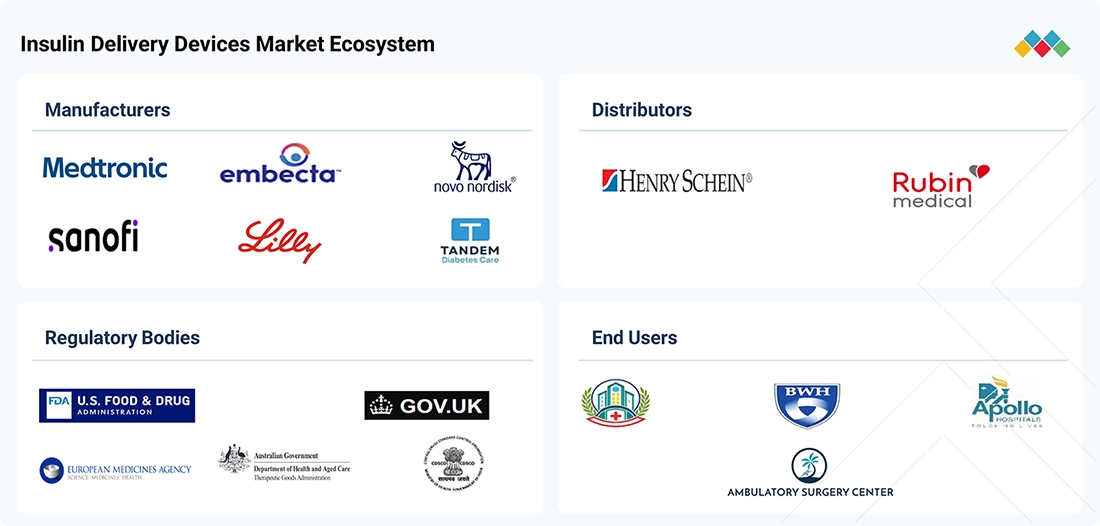
INSULIN DELIVERY DEVICES MARKET: COMMERCIAL USE CASES ACROSS INDUSTRIES
| COMPANY | USE CASE DESCRIPTION | BENEFITS |
|---|---|---|
 |
Novo Nordisk's insulin delivery portfolio includes reusable pens such as NovoPen 6 and NovoPen Echo Plus, as well as prefilled disposable pens such as FlexPen and FlexTouch. These devices are used by patients requiring insulin injections for diabetes management in home healthcare settings and under healthcare-professional supervision. Smart pens record dose information, while dose-setting mechanisms and prefilled designs simplify insulin administration. | Supports accurate and convenient insulin administration, simplifies dose selection, and improves visibility into previous injections through connected or memory-enabled pens. Prefilled and reusable options accommodate different patient preferences and treatment requirements. |
 |
embecta provides insulin pen needles, conventional insulin syringes, and safety-engineered injection products. Its portfolio includes Nano pen needles, Ultra-Fine pen needles, AutoShield Duo safety pen needles, and insulin syringes in different needle lengths and barrel capacities. These products support subcutaneous insulin administration by patients at home and healthcare professionals in clinical settings. | Offers flexibility in insulin administration through different needle lengths and syringe capacities. Shorter pen needles support a more comfortable injection experience, while safety-engineered products help reduce the risk of accidental needlestick injuries. |
 |
Medtronic's MiniMed insulin pump portfolio includes the MiniMed 780G automated insulin delivery system. The system uses continuous glucose monitoring data to adjust insulin delivery and provide automated correction doses. It is designed for eligible people with diabetes requiring insulin and is used in home-based diabetes management with healthcare-professional guidance. | Enables personalized, continuous insulin delivery and automated adjustments based on glucose readings. Integration with glucose sensors can help improve glucose management, reduce the burden of multiple daily injections, and provide patients and care partners with access to diabetes-related information. |
 |
Sanofi offers insulin delivery devices associated with its insulin portfolio, including the SoloStar prefilled disposable pen and reusable pen options such as AllStar and TouStar in India. These devices are used to administer compatible insulin formulations, including Lantus, Toujeo, and Apidra in applicable presentations and markets. They support routine insulin administration for patients with diabetes in home and clinical settings. | Provides prefilled and reusable delivery options to accommodate different treatment needs. Features such as dose selection, portability, and a prefilled format can simplify insulin administration and support convenient diabetes management. Device and insulin compatibility varies by product and market. |
 |
Eli Lilly supplies insulin in prefilled delivery devices, including the KwikPen platform used with products such as Humalog, Humulin, and Lyumjev in applicable markets. These pens enable patients requiring insulin therapy to administer prescribed doses through subcutaneous injection, including in home-based settings. Product-specific presentations and indications vary by country. | Provides a convenient, prefilled insulin administration format with dose-selection features that can simplify routine injections. Multiple insulin formulations and pen presentations support different prescribed treatment requirements and help patients manage insulin administration outside healthcare facilities. |
Logos and trademarks shown above are the property of their respective owners. Their use here is for informational and illustrative purposes only.
Related Ecosystem
Drug Delivery Devices
- Disposable Autoinjectors
- Reusable Autoinjectors
- Insulin Pumps
- Pen Injectors
- Transdermal Patches
- Becton, Dickinson and Company
- Novo nordisk a/s
- Terumo Corporation
- Medtronic plc
- Nipro Corporation
Medical Devices
- Polymerase Chain Reaction (PCR)
- Magnetic Resonance Imaging (MRI)
- Disposable Autoinjectors
- Pulse Oximeters
- Blood Pressure Monitors
- Medtronic plc
- Abbott Laboratories
- Stryker Corporation
- Becton, Dickinson and Company
- JOHNSON & JOHNSON
Key Takeaways
- Australia's insulin delivery device market is estimated at USD 125.8 million in 2025 and will reach USD 158.2 million by 2030.
- Australia is experiencing a 4.7% CAGR, reflecting steady market expansion driven by diabetes prevalence and healthcare accessibility.
- Australia's market growth is supported by advanced healthcare infrastructure and government-backed diabetes management programs.
- Australia represents a mature market within Asia Pacific with consistent demand for insulin delivery innovations.
Insulin Delivery Device Market Report Scope
| Report Metric | Details |
|---|---|
| Base Year | 2025 |
| Fastest Growing Segment | INSULIN PUMPS (Type) |
| Forecast Period | 2025–2030 |
| Growth Rate | CAGR of 8.3% from 2025 to 2030 |
| Largest Segment | TYPE 2 DIABETES (Disease Type) |
| Market Size Base Year (Billions) | ~USD 35.37 (2025) |
| Revenue Forecast (Billions) | ~USD 52.7 (2030) |
| Segments Covered | Type, Disease Type, End User |
Australia Insulin Delivery Device Market Report Segmentation
3 segment dimensions are covered across the global market.
By Type
- Disposable Insulin Pens
- Insulin Pen Needles
- Insulin Pens
- Insulin Pumps
- Insulin Syringes
- Other Insulin Delivery Devices
- Reusable Insulin Pens
- Safety Insulin Pen Needles
- Standard Insulin Pen Needles
- Tethered Insulin Pumps
- Tubeless Insulin Pumps
By Disease Type
- Type 1 Diabetes
- Type 2 Diabetes
By End User
- Home Care Settings
- Hospitals & Clinics
- Other End Users
AUSTRALIA: INSULIN DELIVERY DEVICES MARKET, BY END USER, 2025–2030
| Segment | 2025 | 2026 | 2027 | 2028 | 2029 | 2030 | CAGR (%) |
|---|---|---|---|---|---|---|---|
| HOME CARE SETTINGS | 360.7 | 385.3 | 412.7 | 443.2 | 477.2 | 499.7 | 6.7 |
| HOSPITALS & CLINICS | 135.6 | 142.8 | 150.6 | 159.3 | 169 | 174.3 | 5.1 |
| OTHER END USERS | 27.5 | 29.3 | 31.1 | 33.2 | 35.6 | 37 | 6.1 |
| TOTAL | 523.8 | 557.3 | 594.5 | 635.8 | 681.8 | 711 | 6.3 |
Target Audience
- Medical Device Manufacturers : Manufacturers need Australia-specific market data to assess market potential, identify competitive gaps, and develop localized product strategies for insulin delivery devices.
- Healthcare Investors & PE Firms : Investors require detailed Australian market forecasts and growth drivers to evaluate investment opportunities in diabetes management and insulin delivery technology companies.
- Pharmaceutical & Biotech Companies : Companies developing insulin formulations need insights into Australian delivery device adoption patterns to align product development with market demand and healthcare provider preferences.
- Healthcare Consultants & Advisors : Consultants advising healthcare organizations and government bodies need Australia-specific market intelligence to inform policy recommendations and strategic planning initiatives.
- Distributors & Healthcare Suppliers : Distributors and suppliers require market sizing and growth forecasts for Australia to optimize inventory management, negotiate supplier agreements, and plan distribution network expansion.
Key Companies in the Australia Insulin Delivery Device Market
| Company | HQ | Ownership | Strongest segments |
|---|---|---|---|
| KINDRED HEALTHCARE INC. | United States | Private Company | Injectable and infusion-based therapies in long-term acute care hospitals,Oral therapies in inpatient rehabilitation facilities,Contract rehabilitation and ancillary sites using mixed delivery routes, |
| F5 NETWORKS | United States | Public Company | BIG-IP Systems and Packaged Software,NGINX (Plus, One Console, Ingress, WAF),Distributed Cloud Services (WAAP, Multi-cloud Networking, CDN, DNS), |
| DIALOG SEMICONDUCTOR PLC | United Kingdom | Private Company | Custom Mixed Signal (PMICs, battery management, display power, motor control),Advanced Mixed Signal (configurable ICs, AC/DC, LED and SSL drivers),Connectivity & Audio (BLE, Wi-Fi SoCs, audio CODECs), |
KINDRED HEALTHCARE INC.
Kindred Healthcare Inc. is a United States-based private company founded in 1985 that operates as a major healthcare services provider. With 64,200 employees, the company delivers a range of healthcare services across multiple care settings.
F5 NETWORKS
F5 Networks is a publicly traded United States company founded in 1996 with 6,545 employees that specializes in application delivery networking and security solutions.
DIALOG SEMICONDUCTOR PLC
Dialog Semiconductor PLC is a United Kingdom-based private company founded in 1998 with 2,300 employees that develops semiconductor solutions.
Reasons to Buy this Report
- Localized Market Intelligence : Gain Australia-specific insights on market size, growth trajectories, and regional dynamics that differ from global trends, enabling targeted business strategy development.
- Competitive Landscape Analysis : Understand the competitive positioning of insulin delivery device manufacturers within Australia's healthcare market, including market share distribution and key player strategies.
- Regulatory & Reimbursement Insights : Access detailed information on Australian regulatory requirements, TGA approvals, and Medicare reimbursement policies affecting insulin delivery device commercialization.
- Growth Opportunity Identification : Identify high-potential segments and patient demographics within Australia driving adoption, including Type 1 diabetes, gestational diabetes, and insulin-dependent Type 2 populations.
- Strategic Market Entry Planning : Develop informed market entry or expansion strategies for Australia with data-driven insights on healthcare provider preferences, patient adoption barriers, and distribution channels.
Frequently asked questions
What is the current size of Australia's insulin delivery device market?
Australia's insulin delivery device market is valued at USD 125.8 million in 2025.
What is the projected market size for Australia by 2030?
Australia's insulin delivery device market is forecast to reach USD 158.2 million by 2030.
What is the growth rate of Australia's insulin delivery device market?
Australia's insulin delivery device market is growing at a CAGR of 4.7% from 2025 to 2030.
What factors are driving growth in Australia's insulin delivery device market?
Growth in Australia is driven by rising diabetes prevalence, advanced healthcare infrastructure, government diabetes management initiatives, and increasing patient awareness of insulin delivery technologies.
How does Australia's market compare to the global insulin delivery device market?
Australia's 4.7% CAGR is lower than the global CAGR of 8.3%, reflecting a more mature market with steady, established demand for insulin delivery devices.
RESEARCH METHODOLOGY
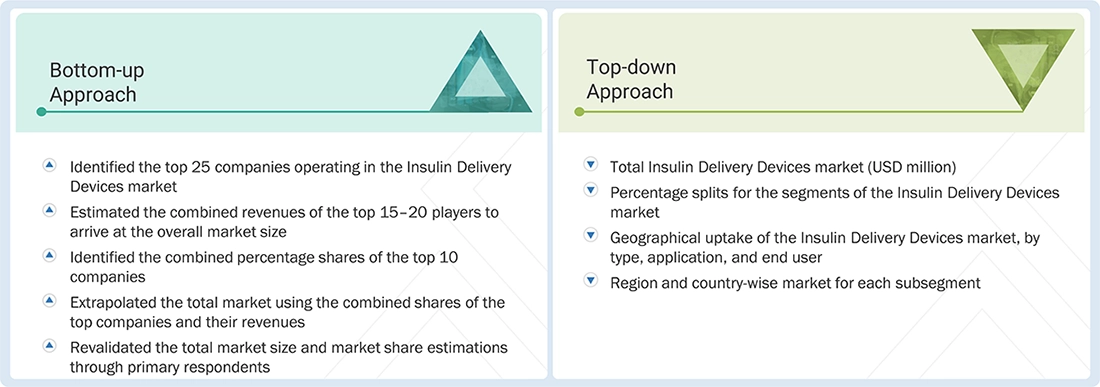
The study focused on estimating the current market size for the insulin delivery devices sector. Extensive secondary research was conducted to gather information about the insulin delivery devices industry. The next step involved validating the findings, assumptions, and estimates through primary research with industry experts across the value chain. Various approaches were used to estimate the total market size, including top-down and bottom-up methods. Next, market segmentation and data triangulation procedures were used to determine the sizes of the segments and subsegments within the insulin delivery devices market.
Secondary Research
The secondary research process relies heavily on secondary sources, including directories and databases such as Bloomberg Businessweek, Factiva, and D&B Hoovers. It also includes white papers, annual reports, investor presentations, company SEC filings, and publications from government sources. Notable examples include the National Institutes of Health (NIH), the U.S. Food and Drug Administration (FDA), the U.S. Census Bureau, the World Health Organization (WHO), the International Trade Administration (ITA), the Global Burden of Disease Study, and the Centers for Medicare and Medicaid Services (CMS). These sources were utilized to gather information for the global insulin delivery devices market study. The process aimed to provide insights into key players, market classification, and segmentation based on industry trends, down to the most detailed level. It also focused on significant developments from both market and technological perspectives. A comprehensive database of key industry leaders was also created using the information obtained through secondary research.
Primary Research
In this report's primary research, we interviewed sources from both the supply and demand sides to gather qualitative and quantitative information. The supply-side primary sources included industry experts such as CEOs, vice presidents, marketing and sales directors, technology and innovation directors, and other key executives from major companies and organizations in the insulin delivery devices market. On the demand side, primary sources included pharmaceutical companies, vaccination centers, hospitals and clinics, pharmacies, and university researchers and academics. This primary research was conducted to validate the market segmentation, identify key players, and gather insights on significant industry trends and market dynamics.
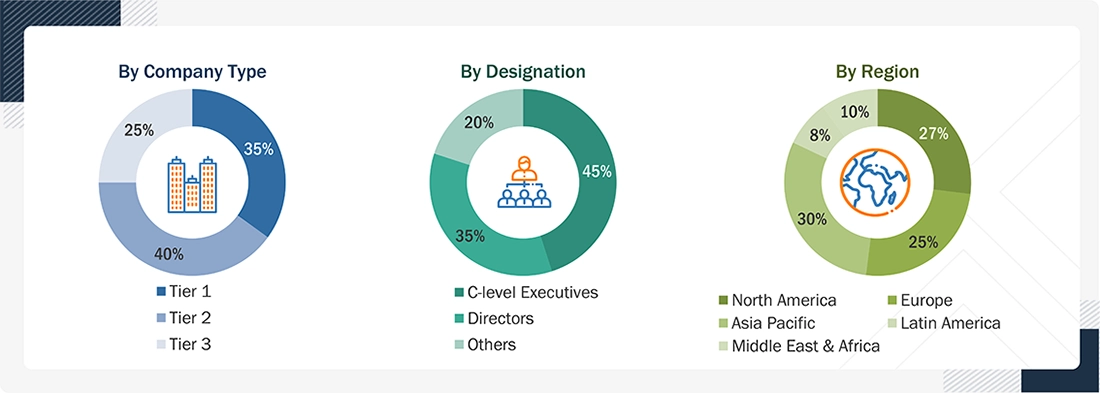
Note 1: C-level primaries include CEOs, CFOs, COOs, and VPs.
Note 2: Others include sales managers, marketing managers, business development managers, product managers, distributors, and suppliers.
Note 3: Companies are classified into tiers based on their total revenue. As of 2024, Tier 1 = >USD 10.00 billion, Tier 2 = USD 1.00 billion to USD 10.00 billion, and Tier 3 = <USD 1.00 billion.
To know about the assumptions considered for the study, download the pdf brochure
Market Size Estimation
For the global market value, annual revenues were calculated based on the revenue mapping of major product manufacturers and OEMs active in the global insulin delivery devices market. All the major product manufacturers were identified at the global and/or country/regional level. Revenue mapping for the respective business segments/subsegments was done for the major players. Also, the global insulin delivery devices market was split into various segments and subsegments based on:
- List of major players operating in the products market at the regional and/or country level
- Product mapping of various insulin delivery device manufacturers at the regional and/or country level
- Mapping of annual revenue generated by listed major players from insulin delivery devices (or the nearest reported business unit/product category)
- Extrapolation of the revenue mapping of the listed major players to derive the global market value of the respective segments/subsegments
- Summation of the market value of all segments/subsegments to arrive at the global insulin delivery devices market
The above data was consolidated and added with detailed inputs and analysis from MarketsandMarkets and presented in this report.
Data Triangulation
After determining the overall size of the global insulin delivery devices market using the methodology above, this market was split into several segments and subsegments. Where applicable, the data triangulation and market breakdown procedures were employed to complete the overall market engineering process and arrive at the exact market value data for the key segments and subsegments. The extrapolated market data were triangulated by analyzing macro indicators and regional trends from both demand- and supply-side participants
Market Definition
Insulin delivery devices are medical devices designed to deliver insulin, a hormone used to manage diabetes, into the body. These devices are primarily used by individuals with diabetes who require insulin therapy to regulate their blood sugar levels. Insulin pens, pumps, pen needles, and syringes are the most widely used delivery devices.
Key Stakeholders
- Manufacturing companies of insulin pen needles, insulin pens, insulin pumps, insulin syringes, injectable insulin delivery devices, and diabetes supplies
- Suppliers and distributors of insulin pen needles, insulin pens, insulin pumps, insulin syringes, injectable insulin delivery devices, and diabetes supplies
- Pharmaceutical and biopharmaceutical companies
- Healthcare service providers
- Teaching hospitals and academic medical centers
- Health insurance players
- Government bodies/municipal corporations
- Regulatory bodies
- Medical research institutes
- Business research and consulting service providers
- Venture capitalists
- Market research and consulting firms
Report Objectives
- To describe, analyze, and forecast the global insulin delivery devices market based on type, end user, and region
- To describe and forecast the insulin delivery devices market for key regions, namely, North America, Europe, Asia Pacific, Latin America, and the Middle East & Africa
- To provide detailed information regarding the drivers, restraints, opportunities, and challenges influencing the growth of the insulin delivery devices market
- To strategically analyze the ecosystem, regulations, patenting trends, value chain, Porter’s five forces, and prices of the market under study
- To strategically analyze micromarkets with respect to individual growth trends, prospects, and contributions to the overall market
- To analyze market opportunities for stakeholders and provide details of the competitive landscape for market players
- To profile the key players and comprehensively analyze their market shares and core competencies in the insulin delivery devices market
- To analyze competitive developments such as partnerships, collaborations, acquisitions, product launches, expansions, and R&D activities in the insulin delivery devices market
- To benchmark players within the market using the proprietary Company Evaluation Matrix framework, which analyzes market players on various parameters within the broad categories of business and product strategy.
Available customizations:
Based on the market data, MarketsandMarkets offers customizations to meet your company’s needs. The following customization options are available for the report:
GEOGRAPHIC ANALYSIS
- Further breakdown of the Rest of Europe’s insulin delivery devices market into Switzerland, Denmark, and Austria, among others
- Further breakdown of the Rest of Asia Pacific’s insulin delivery devices market into Vietnam and Taiwan, among others
- Further breakdown of the Rest of Latin America’s insulin delivery devices market into Argentina, Colombia, Chile, and Ecuador
- Further breakdown of the Southeast Asia insulin delivery devices market into Malaysia, Singapore, Australia, and New Zealand
COMPETITIVE LANDSCAPE ASSESSMENT
- Market share analysis by region (North America and Europe), which provides market shares of the top 3–5 key players in the insulin delivery devices market
- Competitive leadership mapping for established players in the US
Get the Full Insulin Delivery Device Market Report
Full forecast, segment splits, and company analysis for all Insulin Delivery Device Market.
- Mexico Insulin Delivery Device Market
- Rest Of Europe Insulin Delivery Device Market
- Rest Of Asia Pacific Insulin Delivery Device Market
- Canada Insulin Delivery Device Market
- US Insulin Delivery Device Market
- Germany Insulin Delivery Device Market
- UK Insulin Delivery Device Market
- France Insulin Delivery Device Market
- Italy Insulin Delivery Device Market
- Spain Insulin Delivery Device Market
- China Insulin Delivery Device Market
- Japan Insulin Delivery Device Market
- India Insulin Delivery Device Market
- South Korea Insulin Delivery Device Market
- Brazil Insulin Delivery Device Market
Need a Tailored Report?
Customize this report to your needs
Get 10% FREE Customization
Customize This Report
