
Rest Of Europe Insulin Delivery Device Market (2025-2030)

The Rest Of Europe Insulin Delivery Device Market was valued at $275.5 Million in 2025 and projected to reach to $356.3 Million by 2030, representing a compound annual growth rate of 5.3%. Rest Of Europe's insulin delivery device market is positioned for steady expansion driven by demographic shifts and healthcare modernization across the region's diverse economies.


| Market Size in | USD 26.32 MN |
| Market Forecast in | |
| CAGR | |
| Forecast Period | |
| Units Considered | Value (USD MN) |
Rest Of Europe Insulin Delivery Device Market Trends and Insights
- Rest Of Europe encompasses a diverse set of healthcare systems and regulatory environments that collectively drive steady demand for insulin delivery solutions.
- The region benefits from aging populations, rising diabetes prevalence, and increasing adoption of advanced delivery technologies including insulin pens, pumps, and needle-free devices. Rest Of Europe's market growth is supported by improving reimbursement policies, heightened patient awareness, and the introduction of user-friendly insulin delivery systems.
- Between 2025 and 2030, Rest Of Europe is expected to see incremental market penetration as healthcare providers prioritize diabetes management and patients seek convenient, effective delivery options.
- The region's moderate growth trajectory reflects both the maturity of certain markets and emerging opportunities in countries with developing healthcare infrastructure..
Key Market Statistics
- CAGR (2025-2030) 5.3% CAGR
- Market Size, 2025 ~USD 275.5 Million
- Forecast, 2030 ~USD 356.3 Million
- Country Rest Of Europe
Rest Of Europe Insulin Delivery Device Market Overview
Market Valuation :
Rest Of Europe insulin delivery device market valued at USD 275.5 million in 2025, with projected growth to USD 356.3 million by 2030.
Regional CAGR Performance :
The region demonstrates a steady 5.3% CAGR through 2030, reflecting moderate but consistent adoption of advanced insulin delivery technologies across diverse European healthcare systems.
Aging Population Dynamics :
Rest Of Europe benefits from an aging demographic profile, driving increased prevalence of Type 2 diabetes and sustained demand for reliable insulin delivery solutions.
Regulatory Diversity :
The region encompasses varied regulatory frameworks and healthcare reimbursement models, creating both opportunities and challenges for insulin delivery device manufacturers.
Rest Of Europe Insulin Delivery Device Market Dynamics
- The 5.3% CAGR reflects growing adoption of pen devices and emerging pump technologies, supported by improving reimbursement policies and increased diabetes awareness initiatives.
- Healthcare systems in the region are gradually transitioning toward more advanced delivery mechanisms, though adoption rates vary significantly by country.
- Market growth will be sustained by aging populations, rising diabetes incidence, and ongoing investments in healthcare infrastructure across Central, Eastern, and Southern European nations..
Market Ecosystem
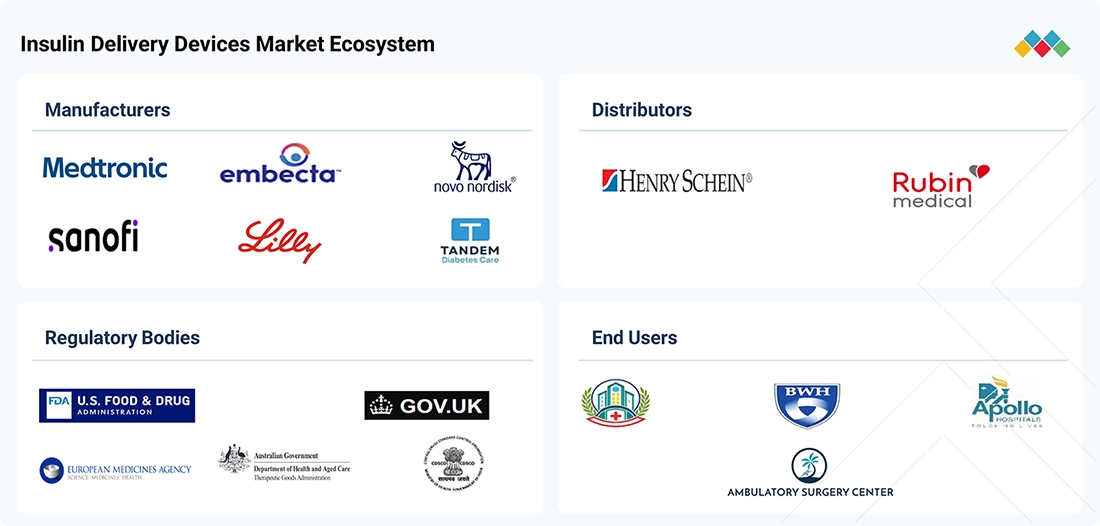
INSULIN DELIVERY DEVICES MARKET: COMMERCIAL USE CASES ACROSS INDUSTRIES
| COMPANY | USE CASE DESCRIPTION | BENEFITS |
|---|---|---|
 |
Novo Nordisk's insulin delivery portfolio includes reusable pens such as NovoPen 6 and NovoPen Echo Plus, as well as prefilled disposable pens such as FlexPen and FlexTouch. These devices are used by patients requiring insulin injections for diabetes management in home healthcare settings and under healthcare-professional supervision. Smart pens record dose information, while dose-setting mechanisms and prefilled designs simplify insulin administration. | Supports accurate and convenient insulin administration, simplifies dose selection, and improves visibility into previous injections through connected or memory-enabled pens. Prefilled and reusable options accommodate different patient preferences and treatment requirements. |
 |
embecta provides insulin pen needles, conventional insulin syringes, and safety-engineered injection products. Its portfolio includes Nano pen needles, Ultra-Fine pen needles, AutoShield Duo safety pen needles, and insulin syringes in different needle lengths and barrel capacities. These products support subcutaneous insulin administration by patients at home and healthcare professionals in clinical settings. | Offers flexibility in insulin administration through different needle lengths and syringe capacities. Shorter pen needles support a more comfortable injection experience, while safety-engineered products help reduce the risk of accidental needlestick injuries. |
 |
Medtronic's MiniMed insulin pump portfolio includes the MiniMed 780G automated insulin delivery system. The system uses continuous glucose monitoring data to adjust insulin delivery and provide automated correction doses. It is designed for eligible people with diabetes requiring insulin and is used in home-based diabetes management with healthcare-professional guidance. | Enables personalized, continuous insulin delivery and automated adjustments based on glucose readings. Integration with glucose sensors can help improve glucose management, reduce the burden of multiple daily injections, and provide patients and care partners with access to diabetes-related information. |
 |
Sanofi offers insulin delivery devices associated with its insulin portfolio, including the SoloStar prefilled disposable pen and reusable pen options such as AllStar and TouStar in India. These devices are used to administer compatible insulin formulations, including Lantus, Toujeo, and Apidra in applicable presentations and markets. They support routine insulin administration for patients with diabetes in home and clinical settings. | Provides prefilled and reusable delivery options to accommodate different treatment needs. Features such as dose selection, portability, and a prefilled format can simplify insulin administration and support convenient diabetes management. Device and insulin compatibility varies by product and market. |
 |
Eli Lilly supplies insulin in prefilled delivery devices, including the KwikPen platform used with products such as Humalog, Humulin, and Lyumjev in applicable markets. These pens enable patients requiring insulin therapy to administer prescribed doses through subcutaneous injection, including in home-based settings. Product-specific presentations and indications vary by country. | Provides a convenient, prefilled insulin administration format with dose-selection features that can simplify routine injections. Multiple insulin formulations and pen presentations support different prescribed treatment requirements and help patients manage insulin administration outside healthcare facilities. |
Logos and trademarks shown above are the property of their respective owners. Their use here is for informational and illustrative purposes only.
Related Ecosystem
Drug Delivery Devices
- Disposable Autoinjectors
- Reusable Autoinjectors
- Insulin Pumps
- Pen Injectors
- Transdermal Patches
- Becton, Dickinson and Company
- Novo nordisk a/s
- Terumo Corporation
- Medtronic plc
- Nipro Corporation
Medical Devices
- Polymerase Chain Reaction (PCR)
- Magnetic Resonance Imaging (MRI)
- Disposable Autoinjectors
- Pulse Oximeters
- Blood Pressure Monitors
- Medtronic plc
- Abbott Laboratories
- Stryker Corporation
- Becton, Dickinson and Company
- JOHNSON & JOHNSON
Key Takeaways
- Rest Of Europe's insulin delivery device market is valued at USD 275.5 million in 2025 and will reach USD 356.3 million by 2030 at a 5.3% CAGR.
- Rest Of Europe benefits from aging demographics and rising diabetes incidence, driving sustained demand for insulin delivery solutions.
- Rest Of Europe's market growth is underpinned by improving reimbursement frameworks and increased adoption of advanced delivery technologies.
- Rest Of Europe presents moderate but stable growth opportunities, with emerging markets offering expansion potential alongside mature healthcare systems.
Insulin Delivery Device Market Report Scope
| Report Metric | Details |
|---|---|
| Base Year | 2025 |
| Fastest Growing Segment | INSULIN PUMPS (Type) |
| Forecast Period | 2025–2030 |
| Growth Rate | CAGR of 8.3% from 2025 to 2030 |
| Largest Segment | TYPE 2 DIABETES (Disease Type) |
| Market Size Base Year (Billions) | ~USD 35.37 (2025) |
| Revenue Forecast (Billions) | ~USD 52.7 (2030) |
| Segments Covered | Type, Disease Type, End User |
Rest Of Europe Insulin Delivery Device Market Report Segmentation
3 segment dimensions are covered across the global market.
By Type
- Disposable Insulin Pens
- Insulin Pen Needles
- Insulin Pens
- Insulin Pumps
- Insulin Syringes
- Other Insulin Delivery Devices
- Reusable Insulin Pens
- Safety Insulin Pen Needles
- Standard Insulin Pen Needles
- Tethered Insulin Pumps
- Tubeless Insulin Pumps
By Disease Type
- Type 1 Diabetes
- Type 2 Diabetes
By End User
- Home Care Settings
- Hospitals & Clinics
- Other End Users
Target Audience
- Medical Device Manufacturers : Evaluate Rest Of Europe as an expansion market, assess competitive positioning, and identify regulatory pathways for insulin delivery device commercialization across the region.
- Healthcare Investors & PE Firms : Analyze investment opportunities in Rest Of Europe's growing insulin delivery sector, including acquisition targets and portfolio companies with regional market exposure.
- Pharmaceutical & Biotech Companies : Understand insulin delivery device adoption trends in Rest Of Europe to optimize companion product strategies and patient access programs for diabetes therapeutics.
- Healthcare Consultants & Advisors : Provide clients with evidence-based market intelligence on Rest Of Europe's insulin delivery landscape to support strategic planning and market development initiatives.
- Payers & Healthcare Systems : Benchmark reimbursement policies, health economic outcomes, and device utilization patterns across Rest Of Europe to inform coverage decisions and procurement strategies.
Key Companies in the Rest Of Europe Insulin Delivery Device Market
| Company | HQ | Ownership | Strongest segments |
|---|---|---|---|
| KINDRED HEALTHCARE INC. | United States | Private Company | Injectable and infusion-based therapies in long-term acute care hospitals,Oral therapies in inpatient rehabilitation facilities,Contract rehabilitation and ancillary sites using mixed delivery routes, |
| F5 NETWORKS | United States | Public Company | BIG-IP Systems and Packaged Software,NGINX (Plus, One Console, Ingress, WAF),Distributed Cloud Services (WAAP, Multi-cloud Networking, CDN, DNS), |
| DIALOG SEMICONDUCTOR PLC | United Kingdom | Private Company | Custom Mixed Signal (PMICs, battery management, display power, motor control),Advanced Mixed Signal (configurable ICs, AC/DC, LED and SSL drivers),Connectivity & Audio (BLE, Wi-Fi SoCs, audio CODECs), |
KINDRED HEALTHCARE INC.
Kindred Healthcare Inc. is a United States-based private company founded in 1985 that operates as a major healthcare services provider. With 64,200 employees, the company delivers a range of healthcare services across multiple care settings.
F5 NETWORKS
F5 Networks is a publicly traded United States company founded in 1996 with 6,545 employees that specializes in application delivery networking and security solutions.
DIALOG SEMICONDUCTOR PLC
Dialog Semiconductor PLC is a United Kingdom-based private company founded in 1998 with 2,300 employees that develops semiconductor solutions.
Reasons to Buy this Report
- Regional Market Segmentation : Gain detailed insights specific to Rest Of Europe's diverse healthcare systems, regulatory environments, and reimbursement landscapes that differ significantly from Western European markets.
- Growth Opportunity Identification : Identify high-potential country-level opportunities within Rest Of Europe where insulin delivery adoption is accelerating, enabling targeted market entry and expansion strategies.
- Competitive Landscape Analysis : Understand regional competitive dynamics, local manufacturer presence, and distribution channel preferences unique to Rest Of Europe's fragmented market structure.
- Demographic & Clinical Insights : Access data on aging populations, diabetes prevalence trends, and clinical adoption patterns specific to Rest Of Europe that drive device demand and market evolution.
- Strategic Investment Planning : Make informed decisions on market entry timing, partnership development, and resource allocation based on Rest Of Europe's 5.3% CAGR and USD 80.8M growth opportunity through 2030.
Frequently asked questions
What is the market size of insulin delivery devices in Rest Of Europe in 2025?
The Rest Of Europe insulin delivery device market is estimated at USD 275.5 million in 2025.
What is the projected market size for Rest Of Europe by 2030?
Rest Of Europe's insulin delivery device market is forecast to reach USD 356.3 million by 2030.
What is the CAGR for the Rest Of Europe insulin delivery device market?
Rest Of Europe's insulin delivery device market is expected to grow at a compound annual growth rate (CAGR) of 5.3% from 2025 to 2030.
What factors are driving growth in Rest Of Europe's insulin delivery device market?
Rest Of Europe's market growth is driven by aging populations, rising diabetes prevalence, improving reimbursement policies, and increased adoption of advanced delivery technologies such as insulin pens, pumps, and needle-free devices.
Which insulin delivery devices are most commonly used in Rest Of Europe?
Rest Of Europe sees widespread use of insulin pens, insulin pumps, and needle-free injection systems, with adoption varying by country based on healthcare infrastructure and reimbursement availability.
RESEARCH METHODOLOGY
The study focused on estimating the current market size for the insulin delivery devices sector. Extensive secondary research was conducted to gather information about the insulin delivery devices industry. The next step involved validating the findings, assumptions, and estimates through primary research with industry experts across the value chain. Various approaches were used to estimate the total market size, including top-down and bottom-up methods. Next, market segmentation and data triangulation procedures were used to determine the sizes of the segments and subsegments within the insulin delivery devices market.
Secondary Research
The secondary research process relies heavily on secondary sources, including directories and databases such as Bloomberg Businessweek, Factiva, and D&B Hoovers. It also includes white papers, annual reports, investor presentations, company SEC filings, and publications from government sources. Notable examples include the National Institutes of Health (NIH), the U.S. Food and Drug Administration (FDA), the U.S. Census Bureau, the World Health Organization (WHO), the International Trade Administration (ITA), the Global Burden of Disease Study, and the Centers for Medicare and Medicaid Services (CMS). These sources were utilized to gather information for the global insulin delivery devices market study. The process aimed to provide insights into key players, market classification, and segmentation based on industry trends, down to the most detailed level. It also focused on significant developments from both market and technological perspectives. A comprehensive database of key industry leaders was also created using the information obtained through secondary research.
Primary Research
In this report's primary research, we interviewed sources from both the supply and demand sides to gather qualitative and quantitative information. The supply-side primary sources included industry experts such as CEOs, vice presidents, marketing and sales directors, technology and innovation directors, and other key executives from major companies and organizations in the insulin delivery devices market. On the demand side, primary sources included pharmaceutical companies, vaccination centers, hospitals and clinics, pharmacies, and university researchers and academics. This primary research was conducted to validate the market segmentation, identify key players, and gather insights on significant industry trends and market dynamics.
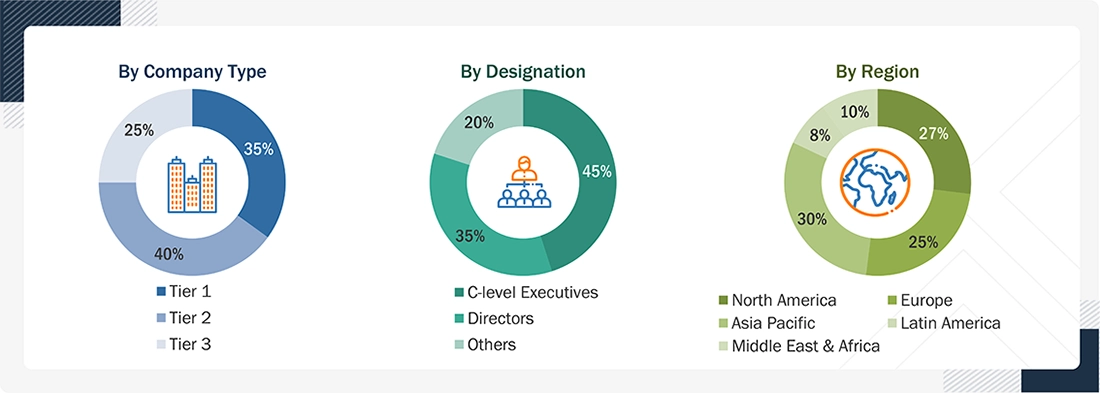
Note 1: C-level primaries include CEOs, CFOs, COOs, and VPs.
Note 2: Others include sales managers, marketing managers, business development managers, product managers, distributors, and suppliers.
Note 3: Companies are classified into tiers based on their total revenue. As of 2024, Tier 1 = >USD 10.00 billion, Tier 2 = USD 1.00 billion to USD 10.00 billion, and Tier 3 = <USD 1.00 billion.
To know about the assumptions considered for the study, download the pdf brochure
Market Size Estimation
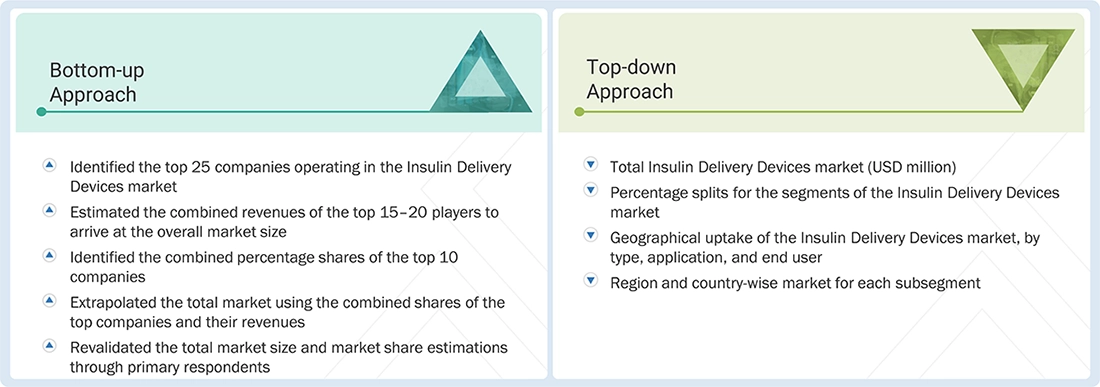
For the global market value, annual revenues were calculated based on the revenue mapping of major product manufacturers and OEMs active in the global insulin delivery devices market. All the major product manufacturers were identified at the global and/or country/regional level. Revenue mapping for the respective business segments/subsegments was done for the major players. Also, the global insulin delivery devices market was split into various segments and subsegments based on:
- List of major players operating in the products market at the regional and/or country level
- Product mapping of various insulin delivery device manufacturers at the regional and/or country level
- Mapping of annual revenue generated by listed major players from insulin delivery devices (or the nearest reported business unit/product category)
- Extrapolation of the revenue mapping of the listed major players to derive the global market value of the respective segments/subsegments
- Summation of the market value of all segments/subsegments to arrive at the global insulin delivery devices market
The above data was consolidated and added with detailed inputs and analysis from MarketsandMarkets and presented in this report.
Data Triangulation
After determining the overall size of the global insulin delivery devices market using the methodology above, this market was split into several segments and subsegments. Where applicable, the data triangulation and market breakdown procedures were employed to complete the overall market engineering process and arrive at the exact market value data for the key segments and subsegments. The extrapolated market data were triangulated by analyzing macro indicators and regional trends from both demand- and supply-side participants
Market Definition
Insulin delivery devices are medical devices designed to deliver insulin, a hormone used to manage diabetes, into the body. These devices are primarily used by individuals with diabetes who require insulin therapy to regulate their blood sugar levels. Insulin pens, pumps, pen needles, and syringes are the most widely used delivery devices.
Key Stakeholders
- Manufacturing companies of insulin pen needles, insulin pens, insulin pumps, insulin syringes, injectable insulin delivery devices, and diabetes supplies
- Suppliers and distributors of insulin pen needles, insulin pens, insulin pumps, insulin syringes, injectable insulin delivery devices, and diabetes supplies
- Pharmaceutical and biopharmaceutical companies
- Healthcare service providers
- Teaching hospitals and academic medical centers
- Health insurance players
- Government bodies/municipal corporations
- Regulatory bodies
- Medical research institutes
- Business research and consulting service providers
- Venture capitalists
- Market research and consulting firms
Report Objectives
- To describe, analyze, and forecast the global insulin delivery devices market based on type, end user, and region
- To describe and forecast the insulin delivery devices market for key regions, namely, North America, Europe, Asia Pacific, Latin America, and the Middle East & Africa
- To provide detailed information regarding the drivers, restraints, opportunities, and challenges influencing the growth of the insulin delivery devices market
- To strategically analyze the ecosystem, regulations, patenting trends, value chain, Porter’s five forces, and prices of the market under study
- To strategically analyze micromarkets with respect to individual growth trends, prospects, and contributions to the overall market
- To analyze market opportunities for stakeholders and provide details of the competitive landscape for market players
- To profile the key players and comprehensively analyze their market shares and core competencies in the insulin delivery devices market
- To analyze competitive developments such as partnerships, collaborations, acquisitions, product launches, expansions, and R&D activities in the insulin delivery devices market
- To benchmark players within the market using the proprietary Company Evaluation Matrix framework, which analyzes market players on various parameters within the broad categories of business and product strategy.
Available customizations:
Based on the market data, MarketsandMarkets offers customizations to meet your company’s needs. The following customization options are available for the report:
GEOGRAPHIC ANALYSIS
- Further breakdown of the Rest of Europe’s insulin delivery devices market into Switzerland, Denmark, and Austria, among others
- Further breakdown of the Rest of Asia Pacific’s insulin delivery devices market into Vietnam and Taiwan, among others
- Further breakdown of the Rest of Latin America’s insulin delivery devices market into Argentina, Colombia, Chile, and Ecuador
- Further breakdown of the Southeast Asia insulin delivery devices market into Malaysia, Singapore, Australia, and New Zealand
COMPETITIVE LANDSCAPE ASSESSMENT
- Market share analysis by region (North America and Europe), which provides market shares of the top 3–5 key players in the insulin delivery devices market
- Competitive leadership mapping for established players in the US
Get the Full Insulin Delivery Device Market Report
Full forecast, segment splits, and company analysis for all Insulin Delivery Device Market.
- Canada Insulin Delivery Device Market
- US Insulin Delivery Device Market
- Germany Insulin Delivery Device Market
- UK Insulin Delivery Device Market
- France Insulin Delivery Device Market
- Italy Insulin Delivery Device Market
- Spain Insulin Delivery Device Market
- China Insulin Delivery Device Market
- Japan Insulin Delivery Device Market
- India Insulin Delivery Device Market
- Australia Insulin Delivery Device Market
- South Korea Insulin Delivery Device Market
- Brazil Insulin Delivery Device Market
- Mexico Insulin Delivery Device Market
- Rest Of Asia Pacific Insulin Delivery Device Market
Need a Tailored Report?
Customize this report to your needs
Get 10% FREE Customization
Customize This Report