
Rest Of Latin America loT Middleware Market (2024-2029)

The Rest Of Latin America loT Middleware Market was valued at $303.6 Million in 2024 and projected to reach to $696.2 Million by 2029, representing a compound annual growth rate of 18.1%. Rest Of Latin America's IoT Middleware Market is positioned for substantial growth through 2029, driven by widespread digital transformation across industrial, manufacturing, and urban development sectors.


| Market Size in | USD 26.32 MN |
| Market Forecast in | |
| CAGR | |
| Forecast Period | |
| Units Considered | Value (USD MN) |
Rest Of Latin America loT Middleware Market Trends and Insights
- This represents an 18.1% compound annual growth rate, reflecting accelerating digital transformation across the region's industrial, manufacturing, and smart city initiatives.
- Rest Of Latin America is increasingly adopting middleware solutions to bridge legacy systems with modern IoT ecosystems, driven by rising cloud adoption and enterprise connectivity demands. The market in Rest Of Latin America is characterized by growing investment in IoT infrastructure and middleware platforms that enable real-time data processing and device management.
- Rest Of Latin America's enterprises are prioritizing interoperability and scalability as key middleware capabilities.
- Between 2024 and 2029, Rest Of Latin America will see heightened competition among regional and global vendors, with particular momentum in edge computing and hybrid deployment models tailored to local market needs..
Key Market Statistics
- CAGR (2024-2029) 18.1% CAGR
- Market Size, 2024 ~USD 303.6 Million
- Forecast, 2029 ~USD 696.2 Million
- Country Rest Of Latin America
Rest Of Latin America loT Middleware Market Overview
Strong Regional Growth Trajectory :
Rest Of Latin America's IoT Middleware Market is expanding at 18.1% CAGR, outpacing the global average of 17.6%, driven by accelerating digital transformation initiatives across industrial and manufacturing sectors.
Significant Market Expansion :
Market valuation is projected to more than double from USD 303.6 million in 2024 to USD 696.2 million by 2029, reflecting increasing middleware adoption across the region's emerging economies.
Smart City & Industrial Focus :
Rest Of Latin America is prioritizing IoT middleware deployment in smart city infrastructure and manufacturing automation, creating substantial opportunities for middleware solution providers and integrators.
Digital Transformation Acceleration :
Regional enterprises are increasingly recognizing middleware as critical infrastructure for connecting legacy systems with modern IoT ecosystems, supporting competitive advantage in emerging markets.
Rest Of Latin America loT Middleware Market Dynamics
- The region's expanding middle class and increasing technology investments are creating favorable conditions for middleware adoption, particularly among enterprises seeking to modernize operations and improve operational efficiency. Government initiatives supporting smart city development and industrial modernization are accelerating middleware deployment across the region.
- As connectivity infrastructure improves and cloud adoption increases, Rest Of Latin America is expected to emerge as a significant growth market for IoT middleware solutions, attracting both regional and global technology providers seeking expansion opportunities in Latin American markets..
Market Ecosystem
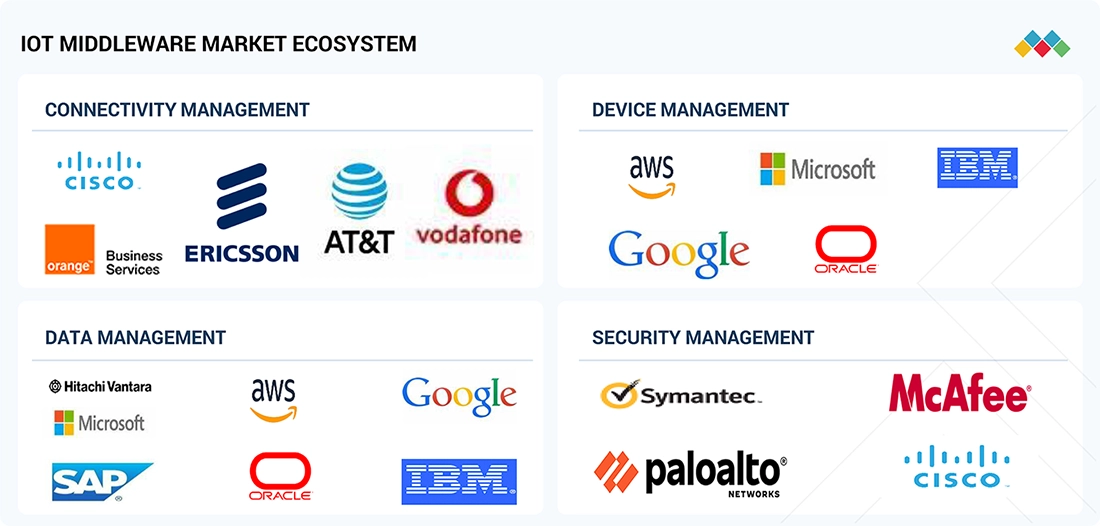
IOT MIDDLEWARE MARKET: COMMERCIAL USE CASES ACROSS INDUSTRIES
| COMPANY | USE CASE DESCRIPTION | BENEFITS |
|---|---|---|
 |
Microsoft implemented Azure-based IoT middleware for Danfoss to connect cooling and energy systems. The platform enabled centralized device management and analytics-driven optimization of energy usage. | Achieved ~30% reduction in energy costs, reduced waste, improved system monitoring, and enabled data-driven operational decisions. |
 |
Siemens deployed its MindSphere (now Insights Hub) IoT middleware platform to connect industrial assets, machines, and production systems across manufacturing environments. The platform collects real-time operational data from machines and integrates it with cloud-based applications for analytics and decision-making. It enables industrial clients to monitor performance, manage assets, and build digital twins for predictive maintenance. | Enabled real-time visibility into machine performance, supported predictive maintenance, reduced downtime, and improved operational efficiency through data-driven decision-making and digital twin capabilities. |
 |
Bosch deployed its Bosch IoT Suite middleware platform for EnBW/SMIGHT to support smart energy infrastructure. The solution enabled device management, edge computing, and data integration across connected energy systems. Middleware facilitated communication between distributed devices and central systems for monitoring and optimization of energy usage. | Improved energy monitoring and grid efficiency, enabled scalable device management, reduced operational complexity, and supported real-time data processing across distributed energy infrastructure. |
Logos and trademarks shown above are the property of their respective owners. Their use here is for informational and illustrative purposes only.
Related Ecosystem
Digitalization And Iot
- Sensors
- Remote Monitoring
- Supply Chain Management
- Passenger Information System (PIS)
- Platform as A Service (PaaS)
- International Business Machines Corporation
- Cisco Systems, Inc.
- MICROSOFT CORPORATION
- Oracle Corporation
- HUAWEI TECHNOLOGIES CO LTD
Key Takeaways
- Rest Of Latin America's IoT Middleware Market will nearly double from USD 303.6M (2024) to USD 696.2M (2029), driven by 18.1% CAGR.
- Rest Of Latin America enterprises are prioritizing middleware solutions for legacy system integration and real-time IoT data management.
- Rest Of Latin America's market growth is fueled by cloud adoption, smart city projects, and industrial digital transformation initiatives.
- Rest Of Latin America will attract increased vendor competition, with emphasis on edge computing and hybrid deployment architectures by 2029.
loT Middleware Market Report Scope
| Report Metric | Details |
|---|---|
| Base Year | 2024 |
| Fastest Growing Segment | HEALTHCARE (Vertical) |
| Forecast Period | 2024–2029 |
| Growth Rate | CAGR of 17.6% from 2024 to 2029 |
| Largest Segment | SMES (Organization Size) |
| Market Size Base Year (Billions) | ~USD 18.54 (2024) |
| Revenue Forecast (Billions) | ~USD 41.7 (2029) |
| Segments Covered | Platform Type, Vertical, Component, Organization Size, Focus Area, Component 2021–2026, Solution, Service, Deployment Mode, Application |
Rest Of Latin America loT Middleware Market Report Segmentation
10 segment dimensions are covered across the global market.
By Platform Type
- Application Management
- Connectivity Management
- Data Management
- Device Management
- Security Management
By Vertical
- Bfsi
- Discrete Manufacturing
- Energy & Utilities
- Government & Defense
- Healthcare
- Manufacturing
- Other Verticals
- Process Manufacturing
- Retail
- Transportation & Logistics
By Component
- Hardware
- Services
- Software Solutions
- Solutions
By Organization Size
- Large Enterprises
- Smes
By Focus Area
- Connected Healthcare
- Other Focus Areas
- Smart Agriculture
- Smart Buildings
- Smart Energy And Utilities
- Smart Manufacturing
- Smart Retail
- Smart Transportation/Mobility
By Component 2021–2026
- Services
- Solutions
By Solution
- Application Management
- Data Management
- Device Management
- Network Management
- Smart Surveillance
By Service
- Managed Services
- Professional Services
By Deployment Mode
- Cloud
- On-Premises
By Application
- Asset Tracking And Management
- Automation Control And Management
- Business Process Optimization/Workflow Optimization
- Emergency And Incident Management, And Business Communication
- Logistics And Supply Chain Management
- Predictive Maintenance
- Real-Time Workforce Tracking And Management
Target Audience
- IoT Middleware Vendors : Solution providers need Rest Of Latin America-specific market data to identify growth opportunities, assess competitive positioning, and develop localized go-to-market strategies for the region.
- Enterprise Technology Leaders : CIOs and digital transformation officers in Rest Of Latin America require market intelligence to evaluate middleware investments, benchmark adoption trends, and align technology roadmaps with regional opportunities.
- System Integrators & Consultants : Implementation partners need Rest Of Latin America market insights to identify client opportunities, develop service offerings, and position expertise in growing industrial IoT and smart city segments.
- Investment & Private Equity Firms : Investors evaluating IoT technology companies need Rest Of Latin America market data to assess growth potential, identify acquisition targets, and understand regional expansion opportunities.
- Government & Policy Makers : Regional development agencies and government bodies need market intelligence to inform digital transformation policies, infrastructure investments, and technology adoption initiatives in Rest Of Latin America.
Key Companies in the Rest Of Latin America loT Middleware Market
| Company | HQ | Ownership | Strongest segments |
|---|---|---|---|
| GIESECKE & DEVRIENT GMBH | Germany | Private Company | Security Management,Connectivity Management,Device Management, |
| HCL TECHNOLOGIES LIMITED | India | Public Company | Device Management,Application Management,Connectivity Management, |
| JABIL | United States | Public Company | Device Management,Application Management,Connectivity Management, |
| NOKIA CORPORATION | Finland | Public Company | Connectivity Management,Device Management,Data Management, |
| TELIA COMPANY | Sweden | Public Company | Connectivity Management,Device Management,Application Management, |
| KUDELSKI GROUP | Switzerland | Public Company | Device Management,Application Management,Connectivity Management, |
| PLDT ENTERPRISE | Philippines | InvalidIdentifier | Device Management,Application Management,Connectivity Management, |
| ARM HOLDINGS PLC | United Kingdom | Public Company | Device Management–linked IP and tools,Application Management–linked compute subsystems,Connectivity Management–linked system IP, |
| LENOVO | China | Public Company | Device Management Platform Attach,Application Management & Edge Runtime,Connectivity & Network Management, |
| MICROSOFT | United States | Public Company | Device Management Platform,Application Management Platform,Connectivity Management Platform, |
| IBM | United States | Public Company | Device Management Platform,Application Management Platform,Connectivity Management Platform, |
| CISCO | United States | Public Company | Connectivity Management,Security Management,Device Management, |
| PTC | United States | Public Company | Device Management,Application Management,Connectivity Management, |
| SAP | Germany | Public Company | Application Management,Data Management,Device Management, |
| HITACHI | Japan | Public Company | Device Management,Application Management,Connectivity Management, |
| ORACLE | United States | Public Company | Device Management Platform,Application Management Platform,Connectivity Management Platform, |
| United States | Public Company | Device Management,Application Management,Connectivity Management, | |
| BOSCH | India | Public Company | Device Management,Application Management,Connectivity Management, |
| HPE | United States | Public Company | Device Management Platform,Application Management Platform,Connectivity Management Platform, |
| SIEMENS | Germany | Public Company | Device Management,Application Management,Connectivity Management, |
| GE | United States | Public Company | Device Management,Application Management,Connectivity Management, |
| SCHNEIDER ELECTRIC | France | Public Company | Device Management,Application Management,Connectivity Management, |
| SOFTWARE AG | Switzerland | Public Company | Application Management Middleware & Services,Data & AI Middleware,Security & Connectivity Management Services, |
GIESECKE & DEVRIENT GMBH
Giesecke & Devrient GmbH is a German private company founded in 1852 with 14,561 employees, operating in the technology and security sectors.
HCL TECHNOLOGIES LIMITED
HCL Technologies Limited is an Indian public company founded in 1976 providing IT services and solutions.
JABIL
Jabil is a United States-based public company founded in 1966 with 135,000 employees, operating as a manufacturing and supply chain solutions provider.
NOKIA CORPORATION
Nokia Corporation is a Finnish public company founded in 1865 with 78,005 employees, specializing in telecommunications and networking technology.
TELIA COMPANY
Telia Company is a Swedish public telecommunications company founded in 1853 with 14,552 employees.
KUDELSKI GROUP
Kudelski Group is a Swiss public company founded in 1951 with 110 employees, operating in digital security and media solutions.
PLDT ENTERPRISE
PLDT Enterprise is a Philippines-based company in the telecommunications and enterprise services sector.
ARM HOLDINGS PLC
ARM Holdings PLC is a United Kingdom-based public company founded in 1990 with 9,584 employees, specializing in semiconductor and processor design.
LENOVO
Lenovo is a Chinese public company founded in 1984, operating as a global technology and computing solutions provider.
MICROSOFT
Microsoft is a United States-based public company founded in 1975 with 228,000 employees, a global leader in software, cloud computing, and technology services.
IBM
IBM is a United States-based public company founded in 1911 with 264,300 employees, providing enterprise IT solutions, cloud services, and consulting.
CISCO
Cisco is a United States-based public company founded in 1984 with 86,200 employees, specializing in networking and cybersecurity solutions.
PTC
PTC is a United States-based public company founded in 1985 with 7,000 employees, offering product lifecycle management and industrial software solutions.
SAP
SAP is a German public company founded in 1972 with 111,038 employees, a global leader in enterprise resource planning and business software.
HITACHI
Hitachi is a Japanese public company founded in 1910 with 287,901 employees, operating across diverse sectors including electronics, infrastructure, and industrial solutions.
ORACLE
Oracle is a United States-based public company founded in 1977 with 141,000 employees, specializing in database software, cloud computing, and enterprise solutions.
Google is a United States-based public company founded in 1998 with 194,668 employees, a global technology leader in search, advertising, and cloud services.
BOSCH
Bosch is an India-based public company founded in 1886 with 37,131 employees, providing automotive, industrial, and consumer technology solutions.
HPE
HPE (Hewlett Packard Enterprise) is a United States-based public company founded in 1939 with 67,000 employees, specializing in enterprise IT infrastructure and services.
SIEMENS
Siemens is a German public company founded in 1847 with 310,312 employees, a global conglomerate operating in electrification, automation, and digitalization.
GE
GE (General Electric) is a United States-based public company founded in 1892 with 57,000 employees, operating across power, renewable energy, and industrial sectors.
SCHNEIDER ELECTRIC
Schneider Electric is a French public company founded in 1836 with 158,122 employees, specializing in energy management and industrial automation solutions.
SOFTWARE AG
Software AG is a Switzerland-based public company founded in 2000 with 12,712 employees, providing enterprise software and digital transformation solutions.
Reasons to Buy this Report
- Regional Market Sizing & Forecasts : Obtain precise market valuation data specific to Rest Of Latin America (USD 303.6M in 2024, USD 696.2M in 2029) with detailed 5-year projections to support strategic planning and investment decisions.
- Competitive Landscape Intelligence : Identify key middleware vendors, solution providers, and emerging competitors operating in Rest Of Latin America, enabling informed competitive positioning and partnership strategies.
- Sector-Specific Growth Opportunities : Understand which industries (industrial, manufacturing, smart cities) are driving middleware adoption in Rest Of Latin America, allowing targeted market entry and product development strategies.
- Regional Adoption Drivers & Barriers : Analyze region-specific factors influencing IoT middleware adoption, including infrastructure maturity, regulatory environment, and enterprise readiness in Rest Of Latin America markets.
- Investment & Expansion Planning : Leverage Rest Of Latin America-specific insights to evaluate market entry feasibility, resource allocation, and go-to-market strategies for IoT middleware solutions and services.
Frequently asked questions
What is the current size of the IoT Middleware Market in Rest Of Latin America?
Rest Of Latin America's IoT Middleware Market was valued at USD 303.6 million in 2024 and is expected to grow to USD 696.2 million by 2029.
What is the projected growth rate for Rest Of Latin America's IoT Middleware Market?
Rest Of Latin America's IoT Middleware Market is projected to grow at a compound annual growth rate (CAGR) of 18.1% from 2024 to 2029.
What are the primary drivers of IoT Middleware adoption in Rest Of Latin America?
Rest Of Latin America's market growth is driven by cloud adoption, smart city initiatives, industrial digital transformation, and the need for legacy system integration with modern IoT platforms.
Which industries in Rest Of Latin America are leading IoT Middleware adoption?
Rest Of Latin America's manufacturing, industrial, telecommunications, and smart city sectors are the primary adopters of IoT Middleware solutions.
What middleware capabilities are most valued in Rest Of Latin America?
Rest Of Latin America enterprises prioritize interoperability, scalability, real-time data processing, edge computing, and hybrid deployment models in their middleware selections.
RESEARCH METHODOLOGY
The research study involved four major activities in estimating the IoT middleware market size. Exhaustive secondary research has been done to collect important information about the market and peer markets. The next step has been to validate these findings and assumptions and size them with the help of primary research with industry experts across the value chain. Both top-down and bottom-up approaches have been used to estimate the market size. Post which, the market breakdown and data triangulation have been adopted to estimate the market sizes of segments and sub-segments.
Secondary Research
The market size of the companies offering IoT middleware solutions to various end users was arrived at based on the secondary data available through paid and unpaid sources, and by analyzing the product portfolios of major companies in the ecosystem and rating the companies based on their performance and quality. In the secondary research process, various sources were referred to identify and collect information for the study. The secondary sources included annual reports, press releases, investor presentations of companies, white papers, journals, certified publications, and articles from recognized authors, directories, and databases. Several journals and associations were referred to, such as the IoT World Alliance, Global System for Mobile Communications (GSMA), and the Industry IoT Consortium (IIC). Secondary research was mainly used to obtain critical information about industry insights, the market’s monetary chain, the overall pool of key players, market classification, and segmentation according to industry trends to the bottom-most level, regional markets, and key developments from both market- and technology-oriented perspectives.
Primary Research
In the primary research process, various sources from the supply and demand sides were interviewed to obtain qualitative and quantitative information for the report, such as Chief Experience Officers (CXOs), Vice Presidents (VPs), directors from business development, marketing, and product development/innovation teams, and related key executives from IoT middleware solution vendors, system integrators, professional and managed service providers, industry associations, independent consultants, and key opinion leaders.
Primary interviews were conducted to gather insights, such as market statistics, data on revenue collected from software and services, market breakups, market size estimations, market forecasts, and data triangulation. Stakeholders from the demand side, such as Chief Information Officers (CIOs), Chief Finance Officers (CFOs), Chief Strategy Officers (CSOs), and the installation team of end users who use IoT middleware, were interviewed to understand buyers’ perspectives on suppliers, products, service providers, and their current usage of IoT middleware solutions which is expected to affect the overall IoT middleware market growth.
Breakdown of Primaries
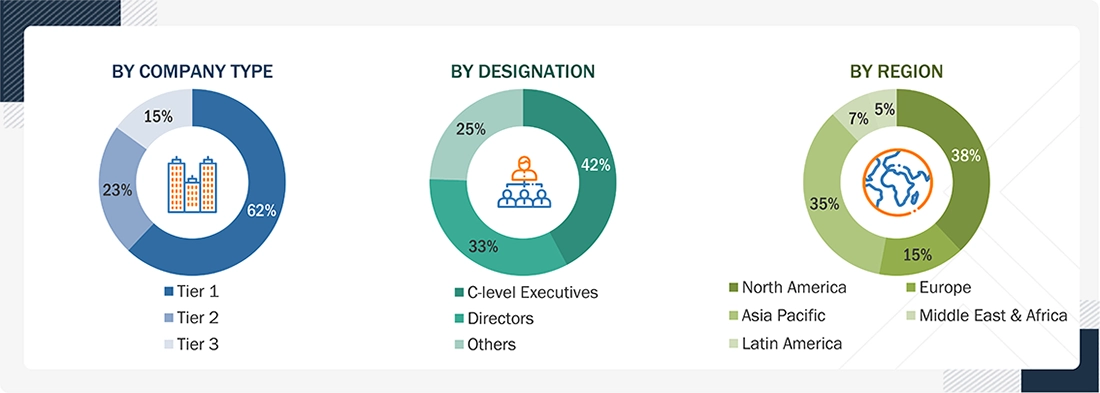
Note 1: Tier 1 companies have revenues of more than USD 10 billion; tier 2 companies’ revenue ranges from USD 1 billion to USD 10 billion; and tier 3 companies’ revenue ranges from USD 500 million to USD 1 billion
Source: Secondary Literature, Interviews with Experts, and MarketsandMarkets Analysis
To know about the assumptions considered for the study, download the pdf brochure
Market Size Estimation
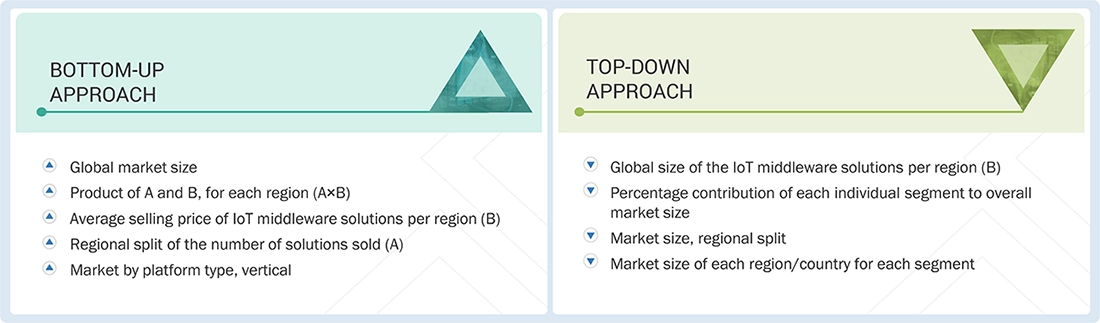
In the market engineering process, the top-down and bottom-up approaches were used along with multiple data triangulation methods to estimate and validate the size of the IoT middleware market and other dependent submarkets. The research methodology used to estimate the market sizes includes the following:
- Initially, MarketsandMarkets focuses on top-line investments and spending in the ecosystems. Further, significant developments in the critical market area have been considered.
- Tracking the recent and upcoming developments in the IoT middleware market that include investments, R&D activities, product launches, collaborations, mergers and acquisitions, and partnerships, as well as forecasting the market size based on these developments and other critical parameters.
- Conduct multiple discussions with key opinion leaders to learn about the diverse types of authentications and brand protection offerings used and the applications for which they are used to analyze the breakdown of the scope of work carried out by major companies.
- Segmenting the market based on technology types concerning applications, wherein the types are to be used, and deriving the size of the global application market.
- Segmenting the overall market into various market segments.
- Validating the estimates at every level through discussions with key opinion leaders, such as chief executives (CXOs), directors, and operations managers, and finally with the domain experts at MarketsandMarkets.
Data Triangulation
The IoT middleware market has been split into segments and sub-segments after the overall market size was estimated using the above estimation process. To complete the overall market engineering process and arrive at the exact statistics for all segments and sub-segments, data triangulation and market breakdown procedures have been used, wherever applicable. The data has been triangulated by studying various factors and trends from both the demand and supply sides.
The IoT middleware market size has been validated using top-down and bottom-up approaches.
Market Definition
The IoT middleware market comprises software platforms that bridge the gap between IoT devices and applications. IoT middleware provides a standardized set of APIs, protocols, and tools that abstract the underlying complexities of hardware, operating systems, and communication protocols, allowing developers to focus on building innovative IoT applications. Key functions of IoT middleware include device management, application enablement, connectivity management, data management, security management, and the ability to integrate with legacy systems. The IoT Middleware market caters to the growing demand for interoperable, scalable, and secure IoT infrastructure across manufacturing, healthcare, transportation & logistics, energy & utilities, etc.
Stakeholders
- IoT middleware providers
- IoT platform providers
- IoT connectivity providers
- Technology providers
- Consulting and advisory firms
- Regional and global government organizations
- Independent software vendors (ISVs)
- Value-added resellers (VARs) and distributors
- System integrators
Report Objectives
- To determine and forecast the global IoT middleware market by platform type, vertical, and region from 2026 to 2032, and analyze the various macroeconomic and microeconomic factors affecting the market growth.
- To forecast the size of the market segments concerning five central regions: North America, Europe, Asia Pacific (APAC), Middle East & Africa (MEA), and Latin America.
- To provide detailed information about the major factors (drivers, restraints, opportunities, and challenges) influencing the growth of the IoT middleware market.
- Analyze each submarket concerning individual growth trends, prospects, and contributions to the overall IoT middleware market.
- To analyze the opportunities in the market for stakeholders by identifying the high-growth segments of the IoT middleware market.
- To profile the key market players, provide a comparative analysis based on business overviews, regional presence, product offerings, business strategies, and key financials, and illustrate the market’s competitive landscape.
- Track and analyze competitive developments in the market, such as mergers and acquisitions, product developments, partnerships and collaborations, and Research and Development (R&D) activities.
Get the Full loT Middleware Market Report
Full forecast, segment splits, and company analysis for all loT Middleware Market.
- UK loT Middleware Market
- Germany loT Middleware Market
- Italy loT Middleware Market
- China loT Middleware Market
- India loT Middleware Market
- Brazil loT Middleware Market
- US loT Middleware Market
- Canada loT Middleware Market
- France loT Middleware Market
- Nordics loT Middleware Market
- Rest Of Europe loT Middleware Market
- Spain loT Middleware Market
- Japan loT Middleware Market
- Rest Of Asia Pacific loT Middleware Market
- South Korea loT Middleware Market
- Mexico loT Middleware Market
- GCC Countries loT Middleware Market
- South Africa loT Middleware Market
Need a Tailored Report?
Customize this report to your needs
Get 10% FREE Customization
Customize This Report
