
South Korea Large Language Model (LLM) Market (2024-2029)

The South Korea Large Language Model (LLM) Market was valued at $198.2 Million in 2024 and projected to reach to $1267.1 Million by 2029, representing a compound annual growth rate of 36.2%. South Korea's LLM market is poised for exceptional growth through 2029, driven by substantial investments in AI research, government support for digital innovation, and increasing enterprise demand for advanced language processing solutions.


| Market Size in | USD 26.32 MN |
| Market Forecast in | |
| CAGR | |
| Forecast Period | |
| Units Considered | Value (USD MN) |
South Korea Large Language Model (LLM) Market Trends and Insights
- This represents a compound annual growth rate (CAGR) of 36.2%, significantly outpacing global trends and reflecting South Korea's strategic positioning as a technology innovation hub.
- South Korea's robust digital infrastructure, strong semiconductor industry, and government support for AI development are driving accelerated LLM adoption across enterprise, research, and consumer sectors. The South Korean LLM market is characterized by intense competition among domestic tech giants and emerging startups, coupled with substantial investment in AI research and development.
- South Korea's emphasis on AI talent development and regulatory frameworks supportive of innovation are creating favorable conditions for market growth through 2029.
- South Korea's integration of LLM technologies into fintech, healthcare, manufacturing, and e-commerce sectors demonstrates the breadth of market opportunity and the nation's commitment to AI-driven digital transformation..
Key Market Statistics
- CAGR (2024-2029) 36.2% CAGR
- Market Size, 2024 ~USD 198.2 Million
- Forecast, 2029 ~USD 1267.1 Million
- Country South Korea
South Korea Large Language Model (LLM) Market Overview
Exceptional Growth Trajectory :
South Korea's LLM market is expanding at 36.2% CAGR, outpacing the global average of 33.2%, driven by aggressive AI adoption and government digital transformation initiatives.
Rapid Market Expansion :
Market valuation is projected to grow from USD 198.2 million in 2024 to USD 1,267.1 million by 2029, representing a 540% increase over five years.
Tech Innovation Hub Status :
South Korea's strategic positioning as a technology innovation hub, combined with world-class digital infrastructure, creates a fertile ecosystem for LLM development and deployment.
Strong Digital Foundation :
The nation's robust telecommunications network, high internet penetration, and tech-savvy population provide ideal conditions for LLM market penetration and enterprise adoption.
South Korea Large Language Model (LLM) Market Dynamics
- Major technology conglomerates and startups are actively developing indigenous LLM capabilities, reducing reliance on foreign solutions and fostering a competitive domestic ecosystem. The market will be further accelerated by integration of LLMs across key sectors including finance, healthcare, e-commerce, and manufacturing.
- South Korea's commitment to becoming a global AI leader, combined with its skilled workforce and venture capital availability, positions the country as a critical growth market.
- Strategic partnerships between local tech firms and international AI providers will expand market accessibility and drive adoption across mid-market and enterprise segments..
Market Ecosystem
Related Ecosystem
Software And Services
- Natural Language Processing (NLP)
- Machine Learning
- Supply Chain Management
- Predictive Analytics
- Image Sensors
- International Business Machines Corporation
- MICROSOFT CORPORATION
- Oracle Corporation
- SAP SE
- Amazon.com, Inc.
Analytics
- Natural Language Processing (NLP)
- Machine Learning
- Supply Chain Management
- Predictive Analytics
- Image Sensors
- International Business Machines Corporation
- MICROSOFT CORPORATION
- Oracle Corporation
- SAP SE
Cloud Computing
- Software as A Service (SaaS)
- Natural Language Processing (NLP)
- Platform as A Service (PaaS)
- Machine Learning
- Supply Chain Management
- International Business Machines Corporation
- MICROSOFT CORPORATION
- Oracle Corporation
- Amazon.com, Inc.
Key Takeaways
- South Korea's LLM market is projected to grow from USD 198.2 million in 2024 to USD 1,267.1 million by 2029, representing a 36.2% CAGR.
- South Korea's advanced semiconductor capabilities and digital infrastructure position the nation as a regional leader in LLM technology deployment and innovation.
- South Korea's government initiatives and corporate investment in AI research are accelerating LLM adoption across financial services, healthcare, and manufacturing sectors.
- South Korea's competitive landscape features both established tech conglomerates and innovative startups driving rapid market expansion and technological advancement.
Large Language Model (LLM) Market Report Scope
| Report Metric | Details |
|---|---|
| Base Year | 2024 |
| Fastest Growing Segment | SUPPLY CHAIN MANAGEMENT (Business Function) |
| Forecast Period | 2024-2029 |
| Growth Rate | CAGR of 33.2% from 2024 to 2029 |
| Largest Segment | MACHINE LEARNING (Technology) |
| Market Size Base Year (Billions) | ~USD 6.46 (2024) |
| Revenue Forecast (Billions) | ~USD 27.1 (2029) |
| Segments Covered | Offering, Software Type, Software Source Code, Software Deployment Mode, Service, Architecture, Modality, Model Size, Application, End User, Type, Source Code, Deployment Mode, Technology, Business Function, Vertical, Data Modality |
South Korea Large Language Model (LLM) Market Report Segmentation
17 segment dimensions are covered across the global market.
By Offering
- Hardware
- Services
- Software
By Software Type
- Domain-Specific Llms
- General-Purpose Llms
- Multilingual Llms
- Task-Specific Llms
By Software Source Code
- Closed-Source Llms
- Open-Source Llms
By Software Deployment Mode
- Cloud
- On-Premises
By Service
- Consulting
- Integration
- Llm Development
- Llm Fine-Tuning
- Llm-Backed App Development
- Prompt Engineering
- Support & Maintenance
By Architecture
- Autoencoding Language Models
- Autoregressive Language Models
- Hybrid Language Models
By Modality
- Code
- Image
- Text
- Video
By Model Size
- 1 Billion To 10 Billion Parameters
- 10 Billion To 50 Billion Parameters
- 100 Billion To 200 Billion Parameters
- 200 Billion To 500 Billion Parameters
- 50 Billion To 100 Billion Parameters
- Above 500 Billion Parameters
- Below 1 Billion Parameters
By Application
- Code Generation
- Content Generation & Curation
- Customer Service Automation
- Data Analysis & Bi
- Data Analysis & Business Intelligence
- Information Retrieval
- Language Translation & Localization
- Other Applications
By End User
- Bfsi
- Education
- Healthcare & Life Sciences
- It & Ites
- Law Firms
- Manufacturing
- Media & Entertainment
- Other End Users
- Retail & Ecommerce
By Type
- Domain-Specific Llms
- General Purpose Llms
- Multilingual Llms
- Task-Specific Llms
By Source Code
- Closed-Source Llms
- Open-Source Llms
By Deployment Mode
- Cloud
- On-Premises
By Technology
- Computer Vision
- Context Awareness
- Machine Learning
- Natural Language Processing
By Business Function
- Finance
- Human Resource
- Law
- Marketing & Sales
- Operations
- Research & Development
- Security
- Supply Chain Management
By Vertical
- Agriculture
- Automotive, Transportation, And Logistics
- Bfsi
- Energy & Utilities
- Government & Defense
- Healthcare& Life Sciences
- It/Ites
- Manufacturing
- Media & Entertainment
- Other Verticals
- Retail & Ecommerce
- Telecom
By Data Modality
- Audio & Speech
- Code
- Image
- Text
- Video
Target Audience
- Technology Companies & Startups : South Korea-based and international tech firms seeking to understand market opportunities, competitive dynamics, and growth potential in the Korean LLM sector.
- Investment & Venture Capital Firms : Investors evaluating opportunities in South Korea's high-growth AI market need detailed forecasts and market analysis to guide funding decisions and portfolio strategy.
- Enterprise & Corporate Strategy Teams : South Korean enterprises planning LLM adoption and digital transformation initiatives require market insights to benchmark investments and identify solution providers.
- Government & Policy Makers : Korean government agencies and policy bodies developing AI strategies and digital innovation roadmaps need market data to inform regulatory frameworks and incentive programs.
- Consulting & Research Organizations : Management consultants and research firms advising clients on Korean market expansion and AI strategy require authoritative market data and forecasts for credible recommendations.
Reasons to Buy this Report
- Market-Specific Growth Intelligence : Gain detailed insights into South Korea's unique LLM market dynamics, including localized growth drivers, competitive landscape, and investment trends specific to the Korean market.
- Strategic Entry & Expansion Planning : Develop informed market entry strategies for South Korea with comprehensive data on market size, growth projections, and regional opportunities through 2029.
- Competitive Positioning Analysis : Understand South Korea's position relative to global LLM markets and identify competitive advantages in this high-growth technology hub.
- Investment Decision Support : Make data-driven investment decisions with validated forecasts showing 540% market growth potential and 36.2% CAGR over the forecast period.
- Sector-Specific Opportunity Mapping : Identify high-potential application areas and vertical markets within South Korea's LLM ecosystem for targeted business development and partnership opportunities.
Frequently asked questions
What is the current size of South Korea's LLM market?
South Korea's Large Language Model market was valued at USD 198.2 million in 2024 and is expected to grow to USD 1,267.1 million by 2029.
What is the projected growth rate for South Korea's LLM market?
South Korea's LLM market is projected to grow at a compound annual growth rate (CAGR) of 36.2% from 2024 to 2029.
Which industries in South Korea are driving LLM adoption?
South Korea's fintech, healthcare, manufacturing, and e-commerce sectors are primary drivers of LLM market growth and technology integration.
What factors are supporting South Korea's LLM market expansion?
South Korea's advanced digital infrastructure, semiconductor industry strength, government AI initiatives, and substantial R&D investment are key growth enablers.
How does South Korea's LLM market compare to global trends?
South Korea's 36.2% CAGR significantly exceeds the global LLM market CAGR of 33.2%, reflecting the nation's accelerated AI adoption and innovation pace.
RESEARCH METHODOLOGY
The Large Language Model (LLM) market research study involved extensive secondary sources, directories, journals, and paid databases. Primary sources were mainly industry experts from the core and related industries, preferred large language model providers, third-party service providers, consulting service providers, end users, and other commercial enterprises. In-depth interviews were conducted with various primary respondents, including key industry participants and subject matter experts, to obtain and verify critical qualitative and quantitative information, and assess the market’s prospects.
Secondary Research
In the secondary research process, various sources were referred to, for identifying and collecting information for this study. Secondary sources included annual reports, press releases, and investor presentations of companies; white papers, journals, and certified publications; and articles from recognized authors, directories, and databases. The data was also collected from other secondary sources, such as journals, government websites, blogs, and vendors websites. Additionally, large language model spending of various countries was extracted from the respective sources. Secondary research was mainly used to obtain key information related to the industry’s value chain and supply chain to identify key players based on solutions, services, market classification, and segmentation according to offerings of major players, industry trends related to software, hardware, services, technology, applications, warehouse sizes, verticals, and regions, and key developments from both market- and technology-oriented perspectives.
Primary Research
In the primary research process, various primary sources from both supply and demand sides were interviewed to obtain qualitative and quantitative information on the market. The primary sources from the supply side included various industry experts, including Chief Experience Officers (CXOs); Vice Presidents (VPs); directors from business development, marketing, and large language models expertise; related key executives from large language models solution vendors, SIs, professional service providers, and industry associations; and key opinion leaders.
Primary interviews were conducted to gather insights, such as market statistics, revenue data collected from solutions and services, market breakups, market size estimations, market forecasts, and data triangulation. Primary research also helped in understanding various trends related to technologies, applications, deployments, and regions. Stakeholders from the demand side, such as Chief Information Officers (CIOs), Chief Technology Officers (CTOs), Chief Strategy Officers (CSOs), and end users using large language models solutions, were interviewed to understand the buyer’s perspective on suppliers, products, service providers, and their current usage of large language models solutions and services, which would impact the overall large language model market.
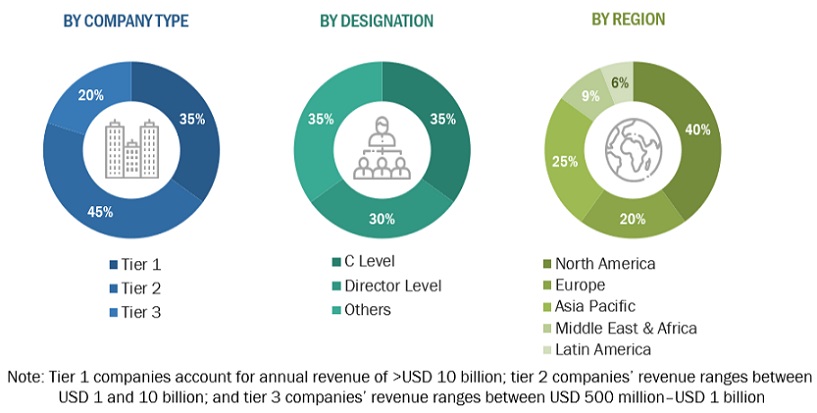
To know about the assumptions considered for the study, download the pdf brochure
Market Size Estimation
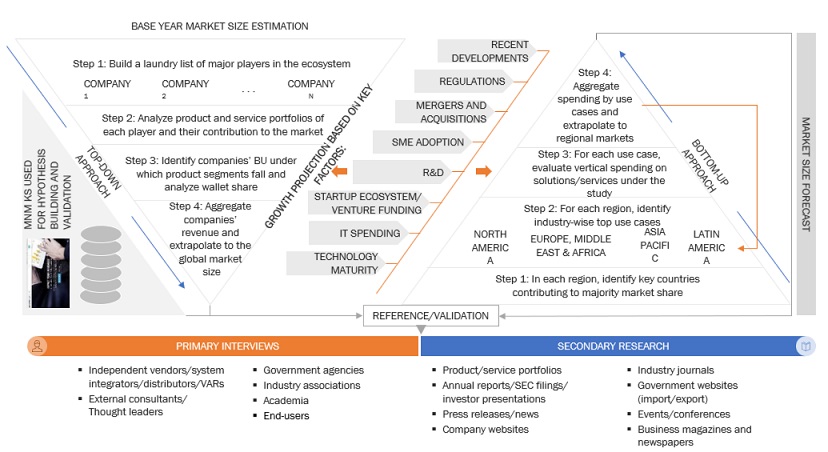
Multiple approaches were adopted for estimating and forecasting the large language model market. The first approach involves estimating the market size by summation of companies’ revenue generated through the sale of solutions and services.
Market Size Estimation Methodology-Top-down approach
In the top-down approach, an exhaustive list of all the vendors offering solutions and services in the large language model market was prepared. The revenue contribution of the market vendors was estimated through annual reports, press releases, funding, investor presentations, paid databases, and primary interviews. Each vendor's offerings were evaluated based on breadth of software and services according to data types, business functions, deployment models, and verticals. The aggregate of all the companies’ revenue was extrapolated to reach the overall market size. Each subsegment was studied and analyzed for its global market size and regional penetration. The markets were triangulated through both primary and secondary research. The primary procedure included extensive interviews for key insights from industry leaders, such as CIOs, CEOs, VPs, directors, and marketing executives. The market numbers were further triangulated with the existing MarketsandMarkets’ repository for validation.
Market Size Estimation Methodology-Bottom-up approach
In the bottom-up approach, the adoption rate of large language model solutions and services among different end users in key countries with respect to their regions contributing the most to the market share was identified. For cross-validation, the adoption of large language models solutions and services among industries, along with different use cases with respect to their regions, was identified and extrapolated. Weightage was given to use cases identified in different regions for the market size calculation.
Based on the market numbers, the regional split was determined by primary and secondary sources. The procedure included the analysis of the large language model market’s regional penetration. Based on secondary research, the regional spending on Information and Communications Technology (ICT), socio-economic analysis of each country, strategic vendor analysis of major large language models providers, and organic and inorganic business development activities of regional and global players were estimated. With the data triangulation procedure and data validation through primary interviews, the exact values of the overall large language model market size and segments’ size were determined and confirmed using the study.
Global Large Language Model Market Size: Bottom-Up and Top-Down Approach:
To know about the assumptions considered for the study, Request for Free Sample Report
Data Triangulation
After arriving at the overall market size using the market size estimation processes as explained above, the market was split into several segments and subsegments. To complete the overall market engineering process and arrive at the exact statistics of each market segment and subsegment, data triangulation and market breakup procedures were employed, wherever applicable. The overall market size was then used in the top-down procedure to estimate the size of other individual markets via percentage splits of the market segmentation.
Market Definition
A large language model (LLM) is a neural network-based artificial intelligence system trained on vast amounts of text data to understand and generate human-like language. It uses deep learning techniques to learn patterns and relationships, allowing coherent and contextually relevant text output. LLMs are called “large” as they consist of billions or trillions of parameters, enabling them to capture extensive knowledge and language patterns. This massive parameter count allows LLMs to perform a wide range of natural language processing tasks with human-like proficiency, such as text generation, summarization, translation, and question-answering.
Stakeholders
- Generative AI software developers
- Large language model software vendors
- Business analysts
- Cloud service providers
- Consulting service providers
- Enterprise end-users
- Distributors and Value-added Resellers (VARs)
- Government agencies
- Independent Software Vendors (ISV)
- Managed service providers
- Market research and consulting firms
- Support & maintenance service providers
- System Integrators (SIs)/migration service providers
- Language service providers
- Technology providers
Report Objectives
- To define, describe, and predict the large language model market by offering (software and services), architecture, modality, model size, application, end-user, and region
- To provide detailed information related to major factors (drivers, restraints, opportunities, and industry-specific challenges) influencing the market growth
- To analyze the micro markets with respect to individual growth trends, prospects, and their contribution to the total market
- To analyze the opportunities in the market for stakeholders by identifying the high-growth segments of the market
- To analyze opportunities in the market and provide details of the competitive landscape for stakeholders and market leaders
- To forecast the market size of segments for five main regions: North America, Europe, Asia Pacific, Middle East Africa, and Latin America
- To profile key players and comprehensively analyze their market rankings and core competencies.
- To analyze competitive developments, such as partnerships, new product launches, and mergers and acquisitions, in the market
- To analyze the impact of recession across all the regions across the large language model market
Available Customizations
With the given market data, MarketsandMarkets offers customizations as per your company’s specific needs. The following customization options are available for the report:
Product Analysis
- Product quadrant, which gives a detailed comparison of the product portfolio of each company.
Geographic Analysis
- Further breakup of the North American large language model market
- Further breakup of the European market
- Further breakup of the Asia Pacific market
- Further breakup of the Middle Eastern & African market
- Further breakup of the Latin America market
Company Information
- Detailed analysis and profiling of additional market players (up to five)
Get the Full Large Language Model (LLM) Market Report
Full forecast, segment splits, and company analysis for all Large Language Model (LLM) Market.
- Rest Of Latin America Large Language Model (LLM) Market
- GCC Large Language Model (LLM) Market
- Canada Large Language Model (LLM) Market
- US Large Language Model (LLM) Market
- UK Large Language Model (LLM) Market
- Germany Large Language Model (LLM) Market
- France Large Language Model (LLM) Market
- China Large Language Model (LLM) Market
- India Large Language Model (LLM) Market
- Japan Large Language Model (LLM) Market
- South Africa Large Language Model (LLM) Market
- Turkey Large Language Model (LLM) Market
- Brazil Large Language Model (LLM) Market
- Mexico Large Language Model (LLM) Market
- Rest Of Europe Large Language Model (LLM) Market
- Rest Of Asia Pacific Large Language Model (LLM) Market
Need a Tailored Report?
Customize this report to your needs
Get 10% FREE Customization
Customize This Report
