
Brazil MRI Systems Market (2025-2030)

The Brazil MRI Systems Market was valued at $249.4 Million in 2025 and projected to reach to $365.4 Million by 2030, representing a compound annual growth rate of 7.9%. Brazil's MRI Systems Market is positioned for sustained expansion through 2030, driven by increasing healthcare modernization initiatives and rising per capita healthcare spending.


| Market Size in | USD 26.32 MN |
| Market Forecast in | |
| CAGR | |
| Forecast Period | |
| Units Considered | Value (USD MN) |
Brazil MRI Systems Market Trends and Insights
- This 7.9% compound annual growth rate reflects Brazil's increasing investment in advanced diagnostic imaging infrastructure and rising healthcare expenditure across both public and private sectors.
- Brazil's market expansion is driven by growing demand for early disease detection, improved access to diagnostic facilities in urban centers, and modernization of hospital equipment. The Brazilian healthcare system's emphasis on upgrading diagnostic capabilities has positioned Brazil as a key growth market within Latin America.
- Brazil's aging population and prevalence of chronic diseases are accelerating the adoption of MRI technology in clinical settings.
- Between 2025 and 2030, Brazil is expected to see significant capital investments in medical imaging, supported by both government healthcare initiatives and private healthcare provider expansion, solidifying Brazil's role as a major contributor to regional market growth..
Key Market Statistics
- CAGR (2025-2030) 7.9% CAGR
- Market Size, 2025 ~USD 249.4 Million
- Forecast, 2030 ~USD 365.4 Million
- Country Brazil
Brazil MRI Systems Market Overview
Market Valuation Growth :
Brazil's MRI Systems Market is valued at USD 249.4 million in 2025, with projections reaching USD 365.4 million by 2030, representing a strong 7.9% CAGR that outpaces the global average of 6.5%.
Public & Private Sector Investment :
Increased healthcare expenditure across Brazil's public (SUS) and private healthcare systems is driving adoption of advanced diagnostic imaging technologies, particularly in major metropolitan areas and emerging regional centers.
Infrastructure Modernization :
Brazil is prioritizing modernization of diagnostic imaging infrastructure in hospitals and diagnostic centers, with MRI systems becoming essential for improved patient outcomes and competitive healthcare service delivery.
Rising Diagnostic Demand :
Growing prevalence of chronic diseases, neurological disorders, and cancer cases in Brazil is fueling demand for advanced MRI diagnostic capabilities across oncology, neurology, and orthopedic specialties.
Brazil MRI Systems Market Dynamics
- The 7.9% CAGR reflects strong institutional investment in diagnostic imaging infrastructure, particularly as private healthcare providers compete to offer cutting-edge services and public healthcare systems upgrade aging equipment. Key growth catalysts include Brazil's expanding middle class, improved insurance penetration, and government initiatives to enhance diagnostic capabilities in underserved regions.
- Market consolidation among healthcare providers and partnerships with international MRI manufacturers are expected to accelerate technology adoption, while competitive pricing and financing options will improve accessibility across both urban and emerging markets..
Market Ecosystem

MRI SYSTEMS MARKET: COMMERCIAL USE CASES ACROSS INDUSTRIES
| COMPANY | USE CASE DESCRIPTION | BENEFITS |
|---|---|---|
 |
Remote MRI scanning support (syngo Virtual Cockpit) at multiple hospital sites (InHealth/GenesisCare) | Enabled expert radiographers to support scans remotely | Reduced need for travel | Improved scheduling flexibility | Reduced bottlenecks in oversight |
 |
Macka EMAR Diagnostic Center (Istanbul): Upgrade to SIGNA Works with AIR Recon DL + Multi-Purpose Coils | Reduced scan times (average drop from 45 to 28 min) | Better image quality | Fewer repeats | Improved throughput |
 |
St. Joseph’s Hospital (Phoenix, Arizona): MRI in Neuro ED with fast protocols | Enabled richer diagnosis (soft tissues, spinal cord) vs CT | Reduction in scan time to ~10 min in some protocols |
 |
Entry into US market | First US installation of uMR 570 1.5T MRI | Market expansion | Baseline clinical viability | Building service infrastructure in US |
Logos and trademarks shown above are the property of their respective owners. Their use here is for informational and illustrative purposes only.
Related Ecosystem
Diagnostic Imaging
- Magnetic Resonance Imaging (MRI)
- Computed Tomography (CT)
- CT Scanners
- Nuclear Imaging
- Positron Emission Tomography
- Siemens healthineers
- PHILIPS HEALTHCARE
- CANON INC.
- FUJIFILM Holdings Corporation
- UNITED IMAGING HEALTHCARE CO., LTD.
Key Takeaways
- Brazil's MRI Systems Market is valued at USD 249.4 million in 2025 and will reach USD 365.4 million by 2030, representing a 7.9% CAGR.
- Brazil's healthcare modernization initiatives and rising chronic disease prevalence are primary drivers of MRI system adoption.
- Brazil's private healthcare sector is increasingly investing in advanced diagnostic imaging to enhance competitive positioning.
- Brazil's market growth outpaces the global average, positioning the country as a strategic growth hub in Latin America.
MRI Systems Market Report Scope
| Report Metric | Details |
|---|---|
| Base Year | 2025 |
| Fastest Growing Segment | ULTRA-HIGH-FIELD MRI SYSTEMS (Field Strength) |
| Forecast Period | 2025–2030 |
| Growth Rate | CAGR of 6.5% from 2025 to 2030 |
| Largest Segment | FIXED/STATIONARY MRI SYSTEMS (Design) |
| Market Size Base Year (Billions) | ~USD 6.58 (2025) |
| Revenue Forecast (Billions) | ~USD 9.01 (2030) |
| Segments Covered | Application, Architecture, Type, Design, Field Strength, End User |
Brazil MRI Systems Market Report Segmentation
6 segment dimensions are covered across the global market.
By Application
- Brain & Neurological Mri
- Breast Mri
- Cardiac Mri
- Other Applications
- Pediatric Mri
- Pelvic & Abdominal Mri
- Spine & Musculoskeletal Mri
- Vascular Mri
By Architecture
- Closed Mri Systems
- Open Mri Systems
By Type
- 1.5T
- 3T
- Ceiling-Fixed Mri Systems
- Floor-Fixed Mri Systems
- Standard Bore Mri Systems
- Wide-Bore Mri Systems
By Design
- Fixed/Stationary Mri Systems
- Portable Mri Systems
By Field Strength
- High-To-Very-High-Field Mri Systems
- Low-To-Mid-Field Mri Systems
- Ultra-High-Field Mri Systems
By End User
- Diagnostic Imaging Centers
- Hospitals
- Other End Users
Target Audience
- MRI Equipment Manufacturers : Manufacturers need Brazil-specific market data to develop localized product strategies, identify distribution partnerships, understand competitive positioning, and forecast revenue potential in this high-growth Latin American market.
- Healthcare Facility Operators : Hospital networks and diagnostic centers require market insights to justify capital investments in MRI equipment, benchmark against competitors, understand patient demand trends, and optimize service offerings across Brazil.
- Healthcare Investors & PE Firms : Investment firms evaluating healthcare opportunities in Brazil need detailed market analysis to assess growth potential, identify acquisition targets, evaluate market entry strategies, and project returns on diagnostic imaging investments.
- Medical Device Distributors : Distributors and resellers need Brazil market intelligence to identify growth segments, understand regional demand patterns, develop sales strategies, and negotiate supplier agreements for MRI systems and related services.
- Healthcare Policy & Government Bodies : Government agencies and health ministry officials require market data to inform healthcare infrastructure planning, budget allocation for diagnostic imaging, and policy decisions supporting modernization of Brazil's healthcare system.
Key Companies in the Brazil MRI Systems Market
| Company | HQ | Ownership | Strongest segments |
|---|---|---|---|
| AT&S | Austria | Public Company | Closed, fixed 1.5T MRI manufacturing automation,Closed, fixed 3T MRI manufacturing automation,Low & mid-field and open MRI system automation, |
| LEONI AG | United States | Private Company | Closed MRI cabling (1.5T/3T),Low & mid-field and open MRI cabling,Portable and point-of-care MRI cabling, |
| SIEMENS HEALTHINEERS | Germany | Public Company | Closed MRI Systems,Open MRI Systems,Fixed MRI Systems, |
| KONINKLIJKE PHILIPS N.V. | Netherlands | Public Company | Closed, Fixed 1.5T Systems,Closed, Fixed 3T Systems,Low & Mid-field Systems (Open and Closed), |
| GE HEALTHCARE | United States | Public Company | Closed MRI Systems (1.5T and 3T, Fixed),Open and Low & Mid-field MRI Systems,Portable / Mobile MRI Systems, |
| FUJIFILM CORPORATION | Japan | Public Company | Open MRI Systems (Low & Mid-field, mixed portable/fixed),Closed Fixed MRI Systems (1.5T and 3T),Portable / Compact MRI Systems, |
| FONAR CORPORATION | United States | Private Company | MRI Equipment – Upright Open Low & Mid-field,Service & Maintenance – MRI Installed Base,Physician Management & Diagnostic Services – Spine/Neuro Focused, |
| ESAOTE S.P.A | Italy | Private Company | Open, low & mid-field MSK / weight-bearing MRI,Open, low & mid-field neuro/spine and head MRI,Fixed 1.5T MRI (general purpose), |
| SHANGHAI UNITED IMAGING HEALTHCARE CO., LTD. | China | Public Company | Closed, fixed 1.5T MRI systems,Closed, fixed 3T MRI systems,Low & mid-field MRI systems, |
| HYPERFINE, INC. | United States | Public Company | Portable low & mid-field MRI systems,Software (Hyperfine Image Viewer, cloud PACS),Services and support, |
| SHENZHEN BASDA MEDICAL APPARATUS CO., LTD. | China | Private Company | Closed, fixed 1.5T MRI systems,Low & mid-field open and closed MRI systems,3T MRI systems, |
| SHENZHEN ANKE HIGH-TECH., LTD. | China | Private Company | Closed fixed 1.5T MRI systems,Closed fixed 3T MRI systems,Low & mid-field and open MRI systems, |
AT&S
AT&S is an Austrian public company established in 1978 that employs 7,000 people.
LEONI AG
Leoni AG is a private company based in the United States with 95,090 employees, tracing its origins to 1569.
SIEMENS HEALTHINEERS
Siemens Healthineers is a German public company established in 1896 with 72,369 employees.
KONINKLIJKE PHILIPS N.V.
Koninklijke Philips N.V. is a Dutch public company founded in 1891 that employs 64,317 people.
GE HEALTHCARE
GE Healthcare is a United States-based public company founded in 2022 with 54,000 employees.
FUJIFILM CORPORATION
Fujifilm Corporation is a Japanese public company founded in 1934 with 73,526 employees.
FONAR CORPORATION
Fonar Corporation is a private company based in the United States, founded in 1978 with 535 employees.
ESAOTE S.P.A
Esaote S.p.A. is an Italian private company established in 1982 with 1,067 employees.
SHANGHAI UNITED IMAGING HEALTHCARE CO., LTD.
Shanghai United Imaging Healthcare Co., Ltd. is a Chinese public company founded in 2011 with 8,703 employees.
HYPERFINE, INC.
Hyperfine, Inc. is a United States-based public company founded in 2014 with 102 employees.
SHENZHEN BASDA MEDICAL APPARATUS CO., LTD.
Shenzhen Basda Medical Apparatus Co., Ltd. is a Chinese private company established in 2000 with 310 employees.
SHENZHEN ANKE HIGH-TECH., LTD.
Shenzhen Anke High-Tech., Ltd. is a Chinese private company founded in 1986 with 716 employees.
Reasons to Buy this Report
- Market-Specific Growth Projections : Access detailed forecasts for Brazil's MRI market through 2030, including segment breakdowns by MRI type, application, and end-user, enabling precise investment and expansion planning in Latin America's largest healthcare market.
- Competitive Landscape Intelligence : Understand key players, market share distribution, and competitive strategies specific to Brazil's MRI sector, including local partnerships, pricing strategies, and distribution channels unique to the Brazilian healthcare ecosystem.
- Regulatory & Reimbursement Insights : Gain clarity on Brazil's healthcare regulations, ANVISA approval processes, SUS reimbursement rates, and private insurance coverage for MRI procedures to navigate market entry and pricing strategies effectively.
- Regional Growth Opportunities : Identify high-growth regions within Brazil, emerging diagnostic centers, and underserved markets where MRI adoption is accelerating, supporting targeted market penetration and partnership development strategies.
- Investment Decision Support : Make informed decisions on market entry, facility expansion, equipment procurement, and partnership opportunities in Brazil with comprehensive data on market drivers, barriers, and growth trajectories through 2030.
Frequently asked questions
What is the current size of Brazil's MRI Systems Market?
Brazil's MRI Systems Market is valued at USD 249.4 million in 2025 and is projected to grow to USD 365.4 million by 2030.
What is the growth rate of Brazil's MRI Systems Market?
Brazil's MRI Systems Market is growing at a compound annual growth rate (CAGR) of 7.9% from 2025 to 2030.
What factors are driving growth in Brazil's MRI Systems Market?
Brazil's market growth is driven by healthcare modernization, an aging population, rising chronic disease prevalence, increased private sector investment, and government healthcare initiatives.
How does Brazil's MRI market growth compare to global trends?
Brazil's 7.9% CAGR exceeds the global average of 6.5%, indicating stronger regional demand and investment in diagnostic imaging infrastructure.
Which sectors are investing most in MRI systems in Brazil?
Both Brazil's public healthcare system and private healthcare providers are significantly investing in MRI technology, with the private sector leading modernization efforts.
RESEARCH METHODOLOGY
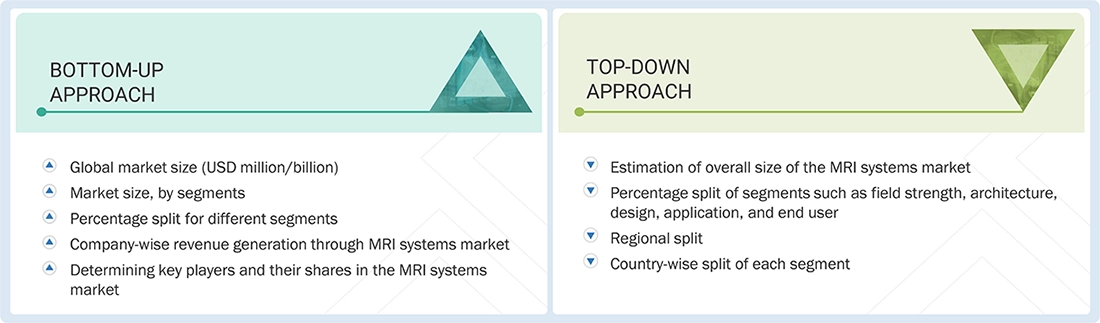
This study balanced primary and secondary research for the MRI systems market by analyzing various market variables affecting small, medium, and large businesses. The next step involved conducting primary research with industry experts along the value chain to validate the findings, assumptions, and market sizing. Multiple methodologies, including top-down and bottom-up approaches, were employed to estimate the overall market size. The study encompasses market segments, evolving trends, regulatory frameworks, and competitive dynamics. It examines leading market players and the strategies they employ in this sector. In conclusion, the total market size was estimated using a combination of top-down and bottom-up approaches, with data triangulation to finalize the market size. Primary research was conducted throughout the study to validate and test each hypothesis.
Secondary Research
During the study, secondary research was conducted using a range of sources, including directories and databases, such as Bloomberg Businessweek, D&B Hoovers, and Factiva. Additional materials included white papers, annual reports, SEC filings, and investor presentations. This research approach was adopted to collect and analyze data that provides comprehensive, technical, and market-focused insights into the MRI systems market. The findings offer insights into key players and market segmentation, informed by recent industry trends and significant developments. A database comprising leading industry figures was also created as part of this secondary research.
Primary Research
Primary research involved activities designed to gather qualitative and quantitative data. A variety of individuals from the supply and demand sides were interviewed during this phase. On the supply side, key figures such as CEOs, vice presidents, directors of marketing and sales, directors of technology and innovation, and other important leaders were interviewed by industry experts. On the demand side, primary sources included academic institutions and research organizations. This research aimed to validate market segmentation, identify prominent market participants, and gain insights into significant industry trends and market dynamics through a real-world primary study.
A breakdown of the primary respondents is provided below:
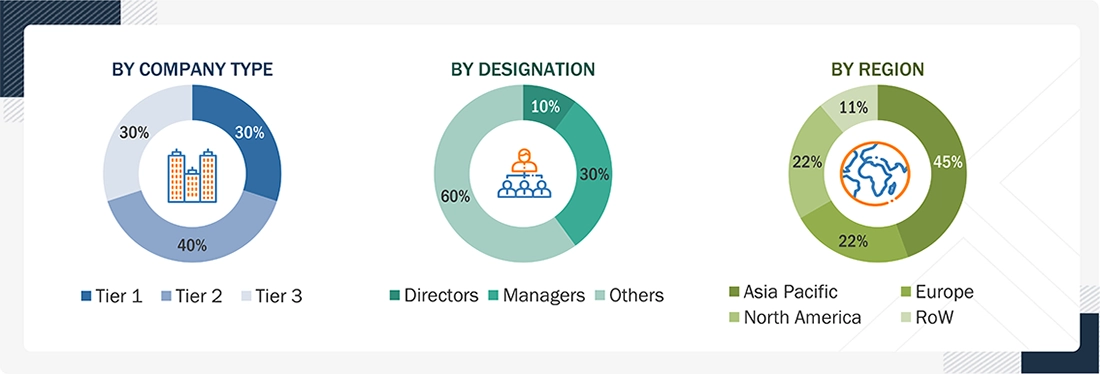
Notes:
- Others include distributors, suppliers, product managers, business development managers, marketing managers, and sales managers.
- Companies are categorized into tiers based on their total revenue. Here are the categories used:
As of 2025, Tier 1 = >USD 1,000 million, Tier 2 = USD 500–1,000 million, and Tier 3 = <USD 500 million.
To know about the assumptions considered for the study, download the pdf brochure
Market Size Estimation
This report provides an analysis of the global MRI systems market size by reviewing the revenue shares of prominent companies. Key players with significant market shares were identified through secondary research, and their revenue from MRI systems sales was calculated and subsequently validated through primary research. The secondary research included an analysis of annual and financial reports from leading market participants. Meanwhile, the primary research involved in-depth interviews with key thought leaders, such as directors, CEOs, and marketing executives.
To calculate the global market value, segmental revenue was determined based on the revenue mapping of service and product providers. The process involved the following steps:
- Generating a list of key players that operate in the MRI systems market at the regional or global levels
- Mapping the products of manufacturers of MRI systems and related product lines at the regional level
- Mapping the revenues of listed players through the sales of MRI systems and related products
- Mapping the revenues of major players to cover at least ~90% of the global market share as of 2025
- Extrapolating the mapped revenues of players to arrive at the global market value for the respective segment
- Summing up the market value for all segments and subsegments to achieve the actual value of the global MRI systems market
MRI Systems Market : Top-Down and Bottom-Up Approach
Data Triangulation
After estimating the overall market size, the MRI systems market was classified into various subsegments. The overall market engineering process was finalized through data triangulation and market segmentation, yielding accurate statistics for all segments and subsegments. This triangulation involved analyzing various trends and factors on both the demand and supply sides. Furthermore, the MRI systems market data was verified and validated using both top-down and bottom-up approaches.
Market Definition
Magnetic resonance imaging (MRI) is a diagnostic technique designed to visualize/create images of the internal structures of the human body using magnetic and electromagnetic fields, which induce a resonance effect of hydrogen atoms in body parts. The associated software registers and processes the electromagnetic emission created by these atoms to produce images of the body structures. These modalities help healthcare professionals visualize the internal structure and surrounding tissues. MRI systems are primarily used in hospitals and diagnostic imaging centers
Key Stakeholders
- Academic and Research Institutes
- Regulatory Authorities and Industry Associations
- Hospitals
- Clinics
- Diagnostic Imaging Centers
- Manufacturers and Suppliers of MRI Systems
- Product Suppliers, Distributors, and Channel Partners
- Research Institutes
- Regulatory Authorities and Industry Associations
- Venture Capitalists and Investment Firms
- Research Labs
Report Objectives
- To define, describe, and forecast the size of the MRI systems market based on field strength, architecture, design, application, end user, and region
- To provide detailed information regarding the factors (drivers, restraints, opportunities, challenges, and trends) influencing the growth potential of the global MRI systems market
- To analyze micro markets with respect to individual growth trends, prospects, and contributions to the global MRI systems market
- To analyze key growth opportunities in the global MRI systems market for key stakeholders and provide details of the competitive landscape for market leaders
- To forecast the size of market segments and/or subsegments concerning five regions, namely, North America (US and Canada), Europe (Germany, France, the UK, Spain, Italy, and the Rest of Europe), Asia Pacific (Japan, China, India, Australia, South Korea, and the Rest of Asia Pacific), Latin America (Brazil, Mexico, and the Rest of Latin America), and the Middle East & Africa (GCC Countries and the Rest of the Middle East & Africa).
- To profile the key players in the MRI systems market and comprehensively analyze their market share and core competencies
- To track and analyze the competitive developments undertaken in the global MRI systems market. Some of the developments are product launches/approvals, agreements, expansions, collaborations, and acquisitions
Available customizations:
With the given market data, MarketsandMarkets offers customizations based on your company’s specific needs. The following customization options are available for the present global MRI systems market report:
Product Analysis
- Product matrix, which gives a detailed comparison of the product portfolios of the top 15 companies
Regional Analysis
- Further breakdown of the Rest of Europe MRI systems market into Russia, Belgium, the Netherlands, Switzerland, Austria, Finland, Sweden, Poland, and Portugal
- Further breakdown of the Rest of Asia Pacific MRI systems market into Singapore, Taiwan, New Zealand, the Philippines, Malaysia, and other Asia Pacific countries
- Further breakdown of the Rest of Latin America MRI systems into Argentina, Chile, Peru, and Colombia
Company Information
- Detailed analysis and profiling of additional market players (up to 13)
Get the Full MRI Systems Market Report
Full forecast, segment splits, and company analysis for all MRI Systems Market.
- Canada MRI Systems Market
- US MRI Systems Market
- Germany MRI Systems Market
- UK MRI Systems Market
- France MRI Systems Market
- Italy MRI Systems Market
- Spain MRI Systems Market
- Japan MRI Systems Market
- China MRI Systems Market
- India MRI Systems Market
- Australia MRI Systems Market
- South Korea MRI Systems Market
- Mexico MRI Systems Market
- Rest Of Europe MRI Systems Market
- Rest Of Asia Pacific MRI Systems Market
Need a Tailored Report?
Customize this report to your needs
Get 10% FREE Customization
Customize This Report
