
UK Marine Lubricants Market (2025-2030)

The UK Marine Lubricants Market was valued at $108.4 Million in 2025 and projected to reach to $114.5 Million by 2030, representing a compound annual growth rate of 1.1%. The UK marine lubricants market is positioned for modest but stable growth through 2030, driven by regulatory compliance requirements and the need for advanced formulations in aging commercial fleets.


| Market Size in | USD 26.32 MN |
| Market Forecast in | |
| CAGR | |
| Forecast Period | |
| Units Considered | Value (USD MN) |
UK Marine Lubricants Market Trends and Insights
- The UK's established maritime infrastructure and regulatory compliance requirements drive steady demand for high-performance marine lubricants across commercial shipping, offshore operations, and leisure vessels.
- The UK market reflects mature consumption patterns typical of developed European economies, with growth constrained by fleet modernization cycles and environmental regulations. During the 2025–2030 forecast period, the UK marine lubricants market will be shaped by the International Maritime Organization's (IMO) environmental standards and the UK's post-Brexit regulatory framework.
- The UK's position as a major shipping hub and financial center for maritime services supports consistent lubricant demand, though the modest 1.1% CAGR indicates a stabilizing market with limited expansion opportunities.
- Key drivers include vessel maintenance requirements, compliance with low-sulfur fuel regulations, and the gradual adoption of bio-based and synthetic lubricants in the UK fleet..
Key Market Statistics
- CAGR (2025-2030) 1.1% CAGR
- Market Size, 2025 ~USD 108.4 Million
- Forecast, 2030 ~USD 114.5 Million
- Country UK
UK Marine Lubricants Market Overview
Market Valuation :
The UK marine lubricants market is valued at USD 108.4 million in 2025, with projections reaching USD 114.5 million by 2030, representing steady growth in a mature maritime economy.
Regulatory Compliance Driver :
UK maritime regulations and IMO compliance requirements mandate high-performance lubricants for commercial shipping and offshore operations, ensuring consistent demand across the sector.
Diverse Vessel Portfolio :
The UK market serves commercial shipping fleets, offshore oil and gas operations, and a significant leisure vessel segment, creating diversified demand across multiple marine applications.
Established Infrastructure :
The UK's developed maritime infrastructure, including major ports and shipyards, supports a stable market with established supply chains and long-term customer relationships.
UK Marine Lubricants Market Dynamics
- The 1.1% CAGR reflects a mature market with limited expansion opportunities, though environmental regulations and the transition toward sustainable marine fuels present emerging opportunities for specialized lubricant solutions.
- Offshore operations and leisure vessel maintenance will continue supporting baseline demand, while innovation in biodegradable and low-viscosity lubricants may unlock incremental growth segments..
Market Ecosystem
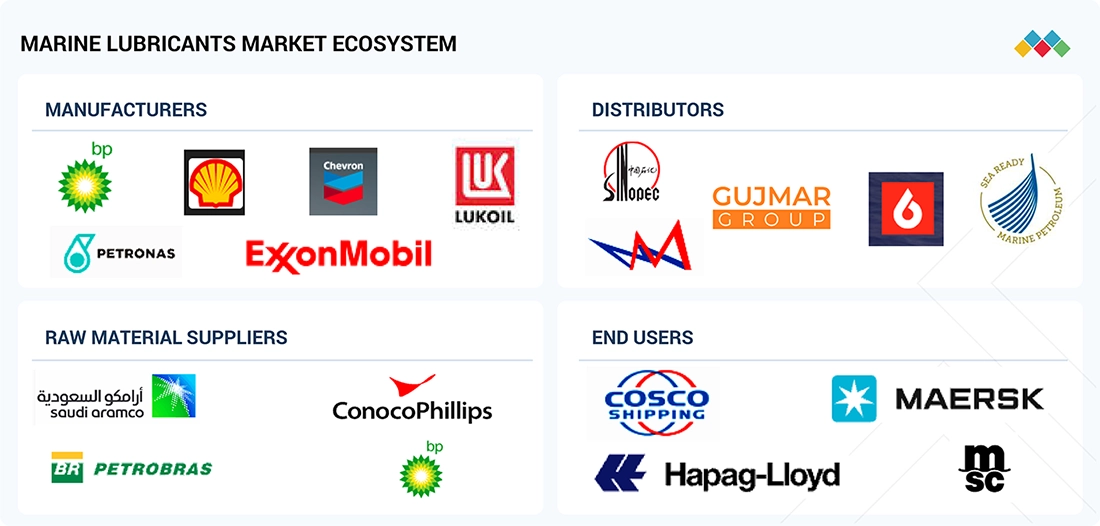
MARINE LUBRICANTS MARKET: COMMERCIAL USE CASES ACROSS INDUSTRIES
| COMPANY | USE CASE DESCRIPTION | BENEFITS |
|---|---|---|
 |
Use of marine engine oils and hydraulic lubricants across container, bulk, and tanker vessels | Improved equipment reliability, enhanced corrosion protection, optimized lubricant consumption |
 |
Use of cylinder oils, system oils, and auxiliary engine lubricants across container vessels operating on long-haul and high-utilization routes | Extended engine life, improved fuel efficiency, reduced maintenance frequency |
 |
Application of marine lubricants for main engines, generators, and deck machinery across a diversified global fleet | Reliable engine performance, reduced wear, consistent lubrication under variable operating conditions |
 |
Use of marine lubricants for propulsion systems and onboard equipment under fuel-efficient and emissions-focused operations | Improved thermal stability, lower lubricant degradation, reduced operating costs |
Logos and trademarks shown above are the property of their respective owners. Their use here is for informational and illustrative purposes only.
Related Ecosystem
Key Takeaways
- The UK marine lubricants market is valued at USD 108.4 million in 2025 and will reach USD 114.5 million by 2030, growing at 1.1% CAGR.
- The UK's mature maritime sector and established regulatory framework support stable, predictable demand for marine lubricants with limited high-growth opportunities.
- IMO environmental standards and UK post-Brexit regulations are primary drivers shaping product specifications and compliance requirements in the UK market.
- The UK market is characterized by steady consumption from commercial shipping, offshore operations, and leisure vessels with emphasis on premium and compliant lubricant formulations.
Marine Lubricants Market Report Scope
| Report Metric | Details |
|---|---|
| Base Year | 2025 |
| Fastest Growing Segment | COMPRESSOR OIL (Product Type) |
| Forecast Period | 2025–2030 |
| Growth Rate | CAGR of 1.56% from 2025 to 2030 |
| Largest Segment | ENGINE OIL (Product Type) |
| Market Size Base Year (Billions) | ~USD 6.55 (2025) |
| Revenue Forecast (Billions) | ~USD 7.08 (2030) |
| Segments Covered | Ship Type, Product Type, Base Oil, Base Oil 2025–2030 |
UK Marine Lubricants Market Report Segmentation
4 segment dimensions are covered across the global market.
By Ship Type
- Bulk Carriers
- Container Ships
- Other Ship Types
- Others Ship Types
- Tankers (Oil, Gas, Chemical)
By Product Type
- Compressor Oil
- Engine Oil
- Hydraulic Fluid
- Other Product Types
- Other Types
By Base Oil
- Bio-Based Oil
- Mineral Oil
- Synthetic Oil
By Base Oil 2025–2030
- Bio-Based Oil
- Mineral Oil
- Synthetic Oil
Target Audience
- Lubricant Manufacturers : Manufacturers need UK-specific market data to assess market entry viability, competitive intensity, and regulatory requirements for marine lubricant product lines in this established maritime sector.
- Shipping & Logistics Companies : Fleet operators require market intelligence to optimize lubricant procurement strategies, understand cost trends, and ensure compliance with UK and international maritime regulations.
- Offshore Energy Operators : Oil and gas companies operating in UK waters need detailed market analysis to source specialized lubricants meeting stringent offshore operational and environmental standards.
- Distributors & Retailers : Marine lubricant distributors need UK market forecasts and segmentation data to plan inventory, identify growth channels, and develop customer relationships across commercial and leisure segments.
- Investment & Strategy Consultants : Consultants advising maritime and chemical companies require granular UK market data to support due diligence, M&A analysis, and strategic planning in the marine lubricants sector.
Key Companies in the UK Marine Lubricants Market
| Company | HQ | Ownership | Strongest segments |
|---|---|---|---|
| STANLEY BLACK & DECKER, INC. | United States | Public Company | Professional power tools and equipment (DEWALT-led),DIY and consumer tools (BLACK+DECKER, CRAFTSMAN, STANLEY),Outdoor products (CUB CADET, HUSTLER and others), |
| PETROBRAS | Brazil | Public Company | Exploration and Production (crude oil, NGL, natural gas),Refining, Transportation & Marketing (fuels, petro-linked products),Gas & Low Carbon Energies (natural gas, power, renewables, biodiesel), |
| SHELL PLC | United Kingdom | Public Company | Integrated Gas (incl. LNG & GTL),Upstream (oil, gas, NGLs),Marketing (mobility, lubricants, commercial fuels), |
| AZELIS HOLDINGS SA | Belgium | Private Company | Food & Nutrition Ingredients,Personal Care & Home Care Ingredients,Pharma & Healthcare Ingredients, |
| CHEVRON CORPORATION | United States | Public Company | Upstream crude oil and natural gas production,LNG and gas-to-liquids,Refined products and fuels marketing, |
| EXXON MOBIL CORPORATION | United States | Public Company | Upstream (crude oil and natural gas),Energy Products (fuels, aromatics, catalysts, licensing),Chemical Products (olefins, polyolefins, intermediates), |
| TOTALENERGIES SE | France | Public Company | Crude oil production and marketing,Natural gas and LNG,Refined products and biofuels, |
| PETRONAS | Malaysia | Private Company | Crude oil and condensate sales,Refined products and fuels retail,LNG and pipeline gas, |
| IDEMITSU KOSAN CO., LTD | Japan | Public Company | Fuel Oil (incl. SAF, synthetic fuel, biofuels, carbon offset fuel),Basic Chemicals (olefins and aromatics),Functional Materials (lubricants, functional chemicals, electronic materials, bitumen, agri-bio), |
| PETROCHINA COMPANY LIMITED | China | Public Company | Oil, Gas and New Energy,Refining, Chemicals and New Materials,Sales (Refined and Non-oil Products, Trading), |
| FUCHS SE | Germany | Public Company | Automotive lubricants (engine, gear, service fluids, motorcycle/two-wheeler),Industrial oils and specialty fluids (hydraulic, compressor, turbine, machine, textile, agriculture),Lubricating greases (multi-purpose, extreme temperature, food-grade, central systems), |
| LUKOIL | Russia | Public Company | Crude oil & natural gas (upstream sales),Refined petroleum products (gasoline, diesel, jet, fuel oil),Lubricants & petrochemicals, |
| ENI S.P.A. | Italy | Public Company | Exploration & Production (oil, condensates, natural gas),Global Gas & LNG Portfolio and Power,Refining and Chemicals, |
| INDIAN OIL CORPORATION LIMITED | India | Public Company | Sale of Petroleum Products,Sale of Gas (including LPG and city gas distribution),Sale of Petrochemicals, |
STANLEY BLACK & DECKER, INC.
Stanley Black & Decker, Inc. is a publicly traded American manufacturer founded in 1843 with 43,500 employees. The company is a global leader in tools, hardware, and industrial equipment.
PETROBRAS
Petrobras is a publicly traded Brazilian oil and energy company founded in 1953 with 43,199 employees.
SHELL PLC
Shell PLC is a publicly traded British multinational energy company founded in 1897 with 84,000 employees, engaged in oil and gas exploration and production.
AZELIS HOLDINGS SA
Azelis Holdings SA is a private Belgian chemical company founded in 2001 with 1,325 employees.
CHEVRON CORPORATION
Chevron Corporation is a publicly traded American energy company founded in 1879 with 43,039 employees, engaged in oil and gas exploration, production, and refining.
EXXON MOBIL CORPORATION
ExxonMobil Corporation is a publicly traded American multinational energy company founded in 1870 with 57,900 employees, operating in oil, gas, and petrochemical sectors.
TOTALENERGIES SE
TotalEnergies SE is a publicly traded French multinational energy company founded in 1924 with 94,847 employees, engaged in oil, gas, and renewable energy.
PETRONAS
Petronas is a private Malaysian national oil and gas company founded in 1974 with 49,000 employees.
IDEMITSU KOSAN CO., LTD
Idemitsu Kosan Co., Ltd. is a publicly traded Japanese petroleum and chemical company founded in 1911 with 14,392 employees.
PETROCHINA COMPANY LIMITED
PetroChina Company Limited is a publicly traded Chinese oil and gas company founded in 1999 with 367,173 employees.
FUCHS SE
Fuchs SE is a publicly traded German lubricant and specialty chemical company founded in 1931 with 6,857 employees.
LUKOIL
Lukoil is a publicly traded Russian oil and gas company founded in 1992 with 101,374 employees.
ENI S.P.A.
Eni S.p.A. is a publicly traded Italian multinational oil and gas company founded in 1953 with 32,349 employees.
INDIAN OIL CORPORATION LIMITED
Indian Oil Corporation Limited is a publicly traded Indian oil and gas company founded in 1959 with 29,941 employees.
Reasons to Buy this Report
- UK-Specific Market Sizing : Obtain precise valuation data for the UK marine lubricants market with accurate 2025-2030 forecasts, enabling confident investment and expansion decisions in this established maritime economy.
- Regulatory Landscape Insights : Understand UK and IMO compliance requirements driving lubricant specifications, helping suppliers align product portfolios with mandatory standards and capture regulated market segments.
- Competitive Positioning : Identify market dynamics specific to UK commercial shipping, offshore operations, and leisure vessels to benchmark performance and develop targeted go-to-market strategies.
- Growth Opportunity Assessment : Evaluate emerging segments such as sustainable and biodegradable marine lubricants within the UK context, identifying niche opportunities in an otherwise mature market.
- Customer Segmentation Data : Access detailed insights into UK maritime customer profiles—commercial operators, offshore contractors, and leisure vessel owners—to refine sales strategies and product development.
Frequently asked questions
What is the current size of the UK marine lubricants market?
The UK marine lubricants market is valued at USD 108.4 million in 2025 and is expected to grow to USD 114.5 million by 2030.
What is the growth rate of the UK marine lubricants market?
The UK marine lubricants market is growing at a compound annual growth rate (CAGR) of 1.1% from 2025 to 2030.
What are the main drivers of the UK marine lubricants market?
Key drivers include IMO environmental compliance, UK post-Brexit regulatory requirements, vessel maintenance cycles, low-sulfur fuel regulations, and adoption of bio-based and synthetic lubricants.
Which sectors contribute most to UK marine lubricants demand?
The UK market is driven by commercial shipping, offshore operations, and leisure vessel segments, all requiring compliant and high-performance lubricant formulations.
How does the UK market compare to global marine lubricants growth?
The UK's 1.1% CAGR is lower than the global 1.56% CAGR, reflecting a mature, stabilized market with limited expansion compared to emerging maritime regions.
RESEARCH METHODOLOGY
The study involved four major activities in estimating the Marine Lubricants Market size. Exhaustive secondary research was done to collect information on the market, the peer market, and the parent market. The next step was to validate these findings, assumptions, and sizing with industry experts across the value chain through primary research. Both top-down and bottom-up approaches were employed to estimate the complete market size. After that, the market breakdown and data triangulation procedures were used to estimate the market size of the segments and subsegments.
Secondary Research
Secondary sources used in this study included annual reports, press releases, and investor presentations of companies; white papers; certified publications; articles from recognized authors; and gold standard & silver standard websites such as Factiva, ICIS, Bloomberg, and others. The findings of this study were verified through primary research by conducting extensive interviews with key officials such as CEOs, VPs, directors, and other executives. The breakdown of profiles of the primary interviewees is illustrated in the figure below.
Primary Research
The Marine Lubricants Market comprises several stakeholders, such as raw material suppliers, end-product manufacturers, and regulatory organizations in the supply chain. The demand side of this market is characterized by engine oil, turbine oil, gear oil, grease, hydraulic oil, compressor oil, metalworking fluid, and others. Advancements in technology and diverse application industries characterize the supply side. Various primary sources from the supply and demand sides of the market were interviewed to obtain qualitative and quantitative information.
Market Size Estimation
Top-down and bottom-up approaches were used to estimate and validate the total size of theMarine Lubricants Market. These methods were also used extensively to estimate the size of various subsegments in the market. The research methodology used to estimate the market size includes the following parameters:
- The key players in the industry have been identified through extensive secondary research.
- The supply chain of the industry has been determined through primary and secondary research.
- All percentage shares, splits, and breakdowns have been determined using secondary sources and verified through primary sources.
- All possible parameters that affect the markets covered in this research study have been accounted for, viewed in extensive detail, verified through primary research, and analyzed to obtain the final quantitative and qualitative data.
Data Triangulation
After arriving at the overall market size—using the market size estimation processes as explained above—the market was split into several segments and subsegments. Data triangulation and market breakdown procedures were employed to complete the overall market engineering process and arrive at the exact statistics of each market segment and subsegment, wherever applicable. The data was triangulated by studying various factors and trends from both the demand and supply sides in the lubricants industry.
Market Definition
The Marine Lubricants Market encompasses a range of substances engineered to diminish friction between surfaces, thereby reducing heat generation and facilitating the transmission of forces during movement. These substances also serve to transport foreign particles and regulate surface temperatures. Employed across diverse applications, from industrial machinery and cooking to bioapplications such as artificial joints, medical procedures, and intimate relations, lubricants are pivotal in mitigating friction, wear, heat generation, noise, and vibrations within mechanical systems.
Stakeholders
- Lubricants manufacturers
- Lubricants suppliers
- Raw material suppliers
- Service providers
- Application sector companies
- Government bodies
Report Objectives
- To define, describe, and forecast the Marine Lubricants Market in terms of value and volume
- To provide detailed information regarding the drivers, opportunities, restraints, and challenges influencing market growth
- To estimate and forecast the market size by base oil type, product type, end-use industry, and region
- To forecast the size of the market for five main regions: Asia Pacific, Europe, North America, South America, and the Middle East & Africa, along with their key countries
- To strategically analyze micromarkets1 with respect to their growth trends, prospects, and contribution to the overall market
- To analyze opportunities in the market for stakeholders and provide a competitive landscape for market leaders
- To analyze competitive developments, such as deals and expansions, in the market
- To analyze the impact of the recession on the market
- To strategically profile key players and comprehensively analyze their growth strategies.
Get the Full Marine Lubricants Market Report
Full forecast, segment splits, and company analysis for all Marine Lubricants Market.
- China Marine Lubricants Market
- Singapore Marine Lubricants Market
- Hong Kong Marine Lubricants Market
- South Korea Marine Lubricants Market
- Malaysia Marine Lubricants Market
- Japan Marine Lubricants Market
- Taiwan Marine Lubricants Market
- India Marine Lubricants Market
- Australia Marine Lubricants Market
- Canada Marine Lubricants Market
- Mexico Marine Lubricants Market
- US Marine Lubricants Market
- Germany Marine Lubricants Market
- Netherlands Marine Lubricants Market
- Belgium Marine Lubricants Market
- Spain Marine Lubricants Market
- Italy Marine Lubricants Market
- France Marine Lubricants Market
- Greece Marine Lubricants Market
- Turkey Marine Lubricants Market
- Russia Marine Lubricants Market
- UAE Marine Lubricants Market
- Saudi Arabia Marine Lubricants Market
- South Africa Marine Lubricants Market
- Brazil Marine Lubricants Market
- Argentina Marine Lubricants Market
- Rest Of Europe Marine Lubricants Market
- Rest Of Asia Pacific Marine Lubricants Market
Need a Tailored Report?
Customize this report to your needs
Get 10% FREE Customization
Customize This Report
